Within Uzbekistan Cryptids
Was There Ever an Uzbek Wild Man?
Uzbekistan appears on maps of the Central Asian wild-man legend, but traceable local witnesses and physical evidence remain scarce.
On this page
- How the legend reached Uzbekistan
- What Soviet investigators actually recorded
- Why the evidence remains unconvincing
Page outline Jump by section
Introduction
Stories of a hairy, human-like “wild man” appear across much of Central Asia, and Uzbekistan is sometimes included on maps showing the creature’s supposed range. Yet when readers look for specifically Uzbek cases, the trail quickly becomes thin. Unlike parts of the Pamirs, the Caucasus, Mongolia or remote regions of Kazakhstan and Kyrgyzstan, Uzbekistan has produced few well-documented sightings, few named witnesses and no widely accepted physical evidence. The result is an unusual situation: Uzbekistan is often associated with the broader Central Asian wild-man tradition, but the strongest evidence usually comes from outside the country.[ResearchGate]researchgate.netResearch Gate(PDF) Wildmen in Central AsiaResearchGate(PDF) Wildmen in Central AsiaJuly 20, 2017 — 8 Aug 2017 — Central Asian wildmen traditions can be divided into two main lines…

That gap between reputation and documentation is what makes the Uzbek wild-man story interesting. The question is not whether a mysterious creature was conclusively found—there is no convincing evidence that one was—but how Uzbekistan became linked to a legend whose best-known reports were recorded elsewhere.
How the Legend Reached Uzbekistan
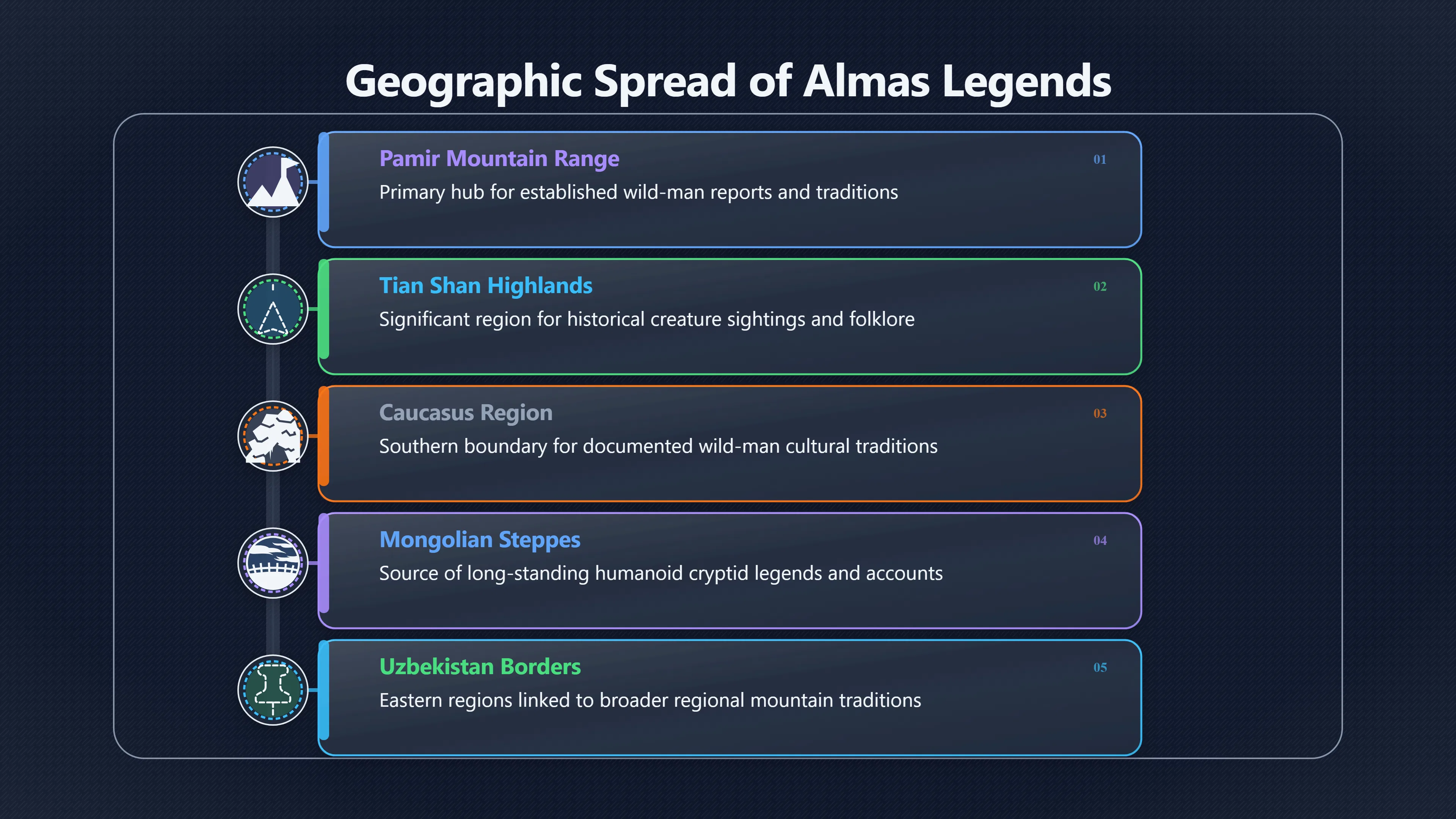
The wild-man tradition of Central Asia is usually grouped under names such as almas or almasty. Descriptions vary, but the creature is commonly portrayed as a shaggy, human-like being living in remote mountains and valleys. Reports have historically been concentrated around the Pamirs, Tian Shan and neighbouring highland regions rather than the heavily populated lowlands of modern Uzbekistan.[ResearchGate]researchgate.netResearch Gate(PDF) Wildmen in Central AsiaResearchGate(PDF) Wildmen in Central AsiaJuly 20, 2017 — 8 Aug 2017 — Central Asian wildmen traditions can be divided into two main lines…
Part of the reason Uzbekistan became associated with the legend is geography. The country’s eastern and south-eastern borders touch mountain systems linked to the wider Central Asian wild-man tradition. During the Soviet period, researchers often treated Central Asia as a connected cultural and ecological region rather than a collection of sharply separated national stories. A report from one mountain area could therefore be discussed alongside accounts from neighbouring republics, creating the impression of a much broader distribution.[ResearchGate]researchgate.netResearch Gate(PDF) Wildmen in Central AsiaResearchGate(PDF) Wildmen in Central AsiaJuly 20, 2017 — 8 Aug 2017 — Central Asian wildmen traditions can be divided into two main lines…
As cryptozoological literature spread internationally, maps of alleged wild-man habitats frequently coloured large sections of Central Asia without distinguishing where reports were actually strongest. Uzbekistan consequently appeared inside the creature’s supposed range even though traceable local cases remained scarce.[ResearchGate]researchgate.netResearch Gate(PDF) Wildmen in Central AsiaResearchGate(PDF) Wildmen in Central AsiaJuly 20, 2017 — 8 Aug 2017 — Central Asian wildmen traditions can be divided into two main lines…
What Soviet Investigators Actually Recorded
The most famous Soviet investigations into wild-man reports were led by historian and cryptozoology enthusiast Boris Porshnev. In the 1950s and 1960s he persuaded Soviet scientific authorities to examine claims of surviving “relict hominids” and organised expeditions into mountain regions of Central Asia. His work helped popularise the idea that wild-man stories might represent surviving Neanderthals.[Wikipedia]WikipediaBoris PorshnevBoris Porshnev
What is striking, however, is where those investigations concentrated. The best-known expeditions focused on the Pamirs of Tajikistan and other mountain regions with established traditions of wild-man reports. Discussions of Soviet investigations repeatedly return to Tajik, Kyrgyz, Kazakh, Mongolian and Caucasian accounts. Uzbekistan appears only marginally in comparison.[IFLScience]iflscience.comThis Historian Believed Sightings Of A "Soviet Sasquatch…5 Mar 2025 — As reports continued to surface, Porshnev secured appr…
Researchers collected folklore, rumours and witness testimony, but they did not produce a specimen, skeleton, body, photograph of convincing quality or a verifiable biological sample. Even supporters of the investigations generally acknowledge that the evidence consisted primarily of stories, tracks, second-hand reports and local traditions.[Wikipedia]WikipediaBoris PorshnevBoris Porshnev
This distinction matters. Soviet investigators did record belief in wild men across parts of Central Asia, but recording a belief is not the same as demonstrating the existence of an unknown species.
The Problem of Missing Uzbek Cases
A reader searching for an “Uzbek Bigfoot” quickly encounters a recurring problem: many claims are difficult to trace back to a named place, date or witness within Uzbekistan itself.
Several patterns appear repeatedly:
- Accounts are often retellings from broader Central Asian folklore rather than reports tied to a specific Uzbek location.
- Some stories migrate across borders as they are retold in books, magazines and online discussions.
- References to “Central Asia” are sometimes later interpreted as evidence for Uzbekistan specifically.
- Many reports are second-hand or third-hand, making independent verification impossible.[ResearchGate]researchgate.netResearch Gate(PDF) Wildmen in Central AsiaResearchGate(PDF) Wildmen in Central AsiaJuly 20, 2017 — 8 Aug 2017 — Central Asian wildmen traditions can be divided into two main lines…
Compared with famous wild-man traditions elsewhere, there is also a notable absence of supporting material. There are no widely accepted hair samples linked to an unknown primate, no authenticated bones, no clear photographs and no preserved body. The lack of physical evidence is especially striking because Soviet investigators and later enthusiasts actively searched for it.[Wikipedia]WikipediaBoris PorshnevBoris Porshnev
In practice, the Uzbek wild man often exists more as a regional possibility than as a documented local creature.
Why the Evidence Remains Unconvincing
The central difficulty is not merely that evidence is weak; it is that the strongest categories of evidence are largely missing.
No Confirmed Physical Remains
Claims about unknown primates become far more persuasive when they produce bones, teeth, tissue or DNA. The Uzbek wild-man tradition has not generated such material. Decades of interest have failed to produce a specimen that can be examined by zoologists or geneticists.[Wikipedia]WikipediaBoris PorshnevBoris Porshnev
Testimony Without Verification
Many wild-man stories depend on eyewitness memories recorded long after the event. Human perception is imperfect, especially in poor weather, darkness or mountainous terrain. Without supporting evidence, testimony alone rarely convinces mainstream science.[SIT Digital Collections]digitalcollections.sit.eduThe almas is the wildman or ape-man of Mongolian legend. The almas is consistently described as a large, man-like creature…Read more…
Alternative Explanations Exist
Remote mountain environments can produce brief, confusing encounters. Bears standing upright, distant shepherds, unusual lighting conditions and expectations shaped by local folklore can all influence how sightings are interpreted. The existence of large mammals in Central Asian mountains does not automatically imply the presence of an unknown human relative.[SIT Digital Collections]digitalcollections.sit.eduThe almas is the wildman or ape-man of Mongolian legend. The almas is consistently described as a large, man-like creature…Read more…
Previous “Wild Man” Evidence Has Collapsed Elsewhere
One reason scientists remain cautious is that several celebrated wild-man cases from the former Soviet sphere have ultimately failed to support cryptozoological claims. The famous case of Zana, once cited as possible evidence for a surviving wild hominid, was later subjected to genetic analysis that identified her as a human woman of African ancestry rather than a relic species.[Wikipedia]WikipediaZana of TkhinaZana of Tkhina
That example does not directly concern Uzbekistan, but it demonstrates how apparently mysterious cases can acquire ordinary explanations once stronger evidence becomes available.
Why the Story Persists
Despite the lack of convincing evidence, the idea of an Uzbek wild man continues to appear in cryptid discussions because it sits at the intersection of three powerful themes.
First, Central Asia contains vast and rugged landscapes that seem capable of hiding mysteries. Second, the region possesses a rich tradition of wild-man folklore stretching across multiple cultures. Third, Soviet-era investigations gave the subject an unusual degree of official attention, creating a body of reports that still fascinates researchers and enthusiasts.[researchgate.net]researchgate.netResearch Gate(PDF) Wildmen in Central AsiaResearchGate(PDF) Wildmen in Central AsiaJuly 20, 2017 — 8 Aug 2017 — Central Asian wildmen traditions can be divided into two main lines…
For Uzbekistan specifically, the enduring mystery is not a dramatic body of evidence but the opposite: the absence of it. The country remains attached to the wider Central Asian wild-man tradition, yet the documented local record is remarkably sparse. The legend survives largely through regional association, folklore and cryptozoological speculation rather than through verifiable discoveries.[ResearchGate]researchgate.netResearch Gate(PDF) Wildmen in Central AsiaResearchGate(PDF) Wildmen in Central AsiaJuly 20, 2017 — 8 Aug 2017 — Central Asian wildmen traditions can be divided into two main lines…
Amazon book picks
Further Reading
Books and field guides related to Was There Ever an Uzbek Wild Man?. Use these as the next step if you want deeper reading beyond the article.
Field Guide To Bigfoot, Yeti, & Other Mystery Primates Worldwide
Directly relates to almas and wild-man traditions of Central Asia.
eBay marketplace picks
Marketplace Samples
Live-tested eBay searches with available results related to this page.




Endnotes
1.
Source: researchgate.net
Title: Research Gate(PDF) Wildmen in Central Asia
Link:https://www.researchgate.net/publication/318563173_Wildmen_in_Central_Asia
Source snippet
ResearchGate(PDF) Wildmen in Central AsiaJuly 20, 2017 — 8 Aug 2017 — Central Asian wildmen traditions can be divided into two main lines...
Published: July 20, 2017
2.
Source: Wikipedia
Link:https://en.wikipedia.org/wiki/Almas_%28folklore%29
Source snippet
Almas (folklore)An almas, alma or almasty, is a cryptid folk creature said to inhabit the Caucasus, Tian Shan and Pamir Mountains of C...
3.
Source: Wikipedia
Title: Boris Porshnev
Link:https://en.wikipedia.org/wiki/Boris_Porshnev
4.
Source: digitalcollections.sit.edu
Link:https://digitalcollections.sit.edu/cgi/viewcontent.cgi?article=1780&context=isp_collection
Source snippet
The almas is the wildman or ape-man of Mongolian legend. The almas is consistently described as a large, man-like creature...Read more...
5.
Source: iflscience.com
Link:https://www.iflscience.com/this-historian-believed-sightings-of-a-soviet-sasquatch-were-living-neanderthals-78312
Source snippet
This Historian Believed Sightings Of A "Soviet Sasquatch...5 Mar 2025 — As reports continued to surface, Porshnev secured appr...
6.
Source: Wikipedia
Title: Zana of Tkhina
Link:https://en.wikipedia.org/wiki/Zana_of_Tkhina
7.
Source: cryptidz.fandom.com
Link:https://cryptidz.fandom.com/wiki/Almas
Additional References
8.
Source: reddit.com
Link:https://www.reddit.com/r/Cryptozoology/comments/18navmx/the_golubyavan_is_a_cryptid_hominidape_reported/
Source snippet
tain ranges in Central Asia with possible populations in western...Read more...
9.
Source: youtube.com
Link:https://www.youtube.com/watch?v=RDRSOCtt9pE
Source snippet
Terrifying Humanoid Beings Documented in Mongolia For Centuries - The Almas...
10.
Source: youtube.com
Title: Terrifying Humanoid Beings Documented in Mongolia For Centuries
Link:https://www.youtube.com/watch?v=0kCPmqBRq4U
Source snippet
10 Cryptids the Whole World Believed In: 9 Turned Out to Be Myths, and One Was Real... | Archive...
11.
Source: vice.com
Title: Khakhlov.Read more
Link:https://www.vice.com/en/article/bigfoot-believers-uncovered-a-lost-manuscript-about-the-soviet-sasquatch/
Source snippet
Bigfoot Believers Uncovered a Lost Manuscript About the '...7 Sept 2022 — An illustration from Porshnev's manuscript of the Central...
12.
Source: youtube.com
Title: The Cryptids of the Soviet Union
Link:https://www.youtube.com/watch?v=7wWfCk_gHU0
Source snippet
Bigfoot Captured and Left Offspring?50 Years of Scientific Investigation Into a Controversial Case...
13.
Source: isu.edu
Link:https://www.isu.edu/media/libraries/rhi/essays/PORSHNEV-FORMATTED.pdf
14.
Source: ecchr.eu
Link:https://www.ecchr.eu/en/case/criminal-complaint-against-zakir-almatov/
15.
Source: facebook.com
Link:https://www.facebook.com/groups/amalgamania/posts/3439216706300951/
16.
Source: dokumen.pub
Link:https://dokumen.pub/the-nature-of-the-beast-the-first-genetic-evidence-on-the-survival-of-apemen-yeti-bigfoot-and-other-mysterious-creatures-into-modern-times-9781444791273.html
17.
Source: caspianpost.com
Link:https://caspianpost.com/uzbekistan/uzbekistan-poacher-faces-massive-fine-for-killing-protected-ram
Topic Tree