Creature Lore of Samoa's Waters and Stories
Samoa does not have a modern cryptid tradition dominated by one nationally famous beast in the manner of Scotland’s Loch Ness Monster.
Page outline Jump by section
Introduction
That distinction matters. Samoa’s mystery-creature history is not a catalogue of zoological specimens awaiting discovery. It is a landscape of stories in which familiar animals may be ancestors, guardians, gods or warnings. Later colonial writers sometimes repackaged these traditions as “bogies”, ghost stories or quaint superstition, blurring the difference between a respected local belief, a storyteller’s tale and a claim that an unknown animal had physically been seen.[e-rara.ch]e-rara.chOld Samoa or flotsam and jetsam from the Pacific OceanOld Samoa or flotsam and jetsam from the Pacific Ocean…
Is there a famous Samoan cryptid?
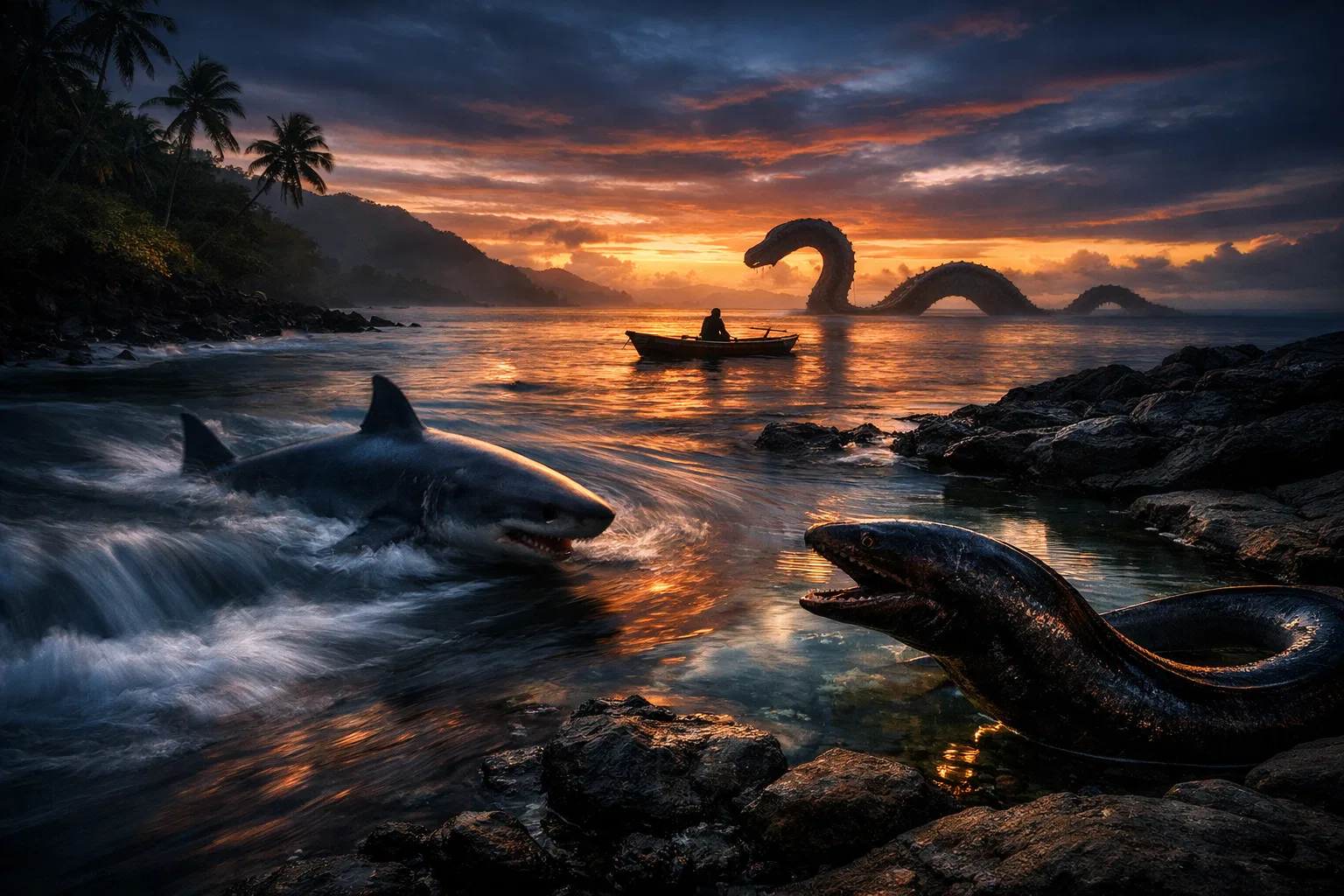
No single creature has accumulated the photographs, expeditions, repeated modern eyewitness reports and commercial branding normally associated with a major cryptid. Searches of historical newspapers and folklore collections instead reveal several overlapping traditions:
- exceptionally dangerous sharks, sometimes treated as supernatural beings;
- a canoe-sinking serpent or fish-beast reported in an 1892 newspaper story;
- giant or magical eels linked with pools and the origin of the coconut;
- spirits believed to appear in animal, human or other physical forms;
- people transformed into sharks, turtles or other creatures at named places.
These stories are better understood as folklore and sacred geography than as evidence for undiscovered species. Even so, they occupy much of the same imaginative territory as cryptid reports: dangerous water, uncertain shapes, inherited testimony and the possibility that an ordinary animal may be more than it appears.
The geography also helps explain the emphasis. Samoa’s settlements, travel routes and food traditions are closely tied to reefs, lagoons, streams and open ocean. Real sharks, eels, turtles, octopuses, whales and large rays provide more than enough raw material for stories of unusual size or supernatural power. Historical fishing accounts show that large sharks entered shallow river mouths and could pose a genuine danger to people crossing or using the water.[noaa.gov]repository.library.noaa.govInstitutional Repository Historic Fishing Methods in American SamoaNOAA Institutional RepositoryHistoric Fishing Methods in American SamoaJune 8, 2011 — The tānifa seldom exceeds 10 ft in size, but the sh…

The shark that crosses into monster territory
The clearest bridge between real wildlife and legendary monster is the large man-eating shark traditionally called the tanifa. Comparative Polynesian language research defines the Samoan word as a kind of large, dangerous shark rather than an imaginary dragon or reptile. Related words elsewhere in Polynesia can refer to fierce sharks, unidentified fish or legendary sea monsters, illustrating how a recognisable predator may acquire increasingly supernatural features as stories travel between islands.[pollex.eva.mpg.de]pollex.eva.mpg.deEntries for TANIFA [OC] Shark spPollex entries:; Rotuman, Tanifa, A large, dangerous shark Problematic; Samoan, Tanifa, Kind of large m…
A historical account of fishing in American Samoa describes these sharks as solitary nocturnal animals that haunted shallow stream mouths. One tale, set at the Vaivasa River on Upolu, concerns two sharks of roughly eight feet after an earlier animal resisted hooks and gunfire. Such accounts provide a plausible natural foundation for “river monster” traditions: a large shark appearing after dark in a narrow, shallow channel would be startling even without supernatural embellishment.[NOAA Institutional Repository]repository.library.noaa.govInstitutional Repository Historic Fishing Methods in American SamoaNOAA Institutional RepositoryHistoric Fishing Methods in American SamoaJune 8, 2011 — The tānifa seldom exceeds 10 ft in size, but the sh…
Older descriptions of Samoan religion add another layer. Nineteenth-century observer John Stair wrote that spiritual beings were thought capable of taking the forms of birds, fish and reptiles. Individual families might regard a shark, bird, stone or reptile as the vessel of a guardian deity. That did not mean every shark was considered magical; Stair noted that a family could revere one shark-associated being while other people continued to catch and eat sharks. The important feature was relationship, not species identification.[e-rara]e-rara.chOld Samoa or flotsam and jetsam from the Pacific OceanOld Samoa or flotsam and jetsam from the Pacific Ocean…
This makes the shark tradition easy to misread through a cryptozoological lens. A report that a shark belonged to a family, protected a village or appeared in response to ritual action is not necessarily claiming the existence of a physically unknown shark species. It may express kinship, divine presence, inherited authority or the dangerous character of a particular waterway.
The canoe-sinking serpent of the 1892 press
The most recognisably “cryptid-like” Samoan monster appeared in an Australian newspaper item published as “Samoan Bogies” in August 1892. The story’s narrator travelled by boat with a Samoan guide who became frightened near a dark bay. According to the account, a huge serpent slept underwater close to shore. It was described as part fish and part beast, capable of throwing its body across canoes and sinking them. It could also supposedly thicken or poison the water so that drowned bodies did not rise.[Trove]trove.nla.gov.au13 Aug 1892 - SAMOAN BOGIES. - Troveserpent sleeps. If the canoes go in too. close this monster, part fish and part beast. is distu…
This is vivid monster material, but its evidential value is weak. The article offers no named bay, date of an attack, recovered body, physical trace or independent witness. Within the story, the guide herself calls it one of the community’s ghost stories. The piece then moves on to a supernatural light near the reef at Mulinu‘u, suggesting that the writer’s subject was local storytelling rather than a contemporary zoological investigation.[Australian Women Writers Challenge Blog]australianwomenwriters.comflorence blair samoan ghosts short storyflorence blair samoan ghosts short story
Several explanations remain possible without choosing a single one. The legend may encode warnings about reefs, sudden depth changes, rip currents or large sharks near a canoe route. A shark, ray, whale or floating timber glimpsed in poor light could also look serpentine. The claim that the water prevents bodies from resurfacing may preserve knowledge of strong currents carrying victims away, although this is an inference rather than something demonstrated by the newspaper account.
The article must also be read as a colonial text. Its title and conversational framing turn Samoan beliefs into exotic entertainment for Australian readers. The narrative may preserve genuine local material, but it is filtered through an outsider’s expectations about the mysterious South Pacific. It should therefore be treated as evidence that such a story circulated, not proof that every detail was widely believed or accurately translated.
Giant eels, sacred pools and transforming animals
The best-known Samoan animal legend concerns Sina and a remarkable eel. In a version recorded by the US National Park Service, the eel appeared only to Sina, followed her between bathing places and eventually became extremely large. Later versions connect the eel’s death and buried head with the growth of the first coconut tree, whose three marks resemble a face.[National Park Service]nps.govNational Park Service Sina and Her Eel (tunaNational Park Service Sina and Her Eel (tuna
A freshwater pool at Matavai on Savai‘i is associated with the story, giving the legend a physical location that visitors can see. That does not turn the eel into a cryptid: the tale is an origin story, not a sequence of modern sightings. Nevertheless, it uses several motifs common to monster traditions—a rapidly growing animal, persistent appearances, a particular pool and a being whose identity extends beyond ordinary zoology.
The same pattern appears in the Turtle and Shark tradition associated with Vaitogi in American Samoa. Although outside the independent state of Samoa, it belongs to the wider Samoan cultural world and provides a useful comparison. The story tells of a neglected woman and child who leap from a coastal cliff and transform into marine animals. The cove remains a recognised cultural site, and maps produced by the National Park Service identify it as the Turtle and Shark legend location.[nps.gov]nps.govNational Park Service Local Area / Island MapNational Park Service Local Area / Island Map
Tradition holds that ritual singing can summon a shark and turtle to the surface. From a sceptical perspective, the cove lies in genuine turtle and shark habitat, so animals surfacing after people gather and sing need not imply supernatural transformation. Culturally, however, reducing the event to coincidence misses the point. The story binds named animals, moral failure, ancestral memory and a specific coastline into one continuing tradition.
Animal-shaped spirits and haunted places
Some Samoan mystery-animal accounts belong more properly to spirit belief. Historical sources describe several classes of supernatural beings and record the idea that they could inhabit animals or assume animal form. Roads, mountain passes, trees, pools and coastal areas might become associated with a dangerous presence, sometimes requiring travellers to offer a small gift or request safe passage.[e-rara]e-rara.chOld Samoa or flotsam and jetsam from the Pacific OceanOld Samoa or flotsam and jetsam from the Pacific Ocean…
Such traditions remain locally meaningful. The National Park Service records warnings about the To‘aga area on Ofu, where residents advised researchers not to wander at high noon or after dark because the beach was associated with spirit beings. A 1950 public-health history repeated stories of knocks, moving furniture and headless apparitions around a dispensary built there in the 1920s. The same source acknowledges that the truth of the story was disputed, while noting that the building was later relocated and its foundations remained visible.[National Park Service]nps.govNational Park Service The To'aga AituNational Park ServiceThe To'aga Aitu - National Park of American Samoa (U.S. National Park Service)…
These are not cryptid reports in a strict sense because the alleged entities are not presented as undiscovered animals. Yet animal manifestation is part of the broader belief system, and modern retellings can detach a strange creature from its spiritual setting. A shark-shaped guardian may become “a monster shark”; a warning attached to a pool may become “an unknown beast in the water”. This is one way folklore is converted into cryptozoology after the fact.
What could witnesses actually be seeing?
Samoa’s real fauna offers several strong candidates for monster-like impressions. Flying foxes are the islands’ only native land mammals and have broad wings, visible claws and a dog-like or fox-like face. Seen crossing a road or hanging in a dark tree, a large individual can look decidedly uncanny to someone unfamiliar with fruit bats. They also have genuine cultural importance and feature in stories as forest-associated animals.[National Park Service]nps.govNational Park Service Natural History Guide to American SamoaSina would be well fed. Sina was adopted by the family of High… The plover is the commonest tuli in Samoa, and it features in many myt…
In the water, large eels can move between freshwater and the sea, disappear into holes and survive in surprisingly confined pools. Sharks may enter lagoons and stream mouths. Sea turtles surface briefly and silently, while rays can produce broad, dark shapes below a canoe. Whales, dolphins and octopuses occur in the surrounding marine environment, and humpback whales migrate through Samoan waters seasonally. A partial view of any of these animals, especially through glare or breaking surf, can exaggerate size and conceal familiar features.[wikipedia.org]WikipediaNational Marine Sanctuary of American SamoaNational Marine Sanctuary of American Samoa
Sea-serpent reports elsewhere have often been linked to whales seen in a line, unusually shaped fish, floating debris or expectations borrowed from popular images of prehistoric marine reptiles. Research into historical sea-monster imagery suggests that witnesses increasingly described creatures in plesiosaur-like terms after fossil reptiles became widely known. Samoa’s 1892 serpent story predates the modern Loch Ness craze, but it still reached readers already familiar with nineteenth-century sea-serpent journalism.[St Andrews News]news.st-andrews.ac.ukSt Andrews News Sea serpent sightings influenced by ancient marine reptileSt Andrews News Sea serpent sightings influenced by ancient marine reptile
Environmental danger may be the most practical explanation for some legends. Coral reefs produce abrupt channels, powerful waves and confusing patches of dark water. A story about a creature that sinks canoes can discourage people from approaching a hazardous bay more effectively than an abstract lecture about currents. This does not prove that every monster story was invented as a safety warning, but it explains why dangerous places so often acquire dangerous beings.

Folklore, sightings and evidence
Samoa’s creature traditions fall into three broad categories that should not be collapsed together.
Traditional narratives include magical eels, transformed sharks and turtles, guardian animals and spirit beings. Their value lies in cultural meaning, continuity and connection to place, not in demonstrating a new biological species.
Historical reports include the 1892 canoe-sinking serpent story and scattered newspaper references to sea monsters in the wider Pacific. These can show what people said or what editors considered publishable, but most lack the precise locations, multiple witnesses and physical evidence needed for zoological assessment.[Trove]trove.nla.gov.au13 Aug 1892 - SAMOAN BOGIES. - Troveserpent sleeps. If the canoes go in too. close this monster, part fish and part beast. is distu…
Plausible animal encounters involve known wildlife appearing under unusual conditions: sharks in freshwater mouths, oversized eels, fruit bats at night or marine animals partly obscured by waves. These explanations fit Samoa’s ecology without requiring an unknown giant predator.
No verified carcass, diagnostic photograph, genetic sample, trackway or sustained series of independently documented sightings currently supports the existence of a distinct Samoan cryptid. The more compelling story is how ordinary wildlife, dangerous geography and spiritual relationships overlap. In Samoa, the mysterious animal is rarely just an animal. It may also be an ancestor, a warning, a family protector, a transformed person or the living sign of a place where memory has not faded.
How the legends changed
The oldest recorded traditions were embedded in family, village and religious life. Missionaries and colonial writers then translated them into European categories such as gods, demons, ghosts and superstition. Newspaper editors further reshaped them as colourful tales from an exotic island world. Modern tourism has attached several legends to accessible pools, cliffs and coastal viewpoints, where stories can be retold to visitors alongside real encounters with eels, sharks or turtles.[e-rara.ch]e-rara.chOld Samoa or flotsam and jetsam from the Pacific OceanOld Samoa or flotsam and jetsam from the Pacific Ocean…
Popular culture has widened that process. The coconut origin story behind Sina and the eel has echoes in modern Pacific-inspired entertainment, while online cryptid lists often detach creatures from their village, family or spiritual setting and present them as interchangeable “Samoan monsters”. That approach can create impressive catalogues, but it also produces invented names, combines traditions from different Pacific societies and treats sacred beings as if they were zoological rumours.
The evidence-aware view is less spectacular but more interesting. Samoa’s creature lore is not a failed search for its own Loch Ness Monster. It is a distinct tradition in which sharks can be both dangerous animals and spiritual vessels, an eel can explain the coconut, and a threatening bay can be remembered through the body of a sleeping serpent. The mystery survives not because a hidden species has been proved, but because sea, animal, ancestry and place remain difficult to separate.
Amazon book picks
Further Reading
Books and field guides related to What Creatures Haunt Samoa's Waters and Stories?. Use these as the next step if you want deeper reading beyond the article.
The Book of Legendary Lands
Explores how cultures create and preserve extraordinary stories.
Tales of the Tikongs
Provides cultural context for understanding Pacific Island storytelling.
Myths and Legends of the Pacific
Covers legendary creatures, spirits and traditional narratives from the region.
eBay marketplace picks
Marketplace Samples
Live-tested eBay searches with available results related to this page.
Endnotes
1.
Source: e-rara.ch
Title: Old Samoa or flotsam and jetsam from the Pacific Ocean
Link:https://www.e-rara.ch/download/pdf/30473519.pdf
Source snippet
Old Samoa or flotsam and jetsam from the Pacific Ocean...
2.
Source: repository.library.noaa.gov
Title: Institutional Repository Historic Fishing Methods in American Samoa
Link:https://repository.library.noaa.gov/view/noaa/4172/noaa_4172_DS1.pdf
Source snippet
NOAA Institutional RepositoryHistoric Fishing Methods in American SamoaJune 8, 2011 — The tānifa seldom exceeds 10 ft in size, but the sh...
Published: June 8, 2011
3.
Source: researchgate.net
Link:https://www.researchgate.net/publication/381654288_Sharks_and_rays_of_the_Samoan_archipelago_a_review_of_their_biological_diversity_social_and_cultural_values_and_conservation_status
Source snippet
Sharks and rays of the Samoan archipelago: a review...4 Jun 2024 — Aims This study aims to provide a desktop review and info...
4.
Source: pollex.eva.mpg.de
Link:https://pollex.eva.mpg.de/entry/tanifa/
Source snippet
Entries for TANIFA [OC] Shark spPollex entries:; Rotuman, Tanifa, A large, dangerous shark Problematic; Samoan, Tanifa, Kind of large m...
5.
Source: Wikipedia
Link:https://en.wikipedia.org/wiki/Taniwha
6.
Source: Wikipedia
Title: Sina and the Eel
Link:https://en.wikipedia.org/wiki/Sina_and_the_Eel
7.
Source: polynesia.com
Link:https://www.polynesia.com/blog/samoa-legend-turtle-and-the-shark
8.
Source: Wikipedia
Title: Turtle and Shark
Link:https://en.wikipedia.org/wiki/Turtle_and_Shark
9.
Source: Wikipedia
Title: National Marine Sanctuary of American Samoa
Link:https://en.wikipedia.org/wiki/National_Marine_Sanctuary_of_American_Samoa
10.
Source: samoa.travel
Link:https://www.samoa.travel/
11.
Source: Wikipedia
Title: List of legendary creatures by type
Link:https://en.wikipedia.org/wiki/List_of_legendary_creatures_by_type
12.
Source: youtube.com
Title: Sina and the Eel
Link:https://www.youtube.com/watch?v=RNkNqiC5W5U
Source snippet
Sina ma le Tuna (Sina and the Eel)...
13.
Source: nps.gov
Title: National Park Service The To’aga Aitu
Link:https://www.nps.gov/npsa/learn/historyculture/toagaaitu.htm
Source snippet
National Park ServiceThe To'aga Aitu - National Park of American Samoa (U.S. National Park Service)...
14.
Source: trove.nla.gov.au
Link:https://trove.nla.gov.au/newspaper/article/8449141
Source snippet
13 Aug 1892 - SAMOAN BOGIES. - Troveserpent sleeps. If the canoes go in too. close this monster, part fish and part beast. is distu...
15.
Source: nps.gov
Title: National Park Service Natural History Guide to American Samoa
Link:https://www.nps.gov/npsa/learn/nature/upload/nathistguideas09.pdf
Source snippet
Sina would be well fed. Sina was adopted by the family of High... The plover is the commonest tuli in Samoa, and it features in many myt...
16.
Source: australianwomenwriters.com
Title: florence blair samoan ghosts short story
Link:https://australianwomenwriters.com/2023/06/florence-blair-samoan-ghosts-short-story/
17.
Source: nps.gov
Title: National Park Service Sina and Her Eel (tuna)
Link:https://www.nps.gov/npsa/learn/historyculture/sinatuna.htm
18.
Source: nps.gov
Title: National Park Service Local Area / Island Map
Link:https://www.nps.gov/npsa/planyourvisit/upload/Area_Map.pdf
19.
Source: rio-samoa.mnre.gov.ws
Link:https://rio-samoa.mnre.gov.ws/sites/default/files/Vaiusu%20Bay-Moata%27a%20Mangrove%20BDA%20Final.pdf
20.
Source: news.st-andrews.ac.uk
Title: St Andrews News Sea serpent sightings influenced by ancient marine reptile
Link:https://news.st-andrews.ac.uk/archive/sea-serpent-sightings-influenced-by-ancient-marine-reptile-fossil-finds/
21.
Source: trove.nla.gov.au
Link:https://trove.nla.gov.au/newspaper/article/9527352
22.
Source: archive.org
Link:https://archive.org/download/mythicalmonsters00goulrich/mythicalmonsters00goulrich.pdf
23.
Source: archive.org
Link:https://archive.org/download/mythicalmonsters00gouluoft/mythicalmonsters00gouluoft.pdf
24.
Source: ia600708.us.archive.org
Title: Thompson 2016 Motif Index
Link:https://ia600708.us.archive.org/24/items/Thompson2016MotifIndex/Thompson_2016_Motif-Index.pdf
25.
Source: archive.org
Link:https://archive.org/stream/in.ernet.dli.2015.280986/2015.280986.A-Dictionary_djvu.txt
26.
Source: archive.org
Link:https://archive.org/stream/agefableorbeaut00bulfgoog/agefableorbeaut00bulfgoog_djvu.txt
27.
Source: archive.org
Link:https://archive.org/stream/B-001-002-578/B-001-002-578_djvu.txt
28.
Source: ia801404.us.archive.org
Title: 2015.236311.Myths And text
Link:https://ia801404.us.archive.org/24/items/in.ernet.dli.2015.236311/2015.236311.Myths-And_text.pdf
29.
Source: rio-samoa.mnre.gov.ws
Title: CBD 4th National Rpt 2009
Link:https://rio-samoa.mnre.gov.ws/sites/default/files/CBD%204th%20National%20Rpt%202009.pdf
30.
Source: nps.gov
Link:https://www.nps.gov/npsa/learn/management/upload/npsagmpeis1997textop.pdf
31.
Source: nps.gov
Link:https://www.nps.gov/npsa/planyourvisit/upload/day-hikes-sb_npsa_high-res.pdf
32.
Source: nps.gov
Link:https://www.nps.gov/npsa/planyourvisit/upload/NPSA-Visitor-Guide_web-3.pdf
33.
Source: nla.gov.au
Title: nla.obj 328583865
Link:https://nla.gov.au/nla.obj-328583865
34.
Source: trove.nla.gov.au
Link:https://trove.nla.gov.au/newspaper/article/158937246
35.
Source: nla.gov.au
Link:https://nla.gov.au/nla.obj-838058144
36.
Source: nla.gov.au
Link:https://nla.gov.au/nla.obj-838058144/findingaid
37.
Source: trove.nla.gov.au
Link:https://trove.nla.gov.au/newspaper/article/13717424
38.
Source: trove.nla.gov.au
Link:https://trove.nla.gov.au/newspaper/article/48733059
39.
Source: trove.nla.gov.au
Link:https://trove.nla.gov.au/newspaper/article/197405370
40.
Source: atlasobscura.com
Title: Turtle and Shark
Link:https://www.atlasobscura.com/places/turtle-and-shark-america-samoa
41.
Source: ui.adsabs.harvard.edu
Link:https://ui.adsabs.harvard.edu/abs/2024PacSB..3023039N/abstract
Additional References
42.
Source: youtube.com
Title: The Legend of Sina and Tuna
Link:https://www.youtube.com/watch?v=vb-tVzHiqtA
Source snippet
Shark Worship: The Cultural Importance of Sharks in Polynesia...
43.
Source: history.co.uk
Link:https://www.history.co.uk/articles/strange-sea-serpent-sightings-from-history
44.
Source: facebook.com
Link:https://www.facebook.com/junior.aumavae/videos/be-sure-to-visit-the-turtle-and-shark-site-in-america-samoa-but-be-cautious-and-/619728844531244/
45.
Source: hangar1publishing.com
Link:https://hangar1publishing.com/blogs/cryptids/sea-monsters-cryptozoology?srsltid=AfmBOoovR3HX7-rZIsaIQCAswMFOJwPYbSzzmj4cBvOBWRlNKPM-xczg
46.
Source: instagram.com
Link:https://www.instagram.com/reel/DZ6sLxByUUX/
47.
Source: facebook.com
Link:https://www.facebook.com/mostamazingtop10videos/videos/massive-sea-serpent-filmed-off-coast-of-new-zealand/1505778890665833/
48.
Source: facebook.com
Link:https://www.facebook.com/groups/923688997676304/posts/5154799807898514/
49.
Source: facebook.com
Link:https://www.facebook.com/groups/austronesian.languages/posts/2001792310743774/
50.
Source: facebook.com
Link:https://www.facebook.com/groups/725919078266734/posts/852131368978837/
51.
Source: samoanmythology.net
Link:https://samoanmythology.net/ta-truth/
Topic Tree
Follow this branch
Related pages 192
- Antigua Cryptids
- Maldives Monsters
- Malta Monsters
- Qatar Monsters
- Argentina Monsters
- +187 more in sidebar