Within Spain's Mystery Beasts
Is Spain's Forest Giant Really a Bigfoot?
Spain's shaggy forest lord is a culture-bearing guardian from Basque myth, not simply a local version of Bigfoot.
On this page
- The Basque lord of the woods
- Why the stories centre on wilderness and knowledge
- How modern Bigfoot comparisons distort the myth
Page outline Jump by section
Introduction
When people outside Spain hear about a giant, hairy figure living in northern forests, they often jump straight to Bigfoot. That comparison is understandable, but it misses what makes the Basque forest giant tradition distinctive. The best-known figure, the Basajaun or “Lord of the Woods”, is not primarily a hidden animal reported through modern sightings. He belongs to a much older layer of Basque folklore in which wild beings guard forests, protect livestock, possess ancient knowledge and stand at the boundary between human settlements and untamed nature.[Wikipedia]WikipediaOpen source on wikipedia.org.

For anyone exploring Spain’s mystery-creature traditions, the Basajaun matters because it shows how easily folklore can be mistaken for cryptozoology. The stories preserve a powerful image of a shaggy forest giant, but their purpose is usually cultural and symbolic rather than zoological. They explain where knowledge comes from, why wilderness deserves respect and how people should relate to the dangerous landscapes beyond the village.[Wikipedia]WikipediaOpen source on wikipedia.org.
Is Spain’s Forest Giant Really a Bigfoot?
The short answer is no. Although the Basajaun is often described as a huge, hairy, human-like being living in remote forests and caves, the traditional stories do not present him as an undiscovered ape or mysterious animal. Instead, he is a mythological forest lord with intelligence, social roles and supernatural knowledge.[wikipedia.org]WikipediaOpen source on wikipedia.org.
Descriptions vary from region to region, but several features appear repeatedly:
- A gigantic human-like figure covered in long hair.
- A dweller of forests, mountains and caves.
- A guardian of flocks and shepherds.
- A being connected with hidden knowledge and old skills.
- A creature associated with remote areas of the Basque Country and neighbouring mountain regions.[Wikipedia]WikipediaOpen source on wikipedia.org.
Traditional accounts place Basajaun in landscapes such as the forests around Gorbea, the mountains near Ataun and the Irati Forest of Navarre. These locations are real, rugged environments where forests, caves and mountain weather have long shaped local life.[Wikipedia]WikipediaOpen source on wikipedia.org.
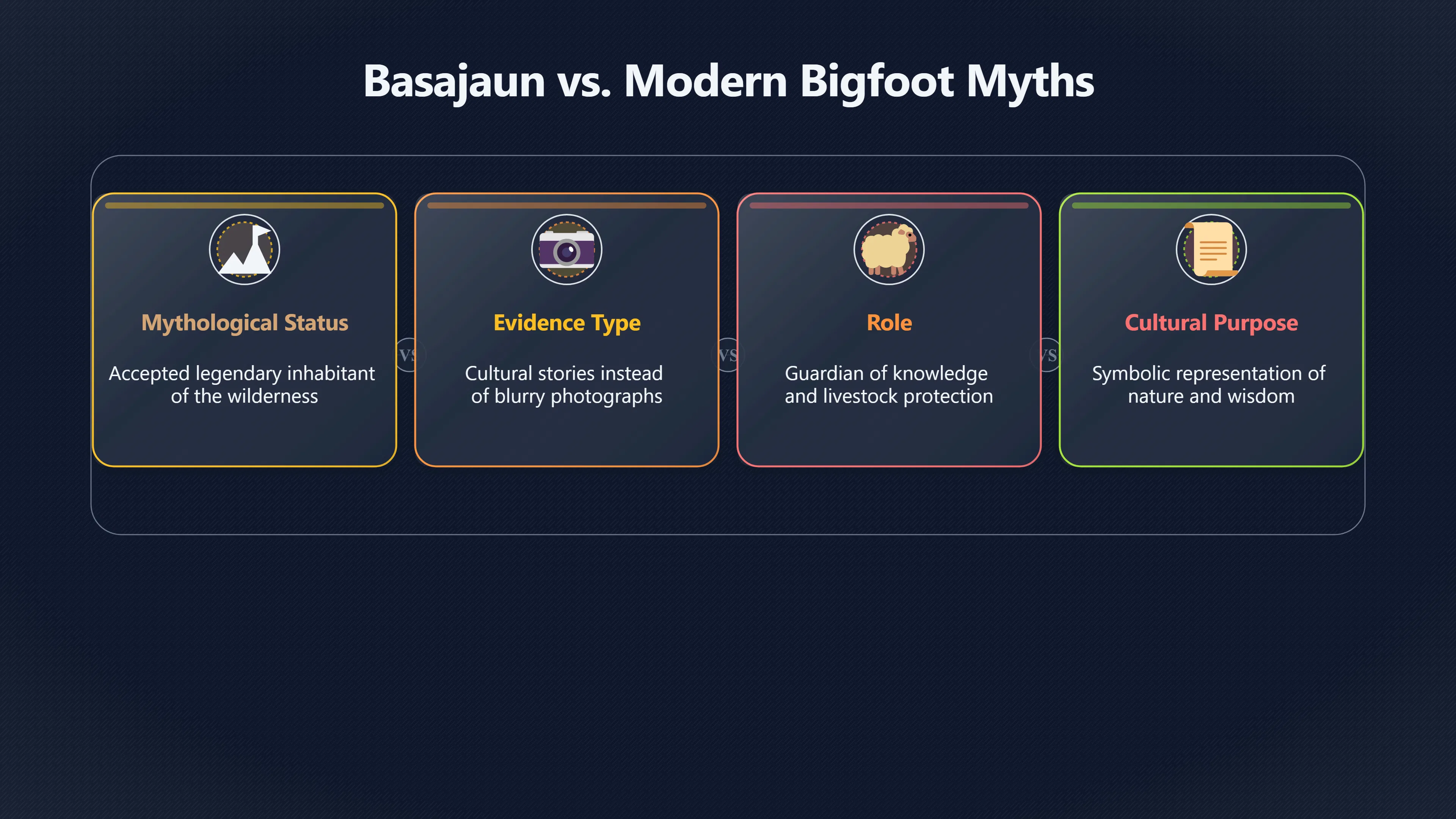
Unlike modern Bigfoot stories, the folklore does not revolve around fleeting eyewitness encounters, footprints, blurry photographs or debates about an unknown primate. The Basajaun is already accepted within the stories as a legendary inhabitant of the wilderness. The question is not whether he exists as an animal but what he represents.[Wikipedia]WikipediaOpen source on wikipedia.org.
The Basque Lord of the Woods
One of the most striking aspects of the tradition is that the forest giant is often benevolent rather than threatening. While some tales portray him as frightening or dangerous, many describe him as a protector of livestock and a guardian of mountain communities.[wikipedia.org]WikipediaOpen source on wikipedia.org.
According to well-known stories, the Basajaun warns shepherds when storms approach. He may howl from the mountains or signal danger before wolves arrive. In some versions, the sheep themselves react to his presence by ringing their bells, reassuring shepherds that the flocks are under protection.[wikipedia.org]WikipediaOpen source on wikipedia.org.
This role reflects the realities of life in the Pyrenean and Basque uplands. For centuries, shepherds depended on weather awareness, knowledge of predators and familiarity with difficult terrain. A supernatural guardian of flocks expresses those concerns in story form. The giant is less a monster than a personification of the mountains themselves.[wikipedia.org]WikipediaOpen source on wikipedia.org.
The tradition also includes a female counterpart, often called the Lady of the Forest. Together, these figures populate a mythic wilderness that exists alongside human society but follows its own rules.[Wikipedia]WikipediaOpen source on wikipedia.org.

Why the Stories Centre on Wilderness and Knowledge
Perhaps the most unusual element of Basajaun folklore is that the giant is credited with possessing valuable knowledge. In many tales, humans learn crucial skills by observing him or cleverly obtaining his secrets. These skills include agriculture, milling, metalworking and other technologies associated with settled civilisation.[wikipedia.org]WikipediaOpen source on wikipedia.org.
This creates an intriguing reversal. In many European wild-man traditions, the forest figure represents untamed chaos opposed to civilisation. In the Basque stories, the wilderness already contains wisdom. Humans do not simply conquer nature; they learn from it.[Wikipedia]WikipediaOpen source on wikipedia.org.
Several traditional narratives describe clever human characters obtaining grain, farming techniques or metalworking knowledge from the forest giants. The lesson is not merely technological. The stories suggest that essential knowledge existed before ordinary human society mastered it, hidden in the mountains and guarded by ancient beings.[wikipedia.org]WikipediaOpen source on wikipedia.org.
Viewed through a folkloric lens, the Basajaun functions almost like a cultural ancestor. He stands between the wild world and the human world, transmitting practical knowledge while remaining fundamentally outside civilisation.[Wikipedia]WikipediaOpen source on wikipedia.org.
From Wild-Man Tradition to Modern Cryptid Comparisons
The Basajaun belongs to a much broader European family of wild-man legends. Across the continent, stories tell of hairy forest dwellers, mountain guardians and beings that inhabit the edge of settled land. Scholars generally classify the Basajaun within this wider wild-man tradition rather than treating him as evidence for an unknown species.[Wikipedia]WikipediaOpen source on wikipedia.org.
Modern comparisons with Bigfoot emerged largely because the physical descriptions overlap. Both are portrayed as large, hairy, human-like figures living in remote landscapes. Yet the similarities are mostly superficial. Bigfoot is usually framed as a potentially real creature whose existence is debated. The Basajaun is embedded in a mythological system that includes supernatural beings, cultural heroes and explanations for the origins of human knowledge.[Wikipedia]WikipediaOpen source on wikipedia.org.
This distinction matters when examining Spain’s cryptid traditions. Some legends begin with alleged encounters and gradually become folklore. The Basajaun developed in the opposite direction. He was already part of a rich mythological framework long before modern cryptozoological comparisons appeared.[Wikipedia]WikipediaOpen source on wikipedia.org.

Why reports of Forest Giants persisted
The Basajaun survives because he embodies themes that remain powerful today. He links identity to landscape, turning forests and mountains into living cultural spaces rather than empty scenery. He also offers a vision of wilderness that is neither wholly hostile nor fully domesticated.[Pyrenean Experience]pyreneanexperience.combasajaun and basque mythologyPyrenean ExperienceBasajaun – Basque Mythology or History?Feb 26, 2015 — Basajaun literally means 'Lord of the Forest' and is one of the…
In modern tourism, popular culture and local storytelling, the giant often appears as a symbol of Basque heritage. Hiking routes, cultural events and regional storytelling continue to invoke the image of the shaggy forest lord. The figure has become an ambassador for the deep forests and mountain traditions of northern Spain.[pyreneanexperience.com]pyreneanexperience.combasajaun and basque mythologyPyrenean ExperienceBasajaun – Basque Mythology or History?Feb 26, 2015 — Basajaun literally means 'Lord of the Forest' and is one of the…
For readers interested in Spanish mystery creatures, the enduring fascination lies not in evidence for an undiscovered ape-man but in the way a forest giant became a keeper of memory, knowledge and place. The Basajaun shows how easily a hairy wild man can resemble a cryptid at first glance while serving a very different role in the folklore that created him.[wikipedia.org]WikipediaOpen source on wikipedia.org.
Amazon book picks
Further Reading
Books and field guides related to Is Spain's Forest Giant Really a Bigfoot?. Use these as the next step if you want deeper reading beyond the article.
The Basque History of the World
Provides cultural background for understanding the Basajaun tradition.
Abominable Science!
Explains why folklore creatures are often reinterpreted as undiscovered animals.
eBay marketplace picks
Marketplace Samples
Live-tested eBay searches with available results related to this page.




Endnotes
1.
Source: Wikipedia
Link:https://en.wikipedia.org/wiki/Basajaun
2.
Source: Wikipedia
Link:https://es.wikipedia.org/wiki/Basajaun
3.
Source: buber.net
Link:https://buber.net/Basque/2021/03/28/basque-fact-of-the-week-the-basajaunak-the-wild-lords-of-the-forest/
Source snippet
Basque Fact of the Week: The Basajaunak, the Wild Lords of...Mar 28, 2021 — He protects flocks from wolves and oncoming storms, ann...
4.
Source: localexpertstours.com
Link:https://www.localexpertstours.com/en/blogs/5-characters-from-basque-mythology/
Source snippet
He is the protector of the forest and nature, especially of flocks and shepherds.Read more...
5.
Source: basquecountryguide.com
Title: basque mythology
Link:https://basquecountryguide.com/basque-mythology/
Source snippet
BASQUE COUNTRY GUIDEBasque Mythology4 Nov 2025 — The Basajaun is also credited with possessing ancient knowledge of agriculture and black...
6.
Source: pyreneanexperience.com
Title: basajaun and basque mythology
Link:https://www.pyreneanexperience.com/basajaun-and-basque-mythology/
Source snippet
Pyrenean ExperienceBasajaun – Basque Mythology or History?Feb 26, 2015 — Basajaun literally means 'Lord of the Forest' and is one of the...
7.
Source: mythus.fandom.com
Link:https://mythus.fandom.com/wiki/Basajaun
Source snippet
Myth and FolkloreBasajaun - Myth and Folklore Wiki - FandomBasajaunak were known to keep great piles of wheat grain obtained from agricul...
8.
Source: transiberica.club
Link:https://www.transiberica.club/basajaun/
9.
Source: noobs-guide-to-necromancy.fandom.com
Link:https://noobs-guide-to-necromancy.fandom.com/wiki/Basajaun
10.
Source: mythbeasts.com
Link:https://mythbeasts.com/beast/basajaun/
11.
Source: basquemythology.amaroa.com
Link:https://basquemythology.amaroa.com/mythologic-characters/basajaun
Additional References
12.
Source: youtube.com
Title: Basajaun — The Lord of the Forest | Basque Mythology in Song (Euskara)
Link:https://www.youtube.com/watch?v=zQeahY3uuvc
Source snippet
The 1911 Expedition That Discovered a Forgotten Valley | The Basajaun Case | Historical Horror...
13.
Source: youtube.com
Link:https://www.youtube.com/watch?v=BA02V30swuM
Source snippet
"The One Who Taught Us" — Basajaun | Basque Folk...
14.
Source: arxiv.org
Link:https://arxiv.org/abs/1907.03969
15.
Source: youtube.com
Title: Basajaun – The Lord of the Forests in Basque Folklore
Link:https://www.youtube.com/watch?v=7VORQGDdyyE
Source snippet
Basajaun — The Lord of the Forest | Basque Mythology in Song (Euskara)...
16.
Source: lurkaia.com
Link:https://lurkaia.com/en/leyendas
Source snippet
Legends and stories from Basque mythology17 Apr 2026 — By observing the Lord of the Forest, he learns techniques of farming and sm...
17.
Source: youtube.com
Title: “The One Who Taught Us” — Basajaun | Basque Folk
Link:https://www.youtube.com/watch?v=UgmRduhX0rw
Source snippet
Basajaun – The Lord of the Forests in Basque Folklore...
18.
Source: isu.edu
Link:https://www.isu.edu/media/libraries/rhi/brief-communications/ANCIENT-REPRESENTATIONS-OF-THE-WILDMAN-IN-FRANCE.pdf
19.
Source: ancestry.com
Link:https://www.ancestry.com/first-name-meaning/basajaun
20.
Source: innovawood.com
Link:https://innovawood.com/project-and-platform/basajaun
21.
Source: basquemythology.neocities.org
Link:https://basquemythology.neocities.org/
Topic Tree