Within Samoan Monsters
Was the Tanifa a Shark or Something More?
The tanifa tradition shows how a real dangerous shark could also become a guardian, ancestor or supernatural presence.
On this page
- What the word tanifa originally meant
- Sharks at river mouths and real danger
- Guardian beings, family ties and misread folklore
Page outline Jump by section
Introduction
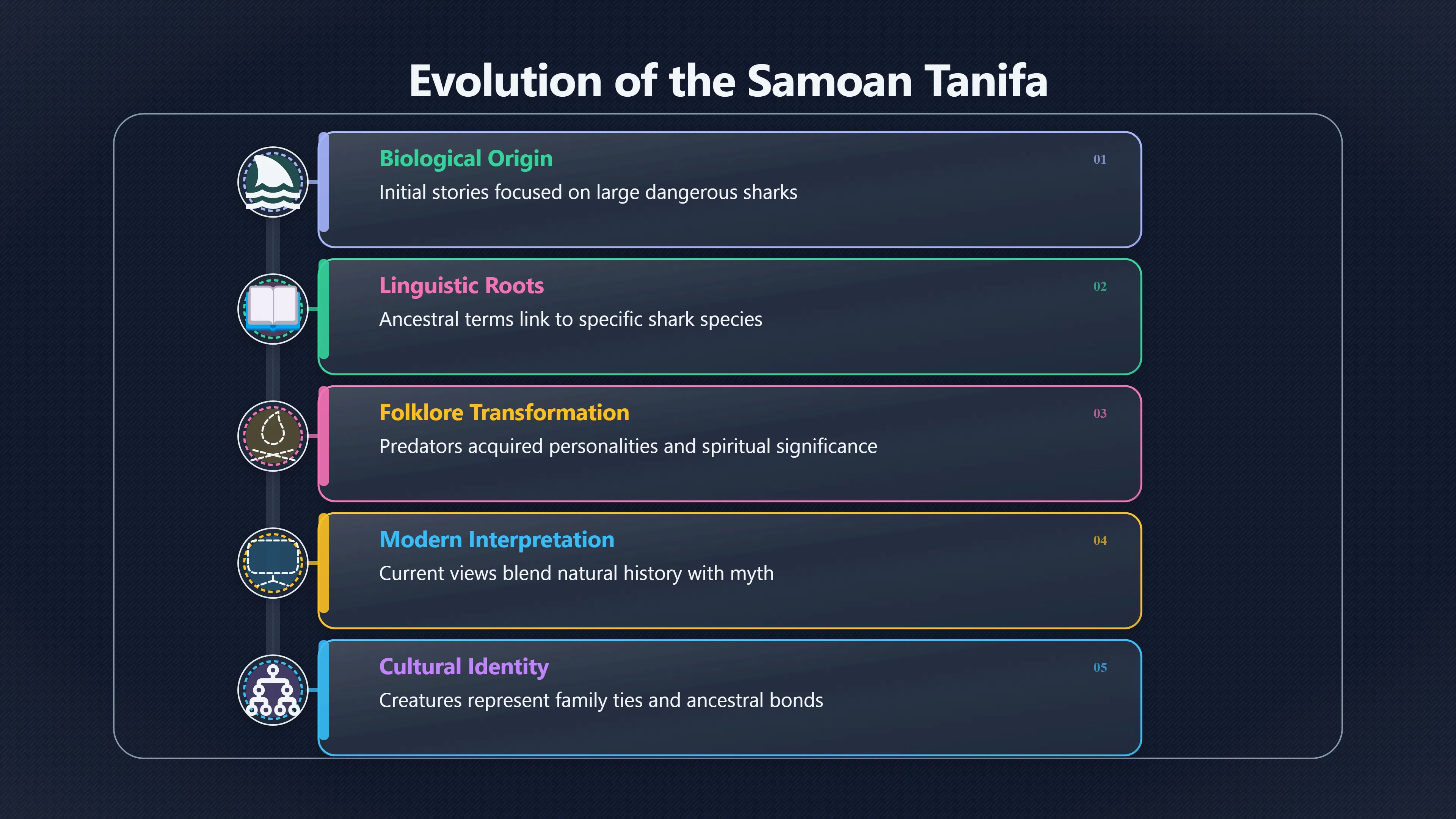
The tanifa occupies an unusual place in Samoan tradition because it sits directly between the natural and supernatural worlds. Unlike many legendary creatures that are clearly described as monsters, the tanifa appears to have begun as a recognised kind of large, dangerous shark. Over time, however, stories attached deeper meanings to these animals. A shark could be a genuine threat lurking at a river mouth, but it could also be a guardian spirit, an ancestral presence, or the visible form of a supernatural being connected to a family or place. This dual role helps explain why the tanifa remains one of the most revealing examples of how Samoan folklore transforms encounters with real animals into stories about identity, protection and danger.[NOAA Institutional Repository]repository.library.noaa.govInstitutional Repository Historic Fishing Methods in American SamoaNOAA Institutional RepositoryHistoric Fishing Methods in American SamoaJune 8, 2011 — The tānifa seldom exceeds 10 ft in size, but the sh…

Was the Tanifa a Shark or Something More?
The simplest answer is that the tanifa was originally a shark. Linguistic research across Polynesian languages traces the word back to an older ancestral term, tanifa, associated with a shark species. Related words in Tonga, Niue and Samoa also refer to large, dangerous sharks, while in some other Polynesian traditions the meaning gradually shifted towards sea monsters and supernatural beings.[Wikipedia]WikipediaOpen source on wikipedia.org.
That evolution is important. It suggests that the earliest stories were not necessarily about unknown creatures. Instead, they were rooted in encounters with real predators. As generations retold those encounters, the shark became more than an animal. It acquired personalities, family connections and spiritual significance.
In Samoa, this process never completely erased the shark beneath the legend. The tanifa remained recognisable as a marine predator even when stories described it as a guardian or sacred being. This distinguishes the tradition from later outsider descriptions that sometimes portrayed it as a purely mythical monster.[Wikipedia]WikipediaOpen source on wikipedia.org.
What the Word Tanifa Originally Meant
Modern readers sometimes assume that tanifa refers to a giant sea serpent or dragon-like creature because of similarities with the better-known Māori taniwha. The historical and linguistic evidence points elsewhere.
Comparative Polynesian language studies identify the Samoan tanifa primarily as a dangerous shark. The connection between sharks and supernatural beings developed later through folklore rather than through a belief in an entirely separate species. Across Polynesia, the same family of words could refer to sharks, mysterious fish, or legendary sea beings depending on local traditions.[Wikipedia]WikipediaOpen source on wikipedia.org.
This broader Polynesian pattern helps explain why descriptions vary. In one community, a tanifa might be remembered as a fearsome predator. In another, it might be a protective spirit watching over descendants of a particular family. The creature changes because its social role changes, not necessarily because people were describing different animals.
Sharks at River Mouths and Real Danger
The most convincing foundation for the tanifa legend is the presence of large sharks in places where people regularly travelled and fished.
Historical accounts from Samoa describe tanifa sharks as solitary animals that frequented shallow stream mouths, particularly at night. These sharks were said to pose a genuine threat to people crossing rivers or gathering food near the water. One account from the Vaivasa River on Upolu tells of repeated attempts to catch a troublesome shark that resisted hooks and even gunfire before additional sharks appeared in the same area.[NOAA Institutional Repository]repository.library.noaa.govInstitutional Repository Historic Fishing Methods in American SamoaNOAA Institutional RepositoryHistoric Fishing Methods in American SamoaJune 8, 2011 — The tānifa seldom exceeds 10 ft in size, but the sh…
For communities that depended on rivers, lagoons and coastal waters every day, such encounters would have been memorable and frightening. A large shark appearing repeatedly in a narrow channel could seem unusually intelligent or purposeful. Over time, stories about dangerous individuals could become attached to specific places.
Several factors would have encouraged this transformation:
- River mouths are naturally dangerous environments where salt and fresh water mix.
- Sharks can appear suddenly in shallow water.
- Individual sharks sometimes return repeatedly to the same feeding areas.
- Fatal or near-fatal encounters become powerful community memories.
Rather than inventing a monster from nothing, the tanifa tradition appears to have grown from genuine ecological realities familiar to coastal Samoans.[NOAA Institutional Repository]repository.library.noaa.govInstitutional Repository Historic Fishing Methods in American SamoaNOAA Institutional RepositoryHistoric Fishing Methods in American SamoaJune 8, 2011 — The tānifa seldom exceeds 10 ft in size, but the sh…
How a Predator Became a Guardian
The most fascinating aspect of the tanifa is that fear did not exclude respect. In many Polynesian cultures, dangerous animals could become symbols of protection precisely because they were powerful.
Historical descriptions of Samoan belief systems record that certain families associated themselves with particular animals, including sharks. These animals could serve as visible manifestations of spiritual beings or family protectors. A shark connected to one lineage might be treated with reverence, while other sharks remained ordinary prey. The key relationship was not with the species as a whole but with a specific spiritual connection.[e-rara]e-rara.chOld Samoa or flotsam and jetsam from the Pacific OceanJOHN B. STAIR LATEVICAROP. General Description of the Samoan Group. Social an…
This idea fits a wider Polynesian pattern. Across the Pacific, sharks frequently appear as ancestral guardians, protective spirits and intermediaries between humans and the supernatural world. Samoa’s tanifa tradition belongs to this broader cultural landscape while retaining its own local character.[Te Ara]teara.govt.nzpage 2Te AraMāori and sharks2 Mar 2009 — Polynesians, the ancestors of Māori, thought of sharks as guardian spirits. Many Hawaiian families had…
From this perspective, a guardian shark was not contradictory. The same creature capable of harming strangers could be expected to protect relatives, warn communities of danger, or represent a continuing bond with ancestors.
Family Ties and Misread Folklore
One of the most common misunderstandings in modern retellings is the assumption that stories about sacred sharks were primitive attempts to explain unusual animals.
In reality, many traditional accounts are less concerned with zoology than with relationships. The important question is not whether a shark was biologically unusual but whether it had a recognised connection to a family, village or spiritual tradition.
Nineteenth-century missionaries and colonial observers sometimes described such beliefs as superstition or confused them with monster stories. In doing so, they often overlooked the social role of these traditions. A shark linked to a family could express ideas about ancestry, obligation, identity and respect for place. The shark’s significance came from its relationship with people rather than from claims about its physical appearance.[e-rara.ch]e-rara.chOld Samoa or flotsam and jetsam from the Pacific OceanJOHN B. STAIR LATEVICAROP. General Description of the Samoan Group. Social an…
This distinction matters because it changes how the tanifa should be understood. It is not simply Samoa’s version of a lake monster. It is a cultural figure that emerged where practical knowledge of dangerous sharks met a worldview in which animals, ancestors and spiritual forces could overlap.
Why the Tanifa Still Matters
The tanifa remains one of the clearest examples of how Samoan traditions blur the boundary between natural history and folklore. At its core stands a real animal: a large shark capable of threatening people in coastal waters and river mouths. Around that animal grew stories about guardianship, ancestry and sacred relationships.[NOAA Institutional Repository]repository.library.noaa.govInstitutional Repository Historic Fishing Methods in American SamoaNOAA Institutional RepositoryHistoric Fishing Methods in American SamoaJune 8, 2011 — The tānifa seldom exceeds 10 ft in size, but the sh…
For readers interested in mystery creatures, the tanifa is intriguing precisely because it resists simple classification. It is not best understood as an undiscovered beast. Nor is it merely a fictional monster. Instead, it reflects a deeper cultural process in which a feared predator became a protector, a symbol of family identity and a reminder that in Samoa’s traditional worldview the most powerful creatures were often both dangerous and sacred at the same time.[e-rara.ch]e-rara.chOld Samoa or flotsam and jetsam from the Pacific OceanJOHN B. STAIR LATEVICAROP. General Description of the Samoan Group. Social an…
Amazon book picks
Further Reading
Books and field guides related to Was the Tanifa a Shark or Something More?. Use these as the next step if you want deeper reading beyond the article.
Emperors of the Deep: The Ocean’s Most Mysterious, Misunderst...
Explores the real animals that underlie many shark legends.
Polynesian Mythology:
Provides context for supernatural shark beings across Polynesia.
Myths and Legends of the Pacific
Includes the broader mythological setting in which tanifa stories developed.
Polynesian Mythology and Ancient Traditional History of the N...
First published 2005.
eBay marketplace picks
Marketplace Samples
Live-tested eBay searches with available results related to this page.

Endnotes
1.
Source: repository.library.noaa.gov
Title: Institutional Repository Historic Fishing Methods in American Samoa
Link:https://repository.library.noaa.gov/view/noaa/4172/noaa_4172_DS1.pdf
Source snippet
NOAA Institutional RepositoryHistoric Fishing Methods in American SamoaJune 8, 2011 — The tānifa seldom exceeds 10 ft in size, but the sh...
Published: June 8, 2011
2.
Source: Wikipedia
Link:https://en.wikipedia.org/wiki/Taniwha
3.
Source: e-rara.ch
Link:https://www.e-rara.ch/download/pdf/30203242.pdf
Source snippet
Old Samoa or flotsam and jetsam from the Pacific OceanJOHN B. STAIR LATEVICAROP. General Description of the Samoan Group. Social an...
4.
Source: tribalartreference.com
Link:https://www.tribalartreference.com/jps.php
Source snippet
Journal of the Polynesian SocietyStair, Rev. John B. Jottings on the mythology and spirit-lore of old Samoa, 1896, 5, 1, 33-57. Stair, Re...
5.
Source: nus.edu.ws
Link:https://nus.edu.ws/wp-content/uploads/2025/03/5.5-Indigenous-Samoan-perceptions-of-themselves-and-the-natural-env.compressed.pdf
Source snippet
Va'aby ULF Va'a — Religion played an important part in Samoan perceptions of the environment because various rocks, planets, trees, anima...
6.
Source: polynesia.com
Link:https://www.polynesia.com/blog/samoa-legend-turtle-and-the-shark
7.
Source: nesplandscapes.edu.au
Link:https://nesplandscapes.edu.au/wp-content/uploads/2015/10/A-guide-to-sharks-of-Kakadu-Rivers.pdf
8.
Source: teara.govt.nz
Title: page 2
Link:https://teara.govt.nz/en/sharks-and-rays/page-2
Source snippet
Te AraMāori and sharks2 Mar 2009 — Polynesians, the ancestors of Māori, thought of sharks as guardian spirits. Many Hawaiian families had...
9.
Source: blog.tepapa.govt.nz
Title: shark bait le vaiaso o le gagana samoa samoan language week 2013
Link:https://blog.tepapa.govt.nz/2013/05/31/shark-bait-le-vaiaso-o-le-gagana-samoa-samoan-language-week-2013/
10.
Source: teara.govt.nz
Link:https://teara.govt.nz/en/taniwha/print
11.
Source: scribd.com
Link:https://www.scribd.com/document/515856704/Taniwha
12.
Source: oceancolor.gsfc.nasa.gov
Link:https://oceancolor.gsfc.nasa.gov/staff/gene/shark.html
13.
Source: scholarspace.manoa.hawaii.edu
Link:https://scholarspace.manoa.hawaii.edu/bitstreams/6f06b90f-43e9-461e-9814-56af01405722/download
Additional References
14.
Source: instagram.com
Link:https://www.instagram.com/reel/CvwQGJ9IqF5/
Source snippet
, speaks to the interconnectedness our ancestors had with both their natural and...
15.
Source: youtube.com
Title: Shark Worship: The Cultural Importance of Sharks in Polynesia!
Link:https://www.youtube.com/watch?v=DD1VUWRSEQM
Source snippet
Uncovering Fiji's Shark God - The Real Legend of Dakuwaqa...
16.
Source: facebook.com
Link:https://www.facebook.com/groups/aotearoanzhistory/posts/1142349584254069/
17.
Source: facebook.com
Link:https://www.facebook.com/groups/aotearoanzhistory/posts/877395104082853/
18.
Source: youtube.com
Title: The Turtle & the Shark
Link:https://www.youtube.com/watch?v=sitoYDyueTw
Source snippet
Shark Worship: The Cultural Importance of Sharks in Polynesia...
19.
Source: library.sprep.org
Title: samoas shark sanctuary nofoaga faasao mo le malu puipuia o malie
Link:https://library.sprep.org/content/samoas-shark-sanctuary-nofoaga-faasao-mo-le-malu-puipuia-o-malie
20.
Source: facebook.com
Link:https://www.facebook.com/groups/725919078266734/posts/1056350991890206/
21.
Source: youtube.com
Title: The Turtle and The Shark
Link:https://www.youtube.com/watch?v=VEL7EZTLq6s
Source snippet
The Turtle & the Shark - A Samoan Legend...
22.
Source: youtube.com
Link:https://www.youtube.com/watch?v=40njPrPvRCk
23.
Source: ia801404.us.archive.org
Title: 2015.236311.Myths And text
Link:https://ia801404.us.archive.org/24/items/in.ernet.dli.2015.236311/2015.236311.Myths-And_text.pdf
Topic Tree