Strange Creatures of Trinidad and Tobago's Wild Places
Trinidad and Tobago’s mystery-creature tradition is not built around a single alleged animal comparable to the Loch Ness Monster or Bigfoot.
Page outline Jump by section
Introduction
That distinction matters. These figures sometimes resemble cryptids because people describe encounters with them in forests, villages, rivers and on lonely roads. Yet the surviving material is mainly cultural testimony, not zoological evidence. Trinidad and Tobago’s most revealing “monster” question is therefore not whether an unknown large animal has escaped scientific detection, but how real wildlife, dangerous landscapes and the country’s African and French Creole inheritance combined to produce creatures that still feel locally plausible.[facebook.com]facebook.comFolklore in T&T and many parts of the Caribbean has been…Folklore in T&T and many parts of the Caribbean has been inspired by…
Which creatures define the tradition?
The central figures occupy different parts of the landscape and express different kinds of fear. Some are predatory beings, some protect nature, and others warn children or travellers away from dangerous places.
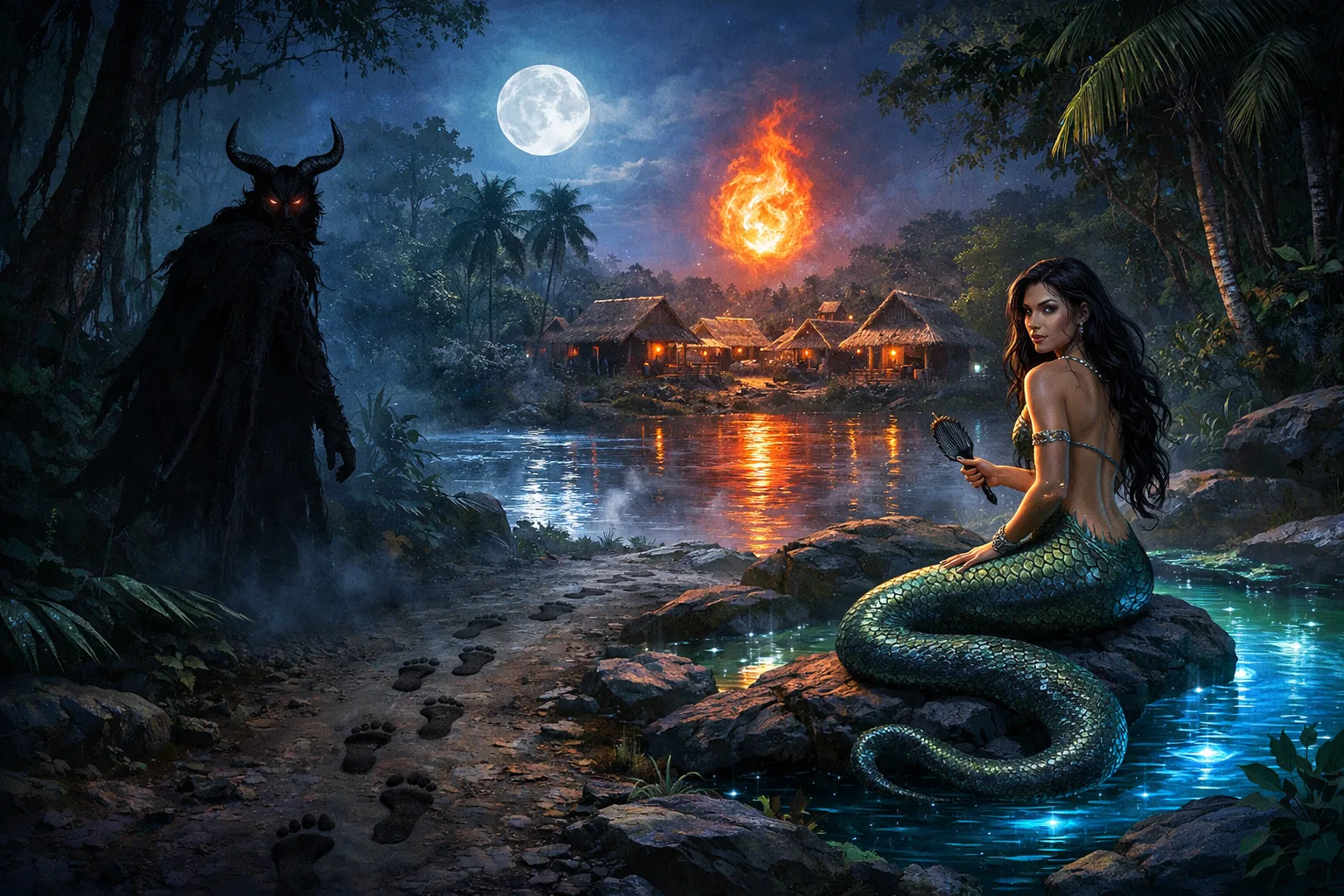
The Lagahoo is the closest Trinidad and Tobago comes to a classic shape-shifting cryptid. Accounts portray it as a person by day and a changing beast by night. Depending on the telling, it may become a dog, pig, goat, horse or bull, or appear as a headless figure carrying a coffin and dragging chains. Its instability is part of its identity: there is no single fixed Lagahoo anatomy that eyewitnesses could reliably compare. The name is associated with the French werewolf tradition of the loup-garou, altered in local speech and storytelling into Lagahoo.[guardian.co.tt]guardian.co.ttTrinidad Guardian About Lagahoos, La Diablesse, Douens and Anansi Helen DraytonI assure readers that if they ever saw that shifty character called a lagahoo they'll hold dey head and bawl fuh mercy. I promise a lagah…
The Soucouyant is normally described as an elderly woman who removes her skin at night, becomes a ball of fire and slips into houses to feed on victims. Stories prescribe defensive measures such as scattering rice, which the creature must stop to count, or placing salt in its abandoned skin. These details place the Soucouyant firmly in supernatural folklore rather than mystery zoology, although reports of moving lights or unexplained illness could be interpreted through the legend.[wikipedia.org]WikipediaOpen source on wikipedia.org.
The Douen is usually imagined as a lost or unbaptised child with a broad hat and feet pointing backwards. Douens call other children into the forest, where the reversed footprints make pursuit or escape confusing. The story works as a practical warning about wandering away from home, but its disturbing visual design has also made it one of the country’s most durable monster figures.[newsday.co.tt]newsday.co.ttLagahoo or lagahuTrinidad and Tobago NewsdayLessons from mystical beings of the mas6 Feb 2021 — Around the 1840s and 50s characters such as the douen, sou…
Papa Bois is less a monster than an enforcer of woodland rules. He is commonly portrayed as a hairy old man, sometimes with horns or cloven feet, who protects forest animals and misleads hunters. Some versions say he can take the form of a deer or another animal. The figure turns the forest into morally governed territory: hunting may be permitted, but cruelty, greed and disrespect invite punishment.[tntisland.com]tntisland.comOpen source on tntisland.com.
Mama D’Leau occupies rivers and forest pools. She is generally depicted with the upper body of a woman and a coiled, snake-like lower half, sometimes holding a comb. Like Papa Bois, she is associated with the protection of wildlife and punishment of people who abuse natural places. Her story belongs to a wider Caribbean family of water spirits, but its placement in Trinidadian rivers gives it a distinct local setting.[Wikipedia]WikipediaMama D'LeauMama D'Leau
These figures overlap with other supernatural characters, including La Diablesse, jumbies and Tobago’s Gang Gang Sarah. Not all qualify even loosely as mystery animals. Their importance here is that they inhabit the same storytelling world, where people, spirits and animals can change shape and where an apparently ordinary road, river or forest edge can become dangerous after dark.[Trinidad Guardian]guardian.co.ttTrinidad Guardian About Lagahoos, La Diablesse, Douens and Anansi Helen DraytonI assure readers that if they ever saw that shifty character called a lagahoo they'll hold dey head and bawl fuh mercy. I promise a lagah…
Where do encounters supposedly happen?
Traditional stories rarely provide the precise dates, mapped coordinates or independently interviewed witnesses expected in a modern cryptid investigation. Instead, they attach creatures to recognisable types of place.
Forests and hunting grounds belong chiefly to Papa Bois and the Lagahoo. Douens also inhabit woodland paths, where children can become lost and tracks are difficult to follow. Rivers and deep pools are associated with Mama D’Leau, while the Soucouyant moves between village homes, cemeteries and the night sky. Lonely roads and crossroads provide stages for La Diablesse and other deceptive travellers.[newsday.co.tt]newsday.co.ttLagahoo or lagahuTrinidad and Tobago NewsdayLessons from mystical beings of the mas6 Feb 2021 — Around the 1840s and 50s characters such as the douen, sou…
This geography reflects Trinidad and Tobago’s real environments. Trinidad supports monkeys, deer, peccaries, armadillos, porcupines, ocelots, numerous bats and aquatic mammals, while its forested hills, wetlands and caves create unfamiliar sounds and fleeting animal silhouettes. Government biodiversity records list 96 native mammal species, and the University of the West Indies describes bats and rodents as the largest mammal groups in and around the islands.[biodiversity.gov.tt]biodiversity.gov.ttTrinidad and Tobago BiodiversityTrinidad and Tobago Biodiversity
Some ordinary wildlife can be startling under poor conditions. Howler monkeys produce exceptionally powerful calls that carry through forest, while an ocelot glimpsed briefly at night may look larger or stranger than expected. Bats, nocturnal birds and reflected firelight can also supply fragments from which a supernatural interpretation is built. Such possibilities do not explain every personal story, but they show why wooded Trinidad offers more raw material for beast legends than an urban street in full daylight.[wildliferescuett.org]wildliferescuett.orgOpen source on wildliferescuett.org.
Tobago has related folklore, but its tradition is not simply a duplicate of Trinidad’s. Local accounts include distinctive names for birds and animals alongside characters shared with the wider African Caribbean world. The surviving material suggests two overlapping island traditions rather than a single, neatly standardised national catalogue.[Citizens for Conservation]citizensforconservationtt.orgOpen source on citizensforconservationtt.org.
Did the stories begin as eyewitness reports?
There is no well-supported starting date for most of these beings. They circulated orally before collectors, artists and newspapers fixed versions in print. That makes it difficult to identify a “first sighting” or to distinguish an early encounter claim from a story already familiar to the teller.
The tradition grew within a society shaped by Indigenous presence, European colonisation, slavery, migration and language contact. Trinidadian cultural sources particularly emphasise West African and French Creole influences. The Lagahoo’s connection to the loup-garou is one obvious example; the Soucouyant also belongs to a broader family of Caribbean blood-drinking night beings whose names and details vary from island to island.[facebook.com]facebook.comFolklore in T&T and many parts of the Caribbean has been…Folklore in T&T and many parts of the Caribbean has been inspired by…
Folklore was not merely an attempt to catalogue literal animals. The stories entertained listeners, explained frightening experiences and enforced practical rules. Douen tales discouraged children from roaming into forests. Papa Bois stories taught restraint in hunting. Mama D’Leau guarded rivers. The Soucouyant gave narrative form to nocturnal lights, unexplained weakness, neighbourly suspicion and fears surrounding the ageing female body.[newsday.co.tt]newsday.co.ttLagahoo or lagahuTrinidad and Tobago NewsdayLessons from mystical beings of the mas6 Feb 2021 — Around the 1840s and 50s characters such as the douen, sou…
Personal encounter stories remain culturally important, but they are usually preserved as memories rather than testable case files. A person may sincerely recall chains in the night, a fireball crossing the sky or a strange animal on a forest road. Without contemporary notes, multiple witnesses, photographs or physical traces, however, later researchers cannot reliably separate misperception, embellished memory and deliberate storytelling.
What evidence exists?
For the famous creatures, the strongest evidence is evidence of tradition: repeated descriptions, published retellings, artworks, Carnival representations and recognition across generations. The Heritage Library material reproduced in the Trinidad and Tobago Guardian, collections held through the University of the West Indies and continuing cultural projects all demonstrate that these beings are established parts of national folklore.[guardian.co.tt]guardian.co.ttTrinidad Guardian About Lagahoos, La Diablesse, Douens and Anansi Helen DraytonI assure readers that if they ever saw that shifty character called a lagahoo they'll hold dey head and bawl fuh mercy. I promise a lagah…
Evidence for unknown animals is much weaker. There is no accepted body, bone, hide, DNA sample, trackway or clear sequence of photographs supporting a Lagahoo-like species. Nor is there a stable anatomical description: the creature changes from a headless coffin-bearer to a pig, horse, goat, dog or partly human form. That flexibility makes the legend powerful but prevents ordinary biological testing.
The Soucouyant, Douen and Mama D’Leau present an even clearer category problem. A flying fireball that leaves its skin behind, a dead child with reversed feet and a woman-serpent river guardian are not proposed species in any conventional zoological sense. Treating them as animals awaiting discovery strips away much of their religious, moral and social meaning.
The responsible conclusion is therefore that Trinidad and Tobago possesses a strong monster tradition but a weak modern cryptid casebook. The creatures are well attested as stories; they are not well evidenced as undiscovered fauna.

How might strange sightings arise?
Several ordinary mechanisms can produce memorable monster experiences without requiring dishonesty from the witness.
Brief wildlife encounters. A deer, peccary, ocelot, dog or monkey seen through vegetation may be difficult to identify. At night, distance and scale are especially unreliable, while eyeshine can make an animal appear unnatural.
Unfamiliar sounds. Howler monkeys can be heard from kilometres away, and nocturnal birds, bats and forest mammals produce calls that listeners may struggle to locate. A sound with no visible source is easily assigned to a creature already known from childhood stories.[Chaguaramas]chaguaramas.comOpen source on chaguaramas.com.
Fire and moving lights. A distant torch, burning debris, lightning, vehicle lights or other luminous phenomena may be interpreted as a Soucouyant when seen briefly through trees or across uneven ground. Once the cultural label is supplied, later memory may become more detailed than the original view.
Tracks and reversed direction. Partial footprints, overlapping tracks or animals doubling back can create misleading trails. The Douen’s backward feet turn the real difficulty of tracking in leaf litter and mud into a memorable supernatural feature.
Expectation and retelling. People tend to interpret ambiguous sights through familiar categories. A witness who already knows the Lagahoo story has a ready explanation for an oddly moving dog or pig. Repeated retelling can then sharpen uncertain details, particularly when listeners expect chains, fire, hooves or shape-changing.
Human performance or mischief. Masks, costumes, practical jokes and staged scares can exploit well-known legends. Trinidad and Tobago’s strong masquerade tradition makes the boundary between frightening folklore and public performance especially porous, although no single hoax explains the tradition as a whole.
How Carnival kept the monsters alive
The creatures did not remain confined to whispered night-time tales. Newspaper coverage of traditional masquerade records Douens, Soucouyants and Lagahoos appearing in Carnival from the nineteenth century. Performance gave beings with no fixed physical form a visible body: masks, fabric, movement and speech could turn an oral description into something audiences could immediately recognise.[Trinidad and Tobago Newsday]newsday.co.ttLagahoo or lagahuTrinidad and Tobago NewsdayLessons from mystical beings of the mas6 Feb 2021 — Around the 1840s and 50s characters such as the douen, sou…
Carnival also changes the emotional balance. A creature that once frightened children can become comic, political or spectacular when performed before a crowd. Papa Bois may represent environmental guardianship; the Soucouyant can become a figure through which artists explore gender, age and social suspicion; the Lagahoo’s transformations suit costumes built around visual surprise.
Contemporary artists and writers continue the process. University of the West Indies research documents the use of the Douen and Soucouyant in the work of Trinidadian artist and poet LeRoy Clarke. Local museums, heritage projects and exhibitions likewise present folklore as cultural inheritance rather than as a literal field guide to dangerous animals.[UWISpace]uwispace.sta.uwi.eduCaribbean Studies Project HUMN 3099 - UWISpaceThis study aims to review the use of folklore within bodies of work extending acros…
The National Trust’s transformation of Mille Fleurs in Port of Spain into a folklore-themed “Mystery House” in 2023 illustrates the modern afterlife particularly well. Traditional beings were presented through art and live representation in a heritage setting, blending education, entertainment and seasonal spookiness.[Global Voices]globalvoices.orgthis mystery house highlights the characters of caribbean folklorethis mystery house highlights the characters of caribbean folklore
Folklore, cryptid or misidentified animal?
The label depends on what is being claimed.
A folklore figure is preserved primarily through traditional stories and shared cultural meaning. Papa Bois, Mama D’Leau, Douens and the Soucouyant fit this category most clearly.
A witness claim is a person’s report of something seen, heard or experienced. It may be sincere without proving that the witness’s interpretation was correct.
A cryptid claim proposes that reports may involve an unrecognised animal population. Trinidad and Tobago has relatively little strong material of this kind. The Lagahoo is sometimes placed in cryptid lists because it appears as a beast, but supernatural shape-changing places it outside an ordinary zoological hypothesis.
A misidentification occurs when a known animal or natural event is given the wrong label. Trinidad’s varied fauna, dense vegetation and nocturnal soundscape make this plausible in isolated cases, although a general explanation should not be mistaken for proof about a particular encounter.[biodiversity.gov.tt]biodiversity.gov.ttTrinidad and Tobago BiodiversityTrinidad and Tobago Biodiversity
A hoax or performance involves deliberate fabrication, disguise or theatrical presentation. Carnival costumes and folklore exhibitions are openly performative; a supposed roadside encounter staged to frighten someone would be a hoax. Neither invalidates the older tradition, because the cultural creature existed before the performance.
Keeping these categories separate prevents two opposite mistakes. One is to present supernatural beings as confirmed animals. The other is to dismiss the stories as worthless merely because they do not describe biological species. Their value lies in how they map danger, memory, nature and social rules onto the islands’ landscape.
Why the legends still matter
Trinidad and Tobago’s creatures have survived because they remain adaptable. The Lagahoo can become whatever shape a new storyteller needs. The Soucouyant can be terrifying, comic or socially critical. Papa Bois and Mama D’Leau speak naturally to modern concerns about wildlife protection and environmental damage. Douens continue to embody the fear of children becoming lost beyond the safety of home.
They also give the country a monster tradition that is recognisably its own while remaining connected to the wider Caribbean. Shared African diasporic and French Creole roots explain similarities with beings found on neighbouring islands, but local landscapes, speech, art and Carnival have reshaped them.[citizensforconservationtt.org]citizensforconservationtt.orgOpen source on citizensforconservationtt.org.
For readers searching for a hidden giant animal, the evidence is disappointing: no well-documented Trinidadian lake monster, ape-man or phantom cat population has emerged from the available record. For readers interested in how monster beliefs actually develop, however, the country offers something richer. Its strange beings show how ordinary wildlife, darkness, colonial history, oral teaching and theatrical invention can combine until a creature becomes culturally real even when it is not zoologically confirmed.
Amazon book picks
Further Reading
Books and field guides related to What Haunts Trinidad and Tobago's Wild Places?. Use these as the next step if you want deeper reading beyond the article.
The Mythology Book
Provides broad background on myth-making, folklore and legendary beings.
Caribbean Folklore
Covers major folklore traditions and creatures across the Caribbean, including cultural context relevant to Trinidad and Tobago.
Encyclopedia of Things that Never Were
Places Trinidadian legendary beings within a wider world of mythical creatures.
Endnotes
1.
Source: facebook.com
Link:https://www.facebook.com/NALISChaguanasTT/posts/folklore-in-tt-and-many-parts-of-the-caribbean-has-been-inspired-by-the-influenc/200323208262788/
Source snippet
Folklore in T&T and many parts of the Caribbean has been...Folklore in T&T and many parts of the Caribbean has been inspired by...
2.
Source: Wikipedia
Link:https://en.wikipedia.org/wiki/Lagahoo
3.
Source: Wikipedia
Link:https://en.wikipedia.org/wiki/Soucouyant
4.
Source: Wikipedia
Link:https://en.wikipedia.org/wiki/Douen
5.
Source: nalis.gov.tt
Link:https://www.nalis.gov.tt/wp-content/uploads/2025/01/Mishal-Rahaman-Ali_15th-Annual-FTA-Programme-2024-board.pdf
6.
Source: explorersweb.com
Title: guide caribbean folklore
Link:https://explorersweb.com/guide-caribbean-folklore/
7.
Source: Wikipedia
Title: Papa Bois
Link:https://en.wikipedia.org/wiki/Papa_Bois
8.
Source: Wikipedia
Title: Mama D’Leau
Link:https://en.wikipedia.org/wiki/Mama_D%27Leau
9.
Source: biodiversity.gov.tt
Title: Trinidad and Tobago Biodiversity
Link:https://www.biodiversity.gov.tt/index.php/trinidad-a-tobago-biodiversity/fauna-checklist/vertebrates/mammals.html
10.
Source: wildliferescuett.org
Link:https://www.wildliferescuett.org/wildlife-guide/
11.
Source: chaguaramas.com
Link:https://chaguaramas.com/chaguaramas-fauna-animals
12.
Source: facebook.com
Link:https://www.facebook.com/emauthority/posts/biodiversity-matters-learn-about-trinidad-and-tobagos-environmentally-sensitive-/10160480475914885/
13.
Source: visittobago.gov.tt
Title: journey through time exploring buccoo museum tobago
Link:https://visittobago.gov.tt/journey-through-time-exploring-buccoo-museum-tobago
14.
Source: nalis.gov.tt
Title: caribbean folklore part 3
Link:https://www.nalis.gov.tt/blog/caribbean-folklore-part-3/
15.
Source: facebook.com
Link:https://www.facebook.com/groups/191766699268/posts/10161118753929269/
16.
Source: facebook.com
Link:https://www.facebook.com/TTGuardian/posts/trinidad-tobago-has-a-rich-folklore-history-so-for-world-folktales-fables-week-w/1368260911997723/
17.
Source: facebook.com
Link:https://www.facebook.com/groups/191766699268/posts/10160854458894269/
18.
Source: facebook.com
Link:https://www.facebook.com/groups/269202760462518/posts/592001278182663/
19.
Source: facebook.com
Link:https://www.facebook.com/BookMuseum/videos/%F0%9D%91%AD%F0%9D%92%86%F0%9D%92%82%F0%9D%92%95%F0%9D%92%96%F0%9D%92%93%F0%9D%92%86-%F0%9D%91%AD%F0%9D%92%93%F0%9D%92%8A%F0%9D%92%85%F0%9D%92%82%F0%9D%92%9A-%F0%9D%91%BA%F0%9D%92%91%F0%9D%92%90%F0%9D%92%95%F0%9D%92%8D%F0%9D%92%8A%F0%9D%92%88%F0%9D%92%89%F0%9D%92%95-%F0%9D%92%90%F0%9D%92%8F-%F0%9D%91%AD%F0%9D%92%90%F0%9D%92%8D%F0%9D%92%8C%F0%9D%92%8D%F0%9D%92%90%F0%9D%92%93%F0%9D%92%86-%F0%9D%91%B3%F0%9D%92%86%F0%9D%92%88%F0%9D%92%86%F0%9D%92%8F%F0%9D%92%85%F0%9D%92%94-%F0%9D%92%90%F0%9D%92%87-%F0%9D%91%BB%F0%9D%92%93%F0%9D%92%8A%F0%9D%92%8F%F0%9D%92%8A%F0%9D%92%85%F0%9D%92%82%F0%9D%92%85-%F0%9D%92%82%F0%9D%92%8F%F0%9D%92%85-%F0%9D%91%BB%F0%9D%92%90%F0%9D%92%83%F0%9D%92%82%F0%9D%92%88%F0%9D%92%90todays-featur/954565730781739/
20.
Source: facebook.com
Link:https://www.facebook.com/groups/191766699268/posts/10163425204784269/
21.
Source: facebook.com
Link:https://www.facebook.com/ExpeditionUnknownTV/posts/investigate-the-mystery-of-the-chupacabra-alongside-joshua-gates-now-on-expediti/390621281831594/
22.
Source: facebook.com
Title: terrifying real chupacabra sightings caught on camera chupacabra creature
Link:https://www.facebook.com/mostamazingtop10videos/posts/terrifying-real-chupacabra-sightings-caught-on-camera-chupacabra-creature/1271063974391399/
23.
Source: facebook.com
Link:https://www.facebook.com/pbcjamaica/posts/pbcj-programmes-manager-and-archives-records-management-graduate-carol-francis-i/2527993723904953/
24.
Source: facebook.com
Link:https://www.facebook.com/groups/191766699268/posts/10161865081959269/
25.
Source: facebook.com
Link:https://www.facebook.com/DjKid868/posts/late-night-topic-yall-ever-had-any-experiences-with-any-trinidadian-folklore-cre/811506643967929/
26.
Source: Wikipedia
Link:https://en.wikipedia.org/wiki/Chupacabra
27.
Source: Wikipedia
Link:https://fr.wikipedia.org/wiki/Lagahoo
28.
Source: Wikipedia
Title: List of mammals of Trinidad and Tobago
Link:https://en.wikipedia.org/wiki/List_of_mammals_of_Trinidad_and_Tobago
29.
Source: foreign.gov.tt
Title: London Mission Vol 77 web
Link:https://foreign.gov.tt/documents/1382/London_Mission_-_Vol_77_web.pdf
30.
Source: youtube.com
Title: T&T Folklore Pt. 2: PAPA BOIS
Link:https://www.youtube.com/watch?v=EdFP5cEP7v8
Source snippet
Lagahoo - Trinidad and Tobago Folklore...
31.
Source: youtube.com
Link:https://www.youtube.com/watch?v=iDK6NyXe5PI
Source snippet
Folklore of Trinidad and Tobago:Soucouyant, Papa Bois, Buck etc...
32.
Source: guardian.co.tt
Title: Trinidad Guardian About Lagahoos, La Diablesse, Douens and Anansi Helen Drayton
Link:https://www.guardian.co.tt/article-6.2.405946.e0a3acecd6
Source snippet
I assure readers that if they ever saw that shifty character called a lagahoo they'll hold dey head and bawl fuh mercy. I promise a lagah...
33.
Source: newsday.co.tt
Title: Lagahoo or lagahu
Link:https://newsday.co.tt/2021/02/06/lessons-from-mystical-beings-of-the-mas/
Source snippet
Trinidad and Tobago NewsdayLessons from mystical beings of the mas6 Feb 2021 — Around the 1840s and 50s characters such as the douen, sou...
34.
Source: uwispace.sta.uwi.edu
Link:https://uwispace.sta.uwi.edu/bitstreams/b55d4d5b-baa7-4d42-84ef-bdf2dcac92fe/download
Source snippet
Caribbean Studies Project HUMN 3099 - UWISpaceThis study aims to review the use of folklore within bodies of work extending acros...
35.
Source: uwispace.sta.uwi.edu
Link:https://uwispace.sta.uwi.edu/bitstreams/f3f9ac42-6de6-402a-b111-e302fcb8fb60/download
Source snippet
by RA Bridgemohan — Soucouyant and Douen were also easily recognised by this age group as an 'old lady-looking vampire' and 'poss...
36.
Source: sta.uwi.edu
Title: The University of the West Indies Mammals | The Department of Life Sciences
Link:https://sta.uwi.edu/fst/lifesciences/mammals
Source snippet
Augustine22 Jun 2018 — There are around 100 species of mammals from 22 different families found in and around Trinidad and Tobago. These...
37.
Source: tntisland.com
Link:https://www.tntisland.com/folklore.html
38.
Source: citizensforconservationtt.org
Link:https://citizensforconservationtt.org/home/sites/tobago-folklore/
39.
Source: uwispace.sta.uwi.edu
Title: Space West Indian Calendar Collection
Link:https://uwispace.sta.uwi.edu/bitstreams/1268b7ca-9381-4fe8-9f28-a3b3b1c03ccb/download
40.
Source: globalvoices.org
Title: this mystery house highlights the characters of caribbean folklore
Link:https://globalvoices.org/2023/10/31/this-mystery-house-highlights-the-characters-of-caribbean-folklore/
41.
Source: newsday.co.tt
Link:https://newsday.co.tt/page/5909/?search=
42.
Source: guardian.co.tt
Link:https://www.guardian.co.tt/article-6.2.395646.cb14c16ecd
43.
Source: guardian.co.tt
Title: anansi ghost ships and sweet pan 6.2.2102168.fbab59f7fb
Link:https://www.guardian.co.tt/article/anansi-ghost-ships-and-sweet-pan-6.2.2102168.fbab59f7fb
Additional References
44.
Source: youtube.com
Title: Folklore of Trinidad and Tobago:Soucouyant, Papa Bois, Buck etc
Link:https://www.youtube.com/watch?v=eKsJ_Xpnw9I
Source snippet
The Legend of the Socouyant - A Trinbagonian Folklore...
45.
Source: caribbeanentertainmenthub.com
Link:https://caribbeanentertainmenthub.com/caribbean-folklore-with-illustration
46.
Source: scribd.com
Link:https://www.scribd.com/document/772218778/Characters-from-Caribbean-Folklore
47.
Source: instagram.com
Link:https://www.instagram.com/reel/DQeDKmikSLZ/
48.
Source: dokumen.pub
Link:https://dokumen.pub/the-things-that-fly-in-the-night-female-vampires-in-literature-of-the-circum-caribbean-and-african-diaspora-9780813565750.html
49.
Source: a-z-animals.com
Link:https://a-z-animals.com/animals/location/americas/trinidad-and-tobago/
50.
Source: museum.centralbankarts.org.tt
Link:https://museum.centralbankarts.org.tt/
51.
Source: pt.slideshare.net
Link:https://pt.slideshare.net/slideshow/folklore-in-trinidad-and-tobago/248334833
52.
Source: instagram.com
Link:https://www.instagram.com/p/Cy3fwoKurzN/?hl=en
53.
Source: youtube.com
Link:https://www.youtube.com/watch?v=YEdkoXwX0fg
Topic Tree
Follow this branch
Related pages 192
- Antigua Cryptids
- Maldives Monsters
- Malta Monsters
- Qatar Monsters
- Argentina Monsters
- +187 more in sidebar