Within Singapore Monsters
Which Animals Could Explain Monkey Man Sightings?
Macaques, colugos, rare langurs and poor night-time views can turn brief wildlife encounters into reports of something human-like.
On this page
- Long tailed macaques on two legs
- Colugos and unfamiliar night time shapes
- Why forest conditions distort size and movement
Page outline Jump by section
Introduction
Stories about the Bukit Timah Monkey Man often focus on an unknown upright primate lurking in Singapore’s remaining rainforest. Yet one of the simplest explanations is also the most persuasive: many “monster” encounters may begin with real animals seen briefly, at awkward angles, in poor light. Bukit Timah Nature Reserve contains long-tailed macaques, colugos, squirrels, civets and other mammals that can appear surprisingly human-like or unfamiliar when glimpsed at dusk or after dark. Reserve staff have explicitly suggested that some Monkey Man reports are likely cases of mistaken identity involving ordinary macaques rather than an undiscovered creature.[Wikipedia]WikipediaBukit Timah Monkey ManBukit Timah Monkey Man
This does not mean every witness invented what they saw. Instead, it highlights how a dense tropical forest can transform a fleeting wildlife encounter into a memorable mystery. Understanding the animals that actually live in Bukit Timah helps explain why reports of strange, monkey-like figures have persisted for decades.
Which Animals Could Explain Monkey Man Sightings?
The strongest natural explanation for many Bukit Timah monster reports is not a single species but a combination of several animals and difficult viewing conditions.
Bukit Timah is one of Singapore’s richest wildlife areas. The reserve and connected Central Catchment forests support long-tailed macaques, colugos, squirrels, pangolins and other mammals, including species that are rarely seen by casual visitors.[Wikipedia]WikipediaBukit Timah Nature ReserveBukit Timah Nature Reserve
When a witness encounters an unfamiliar animal unexpectedly—especially at night—the brain often fills in missing details. Size can be exaggerated, posture can be misread and movement can seem far stranger than it really is. That is particularly relevant to Monkey Man stories, which usually involve brief sightings rather than prolonged observation.[Wikipedia]WikipediaBukit Timah Monkey ManBukit Timah Monkey Man
Long-Tailed Macaques on Two Legs
The long-tailed macaque is the most obvious candidate. These monkeys are common in and around Bukit Timah and are frequently encountered by hikers and residents living near forest edges.[nparks.gov.sg]nparks.gov.sgDefault Macaca fascicularisDefaultMacaca fascicularis - SingaporeCommon Name: Long-tailed Macaque, Crab-eating. Found in forest and adjacent parkland. In Singapore…
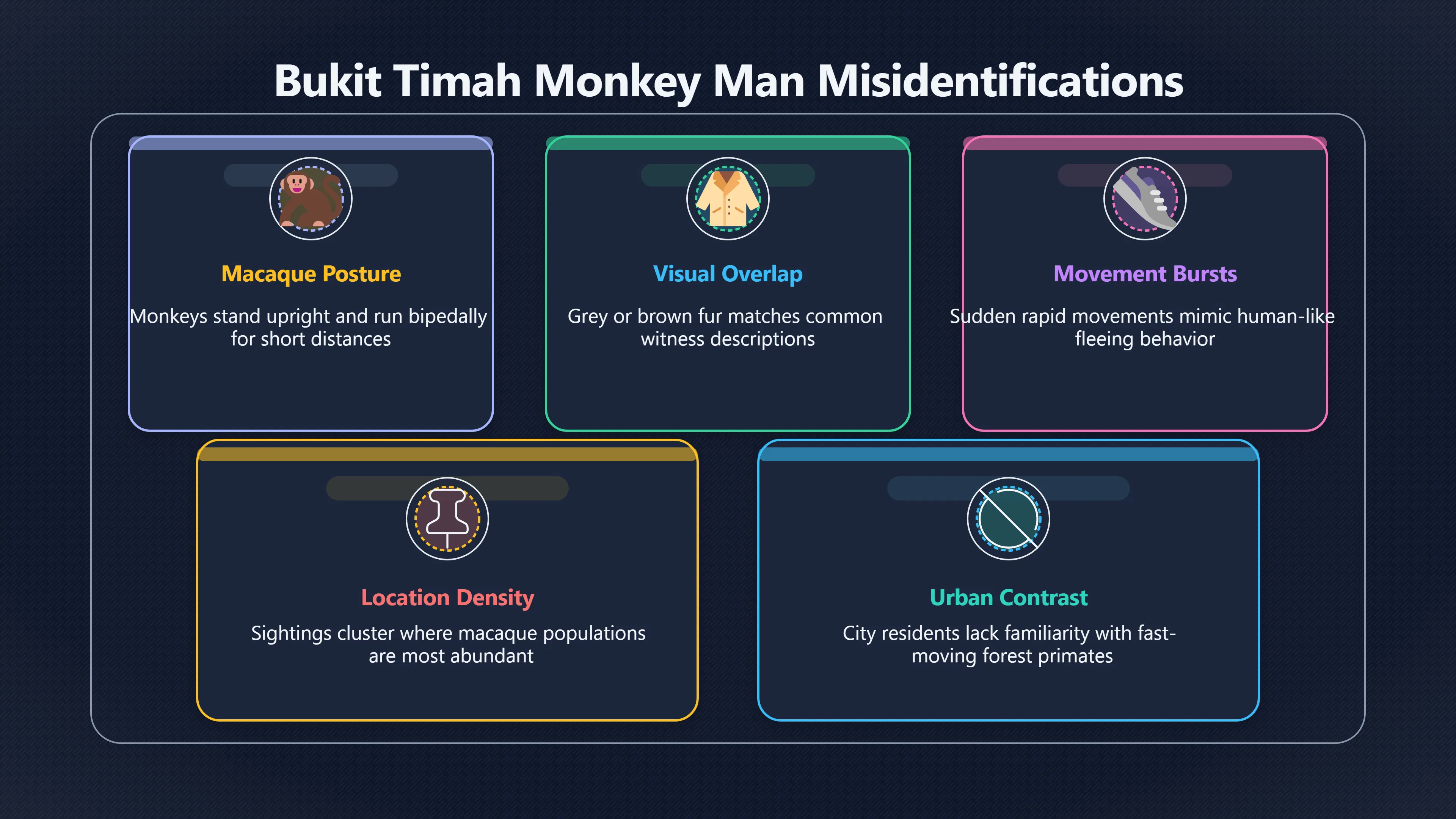
Although usually moving on all fours, macaques can stand upright, run bipedally for short distances and adopt surprisingly human-like poses. A monkey carrying food, climbing a slope or crossing a road can briefly resemble a small hairy person, particularly when seen from a distance. Reserve officials cited macaque misidentification as a likely explanation when journalists investigated Monkey Man rumours.[Wikipedia]WikipediaBukit Timah Monkey ManBukit Timah Monkey Man
Several features of Monkey Man descriptions overlap with macaque behaviour:
- A monkey-like face.
- Grey or brown fur.
- Sudden bursts of movement.
- Brief upright posture.
- Sightings concentrated in areas where macaques are abundant.[wikipedia.org]WikipediaBukit Timah Monkey ManBukit Timah Monkey Man
Human perception studies in Singapore also show that macaques regularly attract strong reactions from people, especially when encounters are unexpected. Familiarity with the species varies greatly, meaning some observers may misjudge their size or behaviour.[PMC]pmc.ncbi.nlm.nih.govHuman behavior is largely responsible for macaque-to-humanMacaque–Human Interactions and the Societal Perceptions of…by JCMUN SHA · 2009 · Cited by 155 — Our results show that human–macaque…

Colugos and Unfamiliar Night-Time Shapes
If macaques explain many daylight reports, the Malayan colugo may account for some of the stranger nocturnal impressions.
Colugos are often called “flying lemurs”, although they are neither true lemurs nor capable of powered flight. They glide between trees using a broad membrane that stretches between their limbs and tail. Bukit Timah is one of Singapore’s best-known places to see them.[Wikipedia]WikipediaBukit Timah Nature ReserveBukit Timah Nature Reserve
By day, a resting colugo can appear like a shapeless lump of bark attached to a tree trunk. At night, however, it becomes active. A large animal suddenly launching itself from a tree and silently gliding through darkness can be startling even when correctly identified.[iPackTravel]ipacktravel.comflying lemurs bukit timah nature reserveFlying Lemurs of Bukit Timah Nature Reserve21 Jun 2017 — The colugos are nocturnal animals and usually feed and move around at…
Several characteristics make colugos unusually easy to misinterpret:
- Large reflective eyes visible in torchlight.
- A broad gliding membrane that alters their outline.
- Nocturnal habits that limit clear observation.
- Unexpected appearances high in the forest canopy.
- Awkward, almost creature-like movements when climbing.[iPackTravel]ipacktravel.comflying lemurs bukit timah nature reserveFlying Lemurs of Bukit Timah Nature Reserve21 Jun 2017 — The colugos are nocturnal animals and usually feed and move around at…
A witness who catches only a silhouette or brief movement may remember something far larger or stranger than the actual animal.
Why Forest Conditions Distort Size and Movement
The environment of Bukit Timah may be just as important as the animals themselves.
Dense tropical vegetation breaks up sightlines and makes distance difficult to judge. A macaque standing on a fallen log or raised embankment can seem much taller than it really is. Shadows, tangled roots and overlapping foliage create visual patterns that encourage misinterpretation.[Wikipedia]WikipediaBukit Timah Nature ReserveBukit Timah Nature Reserve
Night-time conditions amplify these effects. Human vision relies heavily on pattern recognition, and in darkness people often identify shapes before they identify details. A moving animal can therefore register first as a vaguely human figure and only later as wildlife.
The reserve also sits within a highly urbanised city. Many visitors are not experienced forest observers. Someone who regularly encounters pigeons, cats and urban wildlife may react very differently when faced with a fast-moving primate or nocturnal mammal in dense rainforest. The rarity of the experience can make it seem extraordinary.[Wikipedia]WikipediaWildlife of SingaporeWildlife of Singapore
Rare Animals and the Power of Surprise
Not every unusual sighting in Bukit Timah has to involve common macaques. The forest contains a range of less familiar mammals, and wildlife movement between Bukit Timah and the Central Catchment has increased through habitat connections such as the Eco-Link@BKE. Animals including pangolins, mouse deer and other forest species have been recorded moving through these linked habitats.[Wikipedia]WikipediaOpen source on wikipedia.org.
A person who unexpectedly encounters an uncommon animal may struggle to identify it correctly. History shows that many monster stories around the world begin with genuine observations of real but unfamiliar wildlife. In Bukit Timah, the mystery is less about a lack of animals and more about the surprising variety of creatures living in a small patch of forest surrounded by a modern city.
Why the Misidentification Theory Remains Strong
The Monkey Man legend survives because it sits in a believable setting: a fragment of ancient rainforest where unusual encounters genuinely occur. Yet the evidence for an unknown primate remains extremely thin. No specimen, verified photograph, track series or physical trace has emerged despite decades of stories. By contrast, the reserve is known to contain animals whose appearance and behaviour overlap with witness descriptions.[Wikipedia]WikipediaBukit Timah Monkey ManBukit Timah Monkey Man
For that reason, wildlife misidentification remains the leading explanation for Bukit Timah’s monster reports. Long-tailed macaques provide the closest match to the classic upright “Monkey Man”, while nocturnal animals such as colugos demonstrate how easily unfamiliar shapes can become something mysterious in the imagination. The legend may be about a monster, but its most convincing roots lie in the very real wildlife of Singapore’s last great rainforest.[wikipedia.org]WikipediaBukit Timah Monkey ManBukit Timah Monkey Man
Amazon book picks
Further Reading
Books and field guides related to Which Animals Could Explain Monkey Man Sightings?. Use these as the next step if you want deeper reading beyond the article.
A Naturalist's Guide to the Mammals of Southeast Asia 3/e
Identifies macaques, colugos and other relevant mammals.
eBay marketplace picks
Marketplace Samples
Live-tested eBay searches with available results related to this page.




Endnotes
1.
Source: Wikipedia
Title: Bukit Timah Monkey Man
Link:https://en.wikipedia.org/wiki/Bukit_Timah_Monkey_Man
2.
Source: Wikipedia
Title: Bukit Timah Nature Reserve
Link:https://en.wikipedia.org/wiki/Bukit_Timah_Nature_Reserve
3.
Source: Wikipedia
Title: Central Catchment Nature Reserve
Link:https://en.wikipedia.org/wiki/Central_Catchment_Nature_Reserve
4.
Source: pmc.ncbi.nlm.nih.gov
Title: Human behavior is largely responsible for macaque-to-human
Link:https://pmc.ncbi.nlm.nih.gov/articles/PMC4487983/
Source snippet
Macaque–Human Interactions and the Societal Perceptions of...by JCMUN SHA · 2009 · Cited by 155 — Our results show that human–macaque...
5.
Source: ipacktravel.com
Title: flying lemurs bukit timah nature reserve
Link:https://www.ipacktravel.com/post/flying-lemurs-bukit-timah-nature-reserve
Source snippet
Flying Lemurs of Bukit Timah Nature Reserve21 Jun 2017 — The colugos are nocturnal animals and usually feed and move around at...
6.
Source: Wikipedia
Title: Wildlife of Singapore
Link:https://en.wikipedia.org/wiki/Wildlife_of_Singapore
7.
Source: Wikipedia
Link:https://en.wikipedia.org/wiki/Eco-Link%40BKE
8.
Source: nparks.gov.sg
Title: Default Macaca fascicularis
Link:https://www.nparks.gov.sg/florafaunaweb/fauna/4/7/475
Source snippet
DefaultMacaca fascicularis - SingaporeCommon Name: Long-tailed Macaque, Crab-eating. Found in forest and adjacent parkland. In Singapore...
9.
Source: mammalwatching.com
Title: one day in singapore
Link:https://www.mammalwatching.com/community-post/one-day-in-singapore/
Source snippet
Mammal WatchingOne Day in Singapore2 May 2025 — Long-tailed Macaque. Common in most nature parks. Many seen at Bukit Timah Nature Reserve...
Published: May 2025
10.
Source: ecologyasia.com
Title: Bukit Timah Nature Reserve
Link:https://www.ecologyasia.com/html-loc/bukit-timah.htm
11.
Source: cryptidz.fandom.com
Title: Bukit Timah Monkey Man
Link:https://cryptidz.fandom.com/wiki/Bukit_Timah_Monkey_Man
12.
Source: cryptidnomi.com
Title: Bukit Timah Monkey Man
Link:https://cryptidnomi.com/entries/bukit-timah-monkey-man
Additional References
13.
Source: kontinentalist.com
Title: macaques are not dangerous or aggressive if we leave them alone
Link:https://kontinentalist.com/stories/macaques-are-not-dangerous-or-aggressive-if-we-leave-them-alone
Source snippet
More than monkey businessJul 29, 2022 — Most Singaporeans now know to keep their distance from the native long-tailed macaq...
14.
Source: youtube.com
Title: BUKIT TIMAH WILDLIFE SNAP ADVENTURE | Wildlife Snap! With Biogirl MJE13
Link:https://www.youtube.com/watch?v=SjXfbw1iBSg
Source snippet
We Finally Solved The Loch Ness Monster Mystery...
15.
Source: bloodandporridge.co.uk
Link:https://bloodandporridge.co.uk/wp/tag/bukit-timah-monkey-man/
Source snippet
Blood and PorridgeBukit Timah Monkey Man – Blood and PorridgeJul 6, 2023 — It's assumed that people have seen the real monkeys in poor vi...
16.
Source: youtube.com
Title: The Big Foot of the East? The Monkey Man of Bukit Timah, Singapore
Link:https://www.youtube.com/watch?v=tNnpKNbtbN8
Source snippet
Lost in Bukit Timah: A Tale of the Monkey Man...
17.
Source: facebook.com
Link:https://www.facebook.com/ChannelNewsAsia/posts/heard-of-the-bukit-timah-monkey-man-if-you-thought-you-saw-the-mystery-monster-r/10155241923477934/
18.
Source: instagram.com
Link:https://www.instagram.com/reel/C6duPIvyZ9w/
19.
Source: instagram.com
Link:https://www.instagram.com/p/DZpcRZII383/
20.
Source: janegoodall.org.sg
Link:https://janegoodall.org.sg/our-programmes-and-campaigns/wildlife-environment/long-tailed-macaque/
21.
Source: reddit.com
Link:https://www.reddit.com/r/singapore/comments/1mmxbe2/til_the_bukit_timah_monkey_man_commonly/
22.
Source: youtube.com
Title: NOT A HOAX. This Is A Predator!
Link:https://www.youtube.com/watch?v=3CWGLXQkoQE
Source snippet
BUKIT TIMAH WILDLIFE SNAP ADVENTURE | Wildlife Snap! With Biogirl MJE13...
Topic Tree