Where Lithuania's Monsters Cross the Threshold
Lithuania is not best understood as a country of headline-grabbing modern cryptid hunts. Its strongest “mystery creature” tradition sits deeper: in serpent husbands, household fire-dragons, werewolves, bogey-beasts, water spirits and forest figures preserved through folklore rather than police reports, blurry photographs or organised expeditions.
Page outline Jump by section
Introduction
For cryptid-minded readers, the practical answer is clear: Lithuania has rich creature folklore, but little credible evidence for a hidden unknown animal comparable to the Loch Ness Monster. Its most important cases are cultural rather than zoological: the serpent king of “Eglė the Queen of Serpents”, the flying treasure-bringing Aitvaras, werewolves recorded in belief legends, and child-frightening or household spirits such as Baubas. These stories are still visible in public culture, from literary retellings to the oak-carved creatures of the Hill of Witches in Juodkrantė.[Lietuvos Radijas ir Televizija]lrt.ltOpen source on lrt.lt.
What creature stories define Lithuania?
Lithuanian monster lore is unusually animal-shaped. Snakes, wolves, birds, dragons, seals, bears and shadowy domestic beings appear not as one-off curiosities, but as figures that explain danger, luck, kinship, greed, weather, water and village suspicion. That makes Lithuania a strong folklore country and a weaker modern cryptid country: the evidence base is mostly collected oral tradition, literary publication, museum interpretation and local tourism, not sustained contemporary sighting files.
The most important creature strands are:
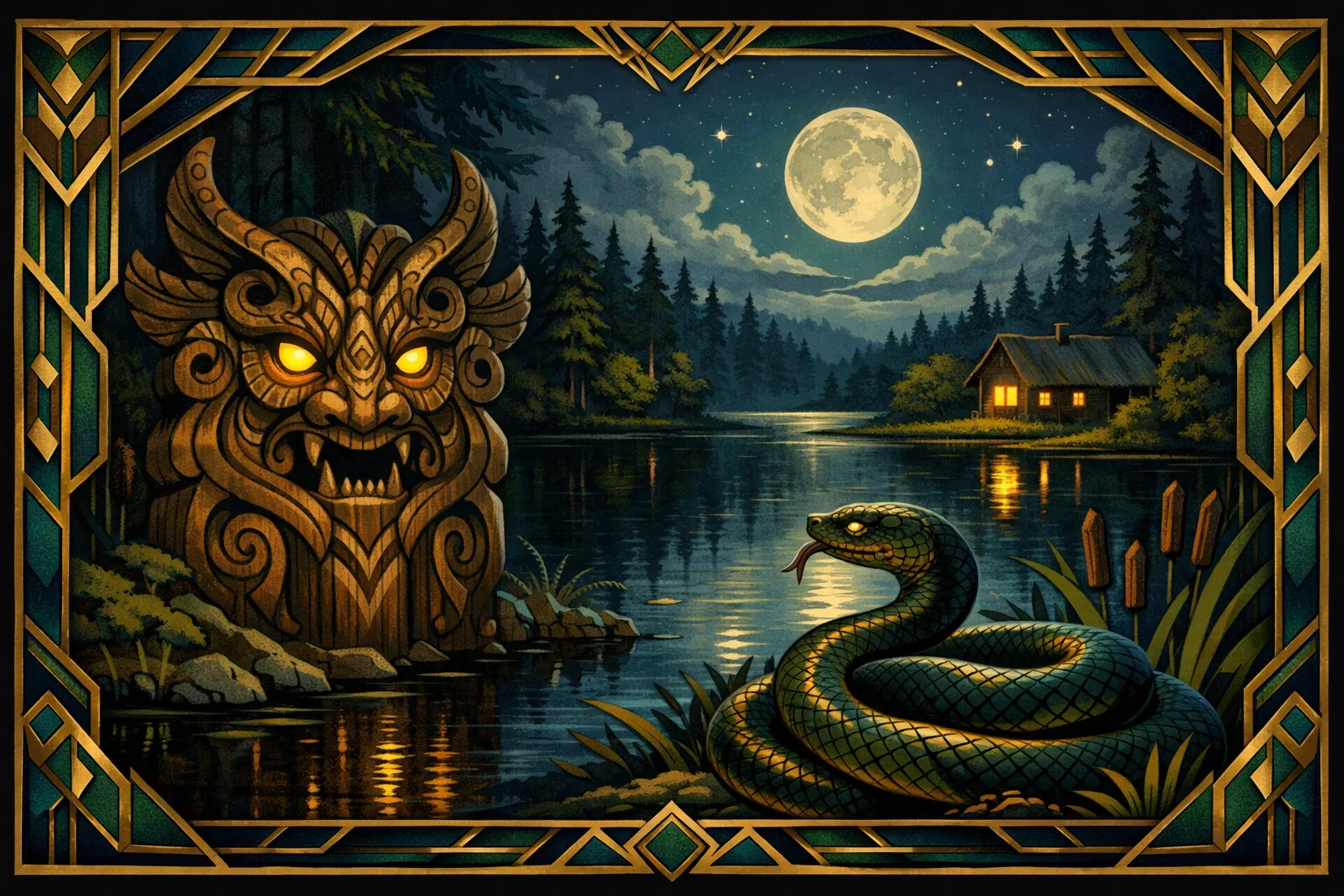
The serpent husband and water-world ruler. “Eglė the Queen of Serpents” is the best-known Lithuanian creature tale. In its familiar shape, a young woman encounters a serpent after bathing, marries him, lives in an underwater realm and eventually suffers a tragic break between her human family and her animal husband. Modern Lithuanian commentary treats the tale as unusually sympathetic to the animal bridegroom, not merely as a monster to be defeated.[Lietuvos Radijas ir Televizija]lrt.ltOpen source on lrt.lt.
Aitvaras, the flying house-spirit. The Aitvaras is often described as a fiery or shape-changing being linked with wealth, theft and household fortune. Public folklore displays and popular summaries variously present it as a rooster-like creature, serpent, dragon, spark, piece of charcoal or other uncanny form, which is typical of a being that belongs more to belief legend than biological description.[Lithuanian World Center]lcenter.orgspotlight on lithuanian culture chapter 6 mythical creaturesspotlight on lithuanian culture chapter 6 mythical creatures
Werewolves and wolf-men. Lithuanian werewolf material is not just imported Halloween imagery. A scholarly summary of Lithuanian folklore sources reports more than 350 werewolf narratives in the Lithuanian Folklore Archives, mostly classified as belief legends, with many nineteenth- and twentieth-century accounts reflecting village beliefs, memories and suspicions rather than eyewitness zoology.[Academia]academia.eduWerewolves in Lithuanian Folklore Sources of the EndWerewolves in Lithuanian Folklore Sources of the End
Bogey-beasts and child-threatening figures. Lithuanian folklore includes beings used to warn children away from dangerous places or bad behaviour. Research on child-threatening mythical creatures in Lithuanian tradition distinguishes between real threats perceived by adults and constructed threats expressed through mythical figures, making these monsters part of everyday social teaching as much as supernatural entertainment.[Academy's Library Repository]real.mtak.huAcademy's Library Repository Child-threatening Mythical Creatures in TraditionalAcademy's Library Repository Child-threatening Mythical Creatures in Traditional
Why the serpent queen matters more than any lake monster
The closest Lithuania comes to a nationally famous aquatic monster tradition is not a modern “lake beast” but the serpent world of “Eglė the Queen of Serpents”. That distinction matters. A lake monster is usually framed as an animal claim: something large, physical and hidden in water. Eglė’s serpent belongs to a different category: he is an otherworldly spouse, a ruler, a test of loyalty and a bridge between human and non-human worlds.
The tale has been interpreted as one of Lithuania’s central cultural narratives. LRT, Lithuania’s public broadcaster, presents recent discussion of the story as a window into European prehistory, Baltic myth and the “feminine mystery”, while the Bank of Lithuania’s commemorative material for an Eglė coin describes the serpent in old religions as a supernatural being or deity that should not be killed.[Lietuvos Radijas ir Televizija]lrt.ltOpen source on lrt.lt.
For cryptid history, this means the serpent should not be flattened into a claim about a real oversized snake. Lithuania does have real snakes, and the grass snake has strong symbolic importance in Baltic tradition, but the Eglė story is about transformation, taboo, kinship and betrayal. Its creature is “evidence” of a worldview, not evidence of an undiscovered reptile.
The story also explains why Lithuanian monster lore often feels emotionally different from simple monster-slaying tales. The serpent husband is frightening, but he is not merely evil. The violence comes from the breakdown between communities: Eglė’s human relatives cannot accept the non-human spouse, and the result is tragedy rather than heroic victory. That makes the tale especially useful for understanding Lithuania’s wider creature tradition: monsters are often neighbours, spouses, helpers, workers or suspected villagers before they are enemies.
Werewolves: the strongest Lithuanian “cryptid-like” archive
If a cryptid is a creature people claim to encounter, fear or identify in the real world, Lithuanian werewolf legends are the country’s most important historical candidate. They are not evidence for literal wolf-people, but they are evidence for a long-running belief tradition in which humans could become wolves, be changed into wolves, or be suspected of wolfish double lives.
The strongest modern summary is cautious. It reports that Lithuanian folklore archives contain about 350 werewolf narratives, but also notes that by the first half of the twentieth century many accounts had become memories of older beliefs rather than direct claims of seeing a werewolf. It also stresses the social function of the stories: suspicion that a neighbour might be a werewolf could reflect village tensions and questions of trust.[Academia]academia.eduWerewolves in Lithuanian Folklore Sources of the EndWerewolves in Lithuanian Folklore Sources of the End
That makes Lithuanian werewolf lore valuable in three ways:
- As creature folklore: it keeps the wolf at the centre of fear, respect and transformation.
- As social evidence: it shows how monster beliefs could attach to real people in rural communities.
- As ecological imagination: it reflects life in a landscape where wolves were not abstract symbols but known predators.
The natural context still matters. Wolves and lynx are real parts of Lithuania’s wider ecological setting: EU material on large carnivores places wolves across all monitored European countries and tracks lynx recovery in Europe, while Lithuania’s own environmental guidance identifies wolves and lynx as among the few natural enemies of certain invasive mammals.[Environment]environment.ec.europa.euEnvironment Large carnivore populations across EuropeEnvironment Large carnivore populations across Europe
A sceptical reading does not make the werewolf stories dull. It makes them more human. In a village world of livestock losses, forest edges, winter travel and neighbourly grudges, “werewolf” could work as a frightening explanation, a moral accusation and a memorable story all at once.
Aitvaras and the household monster that brings stolen luck
Aitvaras is one of Lithuania’s most cryptid-friendly mythical beings because it is visual, mobile and contradictory. It may appear as a fiery-tailed bird, a rooster, a serpent, a dragon-like form, a spark or even an object. It brings wealth, but the wealth is often morally suspect because it may be stolen. It helps the household, but can also bring trouble.
That ambiguity is exactly what keeps it interesting. Unlike a lake monster, Aitvaras does not belong to one body of water or one remote forest. It belongs to the economy of the home: barns, grain, money, luck, envy and greed. A Lithuanian Culture Centre summary describes Aitvaras as a being linked with water, atmosphere, clouds and earthly riches, while the Hill of Witches sculpture guide presents it as a magical Lithuanian creature capable of taking several forms.[Lithuanian World Center]lcenter.orgspotlight on lithuanian culture chapter 6 mythical creaturesspotlight on lithuanian culture chapter 6 mythical creatures
For a modern reader, Aitvaras is best read as a folklore explanation for sudden prosperity and uneasy fortune. If one family’s granary seemed mysteriously full while another’s was empty, a story about a secret spirit bringing stolen goods made wealth feel both magical and morally dangerous. The “monster” is not simply outside the house; it is implicated in the household’s success.
That gives Aitvaras an afterlife that a purely zoological cryptid could not easily have. It can be carved, illustrated, performed, reimagined in fantasy art and used as a symbol of Lithuanian myth without needing anyone to prove that fiery roosters are physically flying over the countryside.
Where Lithuanian monster lore clusters
Lithuania’s creature traditions cluster around places where ordinary life meets uncertainty: water, forest, field, home and borderland. These are not random settings. They are the places where people historically faced drowning, storms, wolves, crop failure, darkness, illness, poverty and social mistrust.
Water is the most symbolically loaded setting. Eglė’s serpent realm lies beyond the ordinary human shore, while Lithuanian lists of mythological figures include spirits associated with lakes and rivers. Water in these stories is not just scenery; it is a threshold. It can hide a spouse, a palace, a danger or a rule that humans do not fully understand.[Wikipedia]WikipediaList of Lithuanian gods and mythological figuresList of Lithuanian gods and mythological figures
Forests and fields produce a different kind of monster. Wolves, werewolves, devils, witches and field spirits belong to places where work, travel and danger overlap. In agrarian folklore, a rustling crop, a night sound or a missing animal could invite explanation through spirits as well as through ordinary wildlife. The broader study of animal folktales supports this kind of reading: animal stories often encode folk knowledge about predator-prey relationships and the behaviour of wild and domestic animals.[arXiv]arxiv.orgOpen source on arxiv.org.
The home is the third great setting. Aitvaras, Baubas and other household figures bring monster lore indoors. That is important because it prevents Lithuanian creature tradition from being only a wilderness tradition. The uncanny can live under the roof, in the dark corner, near the child’s bed or around the stores of grain.
Why Lithuania has few modern lake-monster claims
Lithuania has lakes, lagoons, rivers, wetlands and a Baltic coastline, so a reader might expect a catalogue of Nessie-style reports. The evidence does not really support that. Fresh searches for Lithuanian lake monsters turn up little that is robust, local and well documented; the strongest aquatic creature tradition remains mythic-serpentine rather than modern cryptozoological.
There are good reasons for this. Lithuania’s best-known water creature story was already culturally powerful without needing to become a camera-age monster hunt. Eglė’s serpent explains the water as a supernatural kingdom, not as a hiding place for a surviving prehistoric animal. That leaves less cultural space for a modern “unknown beast in the lake” narrative to dominate.
The real Baltic environment also encourages more ordinary explanations for many strange coastal or water sightings. The Baltic Sea is a young, semi-enclosed brackish sea under heavy ecological pressure, and grey seals are real, charismatic animals in the region. The European Commission describes the Baltic as one of the world’s largest brackish waters, while marine and rescue sources document grey seals in the Baltic and Lithuania’s rehabilitation work for injured or young seals.[europa.eu]oceans-and-fisheries.ec.europa.euOceans and fisheries Baltic SeaOceans and fisheries Baltic Sea
A seal seen briefly at distance, especially by an unprepared observer, can look strange without being unknown. The same applies to large fish, swimming mammals, floating logs, waves, birds in low light or groups of animals surfacing together. Sceptical explanation does not erase the story; it helps sort folklore, misidentification and actual wildlife into different boxes.
Tourism and pop culture keep the creatures visible
Lithuanian monster lore is not locked away in archives. It is public, walkable and highly visual. The best example is the Hill of Witches in Juodkrantė on the Curonian Spit, where Lithuania Travel describes more than 80 oak-carved figures from Lithuanian legends, including demons, witches and things that “go bump in the night”.[Lithuania Travel]lithuania.travelOpen source on lithuania.travel.
The Hill of Witches matters because it turns folklore into a creature trail. Visitors do not need to read a specialist archive to meet devils, witches, legendary beings and carved monsters in a forest setting. The Neringa museum page similarly describes the site as a unique wooden sculpture museum where devils, witches and other folklore characters “reign supreme”.[neringosmuziejai.lt]neringosmuziejai.ltOpen source on neringosmuziejai.lt.
This public afterlife changes the creatures. A being like Aitvaras becomes not only a belief figure but a sculpture, a tourist image and a family-friendly encounter. A serpent queen becomes not only a folktale but a subject for coins, essays, retellings and national cultural reflection. A werewolf becomes less a neighbourly accusation and more a historical monster motif.
That shift is common in modern folklore tourism. Dangerous beings become safe to visit. Local fears become heritage. The monster moves from testimony to trail map.
What a sceptical reader should conclude
The best evidence for Lithuanian cryptids is evidence of tradition, not evidence of undiscovered animals. There is no strong mainstream case for a hidden Lithuanian lake monster, ape-like beast, surviving sea serpent or phantom big cat population. What Lithuania offers instead is a dense creature ecology of stories: serpents who marry, wolves who may be human, fiery beings who bring stolen wealth, spirits who frighten children and carved monsters who now welcome tourists.
That does not make the topic weaker. It makes it clearer. Lithuania’s monster lore is strongest when treated as folklore with real cultural roots and real social functions. The serpent queen speaks to kinship, taboo and the sacred status of animals. Werewolves speak to fear, suspicion and the closeness of human and predator worlds. Aitvaras speaks to wealth, envy and household luck. Baubas and other child-frightening beings speak to danger, discipline and the dark corners of domestic life.
For cryptid history, Lithuania is therefore a useful corrective to monster-hunting habits. Not every country’s mystery-beast tradition is built from modern sightings. Some are built from older questions: what lives under the water, what crosses the forest edge, what enters the house at night, and what happens when the animal world looks back like kin?
Amazon book picks
Further Reading
No matched book cards were available for Where Lithuania's Monsters Cross the Threshold, so this fallback keeps a direct Amazon reading path visible.
Topical books
Lithuanian folklore geography guide
Browse books, explainers and reference titles related to this topic.
Search AmazonRelated search
Lithuanian folklore guide
Browse books, explainers and reference titles related to this topic.
Search AmazonRelated search
Baltic prehistory books
Browse books, explainers and reference titles related to this topic.
Search AmazonEndnotes
1.
Source: lrt.lt
Link:https://www.lrt.lt/en/news-in-english/19/2651262/egle-the-queen-of-serpents-european-prehistory-and-the-unveiling-of-the-feminine-mystery?srsltid=AfmBOoplJe-iXlUoxxU3_6FIDXKrFiJIgaGHu9khGFFkUXDU2nc3QUw2
2.
Source: lithuania.travel
Link:https://lithuania.travel/en/why-lithuania/culture-and-heritage/culture-and-art/museums/open-air-museums/hill-of-witches
3.
Source: academia.edu
Title: Werewolves in Lithuanian Folklore Sources of the End
Link:https://www.academia.edu/113746951/Werewolves_in_Lithuanian_Folklore_Sources_of_the_End_of_the_Nineteenth_and_Twentieth_Centuries
4.
Source: environment.ec.europa.eu
Title: Environment Large carnivore populations across Europe
Link:https://environment.ec.europa.eu/topics/nature-and-biodiversity/habitats-directive/large-carnivores/large-carnivore-populations-across-europe_en
5.
Source: Wikipedia
Title: List of Lithuanian gods and mythological figures
Link:https://en.wikipedia.org/wiki/List_of_Lithuanian_gods_and_mythological_figures
6.
Source: arxiv.org
Link:https://arxiv.org/abs/1907.03969
7.
Source: oceans-and-fisheries.ec.europa.eu
Title: Oceans and fisheries Baltic Sea
Link:https://oceans-and-fisheries.ec.europa.eu/coastal-communities/sea-basins/baltic-sea_en
8.
Source: emsa.europa.eu
Title: Baltic Sea Animal Rehabilitation Centre [Lithuania]
Link:https://www.emsa.europa.eu/outreach-and-awareness-raising/item/5189-baltic-sea-animal-rehabilitation-centre-lithuania.html
9.
Source: neringosmuziejai.lt
Link:https://www.neringosmuziejai.lt/en/hill-of-witches/
10.
Source: Wikipedia
Title: Eglė the Queen of Serpents
Link:https://en.wikipedia.org/wiki/Egl%C4%97_the_Queen_of_Serpents
11.
Source: Wikipedia
Link:https://en.wikipedia.org/wiki/Lietuv%C4%93ns
12.
Source: Wikipedia
Title: Slavic dragon
Link:https://en.wikipedia.org/wiki/Slavic_dragon
13.
Source: Wikipedia
Title: Lake monster
Link:https://en.wikipedia.org/wiki/Lake_monster
14.
Source: Wikipedia
Link:https://en.wikipedia.org/wiki/Werewolf
15.
Source: Wikipedia
Link:https://en.wikipedia.org/wiki/Aitvaras
16.
Source: Wikipedia
Title: Loch Ness Monster
Link:https://en.wikipedia.org/wiki/Loch_Ness_Monster
17.
Source: Wikipedia
Title: Lithuanian mythology
Link:https://en.wikipedia.org/wiki/Lithuanian_mythology
18.
Source: Wikipedia
Title: Hill of Witches
Link:https://en.wikipedia.org/wiki/Hill_of_Witches
19.
Source: wolf.org
Link:https://wolf.org/wow/europe/lithuania/
20.
Source: werewolves.com
Title: the vilkacis
Link:https://www.werewolves.com/the-vilkacis/
21.
Source: unknown.lt
Link:https://www.unknown.lt/en/location/hill-of-witches
22.
Source: lrt.lt
Link:https://www.lrt.lt/en/news-in-english/19/2651262/egle-the-queen-of-serpents-european-prehistory-and-the-unveiling-of-the-feminine-mystery?srsltid=AfmBOopZCLTA2tISbrJoCDiFEFmTX0pG2V0NbnOZSaxtYhMnXHk1SWOb
23.
Source: archive.org
Link:https://archive.org/details/lithuanianfolkta0000unse
24.
Source: ia600809.us.archive.org
Link:https://ia600809.us.archive.org/21/items/algirdas-j.-greimas-of-gods-and-men-studies-in-lithuanian-mythology-midland-book/Algirdas%20J.%20Greimas%20-%20Of%20Gods%20and%20Men_%20Studies%20in%20Lithuanian%20Mythology%20%28Midland%20Book%29-Indiana%20University%20Press%20%281992%29.pdf
25.
Source: youtube.com
Title: Grand Duke Gediminas: The Founding of Medieval Lithuania’s capital Vilnius
Link:https://www.youtube.com/watch?v=2vDGJV7Qav8
Source snippet
The Hill of Witches - Juodkranté - Lithuania...
26.
Source: youtube.com
Title: The Hill of Witches
Link:https://www.youtube.com/watch?v=-ubQlO3r6vw
Source snippet
The Baltic Review...
27.
Source: tautosakos-rankrastynas.lt
Link:https://www.tautosakos-rankrastynas.lt/en/
28.
Source: lcenter.org
Title: spotlight on lithuanian culture chapter 6 mythical creatures
Link:https://www.lcenter.org/spotlight-on-lithuanian-culture-chapter-6-mythical-creatures/
29.
Source: real.mtak.hu
Title: Academy’s Library Repository Child-threatening Mythical Creatures in Traditional
Link:https://real.mtak.hu/128222/1/article-p425.pdf
30.
Source: cryptidz.fandom.com
Title: Lake Monsters
Link:https://cryptidz.fandom.com/wiki/Lake_Monsters
31.
Source: warriorsofmyth.fandom.com
Link:https://warriorsofmyth.fandom.com/wiki/Aitvaras
32.
Source: traditionarchives.org
Link:https://www.traditionarchives.org/archives/lithuania
33.
Source: blackdrago.com
Link:https://www.blackdrago.com/species/aitvaras.htm
34.
Source: instagram.com
Link:https://www.instagram.com/reel/DXdmYSGzALR/
35.
Source: tripadvisor.com
Title: Hill of Witches
Link:https://www.tripadvisor.com/Attraction_Review-g1167917-d4353033-Reviews-Hill_of_Witches-Juodkrante_Neringa_Klaipeda_County.html
36.
Source: europeisnotdead.com
Link:https://europeisnotdead.com/lithuania-egle-the-queen-of-serpents/
37.
Source: atlasobscura.com
Title: hill of witches
Link:https://www.atlasobscura.com/places/hill-of-witches
Additional References
38.
Source: youtube.com
Link:https://www.youtube.com/watch?v=E9TS39kSWOM
Source snippet
Grand Duke Gediminas: The Founding of Medieval Lithuania's capital Vilnius...
39.
Source: youtube.com
Title: LITHUANIAN MYTHOLOGY is this dark?!
Link:https://www.youtube.com/watch?v=rYQRklboLlE
Source snippet
ANIMACINIS FILMAS "LIETUVIŲ MITOLOGINĖS BŪTYBĖS"- “ LITHUANIAN MYTHOLOGICAL BEINGS”...
40.
Source: raganukalnas.lt
Link:https://www.raganukalnas.lt/en/sculptures/-aitvarai-a-magic-creatures-of-lithuanian-mythology-/67
41.
Source: instagram.com
Link:https://www.instagram.com/reel/DMGDkmgt8iG/
42.
Source: researchgate.net
Link:https://www.researchgate.net/publication/271529486_Potential_Masking_of_the_Baltic_Grey_Seal_Vocalisations_by_Underwater_Shipping_Noise_in_the_Lithuanian_Area_of_the_Baltic_Sea
43.
Source: researchgate.net
Link:https://www.researchgate.net/publication/398881483_The_Lake_and_Its_Monster_Communicating_Connections_with_Landscape_Belonging_and_Sense_of_Place_with_Great_Lake_Monster_Narratives
44.
Source: instagram.com
Link:https://www.instagram.com/p/Cg5mBoKucNt/
45.
Source: instagram.com
Link:https://www.instagram.com/p/DUs6bxIDCJr/
46.
Source: prussia.online
Link:https://prussia.online/Data/Book/an/ancient-symbolism-in-lithuanian-folk-art/Gimbutas%20M.%20Ancient%20Symbolism%20in%20Lithuanian%20Folk%20Art%20%281958%29%20archive.org%2C%20OCR.pdf
47.
Source: reddit.com
Link:https://www.reddit.com/r/BalticStates/comments/13eq8bs/are_there_any_cryptids_that_live_in_your_country/
Amazon book picks
Further Reading
Books and field guides related to Where Lithuania's Monsters Cross the Threshold. Use these as the next step if you want deeper reading beyond the article.
The World of Lore: Monstrous Creatures
Examines the cultural role of monsters and legendary creatures.
The Book of Imaginary Beings
Helps readers compare Lithuanian beings with world folklore.
Encyclopedia of Things that Never Were
Offers a broad survey of legendary beings akin to Lithuanian folklore creatures.
Topic Tree
Follow this branch
Related pages 192
- Antigua Cryptids
- Maldives Monsters
- Malta Monsters
- Qatar Monsters
- Argentina Monsters
- +187 more in sidebar