Cryptids of North Korea's Mountains
North Korea’s cryptid record is not a crowded cabinet of famous monsters. The country’s strongest mystery-animal tradition is concentrated around one dramatic place: Heaven Lake on Mount Paektu, the crater lake on the China–North Korea border.
Page outline Jump by section
Introduction
That makes North Korea an unusual cryptid case. Its most famous “monster” belongs partly to China, its most visible mythical beast is the winged horse Chollima in Pyongyang, and its most plausible mystery-beast background comes from the historical presence of tigers, leopards, bears, wolves, and other large animals in northern Korean forests. Modern reports are sparse, partly because independent fieldwork and local press access are limited.
The main claim: a monster in Heaven Lake
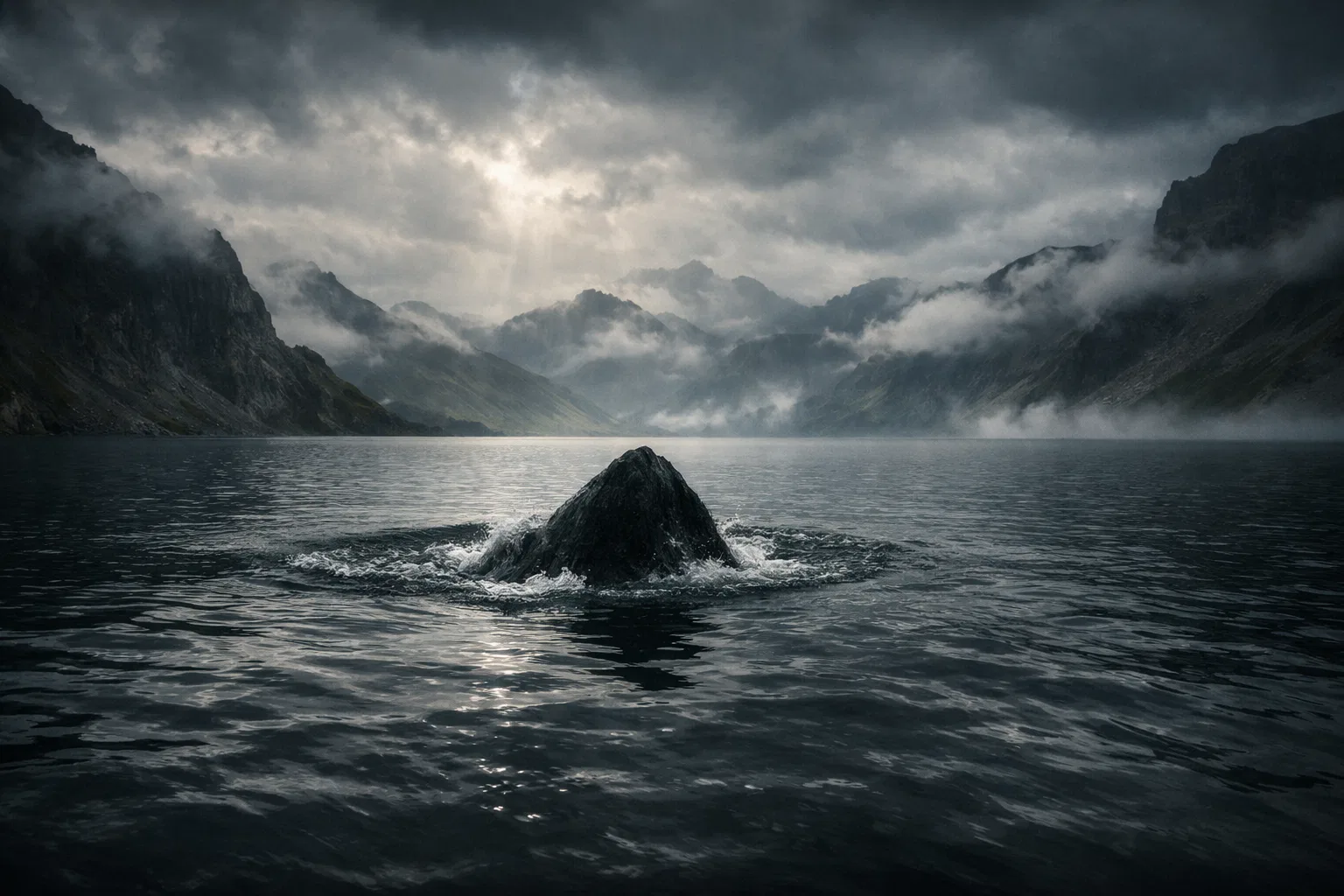
The creature most often linked to North Korea is the Lake Tianchi Monster, said to inhabit Heaven Lake at the summit of Mount Paektu. The lake lies in a volcanic caldera straddling Jilin Province in China and Ryanggang Province in North Korea, so the creature is often filed as both a Chinese and North Korean lake monster. UNESCO describes Mount Paektu as a volcanic landscape shaped by eruptions and glacial erosion, while its biosphere reserve entry places the mountain directly on the frontier with China.[UNESCO]unesco.orgOpen source on unesco.org.
The reports do not describe one consistent animal. Some accounts speak of a dark object disturbing the water; others describe several creatures swimming together; later retellings borrow the familiar language of “Nessie” and lake monsters. China Daily reported a 2005 claim in which a tourist said he saw and videotaped a strange black object emerging in the middle of the lake. In 2007, the same outlet reported that TV reporter Zhuo Yongsheng said he had filmed six “Lake Tianchi Monsters” near the border with the Democratic People’s Republic of Korea.[China Daily]chinadaily.com.cncontent 458959content 458959
The 2007 case is the best-known modern sighting because it offers the most concrete narrative: a named observer, a claimed 20-minute video, multiple creatures, and a border-lake setting already primed for mystery. China.org.cn’s report said Zhuo sent still pictures to Xinhua’s Jilin bureau and described six creatures moving in the water; the same source later carried an explanation suggesting that the photographed “monster” was probably connected to trout introduced into the lake decades earlier by North Korean researchers.[China.org.cn]china.org.cnOpen source on china.org.cn.
Why Paektu is perfect monster country
Heaven Lake has the ingredients that make lake-monster stories travel: deep water, harsh weather, a remote upland setting, a border location, and a powerful sacred reputation. The European Space Agency describes Mount Paektu as the highest mountain in the Changbai range and identifies Heaven Lake as one of the world’s highest crater lakes. UNESCO’s Global Geopark description stresses the mountain’s volcanic importance, and its biosphere reserve entry notes rare or at-risk animals in the wider reserve, including tiger, dhole and grey wolf.[esa.int]esa.intEuropean Space Agency ESAEuropean Space Agency ESA
The cultural weight matters as much as the geography. Mount Paektu is not just a mountain in North Korean public life; it is a national symbol. The Korea Economic Institute describes it as central to the Korean origin myth of Dangun, the legendary first Korean ancestor. North Korea also uses Paektu heavily in state symbolism around the Kim family, while UNESCO’s 2025 Global Geopark listing has added an international heritage frame to a place already surrounded by legend and politics.[Korea Economic Institute of America]keia.orgOpen source on keia.org.
For cryptid history, that symbolic charge does not prove a creature exists. It explains why ambiguous movement on the lake is more likely to become a story. A dark ripple on an ordinary reservoir may stay a ripple. A dark ripple on a sacred volcanic border lake becomes a candidate for a monster, a dragon, a sign, or a tourist tale.
What witnesses say they saw
The strongest English-language reports are clustered around Chinese-side tourism and media, not North Korean open reporting. That is important: the lake partly belongs to North Korea, but many accessible sightings are observed, reported, and circulated through Chinese outlets. The country-level link is still valid because the water and mountain cross the border, but the evidential trail is not primarily North Korean.
The recurring descriptions fall into several patterns:
- A dark object or head breaking the surface. The 2005 China Daily account described a strange black object emerging towards the centre of the lake and disturbing the calm water.[China Daily]chinadaily.com.cncontent 458959content 458959
- Several creatures moving together. The 2007 Zhuo Yongsheng report described six “Loch Ness-type” creatures or “monsters” in the lake near the DPRK border.[China Daily]chinadaily.com.cncontent 6092125content 6092125
- Dragon-like language. CGTN, in a 2020 feature, cited an older description of a golden monster with a basin-sized head, horns, a long neck and whiskers, interpreted by the observer as a dragon.[CGTN News]news.cgtn.comOpen source on cgtn.com.
- Modern viral footage. A 2023 tourist video was reported by several media outlets as showing a long silver or dark form in Lake Tianchi, though the reports did not establish a biological identification.[New York Post]nypost.commysterious 50 foot monster spotted in lake in chinamysterious 50 foot monster spotted in lake in china
The pattern is familiar from lake-monster traditions elsewhere. The creature changes shape from report to report: sometimes fish-like, sometimes seal-like, sometimes serpentine, sometimes dragonish. That instability does not make the stories worthless, but it does mean they should be treated as reports and interpretations, not as a stable zoological description.
The trout explanation and other sceptical readings
The most grounded explanation for the Tianchi monster is not a prehistoric survivor or an unknown lake mammal. It is misidentification: fish, waves, reflections, floating objects, birds, volcanic material, or ordinary lake effects seen at distance. China.org.cn reported in 2007 that the “monster” photographed by Zhuo Yongsheng was probably the mutated offspring of trout stocked by North Korea decades earlier, linking the mystery directly to a known animal introduction rather than a hidden species.[China.org.cn]china.org.cnOpen source on china.org.cn.
That trout theory is interesting because it sits halfway between debunking and folklore. It does not say witnesses saw nothing. It says they may have seen real fish in unusual conditions, then read them through the lens of a monster tradition. This is often how durable cryptid stories survive: they attach to repeatable natural triggers.
The lake’s environment also makes a large breeding population of unknown animals difficult to argue for. Heaven Lake is a high crater lake in a severe mountain climate, and Mount Paektu’s volcanic history is central to its geology. UNESCO’s Global Geopark entry frames the area as a landscape shaped by volcanic eruptions and glacial erosion, while the ESA identifies Heaven Lake as a high crater lake rather than an ordinary lowland ecosystem.[UNESCO]unesco.orgOpen source on unesco.org.
None of this proves every sighting has a single explanation. It does, however, set a high bar for claims of a large unknown resident animal. A sustainable population would need food, breeding numbers, ecological space, and repeated physical evidence. Publicly available reports have not supplied that.
North Korea’s folklore creatures are not cryptids in the strict sense
North Korea shares the broader Korean folklore world of dragons, goblin-like beings, mountain spirits, tiger legends, and supernatural animals. These are not cryptids in the modern mystery-animal sense unless someone is claiming a real, flesh-and-blood animal behind them. They matter because they shape how people imagine strange creatures in mountains, rivers and remote places.
The National Folk Museum of Korea’s English materials describe Dokkaebi as beings with extraordinary powers who enchant, tease or interact with humans, while the museum’s exhibition material places Dragon Gods and Dokkaebi among deities and beings tied to everyday wishes, livelihood and protection.[Folk Encyclopedia]folkency.nfm.go.krFolk Encyclopedia GoblinFolk Encyclopedia Goblin
Dragons are especially relevant to lake-monster interpretation. Korean dragon traditions are associated with water, rain, rivers, lakes and agriculture, rather than with the fire-breathing monsters of much European fantasy. That makes a dragon-like reading of a strange lake creature culturally legible, especially in a mountain crater lake with sacred status.[Wikipedia]WikipediaKorean dragonKorean dragon
This does not mean North Koreans, or Koreans more broadly, “believe in lake monsters” in a simple literal way. It means that inherited creature language gives witnesses and storytellers a ready-made vocabulary for ambiguous experiences: a strange water form can be a fish, a monster, a dragon sign, or a joke depending on context.
Chollima: North Korea’s most visible mythical animal
If the Heaven Lake creature is North Korea’s main cryptid-adjacent case, Chollima is its most visible legendary animal. Chollima is the “thousand-li horse”, a swift mythical horse found across East Asian tradition and adopted in North Korea as a symbol of speed, mobilisation and national reconstruction. In Pyongyang, the Chollima Statue on Mansu Hill shows the winged horse carrying a worker and a peasant, and tourist guides describe it as a central image of the post-war Chollima Movement.[Wikipedia]WikipediaOpen source on wikipedia.org.
Chollima is not normally a cryptid. No serious modern claim says a winged horse is roaming North Korean mountains. Its importance lies elsewhere: it shows how North Korea can turn a legendary creature into public art, political language and national identity. The mythical animal becomes a state symbol, not a mystery beast.
That distinction is useful for the whole country page. North Korea’s creature traditions often live in symbolism rather than eyewitness zoology. Chollima is remembered because it represents impossible speed. Paektu’s monster is remembered because a real lake produces ambiguous sightings. Tiger folklore survives because a real predator once shaped fear, art and mountain imagination.
Tigers, phantom predators and the real-animal background
For readers looking for “phantom cats” or mystery predators, North Korea’s most important background animal is the tiger. The Korean Peninsula was historically tiger country, and Korean art and folklore are full of tiger imagery. The National Museum of Korea notes that tiger paintings were used to ward off evil spirits from the early Joseon period, while other Korean heritage sources describe tigers as auspicious, protective, and deeply embedded in Korean visual culture.[국립중앙박물관]museum.go.krOpen source on go.kr.
The modern wildlife picture is much harder to confirm. UNESCO’s Mount Paektu Biosphere Reserve page lists tiger among rare or at-risk taxa in the reserve, and North Korea’s biodiversity planning documents have listed tiger, leopard, wolf, bear, otter, deer and goral among representative mammals.[UNESCO]unesco.orgMount PaektuMount Paektu
That does not mean there is a healthy confirmed tiger population in North Korea. Wildcat conservation sources describe the Amur tiger’s former range as including the Korean Peninsula, but say its status in North Korea is unknown and that few, if any, animals are likely to remain. The uncertainty itself is important: North Korea’s closed terrain makes verification difficult, and occasional cross-border movement from China or Russia would be possible in theory without creating a stable, well-documented population.[WildCats Conservation Alliance]conservewildcats.orgOpen source on conservewildcats.org.
This is where cryptid thinking and conservation reality overlap. A rumour of a giant striped animal in a northern forest could be folklore, misidentification, an old tiger memory, or a rare dispersing Amur tiger. The sober answer is not “monster”; it is “possible large carnivore claim needing physical evidence”.
Why there are so few modern North Korean monster flaps
North Korea is not like the United States, Britain or Japan, where local newspapers, amateur investigators, tourism boards and regional TV can turn a strange-animal sighting into a documented flap. The accessible public record is thinner. That does not necessarily mean people in North Korea do not tell strange stories. It means fewer stories enter searchable international media in a form that can be checked.
The lack of independent access also makes North Korea unusually vulnerable to exaggeration. A 2025 study on language models and North Korea warned that the country’s restricted information environment and the prevalence of sensational falsehoods make it a difficult subject for reliable public knowledge. That warning applies well to cryptid material: monster claims about North Korea should be handled with extra caution, especially when they appear only in unsourced social posts or recycled lists.[arXiv]arxiv.orgOpen source on arxiv.org.
Tourism adds another filter. Mount Paektu, Heaven Lake and the Chollima Statue are all visitor-facing symbols, and guides for North Korea travel regularly present Paektu and Chollima as major cultural sights. That tourist framing can preserve legends, but it can also simplify them into neat, exportable stories.[Koryo Tours]koryogroup.comlake chon north korea travel guidelake chon north korea travel guide
How to read North Korean cryptid claims
The best way to approach North Korean mystery-creature stories is to sort them into four categories.
Folklore creatures include dragons, Dokkaebi, mountain spirits and symbolic tigers. These belong to Korean cultural tradition and should not be treated as zoological claims unless a specific modern witness says they saw a physical animal. Museum sources place these beings within folk belief, protection, livelihood and storytelling rather than modern biology.[Folk Encyclopedia]folkency.nfm.go.krFolk Encyclopedia GoblinFolk Encyclopedia Goblin
Symbolic state creatures include Chollima. It is a mythical horse with political and cultural afterlives, especially through the Chollima Movement and the Pyongyang statue. It matters for North Korean creature culture, but not as an alleged hidden species.[Wikipedia]WikipediaOpen source on wikipedia.org.
Mystery-animal claims mainly centre on Heaven Lake. These are the closest thing to a North Korean cryptid tradition in the modern sense: recurring sightings, water-monster language, photographs or videos, and attempts at natural explanation. The strongest public cases remain unproven and are best read as lake-monster folklore attached to a real border lake.[China Daily]chinadaily.com.cncontent 458959content 458959
Plausible wildlife confusion covers tigers, leopards, bears, wolves, large fish and birds. North Korea’s northern mountains have real ecological depth, and the Paektu reserve is recognised for significant biodiversity. But rare wildlife should not be inflated into cryptids without tracks, photographs, carcasses, DNA or repeated independent observations.[UNESCO]unesco.orgMount PaektuMount Paektu
The takeaway: one border lake, many layers of legend
North Korea’s cryptid landscape is small but unusually layered. Heaven Lake gives the country a genuine lake-monster tradition, though most accessible reports come through Chinese media and remain unverified. Mount Paektu gives the story a sacred and political stage. Korean folklore supplies dragons, goblin-like beings and tiger guardians. North Korea’s modern state imagery adds Chollima, the winged horse of impossible speed. Real wildlife history adds the shadow of tigers and other large carnivores in northern forests.
The result is not a country full of confirmed monsters. It is a country where a few strong places and symbols do a lot of creature-making work. The evidence-aware reading is simple: Heaven Lake has a durable monster legend; Chollima is a national mythic emblem; tigers belong to both ecological memory and folklore; and modern North Korean cryptid claims need careful checking before they are treated as more than stories, sightings or misidentified animals.
Amazon book picks
Further Reading
Books and field guides related to What Monsters Haunt North Korea's Mountains?. Use these as the next step if you want deeper reading beyond the article.
Nothing to Envy
Provides cultural and social context for understanding modern North Korean narratives.
Korean Myths and Legends
Directly addresses the mythological background behind monster stories.
eBay marketplace picks
Marketplace Samples
Live-tested eBay searches with available results related to this page.


Endnotes
1.
Source: unesco.org
Link:https://www.unesco.org/en/iggp/mt-paektu-unesco-global-geopark
2.
Source: unesco.org
Title: Mount Paektu
Link:https://www.unesco.org/en/mab/mount-paektu
3.
Source: china.org.cn
Link:https://www.china.org.cn/english/China/223790.htm
4.
Source: china.org.cn
Link:https://www.china.org.cn/english/environment/232043.htm
5.
Source: esa.int
Title: European Space Agency ESA
Link:https://www.esa.int/Applications/Observing_the_Earth/Mount_Paektu
6.
Source: unesco.org
Title: names 16 new global geoparks
Link:https://www.unesco.org/en/articles/unesco-names-16-new-global-geoparks
7.
Source: news.cgtn.com
Link:https://news.cgtn.com/news/2020-11-17/The-mystery-creature-at-Tianchi-Lake-Vulcyb3X56/index.html
8.
Source: Wikipedia
Title: Korean dragon
Link:https://en.wikipedia.org/wiki/Korean_dragon
9.
Source: Wikipedia
Link:https://en.wikipedia.org/wiki/Qianlima
10.
Source: Wikipedia
Title: Chollima Statue
Link:https://en.wikipedia.org/wiki/Chollima_Statue
11.
Source: arxiv.org
Link:https://arxiv.org/abs/2501.05981
12.
Source: Wikipedia
Title: Lake Tianchi Monster
Link:https://en.wikipedia.org/wiki/Lake_Tianchi_Monster
13.
Source: Wikipedia
Link:https://en.wikipedia.org/wiki/Dokkaebi
14.
Source: Wikipedia
Title: Mount Paektu
Link:https://en.wikipedia.org/wiki/Mount_Paektu
15.
Source: Wikipedia
Title: Heaven Lake
Link:https://en.wikipedia.org/wiki/Heaven_Lake
16.
Source: Wikipedia
Title: Siberian tiger
Link:https://en.wikipedia.org/wiki/Siberian_tiger
17.
Source: unesco.org
Link:https://www.unesco.org/en/iggp/geoparks
18.
Source: unesco.org
Title: Mount Chilbo
Link:https://www.unesco.org/en/mab/mount-chilbo
19.
Source: china.org.cn
Link:https://www.china.org.cn/english/China/38337.htm
20.
Source: korea.net
Link:https://www.korea.net/NewsFocus/Culture/view?articleId=209070
21.
Source: korea.net
Link:https://www.korea.net/NewsFocus/HonoraryReporters/view?articleId=209070
22.
Source: chinadaily.com.cn
Title: content 458959
Link:https://www.chinadaily.com.cn/english/doc/2005-07/11/content_458959.htm
23.
Source: chinadaily.com.cn
Title: content 6092125
Link:https://www.chinadaily.com.cn/cndy/2007-09/10/content_6092125.htm
24.
Source: keia.org
Link:https://keia.org/analysis/the-mountain-at-the-heart-of-koreas-past-and-future/
25.
Source: nypost.com
Title: mysterious 50 foot monster spotted in lake in china
Link:https://nypost.com/2023/09/04/mysterious-50-foot-monster-spotted-in-lake-in-china/
26.
Source: folkency.nfm.go.kr
Title: Folk Encyclopedia Goblin
Link:https://folkency.nfm.go.kr/en/topic/detail/1968
27.
Source: nfm.go.kr
Link:https://www.nfm.go.kr/user/bbs/english/17/469/bbsDataView/23209.do?page=1
28.
Source: koryogroup.com
Title: north korea guide chollima statue
Link:https://koryogroup.com/blog/north-korea-guide-chollima-statue
29.
Source: museum.go.kr
Link:https://www.museum.go.kr/ENG/contents/E0403000000.do?relicId=2492&schM=relic_represent_view
30.
Source: conservewildcats.org
Link:https://conservewildcats.org/resources/amur-tiger-facts/
31.
Source: koryogroup.com
Title: lake chon north korea travel guide
Link:https://koryogroup.com/blog/lake-chon-north-korea-travel-guide
32.
Source: cryptidz.fandom.com
Title: Lake Tianchi Monster
Link:https://cryptidz.fandom.com/wiki/Lake_Tianchi_Monster
33.
Source: cryptidz.fandom.com
Title: Lake Monsters
Link:https://cryptidz.fandom.com/wiki/Lake_Monsters
34.
Source: itsmth.fandom.com
Title: Lake Tianchi Monster
Link:https://itsmth.fandom.com/wiki/Lake_Tianchi_Monster
35.
Source: nfm.go.kr
Link:https://www.nfm.go.kr/english/subIndex/1014.do
36.
Source: koryogroup.com
Title: three tigers of mt paektu mosaic north korea travel guide
Link:https://koryogroup.com/blog/three-tigers-of-mt-paektu-mosaic-north-korea-travel-guide
37.
Source: atlasobscura.com
Title: chollima statue
Link:https://www.atlasobscura.com/places/chollima-statue
38.
Source: biodb.com
Title: north korea
Link:https://biodb.com/region/north-korea/
39.
Source: museum.go.kr
Link:https://www.museum.go.kr/site/eng/exhiSpecialTheme/view/current?exhiSpThemId=262851
40.
Source: museum.go.kr
Link:https://www.museum.go.kr/site/eng/exhiSpecialTheme/view/specialGallery?exhiSpThemId=262851&listType=gallery
41.
Source: chinadaily.com.cn
Title: content 13666424
Link:https://www.chinadaily.com.cn/kindle/2011-09/11/content_13666424.htm
42.
Source: chinadaily.com.cn
Title: content 269053
Link:https://www.chinadaily.com.cn/en/doc/2003-10/01/content_269053.htm
43.
Source: washingtondc.korean-culture.org
Link:https://washingtondc.korean-culture.org/en/1126/board/890/read/140745
44.
Source: globalgeoparksnetwork.org
Link:https://www.globalgeoparksnetwork.org/sites/default/files/2025-09/GGN_MAP_2025-2026.pdf
45.
Source: conservewildcats.org
Title: illegal wildlife trade in north korea
Link:https://conservewildcats.org/2025/10/09/illegal-wildlife-trade-in-north-korea/
46.
Source: traveltomorrow.com
Title: unesco designates mount paektu in north korea as a global geopark
Link:https://traveltomorrow.com/unesco-designates-mount-paektu-in-north-korea-as-a-global-geopark/
Additional References
47.
Source: youtube.com
Link:https://www.youtube.com/watch?v=XFj4EyG89-g
Source snippet
Chollima: The Untamed Winged Horse of Korean Mythology...
48.
Source: youtube.com
Title: Mystery Chronicles: The Legend of the Lake Tianchi Monster
Link:https://www.youtube.com/watch?v=g0vqyvfEiGY
Source snippet
North Korean Nessie? | The Lake Tianchi Monster...
49.
Source: youtube.com
Title: North Korean Nessie? | The Lake Tianchi Monster
Link:https://www.youtube.com/watch?v=vBEduj7ylkA
Source snippet
The Most Controversial Kaiju... PULGASARI (History & Review)...
50.
Source: facebook.com
Link:https://www.facebook.com/telegraphGA/posts/2-foot-long-creature-found-lurking-near-stream-in-china-its-a-new-species/1340513508085461/
51.
Source: facebook.com
Link:https://www.facebook.com/mariamimay.net/posts/a-tiger-depicted-on-the-way-to-cheongun-library-likely-symbolizes-protection-fro/1264620895702994/
52.
Source: instagram.com
Link:https://www.instagram.com/p/DR7KWBfE66C/
53.
Source: facebook.com
Link:https://www.facebook.com/100089858404295/posts/a-sea-monster-with-an-odd-shape-that-is-nearly-5-meters-long-was-found-in-china/128620326838808/
54.
Source: neaspec.org
Link:https://www.neaspec.org/sites/default/files/2022-01/Amurtiger.pdf
55.
Source: flickr.com
Link:https://www.flickr.com/photos/mytripsmypics/7273000492
56.
Source: cbd.int
Link:https://www.cbd.int/doc/world/kp/kp-nbsap-v2-en.pdf
Topic Tree
Follow this branch
Related pages 192
- Antigua Cryptids
- Maldives Monsters
- Malta Monsters
- Qatar Monsters
- Argentina Monsters
- +187 more in sidebar