Within Iceland Monsters
Was the Hafgufa Monster Really a Whale?
The Hafgufa shows how an island-sized monster story may preserve distorted memories of unusual whale feeding.
On this page
- The island sized creature in old Norse tradition
- Trap feeding and tread water feeding
- When real animals become monsters
Page outline Jump by section
Introduction
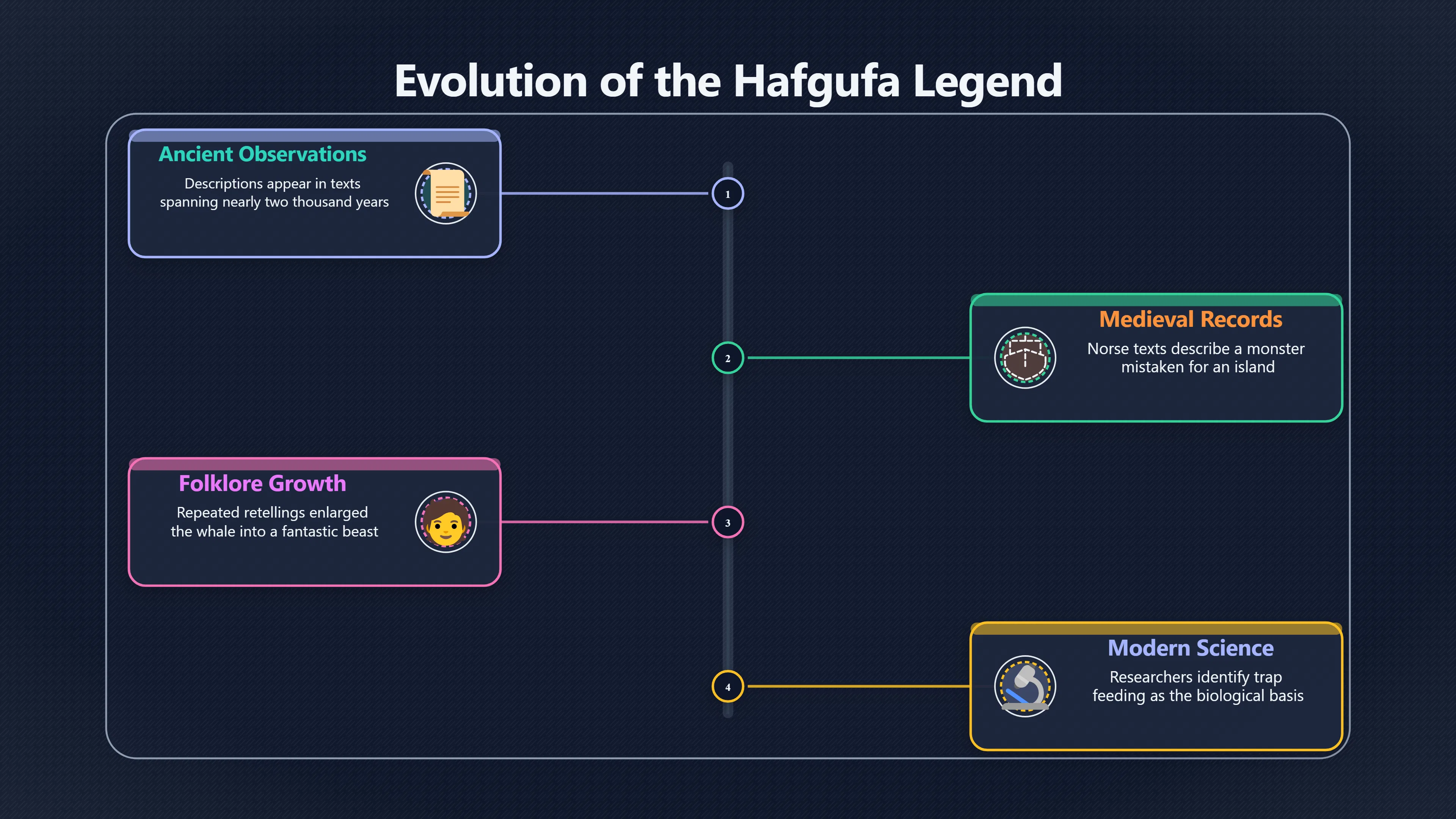
The Hafgufa is one of the most intriguing creatures in Icelandic and wider North Atlantic sea-monster lore because it may represent a rare case where a legendary monster preserves an accurate observation of real animal behaviour. Medieval descriptions portray the Hafgufa as a gigantic sea creature so large that sailors could mistake it for part of the ocean itself. For centuries, the story was treated as pure folklore. Yet recent research suggests that key details in the legend closely resemble an unusual feeding technique used by certain whales, a behaviour that marine scientists only formally documented in the twenty-first century.[Wiley Online Library]onlinelibrary.wiley.comThe hafgufa tradition can be traced back…
Rather than showing how people invented monsters from nothing, the Hafgufa may demonstrate how extraordinary encounters with real whales gradually transformed into tales of an island-sized beast.
The island-sized creature in old Norse tradition
The Hafgufa appears in medieval Nordic texts connected with the seas around Iceland, Greenland and the North Atlantic. It was described as one of the largest creatures in the ocean, sometimes so immense that observers could mistake parts of its body for rocks or small islands. In some versions, the monster waits motionless at the sea surface with its mouth open, allowing fish to gather before suddenly swallowing them.[Wikipedia]WikipediaApril 13, 2026 — Although it was thought to be a sea monster, research suggests that the stories originated from a specialized feeding te…
This feeding method was unusual even by the standards of medieval monster stories. Many legendary sea beasts attack ships, create storms or drag sailors underwater. The Hafgufa’s defining trait was different: it fed by remaining almost completely still and letting prey come to it. Medieval accounts even describe fish being attracted toward the creature before it snapped its jaws shut.[Research @ Flinders]researchnow.flinders.edu.auThe hafgufa tradition can be traced…Read more…
For generations, scholars viewed these details as symbolic or fantastical. The creature’s enormous size, combined with stories that it could swallow ships or whales, seemed to place it firmly in the realm of legend.[Wikipedia]WikipediaApril 13, 2026 — Although it was thought to be a sea monster, research suggests that the stories originated from a specialized feeding te…
Trap feeding and tread-water feeding
The modern re-evaluation of the Hafgufa began after marine biologists documented an unusual feeding strategy in whales. In 2011, researchers observed Bryde’s whales in the Gulf of Thailand floating nearly upright in the water with their mouths held open. Rather than actively chasing prey, the whales remained largely stationary while fish swam directly into their jaws. Scientists named this behaviour “tread-water feeding”. Similar behaviour observed in humpback whales has often been called “trap feeding”.[PubMed]pubmed.ncbi.nlm.nih.govTread-water feeding of Bryde's whalesby T Iwata · 2017 · Cited by 56 — Tread-water feeding is considered passive feeding as compare…
The behaviour is striking because it looks unlike the dramatic lunging commonly associated with baleen whales. The whale becomes a passive trap. Fish gather near the open mouth, apparently attracted by shelter, food opportunities or schooling instincts. When enough prey accumulates, the whale closes its jaws and feeds.[PubMed]pubmed.ncbi.nlm.nih.govTread-water feeding of Bryde's whalesby T Iwata · 2017 · Cited by 56 — Tread-water feeding is considered passive feeding as compare…
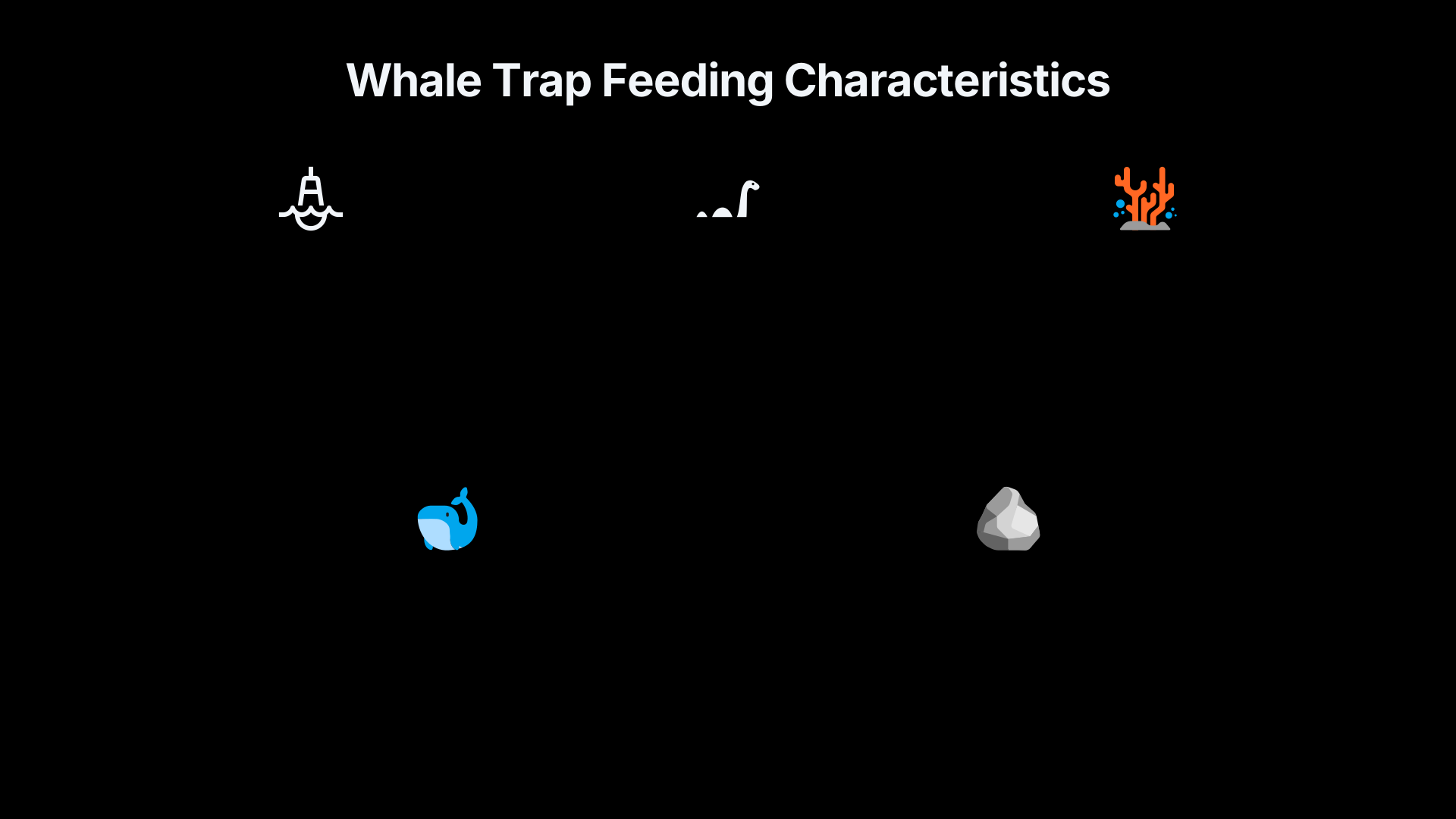
In 2023, researchers compared descriptions of the Hafgufa with modern observations of trap-feeding whales. They found remarkable parallels:
- Both remain largely motionless at the surface.
- Both feed with the mouth held wide open.
- Both rely on prey approaching the mouth rather than being chased.
- Both can appear strangely immobile and difficult to identify from a distance.
- Both create a visual impression unlike typical whale feeding behaviour.[wiley.com]onlinelibrary.wiley.comThe hafgufa tradition can be traced back…
The researchers argued that medieval observers may have witnessed this rare behaviour and interpreted it through the worldview available to them. Over time, repeated retellings could have enlarged the whale into a monster of impossible size.[wiley.com]onlinelibrary.wiley.comThe hafgufa tradition can be traced back…
Why the comparison matters
The Hafgufa hypothesis is not simply a claim that “the monster was a whale”. Sailors had known whales for centuries. The interesting question is why a familiar animal would generate such an extraordinary legend.
The answer may lie in behaviour rather than appearance. A whale feeding normally looks recognisable. A whale sitting vertically at the surface with its mouth open for long periods looks far stranger. Viewed from a ship, especially in rough weather or poor visibility, the exposed mouth and head could appear as a rocky opening in the sea. Medieval witnesses lacked underwater photography, marine biology and the ability to compare observations across oceans. A rare feeding event could therefore become a memorable marvel.[theguardian.com]theguardian.comThe GuardianAncient texts shed new light on mysterious whale…28 Feb 2023 — Scientists termed the unusual technique, then unknown to mo…
Researchers also note that descriptions similar to the Hafgufa appear in texts stretching back far beyond medieval Iceland, suggesting that people may have been observing the same unusual behaviour for nearly two thousand years. The consistency of the feeding description across centuries is one of the strongest points in favour of the whale interpretation.[wiley.com]onlinelibrary.wiley.comThe hafgufa tradition can be traced back…
When real animals become monsters
The Hafgufa offers a useful lesson for understanding Icelandic monster traditions more broadly. Legends do not always emerge from complete misunderstandings. Sometimes they begin with a genuine observation that is unusual enough to resist easy explanation.
In this case, medieval sailors may have accurately recorded a rare feeding strategy while misunderstanding the nature and scale of the animal performing it. As stories travelled between sailors, storytellers and manuscript writers, the behaviour remained recognisable even while the creature itself grew more fantastic.[Research @ Flinders]researchnow.flinders.edu.auThe hafgufa tradition can be traced…Read more…
That makes the Hafgufa different from many modern cryptid stories. The mystery is not whether an undiscovered monster exists in Icelandic waters. Instead, the fascination lies in how an authentic piece of whale behaviour may have survived inside a sea-monster tradition for centuries before science finally recognised the behaviour itself.[wiley.com]onlinelibrary.wiley.comThe hafgufa tradition can be traced back…
For readers exploring Iceland’s strange-animal folklore, the Hafgufa stands as one of the clearest examples of the boundary between legend and natural history: a monster story that may preserve a surprisingly accurate memory of the real ocean.[theguardian.com]theguardian.comThe GuardianAncient texts shed new light on mysterious whale…28 Feb 2023 — Scientists termed the unusual technique, then unknown to mo…
Amazon book picks
Further Reading
Books and field guides related to Was the Hafgufa Monster Really a Whale?. Use these as the next step if you want deeper reading beyond the article.
Spying on Whales
Explains whale evolution and behavior relevant to monster interpretations.
Norse Mythology
Introduces readers to the legendary world that produced Nordic sea-creature tales.
eBay marketplace picks
Marketplace Samples
Live-tested eBay searches with available results related to this page.

Endnotes
1.
Source: onlinelibrary.wiley.com
Link:https://onlinelibrary.wiley.com/doi/10.1111/mms.13009
Source snippet
The hafgufa tradition can be traced back...
2.
Source: Wikipedia
Link:https://en.wikipedia.org/wiki/Hafgufa
Source snippet
April 13, 2026 — Although it was thought to be a sea monster, research suggests that the stories originated from a specialized feeding te...
Published: April 13, 2026
3.
Source: Wikipedia
Link:https://en.wikipedia.org/wiki/Lyngbakr
4.
Source: youtube.com
Title: Ancient texts suggest Norse sea monster was a trap-feeding whale
Link:https://www.youtube.com/watch?v=R5vcQVqD7pY
Source snippet
Trap-Feeding - a novel Humpback Feeding Strategy (compilation of footage)...
5.
Source: youtube.com
Link:https://www.youtube.com/watch?v=STZDtHn39QI
Source snippet
10 Ancient Creatures Rumoured to Exist in Our Oceans...
6.
Source: theguardian.com
Link:https://www.theguardian.com/environment/2023/mar/01/ancient-texts-power-new-light-shed-on-mysterious-whale-behaviour-that-captured-imagination
Source snippet
The GuardianAncient texts shed new light on mysterious whale...28 Feb 2023 — Scientists termed the unusual technique, then unknown to mo...
7.
Source: researchnow.flinders.edu.au
Link:https://researchnow.flinders.edu.au/files/67513473/Marine_Mammal_Science_2023_McCarthy_Parallels_for_cetacean_trap_feeding_and_tread_water_feeding_in_the_historical.pdf
Source snippet
The hafgufa tradition can be traced...Read more...
8.
Source: pubmed.ncbi.nlm.nih.gov
Link:https://pubmed.ncbi.nlm.nih.gov/29112865/
Source snippet
Tread-water feeding of Bryde's whalesby T Iwata · 2017 · Cited by 56 — Tread-water feeding is considered passive feeding as compare...
9.
Source: smithsonianmag.com
Link:https://www.smithsonianmag.com/smart-news/these-mythical-sea-monsters-may-have-been-whales-with-unusual-dining-habits-180981729/
Source snippet
These Mythical Sea Monsters May Have Been Whales With...Mar 2, 2023 — Though it is unlikely researchers can prove the hafgufa was, in fa...
10.
Source: nhm.ac.uk
Title: legendary beasts ancient literature may have been whales gulping down fish
Link:https://www.nhm.ac.uk/discover/news/2023/february/legendary-beasts-ancient-literature-may-have-been-whales-gulping-down-fish.html
Source snippet
Norse description of the hafgufa was very similar to the behaviour of trap feeding whales, I thought it was just an interesting coincidence...
11.
Source: researchnow.flinders.edu.au
Title: parallels for cetacean trap feeding and tread water feeding in th
Link:https://researchnow.flinders.edu.au/en/publications/parallels-for-cetacean-trap-feeding-and-tread-water-feeding-in-th/
Source snippet
The hafgufa tradition can be traced back to the...
Additional References
12.
Source: researchgate.net
Link:https://www.researchgate.net/publication/379914494Antecedent_description_and_depiction_of_the_recently_described_cetacean_behaviour_of_traptread-water_feeding_inferred_from_a_nineteenth-century_sighting_of_a%27sea_monster%27_in_the_Gulf_of_Suez_Egypt
Source snippet
(PDF) Antecedent description and depiction of the recently...1 Jan 2026 — Called 'trap' or 'tread-water' feeding, the behaviour was of i...
13.
Source: nine.com.au
Link:https://www.nine.com.au/world-news/a-recently-discovered-whale-feeding-strategy-has-turned-up-in-2000yearold-texts-about-fearsome-sea-monsters-20230302-p5ypli.html
Source snippet
A 'recently discovered' whale feeding strategy has turned...3 Mar 2023 — In 2011, researchers observed a previously unknown feeding stra...
14.
Source: earth.com
Title: trap feeding whales help explain beasts in ancient literature
Link:https://www.earth.com/news/trap-feeding-whales-help-explain-beasts-in-ancient-literature/
Source snippet
28 Feb 2023 — “Similarities between the hafgufa/aspidochelone traditions and cetacean trap feeding and tread-water feeding strategies hav...
15.
Source: instagram.com
Title: Mouth open at the surface, drawing prey in. The Vikings were
Link:https://www.instagram.com/reel/DP2Tal4AOtU/?hl=en
Source snippet
Medieval sailors feared the Hafgufa — a massive sea monster...In 2011, marine biologists filmed humpback whales doing exactly this: trap...
16.
Source: abc.net.au
Title: ancient texts norse saga hafgufa whale trap feeding
Link:https://www.abc.net.au/news/science/2023-03-01/ancient-texts-norse-saga-hafgufa-whale-trap-feeding/102027600
Source snippet
Ancient medieval texts suggest a sea monster in Norse...28 Feb 2023 — The Hafgufa was described in the Norse sagas as a sea monster that...
17.
Source: divernet.com
Title: were ancient sea monsters trap feeding whales
Link:https://divernet.com/scuba-news/were-ancient-sea-monsters-trap-feeding-whales/
Source snippet
Were ancient sea monsters trap-feeding whales?19 Mar 2023 — “It struck me that the Norse description of the hafgufa was very similar to t...
18.
Source: arstechnica.com
Link:https://arstechnica.com/science/2023/03/medieval-manuscripts-may-have-described-new-whale-feeding-trick-centuries-ago/
Source snippet
Ars TechnicaMedieval manuscripts may have described “new” whale...1 Mar 2023 — Fish would swim into their mouths, and the whales would s...
19.
Source: facebook.com
Link:https://www.facebook.com/groups/1680627865521217/posts/3262868817297106/
Source snippet
ing she could catch, including ships, humans, and whales. Because...
20.
Source: researchgate.net
Link:https://www.researchgate.net/publication/368874548_Parallels_for_cetacean_trap_feeding_and_tread-water_feeding_in_the_historical_record_across_two_millennia
Source snippet
The hafgufa tradition can be traced back...Read more...
21.
Source: open.spotify.com
Title: The hafgufa is actually
Link:https://open.spotify.com/episode/7q4Fv3dXroz09yqugcMD78
Source snippet
472: The Hafgufa - Strange Animals Podcast16 Feb 2026 — Generally, any sea monster that's said to be mistaken for an island was inspired...
Topic Tree