Cryptids of Botswana's Stories
Botswana is not a country with one world-famous “national cryptid” in the Loch Ness or Bigfoot mould.
Page outline Jump by section
Botswana’s monster map is shaped by desert, delta, and village rumour
Botswana’s creature lore makes most sense when placed against the country’s two great imaginative landscapes: the Kalahari and the Okavango. The Kalahari offers the classic setting for stories about lone travellers, night movement, tracks in sand, predatory animals, thirst, and hidden beings. The Okavango Delta, by contrast, is a huge watery system of channels, pools, papyrus, islands, hippos, crocodiles, and seasonal animal movement. Botswana Tourism describes the Okavango as the world’s largest intact inland delta, varying from about 15,000 to 22,000 square kilometres, with 122 mammal species, 64 reptiles, 71 fish species and 444 bird species recorded in the region. It specifically lists hippo, crocodile, leopard, lion, cheetah, serval and caracal among the animals visitors may encounter.[Botswana Tourism]botswanatourism.co.bwBotswana Tourism Okavango Delta | Botswana Tourism OrganisationBotswana Tourism Okavango Delta | Botswana Tourism Organisation
That matters because many “mystery animal” traditions begin where ordinary wildlife is already dangerous, elusive, nocturnal, or easily misread. A hippo surfacing in poor light, a crocodile half-seen at the edge of reeds, a leopard moving near a village, or an unfamiliar carcass after scavengers have been at it can all become the seed of a stranger story. Botswana’s real animals are dramatic enough that folklore does not need to invent entirely new biology; it can exaggerate, moralise, spiritualise, or misidentify what people already know.
The other important point is that Botswana’s public creature stories are not confined to remote wilderness. The thokolosi, in particular, appears in village and town settings, in adverts by self-styled traditional healers, in television drama, and in court-report journalism. That makes it less like a hidden animal in the bush and more like a social monster: a figure used to explain misfortune, wealth, fear, jealousy, sexual anxiety, exploitation, or deception.
The thokolosi is Botswana’s most visible modern monster
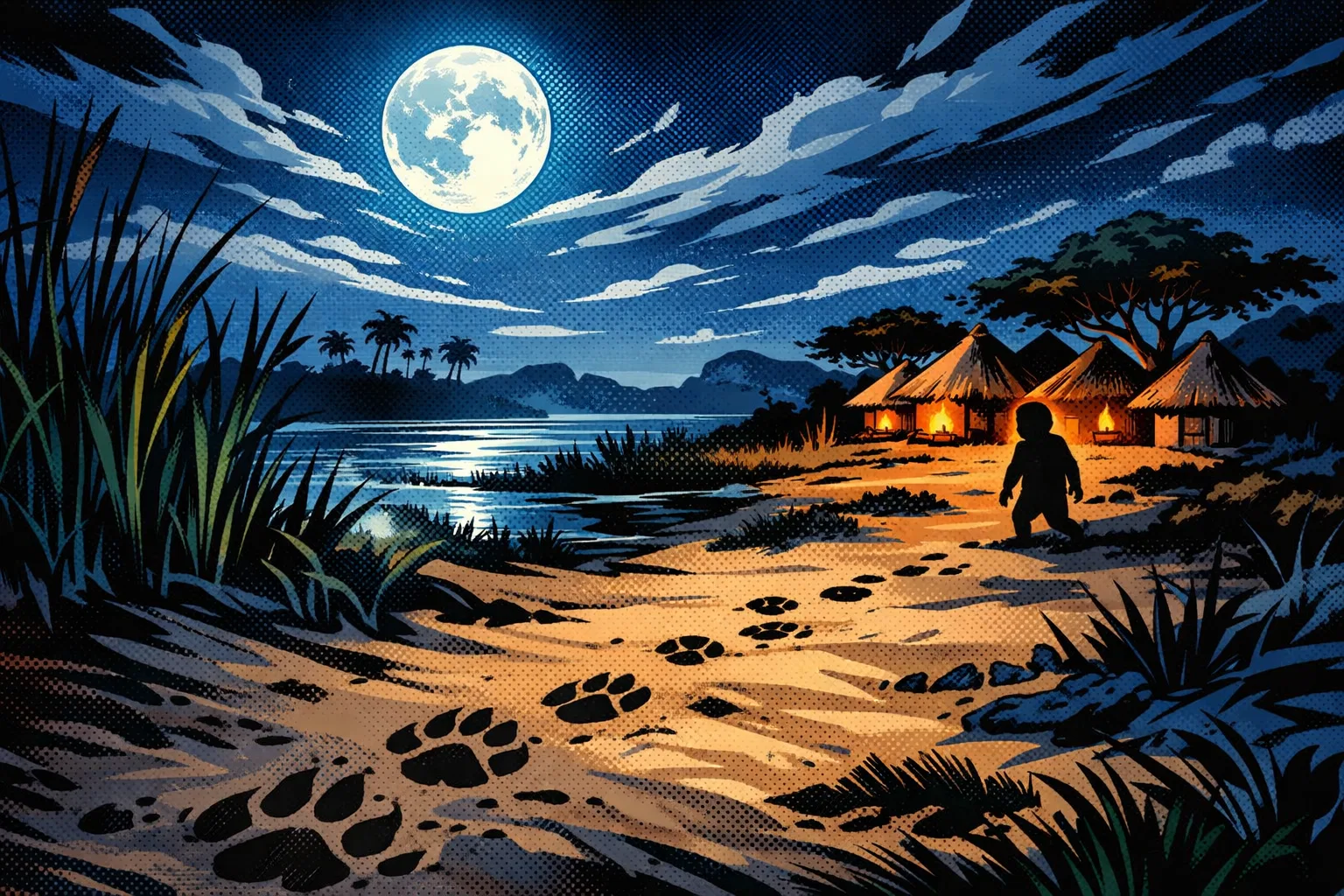
The most clearly documented monster-like figure in Botswana’s recent public record is the thokolosi, a small supernatural being widely known across southern Africa. In Botswana reporting, it appears less as an animal to be tracked and more as a familiar, servant, night visitor, scapegoat, or explanation for alarming events.
A 2010 Mmegi feature, “‘I Have A Thokolosi For Sale’”, shows how the figure entered everyday public commerce. The article describes newspaper adverts by a “thokolosi manufacturer” who claimed to sell the being, presenting it as a creature of great strength that could do its owner’s bidding, including work around the house, brick-moulding, or field labour. The report is valuable not because it proves such a being exists, but because it shows how the thokolosi had become familiar enough in Botswana for advertisers, readers, and journalists to treat it as a recognisable cultural reference.[Mmegi Online]mmegi.bwOnline'I Have A Thokolosi For SaleMmegi Online…
The same figure continues to surface in harder-edged contexts. In June 2026, The Voice Botswana reported a Kanye Magistrates Court case in which a convicted stepfather blamed the rape of his 11-year-old stepdaughter on a thokolosi. The court rejected the claim as improbable and unsupported by evidence, relying instead on the child’s identification and corroborating circumstantial evidence.[thevoicebw.com]thevoicebw.com‘I didn’t rape my girl, a thokolosi did!’ » The Voice BW‘I didn’t rape my girl, a thokolosi did!’ » The Voice BW This is a grim but important example of how supernatural explanations can be invoked not only in folklore but in attempts to deflect responsibility.
The thokolosi also had a pop-cultural afterlife in Botswana. A 2007 academic article indexed in Marang: Journal of Language and Literature examined the Botswana Television drama Thokolosi, screened in 2006, which dealt with witchcraft and prompted controversy among viewers, including objections that its setting and representation were culturally insensitive.[Journals]journals.co.zaAJA18167659 73AJA18167659 73 That places the creature in a modern media loop: old belief, television fiction, public debate, newspaper stories, and online rumour all feeding one another.
Kalahari man-eaters and the Aigamuxa tradition
The creature most often linked to the wider Kalahari in cryptid-style writing is the Aigamuxa, or Aigamuchab: a man-eating humanoid from Khoikhoi and southern African folklore, usually described as having eyes on its feet and needing to bend, lie down, or stand strangely in order to see. Popular cryptid sources now connect it broadly with the Kalahari and sometimes include Botswana in its range, though the older documented tradition is more strongly associated with Khoikhoi material collected in the Namaland and Kalahari region rather than with a specific Botswana sighting file.[Wikipedia]WikipediaOpen source on wikipedia.org.
As a cryptid, the Aigamuxa is weak: there are no good modern zoological records, carcasses, photographs, or consistent eyewitness clusters in Botswana. As folklore, however, it is powerful. Its odd anatomy makes narrative sense. A creature with eyes on its feet is terrifying but also defeatable: it has to expose its weakness in order to hunt. That gives the tale the shape of a desert survival story, not a field guide entry.
The Kalahari setting also gives the Aigamuxa a plausible social role. It warns against isolation, night travel, and underestimating the landscape. It turns the desert’s real dangers — predators, thirst, disorientation, darkness, and distance from help — into one memorable body. In that respect, the Aigamuxa belongs beside other African ogre and cannibal figures: it is a story about vulnerability at the edge of the human community.
Sacred tracks, giant ancestors, and animal origins at Matsieng
Botswana’s creature traditions are not only about fear. Some are about origin, ancestry, and the boundary between people and animals. The Matsieng Footprints site in south-eastern Botswana is one of the clearest examples. Botswana Tourism’s description says local legend presents Matsieng as the first ancestor of the Batswana, a giant one-legged man who climbed out of one of the holes followed by his people, domestic animals, and wild animals.[Botswana Tourism]botswanatourism.co.bwOpen source on botswanatourism.co.bw.
The Botswana Society gives a similar account: according to local lore, Matsieng emerged from the mysterious waterhole with his livestock, leaving footprints in soft sandstone that later hardened.[TheBotswanaSociety]thebotswanasociety.netOpen source on thebotswanasociety.net. The site’s engraved human and animal-like tracks therefore sit at an important intersection. To an archaeologist, they are rock engravings and a cultural landscape. To folklore, they are traces of a moment when beings entered the world.
For a cryptid-oriented reader, Matsieng is not a monster case in the modern sense. It is better understood as a creature-origin landscape. The animals are not “unknown species”; they are part of a mythic explanation for why people, livestock, wild animals, waterholes, and stone marks belong together. That distinction is important because it stops us flattening sacred or origin stories into “sightings”.
The python cave controversy shows why evidence matters
Tsodilo Hills, a UNESCO World Heritage Site in north-western Botswana, is one of the country’s most important cultural landscapes. UNESCO describes Tsodilo as a place visited and settled by humans for many millennia, with rock art spanning from the Stone Age to the 19th century. It also notes that local Hambukushu and San communities revere its hills and waterholes as a sacred landscape associated with ancestral spirits.[UNESCO World Heritage Centre]whc.unesco.orgWorld Heritage Centre TsodiloWorld Heritage Centre Tsodilo
This is where a famous “python cave” claim enters the story. In the 2000s, reports circulated that a cave at Tsodilo contained evidence of very ancient python worship. The idea was dramatic: a rock formation interpreted as a python, cupules or depressions read as scales, and a suggestion of extremely early ritual behaviour. It fitted beautifully with the broader importance of snakes and pythons in southern African spiritual imagination.
But the interpretation was sharply challenged by archaeologists who had worked at the site. Lawrence Robbins, Alec Campbell, George Brook, and Michael Murphy argued in Nyame Akuma that the cave was actually known as Rhino Cave, that the “python” reading was highly subjective, and that there was no demonstrated evidence that the cupules dated to a single period or represented a snake. They also warned against projecting modern San beliefs tens of thousands of years into the past without stronger evidence.[Society of Africanist Archaeologists]africanistarchaeology.netSociety of Africanist Archaeologists No. 67.pmdSociety of Africanist Archaeologists No. 67.pmd
For Botswana monster lore, this is a useful cautionary tale. A snake-shaped reading of a rock surface can be culturally interesting without being archaeologically settled. The best version of the story is not “scientists proved ancient python worship”, but “Tsodilo is a sacred animal-rich landscape where one striking python interpretation became famous, then contested”. That is more accurate, and it is more interesting because it shows how myth, archaeology, media, and evidence collide.
Botswana’s animal folktales are not cryptids, but they explain the pattern
Setswana folktales often give animals human qualities, moral roles, and social meaning. A study of Setswana folktales notes that animal stories are a major component of the tradition, that animals are personified, and that the hare is the most common and popular trickster, often using cunning to outwit stronger animals such as lion, elephant, and crocodile.[UJ Content]ujcontent.uj.ac.zaUJ Contentthe social function of setswana folktalesUJ Contentthe social function of setswana folktales
That matters for cryptid history because it shows that Botswana’s creature imagination has long worked through known animals rather than necessarily inventing hidden species. Hare, jackal, hyena, lion, crocodile, elephant, and other animals become characters through which people talk about wit, greed, danger, weakness, bravery, hunger, and social order. The supernatural may appear, but ordinary animals already carry extraordinary narrative weight.
The same study stresses that folktales entertain, educate, preserve historical memory, and help children develop morally.[UJ Content]ujcontent.uj.ac.zaUJ Contentthe social function of setswana folktalesUJ Contentthe social function of setswana folktales So when a monster-like figure appears in Botswana tradition, it should be read in that wider storytelling context. The creature may not be “reported” in the way a modern cryptozoologist wants. It may be doing social work: warning, teasing, judging, explaining, or preserving a memory of how people relate to animals and place.
What evidence exists for Botswana cryptids?
The evidence is uneven, and that is the main takeaway. Botswana has strong evidence for creature traditions, but weak evidence for undiscovered large animals.
Folklore evidence is strong. The thokolosi, Matsieng, animal trickster tales, Kalahari ogre motifs, and sacred animal landscapes all have clear cultural footprints. They appear in oral tradition, journalism, tourism interpretation, academic study, and popular media.
Modern sighting evidence is thin. There is no well-documented Botswana equivalent of a lake monster file, a long-running ape-man flap, or a nationally famous phantom cat case supported by repeated named witnesses and physical traces. Online posts sometimes circulate alleged “strange creature” photographs, but those are usually too poorly sourced to carry much weight.
Journalistic evidence shows belief and social use. Mmegi’s thokolosi-for-sale article shows the creature as a commercial and popular belief motif; The Voice’s 2026 court report shows the same idea being used as an attempted legal excuse; the BTV drama controversy shows its media afterlife.[mmegi.bw]mmegi.bwOnline'I Have A Thokolosi For SaleMmegi Online…
Environmental evidence supports misidentification. Botswana’s real fauna includes large aquatic animals, big cats, nocturnal predators, reptiles, and many species encountered in low-visibility environments such as reeds, floodplains, pans, and bush. The Okavango alone contains hippos, crocodiles, lions, leopards, cheetahs, servals and caracals, any of which can become frightening or ambiguous when glimpsed briefly.[Botswana Tourism]botswanatourism.co.bwBotswana Tourism Okavango Delta | Botswana Tourism OrganisationBotswana Tourism Okavango Delta | Botswana Tourism Organisation
Plausible explanations: why strange-creature stories stick
The most plausible explanation is not one single hoax or one single hidden animal. Botswana’s creature stories persist because several forces overlap.
First, real wildlife provides raw material. In a country where crocodiles, hippos, big cats, hyenas, snakes, and large antelope are part of the living environment, people do not need to imagine danger from scratch. A noise at night or a shape near water may already be alarming before folklore interprets it.
Second, oral tradition gives animals social meaning. Setswana animal tales personify animals and use them to teach, entertain, and moralise. Once animals are already moral actors in stories, it is a short step for unusual events to be narrated through creature figures.
Third, supernatural explanations can be socially useful. The thokolosi may be invoked to explain illness, fear, wealth, sexual violation, household trouble, or unexplained noises. Sometimes that use is playful or commercial; sometimes, as in the 2026 court case, it can be harmful when used to evade accountability.[thevoicebw.com]thevoicebw.com‘I didn’t rape my girl, a thokolosi did!’ » The Voice BW‘I didn’t rape my girl, a thokolosi did!’ » The Voice BW
Fourth, tourism and heritage interpretation can amplify animal-linked sacred places. Tsodilo and Matsieng are not cryptid attractions in a cheap sense, but visitors encounter them through stories of ancestors, animals, tracks, waterholes, and sacred landscapes. That keeps creature-centred interpretation alive in public-facing culture.[UNESCO World Heritage Centre]whc.unesco.orgWorld Heritage Centre TsodiloWorld Heritage Centre Tsodilo

The careful way to read Botswana’s cryptid tradition
Botswana’s mystery-creature record is best read as a layered tradition rather than a hunt for a single hidden beast. At the top layer are modern rumours and media stories: thokolosi adverts, court claims, television drama, and online posts. Beneath that are older regional motifs: Kalahari man-eaters, trickster animals, supernatural beings, sacred snakes, giant ancestors, and animal tracks. Beneath those again is the physical country itself: desert, delta, rock shelter, waterhole, night sounds, predator tracks, and the real risk of dangerous animals.
The result is a creature tradition that is quieter than some countries’ but rich in meaning. Botswana does not need a Nessie to have a monster history. Its strongest strange beings are those that explain how people imagine danger, power, ancestry, animals, and landscape: the thokolosi in the village, the man-eater in the Kalahari, the giant ancestor at the waterhole, and the python-shaped possibility in a sacred hill.
Amazon book picks
Further Reading
Books and field guides related to What Monsters Haunt Botswana's Stories?. Use these as the next step if you want deeper reading beyond the article.
African Myths of Origin
Provides broad context for creature and origin stories across southern Africa.
Cry of the Kalahari
Captures the landscape that inspires many Botswana creature traditions.
Myths and Legends of Africa
Introduces readers to recurring African supernatural beings and folklore.
eBay marketplace picks
Marketplace Samples
Live-tested eBay searches with available results related to this page.
Endnotes
1.
Source: mmegi.bw
Title: Online’I Have A Thokolosi For Sale’
Link:https://www.mmegi.bw/features/i-have-a-thokolosi-for-sale/news
Source snippet
Mmegi Online...
2.
Source: thevoicebw.com
Title: ‘I didn’t rape my girl, a thokolosi did!’ » The Voice BW
Link:https://thevoicebw.com/i-didnt-rape-my-girl-a-thokolosi-did/
3.
Source: Wikipedia
Link:https://en.wikipedia.org/wiki/Aigamuxa
4.
Source: thebotswanasociety.net
Link:https://www.thebotswanasociety.net/matsieng
5.
Source: whc.unesco.org
Title: World Heritage Centre Tsodilo
Link:https://whc.unesco.org/en/list/1021/
6.
Source: Wikipedia
Title: List of lake monsters
Link:https://en.wikipedia.org/wiki/List_of_lake_monsters
7.
Source: Wikipedia
Title: Mokele mbembe
Link:https://en.wikipedia.org/wiki/Mokele-mbembe
8.
Source: Wikipedia
Link:https://en.wikipedia.org/wiki/Tokoloshe
9.
Source: Wikipedia
Link:https://en.wikipedia.org/wiki/Tsodilo
10.
Source: Wikipedia
Title: Brown hyena
Link:https://en.wikipedia.org/wiki/Brown_hyena
11.
Source: Wikipedia
Link:https://ff.wikipedia.org/wiki/Aigamuxa
12.
Source: Wikipedia
Title: Matsieng Footprints
Link:https://en.wikipedia.org/wiki/Matsieng_Footprints
13.
Source: Wikipedia
Title: Literature of Botswana
Link:https://en.wikipedia.org/wiki/Literature_of_Botswana
14.
Source: folktales.africa
Title: the hyena and the hare a tale of wit and cunning
Link:https://folktales.africa/the-hyena-and-the-hare-a-tale-of-wit-and-cunning/
15.
Source: thevoicebw.com
Title: thokolosi on the loose
Link:https://thevoicebw.com/thokolosi-on-the-loose/
16.
Source: thevoicebw.com
Title: thokolosi defeated
Link:https://thevoicebw.com/thokolosi-defeated/
17.
Source: okavango.com
Link:https://www.okavango.com/
18.
Source: youtube.com
Title: Botswana & Okavango Delta 4K
Link:http://www.youtube.com/watch?v=9rz91N8kmKw
Source snippet
The Kalahari | A Guide for Photographers...
19.
Source: youtube.com
Title: The Kalahari | A Guide for Photographers
Link:http://www.youtube.com/watch?v=8wewjV4cckE
Source snippet
Things You Didn't Know About The SAN Tribe Of AFRICA...
20.
Source: botswanatourism.co.bw
Title: Botswana Tourism Okavango Delta | Botswana Tourism Organisation
Link:https://www.botswanatourism.co.bw/explore/okavango-delta
21.
Source: journals.co.za
Title: AJA18167659 73
Link:https://journals.co.za/doi/pdf/10.10520/AJA18167659_73
22.
Source: botswanatourism.co.bw
Link:https://www.botswanatourism.co.bw/explore/matsieng-footprints
23.
Source: africanistarchaeology.net
Title: Society of Africanist Archaeologists No. 67.pmd
Link:https://www.africanistarchaeology.net/s/Nyame-Akuma-Issue-067-Robbins.pdf
24.
Source: ujcontent.uj.ac.za
Title: UJ Contentthe social function of setswana folktales
Link:https://ujcontent.uj.ac.za/esploro/fulltext/graduate/The-social-function-of-Setswana-folktales/9913579007691?institution=27UOJ_INST&mId=135509010007691&repId=125290390007691
25.
Source: ujcontent.uj.ac.za
Link:https://ujcontent.uj.ac.za/view/pdfCoverPage?download=true&filePid=135638920007691&instCode=27UOJ_INST
26.
Source: villains.fandom.com
Link:https://villains.fandom.com/wiki/Aigamuxa
27.
Source: fiction-taxonomy.fandom.com
Link:https://fiction-taxonomy.fandom.com/wiki/Aigamuxa
28.
Source: metmuseum.org
Title: tsodilo hills
Link:https://www.metmuseum.org/perspectives/tsodilo-hills
29.
Source: okavangodelta.com
Link:https://okavangodelta.com/the-okavango/wildlife/
30.
Source: atlasobscura.com
Title: matsieng footprints
Link:https://www.atlasobscura.com/places/matsieng-footprints
31.
Source: rss.listal.com
Link:https://rss.listal.com/character/aigamuxa
32.
Source: journals.co.za
Title: AJA052550590 86
Link:https://journals.co.za/doi/pdf/10.10520/AJA052550590_86
33.
Source: sacredsitesfoundation.co.za
Title: Tsodilo Hills
Link:https://sacredsitesfoundation.co.za/sacred-sites/botswana/tsolido-hills/
34.
Source: clayvermulmfiction.com
Title: The Aigamuxa
Link:https://www.clayvermulmfiction.com/post/cryptid-tidbit-9-the-aigamuxa
35.
Source: itravelto.com
Title: The Python Cave
Link:https://www.itravelto.com/python-cave-tsodilo-hills.html
36.
Source: bestiary.us
Link:https://www.bestiary.us/aigamuchab/en
37.
Source: evolveback.com
Title: tsodilo hills
Link:https://www.evolveback.com/blogs/tsodilo-hills.html
38.
Source: info-botswana.com
Title: Okavango Delta
Link:https://www.info-botswana.com/activities-and-places-of-interest/okavango-delta/okavango-delta
Additional References
39.
Source: youtube.com
Title: Guardians of Modimo: Healing Through Ancestors in Tswana Mythology
Link:http://www.youtube.com/watch?v=rfmTDR06Qmg
Source snippet
Botswana San people mythology stories African San Bushmen Creation Myth | The Earth with Kaang | The Great Master and Lord of All Life Mo...
40.
Source: youtube.com
Link:http://www.youtube.com/watch?v=tD9WS1kqKhE
Source snippet
Botswana & Okavango Delta 4K - Scenic Wildlife Film With African Music...
41.
Source: youtube.com
Title: Things You Didn’t Know About The SAN Tribe Of AFRICA
Link:http://www.youtube.com/watch?v=csZjK_Somac
Source snippet
Guardians of Modimo: Healing Through Ancestors in Tswana Mythology...
42.
Source: academia.edu
Link:https://www.academia.edu/104414477/TSODILO_HILLS_The_Rock_that_Whispers
43.
Source: yourbotswana.com
Link:https://yourbotswana.com/14-facts-that-dispel-the-myths-about-botswanas-spotted-hyenas/
44.
Source: jstor.org
Link:https://www.jstor.org/stable/pdf/534645.pdf
45.
Source: researchgate.net
Link:https://www.researchgate.net/publication/376958093Response_to_World%27s_Oldest_Ritual_Site_The%27Python_Cave%27_at_Tsodilo_Hills_World_Heritage_Site_Botswana_by_Lawrence_H_Robbins_Alec_C_Campbell_George_A_Brook_and_Michael_L_Murphy
46.
Source: facebook.com
Link:https://www.facebook.com/okavangowildernessproject/posts/a-busy-few-days-meeting-and-greeting-the-local-hippos-we-move-around-them-in-the/1812000708875645/
47.
Source: facebook.com
Link:https://www.facebook.com/botsmag/posts/a-strange-creature-found-in-bobonong-villagers-believe-its-a-tokoloshe/1971042676251402/
48.
Source: abookofcreatures.com
Link:https://abookofcreatures.com/tag/african-folklore/
Topic Tree
Follow this branch
Related pages 192
- Antigua Cryptids
- Maldives Monsters
- Malta Monsters
- Qatar Monsters
- Argentina Monsters
- +187 more in sidebar