Does Nauru Have Cryptids or Only Legends?
Nauru is not a country with a well-documented modern cryptid tradition in the Loch Ness, Bigfoot, phantom-cat, or sea-serpent sense.
Page outline Jump by section
Introduction
The short answer is that Nauru’s creature lore is better read as folklore and cosmology than as zoological mystery. Nauru is a very small raised coral-limestone island of about 21 square kilometres, with limited terrestrial wildlife, no indigenous land mammals, and an environment heavily altered by phosphate mining. Those facts make claims of unknown large land animals especially unlikely, while leaving plenty of room for sea-based legend, fishing explanations, misidentified marine life, and symbolic animal figures in traditional storytelling.[dfat.gov.au]dfat.gov.auOpen source on dfat.gov.au.
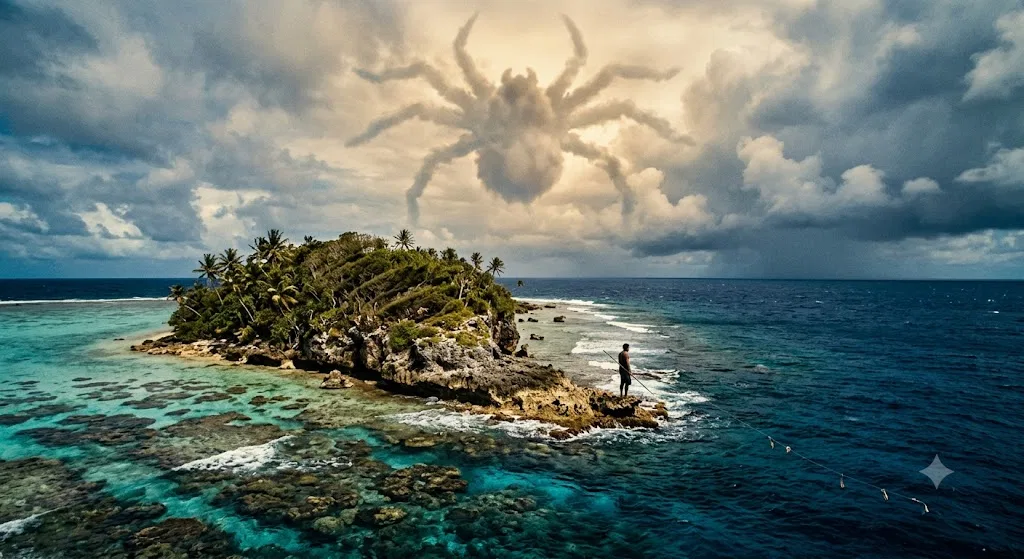
The “Nauru cryptid” is usually a mythic spider, not a hidden animal
The figure most often attached to Nauru in online cryptid-by-country lists is Areop-Enap, described as an old spider or spider-god of creation. In the better-supported mythological summaries, Areop-Enap exists at the beginning with the sea, uses snails in the creation of the sun and moon, and has a worm help divide a shell into sky and earth. Pantheon’s mythology entry similarly calls Areop-Enap “the Ancient Spider” of Nauru Island and gives the same broad creation pattern: shell, snail, worm, sky, earth, sea, sun, moon, and people made from stones.[Omnika]omnika.orgAreop-Enap, Two Snails, and the WormAreop-Enap, Two Snails, and the Worm - Myth - OMNIKA Mythology…
That is fascinating creature lore, but it is not a cryptid report in the strict sense. A cryptid normally implies an alleged animal that witnesses claim exists physically, often with sightings, tracks, photographs, local clusters, or newspaper reports. Areop-Enap belongs to mythic creation narrative. The “spider” element is symbolic and cosmological: the being explains the structure of the world, not an unknown species hiding in Nauru’s scrub or reef.
This distinction matters because modern online lists sometimes flatten very different traditions into one “monster per country” format. Brilliant Maps, for example, lists Nauru as Areop-Enap, “Spider-god of creation”, while placing it beside creatures that include lake monsters, ape-like beings, and legendary serpents from other countries. That is useful as pop-culture afterlife, but it can mislead readers into expecting a modern sighting tradition where the available evidence points instead to mythology.[Brilliant Maps]brilliantmaps.comBrilliant MapsCryptids By Country World Map: List Of Most Popular Mythical Creatures - Brilliant Maps…
Detora gives Nauru its strongest sea-creature atmosphere
If any Nauruan tradition comes closest to the mood of cryptid storytelling, it is Detora. The Government of the Republic of Nauru preserves “The story of Detora, the King of the sea” among its Nauruan Stories pages. In that version, Detora ultimately goes down to live with his grandparents at the bottom of the sea and becomes “king of the Sea” and “the Great Spirit of Fishing and Fishermen”. The tale even gives a small everyday explanation: lost fishing lines or hooks are said to be lying on the roof of Detora’s house.[Nauru Government]nauru.gov.nrNauru Government Nauruan StoriesernmentNauruan Stories - The Government of the Republic of Nauru…
That final detail is exactly the sort of thing that makes folklore memorable. It ties a supernatural being to a practical frustration known to fishers: tackle vanishes beneath the water, and a story explains where it went. Unlike a sea-serpent flap, it does not appear as a record of repeated monster sightings. It works more like a fishing-world explanation, turning the sea floor into a lived-in place with agency, family, property, and rules.
For a cryptid-minded reader, Detora is valuable because he shows why Nauru’s mystery-creature material belongs offshore more than inland. Nauru’s coastline, reef edge, fishing culture, and surrounding deep water provide a natural setting for stories about beings below the surface. The Nauru BIORAP biodiversity assessment notes that the island is surrounded by a fringing coral reef that drops sharply seaward to very deep water, while Nauru’s exclusive economic zone is far larger than the island itself.[Pacific Environment Data Portal]pacific-data.sprep.orgPacific Environment Data Portal
Why Nauru has no famous lake monster, ape-man, or phantom cat
The absence of a famous Nauruan lake monster or large land cryptid is not surprising once the island’s geography is taken seriously. Nauru is tiny, densely known by its residents, and ecologically constrained. The Australian Department of Foreign Affairs and Trade describes it as an island republic with a total land area of 21 square kilometres and a population of about 13,000. That leaves little room for a breeding population of unknown large animals to remain hidden.[DFAT]dfat.gov.auOpen source on dfat.gov.au.
Its wildlife profile points the same way. The 2015 Nauru BIORAP states that Nauru’s main indigenous land animals are birds, lizards, invertebrates and land crabs, and that there are no indigenous land mammals. Nauru’s national biodiversity strategy describes the country as a small raised coral-limestone island with limited land and marine habitat, listing indigenous birds, insects, land crabs, finfish, turtles, crustaceans, octopus, shellfish, sea cucumbers and other invertebrates among the relevant groups.[Pacific Environment Data Portal]pacific-data.sprep.orgPacific Environment Data Portal
That does not mean people never missee animals on Nauru. It means the plausible misidentifications are likely to be small-scale or marine: birds in odd light, crabs or lizards glimpsed quickly, turtles or large fish near the reef, octopus in tide pools, or unfamiliar sea creatures washed ashore. A giant ape, mystery panther, or surviving prehistoric reptile would clash sharply with the island’s scale, known fauna, and lack of habitat.

Phosphate mining changed the setting for folklore and sightings
Nauru’s landscape has also been transformed in a way that affects how any mystery-animal claim should be read. The Convention on Biological Diversity country profile says more than a century of phosphate mining cleared ancient indigenous forests on the central plateau, which made up about 80% of the island’s land area. It also describes the island’s soils as thin, nutrient-poor, and dependent on vegetation regrowth for restoration.[Convention on Biological Diversity]cbd.intConvention on Biological Diversity Main DetailsConvention on Biological Diversity Main Details
This matters for cryptid interpretation because habitat is evidence. In countries with large forest blocks, mountains, swamps, or deep lakes, stories of hidden animals can attach themselves to places that seem difficult to search. Nauru has the opposite problem. Its altered interior, small total land area, limited native biodiversity, and absence of native land mammals make terrestrial monster traditions hard to sustain as animal claims.
At the same time, environmental change can make older stories feel more important. When a landscape is mined, built over, or ecologically disrupted, oral tradition can become one of the places where older relationships with sea, reef, trees, fishing, and ancestry remain visible. Nauru’s official “Nauruan Stories” section preserves items such as Eigigu and Detora alongside cultural material about tribes, the flag and national days, showing that these stories function as cultural memory rather than field reports of unknown animals.[Nauru Government]nauru.gov.nrNauru Government Nauruan StoriesernmentNauruan Stories - The Government of the Republic of Nauru…
Are there newspaper-style monster reports from Nauru?
Searches for Nauru-specific cryptid reports turn up very little of substance. There is no strong public trail of recurring Nauruan lake monsters, sea-serpent panics, hairy hominids, phantom cats, thunderbirds, or named mystery beasts comparable to better-known traditions elsewhere in Oceania and beyond. Some archive hits are misleading: for example, old Pacific publications may include articles by a writer using a pen name such as “Sea-Serpent” while discussing ordinary regional news, not a Nauruan monster sighting.[nla.gov.au]nla.gov.auOpen source on nla.gov.au.
The most visible modern “Nauru cryptid” footprint is therefore secondary: list culture, mythology sites, and country-by-country creature maps that select Areop-Enap as the representative being. That is not worthless, but it is a different kind of evidence. It shows how Nauru is being packaged for global monster-fandom audiences, not how Nauruans have reported an unknown animal in newspapers or field investigations.
A fair Nauru page should therefore avoid pretending there is a dramatic lost dossier. The evidence supports a restrained conclusion: Nauru’s creature tradition is real, but it is mostly mythological and maritime, not cryptozoological in the investigative sense.

How to read Nauru’s creature lore without flattening it
The most useful way to approach Nauru is to separate four categories that often get mixed together.
Mythic beings: Areop-Enap belongs here. The spider form is part of a creation story explaining cosmic order. Treating this as a literal giant spider report strips away the point of the narrative.[Omnika]omnika.orgAreop-Enap, Two Snails, and the WormAreop-Enap, Two Snails, and the Worm - Myth - OMNIKA Mythology…
Sea and fishing folklore: Detora belongs here. He is attached to the sea, the sea floor, fishing luck, and lost tackle. The story is creature-adjacent and wonderfully vivid, but it is not a modern eyewitness file.[Nauru Government]nauru.gov.nrNauru Government The story of Detora, the King of the seaernmentThe story of Detora, the King of the sea - The Government of the Republic of Nauru…
Possible misidentifications: Nauru’s real environment provides candidates for ordinary mystery sightings: seabirds, lizards, land crabs, turtles, octopus, reef fish, sharks or unusual strandings. These are not “debunkings” of any specific famous Nauruan case, because no such major case is well established; they are the plausible natural background for island mystery-animal stories.[Pacific Environment Data Portal]pacific-data.sprep.orgPacific Environment Data Portal
Pop-culture afterlife: Online cryptid maps and creature lists may use Areop-Enap as Nauru’s entry because every country needs a representative monster in that format. This keeps the name circulating, but it also encourages readers to mistake mythology for cryptid reportage.[Brilliant Maps]brilliantmaps.comBrilliant MapsCryptids By Country World Map: List Of Most Popular Mythical Creatures - Brilliant Maps…
The bottom line on Nauru’s mystery creatures
Nauru’s creature lore is small in volume but distinctive in character. Its central figure in global cryptid-list culture, Areop-Enap, is best understood as a spider-like creator of myth rather than a hidden animal. Its strongest sea-centred tradition, Detora, speaks to fishing, loss, and the imagined life of the ocean floor. Its real ecology makes large undiscovered land animals highly implausible, while its reef and deep surrounding waters explain why sea-based stories feel more natural than forest-beast legends.
That makes Nauru a quietly instructive country in cryptid history. It shows that not every national monster page should chase sightings that are not there. Sometimes the honest story is stranger and more interesting: a tiny Pacific island where the “cryptid” label has attached itself to creation mythology, where the sea has a king, and where the best evidence points not to an unknown beast, but to the long life of folklore in a dramatically changed island landscape.
Amazon book picks
Further Reading
Books and field guides related to Does Nauru Have Cryptids or Only Legends?. Use these as the next step if you want deeper reading beyond the article.
The Hero with a Thousand Faces
Helps explain creator figures and recurring mythic themes.
eBay marketplace picks
Marketplace Samples
Live-tested eBay searches with available results related to this page.


Endnotes
1.
Source: omnika.org
Title: Areop-Enap, Two Snails, and the Worm
Link:https://omnika.org/myths/areop-enap-two-snails-and-the-worm
Source snippet
Areop-Enap, Two Snails, and the Worm - Myth - OMNIKA Mythology...
2.
Source: nauru.gov.nr
Title: Nauru Government The story of Detora, the King of the sea
Link:https://www.nauru.gov.nr/about-nauru/nauruans%27-stories/the-story-of-detora.aspx
Source snippet
ernmentThe story of Detora, the King of the sea - The Government of the Republic of Nauru...
3.
Source: dfat.gov.au
Link:https://www.dfat.gov.au/geo/nauru/nauru-country-brief
4.
Source: pacific-data.sprep.org
Title: Pacific Environment Data Portal
Link:https://pacific-data.sprep.org/system/files/771676f4-8760-4155-9327-d783e5aa5001/Nauru-BIORAP-2015.pdf
5.
Source: pantheon.org
Title: Areop-Enap | Facts, Information, and Mythology
Link:https://pantheon.org/articles/a/areop-enap.html
Source snippet
Areop-Enap | Facts, Information, and Mythology...
6.
Source: nauru.gov.nr
Title: Nauru Government Nauruan Stories
Link:https://www.nauru.gov.nr/about-nauru/nauruans%27-stories.aspx
Source snippet
ernmentNauruan Stories - The Government of the Republic of Nauru...
7.
Source: nauru.gov.nr
Title: Nauru Government The Story of Eigigu
Link:https://www.nauru.gov.nr/about-nauru/nauruans%27-stories/the-story-of-eigigu.aspx
Source snippet
ernmentThe Story of Eigigu - The Government of the Republic of Nauru...
8.
Source: nla.gov.au
Link:https://nla.gov.au/nla.obj-333438901/view?partId=nla.obj-334808292
9.
Source: nla.gov.au
Title: Vol. 1 No. 10 (
Link:https://nla.gov.au/nla.obj-338855939
10.
Source: cryptidz.fandom.com
Title: Manaia and Hei tiki
Link:https://cryptidz.fandom.com/wiki/Manaia_and_Hei-tiki
11.
Source: secretsnicholasflamel.fandom.com
Title: Areop Enap
Link:https://secretsnicholasflamel.fandom.com/wiki/Areop-Enap
12.
Source: cryptidarchives.fandom.com
Title: Category:Cryptids by country
Link:https://cryptidarchives.fandom.com/wiki/Category%3ACryptids_by_country
13.
Source: nauru.gov.nr
Title: Tribes of Nauru
Link:https://www.nauru.gov.nr/about-nauru/nauruans%27-stories/tribes-of-nauru.aspx
14.
Source: nauru.gov.nr
Title: Angam Day
Link:https://www.nauru.gov.nr/about-nauru/nauruans%27-stories/angam-day.aspx
15.
Source: nauru.gov.nr
Title: The Nauruan Flag
Link:https://www.nauru.gov.nr/about-nauru/nauruans%27-stories/the-nauruan-flag.aspx
16.
Source: nauru.gov.nr
Title: About Nauru
Link:https://www.nauru.gov.nr/about-nauru.aspx
17.
Source: omnika.org
Link:https://omnika.org/deities/areop-enap
18.
Source: cbd.int
Title: Convention on Biological Diversity Main Details
Link:https://www.cbd.int/countries/profile/?country=nr
19.
Source: brilliantmaps.com
Link:https://brilliantmaps.com/cryptids-by-country/
Source snippet
Brilliant MapsCryptids By Country World Map: List Of Most Popular Mythical Creatures - Brilliant Maps...
20.
Source: cbd.int
Title: Convention on Biological Diversity CBD Strategy and Action Plan
Link:https://www.cbd.int/doc/world/nr/nr-nbsap-01-en.pdf
Source snippet
Convention on Biological DiversityCBD Strategy and Action Plan - Nauru (English version)...
21.
Source: cbd.int
Title: CB D Sixth National Report
Link:https://www.cbd.int/doc/nr/nr-06/nr-nr-06-en.pdf
22.
Source: worldbooktour.wordpress.com
Link:https://worldbooktour.wordpress.com/2017/03/26/nauru/
23.
Source: Wikipedia
Link:https://en.wikipedia.org/wiki/Nauru
24.
Source: thecommonwealth.org
Link:https://thecommonwealth.org/our-member-countries/nauru
25.
Source: openfactbook.org
Link:https://openfactbook.org/countries/nauru/
26.
Source: nauru-data.sprep.org
Title: nauru rapid biodiversity assessment project biorap
Link:https://nauru-data.sprep.org/data-story/nauru-rapid-biodiversity-assessment-project-biorap
27.
Source: nauru-data.sprep.org
Title: Peter Jacob 2000 Statusof marine resources of Nauru
Link:https://nauru-data.sprep.org/system/files/Peter%20Jacob_2000_Statusof%20marine%20resources%20of%20Nauru.pdf
28.
Source: library.sprep.org
Title: country profile nauru
Link:https://library.sprep.org/sites/default/files/2021-02/country-profile-nauru.pdf
29.
Source: ebsco.com
Link:https://www.ebsco.com/research-starters/geography-and-cartography/nauru
30.
Source: en.wikisource.org
Link:https://en.wikisource.org/wiki/CIA_World_Fact_Book%2C_2004/Nauru
31.
Source: geofactbook.com
Link:https://geofactbook.com/countries/nauru
32.
Source: pacifictradeinvest.com
Title: Country Profile
Link:https://pacifictradeinvest.com/stories/focus/country-profile-nauru/
33.
Source: mecce.ca
Link:https://mecce.ca/country_profiles/cce-country-profile-nauru/
34.
Source: journals.openedition.org
Link:https://journals.openedition.org/jso/pdf/7055
35.
Source: commonwealthchamber.com
Link:https://commonwealthchamber.com/member-countries/nauru/
36.
Source: datazone.birdlife.org
Link:https://datazone.birdlife.org/country/factsheet/Nauru
37.
Source: tmrowe.com
Link:https://tmrowe.com/page/4/
Additional References
38.
Source: researchgate.net
Link:https://www.researchgate.net/publication/272889697_Invasive_rats_on_tropical_islands_Their_population_biology_and_impacts_on_native_species
39.
Source: facebook.com
Link:https://www.facebook.com/groups/nomadsculpt/posts/952232255957314/
40.
Source: mythlok.com
Link:https://mythlok.com/areop-enap/
41.
Source: islandinvasives.org
Link:https://www.islandinvasives.org/files/2025/02/32_Samaniego-Herrera_2019.pdf
42.
Source: degruyterbrill.com
Link:https://www.degruyterbrill.com/document/doi/10.1515/9780824860110-009/html?srsltid=AfmBOop92Sn4jJG1lBLB_gNJ4c3aRwTYmb3RmG_6FgoJqeDx4wx7yM17
43.
Source: academia.edu
Link:https://www.academia.edu/98427454/The_Vengeful_Spirit_Chudail_Oral_Traditions_and_the_Archaeology_of_Folklore
44.
Source: ebay.com
Link:https://www.ebay.com/itm/389714441223?mkevt=1&mkcid=1&mkrid=710-53481-19255-0&campid=5339151051&customid=endnote-source&toolid=10001
45.
Source: iflscience.com
Link:https://www.iflscience.com/tags/cryptids
46.
Source: mythlok.com
Link:https://mythlok.com/eigigu/
47.
Source: hangar1publishing.com
Link:https://hangar1publishing.com/blogs/cryptids/sea-monsters-cryptozoology?srsltid=AfmBOop7t3LsQ6MQRvHXzX8I4-U9gCMsAEr_mBsTgScpTa3ycTxbCOTd
Topic Tree
Follow this branch
Related pages 192
- Antigua Cryptids
- Maldives Monsters
- Malta Monsters
- Qatar Monsters
- Argentina Monsters
- +187 more in sidebar