Cryptids of Cape Verde's Atlantic Waters
Cape Verde is not a country with a large, well-documented cryptid canon in the way Scotland has Loch Ness or the Congo Basin has Mokele-mbembe.
Page outline Jump by section
Introduction
The useful way to read Cape Verde’s monster tradition is therefore not as a catalogue of proven beasts, but as a meeting point between island folklore, colonial-era oral tradition, fishing experience, real marine megafauna, and 21st-century cryptid culture. The strangest creature is not necessarily the best-evidenced one; it is the one that shows how easily the Atlantic can turn a half-seen animal, a cautionary tale, or a copied online entry into a national “cryptid”.
The Koakun-Klun: Cape Verde’s internet sea monster
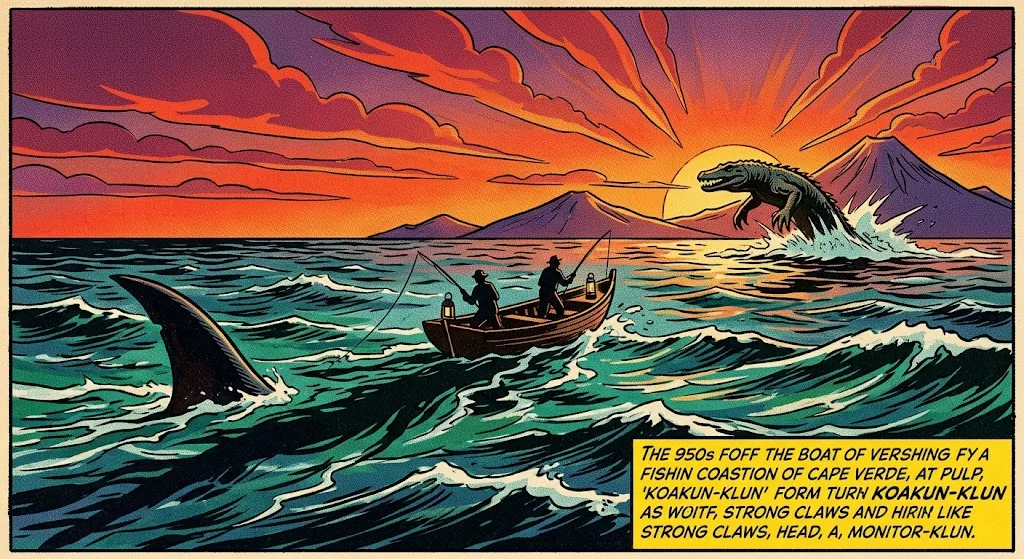
The creature most often labelled as Cape Verde’s cryptid is the Koakun-Klun, sometimes rendered as Coacun-Clune. Modern cryptid listings describe it as a semi-aquatic, crocodile-like or monitor-lizard-like beast living around the Cape Verde islands, with a long body, strong claws, a blue forked tongue, lungs, and a habit of leaping from the sea or dragging prey underwater.[fandom.com]cryptidz.fandom.comCryptid Wiki Koakun-KlunCryptid Wiki Koakun-Klun
Those details make it memorable, but they also raise immediate problems. The sources that circulate the Koakun-Klun are mostly user-edited cryptid wikis, social posts, art pages, and derivative monster lists. They tend to repeat one another, often without identifying an original witness, date, island, newspaper report, field collector, museum specimen, or local-language source. A New Bedford Fishing Heritage Center school programme, for example, includes “Cape Verde’s Koakun-Klun” alongside the Kraken as a sea-monster teaching example, which shows the creature has entered educational and pop-culture circulation, but not that it rests on a strong historical case file.[New Bedford Fishing Heritage Center]fishingheritagecenter.orgOpen source on fishingheritagecenter.org.
The creature’s design also looks suspiciously like a collage of familiar monster ingredients. Crocodiles “death roll”; monitor lizards have claws, forked tongues and reptilian menace; whales and large fish breach the sea surface; and old sea-serpent reports often become more dramatic as they are retold. Cabo Verde’s real reptile fauna does not support a native crocodile-sized aquatic lizard: the terrestrial reptiles known from the archipelago are geckos, skinks and related island reptiles, while the coasts host sea turtles.[Wikipedia]WikipediaList of reptiles of Cape VerdeList of reptiles of Cape Verde
That does not make the Koakun-Klun worthless as folklore. It is useful because it shows how modern cryptid culture works. A country with strong maritime identity but few globally famous monster legends can acquire a “national cryptid” through online repetition. Over time, the creature gains a profile: a name, a shape, a habitat, an attack style, a size range, and fan art. What it still lacks is the harder material that would move it from internet cryptid to historically traceable Cape Verdean beast tradition.
What older Cape Verdean folklore actually preserves
The most important older source for Cape Verdean oral tradition is Elsie Clews Parsons’s two-volume Folk-lore from the Cape Verde Islands, published in 1923 by the American Folklore Society with the Hispanic Society of America. Archive and catalogue records identify it as a major collection of Cape Verdean tales, with English texts and Cape Verdean Creole material, gathered from Cape Verdean immigrants in Massachusetts and Rhode Island during the summers of 1916 and 1917.[archive.org]archive.orgOpen source on archive.org.
That collection matters because it gives Cape Verde’s monster material a firmer base than many modern cryptid pages. It is not a monster-hunter’s dossier, but a folklore collection: tales of witches, kings, enchanted figures, animal helpers, dangerous beings, magical transformations and story types shared across Portuguese, African and Atlantic traditions. Searchable records and later tale-index references show Parsons’s Cape Verdean material included mermaid motifs, animal-marriage tales, enchanted princes, and stories in which scales, feathers or horns summon animal helpers.[archive.org]archive.orgOpen source on archive.org.
This distinction is important. A folktale creature is not the same as a cryptid report. In folklore, a mermaid, witch, beast-husband or dragon-like enemy may express danger, desire, taboo, migration, family conflict or moral testing. It does not need to be a zoological claim. Cape Verde’s older monster-adjacent material therefore sits closer to Atlantic folk narrative than to modern eyewitness cryptozoology.
Even so, these older materials help explain why later sea-monster stories can feel locally plausible. Cabo Verde was historically shaped by Portuguese colonisation, West African enslavement, Atlantic migration, drought and seafaring. The islands were reported as uninhabited at Portuguese arrival in the 15th century, then settled by Europeans and enslaved Africans, creating a creole society with oral traditions drawn from several worlds.[Cape Verdean Museum]capeverdeanmuseum.orgOpen source on capeverdeanmuseum.org. In that setting, stories about dangerous waters, uncanny beings, animal helpers and ambiguous sea creatures had many routes by which to travel, mutate and settle.
Mermaid-like beings and the haunted Atlantic
The clearest creature type with a natural home in Cape Verde is not a land monster, but the mermaid or sea-being. A Cape Verdean folklore explainer aimed at travellers describes “Odjo d’Água” as a fishermen’s tale of mermaid-like marine beings, beautiful and elusive, associated with coastal waters and sometimes imagined in relationships with humans.[Sal Cabo Verde]salcaboverde.comSal Cabo Verde Cape Verdean Folklore: Tales and Legends of the IslandsSal Cabo Verde Cape Verdean Folklore: Tales and Legends of the Islands This is a secondary, tourism-facing source rather than a scholarly primary record, so it should be handled carefully; still, it matches a broader Atlantic pattern in which mermaid and water-spirit traditions cluster around fishing, drowning risk, desire, and the uncertain boundary between land and sea.
There is also a practical reason mermaid stories persist in island cultures. The sea is both provider and threat. A fishing community may experience abundance, loss, sudden weather, disappearances, strange lights, unfamiliar carcasses, and half-seen animals at the surface. A mermaid-like being gives that uncertainty a face. It can warn children away from dangerous water, explain a fisher’s disappearance, dramatise temptation, or turn the ocean itself into a character.
Cape Verde’s real marine life adds texture to these stories without proving them. Boa Vista’s biodiversity material records turtles, cetaceans, birds, sharks and marine invertebrates; it also notes 24 cetacean species observed in the archipelago, including humpback whales that migrate to waters between Sal, Boa Vista, Maio and Santiago from March to May.[Cabo Verde Natura 2000]caboverdenatura2000.orgOpen source on caboverdenatura2000.org. Project Biodiversity describes Cabo Verde as an important refuge for sharks and rays, with more than sixty species in its tropical North Atlantic waters, while other conservation work estimates at least fifty shark and ray species, including tiger shark, whale shark, oceanic manta ray and scalloped hammerhead.[Project Biodiversity 2025]projectbiodiversity.orgthe ultimate guide to wildlifethe ultimate guide to wildlife
For a monster tradition, that matters. A surfacing whale, a ray seen in poor light, a shark in shallow water, a turtle at night, or a decomposing carcass on a beach can all become strange when filtered through fear, distance, darkness and retelling. Cape Verde does not need a hidden reptile to generate sea-monster talk; the actual Atlantic already supplies large, rare, dramatic animals.
Why the islands favour sea monsters over forest beasts
Many famous cryptids depend on forests, lakes, swamps or remote mountains. Cape Verde’s ecological stage is different. The islands are volcanic, dry in many places, and surrounded by productive Atlantic waters. They have striking landscapes, including mountains and Fogo’s volcano, but they do not have the large inland wilderness, deep freshwater lakes, crocodile rivers or dense equatorial forest that usually support rumours of giant land animals.[EBSCO]ebsco.comOpen source on ebsco.com.
That environmental fact shapes the folklore. The most plausible Cape Verdean mystery-beast traditions are coastal: sea serpents, mermaids, monstrous fish, giant turtles, sharks, rays, whales, and strange things seen from boats. The sea is where surprise lives. It is also where evidence disappears. A witness may glimpse a fin, neck, hump or tail for seconds; then the animal dives, the water closes, and the story must do the rest.
This helps explain why the Koakun-Klun is usually placed “on and near” the islands rather than in a named cave, river or forest. Its setting is the ambiguous shoreline: not fully marine, not fully terrestrial, half crocodile, half lizard, behaving like a whale, shark or reptile depending on the version.[Paranormal Strange]paranormal-strange.fandom.comParanormal Strange Koakun-klunParanormal Strange Koakun-klun It is almost a perfect internet sea monster for an archipelago: specific enough to draw, vague enough to relocate, and exotic enough to stand apart from better-known European sea serpents.
The weakness is the lack of local anchoring. A strong country-level cryptid usually has named lakes, villages, dates, newspapers, hunters, fishers, or repeated witness clusters. For Cape Verde, the better-documented place names in public travel and wildlife writing are ecotourism locations rather than monster hotspots: Boa Vista for turtles and whales, Sal for beach tourism and diving, Santiago for history and terrain, Fogo for the volcano, Santo Antão for mountain walking, and São Vicente for Mindelo’s cultural life.[The Times]thetimes.comThe Times Which is the best Cape Verde island? Here's how to chooseSal and Boa Vista are the most popular for tourists, featuring luxurious all-inclusive resorts and golden beaches with plenty of acti…
Misidentification is the strongest explanation
The sceptical explanation for Cape Verde’s monster claims is not that witnesses are foolish. It is that marine perception is hard. Open water distorts scale. Waves hide most of an animal’s body. A line of dolphins can look like one long creature. A whale’s back, fluke and blow can appear in separate pieces. A ray or shark in shallow water can look monstrous from above. A turtle seen at night may seem larger or stranger than it is. A decomposing carcass can lose the features that would make it recognisable.
Sea-serpent scholarship has long noted that many historical reports are shaped by ordinary animals seen under extraordinary conditions. Studies of famous sea-serpent accounts have examined cetaceans, entangled animals, carcasses, misread marine behaviour and cultural expectation as possible explanations.[Anthropocenes]anthropocenes.netImaginary 'Sea Serpents' from the 'Dark Continent' RevealImaginary 'Sea Serpents' from the 'Dark Continent' Reveal Cape Verde’s case fits that pattern better than it fits the discovery of a new crocodile-sized amphibious reptile.
The Koakun-Klun’s body plan is especially vulnerable to this reading. A “crocodile-monitor” form does not match Cabo Verde’s known native reptile fauna, but its individual features can be borrowed from familiar animals: claws and forked tongue from lizards, the underwater attack from crocodile lore, breaching from whales or large fish, and the terrifying sea habitat from older sea-serpent tradition.[wikipedia.org]WikipediaList of reptiles of Cape VerdeList of reptiles of Cape Verde
There is one extinct local reptile worth mentioning carefully: the Cape Verde giant skink, an unusually large island skink that survived into historical times before disappearing in the early 20th century. It was not a crocodile-sized sea monster, but its existence shows how islands can produce striking reptile forms and how extinction can leave cultural memory behind.[Wikipedia]WikipediaList of reptiles of Cape VerdeList of reptiles of Cape Verde A modern Koakun-Klun claim should not be reduced to the giant skink, yet readers can see how real island reptiles, half-remembered or exaggerated, might contribute to monster imagery.
Tourism, pop culture and the making of a national cryptid
Cape Verde’s monster lore now circulates in two different public worlds. One is heritage and tourism: folklore articles, hotel names, island guides, music, fishing culture, and wildlife experiences. The other is online cryptid culture: wikis, fan art, monster-rating videos, social posts and school activities that organise global creatures by country. The Koakun-Klun thrives mainly in the second world.[deviantart.com]deviantart.comOpen source on deviantart.com.
That is not unusual. Many modern cryptids become “national” only after being sorted into global lists. Once a creature is assigned to a country, artists give it a stable look, writers repeat its powers, and educators use it as a colourful example of oral tradition. The process can be creative and enjoyable, but it can also flatten local culture. A creature may be presented as if it had centuries of continuous island testimony when the accessible evidence is actually recent, derivative and thin.
Cape Verde’s more visible wildlife tourism has a stronger evidence base. Turtle nesting, whale watching, diving, shark and ray conservation, and island ecotourism are all grounded in living ecosystems.[projectbiodiversity.org]projectbiodiversity.orgOpen source on projectbiodiversity.org. In a public-facing cryptid article, that contrast is useful: the real animals are often more impressive than the invented monster, and they explain why the invented monster feels possible.
The best Cape Verde monster page should therefore resist the temptation to oversell. The country’s strange-animal tradition is not a tidy list of confirmed lake monsters and newspaper flaps. It is a layered maritime imagination: old folktales, mermaid motifs, fishermen’s warnings, real Atlantic megafauna, extinct island reptiles, and a modern internet beast that has become Cape Verde’s best-known cryptid almost by repetition.
What can actually be said with confidence
Cape Verde has no well-supported, mainstream evidence for an undiscovered large amphibious reptile or confirmed sea monster. The Koakun-Klun is best treated as a modern cryptid entry attached to the archipelago, not as a documented zoological case. Its sources are interesting for pop-culture afterlife, but weak for historical reconstruction.[fandom.com]cryptidz.fandom.comCryptid Wiki Koakun-KlunCryptid Wiki Koakun-Klun
The older and stronger evidence points towards folklore rather than cryptozoology. Parsons’s 1923 collection confirms a rich Cape Verdean oral tradition, including magical and animal-related tale types, while later references and tourism-facing folklore writing show that mermaid-like sea beings remain an accessible part of the islands’ mythic image.[archive.org]archive.orgOpen source on archive.org.
The most plausible natural explanations for Cape Verdean sea-monster material are misidentified marine animals, exaggerated fishing stories, imported or blended Atlantic folklore, and modern online elaboration. This does not make the stories meaningless. It makes them island stories: shaped by distance, danger, migration, memory and the Atlantic itself.
For readers looking for Cape Verde’s “monster”, the honest answer is that the monster is less a single beast than a tradition of sea-haunting imagination. The Koakun-Klun gives that tradition a modern reptilian face. The mermaid-like water beings give it older folklore depth. The whales, turtles, sharks and rays give it a living ecological background. Together, they make Cape Verde a small but revealing case in how cryptids are built: not only from sightings, but from place, sea, story and repetition.
eBay marketplace picks
Marketplace Samples
Example marketplace items related to this page. Use the search link to explore similar finds on eBay.
Endnotes
1.
Source: caboverdenatura2000.org
Link:https://caboverdenatura2000.org/en/biodiversity/
2.
Source: Wikipedia
Title: List of reptiles of Cape Verde
Link:https://en.wikipedia.org/wiki/List_of_reptiles_of_Cape_Verde
3.
Source: Wikipedia
Title: Wildlife of Cape Verde
Link:https://en.wikipedia.org/wiki/Wildlife_of_Cape_Verde
4.
Source: archive.org
Link:https://archive.org/details/folklorefromcape01pars
5.
Source: catalog.hathitrust.org
Link:https://catalog.hathitrust.org/Record/006930870
6.
Source: jstor.org
Link:https://www.jstor.org/stable/534965
7.
Source: archive.org
Link:https://archive.org/download/folklorefromcape01pars/folklorefromcape01pars.pdf
8.
Source: Wikipedia
Title: Swan maiden
Link:https://en.wikipedia.org/wiki/Swan_maiden
9.
Source: Wikipedia
Title: The Three Enchanted Princes
Link:https://en.wikipedia.org/wiki/The_Three_Enchanted_Princes
10.
Source: ebsco.com
Link:https://www.ebsco.com/research-starters/social-sciences-and-humanities/cape-verde-cabo-verde
11.
Source: anthropocenes.net
Title: Imaginary ‘Sea Serpents’ from the ‘Dark Continent’ Reveal
Link:https://www.anthropocenes.net/article/931/galley/4830/view/
12.
Source: seaworld.org
Link:https://seaworld.org/animals/facts/reptiles/crocodile-monitor/
13.
Source: deviantart.com
Link:https://www.deviantart.com/oxalaiafanboy/art/Koakun-Klun-1283285467
14.
Source: youtube.com
Link:https://www.youtube.com/watch?v=phn0uzstjcw
15.
Source: Wikipedia
Title: Cape (geography)
Link:https://en.wikipedia.org/wiki/Cape_%28geography%29
16.
Source: Wikipedia
Title: Sea serpent
Link:https://en.wikipedia.org/wiki/Sea_serpent
17.
Source: Wikipedia
Title: Cape Verde
Link:https://en.wikipedia.org/wiki/Cape_Verde
18.
Source: Wikipedia
Title: History of Cape Verde
Link:https://en.wikipedia.org/wiki/History_of_Cape_Verde
19.
Source: Wikipedia
Title: Jesper Who Herded the Hares
Link:https://en.wikipedia.org/wiki/Jesper_Who_Herded_the_Hares
20.
Source: Wikipedia
Title: Varanus salvadorii
Link:https://en.wikipedia.org/wiki/Varanus_salvadorii
21.
Source: cape.co
Link:https://www.cape.co/
22.
Source: cape.ca
Link:https://cape.ca/
23.
Source: cape.ca
Title: About us
Link:https://cape.ca/about-us/
24.
Source: jstor.org
Link:https://www.jstor.org/stable/3819045
25.
Source: jstor.org
Link:https://www.jstor.org/stable/3818925
26.
Source: jstor.org
Link:https://www.jstor.org/stable/pdf/540390.pdf
27.
Source: youtube.com
Link:https://www.youtube.com/watch?v=OgBPzzSwrmk
28.
Source: youtube.com
Link:https://www.youtube.com/watch?v=_kyi-c_CQNI
29.
Source: youtube.com
Link:https://www.youtube.com/watch?v=0DxpwGsvIMA
30.
Source: youtube.com
Link:https://www.youtube.com/watch?v=qJK5Y27xBOg
31.
Source: cabo-verde.cv
Title: shadows of cabo verde legends myths of the islands
Link:https://cabo-verde.cv/shadows-of-cabo-verde-legends-myths-of-the-islands/
32.
Source: cabo-verde.cv
Title: cape verdean superstitions a guide to local customs beliefs
Link:https://cabo-verde.cv/cape-verdean-superstitions-a-guide-to-local-customs-beliefs/
33.
Source: cabo-verde.cv
Title: cape verdes blue sharks launch marine conservation mission
Link:https://cabo-verde.cv/cape-verdes-blue-sharks-launch-marine-conservation-mission/
34.
Source: youtube.com
Title: Cape Verde
Link:https://www.youtube.com/watch?v=7iZhMkCWZNw
Source snippet
Snorkeling Adventure (Boa Vista, Cape Verde)...
35.
Source: youtube.com
Title: Snorkeling Adventure (Boa Vista, Cape Verde)
Link:https://www.youtube.com/watch?v=DKVnkSODgfg
Source snippet
From Portugal to Creole: The Untold Story of Cabo Verde's People & Culture...
36.
Source: youtube.com
Title: From Portugal to Creole: The Untold Story of Cabo Verde’s People & Culture
Link:https://www.youtube.com/watch?v=YPT0v8hcxwo
Source snippet
Our Islands, Our Oceans - Cabo Verde...
37.
Source: youtube.com
Title: Our Islands, Our Oceans
Link:https://www.youtube.com/watch?v=Ey-RTS5Ljjk
Source snippet
CAPE VERDE: The Hidden Paradise You Know Nothing About...
38.
Source: youtube.com
Title: CAPE VERDE: The Hidden Paradise You Know Nothing About
Link:https://www.youtube.com/watch?v=QKU9RQ2zoNY
39.
Source: worldbank.org
Link:https://www.worldbank.org/ext/en/country/caboverde
40.
Source: projectbiodiversity.org
Title: the ultimate guide to wildlife
Link:https://www.projectbiodiversity.org/the-ultimate-guide-to-wildlife
41.
Source: cryptidz.fandom.com
Title: Cryptid Wiki Koakun-Klun
Link:https://cryptidz.fandom.com/wiki/Koakun-Klun
42.
Source: paranormal-strange.fandom.com
Title: Paranormal Strange Koakun-klun
Link:https://paranormal-strange.fandom.com/wiki/Koakun-klun
43.
Source: fishingheritagecenter.org
Link:https://fishingheritagecenter.org/learn/school-programs/
44.
Source: capeverdeanmuseum.org
Link:https://capeverdeanmuseum.org/history
45.
Source: salcaboverde.com
Title: Sal Cabo Verde Cape Verdean Folklore: Tales and Legends of the Islands
Link:https://salcaboverde.com/cape-verdean-folklore-tales-and-legends-of-the-islands/
46.
Source: thetimes.com
Link:https://www.thetimes.com/travel/destinations/africa-travel/cape-verde/best-things-to-do-in-cape-verde-pcsqm93tc
Source snippet
Adventure seekers can enjoy surfing, kitesurfing, diving, dune buggy tours, and volcano hiking, especially on islands like Sal, Boa Vista...
47.
Source: thetimes.com
Title: The Times Which is the best Cape Verde island? Here’s how to choose
Link:https://www.thetimes.com/travel/destinations/africa-travel/cape-verde/which-is-the-best-cape-verde-island-0l9qh6tcw
Source snippet
**Sal and Boa Vista** are the most popular for tourists, featuring luxurious all-inclusive resorts and golden beaches with plenty of acti...
48.
Source: projectbiodiversity.org
Link:https://www.projectbiodiversity.org/
49.
Source: data.worldbank.org
Title: cabo verde
Link:https://data.worldbank.org/country/cabo-verde
50.
Source: documents.worldbank.org
Link:https://documents.worldbank.org/en/publication/documents-reports/documentdetail/099011425053533766
51.
Source: documents1.worldbank.org
Title: orgcabo verde
Link:https://documents1.worldbank.org/curated/en/099011425053533766/pdf/P500457-ab149c65-20d3-4583-bd20-e73fbf70a940.pdf
52.
Source: openknowledge.worldbank.org
Link:https://openknowledge.worldbank.org/entities/publication/7fa21da5-8027-44e9-bbd7-fc42b9ab9706
53.
Source: fauna-flora.org
Title: cabo verde
Link:https://www.fauna-flora.org/countries/cabo-verde/
54.
Source: instagram.com
Link:https://www.instagram.com/reel/DabHnaXRx-4/
55.
Source: openfactbook.org
Title: Cabo Verde
Link:https://openfactbook.org/countries/cabo-verde/
56.
Source: facebook.com
Link:https://www.facebook.com/WorldBankAfrica/posts/exciting-times-celebrating-caboverdes-50-years-of-independence-development-journ/1116834357138899/
57.
Source: 2017-2021.state.gov
Title: cabo verde
Link:https://2017-2021.state.gov/countries-areas/cabo-verde/
58.
Source: dragons.fandom.com
Title: Sea serpent
Link:https://dragons.fandom.com/wiki/Sea_serpent
59.
Source: myl.fandom.com
Title: Koakun Klun
Link:https://myl.fandom.com/es/wiki/Koakun-Klun
60.
Source: wildlife-animal-pedia.fandom.com
Title: Crocodile Monitor
Link:https://wildlife-animal-pedia.fandom.com/wiki/Crocodile_Monitor
61.
Source: cbd.int
Title: Cabo Verde
Link:https://www.cbd.int/countries/profile/?country=cv
62.
Source: globaledge.msu.edu
Title: cabo verde
Link:https://globaledge.msu.edu/countries/cabo-verde
63.
Source: observation.org
Title: Cape Verde Giant Skink
Link:https://observation.org/species/913005/
64.
Source: capeverde.com
Link:https://www.capeverde.com/country-info/fauna
65.
Source: thebhs.org
Link:https://www.thebhs.org/publications/the-herpetological-bulletin/issue-number-92-summer-2005/2957-hb092-03/file
66.
Source: dictionary.cambridge.org
Link:https://dictionary.cambridge.org/dictionary/english/cape
67.
Source: portalrevistas.ucb.br
Link:https://portalrevistas.ucb.br/index.php/rl/article/download/3856/2975/17894
Additional References
68.
Source: academia.edu
Link:https://www.academia.edu/44739298/Myth_and_Folklore
69.
Source: academia.edu
Link:https://www.academia.edu/77811201/The_American_Folklore_Society
70.
Source: uplopen.com
Link:https://uplopen.com/chapters/1133/files/c0bac7e9-7d3a-44e8-85ba-43e1bcc9a6d1.pdf
71.
Source: reddit.com
Link:https://www.reddit.com/r/FolkloreAndMythology/comments/1oqczp4/ancestry_mythology_folklore/
72.
Source: discover-cape-verde.com
Link:https://www.discover-cape-verde.com/guide/animals-cape-verde/
73.
Source: merriam-webster.com
Link:https://www.merriam-webster.com/dictionary/cape
74.
Source: newibnet.org
Link:https://newibnet.org/country-profiles/cabo-verde
75.
Source: cape-educators.ca
Link:https://www.cape-educators.ca/
76.
Source: zootierliste.de
Link:https://www.zootierliste.de/en/?art=55007113&familie=30323&klasse=3&ordnung=303
77.
Source: instagram.com
Link:https://www.instagram.com/p/DZtkoLXCIWC/?hl=en
Topic Tree
Follow this branch
Related pages 192
- Antigua Cryptids
- Maldives Monsters
- Malta Monsters
- Qatar Monsters
- Argentina Monsters
- +187 more in sidebar