Cryptids of Jamaica's Roads and Rivers
Jamaica does not have a Loch Ness-style national monster backed by a long run of alleged photographs, expeditions and lake-watch reports.
Page outline Jump by section
Jamaica’s monster tradition is mostly folklore, not field zoology
A useful starting point is the word “duppy”. In Jamaican usage, a duppy is a ghost or spirit, and many of the island’s famous frightening beings are types of duppy rather than flesh-and-blood animals. Early twentieth-century folklore collector Martha Warren Beckwith recorded Jamaican spirit traditions in fieldwork, and later scholarship notes that she visited Jamaica repeatedly between 1919 and 1924, documenting stories, songs, proverbs, rites, children’s games, plant lore and folk religion at a time when Caribbean folk culture was often neglected by formal anthropology.[WRAP]wrap.warwick.ac.ukOpen source on warwick.ac.uk.
That matters for a cryptid page because Jamaica’s “monsters” often sit in a borderland. They look animal-like, appear in specific habitats and are spoken about as things one might meet on a road or near water, but they behave like moral spirits. The Rolling Calf may be described as a bull, goat or calf; the River Mumma as a mermaid or water creature; the Ol’ Hige as an owl-like night attacker. Yet their stories are usually about danger, greed, punishment, death, spiritual power and social memory, not about a breeding population of unknown animals.
Jamaican storytelling also has a strong recognised place in national culture. The Jamaica Information Service describes Anancy stories as among the best-known and oldest Jamaican cultural tales, with roots in Akan culture and a life in post-slavery free villages, households, song and performance.[Jamaica Information Service]jis.gov.jmOpen source on jis.gov.jm. The same storytelling world helps explain why creature legends remain vivid: these are not isolated “monster sightings” so much as stories passed through families, communities, performance, children’s warnings and local place-memory.
The Rolling Calf: Jamaica’s great roadside beast
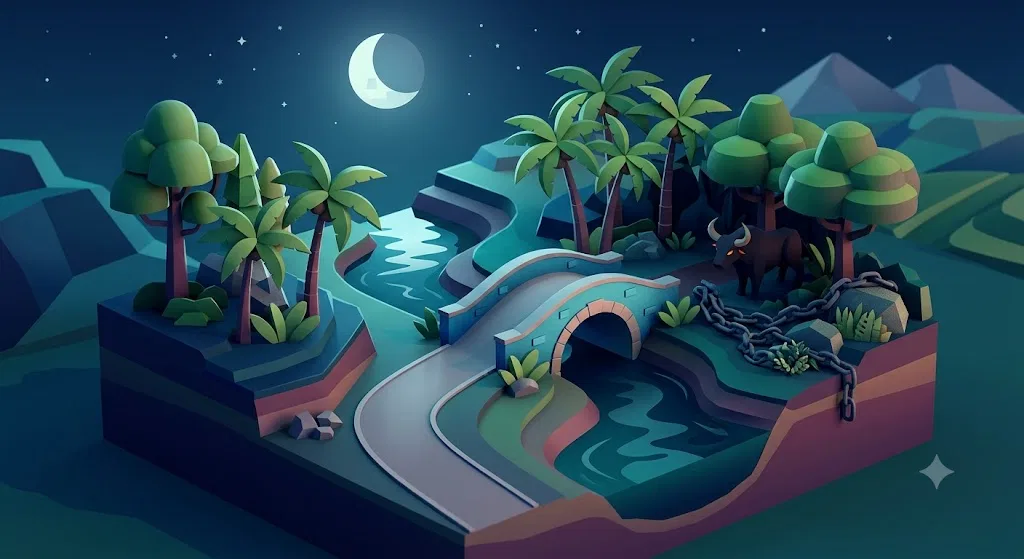
The Rolling Calf is the closest Jamaica comes to a classic land cryptid: a terrifying animal-shaped thing encountered at night, often on lonely country roads. In one modern Jamaican newspaper summary, it is a “huge, calf-like creature” that blocks night travellers, chases them, has blazing eyes, and drags a frightening chain behind it. The same account links the creature to the spirit of a dishonest butcher who cannot rest after death.[Jamaica Observer]jamaicaobserver.comJamaica Observer Glimpses of Jamaican FolkloreJamaica Observer Glimpses of Jamaican Folklore
Older folklore material gives the legend an even sharper shape. In Beckwith’s collected Jamaican material, a note describes the Rolling Calf as a duppy with fiery eyes, flames from its nostrils and a chain around its neck, whose rattling terrifies night travellers.[Internet Sacred Text Archive]sacred-texts.comInternet Sacred Text Archive Duppy Stories. | Internet Sacred Text ArchiveInternet Sacred Text Archive Duppy Stories. | Internet Sacred Text Archive This is a wonderfully compact monster image: not merely a bull in the road, but a supernatural warning sign that announces itself before it arrives.
The detail of the chain is especially important. On the surface, it makes the story frightening and memorable: a traveller hears metal dragging in the dark before seeing the beast. Symbolically, it also ties the creature to bondage, punishment and the afterlife of cruelty. In many tellings, the Rolling Calf is not random wildlife but transformed wickedness. It is what a bad person becomes, or what a spiritual worker may send, or what waits where ordinary rules fail.
For a sceptical reader, the Rolling Calf is not supported by the kind of evidence usually sought for an unknown animal: no accepted specimen, no reliable modern photographic record, no ecological niche for a large fire-breathing chain-dragging beast. Its consistency lies in folklore motifs: the night road, the frightening sound, the animal body, the moral backstory and the possibility of outwitting it. As a Jamaican cryptid tradition, it is powerful precisely because it makes social fear move like an animal.

The River Mumma: mermaid, river guardian and warning about dangerous water
If the Rolling Calf belongs to roads, the River Mumma belongs to water. She is usually described as a mermaid-like female spirit associated with rivers, deep pools and dangerous crossings. Modern summaries of Jamaican folklore describe her as a female spirit lurking at the source of Jamaican rivers, while other accounts place her in streams, lakes and river pools where she may lure, punish, protect or drown.[workandjam.com]workandjam.comOpen source on workandjam.com.
The most place-specific River Mumma tradition clusters around the Rio Cobre, Flat Bridge and Bog Walk Gorge in St Catherine. A Jamaica Observer essay describes the Rio Cobre and Flat Bridge as a landscape thick with myths and duppy stories, including the golden table and the River Mumma beneath one of Jamaica’s oldest bridges. It also notes two opposed strands of the legend: in some stories she pulls doomed cars into the water; in others she rescues passengers from death.[Jamaica Observer]jamaicaobserver.comJamaica Observer River Mumma: The Untamed Potential of JamaicaJamaica Observer River Mumma: The Untamed Potential of Jamaica
That ambiguity is part of her appeal. The River Mumma is not just a simple “killer mermaid”. She can be a guardian of water, a test of greed, a sign of abundance, a reminder of deaths near a hazardous crossing, or a poetic image of Jamaica’s untamed potential. The golden comb and golden table motifs fit a wider pattern of water-spirit stories in which treasure appears near dangerous water and the greedy person who reaches for it risks being taken below.
A practical reading does not make the legend boring. Jamaica has many rivers, springs, blue holes and subterranean waterways, and the country profile for the Convention on Biological Diversity notes more than 100 streams and rivers, plus ponds, springs, blue holes and underground waterways.[Convention on Biological Diversity]cbd.intConvention on Biological Diversity Main DetailsConvention on Biological Diversity Main Details A culture with dramatic river gorges, flood-prone crossings and deep pools has good reason to tell memorable stories that make children and travellers treat water with respect.
Ol’ Hige, three-footed horses and other night beings
Not every Jamaican monster tradition is a cryptid in the animal-mystery sense, but several are creature-like enough to belong in the same conversation. The Ol’ Hige is a night hag figure: a witch or spirit who sheds her skin, takes an owl-like form and attacks sleeping victims, especially babies. A Jamaica Observer folklore summary traces the figure back to West African influence and describes the familiar protective countermeasure of salting or peppering the discarded skin so she cannot re-enter it.[Jamaica Observer]jamaicaobserver.comJamaica Observer Glimpses of Jamaican FolkloreJamaica Observer Glimpses of Jamaican Folklore
The three-footed horse appears in lists of particular duppies alongside the Rolling Calf, another example of a spirit that takes an animal form and haunts travel routes or night spaces. These beings are not usually investigated as possible undiscovered species because their defining traits are supernatural: odd numbers of limbs, shape-shifting, spirit origin, magical weakness, selective appearances and moral purpose.
Still, they matter to a country-level cryptid history because they show how Jamaican monster lore works. The terrifying being often appears where a person is vulnerable: on the road at night, in bed, near a river, at a bridge, in a lonely rural place or in a space associated with death. The creature is a story technology for danger. It gives fear a body.
Where reports and memories cluster
Jamaican mystery-creature traditions are strongly tied to landscape rather than to a single “sighting flap”. The main clusters are not formal case files but recurring story-settings:
Lonely roads and crossroads: The Rolling Calf is most at home on dark rural roads, where the sound of its chain becomes a warning before the creature itself appears. This setting also reflects older travel realities: walking at night, poor lighting, animal noises, dangerous paths and the heightened imagination of a journey after dark.
Rivers, bridges and deep pools: The River Mumma belongs to freshwater places, especially stories around the Rio Cobre, Flat Bridge and Bog Walk Gorge. Her legend makes dangerous water memorable and morally charged: the river is not just a hazard, but a place with a will.
Cotton trees, bamboo, caves and old ruins: Duppy lore often attaches itself to places that already feel uncanny: large old trees, abandoned buildings, caves, former plantation spaces and thickets where visibility is poor. Such locations naturally produce noises, shadows and animal movements that can be folded into supernatural interpretation.
Plantation and post-slavery memory: Many Jamaican ghost-creature traditions carry the emotional weight of slavery, punishment, hidden violence and unresolved death. The chain of the Rolling Calf and the haunted bridge or river are not incidental props; they make the monster part of historical memory.
What real animals might explain some sightings?
Jamaica’s actual wildlife is distinctive, but it does not offer much support for large unknown land beasts. The Natural History Museum of Jamaica says the island has more than 8,000 recorded animal species, high endemism, over 300 bird species, 33 endemic reptile species, 21 endemic frog species and 21 bat species, with bats making up more than 75% of native land mammals.[Natural History Museum of Jamaica]nhmj-ioj.org.jmNatural History Museum of Jamaica -Do You KnowNatural History Museum of Jamaica -Do You Know That is a fascinating ecological setting, but not one that points towards hidden big cats, apes or unknown hoofed predators.
Some misidentification pathways are plausible:
Cattle, goats, pigs and dogs at night: A startled traveller seeing livestock in low light could produce a story of an abnormal beast, especially if bells, chains, fences or dragging debris are involved. A bull or goat glimpsed on a road is a more plausible seed for a Rolling Calf encounter than an unknown species.
Bats and owls: Jamaica’s bat diversity and nocturnal bird life can help explain some winged or night-hag impressions, especially around houses, trees and caves. This does not “explain away” the Ol’ Hige as a single animal, but it shows how night flight, sudden movement and sleeping fear can feed the legend.
Crocodiles in water: The American crocodile is real in Jamaica and legally protected. Jamaica’s National Environment and Planning Agency, through JIS reporting, lists the American crocodile among protected species and says NEPA studies crocodile numbers, distribution and movement while identifying wetland sanctuaries.[Jamaica Information Service]jis.gov.jmOpen source on jis.gov.jm. A large crocodile near a river mouth, wetland or coastal channel could easily become a monster report if seen briefly, especially by someone already primed by River Mumma or river-duppy stories.
Introduced mammals and ecological disruption: The small Indian mongoose is a famous introduced animal in Jamaica. A 2023 Cambridge University Press article describes how mongooses were introduced in 1872 to control rats in sugar plantations, then preyed on native birds and reptiles and contributed to ecological problems that became widely discussed in colonial Jamaica.[Cambridge University Press & Assessment]cambridge.orgUniversity Press & Assessment A plague of weasels and ticks: animalUniversity Press & Assessment A plague of weasels and ticks: animal Although mongooses are too small to explain a Rolling Calf, their history is a reminder that unfamiliar or introduced animals can quickly acquire cultural meanings beyond their size.
Why Jamaica has fewer “unknown animal” cryptids than some countries
Some countries have cryptid traditions built around vast forests, mountain wilderness, large lakes or sparsely surveyed habitats. Jamaica is different. It has rugged mountains, caves, forests, wetlands and coastal waters, but it is also a relatively small island with a long history of settlement, plantation agriculture, roads, hunting, natural-history collecting and environmental monitoring.
That does not mean every species is known in a casual sense. Jamaica’s biodiversity is rich, and caves, reefs, forests and wetlands can still hold surprises, especially among small animals, invertebrates, reptiles, amphibians and bats. But the likelihood of an undiscovered large land animal is low compared with the likelihood of folklore, misidentified known animals, night-time perception, oral tradition and symbolic storytelling.
The strongest Jamaican “cryptids” therefore are not failed zoological hypotheses. They are successful legends. The Rolling Calf survives because it makes darkness, guilt and danger audible. The River Mumma survives because she gives rivers a face, a temper and a memory. Ol’ Hige survives because night fears and infant vulnerability have never stopped being human concerns.
The changing story around Jamaica’s cryptid traditions
Older Jamaican folklore collections often present these beings as living belief: things people knew how to avoid, recognise or resist. The stories were practical as well as entertaining. They warned people about night roads, water, greed, unsafe places, strangers, spiritual danger and wrongdoing.
Modern versions often shift tone. Newspapers, heritage features, blogs, tourism writing and social media retell the creatures as cultural icons. The River Mumma becomes a metaphor for Jamaican beauty, danger and abundance; the Rolling Calf becomes a Halloween-ready monster; Anancy becomes a symbol of wit and resilience. The Jamaica Information Service notes that Anancy stories moved from post-slavery village nights into households and wider cultural performance, and that storytelling remains central to Jamaican cultural expression.[Jamaica Information Service]jis.gov.jmOpen source on jis.gov.jm.
This afterlife is not a loss of authenticity. Folklore changes by being retold. What matters is not whether every modern retelling matches an older field note, but whether the creature still does cultural work. In Jamaica, these beings still mark certain places as charged, certain behaviours as risky and certain histories as unfinished.

How to read Jamaican monster stories fairly
The fairest approach is neither to mock the stories nor to pretend they prove unknown animals. A Jamaican creature account can be several things at once: a childhood warning, a place legend, a ghost story, a memory of danger, a coded historical image, a misidentified animal encounter, a performance piece and a community joke.
For readers interested in cryptids, the key distinction is evidence type. The Rolling Calf and River Mumma have strong folkloric evidence: repeated motifs, named places, older collections, living retellings and cultural recognition. They do not have strong zoological evidence: no bodies, no confirmed tracks, no credible biological mechanism for fire-breathing spirits, no stable population data and no need to posit a new species.
That does not make them less worth studying. It makes them Jamaican in a very specific way. The island’s mystery creatures are not hidden in the manner of a shy ape or lake animal. They are hidden in speech, memory, fear, landscape and performance. Their tracks are not footprints in mud but recurring images: chains on a dark road, hair combed by a river, wings at a bedroom window, a bridge with too many stories attached to it.
The main Jamaican creatures at a glance
FigureUsual formMain settingBest readingRolling CalfFiery-eyed calf, bull or goat-like duppy with a chainLonely roads, night journeys, rural darknessRoadside spirit, moral monster, fear of night travelRiver MummaMermaid-like water spirit or river guardianRivers, deep pools, Rio Cobre, Flat BridgeWater-spirit folklore, danger warning, symbol of abundance and lossOl’ HigeSkin-shedding night hag, sometimes owl-likeBedrooms, night, vulnerable sleepersNight terror figure, infant-protection warning, West African-derived folkloreThree-footed horseAbnormal horse-like duppyRoads and haunted night spacesAnimal-shaped spirit rather than unknown animalDuppy animals more broadlyGhostly beings taking animal or hybrid formsTrees, ruins, roads, caves, graveyards, old settlementsSpirit folklore with animal imagery
Conclusion
Jamaica’s cryptid map is not dominated by a single lake monster, ape-man or phantom cat. It is dominated by duppy logic: spirits that borrow animal bodies, water beings that guard dangerous places, and night creatures that turn moral lessons into unforgettable images. The Rolling Calf and River Mumma are the central figures because they feel almost physical. One can hear the chain. One can picture the river. Yet the evidence places them most securely in folklore, not zoology.
That is not a weakness. Jamaica’s monster tradition is valuable because it shows how creature stories can preserve more than fear. They preserve routes, rivers, bridges, work, danger, slavery’s echoes, family warnings, performance, humour and the stubborn pleasure of a strange story told after dark.
Amazon book picks
Further Reading
Books and field guides related to What Monsters Haunt Jamaica's Roads and Rivers?. Use these as the next step if you want deeper reading beyond the article.
Jamaican Folk Tales and Oral Histories
Covers duppies, spirits, landscape legends and oral traditions central to Jamaican monster lore.
The Book of Yokai
Explains how folklore creatures function culturally, useful for comparing cryptid-like traditions.
The Encyclopedia of Ghosts and Spirits
Helps readers explore ghost and spirit traditions similar to duppy beliefs.
Caribbean Folklore
Provides wider Caribbean context for Jamaican spirits and monsters.
eBay marketplace picks
Marketplace Samples
Live-tested eBay searches with available results related to this page.
Endnotes
1.
Source: workandjam.com
Link:https://www.workandjam.com/news/jamaican-folklore.htm
2.
Source: cambridge.org
Title: University Press & Assessment A plague of weasels and ticks: animal
Link:https://www.cambridge.org/core/journals/british-journal-for-the-history-of-science/article/plague-of-weasels-and-ticks-animal-introduction-ecological-disaster-and-the-balance-of-nature-in-jamaica-18701900/111337F9B312A6994CBE64FCEF46E963
3.
Source: archive.org
Link:https://archive.org/download/blackroadwaysstu03beck/blackroadwaysstu03beck.pdf
4.
Source: archive.org
Link:https://archive.org/details/blackroadwaysstu03beck
5.
Source: youtube.com
Title: Rolling Calf | Jamaican Folklore | Terrifying Duppy Story
Link:https://www.youtube.com/watch?v=t5jpbwkGPpw
Source snippet
The Haunting of Rolling Calf Hollow | Jamaican Folktale | Mi A Story Man...
6.
Source: wrap.warwick.ac.uk
Link:https://wrap.warwick.ac.uk/id/eprint/71099/
7.
Source: jis.gov.jm
Link:https://jis.gov.jm/information/get-the-facts/origin-anancynancy-stories/
8.
Source: jamaicaobserver.com
Title: Jamaica Observer Glimpses of Jamaican Folklore
Link:https://www.jamaicaobserver.com/2012/08/05/glimpses-of-jamaican-folklore/
9.
Source: sacred-texts.com
Title: Internet Sacred Text Archive Duppy Stories. | Internet Sacred Text Archive
Link:https://sacred-texts.com/afr/jas/jas151.htm
10.
Source: jamaicaobserver.com
Title: Jamaica Observer River Mumma: The Untamed Potential of Jamaica
Link:https://www.jamaicaobserver.com/2019/01/26/river-mumma-the-untamed-potential-of-jamaica/
11.
Source: cbd.int
Title: Convention on Biological Diversity Main Details
Link:https://www.cbd.int/countries/profile/?country=jm
12.
Source: nhmj-ioj.org.jm
Title: Natural History Museum of Jamaica -Do You Know
Link:https://nhmj-ioj.org.jm/do-you-know/
13.
Source: jis.gov.jm
Link:https://jis.gov.jm/features/nepa-protects-countrys-wildlife/
14.
Source: jis.gov.jm
Link:https://jis.gov.jm/information/get-the-facts/storytelling-the-jamaican-experience/
15.
Source: nlj.gov.jm
Link:https://nlj.gov.jm/jamaican-proverbs-2/
16.
Source: raquelbahadoorsingh.wordpress.com
Title: river mumma
Link:https://raquelbahadoorsingh.wordpress.com/river-mumma/
17.
Source: thenyceffect.wordpress.com
Link:https://thenyceffect.wordpress.com/tag/caribbean/
18.
Source: natureandsupernaturalnature.wordpress.com
Title: river mumma
Link:https://natureandsupernaturalnature.wordpress.com/tag/river-mumma/
19.
Source: nepa.gov.jm
Link:https://www.nepa.gov.jm/index.php/reptile
20.
Source: nepa.gov.jm
Link:https://www.nepa.gov.jm/sites/default/files/2019-12/our_land_animals.pdf
21.
Source: wrap.warwick.ac.uk
Title: warwick.ac.uk Shadow worlds and “superstitions”
Link:https://wrap.warwick.ac.uk/71099/1/WRAP_THESIS_Sparkes_2015.pdf
22.
Source: Wikipedia
Title: Phantom cat
Link:https://en.wikipedia.org/wiki/Phantom_cat
23.
Source: Wikipedia
Link:https://en.wikipedia.org/wiki/Duppy
24.
Source: Wikipedia
Title: Martha Warren Beckwith
Link:https://en.wikipedia.org/wiki/Martha_Warren_Beckwith
25.
Source: catalog.hathitrust.org
Link:https://catalog.hathitrust.org/Record/001631370
26.
Source: my-island-jamaica.com
Link:https://www.my-island-jamaica.com/rolling_calf.html
27.
Source: megid.gov.jm
Link:https://megid.gov.jm/biodiversity-loss-the-case-for-protecting-our-ecosystems-and-wildlife/
28.
Source: cryptidz.fandom.com
Title: Rolling Calf
Link:https://cryptidz.fandom.com/wiki/Rolling_Calf
29.
Source: villains.fandom.com
Title: River Mumma
Link:https://villains.fandom.com/wiki/River_Mumma
30.
Source: forestry.gov.jm
Title: Faunal Report Dolphin Head
Link:https://www.forestry.gov.jm/resourcedocs/Faunal_Report_Dolphin_Head.pdf
31.
Source: michaelseanharris.substack.com
Title: the rolling calf
Link:https://michaelseanharris.substack.com/p/the-rolling-calf
Additional References
32.
Source: researchgate.net
Link:https://www.researchgate.net/publication/232018445_Cave_bats_in_Jamaica
33.
Source: instagram.com
Link:https://www.instagram.com/reel/DSBwH_qiJgR/?hl=en
34.
Source: researchgate.net
Link:https://www.researchgate.net/publication/355714743_The_Waters_Were_Made_for_Her_River_Mumma_beliefs_in_19th_and_20th_century_Jamaican_ethnographic_accounts
35.
Source: facebook.com
Link:https://www.facebook.com/Dexerto/posts/a-mystery-big-cat-has-been-spotted-roaming-the-english-countrysideexperts-believ/1611056191020021/
36.
Source: instagram.com
Link:https://www.instagram.com/reel/DKxdbfJui0R/
37.
Source: facebook.com
Link:https://www.facebook.com/sevensharp/posts/a-phantom-puma-or-just-a-fat-feral-cat-we-put-what-could-be-the-south-island-pan/10157516578707268/
38.
Source: instagram.com
Link:https://www.instagram.com/reel/DGdpIcwNAax/?hl=en
39.
Source: my-island-jamaica.com
Link:https://www.my-island-jamaica.com/are_mermaids_real_in_jamaica.html
40.
Source: facebook.com
Link:https://www.facebook.com/cvmtv/videos/authorities-remain-on-high-alert-following-the-mysterious-disappearance-of-a-rar/1907074183425651/
41.
Source: instagram.com
Link:https://www.instagram.com/reel/DB6OxTsOmlP/?hl=en
Topic Tree
Follow this branch
Related pages 192
- Antigua Cryptids
- Maldives Monsters
- Malta Monsters
- Qatar Monsters
- Argentina Monsters
- +187 more in sidebar