Cryptid Reports from Sri Lanka's Wild Places
Sri Lanka’s mystery-creature tradition is not dominated by a single famous lake monster or modern “Bigfoot” figure.
Page outline Jump by section
Introduction
The evidence is uneven. The Nittaewo story survives mainly through late nineteenth- and early twentieth-century accounts collected from local informants, not bones or specimens. The Devil Bird is probably rooted in the cries of real nocturnal birds. The black “panther”, once easy to dismiss as a jungle rumour, is firmly grounded in rare melanistic Sri Lankan leopards. Sri Lanka therefore offers an unusually clear lesson in how folklore, wildlife, fear, colonial recording and later cryptozoology can turn different kinds of uncertainty into “monsters”.[academia.edu]academia.eduOpen source on academia.edu.
The Nittaewo: Sri Lanka’s lost forest people
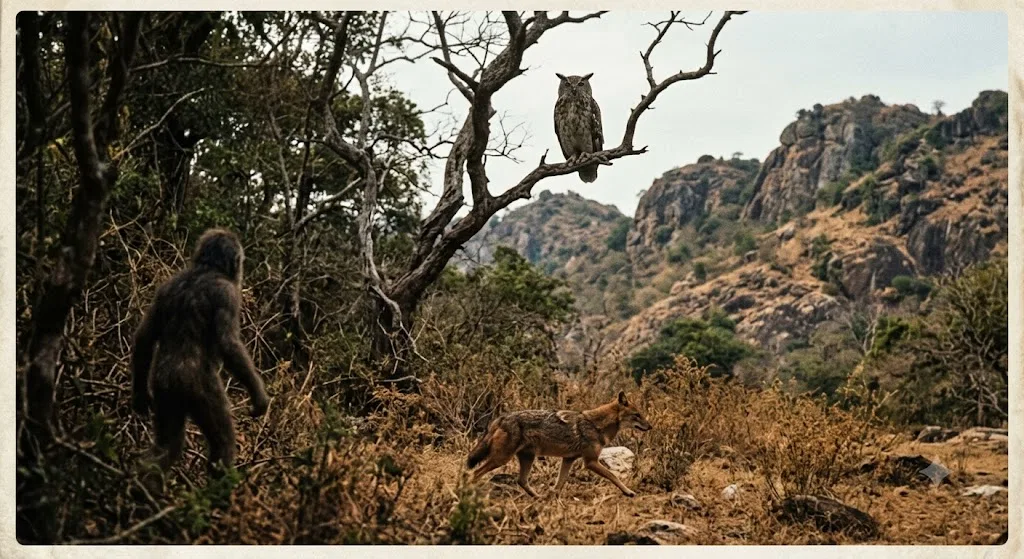
The Nittaewo are the closest thing Sri Lanka has to a classic hominid cryptid. They are usually described as short, upright, hairy beings with powerful arms and long nails or claws, once living in the remote forests of the island’s south-east. Unlike many modern ape-man tales, the oldest surviving version is not primarily a story about fleeting sightings. It is an extinction narrative: the creatures supposedly fought with local Vedda communities until they were driven into a cave or rock shelter, trapped inside and killed with fire.
The most influential written account was published by the British civil servant and antiquarian Hugh Nevill in the 1880s. Nevill did not claim to have encountered the beings himself. His version passed through several tellers, including a hunter who had heard the story from an elderly Vedda informant. That distance matters. It makes the account valuable as recorded oral tradition, but weak as zoological testimony. Later enquiries by Frederick Lewis in the early twentieth century reportedly found similar traditions among people in eastern and south-eastern Sri Lanka, giving the story a broader local footing without providing physical proof.[Academia]academia.eduOpen source on academia.edu.
Where the story belongs
The Nittaewo are chiefly associated with the sparsely populated forests, caves and rocky country of eastern Uva and the south-east, including areas around Lenama, Panama and Kudumbigala. This landscape has helped the legend endure. Dry forest, scrub, isolated rock formations and poor visibility make it easy to imagine a small population surviving beyond settled land.
The geography also reflects the people who preserved the story. Vedda communities possessed detailed knowledge of local animals, seasonal resources and forest routes, but colonial collectors often presented their accounts through a European framework of “primitive tribes”, lost races and evolutionary survivals. The Nittaewo consequently moved from local memory into a late Victorian debate about whether unknown human or ape-like populations might still exist.[Academia]academia.eduOpen source on academia.edu.
Expeditions without a specimen
Later investigators treated the tradition more literally. Primatologist William Charles Osman Hill discussed the Nittaewo as an unresolved zoological and anthropological problem during the mid-twentieth century. In 1963, Captain A. T. Rambukwella investigated caves near Kudumbigala. Reports of the expedition mention food remains such as shells and turtle material, but nothing demonstrated the presence of an unknown primate or human population. Shells in a cave are not diagnostic evidence: they may have been left by people, predators or ordinary animal activity.[Wikipedia]WikipediaOpen source on wikipedia.org.
A Sri Lankan archaeological discussion published in 2011 reached a similarly cautious position. It noted the persistence of the tradition while acknowledging that excavations had produced no physical evidence for a separate hominid population. That distinction is central to the case. There is evidence that people told stories about the Nittaewo; there is no archaeological specimen establishing what, if anything, inspired them.[Academia]academia.eduOpen source on academia.edu.

Could they have been apes?
One popular cryptozoological suggestion is that the Nittaewo were gibbon-like apes. Small gibbons can walk upright, live socially and appear remarkably human at a distance. The difficulty is biogeographical: modern Sri Lanka has monkeys and lorises, but no native non-human apes. Scientific reviews of the island’s primates describe macaques, langurs and slender lorises rather than any gibbon population. The nearest living gibbons occur far to the north-east of the Indian subcontinent, not in Sri Lanka or southern India.[primate-sg.org]primate-sg.orgOpen source on primate-sg.org.
Known Sri Lankan primates could still have contributed details. A toque macaque standing briefly on two legs, a large langur glimpsed through vegetation or a nocturnal slender loris caught in poor light can look unfamiliar. Yet none fits the full traditional portrait. Macaques and langurs do not have the Nittaewo’s supposed long claws, while lorises are small, slow and tree-dwelling. Misidentification may explain individual sightings, but it does not by itself explain the story of conflict and extermination.
A more plausible historical interpretation is that “Nittaewo” referred to a marginalised human group, an enemy community or a remembered population transformed through generations of storytelling. Terms for supposedly wild or uncivilised people have often shifted between ethnic description, insult and monster tale. The account’s themes—territorial rivalry, theft of food, violent retaliation and the destruction of a weaker group—sound at least as much like human history as zoology. This remains an interpretation, however, not a demonstrated identification.
Modern sightings change the creature
Twentieth- and twenty-first-century versions increasingly resemble international ape-man folklore. A widely repeated claim says that a foreign anthropologist encountered a hairy human-like creature in 1984, although the story is poorly documented and lacks contemporary field records. Reports publicised in 2019 described black, long-clawed or gorilla-faced figures in several Sri Lankan districts. These images differ noticeably from the older tradition of a small forest-dwelling people and may reflect rumours, pranks, frightened misidentification or the influence of modern monster imagery.[Wikipedia]WikipediaOpen source on wikipedia.org.
That change is revealing. The historical Nittaewo were remembered collectively, as a people with territory and a tragic end. The modern Nittaewo are more often imagined as solitary hairy creatures darting across roads or between trees. Cryptozoology has converted an extinction legend into a surviving-ape hunt.
The Devil Bird: a monster made from a scream
Sri Lanka’s Devil Bird is more often heard than seen. The traditional experience is simple and powerful: a terrible human-like cry erupts from the forest at night, alarming anyone who hears it. In many retellings the sound is an omen of death. Some stories explain it as the voice of a woman transformed into a bird after a family tragedy, giving the cry both an animal source and a supernatural meaning.
Nineteenth- and early twentieth-century writers treated the creature as one of Ceylon’s great natural mysteries. Newspaper stories circulated beyond the island, often presenting the cry as something known to local people but unidentified by European naturalists. This helped create the classic Devil Bird image: a large, rarely seen jungle bird with a scream too dreadful to belong to an ordinary animal.[Wikipedia]WikipediaDevil BirdDevil Bird
The strongest modern explanation is the spot-bellied eagle-owl, a large forest owl with prominent ear tufts and a range of deep calls and piercing, human-like screams. Brown wood owls, hawk-eagles, honey buzzards and nightjars have also been proposed. The continuing disagreement does not necessarily mean that an unknown bird is involved. “Devil Bird” reports may combine the calls of several species, especially when witnesses hear a brief sound in darkness and never see its source.[Popular Mechanics]popularmechanics.comPopular Mechanics The Shriek of the 'Devil Bird' Haunted Locals for YearsScientists May Have Found the Culprit.For over a century, locals on the South Asian island of Sri Lanka have been haunted by the eerie cr…
The legend demonstrates how an ordinary biological signal can become culturally extraordinary. A nocturnal bird calls when people are tired, visibility is poor and the forest conceals distance and direction. The sound may resemble a scream, but its source remains invisible. Folklore supplies the missing explanation, while each frightened retelling reinforces the expectation that the cry announces disaster.
This does not make the experience trivial. Bird calls can be genuinely unsettling, and local names and stories may preserve careful observations of behaviour that formal science initially overlooks. The evidence-aware conclusion is not that the Devil Bird was “fake”, but that a real acoustic phenomenon acquired supernatural and monster-like meanings.
The horned jackal and the trade in impossible trophies
The horned jackal occupies a different borderland between zoology and magic. Sri Lankan tradition held that an exceptional jackal—often the leader of a pack—might possess a small horn hidden beneath the fur of its head. The object was valued as a charm associated with luck, protection, success in disputes or other powers. Nineteenth-century naturalist James Emerson Tennent recorded the belief in his writings on Ceylon, showing that it was already well established during the colonial period.[ShukerNature]karlshuker.blogspot.comthe horned jackal and narri comboo hornthe horned jackal and narri comboo horn
Golden jackals are real and widespread in Sri Lanka. Their howls, flexible diet and tendency to appear around the margins of human settlement have made them prominent characters in South Asian folklore. The horn, however, is not a normal anatomical structure of the species. Supposed examples may be fabricated from skin, hair, deer antler, bone or other animal material. The rarity claimed for the object makes fraud particularly easy: almost nobody has seen one attached to a living jackal, while a detached “horn” cannot readily prove its origin.
Comparable objects are still traded elsewhere in South Asia. Wildlife forensic researchers examining confiscated “jackal horns” have found that magical claims can encourage fraud and the persecution of real jackals. Modern reporting from India has documented animals killed or mutilated for a body part that jackals do not naturally possess. The Sri Lankan legend therefore has consequences beyond an entertaining curiosity: belief in monster anatomy can create a market that harms ordinary wildlife.[Wikipedia]WikipediaJackal's hornJackal's horn
The horned jackal differs from the Nittaewo because it does not require an unknown species. It adds an impossible or extremely doubtful feature to a familiar animal. It is best understood as a magical-animal tradition, strengthened by rare trophies and commercial deception rather than repeated sightings of a distinct creature.

Black panthers: when the mystery animal is real
Reports of large black cats often become classic “phantom panther” stories in countries without native big cats. Sri Lanka is different. It has a native leopard, and rare individuals genuinely are black. These animals are melanistic: genetic changes increase dark pigmentation, making the coat appear almost uniformly black, although rosette markings may remain visible under suitable light.
For years, stories of black leopards in Sri Lanka could be treated as elusive or poorly documented. Camera-trap footage recorded by wildlife authorities in 2019 provided firm modern evidence of a living melanistic leopard. Genetic research has since identified a mutation associated with melanism in Sri Lankan leopards, confirming that the colour form is biologically real rather than a separate species or purely folkloric “black panther”.[nih.gov]pubmed.ncbi.nlm.nih.govA unique single nucleotide polymorphism in Agouti…by MGC Sooriyabandara · 2023 · Cited by 8 — The wild type leopards in Sri Lank…
The story has also acquired a tragic conservation dimension. A melanistic leopard rescued from a snare in the central highlands died from its injuries in 2020. In 2023, a young black leopard was reported in Yala National Park, prompting wildlife officials to restrict access around the animal’s location amid concern about disturbance and poaching.[The Sunday Times]sundaytimes.lkno go zone within yala to protect its first black beauty 516141The Sunday TimesNo-go zone within Yala to protect its first black beauty2 Apr 2023 — A special security arrangement is being implemented…
These confirmed animals show why not every dramatic witness report should be dismissed. A brief view of a black leopard crossing a forest road at dusk could sound exaggerated to someone unfamiliar with melanism, yet be completely accurate. At the same time, evidence for one rare black animal does not validate every tale of oversized cats, supernatural predators or unknown feline species. Camera traps, genetic testing and clear photographs turn a mystery claim into zoology one case at a time.
Why Sri Lanka produces convincing monster stories
Sri Lanka’s landscape is exceptionally good at generating ambiguous encounters. Tropical forest restricts visibility, scrub conceals even large animals, and many species are most active at night. Calls travel through trees while their sources remain hidden. Leopards, lorises, owls, civets, jackals and primates may be present without being clearly observed. The island also contains many endemic or regionally distinctive animals, so even genuine wildlife can look unfamiliar to visitors and to residents seeing it under unusual conditions.[Ceylon Journal of Science]cjs.sljol.infoCeylon Journal of ScienceThe biogeography and ecology of Sri Lankan mammals…by WPJ Dittus · 2017 · Cited by 33 — This suggests a great…
Several recurring mechanisms shape Sri Lankan creature legends:
- A sound without a visible source: the Devil Bird begins with an alarming cry heard in darkness.
- A familiar animal with one strange feature: the horned jackal adds magical anatomy to a real species.
- A remembered people recast as animals: the Nittaewo may preserve social or historical memory before becoming ape-like cryptids.
- A rare natural variation: melanism turns a known leopard into an apparently different black beast.
- Retelling through new media: newspaper reports, tourism pages and online monster culture simplify uncertain traditions into definite creature profiles.
Colonial writing played a particularly important role. British officials and naturalists recorded local knowledge, but they also filtered it through contemporary ideas about racial hierarchy, “primitive” survivors and unexplored wilderness. Their publications preserved traditions that might otherwise have been lost, while simultaneously reshaping them for international readers.
Modern tourism performs a similar double action. Creature tales offer memorable ways to market forests, caves and wildlife areas, but promotional retellings often remove the uncertainty and cultural context. The Nittaewo become a Sri Lankan Bigfoot; the Devil Bird becomes a single terrifying species; a black leopard becomes an almost supernatural jungle panther. The simplified version is easier to sell, but less faithful to the evidence.
What the evidence supports
Sri Lanka has no well-supported record of an undiscovered giant lake animal, breeding population of unknown apes or scientifically recognised monster species. Its most famous cases instead occupy different positions on a scale from folklore to confirmed wildlife.
The Nittaewo are historically important but zoologically unproven. Their strongest evidence is the existence of recurring oral accounts recorded from several informants. No accepted bones, tools, bodies, photographs or genetic samples establish a separate hominid.
The Devil Bird is best treated as folklore built around genuine bird calls. The spot-bellied eagle-owl is a strong candidate, but the name may have been applied to more than one frightening nocturnal voice.
The horned jackal is a belief attached to a real animal. There is no persuasive evidence that Sri Lankan jackals naturally grow the magical horn described in tradition, and detached charms are particularly vulnerable to fabrication.
The black leopard is not a cryptid at all once properly documented. It is a rare colour form of Sri Lanka’s native leopard, supported by photographs, official observations and genetics. Its history is a useful reminder that scepticism should demand evidence rather than assume that every unusual animal report is impossible.[academia.edu]academia.eduOpen source on academia.edu.
A tradition built on uncertainty
Sri Lanka’s creature stories endure because they preserve more than alleged animals. The Nittaewo express anxiety about vanished peoples, forest conflict and extinction. The Devil Bird turns the frightening uncertainty of a nocturnal scream into a warning about death. The horned jackal joins wildlife to luck, magic and trade. The black leopard shows how a seemingly fabulous beast can prove real while remaining rare and vulnerable.
Taken together, these cases discourage both easy belief and easy dismissal. Folklore is evidence that a story mattered, not proof that its creature existed exactly as described. Eyewitness testimony can preserve real observations, but darkness, distance and expectation affect what people perceive. Scientific explanations may solve the animal identity without explaining why that animal became culturally feared or revered.
Sri Lanka’s most interesting “monsters” therefore live at the meeting point of ecology and imagination. Some are probably known animals heard or seen under difficult conditions. Some may encode memories of human encounters now impossible to reconstruct. Others survive because a good mystery changes shape more easily than it disappears.

Amazon book picks
Further Reading
Books and field guides related to What Lurks in Sri Lanka's Wild Places?. Use these as the next step if you want deeper reading beyond the article.
The Element Encyclopedia of Magical Creatures
Useful for readers exploring world creature traditions.
Encyclopedia of Things that Never Were
Offers broad context for cryptids and legendary beings like those of Sri Lanka.
eBay marketplace picks
Marketplace Samples
Live-tested eBay searches with available results related to this page.

Endnotes
1.
Source: academia.edu
Link:https://www.academia.edu/8158183/Nittaewo_The_Cursed_Child_of_the_Veddah
2.
Source: Wikipedia
Link:https://en.wikipedia.org/wiki/Nittaewo
3.
Source: primate-sg.org
Link:https://www.primate-sg.org/storage/asian-primates-journal/volume-91/2021March29_Article_3.pdf
4.
Source: dl-ifs.nsf.gov.lk
Link:https://dl-ifs.nsf.gov.lk/ifs/api/core/bitstreams/ca6647c0-2b16-471b-8034-334781b7c760/content
5.
Source: Wikipedia
Title: Devil Bird
Link:https://en.wikipedia.org/wiki/Devil_Bird
6.
Source: Wikipedia
Title: Spot-bellied eagle-owl
Link:https://en.wikipedia.org/wiki/Spot-bellied_eagle-owl
7.
Source: island.lk
Title: the way of the jackal
Link:https://island.lk/the-way-of-the-jackal/
8.
Source: Wikipedia
Title: Jackal’s horn
Link:https://en.wikipedia.org/wiki/Jackal%27s_horn
9.
Source: Wikipedia
Title: Sri Lankan leopard
Link:https://en.wikipedia.org/wiki/Sri_Lankan_leopard
10.
Source: Wikipedia
Title: List of mammals of Sri Lanka
Link:https://en.wikipedia.org/wiki/List_of_mammals_of_Sri_Lanka
11.
Source: primates.lk
Title: Wildlife at Polonnaruwa
Link:https://www.primates.lk/primates/
12.
Source: Wikipedia
Title: Phantom cat
Link:https://en.wikipedia.org/wiki/Phantom_cat
13.
Source: env.gov.lk
Link:https://env.gov.lk/web/images/WFRCD/11_-_Adams_Peak_Wilderness_Reserve.pdf
14.
Source: youtube.com
Title: The Devil Bird of Sri Lanka
Link:https://www.youtube.com/watch?v=p46A3HMuoCo
Source snippet
Devil Bird...
15.
Source: youtube.com
Title: Devil Bird
Link:https://www.youtube.com/watch?v=9qoQT8YkBfA
16.
Source: popularmechanics.com
Title: Popular Mechanics The Shriek of the ‘Devil Bird’ Haunted Locals for Years
Link:https://www.popularmechanics.com/science/animals/a71574470/sri-lanka-devil-bird/
Source snippet
Scientists May Have Found the Culprit.For over a century, locals on the South Asian island of Sri Lanka have been haunted by the eerie cr...
17.
Source: sundaytimes.lk
Title: no go zone within yala to protect its first black beauty 516141
Link:https://www.sundaytimes.lk/230402/news/no-go-zone-within-yala-to-protect-its-first-black-beauty-516141.html
Source snippet
The Sunday TimesNo-go zone within Yala to protect its first black beauty2 Apr 2023 — A special security arrangement is being implemented...
18.
Source: pubmed.ncbi.nlm.nih.gov
Link:https://pubmed.ncbi.nlm.nih.gov/37440497/
Source snippet
A unique single nucleotide polymorphism in Agouti...by MGC Sooriyabandara · 2023 · Cited by 8 — The wild type leopards in Sri Lank...
19.
Source: cjs.sljol.info
Link:https://cjs.sljol.info/articles/7453/files/submission/proof/7453-1-26362-1-10-20171127.pdf
Source snippet
Ceylon Journal of ScienceThe biogeography and ecology of Sri Lankan mammals...by WPJ Dittus · 2017 · Cited by 33 — This suggests a great...
20.
Source: srilanka.travel
Title: Sri Lanka Travel Nittaewo
Link:https://srilanka.travel/nittaewo-in-srilanka
Source snippet
Osman Hill of Edinburgh University, an expert on...
21.
Source: karlshuker.blogspot.com
Title: the horned jackal and narri comboo horn
Link:https://karlshuker.blogspot.com/2016/12/the-horned-jackal-and-narri-comboo-horn.html
22.
Source: srilankaembassyjakarta.com
Title: spotted the sri lankan black leopard in the central hills
Link:https://srilankaembassyjakarta.com/2020/01/28/spotted-the-sri-lankan-black-leopard-in-the-central-hills/
23.
Source: amazinglanka.com
Link:https://amazinglanka.com/wp/primates/
24.
Source: cryptidarchives.fandom.com
Link:https://cryptidarchives.fandom.com/wiki/Nittaewo
25.
Source: cryptidarchives.fandom.com
Title: Horned jackal
Link:https://cryptidarchives.fandom.com/wiki/Horned_jackal
26.
Source: facebook.com
Link:https://www.facebook.com/animalworldus.1/photos/-rusty-spotted-cat-the-worlds-tiny-wild-phantom-of-india-and-sri-lankathe-rusty-/122164518602410509/
27.
Source: youtube.com
Link:https://www.youtube.com/watch?v=pGFJeJh7g6Q
28.
Source: bloodandporridge.co.uk
Link:https://bloodandporridge.co.uk/wp/tag/nittaewo/
29.
Source: journals.sjp.ac.lk
Link:https://journals.sjp.ac.lk/index.php/fesympo/article/view/6526
30.
Source: thehistorymanatlarge.blogspot.com
Title: ancient evidence for nittaewo cryptid
Link:https://thehistorymanatlarge.blogspot.com/2021/01/ancient-evidence-for-nittaewo-cryptid.html
Additional References
31.
Source: researchgate.net
Link:https://www.researchgate.net/publication/270059036_Subspecies_of_Sri_Lankan_Mammals_as_Units_of_Biodiversity_Conservation_with_Special_Reference_to_the_Primates
32.
Source: facebook.com
Link:https://www.facebook.com/sevensharp/posts/a-phantom-puma-or-just-a-fat-feral-cat-we-put-what-could-be-the-south-island-pan/10157516578707268/
33.
Source: facebook.com
Link:https://www.facebook.com/aeglecreations/posts/a-short-documentary-about-the-notorious-devil-bird-forest-eagle-owl-of-sri-lanka/919093963566133/
34.
Source: reddit.com
Link:https://www.reddit.com/r/Cryptozoology/comments/1kqrc8k/as_someone_who_is_an_enthusiast_of_south_asian/
35.
Source: reddit.com
Link:https://www.reddit.com/r/AskHistorians/comments/orjjh0/i_randomly_came_across_hundreds_of_newspaper/
36.
Source: facebook.com
Link:https://www.facebook.com/mercurynews/posts/how-a-local-sea-monster-spawned-a-century-of-myth-mystery-and-scientific-discove/1282120103950343/
37.
Source: facebook.com
Link:https://www.facebook.com/PublicDomainReview/posts/in-his-sea-monsters-unmasked-and-sea-fables-explained-both-published-in-1883-hen/1329506039206764/
38.
Source: amazinglanka.com
Link:https://amazinglanka.com/wp/leopards/
39.
Source: instagram.com
Link:https://www.instagram.com/reel/DMFRlr6MGdQ/?hl=en
40.
Source: sacred-texts.com
Link:https://sacred-texts.com/earth/mm/mm12.htm
Topic Tree
Follow this branch
Related pages 192
- Antigua Cryptids
- Maldives Monsters
- Malta Monsters
- Qatar Monsters
- Argentina Monsters
- +187 more in sidebar