Which Vietnamese Monsters Were Ever Real?
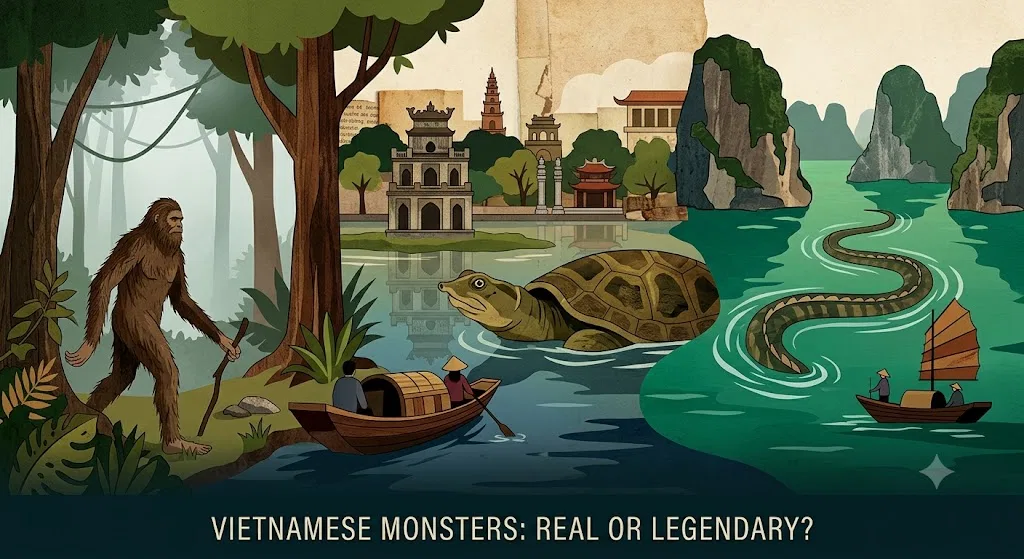
Vietnam’s mystery-creature tradition is dominated by three very different stories: hairy “forest people” reported in the central highlands, giant turtles whose real existence reinforced an old national legend, and sea-serpent tales associated with the coast around Hạ Long Bay.
Page outline Jump by section
Introduction
This distinction matters. Vietnam certainly has rich traditions of dragons, sacred animals and dangerous forest beings, but folklore is not automatically zoological evidence. The most useful way to approach the country’s monsters is to ask where each story came from, what witnesses actually described, whether physical evidence survives, and which known Vietnamese animals could have inspired it.
The forest wildman and the “rock apes”
The best-known Vietnamese cryptid is an alleged upright, hairy forest-dweller. English-language accounts commonly call it the Vietnamese wildman, forest man or “rock ape”. The last term became especially prominent among American troops during the Vietnam War, although soldiers did not necessarily use it for one consistently described animal. Some stories concern small monkeys or gibbon-like creatures; others describe something closer to a human-sized, reddish or dark-haired ape walking on two legs.
Reports are most often associated with forested uplands in central Vietnam, particularly areas around the Annamite mountains and the central highlands. Wartime retellings also link them with places such as Sơn Trà, where “Monkey Mountain” was already an informal military name. Later cryptozoological summaries added alleged encounters in Kon Tum and neighbouring provinces, producing a broad but poorly defined sighting zone rather than one precise hotspot.[warhistoryonline.com]warhistoryonline.comrock apes not a 70s rock bandHow Vietnam's 'Rock Apes' Confounded American GIsApr 5, 2019 — Some rock ape sightings, however, may well have been gibbo…
What witnesses claimed
Published versions of the stories usually repeat several features:
- a roughly human-shaped body covered in hair;
- unusually long arms;
- upright walking, at least for short distances;
- reddish, brown or black colouring;
- appearances in groups;
- occasional stone-throwing or aggressive displays.
The difficulty is that these details come mainly from retrospective memoirs, popular military articles and cryptozoological retellings, not from a coherent archive of dated field reports. Descriptions also vary greatly in height, behaviour and anatomy. A three-foot animal moving through trees presents a very different zoological problem from a six-foot creature walking habitually on the ground.[militarymachine.com]militarymachine.comMilitary MachineVietnam Rock Apes: Myth, Fact and Everything In-BetweenJanuary 25, 2018 — 25 Jan 2021 — Is the Vietnam Rock Ape a myth, a…
Stories of organised searches and footprint casts are frequently repeated. One often-cited claim concerns a cast reportedly made in Kon Tum after unusual tracks were found in the 1980s. However, no specimen, bone, independently verified hair sample or reproducible genetic result has established the existence of an unknown great ape in Vietnam. The footprint material has circulated mainly through television, paranormal media and cryptozoological commentary rather than a published scientific description with a secure chain of custody.
Why known primates remain the strongest explanation
Vietnam does have native apes: gibbons. It also has several monkeys and langurs, many of them rare, visually striking and unfamiliar to outsiders. Conservation reviews describe an exceptionally diverse primate fauna, including animals restricted to remote forests and species whose ranges were still being clarified in recent decades. A new species of crested gibbon from the central Annamite region was formally described as recently as 2010, demonstrating how difficult primate fieldwork in this landscape can be without implying that a human-sized unknown ape exists there.[gibbons.asia]gibbons.asiaAt the beginning of the new millennium,vietnam primate conservation status review 2000 part 1June 18, 2001 — by T GEISSMANN · 2000 — The Primate Conservation Status Review, Vie…
Gibbons can move upright on branches or on the ground, have very long arms and may look surprisingly human when glimpsed briefly. Different gibbon species and sexes can also show black, pale or reddish coats. Macaques and langurs provide further possibilities for small “rock ape” reports. Dense vegetation, poor visibility, stress, distance and the unfamiliarity of foreign soldiers with local wildlife could easily distort apparent size and posture.
Stone-throwing claims are harder to assess, but even these do not require an unknown hominid. A falling branch or rock may be interpreted as deliberate during a tense jungle encounter, while macaques are capable of threatening displays and manipulating objects. Some wartime “rock ape” tales may also have grown through barracks storytelling, with separate incidents gradually acquiring the same name.
The most defensible conclusion is therefore not that every witness invented an encounter. Many probably saw real animals. The problem is that “rock ape” became a flexible label covering ordinary primates, fleeting human silhouettes, jokes, rumours and perhaps a small residue of genuinely puzzling observations.
Hanoi’s giant turtle: when legend met a real animal
Vietnam’s clearest monster story is also the least mysterious zoologically. For generations, a huge softshell turtle lived in Hoàn Kiếm Lake in central Hanoi. The animal was not a mythical species hiding from science: it belonged to the critically endangered giant softshell turtle lineage generally classified as Rafetus swinhoei. Genetic work on the lake specimen supported that identification, although some Vietnamese researchers previously argued that the Hanoi turtles represented a separate species.[Wikipedia]WikipediaHoan Kiem turtleHoan Kiem turtle
What made the turtle extraordinary was its connection with the legend of Emperor Lê Lợi. In the familiar story, a divine turtle reclaimed the magical sword that had helped him defeat Ming forces in the fifteenth century. The lake consequently became known as the Lake of the Returned Sword. Because a genuinely enormous and rarely seen turtle still surfaced there, residents could encounter a living animal in the precise setting of the national tale.[researchgate.net]researchgate.netResearch Gate The Legendary Sword Lake Turtle of Hoan Kiem LakeResearch Gate The Legendary Sword Lake Turtle of Hoan Kiem Lake
The last known giant turtle in Hoàn Kiếm Lake died in January 2016. Its death prompted public mourning and international coverage, showing that it functioned as far more than an unusual zoological curiosity. It represented independence, continuity and a physical connection between modern Hanoi and the founding legend.[turtleconservancy.org]turtleconservancy.orgOpen source on turtleconservancy.org.
A “former cryptid” only in a limited sense
The turtle is sometimes presented as a cryptid that was eventually proven real. That description needs care. Giant softshell turtles were known to zoology, and Hanoi’s animal was repeatedly photographed, examined and treated by veterinarians. The unresolved question concerned its precise classification and the number of surviving individuals, not whether a giant turtle existed in the lake.
The case is still valuable because it shows how legends can preserve a realistic ecological core. Northern Vietnam’s large rivers and lakes once supported these turtles more widely. Hunting, pollution, river alteration and the loss of nesting habitat pushed them towards extinction. Conservation surveys have since used direct observation and environmental DNA — genetic traces left in water — to search other lakes near Hanoi for survivors.[wcs.org]programs.wcs.orgOpen source on wcs.org.
In 2023, the confirmed female living in Đồng Mô Lake was found dead, leaving the species in an even more precarious position. Conservationists have continued searching for additional turtles because unconfirmed individuals may remain in Vietnamese waters. The modern mystery is therefore not a lake monster question but an urgent conservation question: whether an almost vanished animal can still be found before reproduction becomes impossible.[Time]time.comOpen source on time.com.
Sea serpents in Hạ Long Bay
Northern Vietnam’s principal marine-monster tradition concerns long, serpentine creatures allegedly seen around Hạ Long Bay and the Gulf of Tonkin. Modern retellings commonly merge two strands: sightings attributed to French naval personnel in the late nineteenth century, and the story of a segmented carcass described as resembling an enormous marine centipede.
One frequently repeated account says that officers and crew aboard a French vessel encountered a large, vertically undulating animal in or near Hạ Long Bay in the late 1890s. Later tourism histories connect the incident with newspaper language about a “dragon” appearing in the bay. The tale fits the setting perfectly: the name Hạ Long means “descending dragon”, and the bay’s steep limestone towers create a landscape already primed for dragon imagery.[heritagevietnamairlines.com]heritagevietnamairlines.comHeritage Vietnam Airlines The legend of Ha Long BayHeritage Vietnam Airlines The legend of Ha Long Bay
The records are nevertheless unstable. Retellings disagree over the vessel’s spelling, the officer’s name, the exact year and whether there was one encounter or several. The original newspaper text is rarely reproduced in full, while later writers often cite one another. The basic claim may preserve a genuine naval observation, but its most dramatic details cannot be treated as firmly documented without a recoverable contemporary report.
The segmented “sea centipede”
An even stranger story concerns a carcass supposedly found near Hòn Gai in 1883. According to later cryptozoological descriptions, it was extremely long, armour-plated and divided into regular segments, with paired projections resembling fins or legs. It became known in English-language monster literature as a Vietnamese “sea centipede”.
No preserved tissue, skeleton, photograph or contemporary scientific report is available for examination. The carcass story appears chiefly in twentieth-century sea-serpent literature and later online summaries. Even specialist retellings acknowledge the absence of physical evidence.[fandom.com]new-cryptozoology.fandom.comCon RitCon Rit
A badly decomposed whale is an obvious candidate. As a whale carcass breaks apart, vertebrae, ribs, connective tissue and strips of blubber can create an apparently segmented body. Large oarfish, groups of porpoises, whale wakes, floating logs and lines of fishing gear can also produce serpentine shapes at sea. Vertical undulation, often stressed in Hạ Long accounts, is characteristic of cetaceans rather than snakes, which bend mainly from side to side.
The colonial setting also shaped how sightings were interpreted. European sea-serpent literature was already flourishing during the nineteenth century, and naval observers arrived with familiar expectations about monstrous marine reptiles. Local dragon imagery then gave the reports a distinct Vietnamese afterlife. The resulting legend is best understood as a cultural hybrid: possible observations of marine animals filtered through European sea-serpent traditions and a landscape internationally marketed as a dragon’s bay.
Folklore is not the same as a sighting report
Vietnamese culture includes dragons, sacred turtles, guardian animals and composite creatures, but most belong clearly to mythology, religion or architectural symbolism rather than cryptozoology. Dragons are associated with rain, rulership, fertility and national ancestry. Lion-dog guardian figures appear at temples and communal buildings. Such beings were not originally proposed as undiscovered zoological species.[Wikipedia]WikipediaOpen source on wikipedia.org.
This matters because modern monster lists often flatten several categories into one:
- Folklore preserves symbolic narratives and moral or historical meanings.
- Witness claims concern an allegedly observed physical creature.
- Media legends grow when newspapers, military memoirs or television programmes repeat and standardise a story.
- Misidentifications begin with a real animal seen under poor conditions.
- Hoaxes involve deliberate fabrication.
- Unresolved reports lack enough information to choose confidently among those explanations.
The Hoàn Kiếm turtle sits unusually between categories: a real animal became inseparable from a sacred legend. The forest wildman belongs mainly to oral tradition and eyewitness claims. The Hạ Long sea serpents survive through unstable historical reporting and repeated cultural adaptation.
Why Vietnam produces convincing monster stories
Vietnam offers unusually fertile conditions for mystery-animal traditions. Its mountains, tropical forests, cave systems, rivers and long coastline contain habitats where animals can be difficult to observe. Scientific surveys continue to document rare primates and other species in isolated areas, while many populations have been depleted by hunting and habitat loss. A fleeting encounter with an unfamiliar langur or gibbon can therefore be both completely genuine and incorrectly identified.[panda.org]awsassets.panda.orgprimate conservation in quang nam province, central vietnamprimate conservation in quang nam province, central vietnam
War added another layer. Soldiers operated under extreme stress in unfamiliar terrain, often at night and with limited knowledge of local wildlife. Memories were later retold within a culture already rich in rumours, nicknames and exaggerated unit stories. That does not make every account worthless, but it lowers the evidential value of stories recorded decades after the event.
Tourism has reinforced the most picturesque legends. At Hoàn Kiếm Lake, the sacred turtle story gives visitors a narrative linking landscape and national history. At Hạ Long Bay, descending dragons and sea-serpent anecdotes turn geological scenery into a monster-haunted seascape. These stories persist because they make places memorable, not because new zoological evidence has accumulated.
What the evidence supports
Vietnam has no confirmed population of unknown human-sized apes, armoured sea serpents or gigantic marine centipedes. The forest-wildman case rests on inconsistent testimony, folklore and weakly documented trace evidence. The Hạ Long reports are historically interesting but suffer from missing originals, changing details and plausible marine misidentifications.
The giant turtle is the exception that explains why the wider tradition remains so compelling. An animal of extraordinary size really did surface in the middle of Hanoi, in the lake where legend said a divine turtle had appeared. Science did not prove the magical story, but it revealed that Vietnamese waters once held creatures remarkable enough to sustain it.
That is the central pattern in Vietnam’s mystery-beast history: real biodiversity, difficult landscapes and powerful folklore repeatedly overlap. The strange stories are worth preserving, but their value lies as much in what they reveal about war, memory, ecology and national identity as in the possibility of an undiscovered animal.
Amazon book picks
Further Reading
Books and field guides related to Which Vietnamese Monsters Were Ever Real?. Use these as the next step if you want deeper reading beyond the article.
Field Guide To Bigfoot, Yeti, & Other Mystery Primates Worldwide
Relevant to Vietnam's wildman and rock-ape reports.
eBay marketplace picks
Marketplace Samples
Live-tested eBay searches with available results related to this page.



Endnotes
1.
Source: warhistoryonline.com
Title: [rock apes]({{ ‘rock-apes/’ | relative_url }}) not a 70s rock band
Link:https://www.warhistoryonline.com/vietnam-war/rock-apes-not-a-70s-rock-band.html
Source snippet
How Vietnam's 'Rock Apes' Confounded American GIsApr 5, 2019 — Some rock ape sightings, however, may well have been gibbo...
2.
Source: gibbons.asia
Title: At the beginning of the new millennium,
Link:https://gibbons.asia/wp-content/uploads/2018/08/Vietnam-Primate-Conservation-Status-Review-1-Gibbons-2000.pdf
Source snippet
vietnam primate conservation status review 2000 part 1June 18, 2001 — by T GEISSMANN · 2000 — The Primate Conservation Status Review, Vie...
Published: June 18, 2001
3.
Source: Wikipedia
Title: Northern buffed-cheeked gibbon
Link:https://en.wikipedia.org/wiki/Northern_buffed-cheeked_gibbon
4.
Source: Wikipedia
Title: [Hoan Kiem turtle]({{ ‘lake-turtle/’ | relative_url }})
Link:https://en.wikipedia.org/wiki/Hoan_Kiem_turtle
5.
Source: researchgate.net
Link:https://www.researchgate.net/publication/324749351_Molecular_phylogenetic_identification_of_the_giant_freshwater_softshell_turtle_in_the_Hoan_Kiem_lake_Hanoi_Vietnam
6.
Source: researchgate.net
Title: Research Gate The Legendary Sword Lake Turtle of Hoan Kiem Lake
Link:https://www.researchgate.net/publication/369143484_Swinhoe%27s_Softshell_Turtle_Rafetus_swinhoei_The_Legendary_Sword_Lake_Turtle_of_Hoan_Kiem_Lake
7.
Source: time.com
Link:https://time.com/6275373/giant-yangtze-softshell-turtle-female-dies/
8.
Source: new-cryptozoology.fandom.com
Title: Con Rit
Link:https://new-cryptozoology.fandom.com/wiki/Con_Rit
9.
Source: cryptidz.fandom.com
Title: Cryptid Wiki Con Rit
Link:https://cryptidz.fandom.com/wiki/Con_Rit
10.
Source: Wikipedia
Link:https://en.wikipedia.org/wiki/Ngh%C3%AA
11.
Source: Wikipedia
Title: Vietnamese dragon
Link:https://en.wikipedia.org/wiki/Vietnamese_dragon
12.
Source: awsassets.panda.org
Title: primate conservation in quang nam province, central vietnam
Link:https://awsassets.panda.org/downloads/primate_cons_quang_nam.pdf
13.
Source: cryptidarchives.fandom.com
Title: Rock ape
Link:https://cryptidarchives.fandom.com/wiki/Rock_ape
14.
Source: cryptidarchives.fandom.com
Title: List of sea serpent sightings in the Pacific Ocean (1848–1891)
Link:https://cryptidarchives.fandom.com/wiki/List_of_sea_serpent_sightings_in_the_Pacific_Ocean_%281848%E2%80%931891%29
15.
Source: cryptidz.fandom.com
Title: Hoan Kiem Turtle
Link:https://cryptidz.fandom.com/wiki/Hoan_Kiem_Turtle
16.
Source: cryptidz.fandom.com
Link:https://cryptidz.fandom.com/wiki/Batutut
17.
Source: non-aliencreatures.fandom.com
Title: Con Rit
Link:https://non-aliencreatures.fandom.com/wiki/Con_Rit
18.
Source: archive.org
Link:https://archive.org/details/greatseaserpenth00oude
19.
Source: gibbons.de
Title: 2003rarest ape
Link:https://www.gibbons.de/main/papers/pdf_files/2003rarest_ape.pdf
20.
Source: researchgate.net
Link:https://www.researchgate.net/publication/359962225_The_sovereign_of_the_jungles_or_the_tiger_image_in_folklore_of_Vietnam
21.
Source: researchgate.net
Link:https://www.researchgate.net/publication/369004424_Method_of_Mythization_and_the_discovery_of_reality_in_Vietnamese_novels_from_1986_to_present
22.
Source: researchgate.net
Link:https://www.researchgate.net/publication/345871835_Forest_resources_and_forestry_in_Vietnam_Tai_nguyen_rung_va_lam_nghiep_o_Viet_Nam
23.
Source: researchgate.net
Link:https://www.researchgate.net/publication/300335774_Viet_Nam%27s_Cultural_Diversity_Approaches_to_Preservation
24.
Source: researchgate.net
Title: 237770180 Conservation status of Vietnamese primates
Link:https://www.researchgate.net/publication/237770180_Conservation_status_of_Vietnamese_primates
25.
Source: researchgate.net
Title: 343380878 Forest Ecological Stratification in Viet nam
Link:https://www.researchgate.net/publication/343380878_Forest_Ecological_Stratification_in_Viet_nam
26.
Source: researchgate.net
Link:https://www.researchgate.net/profile/Minh-Hoang-Nguyen-4/3
27.
Source: researchgate.net
Link:https://www.researchgate.net/publication/337690760_Determining_the_road_traffic_accident_hotspots_using_GIS-based_temporal-spatial_statistical_analytic_techniques_in_Hanoi_Vietnam
28.
Source: researchgate.net
Link:https://www.researchgate.net/publication/352815537_Management_of_Biosphere_Reserves_in_Vietnam_Status_and_Challenges
29.
Source: researchgate.net
Link:https://www.researchgate.net/publication/372899730_PHAT_TRIEN_RUNG_BEN_VUNG_TAI_TINH_YEN_BAI
30.
Source: researchgate.net
Link:https://www.researchgate.net/publication/398909101_Nickel_and_the_pledge_for_environmental_sustainability_Is_it_viable
31.
Source: gibbons.asia
Title: Wearn et al Status of gibbons in Vietnam 2023 1
Link:https://gibbons.asia/wp-content/uploads/2024/03/Wearn-et-al-Status-of-gibbons-in-Vietnam-2023-1.pdf
32.
Source: Wikipedia
Title: List of cryptids
Link:https://en.wikipedia.org/wiki/List_of_cryptids
33.
Source: youtube.com
Title: Vietnam War Rock Apes
Link:https://www.youtube.com/watch?v=BpNxWxSHDoA
Source snippet
Rock Apes | Mysterious Creatures of the Vietnam War - Forgotten History...
34.
Source: youtube.com
Title: Rock Apes | Mysterious Creatures of the Vietnam War
Link:https://www.youtube.com/watch?v=wEETAuXJmqo
Source snippet
Legendary Hoan Kiem Turtle Hanoi Vietnam - Last footage before he died...
35.
Source: wearethemighty.com
Title: the mystery of vietnam apes
Link:https://www.wearethemighty.com/mighty-history/the-mystery-of-vietnam-apes/
Source snippet
We Are The MightyThe mystery of Vietnam apes10 Oct 2023 — Due to the lack of evidence, Vietnam's rock apes have been... Another animal t...
36.
Source: militarymachine.com
Link:https://militarymachine.com/vietnam-rock-apes
Source snippet
Military MachineVietnam Rock Apes: Myth, Fact and Everything In-BetweenJanuary 25, 2018 — 25 Jan 2021 — Is the Vietnam Rock Ape a myth, a...
Published: January 25, 2018
37.
Source: eprc.asia
Link:https://www.eprc.asia/wp-content/uploads/2019/06/VietnameseJournalofPrimatology-1.2.pdf
Source snippet
Endangered Primate Rescue CenterVietnamese Journal of Primatologyby T Nadler — Vietnam has four endemic primate species yet several of th...
38.
Source: asianturtleprogram.org
Title: rafetus project
Link:https://asianturtleprogram.org/rafetus-project/
39.
Source: turtleconservancy.org
Link:https://www.turtleconservancy.org/outreach/the-untimely-death-of-great-grandfather-turtle
40.
Source: theguardian.com
Title: vietnam mourns death of sacred giant turtle
Link:https://www.theguardian.com/world/2016/jan/20/vietnam-mourns-death-of-sacred-giant-turtle
41.
Source: programs.wcs.org
Link:https://programs.wcs.org/vietnam/en-us/Our-work/Conserving-Hoan-Kiem-turtle-in-Viet-Nam.aspx
42.
Source: turtleconservancy.org
Link:https://www.turtleconservancy.org/outreach/some-good-news-for-the-rarest-turtle-in-the-world
43.
Source: heritagevietnamairlines.com
Title: Heritage Vietnam Airlines The legend of Ha Long Bay
Link:https://heritagevietnamairlines.com/en/the-legend-of-ha-long-bay/
44.
Source: universvoyage.com
Title: Univers Voyage Vietnam
Link:https://universvoyage.com/en/viet-nam-dalong-bay-the-descending-dragon/
45.
Source: facebook.com
Link:https://www.facebook.com/AsianTurtleProgram/photos/hanoi-government-takes-new-steps-to-conserve-worlds-most-endangered-turtlethe-pe/2182928605074302/
46.
Source: asianturtleprogram.org
Link:https://asianturtleprogram.org/turtle-conservation-centre/
47.
Source: asianturtleprogram.org
Title: sacred hoan kiem turtle preserved and displayed to the public
Link:https://asianturtleprogram.org/sacred-hoan-kiem-turtle-preserved-and-displayed-to-the-public/
48.
Source: turtleconservancy.org
Link:https://www.turtleconservancy.org/outreach/tag/hoan-kiem-lake
49.
Source: supernaturalandthemakebelief.weebly.com
Link:https://supernaturalandthemakebelief.weebly.com/snakes.html
Additional References
50.
Source: youtube.com
Title: Legendary Hoan Kiem Turtle Hanoi Vietnam
Link:https://www.youtube.com/watch?v=sX8NPtW2CD8
Source snippet
The Legend Beneath Hanoi: The Enigmatic Story of Hoan Kiem Lake...
51.
Source: youtube.com
Title: The Legend Beneath Hanoi: The Enigmatic Story of Hoan Kiem Lake
Link:https://www.youtube.com/watch?v=gzrHgUilz3s
Source snippet
Vietnam Discovery: The Four sacred animal - Tortoise | VTV World...
52.
Source: historicmysteries.com
Title: vietnam rock apes
Link:https://www.historicmysteries.com/unexplained-mysteries/vietnam-rock-apes/22978/
Source snippet
rock apes were consistently sighted in groups. Another candidate is the cheeked gibbon that is native to Vietnam. The gibbons also live i...
53.
Source: history.co.uk
Link:https://www.history.co.uk/articles/strange-sea-serpent-sightings-from-history
54.
Source: instagram.com
Link:https://www.instagram.com/reel/DM8mT51shhn/
55.
Source: tumblr.com
Link:https://www.tumblr.com/shadyufo/764911687900020736/cryptids-creatures-of-folklore-drawtober-day-20
56.
Source: reddit.com
Link:https://www.reddit.com/r/VietNam/comments/x283wl/does_anyone_know_any_viet_supernatural/
57.
Source: reddit.com
Link:https://www.reddit.com/r/AskHistorians/comments/orjjh0/i_randomly_came_across_hundreds_of_newspaper/
58.
Source: vinpearl.com
Link:https://vinpearl.com/en/hoan-kiem-turtle-a-symbolic-creature-of-hanois-history
59.
Source: facebook.com
Link:https://www.facebook.com/groups/HerpingTheGlobe/posts/4118470518406129/
Topic Tree
Follow this branch
Related pages 192
- Antigua Cryptids
- Maldives Monsters
- Malta Monsters
- Qatar Monsters
- Argentina Monsters
- +187 more in sidebar