Strange Creatures of Brazil's Forests and Rivers
Brazil’s monster tradition is less a single cryptid story than a living map of forests, rivers, wetlands and coastlines. The best-known claims cluster around the Amazon, where the hairy Mapinguari, the great river serpent and forest beings such as the Capelobo blur the line between folklore, warning story and mystery-animal report.
Page outline Jump by section
Why Brazil Has So Many Monster Stories
Brazil is one of the world’s great settings for mystery-beast folklore because its real animals already stretch the imagination. Jaguars, black jaguars, giant anteaters, tapirs, caimans, anacondas, maned wolves, river dolphins and huge catfish all live in landscapes where visibility is often poor, sound carries oddly, and water levels can transform familiar places into unfamiliar ones. The Amazon alone covers nearly half of Brazil’s national territory, while the Cerrado, Atlantic Forest, Caatinga, Pampa and Pantanal add savannah, dry forest, grassland and wetland settings with their own animal encounters and local storytelling patterns.[Agência de Notícias - IBGE]agenciadenoticias.ibge.gov.brAgência de NotíciasAgência de Notícias
That environmental variety matters. A creature said to drag livestock under lake water, a fire-serpent seen over wetlands, or a hairy forest thing that confuses hunters does not appear at random. Each legend answers a practical anxiety: what pulled an animal into the river, what made a night light flicker near marshy ground, what left tracks in the mud, what screamed in the forest, or why a hunter should not overstep local rules. The strongest Brazilian cryptid traditions are therefore not just “monsters”; they are explanations attached to place.
A second reason is historical. Some Brazilian creature stories entered European science and newspapers early. The Minhocão was discussed in 19th-century natural history journals, while the Mapinguari later attracted attention from researchers wondering whether Amazonian testimony might preserve memories of extinct ground sloths. That does not make either animal real, but it does explain why Brazilian folklore has a unusually strong afterlife in cryptozoology: local accounts were repeatedly translated into the language of zoological possibility.[wikimedia.org]upload.wikimedia.orgOpen source on wikimedia.org.
The Mapinguari: Brazil’s Famous Forest Cryptid
The Mapinguari is the Brazilian creature most often compared with Bigfoot, although that comparison can be misleading. In popular retellings it is a huge, foul-smelling, hairy forest being with powerful claws, sometimes walking upright, sometimes described with monstrous details such as a single eye or a mouth in its belly. In Brazilian and Amazonian traditions, however, it is not simply an undiscovered ape. It is a shifting forest monster associated with fear, punishment, old age, dangerous hunting and the deep interior of the Amazon.[SciELO]scielo.brOpen source on scielo.br.
The most useful modern study is Felipe Ferreira Vander Velden’s 2016 article on Mapinguari controversies in south-western Amazonia. Vander Velden notes that the being is widely recorded in Amazonian localities and examines how Karitiana accounts from Rondônia sit uneasily between lived testimony, scientific curiosity and fantasy. That tension is exactly what makes the Mapinguari interesting: the creature is meaningful to local narrators even when outside researchers try to convert it into a zoological problem.[SciELO]scielo.brOpen source on scielo.br.
Where reports cluster
Mapinguari traditions are especially associated with the Amazonian north and west: Pará, Amazonas, Acre and Rondônia appear repeatedly in folklore and cryptozoological discussion. WWF’s account of legends in the Juruena River region, for example, describes the Mapinguari as a beast widely reported by riverbank inhabitants and rubber tappers, and mentions that researchers from the Museu Paraense Emílio Goeldi organised an Amazon expedition connected with the animal.[WWF Panda]wwf.panda.orgwwf newswwf news
This geography is important because the Mapinguari is a forest-edge creature as much as a forest creature. Rubber tappers, hunters, Indigenous communities, river dwellers and rural workers are the kinds of witnesses most often attached to the story. Their accounts usually emerge from work landscapes: hunting trails, extractive routes, river margins and remote settlements rather than tourist lookout points.
The ground-sloth theory
The most famous scientific speculation is that the Mapinguari might preserve memories, or even alleged sightings, of a giant ground sloth. David C. Oren argued in the 1990s and early 2000s that some Amazonian descriptions — strong claws, heavy body, defensive hide, powerful smell and partly upright posture — could be read through the extinct ground sloth model. He also acknowledged problems, including reports of short tails where known ground sloths had well-developed tails.[Cryptozoological Reference Library]cryptozoologicalreferencelibrary.wordpress.comOpen source on wordpress.com.
As evidence, the theory is weak. No modern bones, bodies, photographs, DNA samples or reliable specimens show that ground sloths survived in the Amazon into recent times. As folklore interpretation, it is more interesting. South America really did have giant ground sloths, and finds from Brazil show ancient human interaction with giant sloth remains deep in prehistory. A 2023 study reported modified giant-sloth osteoderms from Santa Elina, Brazil, dated to roughly 25,000–27,000 years ago, showing that people and sloth material overlapped culturally long before modern folklore formed. That does not prove living sloths inspired the Mapinguari, but it makes the “memory of extinct megafauna” idea more plausible than a simple Bigfoot import.[Cryptozoological Reference Library]cryptozoologicalreferencelibrary.wordpress.comOpen source on wordpress.com.
The fairest reading is this: the Mapinguari is a real and important Amazonian monster tradition, but the ground-sloth explanation remains an interpretation, not a discovery. Its power lies in the way it connects Indigenous and rural storytelling, Pleistocene animals, forest danger and modern cryptozoological desire.
The Minhocão: The Giant Worm That Entered Natural History
The Minhocão is Brazil’s great “almost scientific” monster. The name is an enlarged form of the Portuguese word for earthworm, but the creature was described in different ways: a gigantic worm, a huge fish, a lungfish-like animal, a burrower, a trench-maker, or a lake creature that dragged livestock underwater. Unlike many folklore beings that stayed mostly in oral tradition, the Minhocão entered European scientific discussion in the 19th century.[Wikipedia]WikipediaMinhocão (legendary creatureMinhocão (legendary creature
French naturalist Auguste de Saint-Hilaire discussed accounts of the Minhocão in the 1840s, including stories connected with lakes in what was then referred to as the Goyaz region. Reports told him of a creature that seized cattle or horses from below the water. Saint-Hilaire treated the matter cautiously and considered whether witnesses might be describing a large South American lungfish rather than a supernatural monster.[Wikimedia Commons]upload.wikimedia.orgOpen source on wikimedia.org.
The creature gained wider attention in 1878 when Nature published “A New Underground Monster”, based on material associated with the German naturalist Fritz Müller. This version placed the animal in southern Brazil and described a vast earthworm-like creature that supposedly moved underground, uprooted trees and left trenches in damp terrain. The account is fascinating partly because it shows Victorian science trying to process rural testimony without modern field evidence.[Nature]nature.comOpen source on nature.com.
Sceptical explanations have always been close at hand. The Minhocão’s trenches could be erosion after heavy rain, landslips, collapsed banks or other wet-ground damage. Its rumbling movement could be storm, flood or seismic noise folded into monster language. Its aquatic form could reflect encounters with large fish, caimans, anacondas or simply the disappearance of livestock in dangerous water. What makes the Minhocão stand out is not the strength of the evidence, but the way a local explanatory monster briefly became a candidate for unknown zoology.
The Great River Serpent: Cobra Grande, Boiúna and Giant Anaconda Claims
Brazil’s river-serpent tradition is broader than one cryptid. In Amazonian folklore, the great snake can be a world-shaping being, a dangerous river presence, a transformed person, or a monster that overturns boats and haunts deep water. The names Cobra Grande and Boiúna are often linked with this tradition, and they overlap with ordinary fear and respect for real anacondas.[Engagement]aesengagement.wordpress.comEngagement Cobra Grande: An Amazonian Vision of HumanEngagement Cobra Grande: An Amazonian Vision of Human
The real-animal basis is obvious but limited. Green anacondas are among the world’s largest snakes, and Brazil’s flooded forests, river channels and wetlands are suitable places for large aquatic snakes to become story engines. Yet the giant-anaconda claims that circulate in cryptid culture usually run beyond verified biology. Reports of snakes far above accepted sizes remain unconfirmed, and classic “monster snake” tales often grow through retelling, uncertain measurement, forced perspective photography and the understandable shock of seeing a large snake in water.[Wikipedia]WikipediaAnaconda giganteAnaconda gigante
The folklore is richer than the cryptozoology. Anthropological work on Amazonian anaconda myths treats the snake not merely as a big animal but as a way of thinking about rivers, settlement, ancestry and the shifting landscape. In one study of eastern Amazonia, the anaconda is read as a metaphor for the river itself: a large, winding body around which human life is organised.[Tidsskrift]tidsskrift.dkOpen source on tidsskrift.dk.
This matters for readers approaching the Cobra Grande as a “Brazilian lake monster”. It is not Brazil’s version of a single lake cryptid with a neat sighting file. It is a family of river stories in which real snakes, dangerous currents, canoe travel, Indigenous cosmology and fear of deep water all reinforce one another.
Capelobo and the Forest Hybrids
The Capelobo is one of Brazil’s stranger forest monsters: part human, part animal, often described with a tapir-like, dog-like, pig-like or giant-anteater-like snout, depending on region. It is especially associated with Pará and Maranhão, and some versions place it in floodplain or riverine forest settings. In several retellings, it is a man-eater, blood-sucker or brain-eater, with a vulnerable spot at the navel.[Wikipedia]WikipediaOpen source on wikipedia.org.
The Capelobo sits close to the Mapinguari in the Brazilian monster family. Both can be hairy, foul, screaming, forest-dwelling and tied to fear of remote places. But the Capelobo’s animal snout gives it a more hybrid feel, as if people were combining memories of giant anteaters, tapirs, dogs, pigs and werewolf-like transformation stories into a single night creature. That hybrid quality is typical of folklore: the monster does not have to obey zoological design rules, because its job is to embody danger.
A sceptical reading does not need to flatten the story. Real giant anteaters are powerful, clawed animals; tapirs are large, heavy and startling when encountered suddenly; nocturnal mammals can sound uncanny in forest. None explains the Capelobo completely, but together they show how Brazil’s actual fauna supplies raw material for creatures that are not simply invented from nothing. The Capelobo is best understood as a regional forest terror with animal ingredients, rather than a strong candidate for an undiscovered species.
Fire, Tracks and Misleading Signs: Boitatá, Curupira and Pé de Garrafa
Not every Brazilian monster tradition is a cryptid in the strict “unknown animal” sense. Some beings are better understood as guardians, warnings or explanations for strange signs. They still matter on a country-level cryptid page because they shape the same landscape of sightings, tracks, lights and forest fear.
Boitatá is the classic fire-serpent or fiery presence. One of the earliest written references comes from the Jesuit José de Anchieta in 1560, who described a dangerous fiery apparition encountered near sea and river settings. Modern discussion often connects Boitatá with will-o’-the-wisp phenomena: mysterious lights over marshy or wet areas, later personified as a serpent or guardian of fields and forests. A 2023 chemistry-history article on ignis fatuus notes Anchieta’s “sparkling beam” account in this context.[Wikipedia]WikipediaOpen source on wikipedia.org.
Curupira, another early-recorded forest being, is famous for backward feet that confuse hunters by reversing the apparent direction of tracks. It is less a mystery animal than a forest rule in creature form: do not hunt wrongly, do not overexploit, and do not trust every footprint. The tracking motif links Curupira naturally to cryptid culture because many mystery-beast claims begin with prints, broken vegetation or sounds rather than a clear sighting.[Wikipedia]WikipediaOpen source on wikipedia.org.
Pé de Garrafa, or “bottle foot”, takes that track anxiety even further. The creature is named for its rounded footmarks, like the base of a bottle pressed into mud or clay. Accounts place it in north-eastern and central-western settings as well as broader forest folklore, where it confuses hunters with calls and tracks. As a cryptid-style motif, it is a reminder that a strange footprint can become the creature: the sign comes first, the monster follows.[Wikipedia]WikipediaPé de garrafaPé de garrafa
Sea Serpents off Brazil’s Coast
Brazil’s monster geography is not only inland. One of the better-known 19th-century sea-serpent reports occurred off Cape São Roque in July 1875, when the crew of the Pauline claimed to see a huge serpent-like creature attacking or entangled with a sperm whale. Historian Charles Paxton has examined the case in detail, tracing the earliest published account to November 1875 and showing how the story travelled through maritime reporting.[St Andrews Research Repository]research-repository.st-andrews.ac.ukPaxton Mariner s Mirror Driven mad CCPaxton Mariner s Mirror Driven mad CC
The Pauline case is useful because it shows how Brazil can enter cryptid history even when the witnesses were not Brazilian and the setting was offshore. It belongs to the global sea-serpent archive, not to a local village tradition. Still, the location matters: the Brazilian coast was part of the 19th-century oceanic imagination, where whales, drifting carcasses, poor visibility, distance from shore and sailors’ testimony produced strange animals before photography and modern marine biology could check every claim.
Modern sceptical explanations for sea-serpent cases often include dying whales, entanglement, floating carcasses, giant squid, oarfish-like impressions, lines of animals swimming together, or errors of scale at sea. Hakai Magazine’s discussion of old sea-monster sightings highlights the possibility that some dramatic accounts may have involved whales struggling with fishing gear or other debris rather than unknown reptiles. That does not “solve” the Pauline case beyond doubt, but it places it in a realistic marine context.[Hakai Magazine]hakaimagazine.comhark sea monster oh no just dying whalehark sea monster oh no just dying whale
Phantom Cats, Black Jaguars and the “Panther” Problem
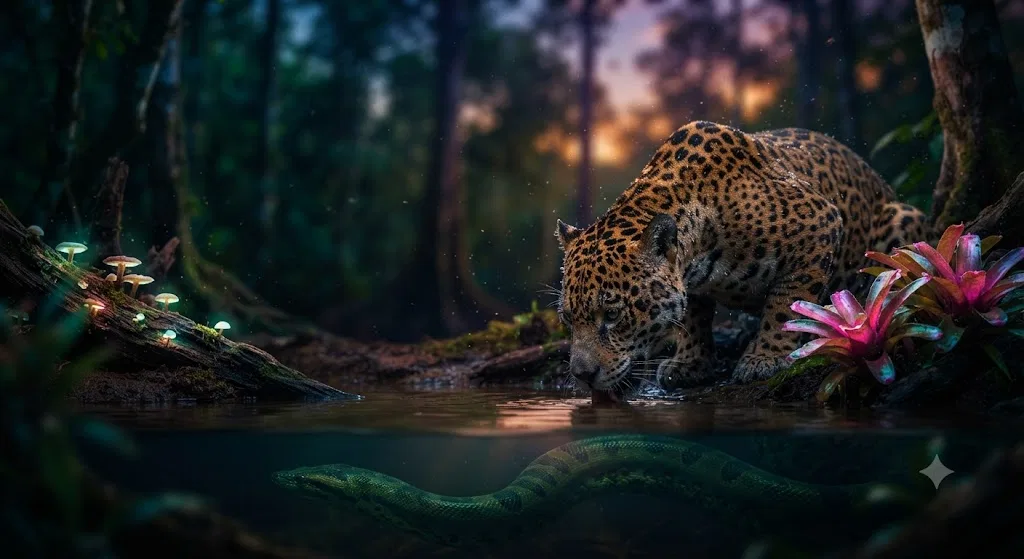
In some countries, “black panther” reports point towards escaped leopards, misidentified dogs or folklore cats. In Brazil, the explanation can be simpler and more interesting: black jaguars are real. They are melanistic jaguars, the same species as the ordinary spotted jaguar, with dark pigmentation that can hide the rosette pattern except in good light. Scientific and conservation sources describe melanism in jaguars as a genetic colour variant, and Brazilian conservation writing uses the term onça-preta for black jaguars.[intechopen.com]intechopen.comIntech Open Ecology and Evolution of Melanism in Big CatsIntech Open Ecology and Evolution of Melanism in Big Cats
This does not mean every dark-cat report in Brazil is automatically a black jaguar. Size, habitat, distance, light, fear and local expectation all affect what witnesses think they have seen. But Brazil differs from places where “black panther” is biologically unlikely: in Amazonian and Cerrado contexts, a real melanistic jaguar is a plausible source for some reports. In 2025, Agência Brasil reported a black jaguar recorded by camera trap in the Serra do Tombador reserve in Goiás, describing it as the first such record for that Cerrado reserve.[Agência Brasil]agenciabrasil.ebc.com.brblack jaguar spotted first time cerrado reserveblack jaguar spotted first time cerrado reserve
For cryptid readers, the lesson is useful: the most satisfying explanation is not always “hoax” or “unknown species”. Sometimes a monster-like report points to a rare but known animal. A black jaguar at night is not a new beast, but it is exactly the kind of real creature that can keep mystery-cat folklore alive.
Hoaxes, Misidentifications and Why the Stories Persist
Brazilian cryptid stories survive because they are flexible. They can absorb new evidence, new media and new anxieties without losing their core. The Mapinguari can be a forest guardian, a cannibal monster, a ground-sloth memory or an Amazonian Bigfoot. The Minhocão can be a fish, worm, lungfish, burrowing animal or erosion myth. Cobra Grande can be a supernatural river being, an exaggerated anaconda or a metaphor for the river itself.
The most common natural explanations fall into a few broad groups:
- Known animals seen badly: jaguars, black jaguars, anacondas, tapirs, giant anteaters, caimans, river dolphins and large fish can all look stranger in poor light, water or dense vegetation.
- Environmental events given a body: erosion trenches, floods, landslides, marsh lights, treefall, drought-altered riverbanks and animal calls can become signs of a creature.
- Folklore protecting behaviour: stories about forest guardians, confusing tracks and punishing monsters often encode warnings about hunting, fire, night travel and disrespecting dangerous places.
- Media amplification: once a monster enters newspapers, natural history journals, tourism copy or online lists, it becomes more standardised and more likely to be repeated as a “case”.
- Cryptozoological reframing: older stories are often reinterpreted through modern categories such as surviving megafauna, giant reptiles, unknown primates or lake monsters.
That last step is where caution matters most. A creature can be culturally real without being zoologically real. The Mapinguari matters even if no ground sloth is hiding in the forest. The Boitatá matters even if marsh lights explain some sightings. The Minhocão matters because 19th-century naturalists took local testimony seriously enough to print it, not because a giant armoured worm has been found.

How Brazil’s Monster Map Has Changed
Brazil’s creature traditions have moved through several phases. First came Indigenous and local oral traditions tied to rivers, forests, hunting and danger. Then colonial and missionary writers recorded beings such as Boitatá and Curupira through European religious and natural-philosophical lenses. In the 19th century, naturalists and newspapers turned creatures such as the Minhocão and sea serpent into public curiosities. In the late 20th century, cryptozoology reframed the Mapinguari as possible surviving megafauna. Today, online culture, tourism and conservation media mix folklore with real wildlife photography, especially around jaguars and Amazonian monsters.[wikipedia.org]WikipediaOpen source on wikipedia.org.
That change can make the legends easier to share but harder to interpret. A short internet entry may present the Mapinguari as a neat “Brazilian Bigfoot”, while an anthropological account shows a more complicated being embedded in local cosmology and testimony. A tourism page may market a black jaguar as an elusive “panther”, while conservation science treats it as a rare colour form of a known threatened cat. A monster list may call Cobra Grande a giant anaconda, while Amazonian myth treats the great snake as river, ancestor, danger and transformation at once.[scielo.br]scielo.brOpen source on scielo.br.
The best way to read Brazil’s cryptid tradition is therefore layered. Ask what the witness or storyteller claimed, what landscape the story belongs to, what known animal or natural event might be involved, and what the legend does for the community that keeps telling it. Brazil’s monsters are most compelling when treated neither as confirmed hidden animals nor as silly mistakes, but as strange, durable stories growing out of some of the richest ecological and cultural terrain on Earth.
Amazon book picks
Further Reading
Books and field guides related to What Haunts Brazil's Forests and Rivers?. Use these as the next step if you want deeper reading beyond the article.
Encyclopedia of Things that Never Were
Useful for readers exploring cryptids and legendary beasts.
eBay marketplace picks
Marketplace Samples
Live-tested eBay searches with available results related to this page.




Endnotes
1.
Source: agenciadenoticias.ibge.gov.br
Title: Agência de Notícias
Link:https://agenciadenoticias.ibge.gov.br/en/agencia-press-room/2185-news-agency/releases-en/25812-ibge-lanca-mapa-inedito-de-biomas-e-sistema-costeiro-marinho-2
2.
Source: scielo.br
Link:https://www.scielo.br/j/bgoeldi/a/SH8jW3RF4Z7zv8RQD57JSvk/abstract/?lang=pt
3.
Source: nature.com
Link:https://www.nature.com/articles/017325a0
4.
Source: upload.wikimedia.org
Link:https://upload.wikimedia.org/wikipedia/commons/f/fe/Annals_and_magazine_of_natural_history_-including_zoology%2C_botany_and_geology%28IA_annalsmagazineof19lond%29.pdf
5.
Source: Wikipedia
Link:https://en.wikipedia.org/wiki/Mapinguari
6.
Source: wwf.panda.org
Title: wwf news
Link:https://wwf.panda.org/wwf_news/?73860%2FLegends-and-myths-in-the-Juruena-river-region=
7.
Source: Wikipedia
Title: Minhocão (legendary creature)
Link:https://en.wikipedia.org/wiki/Minhoc%C3%A3o_%28legendary_creature%29
8.
Source: Wikipedia
Link:https://en.wikipedia.org/wiki/Boiuna
9.
Source: Wikipedia
Title: Anaconda gigante
Link:https://pt.wikipedia.org/wiki/Anaconda_gigante
10.
Source: tidsskrift.dk
Link:https://tidsskrift.dk/bras/article/view/121588/172012
11.
Source: Wikipedia
Link:https://en.wikipedia.org/wiki/Capelobo
12.
Source: Wikipedia
Link:https://en.wikipedia.org/wiki/Boitat%C3%A1
13.
Source: scielo.br
Title: t TNjph Qgp Hw8TPHx5XPt6DB
Link:https://www.scielo.br/j/qn/a/tTNjphQgpHw8TPHx5XPt6DB/?lang=en
14.
Source: Wikipedia
Link:https://en.wikipedia.org/wiki/Curupira
15.
Source: Wikipedia
Link:https://en.wikipedia.org/wiki/Brazilian_mythology
16.
Source: Wikipedia
Title: Pé de garrafa
Link:https://en.wikipedia.org/wiki/P%C3%A9_de_garrafa
17.
Source: intechopen.com
Title: Intech Open Ecology and Evolution of Melanism in Big Cats
Link:https://www.intechopen.com/chapters/56135
18.
Source: Wikipedia
Link:https://en.wikipedia.org/wiki/Minhoc%C3%A3o
19.
Source: Wikipedia
Title: Minhocão (São Paulo)
Link:https://en.wikipedia.org/wiki/Minhoc%C3%A3o_%28S%C3%A3o_Paulo%29
20.
Source: Wikipedia
Link:https://ja.wikipedia.org/wiki/%E3%83%9F%E3%83%8B%E3%83%A7%E3%82%B3%E3%83%B3
21.
Source: Wikipedia
Link:https://it.wikipedia.org/wiki/Minhoc%C3%A3o
22.
Source: Wikipedia
Link:https://en.wikipedia.org/wiki/Karitiana
23.
Source: Wikipedia
Title: Black panther
Link:https://en.wikipedia.org/wiki/Black_panther
24.
Source: Wikipedia
Link:https://en.wikipedia.org/wiki/Pantanal
25.
Source: scielo.br
Title: SH8j W3RF4Z7zv8RQD57JSvk
Link:https://www.scielo.br/j/bgoeldi/a/SH8jW3RF4Z7zv8RQD57JSvk/?format=pdf&lang=pt
26.
Source: scielo.br
Link:https://www.scielo.br/j/bgoeldi/i/2016.v11n3/
27.
Source: upload.wikimedia.org
Title: Edinburgh New Philosophical Journal (IA edinburghnewphil42edin)
Link:https://upload.wikimedia.org/wikipedia/commons/2/23/Edinburgh_New_Philosophical_Journal_%28IA_edinburghnewphil42edin%29.pdf
28.
Source: upload.wikimedia.org
Link:https://upload.wikimedia.org/wikipedia/commons/d/df/The_Annals_And_Magazine_Of_Natural_History_Including_Zoology%2C_Botany_And_Geology_Vol.19_%28IA_in.ernet.dli.2015.21961%29.pdf
29.
Source: wwfbr.awsassets.panda.org
Title: factsheetcerradopantanal ing
Link:https://wwfbr.awsassets.panda.org/downloads/factsheetcerradopantanal_ing.pdf
30.
Source: archive.org
Link:https://archive.org/stream/bibliothecazoolo102caru/bibliothecazoolo102caru_djvu.txt
31.
Source: data.scielo.org
Link:https://data.scielo.org/dataverse/brbgoeldi
32.
Source: mapinguari.org
Title: sobre nos
Link:https://mapinguari.org/sobre-nos/
33.
Source: wwf.de
Link:https://www.wwf.de/themen-projekte/projektregionen/cerrado
34.
Source: youtube.com
Title: The Mapinguari: Brazil’s Forest Giant
Link:http://www.youtube.com/watch?v=S0YjvNYZQjg
Source snippet
The Minhocão | The Monster Worm of Brazil...
35.
Source: youtube.com
Title: The Minhocão | The Monster Worm of Brazil
Link:http://www.youtube.com/watch?v=n5aCIZuobE0
Source snippet
Cryptids and Monsters: The [Minhocao]({{ 'minhocao/' | relative_url }})...
36.
Source: research-repository.st-andrews.ac.uk
Title: Paxton Mariner s Mirror Driven mad CC
Link:https://research-repository.st-andrews.ac.uk/bitstream/10023/23625/1/Paxton_Mariner_sMirror_Driven_mad_CC.pdf
37.
Source: cryptozoologicalreferencelibrary.wordpress.com
Link:https://cryptozoologicalreferencelibrary.wordpress.com/wp-content/uploads/2019/10/oren-2001.pdf
38.
Source: cryptozoologicalreferencelibrary.wordpress.com
Link:https://cryptozoologicalreferencelibrary.wordpress.com/wp-content/uploads/2019/10/oren-1993.pdf
39.
Source: aesengagement.wordpress.com
Title: Engagement Cobra Grande: An Amazonian Vision of Human
Link:https://aesengagement.wordpress.com/2015/11/10/cobra-grande-an-amazonian-vision-of-human-environmental-relations/
40.
Source: atlasobscura.com
Link:https://www.atlasobscura.com/articles/capelobo
41.
Source: hakaimagazine.com
Title: hark sea monster oh no just dying whale
Link:https://hakaimagazine.com/news/hark-sea-monster-oh-no-just-dying-whale/
42.
Source: oncafari.org
Link:https://oncafari.org/en/2023/07/11/black-jaguar-a-symbol-of-resistance-in-the-fight-for-the-conservation-of-the-cerrado/
43.
Source: agenciabrasil.ebc.com.br
Title: black jaguar spotted first time cerrado reserve
Link:https://agenciabrasil.ebc.com.br/en/meio-ambiente/noticia/2025-07/black-jaguar-spotted-first-time-cerrado-reserve
44.
Source: gov.br
Link:https://www.gov.br/museugoeldi/pt-br/arquivos/noticias/as-dinamicas-das-agriculturas-amazonicas-sao-tema-do-boletim-de-ciencias-humanas-do-museu-goeldi
45.
Source: gov.br
Link:https://www.gov.br/secom/en/latest-news/2024/12/deforestation-drops-77-2-in-pantanal-57-2-in-cerrado-between-august-november-2024
Published: november 2024
46.
Source: gov.br
Title: operation guardians of the biome reduces deforestation and fires in the amazon
Link:https://www.gov.br/en/government-of-brazil/latest-news/2022/operation-guardians-of-the-biome-reduces-deforestation-and-fires-in-the-amazon
47.
Source: abookofcreatures.com
Link:https://abookofcreatures.com/category/brazil/
48.
Source: cryptidz.fandom.com
Link:https://cryptidz.fandom.com/wiki/Mapinguari
49.
Source: cryptidarchives.fandom.com
Link:https://cryptidarchives.fandom.com/wiki/Minhoc%C3%A3o
50.
Source: cryptidarchives.fandom.com
Title: Pé de garrafa
Link:https://cryptidarchives.fandom.com/wiki/P%C3%A9_de_garrafa
51.
Source: cryptidarchives.fandom.com
Title: Ground sloth
Link:https://cryptidarchives.fandom.com/wiki/Ground_sloth
52.
Source: cryptidarchives.fandom.com
Link:https://cryptidarchives.fandom.com/wiki/Mapinguari
53.
Source: itsmth.fandom.com
Title: Pé de Garrafa
Link:https://itsmth.fandom.com/wiki/P%C3%A9_de_Garrafa
54.
Source: cryptidz.fandom.com
Link:https://cryptidz.fandom.com/wiki/Minhoc%C3%A3o
55.
Source: mythus.fandom.com
Link:https://mythus.fandom.com/wiki/Curupira
56.
Source: mythus.fandom.com
Link:https://mythus.fandom.com/wiki/Boitat%C3%A1
57.
Source: creepypastafiles.fandom.com
Link:https://creepypastafiles.fandom.com/wiki/Curupira
58.
Source: mythus.fandom.com
Link:https://mythus.fandom.com/wiki/Capelobo
59.
Source: cryptidarchives.fandom.com
Link:https://cryptidarchives.fandom.com/wiki/Capelobo
60.
Source: cryptidz.fandom.com
Link:https://cryptidz.fandom.com/wiki/Capelobo
62.
Source: youtube.com
Link:https://www.youtube.com/watch?v=oZSeZvG0ixQ
63.
Source: facebook.com
Link:https://www.facebook.com/punjabwildlife1/posts/natures-mystery-explaineda-black-panther-isnt-a-different-species-its-usually-a-/1376217534538739/
64.
Source: facebook.com
Link:https://www.facebook.com/groups/1443399102550619/posts/1936540186569839/
65.
Source: fundoamazonia.gov.br
Link:https://www.fundoamazonia.gov.br/en/projeto/Environmental-Monitoring-of-Brazilian-Biomes/
66.
Source: kurupira.net
Title: Brazilian Folklore | Legends #1 | Curupira
Link:https://www.kurupira.net/kurupiraproject/folklore.php
67.
Source: agenciadenoticias.ibge.gov.br
Title: 28948 ibge depicts natural cover of brazilian biomes from 2000 to 2018
Link:https://agenciadenoticias.ibge.gov.br/en/agencia-press-room/2185-news-agency/releases-en/28948-ibge-depicts-natural-cover-of-brazilian-biomes-from-2000-to-2018
68.
Source: hemeroteca-pdf.bn.gov.br
Link:https://hemeroteca-pdf.bn.gov.br/402630/per402630_1881_B00009.pdf
69.
Source: darrahsteffenwrites.wordpress.com
Title: the minhocao
Link:https://darrahsteffenwrites.wordpress.com/2022/05/23/the-minhocao/
70.
Source: markgelbart.wordpress.com
Title: does a species of giant ground sloth still exist in the amazon rain forest
Link:https://markgelbart.wordpress.com/2011/03/30/does-a-species-of-giant-ground-sloth-still-exist-in-the-amazon-rain-forest/
71.
Source: arcanebeastsandcritters.wordpress.com
Link:https://arcanebeastsandcritters.wordpress.com/2018/06/04/minhocao/
72.
Source: cryptozoologicalreferencelibrary.wordpress.com
Link:https://cryptozoologicalreferencelibrary.wordpress.com/v/
73.
Source: casadecha.wordpress.com
Title: boitata the demon with bright eyes
Link:https://casadecha.wordpress.com/2009/08/26/boitata-the-demon-with-bright-eyes/
74.
Source: agenciabrasil.ebc.com.br
Title: new map details brazils six major continental biomes
Link:https://agenciabrasil.ebc.com.br/en/geral/noticia/2019-10/new-map-details-brazils-six-major-continental-biomes
75.
Source: brickthology.com
Link:https://brickthology.com/2021/08/09/curupira/
76.
Source: data.globalforestwatch.org
Link:https://data.globalforestwatch.org/datasets/gfw%3A%3Abrazil-biomes/about
77.
Source: slowly.app
Link:https://slowly.app/stamp/br_folklore-curupira/
78.
Source: slowly.app
Link:https://slowly.app/stamp/br_folklore-boitata/
79.
Source: mythbeasts.com
Link:https://mythbeasts.com/beast/mapinguari/
80.
Source: wildplanetadventures.com
Title: Brazil | Jaguars Trail Pantanal Amazon 16 Day Jaguar Safaris
Link:https://www.wildplanetadventures.com/destinations/?country=brazil&trip=jaguars-trail-pantanal-amazon-16-day
81.
Source: rioandlearn.com
Link:https://rioandlearn.com/curupira/
82.
Source: allthatsinteresting.com
Link:https://allthatsinteresting.com/mapinguari
Additional References
83.
Source: youtube.com
Title: Who is The Mapinguari | Brazilian Folklore
Link:http://www.youtube.com/watch?v=s4yhRI8ViXM
Source snippet
Mapinguari Brazilian cryptid CREEPY Cryptids Brazil: The Mapinguari Strangeology...
84.
Source: facebook.com
Link:https://www.facebook.com/TheFolklorePodcast/posts/today-january-8th-in-1923-a-newspaper-headline-in-the-cordova-daily-times-declar/1370280215112895/
85.
Source: reddit.com
Link:https://www.reddit.com/r/Cryptozoology/comments/1b7hwmc/the_minhoc%C3%A3o_portuguese_giant_earthworm_was_a/
86.
Source: researchgate.net
Link:https://www.researchgate.net/publication/332431639_DID_nineteenth_century_marine_vertebrate_fossil_discoveries_influence_sea_serpent_reports
87.
Source: academia.edu
Link:https://www.academia.edu/41587960/Valhalla_Sea_Serpent_Brazil_December
88.
Source: researchgate.net
Link:https://www.researchgate.net/publication/375715806_A_phantom_cat_at_last_first_melanistic_jaguar_record_in_northern_Central_America
89.
Source: history.co.uk
Link:https://www.history.co.uk/articles/strange-sea-serpent-sightings-from-history
90.
Source: wildlifeworldwide.com
Link:https://www.wildlifeworldwide.com/trip-ideas/quest-for-brazils-black-panther
91.
Source: facebook.com
Link:https://www.facebook.com/groups/mastersoftheuniversefans/posts/2549867862039925/
92.
Source: reddit.com
Link:https://www.reddit.com/r/saopaulo/comments/1jyf8nb/uma_vista_do_minhoc%C3%A3o/?tl=en
Topic Tree
Follow this branch
Related pages 192
- Antigua Cryptids
- Maldives Monsters
- Malta Monsters
- Qatar Monsters
- Argentina Monsters
- +187 more in sidebar