The Creatures Behind Papua New Guinea's Cryptids
Papua New Guinea’s mystery-animal tradition is best understood not as evidence for one hidden “lost world”, but as a meeting point between extraordinary wildlife, locally rooted spirit traditions and modern cryptozoological storytelling.
Page outline Jump by section
Introduction
None has produced the physical evidence needed to establish a new large animal. No verified bones, bodies, tissue samples or consistently clear photographs have emerged. In several cases, ordinary animals—especially crocodiles, large bats and seabirds—provide plausible explanations. Yet the stories remain interesting because Papua New Guinea is genuinely species-rich, geographically difficult to survey and culturally diverse. The country’s monster lore therefore combines real ecological possibility at the small-species level with much weaker claims about surviving pterosaurs, dinosaurs or giant unknown mammals.[cbd.int]cbd.intConvention on Biological DiversityPapua New Guinea's Fifth National Report to the…February 5, 2018 — A truly last frontier for biodive…
Why Papua New Guinea feels like cryptid country
Papua New Guinea contains mountain forests, huge river systems, swamps, volcanic islands, coastal caves and thousands of lakes. A scientific inventory identified roughly 5,383 freshwater lakes, most of them small and many situated in the floodplains of the Fly, Sepik and Aramia rivers. Its national biodiversity report describes the country as an important frontier for species discovery, recording more than 1,000 newly documented species from New Guinea between 1998 and 2008 alone.[Cambridge University Press & Assessment]cambridge.orgCambridge University Press & AssessmentThe freshwater lakes of Papua New Guinea: an inventory…by MR Chambers · 1987 · Cited by 30 — A…
That real biological richness makes mystery-animal stories feel more credible than they might elsewhere. Large areas are difficult to reach, wildlife surveys are uneven and many species remain poorly studied. Papua New Guinea is especially rich in birds, reptiles, amphibians, marsupials and freshwater life, while its government notes that the country is almost devoid of large native land mammals. This last point matters: unknown frogs, insects, fishes or small mammals are entirely plausible, but a breeding population of giant apes or dinosaurs would be much harder to conceal because it would leave tracks, feeding damage, remains, droppings and other ecological traces.[pnglng.com]pnglng.comBiodiversity in Papua New GuineaGuinea ranks fifth for mammals, ninth for birds and second for amphibians. The high degree of floral…Read more…
The “lost world” image can also distort local knowledge. Papua New Guinea contains hundreds of languages and many distinct traditions, so a story from one island or community should not automatically be treated as a nationwide belief. Cryptid writers have sometimes combined unrelated words, spirit narratives and animal descriptions into a single catalogue of supposed biological species.
The ropen: flying creature or modern pterosaur myth?
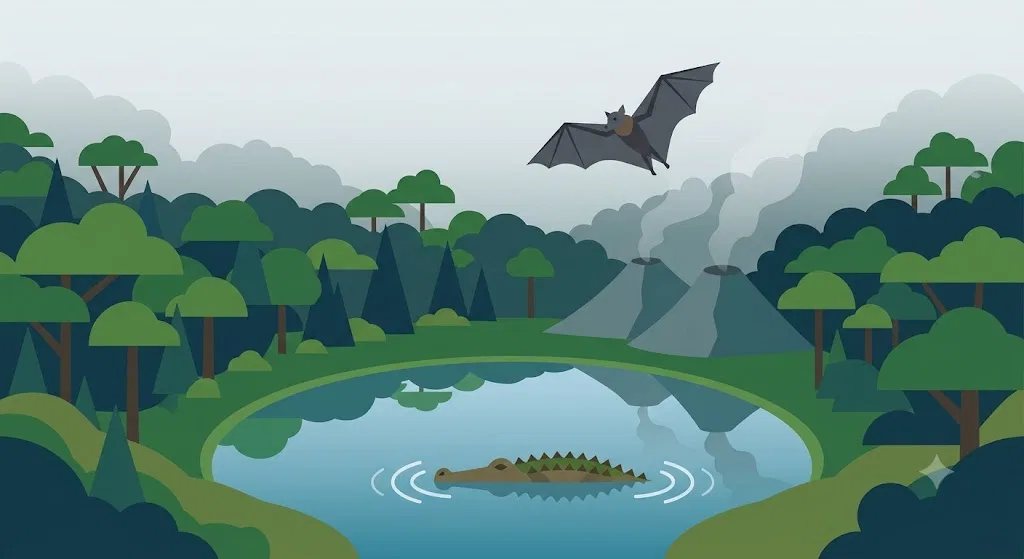
The ropen is Papua New Guinea’s most internationally famous alleged cryptid. Modern accounts commonly place it around Umboi and neighbouring islands in the Bismarck Archipelago. Descriptions vary considerably: it may be a large bat-like animal, a long-tailed flying reptile, a nocturnal scavenger or a glowing object crossing the sky. The most spectacular interpretation identifies it as a surviving pterosaur.
That claim faces an immediate scientific problem. Pterosaurs were flying reptiles rather than dinosaurs, and the known fossil record ends with their extinction about 66 million years ago. A surviving lineage would require not merely one overlooked animal but a reproductively viable population persisting through immense geological and environmental change without leaving recent bones, eggs, carcasses or unmistakable genetic material.[nhm.ac.uk]nhm.ac.ukTheir extinction coincides with when an asteroid collided with Earth.Read moreNatural History MuseumPterosaurs: The truth about these 'flying dinosaurs'Pterosaurs were around until the end of the Cretaceous Period…
How the story took its present form
Cryptid accounts often connect the ropen with British entomologist Evelyn Cheesman, who described mysterious lights seen during her New Guinea travels in her 1935 book The Two Roads of Papua. Her observation involved brief lights moving near a mountain ridge. It did not establish a pterosaur, and later retellings have carried the incident much further than the original puzzle warrants.[Discovery UK]discoveryuk.comDiscovery UKRopen: The Mystery That Refuses to LandDiscovery UKRopen: The Mystery That Refuses to Land
The living-pterosaur version grew mainly through late twentieth- and early twenty-first-century expeditions, books and online films. Some leading promoters approached the subject from young-Earth creationism, because a living pterosaur was imagined as evidence against the conventional geological timeline. That background does not automatically disprove every witness report, but it does affect how testimony has been selected and interpreted. Vague references to wings, tails, lights or night-flying animals were repeatedly fitted to a prehistoric-reptile conclusion before a specimen had been found.[Literary Hub]lithub.comOpen source on lithub.com.
The name itself is less stable than popular summaries imply. Papua New Guinea’s dense linguistic diversity means that similar-sounding terms collected from different communities may not describe the same being. Some reports may concern an animal, others a dangerous spirit, and others simply a mysterious light. Treating all of them as observations of one zoological species creates a false consistency.
What might witnesses actually be seeing?
Large flying foxes are conspicuous in Papua New Guinea and can look striking at dusk, particularly when their size is difficult to judge. Frigatebirds and other long-winged seabirds may appear unfamiliar when viewed from below or at a distance. One widely circulated “ropen” video was identified by zoologist and science writer Brian Switek as showing a frigatebird rather than a prehistoric reptile.[Animalia]animalia.bioOpen source on animalia.bio.
The reported glow is still more problematic. No known large vertebrate produces a bright, sustained light comparable to descriptions of the ropen. Possibilities include distant fires, atmospheric effects, luminous insects seen without scale, lights carried by people, astronomical objects or memory altered by later discussion. Different reports may have different causes; there is no need for one explanation to cover every light and winged silhouette.
The ropen therefore survives mainly as a powerful composite legend. Its raw materials—night-flying animals, unexplained lights, local narratives and genuine remoteness—are real. The leap to a surviving pterosaur is not supported by physical evidence.
Lake Dakataua and the Migo footage
The strongest-looking piece of Papua New Guinean cryptid evidence is not a footprint or an eyewitness sketch but film. During Japanese television expeditions in the 1990s, a large object was recorded swimming in Lake Dakataua, a volcanic caldera lake in West New Britain. The creature became known internationally as the Migo, with other names and spellings appearing in later accounts.
Descriptions assembled by investigators portrayed it as a long-snouted aquatic predator, perhaps four metres long, with a narrow body, tail and apparent flippers. Some enthusiasts proposed an unknown marine reptile or a descendant of a supposedly extinct group. The video seemed to show several humps or sections of a long animal breaking the surface, which gave the story much of its lasting appeal.[tetzoo.com]tetzoo.comthe lake dakataua migo lake monster footage of 1994the lake dakataua migo lake monster footage of 1994
Closer examination makes the footage less exotic. Zoological analysis has argued that the animal’s movement and visible shape are compatible with a crocodile swimming at the surface. A 1980 scientific survey of Lake Dakataua recorded crocodiles among its vertebrate fauna, while the International Union for Conservation of Nature’s Crocodile Specialist Group reports saltwater crocodiles across New Britain and other Papua New Guinean islands.[wiley.com]onlinelibrary.wiley.comj.1365 2427.1980.tb01182.xj.1365 2427.1980.tb01182.x
This explanation also solves an apparent puzzle about the lake. Dakataua is an unusual alkaline freshwater system with no recorded fish population, although it supports frogs, birds and other life. A giant specialised fish-eater or breeding population of marine reptiles would therefore face an obvious food problem. Crocodiles, by contrast, can eat birds, amphibians and animals visiting the shore, and are capable of moving between coastal and inland waters.[Wiley Online Library]onlinelibrary.wiley.comj.1365 2427.1980.tb01182.xj.1365 2427.1980.tb01182.x
The Migo case is a useful lesson in how cryptid footage works. A distant animal filmed in poor conditions may look segmented because its head, back and tail appear and disappear among waves. Once viewers are told they are watching a monster, each dark patch can be read as a separate hump or flipper. The film is genuine evidence that a large animal was present, but it is not persuasive evidence that the animal was unknown.
There is also a cultural complication. “Masalai”, one of the terms sometimes attached to the lake creature, commonly refers in Papua New Guinea to place-associated supernatural beings rather than to a zoological species. Such beings may manifest as snakes, crocodiles or other animals and are linked with particular waterholes, cliffs, rivers or tracts of land. Turning a place spirit into a literal undiscovered reptile can strip the story of its original meaning.[HAL]hal.scienceOpen source on hal.science.
Lake Murray and the dinosaur reports
Lake Murray in Western Province has acquired a looser collection of monster stories. Travel reporting has described local beliefs in a very large aquatic creature, while cryptozoological and creationist sources have circulated claims of dinosaur-like animals seen near the lake around the end of 1999. Some versions say villagers selected images of theropod dinosaurs when shown books by visiting missionaries or investigators.[adventure.com]adventure.comlake of monsters papua new guinealake of monsters papua new guinea
These reports are difficult to verify. Names, dates and descriptions shift between retellings, and much of the material can be traced to websites already committed to finding living dinosaurs. Picture-selection interviews are particularly weak evidence. A witness asked to choose among dramatic prehistoric illustrations may select the closest available outline without claiming that the animal was literally a dinosaur. The process can also introduce features that were absent from the original sighting.
Lake Murray itself contains genuinely impressive animals. It is connected to the Fly River system and supports large crocodiles and introduced black bass, either of which can create startling surface disturbances. Floating logs, swimming reptiles and groups of animals seen at poor angles can produce the impression of a larger, unfamiliar body.[Adventure.com]adventure.comlake of monsters papua new guinealake of monsters papua new guinea
Similar dinosaur reports have been promoted from West New Britain, including alleged long-necked animals around small coastal islands and supposed theropod-like creatures on land. The available accounts largely come through creationist publications rather than independent reporting, scientific field notes or traceable newspaper archives. No corresponding tracks, feeding sites, bones or environmental DNA have been produced.[Creation.com]creation.comtheropod and sauropod dinosaurs sighted in pngtheropod and sauropod dinosaurs sighted in png
The distinction is important: a witness may sincerely report an extraordinary animal without the witness’s interpretation being correct. Memory, translation, leading questions and the circulation of dinosaur pictures can gradually transform “a large reptile” into a detailed sauropod or theropod.
Hairy people and forest beings
Papua New Guinea also has occasional reports of human-like forest creatures. The best-known cryptozoological name is kayadi, attributed to accounts collected among the Amto people. Retellings describe a hairy, upright being capable of climbing quickly and overpowering a person.[karlshuker.blogspot.com]karlshuker.blogspot.comKAYAD IKAYAD I
The evidence is exceptionally thin. The story is known chiefly through later cryptozoological literature rather than a substantial body of independently documented sightings. Papua New Guinea has no recognised native apes or monkeys, and its limited large-mammal fauna makes an undiscovered human-sized primate biologically difficult to accommodate. A breeding population would require food, territory and sufficient numbers to avoid severe inbreeding, while leaving hair, dung, sleeping sites and skeletal remains.
Some hairy-being stories may be folklore rather than animal reports. Others could involve encounters with people, tree-dwelling marsupials seen incompletely, or memories reshaped through comparison with Bigfoot and the orang pendek of western Indonesia. The kayadi is therefore better treated as a marginal and poorly documented tradition, not Papua New Guinea’s equivalent of a well-established nationwide Bigfoot legend.
Folklore is not failed zoology
The most important caution in discussing Papua New Guinea’s monsters is that local narratives do not necessarily ask whether a creature belongs in a field guide. Place spirits, ancestors and dangerous beings may explain ownership, taboo, illness, disappearance or the risks attached to a river, forest or lake.
Masalai traditions illustrate the problem. Anthropological descriptions portray these beings as linked to particular landscape features and social groups. They may appear in animal form, but their significance concerns authority, danger and relationships with place. A crocodile-shaped masalai is not simply a report of an unusually large crocodile.[hal.science]hal.scienceOpen source on hal.science.
Modern cryptozoology often reverses this relationship. It begins with the assumption that a story contains a hidden animal and extracts the bodily details—wings, scales, teeth or size—while discarding the spiritual and social setting. The resulting “cryptid” may therefore be partly a media invention, even when every quoted tradition is authentic.
This does not make folklore worthless as environmental knowledge. Stories can preserve observations about dangerous waterways, animal behaviour, volcanic events and places where people have disappeared. They simply need to be interpreted in their own cultural setting before being turned into zoological claims.
How media reshaped the legends
Papua New Guinea’s cryptids became internationally recognisable through a series of filters:
- Local account: A witness describes an animal, light, spirit or dangerous place in a local language.
- Translation: An investigator or missionary selects an English equivalent, sometimes collapsing several meanings into “monster”.
- Comparison: The account is matched with a familiar global type such as a pterosaur, plesiosaur, dinosaur or Bigfoot.
- Media reconstruction: Television programmes and websites add artwork, dramatic narration and prehistoric silhouettes.
- Online repetition: Later articles cite earlier summaries, making a small number of claims appear to be a large tradition.
The Migo’s international fame came largely from Japanese television footage. The ropen expanded through books, expeditions, documentaries and online creationist culture. West New Britain’s dinosaur reports travelled through specialist websites rather than sustained local or national news coverage. Repetition has kept the creatures alive in popular culture even though the evidential position has barely changed.
This afterlife sometimes overlaps with adventure tourism. Lakes, volcanic islands and remote forests gain an additional layer of appeal when presented as monster country. Yet Papua New Guinea has not built a major official cryptid-tourism industry comparable with Loch Ness. The legends function more as ingredients in travel writing, television and niche expeditions than as organised visitor attractions.
What the evidence supports
Papua New Guinea is an excellent place to discover new species, but species discovery should not be confused with confirmation of famous cryptids. Most newly described animals are identified through specimens, genetic work, detailed measurements and comparison with known species. The ropen, Migo and dinosaur stories have not met those standards.
The present evidence supports several cautious conclusions:
- The Migo footage probably shows a known large animal, with a crocodile providing the strongest explanation because crocodiles are scientifically recorded in Lake Dakataua.
- The ropen is a composite tradition, combining unexplained lights, large flying animals, local stories and later pterosaur imagery.
- Dinosaur reports from Lake Murray and West New Britain are poorly documented, often filtered through sources committed to a living-dinosaur interpretation.
- Hairy forest beings remain folklore or isolated testimony, without biological material demonstrating an unknown ape.
- Local spiritual traditions should not automatically be treated as eyewitness zoology, particularly when terms such as masalai refer to beings associated with land, water and social relationships.
A confirmed large unknown animal would require evidence that can be independently examined: a body or diagnostic tissue, clear imagery with scale and location data, repeated observations by qualified teams, tracks with secure provenance, or environmental DNA that excludes known species. No Papua New Guinean cryptid currently has that level of support.
The enduring appeal
Papua New Guinea’s monster stories endure because the country genuinely challenges the idea that the natural world has been fully catalogued. Its forests and waters continue to yield scientific surprises, and its landscapes can make familiar animals appear strange. Crocodiles surface like prehistoric machines; flying foxes cross the dusk on enormous wings; volcanic lakes hide their depths beneath dark water.
Those realities make better foundations for wonder than claims of confirmed living dinosaurs. The ropen, Migo and Lake Murray monster remain valuable as evolving stories—part wildlife mystery, part cultural translation and part modern media folklore. Their history shows how an uncertain sighting can move from village testimony to television spectacle and finally to a global cryptid legend, gaining sharper claws and more prehistoric features at every stage.
Amazon book picks
Further Reading
Books and field guides related to What Really Lurks Behind Papua New Guinea's Cryptids?. Use these as the next step if you want deeper reading beyond the article.
Field Guide To Bigfoot, Yeti, & Other Mystery Primates Worldwide
Provides context for mystery-animal traditions worldwide including remote regions.
New Guinea Tapeworms and Jewish Grandmothers
Highlights biological discovery and field research in New Guinea.
eBay marketplace picks
Marketplace Samples
Live-tested eBay searches with available results related to this page.

Endnotes
1.
Source: dfa.gov.pg
Link:https://www.dfa.gov.pg/plant-and-animal/
2.
Source: cambridge.org
Link:https://www.cambridge.org/core/journals/journal-of-tropical-ecology/article/freshwater-lakes-of-papua-new-guinea-an-inventory-and-limnological-review/1A3DF15EAF9A42D192CC290FB9F8B51B
Source snippet
Cambridge University Press & AssessmentThe freshwater lakes of Papua New Guinea: an inventory...by MR Chambers · 1987 · Cited by 30 — A...
3.
Source: pnglng.com
Title: Biodiversity in Papua New Guinea
Link:https://www.pnglng.com/media/PNG-LNG-Media/Files/Environment/Biodiversity%20strategy/1284_67_Ch01_Part2.pdf
Source snippet
Guinea ranks fifth for mammals, ninth for birds and second for amphibians. The high degree of floral...Read more...
4.
Source: discoveryuk.com
Title: Discovery UKRopen: The Mystery That Refuses to Land
Link:https://www.discoveryuk.com/mysteries/ropen-the-mystery-that-refuses-to-land/
5.
Source: cryptidz.fandom.com
Title: Cryptid Wiki Ropen
Link:https://cryptidz.fandom.com/wiki/Ropen
6.
Source: animalia.bio
Link:https://animalia.bio/papua-new-guinea-animals?page=2
7.
Source: scienceblogs.com
Title: Filming Migo, the monster of Lake Dakataua
Link:https://scienceblogs.com/tetrapodzoology/2008/10/27/filming-migo-the-monster
8.
Source: onlinelibrary.wiley.com
Title: j.1365 2427.1980.tb01182.x
Link:https://onlinelibrary.wiley.com/doi/abs/10.1111/j.1365-2427.1980.tb01182.x
9.
Source: iucncsg.org
Link:https://www.iucncsg.org/365_docs/attachments/protarea/18%20–8088e67a.pdf
10.
Source: hal.science
Link:https://hal.science/hal-03314396/document
11.
Source: Wikipedia
Link:https://en.wikipedia.org/wiki/Masalai
12.
Source: adventure.com
Title: lake of monsters papua new guinea
Link:https://adventure.com/lake-of-monsters-papua-new-guinea/
13.
Source: cryptidarchives.fandom.com
Title: Neodinosaurs in New Guinea and the Bismarck Archipelago
Link:https://cryptidarchives.fandom.com/wiki/Neodinosaurs_in_New_Guinea_and_the_Bismarck_Archipelago
14.
Source: creation.com
Title: theropod and sauropod dinosaurs sighted in png
Link:https://creation.com/en/articles/theropod-and-sauropod-dinosaurs-sighted-in-png
15.
Source: creation.com
Title: more dino sightings in papua new guinea
Link:https://creation.com/en/articles/more-dino-sightings-in-papua-new-guinea
16.
Source: karlshuker.blogspot.com
Title: KAYAD I
Link:https://karlshuker.blogspot.com/2010/01/kayadi-bigfoot-of-papua-new-guinea.html
17.
Source: iucncsg.org
Link:https://www.iucncsg.org/365_docs/attachments/protarea/ad36d8689b30614e8c5db1a9e118d990.pdf
18.
Source: cryptidarchives.fandom.com
Link:https://cryptidarchives.fandom.com/wiki/Dodu
19.
Source: cryptidz.fandom.com
Link:https://cryptidz.fandom.com/wiki/Murray
20.
Source: cryptidz.fandom.com
Title: Lake Monsters
Link:https://cryptidz.fandom.com/wiki/Lake_Monsters
21.
Source: cryptidarchives.fandom.com
Title: Lake Chad monster
Link:https://cryptidarchives.fandom.com/wiki/Lake_Chad_monster
22.
Source: cryptidz.fandom.com
Link:https://cryptidz.fandom.com/wiki/Migo
23.
Source: cryptidz.fandom.com
Title: Mande Barung
Link:https://cryptidz.fandom.com/wiki/Mande_Barung
24.
Source: cryptidarchives.fandom.com
Link:https://cryptidarchives.fandom.com/wiki/Migo
25.
Source: villains.fandom.com
Link:https://villains.fandom.com/wiki/Ropen
26.
Source: itsmth.fandom.com
Link:https://itsmth.fandom.com/wiki/Migo
27.
Source: Wikipedia
Link:https://en.wikipedia.org/wiki/Fiji
28.
Source: Wikipedia
Title: List of cryptids
Link:https://en.wikipedia.org/wiki/List_of_cryptids
29.
Source: Wikipedia
Title: Fauna of New Guinea
Link:https://en.wikipedia.org/wiki/Fauna_of_New_Guinea
30.
Source: Wikipedia
Title: Saltwater crocodile
Link:https://en.wikipedia.org/wiki/Saltwater_crocodile
31.
Source: Wikipedia
Link:https://en.wikipedia.org/wiki/Dakataua
32.
Source: Wikipedia
Link:https://en.wikipedia.org/wiki/Pterosaur
33.
Source: creation.com
Title: a living dinosaur
Link:https://creation.com/en/articles/a-living-dinosaur
34.
Source: karlshuker.blogspot.com
Title: whatever happened to migo revisiting 19
Link:https://karlshuker.blogspot.com/2020/12/whatever-happened-to-migo-revisiting_19.html
35.
Source: karlshuker.blogspot.com
Title: whatever happened to migo revisiting
Link:https://karlshuker.blogspot.com/2020/12/whatever-happened-to-migo-revisiting.html
36.
Source: animalia.bio
Title: New Guinea Crocodile
Link:https://animalia.bio/new-guinea-crocodile
37.
Source: cbd.int
Link:https://www.cbd.int/doc/world/pg/pg-nr-05-en.pdf
Source snippet
Convention on Biological DiversityPapua New Guinea's Fifth National Report to the...February 5, 2018 — A truly last frontier for biodive...
Published: February 5, 2018
38.
Source: png-data.sprep.org
Link:https://png-data.sprep.org/system/files/Final%20Report_Biodiversity%20%20%28Fauna%29%20%20Survey%20for%20Varirata%20National%20Park.pdf
Source snippet
Papua New Guinea Environment Data PortalFINAL REPORT BIODIVERSITY (FAUNA) SURVEY FOR...9 Oct 2018 — PNG's invertebrate taxa are extensiv...
39.
Source: nhm.ac.uk
Title: Their extinction coincides with when an asteroid collided with Earth.Read more
Link:https://www.nhm.ac.uk/discover/the-truth-about-pterosaurs.html
Source snippet
Natural History MuseumPterosaurs: The truth about these 'flying dinosaurs'Pterosaurs were around until the end of the Cretaceous Period...
40.
Source: amnh.org
Link:https://www.amnh.org/exhibitions/dinosaurs-ancient-fossils/extinction/final-days
Source snippet
American Museum of Natural HistoryFinal Days | AMNHBy 65 million years ago, the pterosaurs, most of these dinosaurs and many other land a...
41.
Source: nhm.ac.uk
Link:https://www.nhm.ac.uk/discover/watch-a-pterosaur-fly.html
42.
Source: lithub.com
Link:https://lithub.com/the-truth-is-out-there-on-the-wild-and-divisive-world-of-cryptozoology/
43.
Source: tetzoo.com
Title: the [lake dakataua migo]({{ ‘lake-migo/’ | relative_url }}) lake monster footage of 1994
Link:https://tetzoo.com/blog/2021/2/16/the-lake-dakataua-migo-lake-monster-footage-of-1994
44.
Source: nhm.ac.uk
Title: early pterosaur fossils hard to find we might now know why
Link:https://www.nhm.ac.uk/discover/news/2025/june/early-pterosaur-fossils-hard-to-find-we-might-now-know-why.html
45.
Source: tetzoo.com
Title: sea monster sightings and the plesiosaur effect
Link:https://tetzoo.com/blog/2019/4/27/sea-monster-sightings-and-the-plesiosaur-effect
46.
Source: jstor.org
Link:https://www.jstor.org/stable/2841079
47.
Source: jstor.org
Link:https://www.jstor.org/stable/2559420
48.
Source: nhm.org
Title: A Ptango With Pterosaurs
Link:https://nhm.org/stories/ptango-pterosaurs
49.
Source: mythlok.com
Link:https://mythlok.com/urban-legends/ropen/
50.
Source: godsandmonsters.info
Link:https://godsandmonsters.info/masalai/
51.
Source: datazone.birdlife.org
Title: papua new guinea
Link:https://datazone.birdlife.org/country/factsheet/papua-new-guinea
Additional References
52.
Source: youtube.com
Title: Cryptid Profile
Link:https://www.youtube.com/watch?v=kHvBjCyb-Qg
Source snippet
How Do These Ancient Animals Hide in the Papuan Forest?...
53.
Source: youtube.com
Title: How Do These Ancient Animals Hide in the Papuan Forest?
Link:https://www.youtube.com/watch?v=0z2vAccPcjk
Source snippet
Did a Glowing Dragon Fly Over Papua New Guinea?...
54.
Source: tropicalsky.co.uk
Link:https://www.tropicalsky.co.uk/south-pacific-holidays/fiji/a-first-timer-s-guide-to-holidaying-in-fiji
55.
Source: joshuaproject.net
Link:https://joshuaproject.net/people_groups/10302
56.
Source: facebook.com
Link:https://www.facebook.com/AboutGreggYan/posts/a-special-wildlife-post-for-today-have-you-ever-heard-of-the-%F0%9D%90%91%F0%9D%90%8E%F0%9D%90%8F%F0%9D%90%84%F0%9D%90%8D-locals-in-pap/24805522129036851/
57.
Source: researchgate.net
Link:https://www.researchgate.net/publication/357886252_Crocodylus_porosus_Saltwater_Crocodile_Assessment_by_THE_IUCN_RED_LIST_OF_THREATENED_SPECIES
58.
Source: reddit.com
Link:https://www.reddit.com/r/Cryptozoology/comments/1b3zwto/cryptids_similar_to_orangpendek_in_southeast_asia/
59.
Source: travelnation.co.uk
Link:https://travelnation.co.uk/blog/fiji-the-islands-where-to-go-what-to-see-on-holiday
60.
Source: dfat.gov.au
Link:https://www.dfat.gov.au/geo/fiji/fiji-country-brief
61.
Source: facebook.com
Link:https://www.facebook.com/ABCPacific/videos/for-the-huli-men-of-papua-new-guinea-hair-is-more-than-style-its-status-strength/1100034762105807/
Topic Tree
Follow this branch
Related pages 192
- Antigua Cryptids
- Maldives Monsters
- Malta Monsters
- Qatar Monsters
- Argentina Monsters
- +187 more in sidebar