Cryptid Reports from Zambia's Swamps and Rivers
Zambia’s mystery-creature tradition is dominated by two striking shapes: a flying reptile said to haunt north-western swamps, and a horned water beast remembered around the Bangweulu basin. The first became famous as the kongamato, often recast by later writers as a surviving pterosaur.
Page outline Jump by section
Introduction
Neither creature is supported by a specimen, verified photograph, trackway or modern zoological survey. Their importance lies elsewhere. Zambia’s monster stories show how local warnings about rivers, animals and dangerous places were recorded by colonial officials, filtered through prehistoric-animal imagery, and then reshaped by cryptozoology and popular culture. The oldest texts are more cautious and complicated than the modern “living dinosaur” versions suggest.[archive.org]archive.orgOpen source on archive.org.
The kongamato: Zambia’s flying monster
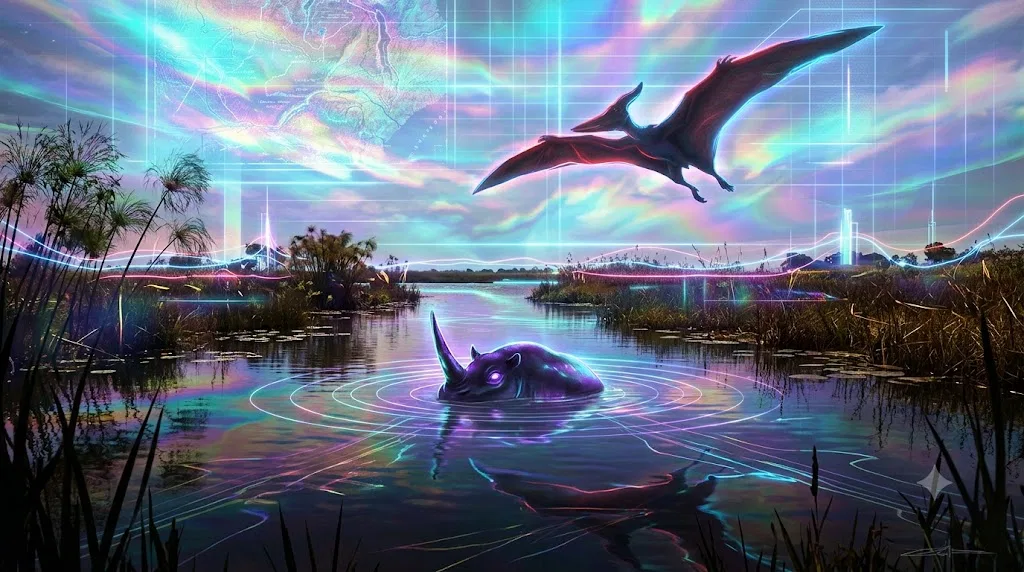
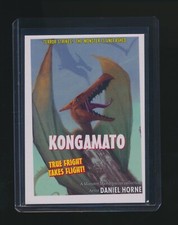
The kongamato is the creature most firmly associated with Zambia in international cryptid literature. It is usually described as a red or dark, featherless flying animal with membranous wings, a long beak and sometimes teeth. Reports are centred on rivers and swamp country in the historic Kasempa District, especially the Jiundu Swamp and the Mutanda River in what is now north-western Zambia.
The story’s most influential source is Frank H. Melland’s 1923 book In Witch-Bound Africa. Melland had served as a magistrate in Northern Rhodesia and devoted a chapter to information he said he gathered from Kaonde informants. His starting point was not a zoological expedition but a protective river-crossing charm. The kongamato was said to lurk near fords and ferries, hold back the water and cause a sudden flood capable of overwhelming travellers. In that form, it was as much an explanation for hazardous water as a flesh-and-blood predator.[Internet Archive]archive.orgInternet ArchiveIn witch-bound Africa: an account of the primitive Kaonde…23 Dec 2009 — In witch-bound Africa: an account of the pri…
Melland then asked what the kongamato looked like. He recorded an answer describing something not quite bird-like but resembling a lizard with bat-like wings. Further enquiries produced a wingspan of roughly four to seven feet, red colouring, bare skin and a possibly toothed beak. Melland showed those present illustrations of prehistoric animals, after which they selected a pterosaur image as the closest match. That picture-identification episode became the foundation for almost every later claim that people in Zambia knew of a surviving “pterodactyl”.[Internet Archive]archive.orgOpen source on archive.org.
What Melland’s account actually proves
Melland believed there might be a real animal behind the reports, but he also recorded serious weaknesses. Nobody would take him to one, nobody produced a body part, and several attributed features were plainly supernatural: the creature was said to be invulnerable, immortal and capable of catching or stopping a canoe from beneath the water. Some informants reportedly said the kongamato was seen directly; others said only that its presence was felt.[Internet Archive]archive.orgOpen source on archive.org.
One alleged incident concerned four people who died near the Mutanda River in 1911. The deaths were blamed on a kongamato, but Melland acknowledged that the river was in flood and that nobody had witnessed what happened. He concluded that the event demonstrated belief in the creature’s powers, not that the creature had caused the deaths. This distinction is often lost in modern retellings, which present the episode as an eyewitness attack.[Internet Archive]archive.orgOpen source on archive.org.
The book also shows how rapidly an ambiguous tradition could become a prehistoric-animal story. Melland supplied the pterosaur pictures, framed the chapter as “The Pterodactyl” and interpreted agreement with the illustration as zoological evidence. Picture matching can be useful, but it is also suggestive: once a recognisable image is offered, a witness may select the nearest available shape without claiming an exact scientific identity. The original description and the later “living pterosaur” conclusion are therefore not the same thing.
Why the Jiundu Swamp mattered
The landscape gave the kongamato story much of its power. Melland described the Jiundu as an inland delta of numerous channels, dense vegetation, wet ground and tangled forest. He estimated its area at about fifty square miles and portrayed it as difficult country in which a rare animal might remain hidden. He also noted that the swamp had served as a refuge for outlaws and people avoiding colonial authority.[Internet Archive]archive.orgOpen source on archive.org.
Such places naturally accumulate stories. Floods can rise suddenly; narrow canoes can snag, overturn or appear to be pulled backwards by currents and submerged vegetation; large birds may launch unexpectedly from reeds; and crocodiles or hippopotamuses can attack with little warning. A named monster can gather these separate risks into one memorable warning.
The geography also helps explain why later versions became more literal. To outside readers, an extensive and poorly familiar swamp looked like a “lost world”. In early twentieth-century adventure writing, Central African wetlands were often imagined as refuges for prehistoric survivors. Zambia’s kongamato could therefore be detached from its river-crossing charm and repackaged as a huntable zoological mystery.
Birds, bats or a surviving pterosaur?
A living pterosaur is the least plausible biological explanation. Pterosaurs were flying reptiles, not dinosaurs, and the known fossil record ends at the mass extinction about 66 million years ago. No confirmed pterosaur remains occur in younger geological deposits, and no modern body, bone, egg, featherless carcass, DNA sample or reliably documented population has been found.[nhm.ac.uk]nhm.ac.ukTheir extinction coincides with when an asteroid collided with EarthNatural History MuseumPterosaurs: The truth about these 'flying dinosaurs'Pterosaurs were around until the end of the Cretaceous Period…
Misidentified wildlife offers more ordinary possibilities, although no single species neatly explains every detail. Zambia supports conspicuous wetland birds with enormous beaks and unusual silhouettes. Bangweulu alone holds hundreds of bird species, including shoebills, wattled cranes, pelicans and saddle-billed storks. A large bird seen briefly, against bright sky or while rising from vegetation, can appear featherless or reptilian, particularly when distance obscures its plumage.[African Parks]africanparks.orgAfrican ParksBangweulu WetlandsBangweulu Wetlands ・ home to hundreds of fish and bird species, the endemic ・ the Endangered shoebill. rei…
The shoebill is especially monster-like in appearance, with a massive hooked bill, broad wings and a slow, heavy flight. Yet it does not have a long tail or toothed jaws, and its main Zambian stronghold lies in Bangweulu rather than the Jiundu area. Fruit bats can produce leathery-winged silhouettes, but known African bats do not match the full reported size and toothed-beak combination either. These are plausible ingredients for mistaken sightings, not decisive identifications.
Another possibility is that the kongamato is not a distorted sighting of one species at all. It may combine observations of birds, bats, crocodiles, floods and canoe accidents with a culturally meaningful being associated with dangerous crossings. Melland’s own material supports this mixed interpretation: the kongamato is alternately a flying animal, a flood-maker, an underwater boat-grabber and an immortal menace.[Internet Archive]archive.orgOpen source on archive.org.
The chipekwe of Bangweulu
Zambia’s other major monster tradition belongs to the water. The chipekwe is usually associated with Lake Bangweulu and nearby swamps, although related names and descriptions have also been reported from the Kafue system, Lake Mweru and areas beyond modern Zambia.
The most frequently cited early account comes from Joseph E. Hughes, who lived around Bangweulu between 1901 and 1919 and later published Eighteen Years on Lake Bangweulu. Hughes reported stories of a dark, smooth-bodied water animal carrying a single horn. One account concerned a remembered hunt involving an earlier generation rather than a recent personal encounter. Later cryptozoological writers linked this creature with similar Central African “elephant-killer” beasts and sometimes reconstructed it as a surviving horned dinosaur.[fandom.com]cryptidarchives.fandom.comEncyclopaedia of Cryptozoology - FandomJoseph Edward Hughes (1876 – 1935), spent the years 1901–1919 on Lake Bangweulu…
The surviving descriptions are not consistent enough to define a zoological species. Chipekwe has been used for a horned amphibious beast, a rhinoceros-like animal, a broadly reptilian creature and, in some sources, more generally for something monstrous or unfamiliar in the water. The word’s shifting use is important: treating every occurrence as the name of one precise animal creates an artificial consistency that the historical reports do not possess.[cryptidarchives.fandom.com]cryptidarchives.fandom.comEncyclopaedia of Cryptozoology - FandomJoseph Edward Hughes (1876 – 1935), spent the years 1901–1919 on Lake Bangweulu…
Bangweulu itself makes an ideal home for such stories. It is an immense seasonal wetland of floodplains, permanent swamps, channels, reeds and woodland. It supports crocodiles, hippopotamuses, black lechwe and an exceptional variety of waterbirds and fish. Visibility can be poor, distances difficult to judge and animal bodies partly concealed by water. A back, head, horn-like branch or wake may be seen for only a few seconds.[African Parks]africanparks.orgAfrican ParksBangweulu WetlandsBangweulu Wetlands ・ home to hundreds of fish and bird species, the endemic ・ the Endangered shoebill. rei…
What could explain a horned water beast?
The most tempting explanation is a rhinoceros, because the chipekwe is repeatedly described as horned and rhinoceros-like. Historical wildlife ranges have changed drastically across southern and central Africa, so a remembered rhinoceros in unfamiliar wetland surroundings cannot be dismissed outright. However, there is no secure specimen or dated field record linking a surviving rhinoceros population to the reported Bangweulu monster.
Hippopotamuses provide another possible source. They are large, aggressive, amphibious and capable of overturning small boats. Seen obliquely, their ears, tusks, splashing or vegetation caught around the head could contribute to a horned-monster report. Crocodiles, swimming elephants and large fish may explain other encounters, tracks or water disturbances. None explains every chipekwe description, which again suggests that the name may have absorbed several animals and stories.
There is also a folklore function. A powerful being that inhabits deep channels and defeats elephants or rhinoceroses expresses the danger and authority of the wetland itself. It warns that familiar rules change at the water’s edge. In that sense, whether a particular report began with a hippo, a spoor or a splash is less important than the way repeated accounts turned Bangweulu into a landscape with a resident monster.
Lake Tanganyika’s scattered monster reports
Zambia borders the southern end of Lake Tanganyika, so the lake’s monster tradition sometimes appears in country-level lists. The reports are much less specifically Zambian than those of the kongamato or chipekwe, however, because the lake is shared with Tanzania, the Democratic Republic of the Congo and Burundi.
An often-repeated nineteenth-century account concerns a missionary who was said to have seen a roughly thirty-foot “sea serpent” both in the water and on shore. Another early twentieth-century report described a tusked or fanged amphibious animal in the southern lake. These stories do not describe a stable, recurring creature: one resembles a serpent, another an unfamiliar mammal, and later retellings merge them into a generic lake monster.[cryptidarchives.fandom.com]cryptidarchives.fandom.comLake Tanganyika monsterLake Tanganyika monster
Lake Tanganyika contains crocodiles, hippopotamuses, large fish and floating debris, all capable of creating dramatic but fleeting impressions. Its great depth and scale encourage speculation, yet depth alone is not evidence for an unknown giant animal. The absence of consistent descriptions, physical traces and a distinctly Zambian sighting cluster makes the “Lake Tanganyika monster” better understood as a regional collection of unusual water reports than as one well-defined cryptid.
Nyami Nyami: river spirit, not undiscovered animal
Nyami Nyami is sometimes placed on cryptid lists because the being is portrayed with a snake-like body and fish-like head. That classification can be misleading. In Tonga tradition, Nyami Nyami is a Zambezi river god or spirit associated with protection, sustenance, floods and the Kariba Gorge, not merely an unidentified animal awaiting scientific discovery.[Facebook]facebook.comOpen source on facebook.com.
The best-known modern form of the story is tied to the building of the Kariba Dam. Floods, deaths and disruption during construction were interpreted in popular retellings as the anger of a river power separated from its mate. The figure later became a widely recognised regional emblem, appearing in carvings, pendants, walking sticks and tourist art on both the Zambian and Zimbabwean sides of the Zambezi.[Wikipedia]WikipediaNyami NyamiNyami Nyami
Nyami Nyami therefore belongs on a page about Zambia’s monster traditions, but with a clear label. It is a sacred or legendary river being with a strong cultural and historical afterlife. Treating it as equivalent to an alleged ape, unknown cat or lake animal strips away much of what the tradition means.
How colonial accounts reshaped the stories
The main Zambian cryptid sources were written during colonial rule by officials, hunters, settlers and travellers. These writers preserved information that might otherwise be difficult to trace, but they also controlled the questions, translations and printed framing. The people who supplied the stories were rarely named in detail, quoted at length or able to correct the finished books.
The kongamato demonstrates the problem clearly. A discussion of a protective charm became a chapter titled “The Pterodactyl”. Informants were shown European illustrations of prehistoric animals, and their selection was then treated as support for survival from the Mesozoic. Even Melland’s relatively careful qualifications were gradually discarded as the story passed through newspapers, books and later websites.[Internet Archive]archive.orgOpen source on archive.org.
The chipekwe underwent a similar transformation. Variable accounts of horned water creatures were grouped with stories from the Congo Basin and southern Africa, then interpreted as evidence for one widespread prehistoric survivor. Differences in language, location, body shape and cultural meaning became inconvenient details rather than clues that several traditions had been combined.
This does not mean local testimony should be dismissed. It means it should be read on its own terms before imposing a modern zoological label. A report can preserve an animal encounter, a warning, a spiritual belief and a historical memory at the same time.
Hoaxes and the internet’s “African dinosaur” package
Zambia’s creatures are frequently mixed online with stories from neighbouring countries. The clearest example is the Kasai rex, a supposed carnivorous dinosaur associated with the Kasai region of the Democratic Republic of the Congo. Fake or manipulated images connected with that story have sometimes been relabelled as photographs of the chipekwe, helping to turn a horned water beast into a flesh-eating theropod.[fandom.com]cryptidz.fandom.comCryptid Wiki Kasai RexCryptid Wiki Kasai Rex
This recycling creates a false impression of accumulating evidence. In reality, the same dubious photographs, anonymous anecdotes and secondary summaries move between names. Kongamato reports from Zambia are combined with flying-creature claims from Cameroon or Zimbabwe; chipekwe traditions are merged with Congo Basin “living dinosaur” stories; and Nyami Nyami is converted from river deity into lake monster.
Modern artwork strengthens the effect. Once a creature is repeatedly illustrated as a pterosaur or ceratopsian dinosaur, that image begins to look like part of the original testimony. Yet the earliest records are often less anatomically precise. The dramatic prehistoric reconstruction is usually the end of the storytelling process, not its starting point.
What the evidence supports
Zambia has genuine and historically documented traditions of dangerous, extraordinary beings connected with wetlands and rivers. The kongamato is rooted in early twentieth-century Kaonde material from the north-west, while the chipekwe belongs to a looser group of horned-water-beast reports around Bangweulu and neighbouring basins. Nyami Nyami represents a different category: a culturally important Zambezi river spirit rather than a straightforward mystery animal.
What Zambia does not have is persuasive evidence for surviving pterosaurs or dinosaurs. There are no verified bodies, recent bones, eggs, clear photographs, repeatable tracks or ecological surveys indicating populations of giant unknown reptiles. The established fossil record places the last pterosaurs and non-avian dinosaurs around 66 million years ago.[Natural History Museum]nhm.ac.ukTheir extinction coincides with when an asteroid collided with EarthNatural History MuseumPterosaurs: The truth about these 'flying dinosaurs'Pterosaurs were around until the end of the Cretaceous Period…
The strongest explanations are layered rather than singular. Known birds, bats, crocodiles, hippopotamuses, rhinoceroses, floods and difficult viewing conditions may account for parts of the testimony. Folklore supplied memorable forms through which hazardous places could be understood. Colonial writers introduced prehistoric illustrations and “lost world” expectations. Cryptozoology then fused separate accounts into apparently coherent species.
That mixture is what makes Zambia’s monster history worth examining. The creatures remain unconfirmed, but the stories reveal how real landscapes, real danger, local knowledge and imported fantasy can combine to create legends that survive long after the original witnesses are gone.
Amazon book picks
Further Reading
Books and field guides related to What Lurks in Zambia's Swamps and Rivers?. Use these as the next step if you want deeper reading beyond the article.
Field Guide To Bigfoot, Yeti, & Other Mystery Primates Worldwide
Provides broader context for mystery-creature traditions.
On the Track of Unknown Animals
Includes discussion of unexplained animal reports worldwide.
eBay marketplace picks
Marketplace Samples
Live-tested eBay searches with available results related to this page.


Endnotes
1.
Source: archive.org
Link:https://archive.org/stream/inwitchboundafri00mell/inwitchboundafri00mell_djvu.txt
2.
Source: cryptidarchives.fandom.com
Link:https://cryptidarchives.fandom.com/wiki/Chipekwe
Source snippet
Encyclopaedia of Cryptozoology - FandomJoseph Edward Hughes (1876 – 1935), spent the years 1901–1919 on Lake Bangweulu...
3.
Source: archive.org
Link:https://archive.org/details/inwitchboundafri00mell
Source snippet
Internet ArchiveIn witch-bound Africa: an account of the primitive Kaonde...23 Dec 2009 — In witch-bound Africa: an account of the pri...
4.
Source: archive.org
Link:https://archive.org/stream/B-001-014-617/B-001-014-617_djvu.txt
5.
Source: cryptidz.fandom.com
Title: Cryptid Wiki Chipekwe
Link:https://cryptidz.fandom.com/wiki/Chipekwe
6.
Source: cryptidarchives.fandom.com
Title: Lake Tanganyika monster
Link:https://cryptidarchives.fandom.com/wiki/Lake_Tanganyika_monster
7.
Source: facebook.com
Link:https://www.facebook.com/100064718077296/posts/nyami-nyamithe-nyami-nyami-otherwise-known-as-the-zambezi-river-god-or-zambezi-s/4634812719888970/
8.
Source: Wikipedia
Title: Nyami Nyami
Link:https://en.wikipedia.org/wiki/Nyami_Nyami
9.
Source: cryptidz.fandom.com
Title: Cryptid Wiki Kasai Rex
Link:https://cryptidz.fandom.com/wiki/Kasai_Rex
10.
Source: cryptidarchives.fandom.com
Title: Kasai rex | Encyclopaedia of Cryptozoology
Link:https://cryptidarchives.fandom.com/wiki/Kasai_rex
11.
Source: cryptidz.fandom.com
Link:https://cryptidz.fandom.com/wiki/Kongamato
12.
Source: villains.fandom.com
Link:https://villains.fandom.com/wiki/Kongamato
13.
Source: cryptidarchives.fandom.com
Link:https://cryptidarchives.fandom.com/wiki/Kongamato
14.
Source: cryptidz.fandom.com
Link:https://cryptidz.fandom.com/wiki/Ichisonga
15.
Source: toonboyfans2022.fandom.com
Link:https://toonboyfans2022.fandom.com/wiki/Ichisonga
16.
Source: ia801406.us.archive.org
Link:https://ia801406.us.archive.org/35/items/inwitchboundaf00mell/inwitchboundaf00mell.pdf
17.
Source: archive.org
Link:https://archive.org/stream/Cryptozoology_201608/Cryptozoology_djvu.txt
18.
Source: facebook.com
Link:https://www.facebook.com/61555526537201/posts/there-are-places-on-earth-where-the-modern-world-feels-thin-a-fragile-veneer-ove/122274529322184217/
19.
Source: facebook.com
Link:https://www.facebook.com/johanegerkranspublic/posts/emela-ntouka-is-a-large-horned-cryptid-from-the-congo-rumoured-to-be-a-highly-de/1285484333379144/
20.
Source: facebook.com
Link:https://www.facebook.com/CryptozoologyFacts/posts/this-drawing-of-the-lake-tanganyika-monster-was-created-by-philippe-coudray-for-/1068754915260683/
21.
Source: facebook.com
Link:https://www.facebook.com/groups/16791880228/posts/10153111260590229/
22.
Source: facebook.com
Link:https://www.facebook.com/groups/262465067275533/posts/1648940578627968/
23.
Source: facebook.com
Title: CHILENGW A NA LESA
Link:https://www.facebook.com/BROWZED/posts/chilengwa-na-lesa-ndola-legend-has-it-the-lake-is-bottomless-mermaids-lives-here/957441463048529/
24.
Source: facebook.com
Title: tubaba and the giant alakuku of africa
Link:https://www.facebook.com/agba.jalingo/posts/tubaba-and-the-giant-alakuku-of-africa/10162296966459738/
25.
Source: facebook.com
Title: in july 1932 the south african franz grobler reported in the cape argus on his i
Link:https://www.facebook.com/markus.hemmler/posts/in-july-1932-the-south-african-franz-grobler-reported-in-the-cape-argus-on-his-i/27278778681753611/
Published: july 1932
26.
Source: facebook.com
Link:https://www.facebook.com/groups/monstertalkgroupmail/posts/27679530034972455/
27.
Source: facebook.com
Link:https://www.facebook.com/johanegerkranspublic/posts/kasai-rex-is-a-saurian-cryptid-from-the-kasai-vally-in-the-democratic-republic-o/1410993524161557/
28.
Source: facebook.com
Link:https://www.facebook.com/TheBalkans/posts/local-residents-believe-that-the-great-prespa-lake-shared-between-albania-greece/1316935671746148/
29.
Source: facebook.com
Title: some sightings are too wild to ignore lake cypress might just be hiding a creatu
Link:https://www.facebook.com/Wildfloridairboats/posts/some-sightings-are-too-wild-to-ignore-lake-cypress-might-just-be-hiding-a-creatu/1393424816163514/
30.
Source: facebook.com
Link:https://www.facebook.com/100069807941475/posts/-the-legend-of-nyami-nyami-the-guardian-of-the-zambezinyami-nyami-also-known-as-/1316811020655817/
31.
Source: facebook.com
Link:https://www.facebook.com/CryptozoologyFacts/posts/this-photo-is-thought-to-be-of-paddler-the-lake-pend-oreille-monster-it-was-take/1469555341847303/
32.
Source: facebook.com
Link:https://www.facebook.com/CryptozoologyFacts/posts/this-newspaper-article-from-the-milwaukee-sentinel-reports-sightings-of-idahos-s/1588151816654321/
33.
Source: facebook.com
Link:https://www.facebook.com/DestinationLivingstoneInitiative/posts/why-livingstone-should-be-on-your-bucket-listdo-you-know-the-legend-of-the-nyami/294574909000231/
34.
Source: facebook.com
Link:https://www.facebook.com/CryptozoologyFacts/posts/this-image-is-a-supposed-photo-of-the-prespa-lake-monster-this-is-a-still-from-a/1078304690972372/
35.
Source: facebook.com
Link:https://www.facebook.com/1025thebull/posts/fulk-lake-is-believed-to-be-the-home-of-the-mysterious-beast-of-busco/4614070081940645/
36.
Source: facebook.com
Link:https://www.facebook.com/creepyacres/posts/the-stories-surrounding-the-conser-lake-monster-are-as-brief-as-they-are-bizarre/1100798381438386/
37.
Source: Wikipedia
Link:https://en.wikipedia.org/wiki/Kongamato
38.
Source: Wikipedia
Title: List of lake monsters
Link:https://en.wikipedia.org/wiki/List_of_lake_monsters
39.
Source: Wikipedia
Title: Lake Mweru
Link:https://en.wikipedia.org/wiki/Lake_Mweru
40.
Source: Wikipedia
Title: Bangweulu Wetlands
Link:https://en.wikipedia.org/wiki/Bangweulu_Wetlands
41.
Source: Wikipedia
Link:https://en.wikipedia.org/wiki/Pterosaur
42.
Source: youtube.com
Link:https://www.youtube.com/watch?v=X-lWVqX_tHo
Source snippet
Terror From Above...
43.
Source: nhm.ac.uk
Title: Their extinction coincides with when an asteroid collided with Earth
Link:https://www.nhm.ac.uk/discover/the-truth-about-pterosaurs.html
Source snippet
Natural History MuseumPterosaurs: The truth about these 'flying dinosaurs'Pterosaurs were around until the end of the Cretaceous Period...
44.
Source: amnh.org
Link:https://www.amnh.org/exhibitions/dinosaurs-ancient-fossils/extinction/final-days
Source snippet
American Museum of Natural HistoryFinal Days | AMNHBy 65 million years ago, the pterosaurs, most of these dinosaurs and many other land a...
45.
Source: africanparks.org
Link:https://www.africanparks.org/the-parks/bangweulu
Source snippet
African ParksBangweulu WetlandsBangweulu Wetlands ・ home to hundreds of fish and bird species, the endemic ・ the Endangered shoebill. rei...
46.
Source: jstor.org
Link:https://www.jstor.org/stable/717809
47.
Source: moderncryptozoology.wordpress.com
Title: the messy embellished history of kasai rex
Link:https://moderncryptozoology.wordpress.com/2026/06/07/the-messy-embellished-history-of-kasai-rex/
48.
Source: abookofcreatures.com
Link:https://abookofcreatures.com/category/zambia/
49.
Source: abookofcreatures.com
Link:https://abookofcreatures.com/2019/05/20/kongamato/
50.
Source: tumblr.com
Link:https://www.tumblr.com/thecreaturecodex/tagged/zambia
51.
Source: mythbeasts.com
Link:https://mythbeasts.com/beast/kongamato/
52.
Source: nhm.ac.uk
Title: early pterosaur fossils hard to find we might now know why
Link:https://www.nhm.ac.uk/discover/news/2025/june/early-pterosaur-fossils-hard-to-find-we-might-now-know-why.html
53.
Source: antiquarianauctions.com
Title: Eighteen Years On Lake Bangweulu
Link:https://antiquarianauctions.com/lots/eighteen-years-on-lake-bangweulu-1
54.
Source: catalog.hathitrust.org
Link:https://catalog.hathitrust.org/Record/001260371
55.
Source: africa-safaris.com
Title: Lake Tanganyika
Link:https://www.africa-safaris.com/blog-post/lake-tanganyika-deepest-lake-in-africa
Additional References
56.
Source: nationalgeographic.com
Title: 140405 pterosaur flying reptile museum exhibit paleontology science
Link:https://www.nationalgeographic.com/animals/article/140405-pterosaur-flying-reptile-museum-exhibit-paleontology-science
Source snippet
National GeographicNew Golden Age for Pterosaurs, Flying Reptiles of the...5 Apr 2014 — Pterosaurs thrived through the Mesozoic, leaving...
57.
Source: brill.com
Link:https://brill.com/downloadpdf/display/title/5607.pdf?srsltid=AfmBOopNITS4n6difuquHtyaM8b0GH77bs2egF05eSPrrwvD1lIWroIB
58.
Source: reddit.com
Link:https://www.reddit.com/r/Cryptozoology/comments/1ju5pgx/a_painting_of_a_kongamato_a_pterosaur_or_flying/
59.
Source: amnh.org
Link:https://www.amnh.org/content/download/342030/5312571/file/ancient-flyers.pdf
60.
Source: reddit.com
Link:https://www.reddit.com/r/TwoSentenceHorror/comments/15fhmwr/as_i_reached_the_waters_edge_i_threw_a_crying/
61.
Source: ebsco.com
Link:https://www.ebsco.com/research-starters/zoology/bangweulu-wetlands
62.
Source: scribd.com
Link:https://www.scribd.com/document/410866578/323758233-encyclopedia-of-monsters-pdf-pdf
63.
Source: instagram.com
Link:https://www.instagram.com/reel/DMvWhhyoscS/?hl=en
64.
Source: scribd.com
Link:https://www.scribd.com/document/754080667/Bernard-Heuvelmans-On-the-Track-of-Unknown-Animals-1970
65.
Source: amazon.com
Link:https://www.amazon.com/-/he/Frank-Hulme-Melland/dp/1397749601?tag=searcht-20
Topic Tree
Follow this branch
Related pages 192
- Antigua Cryptids
- Maldives Monsters
- Malta Monsters
- Qatar Monsters
- Argentina Monsters
- +187 more in sidebar