Does Grenada Have Cryptids or Folklore Monsters?
Grenada is not a country with a Loch Ness-style cryptid dossier full of dated sightings, blurry photographs and organised monster hunts. Its mystery-creature tradition is thinner, older and more folkloric: devil masqueraders, night-roaming shapeshifters, seducing roadside spirits, lake rumours and Caribbean spirit-beasts shared through oral storytelling.
Page outline Jump by section
Grenada’s monster tradition is folklore first, cryptozoology second
A reader looking for “Grenada cryptids” may expect a hidden ape, a sea serpent or a lake beast. The evidence points in a different direction. Grenada’s strongest creature material sits in the wider Caribbean folklore world, where African, European, Indigenous, Indian and other traditions were reshaped through slavery, colonialism, language, religion, plantation life and local storytelling. The National Library and Information System Authority of Trinidad and Tobago describes Caribbean folklore as a mixed inheritance from ancestral lands and local creation, listing figures such as Soucouyants, Anansi, Douens, Lagahoo and the Carriacou “Co co-mar” among the region’s characters.[nalis.gov.tt]nalis.gov.ttOpen source on nalis.gov.tt.
That matters because Grenada’s monster lore does not usually behave like modern cryptid reporting. There is little public evidence of a recurring “case file” with named witnesses, measurement claims, police reports or biological samples. Instead, the creatures work as warnings, Carnival masks, night stories and moral dramas. They explain danger after dark, the risks of lonely roads, suspicious lights, exploitative power, sexual temptation, sickness, bad luck, forest fear and the thin boundary between ordinary life and the spirit world.
This does not make the material less interesting. It simply changes the question. Rather than asking whether Grenada has a confirmed unknown animal, the better question is: what kinds of beings did Grenadians imagine, perform and remember, and why did those beings fit the island’s landscapes and history?
Jab Jab: Grenada’s most visible “devil” is not a monster sighting
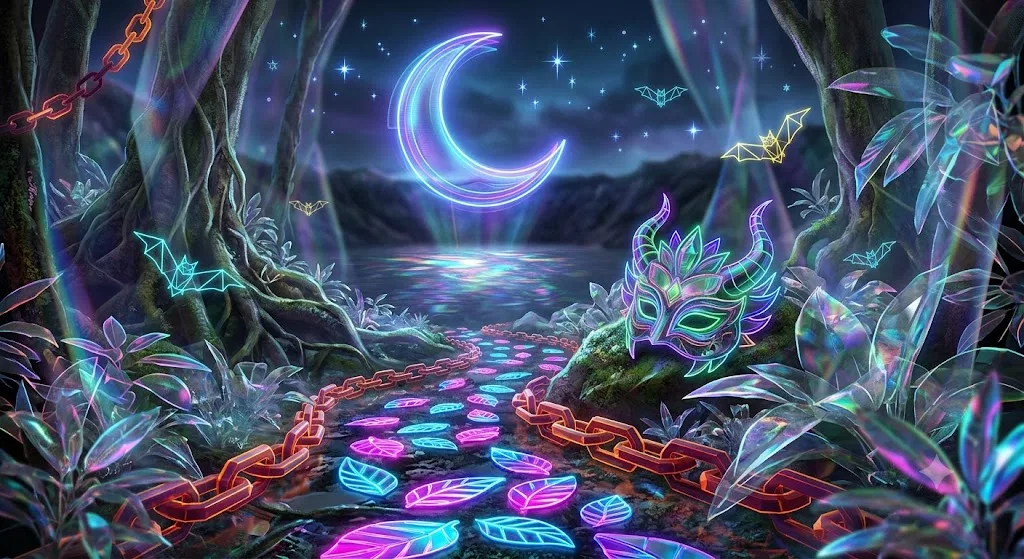
The best-known Grenadian creature-image is the Jab Jab, seen most powerfully during J’ouvert at Spicemas. To an outsider, the horned figures covered in black substance, dragging chains and moving through the streets can look like a living demon tradition. In Grenadian context, however, Jab Jab is better read as masquerade, resistance, satire and remembrance, not a claim that devils literally haunt the island.
During J’ouvert, people “play Jab” by covering their bodies with molasses, tar, old engine oil, black paint or newer mixtures such as vegetable oil and charcoal; horned helmets and chains are common parts of the costume. Essence describes the chains as signifying freedom from bondage, while reporting on Jab Jab as a tradition of Black expression and liberation.[Essence]essence.comOpen source on essence.com.
The deeper story is even sharper. YES! Magazine, citing the Grenada Cultural Foundation, gives a version in which the Jab Jab represents the spirit of an enslaved man who died in a vat of boiling molasses and returns during Carnival to torment his former master. The same account links the blackened body, horns and chains to satirical reversal: enslaved Afro-Grenadians were called devils, and the masquerade turns that insult into a public performance of defiance.[YES! Magazine]yesmagazine.orgYES! Magazine Pleasure Takes Center Stage in Grenada’s J’ouvert CelebrationYES! Magazine Pleasure Takes Center Stage in Grenada’s J’ouvert Celebration
For a cryptid page, Jab Jab is important because it shows how easily a creature tradition can be misread. The Jab Jab has horns, darkness, chains and a frightening visual language, but it is not a hidden species or an eyewitness animal report. It is a performed figure with historical memory inside it. If Grenada has a “monster” known across the world, it is this one — but the monster is colonial cruelty, not the masquerader.
Ligaroo, Lagahoo and the Caribbean shapeshifter
Grenada is often linked with the Ligaroo, a local spelling or variant of the wider Caribbean Loogaroo, Lougarou or Lagahoo tradition. The word ultimately echoes the French “loup-garou”, the werewolf, but Caribbean versions are not simple wolf-men. They can be shapeshifters, sorcerers, night roamers, blood-drinkers, fiery beings or animal-transforming figures depending on island and storyteller.
The public evidence for the Ligaroo as specifically Grenadian is scattered, but it appears repeatedly in summaries of Grenadian folklore and Caribbean monster lists. TravelTips names La Diablesse, Jab Jab and Ligaroo as mythical beings in Grenadian folklore, while a video-summary page of Caribbean folklore describes Ligaroo as a Grenadian creature comparable to a werewolf and often imagined as a fearsome dog or bloodthirsty night-roamer. Those are secondary sources, so they should be treated as orientation rather than proof of a fixed ancient canon.[TravelTips.org]traveltips.orgTravel Tips.org Grenadian Folklore and Legends | Travel Tips.orgTravel Tips.org Grenadian Folklore and Legends | Travel Tips.org
The stronger comparative source base is regional. The Loogaroo entry in broader Caribbean folklore identifies Loogaroo, Ligaroo, Lougarou and Lagahoo as related shapeshifter or vampire-like figures across the Caribbean and African diaspora, often connected to French werewolf language and to Soucouyant-like skin-shedding vampire traditions.[Wikipedia]WikipediaOpen source on wikipedia.org.
As a cryptid claim, the Ligaroo is not persuasive zoology. Grenada has no native wolf, no large unknown carnivore suggested by wildlife data, and no reliable modern case file showing an unknown dog-like predator. As folklore, though, the Ligaroo makes perfect sense: it translates European werewolf language into Caribbean plantation, village and night-road fears. A strange dog, a prowling mongoose, a bat at dusk, a half-seen person in darkness or a story told to keep children indoors could all feed the shape of the legend without requiring an undiscovered animal.
La Diablesse and the dangerous road
La Diablesse is another figure Grenada shares with the wider Caribbean, especially Trinidad and Tobago, Saint Lucia and other islands shaped by French Creole culture. She is usually described as a beautiful, well-dressed woman who lures men away from safety; the horror lies in the hidden sign that she is not fully human, often a cow hoof concealed beneath a long dress.
The most common version has her appearing alluring at first, then leading a man into the forest, ravine or other dangerous place. Wendy Shearer’s accessible folklore account describes La Diablesse as a striking woman who hides in plain sight, associated with daylight as well as roads and open landscapes. General Caribbean summaries also emphasise her broad-brimmed hat, elegant dress and role as a seducer who brings men into danger.[Wendy Shearer]wendyshearer.co.ukWendy Shearer La DiablesseWendy Shearer La Diablesse
In Grenada’s creature-history frame, La Diablesse is best treated as a boundary figure. She is not a “phantom woman” in the generic paranormal sense; she is a monster of roads, gendered risk, desire, social rules and landscape. Her story warns against following beauty without caution, against travelling unwisely, and against assuming that the familiar road is always safe.
Naturalistic explanations are not really the point, but they are still useful. A “sighting” of La Diablesse could arise from misrecognition, darkness, social rumour, a frightening encounter retold with supernatural detail, or the blending of a real woman with a known story pattern. The cow hoof is the tell: it places the tale in the realm of folklore, where one impossible detail exposes the hidden nature of the being.
Soucouyant, jumbies and things that fly in the night
Grenada’s creature world also overlaps with Soucouyant-type folklore: the blood-sucking hag or shapeshifter who may shed her skin and move through the night as a fiery light. The Soucouyant is widespread across the Caribbean under related names, and some reference works note Grenadian spellings such as Soukouyan.[Wikipedia]WikipediaOpen source on wikipedia.org.
This figure sits closer to vampire folklore than to animal cryptids. In many versions, the Soucouyant is an apparently ordinary person by day and a dangerous night-being after dark. The story explains mysterious bruises, illness, weakness, sleep disturbance and fear of unseen harm. Its imagery also overlaps with floating lights, night insects, lamps, fire, fever and rumours about witchcraft.
Jumbies, duppies and other spirit-beings are even broader. They are not cryptids in a strict mystery-animal sense, but they matter because Grenadian monster traditions do not always separate animal, spirit and human categories in the way modern cryptozoology does. A being may be a dead person, a witch, a shapeshifter, a devil-mask, a warning for children and a creature all at once.
That hybridity is one reason Grenada’s folklore should not be flattened into a list of “monsters”. These beings carry social memory. They live in stories about who is trusted, who is feared, what happens after dark, what the forest hides, and how old wrongs return in symbolic form.
Grand Etang Lake: Grenada’s closest thing to a lake-monster setting
If Grenada has a setting that feels made for a lake monster, it is Grand Etang. The lake sits in a volcanic crater within Grand Etang National Park and Forest Reserve, surrounded by rainforest, trails, mist, birds, frogs, lizards and monkeys. Grenada’s tourism authority describes the reserve as habitat for birds, frogs, lizards, opossums, armadillos, mongoose and mona monkeys, with the lake used by birds such as ospreys, herons, spotted sandpipers and Caribbean coots.[Grenada Tourism Authority]puregrenada.comGrenada Tourism Authority Grand Etang National Park & Forest ReserveGrenada Tourism Authority Grand Etang National Park & Forest Reserve
There are modern travel references to legends around Grand Etang, including claims that the crater lake has inspired stories of a sea monster, mermaids or even a Loch Ness-style creature. A travel account on Be-sparkling says the lake’s mysterious appearance, lack of obvious inflow and role as a reservoir helped generate legends about a sea monster. Social posts and travel slides repeat similar ideas, but these are not strong evidence of a long, well-documented monster tradition.[be-sparkling.com]be-sparkling.comOpen source on be-sparkling.com.
The sensible reading is cautious. Grand Etang has the ingredients of a lake-monster legend: deep-looking water, volcanic origin, rainforest isolation, misty weather and tourist imagination. But the available public sources do not show a robust sequence of named sightings comparable to Loch Ness, Lake Champlain or other famous lake monsters. The “monster” may be a local rumour, a guide’s tale, a tourist embellishment, or a modern borrowing of global lake-monster language.
Ecology also lowers the odds of a large unknown animal. Grenada is biodiverse but small, and its terrestrial wildlife is relatively well bounded: official Convention on Biological Diversity country information lists four amphibian species, eight lizard species, five snake species, 150 bird species, four native terrestrial mammal species and 11 native bat species, along with marine and freshwater species.[Convention on Biological Diversity]cbd.intConvention on Biological Diversity Main DetailsConvention on Biological Diversity Main Details
That does not kill the story. It simply moves it from biology to atmosphere. Grand Etang is Grenada’s best “monster lake” because it feels mysterious, not because there is strong evidence that a large animal hides there.
Real animals behind strange encounters
Grenada’s actual wildlife gives plenty of material for misidentification. At Grand Etang, mona monkeys are among the most striking animals visitors may encounter. Grenada’s tourism authority says the mona monkey was transported to Grenada aboard slave ships in the eighteenth century and now lives in forest groups, feeding mainly on fruit but also on insects and leaves.[Grenada Tourism Authority]puregrenada.comGrenada Tourism Authority Grand Etang National Park & Forest ReserveGrenada Tourism Authority Grand Etang National Park & Forest Reserve
For someone hearing movement in thick vegetation, a monkey can become much larger in the imagination than it is in daylight. A mongoose crossing a road, an armadillo rustling in leaf litter, bats moving at dusk, frogs calling from wet forest, snakes near water or birds lifting suddenly from the lake could all become strange in the right conditions. Grenada’s government climate-resilience portal also stresses the island’s range of ecosystems, from rainforests and dry forests to freshwater, mangrove and marine environments, and describes the country’s environmental profile as fragile and vulnerable.[climateresilience.gov.gd]climateresilience.gov.gdBiodiversity Conservation – Climate Resilience PortalBiodiversity Conservation – Climate Resilience Portal
The island’s marine setting adds another layer. Sea-monster traditions worldwide often begin with ordinary but surprising marine animals: oarfish, whales, dolphins, sharks, rays, decomposed carcasses or floating vegetation. The Natural History Museum notes that sea-monster stories have often drawn on real sea creatures such as giant squid, whales and unusual fish, while historical sea-serpent catalogues show how nineteenth-century reports could turn brief sightings into enormous animals through exaggeration and interpretation.[Natural History Museum]nhm.ac.ukOpen source on nhm.ac.uk.
There is no strong Grenadian sea-serpent case in the available public record. The old sea-serpent literature does include a confusing reference to an appearance of a “would-be sea-serpent” on board the Grenada, but that “Grenada” appears to be a vessel name in an account connected with Australia, not evidence for a monster off the island of Grenada.[Project Gutenberg]gutenberg.orgThe Great Sea-serpent. | Project Gutenberg…
Carriacou and the smaller-island edge of the tradition
Grenada’s country scope includes Carriacou and Petite Martinique, and this matters because folklore often survives strongly in smaller communities, festivals and oral performance. NALIS specifically lists a Carriacou “Co co-mar” among Caribbean folklore characters, although the brief online reference does not provide a detailed description.[nalis.gov.tt]nalis.gov.ttcaribbean folklore part 3caribbean folklore part 3
Carriacou is also culturally distinct within the state of Grenada. Grenada’s tourism authority describes it as the second-largest island in the state and part of the Grenadines chain, with strong reef, sailing and beach identities. Travel writing on the island often highlights traditions such as Big Drum, boatbuilding, Carnival and Shakespeare Mas, all of which show how performance and heritage remain central to local identity.[Grenada Tourism Authority]puregrenada.comOpen source on puregrenada.com.
For monster-lore purposes, Carriacou is less useful as a place of documented creature sightings than as a reminder that Grenadian folklore is not only a main-island story. Smaller-island oral traditions may preserve figures that are poorly indexed online. A responsible cryptid history should therefore leave room for local knowledge that is not easily searchable, while not pretending that an undocumented creature has a strong public evidence trail.
What evidence exists, and what is missing?
The available evidence for Grenada’s legendary creatures falls into four broad groups.
First, there is living cultural performance, especially Jab Jab. This is the strongest, most visible and best documented creature-like tradition in Grenada, but it belongs to Carnival, memory and resistance rather than zoological mystery.[Essence]essence.comOpen source on essence.com.
Second, there is regional folklore documentation. La Diablesse, Soucouyant, Lagahoo or Ligaroo, Anansi, Douens and jumbies are widely recognised Caribbean figures, with Grenada participating in that broader story-world. NALIS’s folklore material is useful here because it frames Caribbean folklore as a mixed cultural inheritance rather than a set of isolated island inventions.[nalis.gov.tt]nalis.gov.ttOpen source on nalis.gov.tt.
Third, there are local and travel references. These mention Grenadian folklore books, Ligaroo stories, Grand Etang lake legends and Carriacou figures, but they are uneven in reliability. They help map what people are saying, not what can be confirmed.[traveltips.org]traveltips.orgTravel Tips.org Grenadian Folklore and Legends | Travel Tips.orgTravel Tips.org Grenadian Folklore and Legends | Travel Tips.org
Fourth, there is environmental context. Grenada’s rainforest, crater lakes, bats, birds, reptiles, mona monkeys and marine habitats make strange encounters plausible, even when the supernatural explanation is not. Official biodiversity information is especially helpful because it shows what kinds of animals are actually known from the island.[cbd.int]cbd.intConvention on Biological Diversity Main DetailsConvention on Biological Diversity Main Details
What is missing is just as important: there is no strong public evidence for a recurring Grenadian mystery beast with photographs, tracks, biological samples, repeated named witness accounts and sustained investigation. That absence should not be spun into drama. It simply means Grenada’s creature page is a folklore-and-culture page more than a cryptozoological case file.

The most plausible explanations
The best explanation for Grenada’s monster tradition is not one single origin. It is a layered mix.
Folklore inheritance: Grenada’s legends draw from African, European, French Creole, Indigenous and wider Caribbean sources. The Ligaroo’s name recalls the French werewolf; Soucouyant stories echo Caribbean vampire-hag traditions; Anansi carries West African trickster roots; La Diablesse belongs to a shared Creole world.[nalis.gov.tt]nalis.gov.ttOpen source on nalis.gov.tt.
Historical trauma and satire: Jab Jab shows how a frightening figure can encode slavery, insult, mockery and freedom. The horns and blackened body are not random monster decoration; they speak to colonial language, plantation materials and public reversal.[YES! Magazine]yesmagazine.orgYES! Magazine Pleasure Takes Center Stage in Grenada’s J’ouvert CelebrationYES! Magazine Pleasure Takes Center Stage in Grenada’s J’ouvert Celebration
Landscape fear: Forests, ravines, crater lakes, mangroves, night roads and isolated beaches all help stories feel real. A creature that leads someone into danger works better in a landscape where a wrong path can genuinely matter.
Misidentified animals: Monkeys, bats, snakes, birds, mongoose, armadillos and marine animals can all produce startling impressions, especially at night or in partial view.[Grenada Tourism Authority]puregrenada.comGrenada Tourism Authority Grand Etang National Park & Forest ReserveGrenada Tourism Authority Grand Etang National Park & Forest Reserve
Tourism and pop culture: Grand Etang’s “monster lake” flavour may have been amplified by global Loch Ness language, travel storytelling and the appetite for eerie attractions. That does not make every lake legend fake, but it does warn against treating a tourist anecdote as an old, stable tradition.
Why Grenada’s legends still work
Grenada’s creature lore is compelling because it is not trying to prove a monster in the modern sense. Its figures are memorable because they do cultural work. Jab Jab turns the devil image into resistance. La Diablesse makes the road morally and physically dangerous. The Ligaroo gives shape to fear of night, transformation and hidden malice. The Soucouyant explains invisible harm. Grand Etang’s lake rumours turn a volcanic landscape into a place of mystery.
For readers of cryptids by country, Grenada is therefore a useful corrective. Not every country has a signature mystery animal, and not every monster tradition should be squeezed into the same evidence template. Grenada’s strongest strange creatures are not hidden zoological survivors. They are performed, warned about, whispered over, adapted and remembered — and that is exactly why they have lasted.
Amazon book picks
Further Reading
Books and field guides related to Does Grenada Have Cryptids or Folklore Monsters?. Use these as the next step if you want deeper reading beyond the article.
Anansi the Spider
Anansi traditions are part of the wider folklore landscape referenced in Grenada.
Caribbean Folklore
Strong overview of the folklore traditions that include Grenadian monster and spirit stories.
Encyclopedia of Things that Never Were
Helps readers place Caribbean folklore beings within world monster traditions.
eBay marketplace picks
Marketplace Samples
Live-tested eBay searches with available results related to this page.

Endnotes
1.
Source: nalis.gov.tt
Link:https://www.nalis.gov.tt/blog/caribbean-folklore-part-1/
2.
Source: essence.com
Link:https://www.essence.com/culture/roots-in-resistance-grenada-jab-jab/
3.
Source: traveltips.org
Title: Travel Tips.org Grenadian Folklore and Legends | Travel Tips.org
Link:https://traveltips.org/grenadian-folklore-and-legends/
4.
Source: Wikipedia
Link:https://en.wikipedia.org/wiki/Loogaroo
5.
Source: Wikipedia
Link:https://en.wikipedia.org/wiki/Soucouyant
6.
Source: be-sparkling.com
Link:https://be-sparkling.com/en/grenada-top-11-things-should-see/
7.
Source: facebook.com
Link:https://www.facebook.com/caribbeanbeat/posts/grenadas-famous-grand-etang-lake-has-generated-many-a-myth-and-a-legend-over-the/10158852345014706/
8.
Source: climateresilience.gov.gd
Title: Biodiversity Conservation – Climate Resilience Portal
Link:https://climateresilience.gov.gd/biodiversity-conservation/
9.
Source: gutenberg.org
Title: Project Gutenberg
Link:https://www.gutenberg.org/cache/epub/78334/pg78334-images.html
Source snippet
The Great Sea-serpent. | Project Gutenberg...
10.
Source: nalis.gov.tt
Title: caribbean folklore part 3
Link:https://www.nalis.gov.tt/blog/caribbean-folklore-part-3/
11.
Source: Wikipedia
Title: La Diablesse
Link:https://en.wikipedia.org/wiki/La_Diablesse
12.
Source: Wikipedia
Title: List of lake monsters
Link:https://en.wikipedia.org/wiki/List_of_lake_monsters
13.
Source: Wikipedia
Link:https://en.wikipedia.org/wiki/Grenada
14.
Source: Wikipedia
Title: History of Grenada
Link:https://en.wikipedia.org/wiki/History_of_Grenada
15.
Source: Wikipedia
Title: Geography of Grenada
Link:https://en.wikipedia.org/wiki/Geography_of_Grenada
16.
Source: Wikipedia
Link:https://en.wikipedia.org/wiki/J%27ouvert
17.
Source: Wikipedia
Link:https://en.wikipedia.org/wiki/Carriacou
18.
Source: facebook.com
Link:https://www.facebook.com/groups/191766699268/posts/10163433347459269/
19.
Source: facebook.com
Link:https://www.facebook.com/groups/250840638956722/posts/1460316978009076/
20.
Source: facebook.com
Link:https://www.facebook.com/groups/269202760462518/posts/1333270917389025/
21.
Source: facebook.com
Link:https://www.facebook.com/sfwert344534/posts/spirits-of-the-nightlike-the-greeks-we-too-have-our-mythologythose-were-the-days/10155815923025042/
22.
Source: facebook.com
Link:https://www.facebook.com/NALISPOSALTT/videos/in-celebration-of-folklore-month-we-share-this-indo-trinbagonian-folklore-read-t/831763883143987/
23.
Source: facebook.com
Link:https://www.facebook.com/groups/281886105961506/posts/1936257663857667/
24.
Source: facebook.com
Title: celebrity tale a thon folklore edition 2023
Link:https://www.facebook.com/NALISTT/videos/celebrity-tale-a-thon-folklore-edition-2023/1496158241173624/
25.
Source: facebook.com
Link:https://www.facebook.com/explorecapm/posts/a-fun-encounter-with-the-famous-mona-monkeys-at-grand-etang-grenada-have-you-eve/1578011964327039/
26.
Source: facebook.com
Title: looking for me im a mona monkey you can find me hanging around grand etang fores
Link:https://www.facebook.com/puregrenada/posts/looking-for-me-im-a-mona-monkey-you-can-find-me-hanging-around-grand-etang-fores/10156025923409157/
27.
Source: facebook.com
Link:https://www.facebook.com/vernonchang/videos/grenada-travel-seriesseeing-some-mona-monkeys-at-the-grand-etang-national-park-i/2088917144938821/
28.
Source: facebook.com
Link:https://www.facebook.com/groups/sanpnaturephotographers/posts/1428897207987472/
29.
Source: facebook.com
Link:https://www.facebook.com/puregrenada/posts/to-celebrate-worldhabitatday-we-are-sharing-a-few-important-facts-about-grenadas/10158575781424157/
30.
Source: facebook.com
Link:https://www.facebook.com/BeautifulGrenadaandSpice/posts/the-story-of-jab-jab-is-deep-do-you-know-what-jab-jab-is-and-how-it-came-into-be/1180834310754552/
31.
Source: facebook.com
Link:https://www.facebook.com/groups/191766699268/posts/10161280348219269/
32.
Source: facebook.com
Link:https://www.facebook.com/saysdotcom/posts/capybarely-what-is-this-mystery-animal-on-the-internet-why-is-everyone-so-obsess/948495381041670/
33.
Source: facebook.com
Link:https://www.facebook.com/tanganyikawildlifepark/posts/thats-right-capybaras-have-landed-at-tanganyika-weve-had-a-fun-week-revealing-ou/949763050514670/
34.
Source: facebook.com
Link:https://www.facebook.com/ttnewsday/posts/i-now-call-upon-the-government-to-restore-the-historical-resident-sea-serpent-as/1267140303478571/
35.
Source: facebook.com
Link:https://www.facebook.com/loopnewstt/photos/knowitalldid-you-know-that-there-is-a-lake-in-grenada-grand-etang-which-is-said-/2541123322687938/
36.
Source: facebook.com
Link:https://www.facebook.com/caribbeancompassmag/videos/carriacou-island-is-a-small-beautiful-island-that-is-part-of-grenada-in-the-cari/1138952528430121/
37.
Source: nalis.gov.tt
Title: caribbean folklore part 2
Link:https://www.nalis.gov.tt/blog/caribbean-folklore-part-2/
38.
Source: GOV.UK
Link:https://www.gov.uk/foreign-travel-advice/grenada
39.
Source: yesmagazine.org
Title: YES! Magazine Pleasure Takes Center Stage in Grenada’s J’ouvert Celebration
Link:https://www.yesmagazine.org/health-happiness/2024/12/02/grenada-jab-carnival-pleasure
40.
Source: puregrenada.com
Title: Grenada Tourism Authority Grand Etang National Park & Forest Reserve
Link:https://www.puregrenada.com/grand-etang-national-park-forest-reserve/
41.
Source: cbd.int
Title: Convention on Biological Diversity Main Details
Link:https://www.cbd.int/countries/profile/?country=gd
42.
Source: wendyshearer.co.uk
Title: Wendy Shearer La Diablesse
Link:https://wendyshearer.co.uk/2020/04/la-diablesse/
43.
Source: nhm.ac.uk
Link:https://www.nhm.ac.uk/discover/sea-monsters-inspiration-serpents-mermaids-the-kraken.html
44.
Source: puregrenada.com
Link:https://www.puregrenada.com/about-carriacou/
45.
Source: kraken.travel
Title: sea serpents
Link:https://kraken.travel/story/sea-serpents/
46.
Source: turquoiseholidays.co.uk
Link:https://www.turquoiseholidays.co.uk/blog/destinations/caribbean/grenada/
47.
Source: en.wikivoyage.org
Link:https://en.wikivoyage.org/wiki/Carriacou
Additional References
48.
Source: youtube.com
Title: A TERRIFYING Caribbean FOLKTALE: “La Diablesse” (The Devil Woman)
Link:https://www.youtube.com/watch?v=v16ZMLg_HV4
Source snippet
The African Roots of Carnival (from Jab Jab to Moko Jumbie) - History and the Food...
49.
Source: instagram.com
Link:https://www.instagram.com/p/Cb7hdK_uN9U/
50.
Source: tanrosie.com
Link:https://www.tanrosie.com/about-carriacou
51.
Source: obapao.org
Link:https://obapao.org/sites/default/files/2021-02/Annandale%20and%20Grand%20Etang%20Forest%20Reserves%20Management%20Plan%20%282007%29.pdf
52.
Source: reddit.com
Link:https://www.reddit.com/r/AskTheCaribbean/comments/udeh7l/are_there_any_caribbean_folklore_or_mythical/
53.
Source: tripadvisor.co.uk
Link:https://www.tripadvisor.co.uk/ShowUserReviews-g147297-d149541-r270381717-Grand_Etang_Lake-Grand_Etang_National_Park_Saint_Andrew_Parish_Grenada.html
54.
Source: pinterest.com
Link:https://www.pinterest.com/ideas/caribbean-folklore-characters/940299418715/
55.
Source: amazon.com
Link:https://www.amazon.com/Caribbean-Twilight-Supernatural-Clyde-Viechweg-ebook/dp/B00AP7MOZW?tag=searcht-20
56.
Source: doyleguides.com
Link:https://doyleguides.com/carriacou/
57.
Source: gonomad.com
Link:https://www.gonomad.com/6509-carriacou-a-one-of-a-kind-caribbean-island
Topic Tree
Follow this branch
Related pages 192
- Antigua Cryptids
- Maldives Monsters
- Malta Monsters
- Qatar Monsters
- Argentina Monsters
- +187 more in sidebar