Cryptids of Bahrain's Waters
Bahrain does not have a modern cryptid scene in the familiar “lake monster photographed from the shore” sense.
Page outline Jump by section
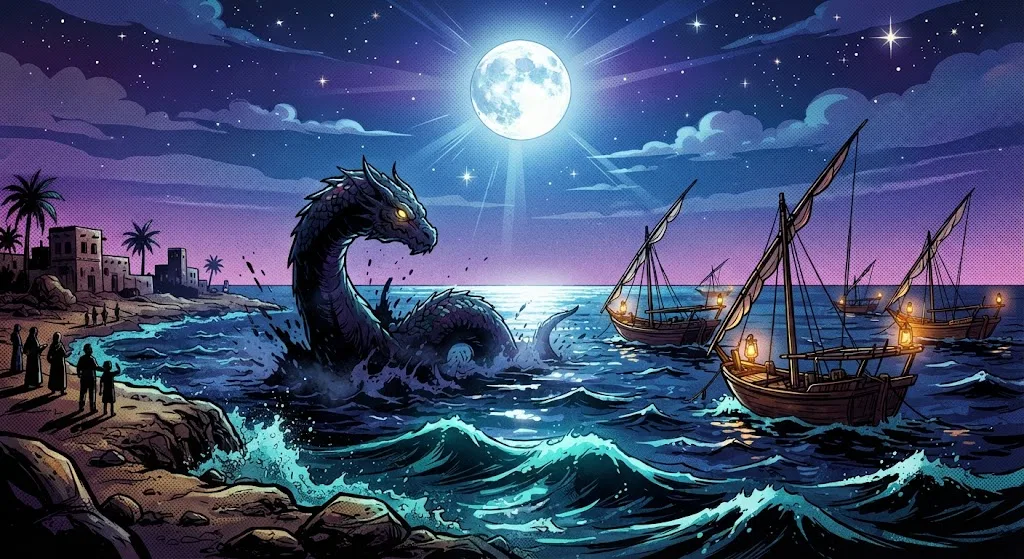
Bahrain’s monster map begins at sea
For Bahrain, the sea is not just scenery. UNESCO describes the island’s traditional pearl harvesting as an economy that shaped Bahrain for millennia, reaching its height in the late nineteenth and early twentieth centuries before collapsing in the 1930s with the rise of cultured pearls. The listed Pearling, Testimony of an Island Economy site includes buildings in Muharraq, offshore oyster beds and the seashore from which boats left for the banks. That matters because Bahrain’s best-known monster stories grew in the same imaginative world: night watches, pearl divers, fishermen, long absences, frightening sounds on the water and the real risk that someone might not return.[UNESCO World Heritage Centre]whc.unesco.orgWorld Heritage Centre Pearling, Testimony of an Island EconomyWorld Heritage Centre Pearling, Testimony of an Island Economy
The Pearling Path’s own interpretation makes the point in cultural rather than spooky terms: Muharraq’s pearling economy may have subsided in the 1930s, but the “grand narrative” it produced remains central to Bahraini cultural identity. Folklore is one part of that narrative. A sea monster in this context is not simply a beast story; it is a way of giving shape to drowning, exhaustion, darkness, dangerous currents, strange animals and the emotional strain of an economy built on the water.[مسار اللؤلؤ]pearlingpath.bhمسار اللؤلؤThe Pearling Path in Detailمسار اللؤلؤThe Pearling Path in Detail
Bu Draya: Bahrain’s lord of the dangerous water
Bu Draya is the clearest Bahrain-linked creature in the country’s mystery-beast tradition. A Bahrain-based folklore article by Husein Mohammad Husein says that stories of part-human, part-sea beings occur in many cultures and that such ideas entered Bahrain and the Arabian Gulf as the figure known as Bu Draya. The same article describes popular belief in Bahrain and the Gulf in Bu Draya, connecting the name to an older “king of the sea” idea and placing the creature among fish lore, sailor knowledge and attempts to explain things seen at sea but not understood.[Folk Culture Bahrain]folkculturebh.orgFolk Culture Bahrain Myths and folktales about sea creatures in BahrainFolk Culture Bahrain Myths and folktales about sea creatures in Bahrain
In Gulf tellings more widely, Bu Draya is often imagined as a water jinn or monstrous sea being that threatens sailors and pearl divers. A peer-reviewed article summary on “The Lord of the Sea” describes the figure as a mysterious Persian Gulf creature, an evil jinn said to appear on dark nights to kill and devour pearl divers. Although that particular study focuses on Qatari folklore, its subject is explicitly a Gulf-wide creature, which helps explain why Bahrain, Qatar, Kuwait and the UAE share overlapping versions rather than neatly separate national monsters.[University of Bucharest Journals]journals.unibuc.roOpen source on unibuc.ro.
For a sceptical reader, the key point is that Bu Draya is best treated as folklore rather than a confirmed unknown animal. There is no strong public evidence of carcasses, photographs, museum specimens or repeated modern biological reports pointing to an undiscovered giant amphibious humanoid in Bahraini waters. What does exist is a well-attested regional sea-monster tradition embedded in maritime labour, oral storytelling and religiously coloured ideas of jinn.
The dugong: the real animal behind the mermaid-like layer
The most plausible animal behind part of Bahrain’s sea-creature tradition is the dugong. The Bahrain-focused Folk Culture article directly discusses the “sea girl” idea in relation to the dugong and notes that the animal is known as a sea cow in the Arabian Gulf. It also distinguishes between older heritage terms and later popular or media-made expressions, which is useful because it shows the legend has been reworked rather than preserved in one fixed form.[Folk Culture Bahrain]folkculturebh.orgFolk Culture Bahrain Myths and folktales about sea creatures in BahrainFolk Culture Bahrain Myths and folktales about sea creatures in Bahrain
Modern conservation sources make the Bahrain connection concrete. The Dugong & Seagrass Hub says dugongs in Bahrain and the Arabian Gulf are known by several local names, including terms translated as “bride of the sea” and “cow of the sea”; it also estimates the Arabian Gulf population at 5,800–7,300 individuals in a 2022 survey. The same source notes that dugongs were still commercially important in Bahrain into the 1930s, when some hunting groups reportedly killed hundreds annually for hides, meat, oil and fat.[Dugong & Seagrass Hub]dugongseagrass.orgDugong & Seagrass Hub BahrainDugong & Seagrass Hub Bahrain
Research on Gulf dugongs also points to the waters between Bahrain and Qatar as especially significant. A 2025 marine-science paper describes the Gulf as a shallow, hot and hypersaline sea that still supports seagrass ecosystems, and it notes large dugong aggregations observed between Bahrain and Qatar, including groups of about 600 animals. This does not “solve” Bu Draya as a dugong in a simple one-to-one way, but it makes a grounded explanation available: real large marine mammals, seen briefly by tired sailors or divers, can become part of a mermaid, sea-cow or sea-spirit tradition over generations.[Frontiers]frontiersin.orgOpen source on frontiersin.org.
Why Bahrain has fewer “sightings” and more remembered creatures
Some countries’ cryptid pages revolve around modern flaps: named witnesses, newspaper dates, police calls, blurry footage and disputed tracks. Bahrain’s case is different. The public record found in accessible sources is thin on modern “unknown animal” incidents but stronger on preserved folklore, museum context and regional oral tradition. That is not a weakness; it tells us what kind of monster tradition Bahrain has.
A Folk Culture article on Gulf narrative structure says desert stories and Gulf folk literature include mythical creatures with set functions, naming Abu Dreya among examples, and adds that many Gulf myths and legends discourage children, women or men from particular actions. It also highlights the need to preserve Bahraini folktales in local dialects, noting the importance of documentation because much of this material belonged to oral tradition.[Folk Culture Bahrain]folkculturebh.orgOpen source on folkculturebh.org.
That helps explain why Bahrain’s creatures often behave like warnings. A sea being keeps divers alert to the dangers of the Gulf. A child-scaring creature keeps children away from dangerous heat or streets. A jinn in an abandoned place turns a real social boundary into a memorable story. In cryptid terms, Bahrain’s monsters sit closer to cautionary folklore than to modern field zoology.
Um Hamar and the child-scaring monster tradition
Away from the sea, the most recognisable Bahrain-linked creature in current popular discussion is Um Hamar, often described as a half-human, half-donkey woman or old woman used to frighten children into behaving. A Local Bahrain feature on filmmaker Hamad Abdulla’s short horror film Hooves says the film is based on Um Hamar, described as a mythological creature from Bahraini childhood. The same article summarises the story as an old woman roaming Bahrain, taking misbehaving children away from the street, half human and half donkey, wearing a black abaya.[Local Bahrain]localbh.comOpen source on localbh.com.
A Gulf Weekly article about a children’s book adaptation gives a softer but revealing version. Bahraini author Eman AlMohri said “any Bahraini” would recognise the folktale of Um Ehmar from childhood, while the article describes the original story as a scary tale about an evil donkey lady who eats children playing outside at noon. The author deliberately gave the fable a funny, child-friendly spin so that families could talk about the old fear across generations.[gulfweekly.com]gulfweekly.comTale of a little girl in a little village: Gulf Weekly OnlineTale of a little girl in a little village: Gulf Weekly Online
That modern afterlife is important. Um Hamar is not being treated as a newly discovered creature; she is being adapted into books and horror films because Bahrainis remember the story. In other words, the creature has moved from domestic warning to cultural reference point. The monster survives because people enjoy retelling what once frightened them.
Ancient Dilmun: serpent-dragons, not modern cryptids
Bahrain’s ancient past adds a deeper layer, but it should be handled carefully. Dilmun is central to Bahrain’s archaeology and cultural identity: the Bahrain Authority for Culture and Antiquities describes Bahrain as the heart and political centre of Dilmun from around 2050 BC, with a major trade role linking the Near East and the Indian Subcontinent. UNESCO identifies Qal’at al-Bahrain as the ancient harbour and capital of Dilmun, with continuous occupation from about 2300 BC to the sixteenth century AD and some of the richest remains of the civilisation.[Culture Bahrain]culture.gov.bhOpen source on culture.gov.bh.
Creature-wise, the most interesting Dilmun material is serpent-dragon imagery on seals and boats. Archaeologist Steffen Terp Laursen’s study of Dilmun boats on seals argues that some boat prows show horned figureheads with large jaws and forward-projecting prongs, and that similar serpent or dragon imagery in Dilmun seal art may point to a Dilmun version of a wider serpent-dragon conflict myth. Laursen suggests this symbolism may have related to primordial sea imagery and royal ideology, not to eyewitness reports of unknown animals.[Pure]pure.au.dkDilmun Boats on Seals, Horned figureheads, and the serpent/dragon slaying myth, c. 2050-1500 BC - Aarhus University…
That distinction matters for a cryptid page. Dilmun serpent-dragons are not “Bahrain’s Loch Ness monster”. They are mythic and symbolic creatures from ancient art and belief. Still, they show that Bahrain’s creature imagination has long been tied to sea power, trade routes, divine danger and the need to represent the ocean as something alive, forceful and potentially hostile.

The best sceptical explanations
Bahrain’s monster traditions make most sense when several explanations are allowed to overlap rather than forcing one tidy answer.
Misidentified marine life is the strongest natural explanation for the mermaid-like and sea-cow strand. Dugongs are real, large, unusual-looking mammals in the Gulf, with culturally loaded names in Bahrain and nearby waters. They do not explain every Bu Draya story, especially the jinn-like attacks and moral lessons, but they plausibly helped feed the wider sea-being imagination.[folkculturebh.org]folkculturebh.orgFolk Culture Bahrain Myths and folktales about sea creatures in BahrainFolk Culture Bahrain Myths and folktales about sea creatures in Bahrain
Pearling danger explains the emotional force of Bu Draya. Bahrain’s pearling economy required men to travel from the shore to oyster beds for long seasons, and UNESCO stresses that the industry was proud but dangerous and demanding. A monster that comes at night, calls from the water or threatens divers turns occupational risk into a memorable story.[UNESCO World Heritage Centre]whc.unesco.orgWorld Heritage Centre Pearling, Testimony of an Island EconomyWorld Heritage Centre Pearling, Testimony of an Island Economy
Cautionary storytelling explains Um Hamar and similar figures. The creature keeps children indoors, away from noon heat, streets or unsafe behaviour, while also giving parents a frightening image that is easy to remember. Modern Bahraini adaptations show that the fear has softened into nostalgia, comedy and horror entertainment rather than public belief in a literal animal-woman.[localbh.com]localbh.comOpen source on localbh.com.
Ancient symbolism explains the Dilmun serpent-dragon layer. Bahrain’s Bronze Age sea imagery belongs to archaeology, religion and royal ideology, not modern zoological mystery. It is relevant because it shows a long tradition of imagining the sea through powerful hybrid beings, but it should not be confused with a modern sighting file.[au.dk]pure.au.dkDilmun Boats on Seals, Horned figureheads, and the serpent/dragon slaying myth, c. 2050-1500 BC - Aarhus University…
How later accounts reshaped Bahrain’s cryptid traditions
Bahrain’s mystery creatures have shifted from lived warnings to heritage material. Bu Draya once made sense in a society where the sea was work, wealth and danger. Today, Bahrain’s pearling past is interpreted through UNESCO sites, restored buildings, museums, festivals and the Pearling Path, so the monster becomes part of a wider memory of the sea rather than a practical warning for divers.[UNESCO World Heritage Centre]whc.unesco.orgWorld Heritage Centre Pearling, Testimony of an Island EconomyWorld Heritage Centre Pearling, Testimony of an Island Economy
Um Hamar has changed in a different way. She has moved from household fright to pop-cultural figure: a subject for children’s literature, local-media nostalgia and short horror filmmaking. That does not make the legend less “real” as folklore. It shows how a monster can survive after literal fear fades, by becoming a shared reference that lets adults remember childhood, creators make new work, and younger audiences meet an old Bahraini figure in safer forms.[Local Bahrain]localbh.comOpen source on localbh.com.
The ancient serpent-dragon has changed most of all, because it is no longer an active folk fear. It survives through archaeology and scholarly interpretation. Yet it still belongs on Bahrain’s creature map because it reveals a very old pattern: the island’s stories repeatedly make the sea into a living boundary between wealth and danger, home and absence, order and the unknown.
What Bahrain’s cryptid tradition really tells us
The honest answer is that Bahrain’s cryptid record is not dominated by modern unresolved animal reports. It is dominated by folklore rooted in a maritime island culture. Bu Draya is the central sea monster, the dugong is the most credible real animal behind part of the mermaid-like tradition, Um Hamar is the best-known child-scaring land figure in modern Bahraini memory, and Dilmun serpent-dragon imagery gives the country a much older mythic layer.
That makes Bahrain a useful reminder that “cryptid by country” does not always mean a hidden animal waiting to be discovered. Sometimes it means a culture’s way of remembering danger. In Bahrain, the monsters gather where the evidence says the old fears gathered too: at the pearl banks, on the night sea, in children’s warnings, among palm groves and in the ancient art of an island civilisation built around trade, water and the uncertain edge of the Gulf.
Endnotes
1.
Source: whc.unesco.org
Title: World Heritage Centre Pearling, Testimony of an Island Economy
Link:https://whc.unesco.org/en/list/1364/
2.
Source: gulfweekly.com
Title: Tale of a little girl in a little village: Gulf Weekly Online
Link:https://www.gulfweekly.com/Articles/360186
3.
Source: whc.unesco.org
Title: World Heritage Centre Qal’at al-Bahrain – Ancient Harbour and Capital of Dilmun
Link:https://whc.unesco.org/en/list/1192/
4.
Source: pure.au.dk
Link:https://pure.au.dk/portal/en/publications/dilmun-boats-on-seals-horned-figureheads-and-the-serpentdragon-sl/
Source snippet
Dilmun Boats on Seals, Horned figureheads, and the serpent/dragon slaying myth, c. 2050-1500 BC - Aarhus University...
5.
Source: ich.unesco.org
Link:https://ich.unesco.org/en/decisions/16.COM/8.B.3
6.
Source: unesco.org
Title: Fjiri | Intangible Heritage
Link:https://www.unesco.org/archives/multimedia/document-5652
7.
Source: whc.unesco.org
Link:https://whc.unesco.org/en/list/1192/gallery/
8.
Source: whc.unesco.org
Link:https://whc.unesco.org/en/documents/113701
9.
Source: bahrain.com
Link:https://www.bahrain.com/en/the-pearling-path
10.
Source: bahrain.com
Title: national museum
Link:https://www.bahrain.com/en/bahrain-national-museum
11.
Source: bahrain.lv
Title: pearl heritage trail
Link:https://bahrain.lv/blog/pearl-heritage-trail
12.
Source: folkculturebh.org
Title: Folk Culture Bahrain Myths and folktales about sea creatures in Bahrain
Link:https://folkculturebh.org/en/?id=916&issue=33&page=article
13.
Source: dugongseagrass.org
Title: Dugong & Seagrass Hub Bahrain
Link:https://www.dugongseagrass.org/where-we-work/bahrain/
14.
Source: pearlingpath.bh
Title: مسار اللؤلؤThe Pearling Path in Detail
Link:https://pearlingpath.bh/en/the-pearling-path-in-detail/
15.
Source: journals.unibuc.ro
Link:https://journals.unibuc.ro/index.php/roar/en/article/view/1900
16.
Source: frontiersin.org
Link:https://www.frontiersin.org/journals/marine-science/articles/10.3389/fmars.2025.1620194/full
17.
Source: folkculturebh.org
Link:https://folkculturebh.org/en/?id=1154&issue=56&page=article
18.
Source: localbh.com
Link:https://localbh.com/bahrain/spotlight-this-bahraini-filmmaker-has-turned-um-hamar-into-a-short-horror-film/
19.
Source: culture.gov.bh
Link:https://culture.gov.bh/en/authority/cultural_sites/BahrainNationalMuseum/HallofDilmun/
20.
Source: Wikipedia
Title: Qatari folklore
Link:https://en.wikipedia.org/wiki/Qatari_folklore
21.
Source: Wikipedia
Link:https://en.wikipedia.org/wiki/Dugong
22.
Source: Wikipedia
Link:https://en.wikipedia.org/wiki/Dilmun
23.
Source: culture.gov.bh
Link:https://culture.gov.bh/en/events/AnnualFestivalsandEvents/HeritageFestival/HeritageFestival2015/TraditionalFolkGames/
24.
Source: culture.gov.bh
Link:https://culture.gov.bh/en/events/past_events/
25.
Source: culture.gov.bh
Link:https://culture.gov.bh/en/authority/infra_projects/Name%2C14932%2Cen.php
26.
Source: culture.gov.bh
Link:https://culture.gov.bh/en/visitingbahrain/CulturalTourism/Destinations/Name%2C9969%2Cen.php
27.
Source: sce.gov.bh
Link:https://www.sce.gov.bh/Media/Pdf/PDF/Bahrain-RedList-Report101.pdf
28.
Source: ancient-cultures.info
Link:https://ancient-cultures.info/data/documents/Dilmun.pdf
29.
Source: 248am.com
Link:https://248am.com/page/63/?su003dAbdullah_Al-Salem_Cultural_Centre=
Additional References
30.
Source: youtube.com
Title: Bahrain: Discover Its Rich Pearl Diving History! | Fact Universe | #Bahrain
Link:http://www.youtube.com/watch?v=c3h1w_enymQ
Source snippet
Bahrain pearl diving history Pearl Diver | The glory of Bahraini Pearls Standart...
31.
Source: youtube.com
Title: What in the World is a Dugong? | National Geographic
Link:http://www.youtube.com/watch?v=YProaycNpHE
Source snippet
Bahrain: Discover Its Rich Pearl Diving History! | FactUniverse | #Bahrain...
32.
Source: instagram.com
Link:https://www.instagram.com/p/5tivXNzF-z/
33.
Source: iloveqatar.net
Link:https://www.iloveqatar.net/videos/qtips/qtip-lady-donkey-of-noon-qatari-folktales
34.
Source: academia.edu
Link:https://www.academia.edu/34106946/A_Tale_of_The_Lord_of_the_Sea_in_Qatari_Folklore_and_Tradition
35.
Source: academia.edu
Link:https://www.academia.edu/75406537/Dilmun_boats_on_seals_horned_figureheads_and_the_serpent_dragon_slaying_myth_c_2050_1500_BC
36.
Source: instagram.com
Link:https://www.instagram.com/reel/DaLAHLPoBb3/
37.
Source: pam-journal.pl
Link:https://pam-journal.pl/en/issues/33-vol-33-regular-issue/a-new-dilmun-related-seal-from-umm-al-quwain-u-a-e
38.
Source: instagram.com
Link:https://www.instagram.com/reel/DQ4eIXEjEB2/
39.
Source: facebook.com
Link:https://www.facebook.com/GDNOnline/posts/a-terrifying-creature-from-bahraini-mythology-has-come-to-life-as-part-of-a-thri/1307259634780743/
Amazon book picks
Further Reading
Books and field guides related to What Monsters Haunt Bahrain's Waters?. Use these as the next step if you want deeper reading beyond the article.
The Book of Legendary Lands
Appeals to readers interested in how legends develop around real environments.
Topic Tree
Follow this branch
Related pages 192
- Antigua Cryptids
- Maldives Monsters
- Malta Monsters
- Qatar Monsters
- Argentina Monsters
- +187 more in sidebar