Within Saint Kitts Mysteries
What Animals Could Be Mistaken for Cryptids?
Monkeys, snakes and unfamiliar marine animals can create alarming reports without requiring an undiscovered species.
On this page
- Green monkeys and ape like sightings
- Rare snakes and sudden public alarms
- How distance, darkness and island ecology distort reports
Page outline Jump by section
Introduction
When people in Saint Kitts and Nevis report seeing a strange animal, the explanation is often more down-to-earth than the first story suggests. Unlike countries with famous long-running mystery-beast traditions, the federation has a small land area, a relatively well-known fauna and a number of introduced or uncommon animals that can appear startling when encountered unexpectedly. Green monkeys, rarely seen snakes, large marine mammals and unusual views across sea and forest can all create the impression that something unknown is lurking nearby. In many cases, the mystery lies less in the animal itself than in the conditions under which it was seen. The islands therefore provide an interesting example of how ordinary wildlife can become extraordinary in local retellings.
Green Monkeys and Ape-Like Sightings
The animal most likely to generate “mystery creature” reports on Saint Kitts and Nevis is the green vervet monkey. These monkeys are not native to the islands. Historical and environmental sources indicate that they were introduced from West Africa during the colonial era, probably as pets or transported animals, and have been established for more than three centuries. Today they exist in very large numbers and are among the most visible wild mammals on the islands.[cbd.int]cbd.intConvention on Biological Diversity Saint Kitts and NevisToday it is estimated that the monkey population exceeds 50,000.Read more…
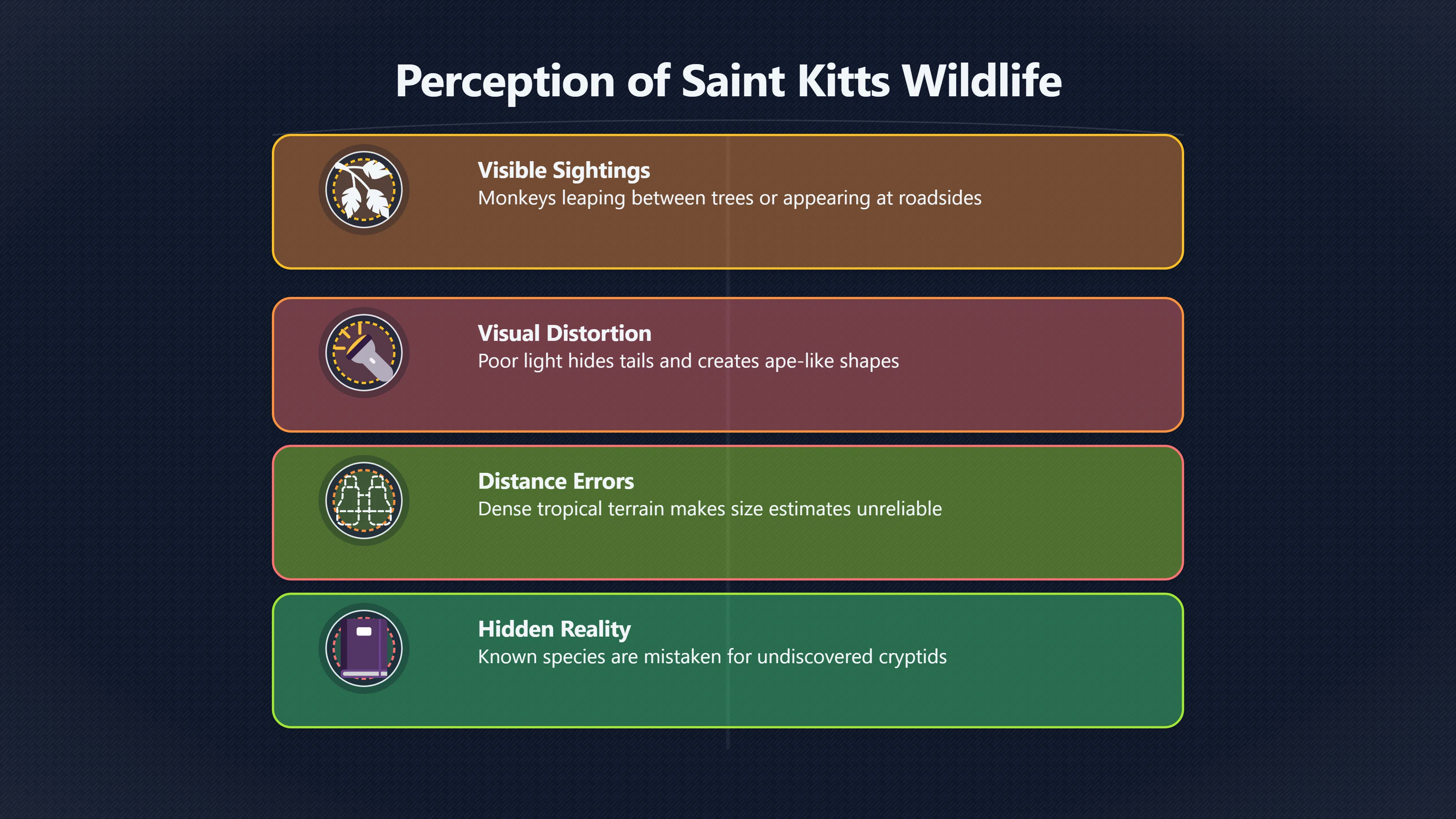
That familiarity can be misleading. Residents know what they are seeing, but visitors or people observing one briefly at dusk may not. A monkey moving upright for a moment, leaping between trees or appearing unexpectedly at the edge of a road can look surprisingly human-like. In poor light, details such as the tail may disappear from view, leaving a witness with the impression of a small ape or an unknown primate.
Several factors make such mistakes easier:
- Vervet monkeys often travel through vegetation where only partial glimpses are possible.
- Their grey-green colouring blends into forest shadows.
- Juveniles and adults differ noticeably in size, making estimates difficult.
- Witnesses frequently judge distance incorrectly in dense tropical terrain.
The islands contain tens of thousands of these animals, meaning that an unusual monkey encounter is statistically far more likely than the presence of an undiscovered primate species.[unep.org]unep.orgUN Environment ProgrammeCaribbean wrestles with mischievous invaders: monkeys29 June 2020 — As iconic as the islands' pristine bea…
In a wider Caribbean context, green monkeys have occasionally contributed to stories about strange ape-like creatures on islands where they are uncommon or unfamiliar. Saint Kitts and Nevis differs because the species is abundant, but the same mechanism applies: a known animal can seem mysterious when seen unexpectedly or under unusual conditions.[DCNA]dcnanature.orgDCNAGreen monkeysThe green monkey (Chlorocebus sabaeus) is native to Africa and was introduced – whether intentionally or unintentionally – to…Read more…
Rare Snakes and Sudden Public Alarms
Snakes often trigger some of the strongest reactions in places where people do not expect to see them. Saint Kitts and Nevis has a limited reptile fauna compared with larger tropical countries, but it does possess native snakes as well as occasional introduced species. The endangered red-bellied racer and several small burrowing snake species are recorded from the islands, while accidental introductions can add to public confusion.[Wikipedia]WikipediaList of amphibians and reptiles of Saint Kitts and NevisList of amphibians and reptiles of Saint Kitts and Nevis
A common pattern in island communities is that a rarely observed snake suddenly becomes the subject of rumours. A witness may report a snake much larger than reality, while retellings quickly transform a normal encounter into a story about a giant or dangerous unknown creature.
The problem is amplified because:
- Most people encounter snakes only briefly.
- Snakes are difficult to judge accurately when moving.
- Fear tends to increase estimated size.
- Photographs are often unavailable.
Reports of tiny introduced blind snakes, sometimes called flowerpot snakes, have caused surprise elsewhere in the Caribbean because people are unfamiliar with their appearance. A person encountering an unexpected snake species may assume it is something exotic or previously unknown.[Facebook]facebook.comFlower pot snake invasion in St. KittsSt. Kitts, The Flower Pot Snake is a Recent Arrival in the Caribbean, 10 snakes were found…
For mystery-animal researchers, snake scares are a useful reminder that rarity alone does not imply a cryptid. An animal can be entirely real, scientifically recognised and still appear mysterious if local observers seldom see it.
Could the Sea Create Monster Stories?
If any environment around Saint Kitts and Nevis is capable of producing genuine “sea monster” impressions, it is the surrounding ocean. The waters of the eastern Caribbean support a surprising diversity of whales and dolphins. Scientific surveys have documented numerous cetacean species in the region, while local sightings continue to occur around the federation.[aquaticmammalsjournal.org]aquaticmammalsjournal.orgCetacean Sightings in the Eastern Caribbean and AdjacentCetacean Sightings in the Eastern Caribbean and Adjacent
Large marine animals are especially prone to misidentification because observers usually see only fragments of them. A surfacing whale may reveal a back, fin or splash but not the entire body. A group of dolphins moving in sequence can appear to be one long serpentine creature. Distance over water also makes size estimates unreliable.
Modern examples show how unusual marine sightings still attract attention. Reports of whales in the channel between Saint Kitts and Nevis generated excitement precisely because such animals are impressive and not always expected by casual observers. Dolphins and other cetaceans are also seen in local waters.[WIC News]wicnews.comWIC News Rare Sight: Huge Whale spotted in channel between StWIC News Rare Sight: Huge Whale spotted in channel between St
Historically, many famous sea-serpent reports around the world have eventually been linked to whales, dolphins, sharks, floating debris or unusual wave patterns. The same principles apply in Caribbean waters. A witness who observes only part of a large animal may honestly describe something that sounds far stranger than what was actually present.
How Distance, Darkness and Island Ecology Distort Reports
The most important explanation for many mystery-animal stories is not a particular species but the way humans perceive wildlife.
Saint Kitts and Nevis contains steep volcanic slopes, forested valleys, coastal cliffs and broad views across open water. These landscapes create ideal conditions for visual errors.
Forest Encounters
In woodland settings, observers often see movement before they see an animal. A rustling branch, a silhouette crossing a gap in the vegetation or a fleeting glimpse of fur can encourage the brain to fill in missing details. Monkeys are especially effective at creating this effect because they move quickly and often disappear before being fully observed.
Night-Time Sightings
Darkness removes many of the features people rely on for identification. Colour disappears, distances become difficult to judge and familiar animals can take on unfamiliar shapes. A monkey, large bird or even a domestic animal can seem much larger or stranger than it really is.
Open-Water Illusions
At sea, the lack of nearby reference points creates persistent problems. An object may appear enormous simply because its distance is unclear. Waves can hide portions of an animal’s body, producing the illusion of a creature with humps, multiple segments or impossible proportions.
The Island Factor
Island ecosystems often contain introduced species, occasional vagrants and animals that arrive naturally from neighbouring islands. Saint Kitts and Nevis is home to introduced green monkeys and other non-native species that have become established over time. When people encounter animals that do not fit their expectations, mystery-animal interpretations become more likely.[cbd.int]cbd.intConvention on Biological Diversity Saint Kitts and NevisToday it is estimated that the monkey population exceeds 50,000.Read more…
Why Misidentifications Matter
Misidentifications are sometimes treated as disappointments, but they are actually one of the most interesting parts of mystery-animal history. They show how legends can emerge from genuine experiences rather than deliberate hoaxes.
In Saint Kitts and Nevis, the strongest wildlife-based explanations involve familiar mechanisms rather than undiscovered beasts: abundant green monkeys mistaken for something more mysterious, rare snake encounters inflated by fear or rumour, and marine mammals viewed under difficult conditions. The result is not a catalogue of hidden monsters but a revealing look at how ordinary animals can acquire extraordinary reputations when surprise, distance and imagination combine.
Amazon book picks
Further Reading
Books and field guides related to What Animals Could Be Mistaken for Cryptids?. Use these as the next step if you want deeper reading beyond the article.
Field Guide To Bigfoot, Yeti, & Other Mystery Primates Worldwide
Explores mistaken sightings and reports of unusual animals.
eBay marketplace picks
Marketplace Samples
Live-tested eBay searches with available results related to this page.

Endnotes
1.
Source: unep.org
Link:https://www.unep.org/news-and-stories/story/caribbean-wrestles-mischievous-invaders-monkeys
Source snippet
UN Environment ProgrammeCaribbean wrestles with mischievous invaders: monkeys29 June 2020 — As iconic as the islands' pristine bea...
Published: June 2020
2.
Source: dcnanature.org
Title: DCNAGreen monkeys
Link:https://dcnanature.org/invasive-monkeys/
Source snippet
The green monkey (Chlorocebus sabaeus) is native to Africa and was introduced – whether intentionally or unintentionally – to...Read more...
3.
Source: Wikipedia
Title: List of amphibians and reptiles of Saint Kitts and Nevis
Link:https://en.wikipedia.org/wiki/List_of_amphibians_and_reptiles_of_Saint_Kitts_and_Nevis
4.
Source: facebook.com
Link:https://www.facebook.com/groups/445396832297065/posts/1929565267213540/
Source snippet
Flower pot snake invasion in St. KittsSt. Kitts, The Flower Pot Snake is a Recent Arrival in the Caribbean, 10 snakes were found...
5.
Source: aquaticmammalsjournal.org
Title: Cetacean Sightings in the Eastern Caribbean and Adjacent
Link:https://www.aquaticmammalsjournal.org/wp-content/uploads/2010/10/36_2_Yoshida.pdf
6.
Source: facebook.com
Link:https://www.facebook.com/FourSeasonsResortNevis/posts/brought-to-st-kitts-and-nevis-by-the-french-in-the-17th-century-these-curious-gr/10160664820449271/
7.
Source: facebook.com
Link:https://www.facebook.com/Bonaire.STINAPA/posts/marine-animal-sighting-formhave-you-observed-marine-animals-such-as-whales-dolph/2631462530204300/
8.
Source: facebook.com
Link:https://www.facebook.com/caribbeanhot7tv/posts/as-concerns-over-snake-encounters-continue-to-grow-in-communities-across-saint-l/1609489807844416/
9.
Source: Wikipedia
Title: Vervet monkey
Link:https://en.wikipedia.org/wiki/Vervet_monkey
10.
Source: cbd.int
Title: Convention on Biological Diversity Saint Kitts and Nevis
Link:https://www.cbd.int/countries/profile/?country=kn
Source snippet
Today it is estimated that the monkey population exceeds 50,000.Read more...
11.
Source: caribbeaninvasives.org
Title: Caribbean Invasive Alien Species Network Green monkeys in St
Link:https://caribbeaninvasives.org/index.php/2021/10/01/green-monkeys-in-st-kitts-and-nevis/
Source snippet
Kitts and Nevis1 Oct 2021 — In St. Kitts and Nevis, the green monkey or African vervet monkey are not native to the country. The monkeys...
12.
Source: wicnews.com
Title: WIC News Rare Sight: Huge Whale spotted in channel between St
Link:https://wicnews.com/saint-kitts-nevis/rare-sight-huge-whale-spotted-in-channel-between-st-kitts-and-nevis
13.
Source: cbd.int
Link:https://www.cbd.int/doc/world/kn/kn-nbsap-01-p5-en.pdf
Additional References
14.
Source: researchgate.net
Link:https://www.researchgate.net/publication/316658684_Vervets_in_the_Caribbean
Source snippet
ResearchGate(PDF) Vervets in the Caribbean... monkey troops, or between 22,000 and 37,000 green monkeys. View. Show abstract. Understandi...
15.
Source: frontiersin.org
Title: Frontiers Understanding Community Perceptions of the St
Link:https://www.frontiersin.org/journals/ecology-and-evolution/articles/10.3389/fevo.2022.904797/full
Source snippet
CA Gallagher · 2022 · Cited by 13 — Monkey trappers capture monkeys in nature for use in biomedical research and also supply...
16.
Source: youtube.com
Title: Amazing St-Kitts
Link:https://www.youtube.com/watch?v=FK0pVb4GIZI
Source snippet
Green Vervet Monkeys, Shipwreck Beach Bar and Grill @ St. Kitts Eastern Caribbean...
17.
Source: instagram.com
Link:https://www.instagram.com/reel/DZpcKk4hC8g/
18.
Source: caribbeaninvasives.org
Link:https://caribbeaninvasives.org/countries-in-action/st-kitts-and-nevis/
19.
Source: medium.com
Link:https://medium.com/%40lidatz/a-barrel-of-monkey-madness-with-green-vervets-on-st-kitts-nevis-ff8db76d613f
20.
Source: ghsindex.org
Link:https://ghsindex.org/wp-content/uploads/2021/12/St-Kitts-Nevis.pdf
21.
Source: tenementyaadmedia.com
Link:https://www.tenementyaadmedia.com/checkmate-1/monkeys
22.
Source: instagram.com
Link:https://www.instagram.com/reel/DMK9ZIJhL1D/
23.
Source: arff.org
Link:https://arff.org/kitts
Topic Tree