What Monsters Live in Lao Legend?
Laos does not have a crowded modern cryptid scene in the way that some countries have Bigfoot-style sighting archives or newspaper monster flaps.
Page outline Jump by section
Introduction
The second thread is more cryptozoological: Laos sits in the Greater Mekong and Annamite landscapes, where rare animals can genuinely remain unseen for long periods. The saola, first documented by scientists in 1992 and often called the “Asian unicorn”, proves that remote forests in and around Laos can still surprise biology. That does not prove Lao cryptids are real, but it explains why mystery-animal stories here feel more plausible than they might in a heavily surveyed landscape.[World Wildlife Fund]worldwildlife.orgOpen source on worldwildlife.org.
Why the Naga dominates Laos’s creature folklore
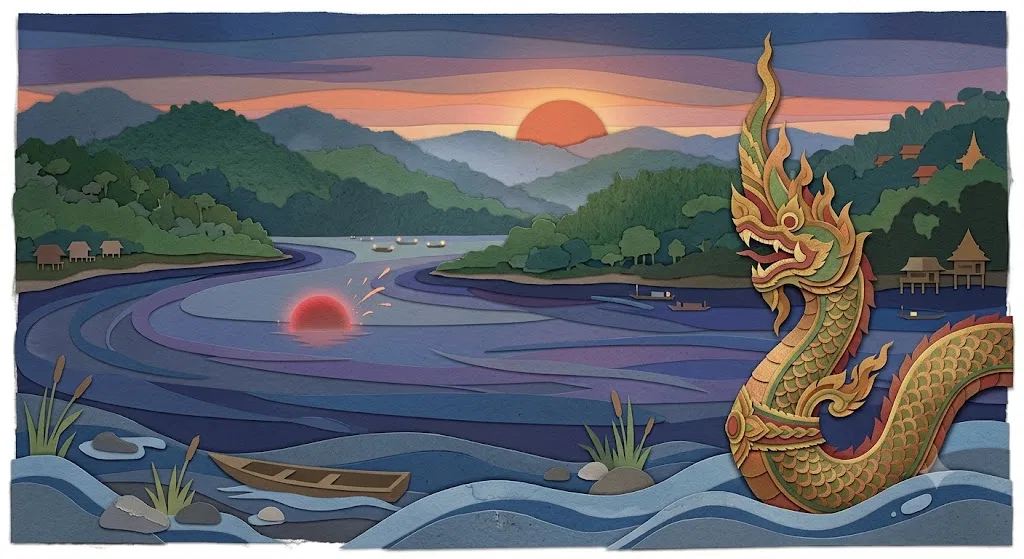
The creature most associated with Laos is the Naga: a serpent-like water being linked to rivers, protection, fertility, Buddhism and older local spirit beliefs. In public-facing terms, it is the country’s key legendary beast. It appears in temple architecture, textiles, stories about the Mekong, and the cultural imagination of Vientiane and Luang Prabang. National Geographic described the Naga as visible across Lao life, from temple rooflines and murals to weaving, and noted a Lao legend in which a half-serpent, half-human water spirit draws a weaver into the depths of the Mekong.[National Geographic]nationalgeographic.comthis serpent god is everywhere in laosthis serpent god is everywhere in laos
The Naga matters because it is not just a decorative dragon. In Lao tradition, serpent spirits are often treated as guardians of place. Luang Prabang, at the meeting of the Mekong and Nam Khan rivers, is associated in legend with guardian Nagas, while Lao tourism material links the old name Sri Sattanak to a legendary serpent said to have dug the Mekong riverbed.[National Geographic]nationalgeographic.comthis serpent god is everywhere in laosthis serpent god is everywhere in laos
That water connection is crucial. Laos is landlocked, so its “sea serpent” tradition is really a river-serpent tradition. The Mekong provides the creature’s stage: deep channels, seasonal flooding, mist, boat traffic, fish, floating debris, river lights and a long history of sacred geography. In that setting, the Naga becomes more than a monster. It is a way of imagining the river as alive, powerful and morally charged.
UNESCO’s description of Lao Naga motif weaving is especially useful because it shows the creature’s cultural status without turning it into a biological claim. Naga motifs are woven by hand on traditional looms; they are not printed or embroidered after the fact. UNESCO’s committee decision says Lao people add Naga motifs to objects, especially textiles, to show respect, and that the motif carries meanings of protection and strength.[UNESCO Intangible Cultural Heritage]ich.unesco.orgOpen source on unesco.org.
What are the Mekong Naga fireballs?
The most famous “sighting” phenomenon linked to the Naga is the annual report of reddish balls of light rising from the Mekong around the end of Buddhist Lent. These are usually discussed through the Thai-Lao border area, especially the Nong Khai and Phon Phisai stretch on the Thai side, but the story is inseparable from Laos because the Mekong is the border and many explanations involve the Lao bank.[Wikipedia]WikipediaNaga fireballNaga fireball
For believers, the lights are commonly understood as signs of the Naga honouring the Buddha. For sceptics, they are a mixed bag: possible festival effects, fireworks, tracer rounds, flare guns, misidentified lights, atmospheric oddities, or stories shaped by expectation. A 2003 Al Jazeera report presented the event as a natural river spectacle, while later Thai sceptical commentary argued that some fireballs were projectile bullets or flares fired from the Lao side.[Al Jazeera]aljazeera.comthailands natural fireball riverthailands natural fireball river
The fireballs are a good example of why Laos’s creature lore needs careful language. They are not evidence of a giant serpent. They are evidence of a recurring public tradition in which lights, festival timing, Buddhist meaning, tourism and borderland storytelling have become braided together. Academic discussion of the phenomenon has also noted that natural and man-made explanations can threaten both supernatural belief and local economic interests, which helps explain why the debate has remained sensitive.[ResearchGate]researchgate.netResearch Gate(PDF) The "Postmodernization" of a Mythical Event: NagaResearch Gate(PDF) The "Postmodernization" of a Mythical Event: Naga
For a cryptid reader, the useful distinction is this:
- Folklore claim: the Naga produces the lights.
- Witness claim: people report seeing reddish lights rise and vanish.
- Tourism event: crowds gather because the spectacle has become a seasonal attraction.
- Sceptical possibilities: flares, tracer rounds, fireworks, optical confusion, or natural gas claims.
- Evidence gap: none of the available explanations has turned the Naga into a confirmed animal.

Have people claimed to see river serpents in Laos?
There are accounts of supposed Naga or river-serpent sightings, but they are much thinner than the cultural tradition around the Naga. One useful older discussion by ichthyologist Tyson R. Roberts, published through the Siam Society, records that witnesses near Salakoktan on the outskirts of Vientiane were interviewed by Alan Davidson while he was British Ambassador to Laos. The reported creatures were said to undulate in the Mekong when the water first began to fall after the rainy season; one observer estimated a length of about 20 to 25 metres and described a red band near the head.[thesiamsociety.org]thesiamsociety.orgNHBSS 050 2j Roberts Payanak As AMythicaNHBSS 050 2j Roberts Payanak As AMythica
That kind of account is vivid, but it is not strong zoological evidence. It depends on memory, distance, water conditions and interpretation. The Mekong contains large fish, floating logs, boat wakes, groups of animals, and unusual light effects. A long shape seen at water level can become serpent-like very quickly, especially in a place where serpent beings already have cultural meaning.
Roberts also discussed a famous confusion between the Naga-like image and the oarfish, a spectacular marine fish sometimes linked to sea-serpent legends. This explanation is weak for Laos as a literal animal candidate because oarfish are marine, not river animals; Roberts explicitly notes that the oarfish family is exclusively marine and has not been found in the Mekong or any other river.[thesiamsociety.org]thesiamsociety.orgNHBSS 050 2j Roberts Payanak As AMythicaNHBSS 050 2j Roberts Payanak As AMythica
So the best reading is not “people saw nothing” or “people saw a monster”. It is that Laos has a powerful serpent framework through which ambiguous river experiences can be interpreted. The Naga legend comes first; particular sightings are then folded into it.
The Lao Beastman and forest wildman rumours
Laos also has a much more obscure cryptid entry sometimes called the Lao Beastman. Compared with the Naga, this is a weakly documented fringe case. The available online trail largely runs through cryptid catalogues, which say that Japanese zoologist and cryptid investigator Tadaaki Imaizumi visited Laos in 1995 after a theory linking the so-called Minnesota Iceman to the Vietnam War. According to these summaries, he gathered local testimony around Lak Sao and Prabang village about a hairy, upright creature, with one version oddly described as horse-like.[Cryptid Wiki]cryptidz.fandom.comCryptid Wiki Lao BeastmanCryptid Wiki Lao Beastman
This is exactly the sort of case that should be handled cautiously. The story is interesting because it sits near a wider Southeast Asian “wildman” tradition, including Vietnamese reports often labelled Rock Ape or forest person. But the Lao version has no clear specimen, photograph, trackway, repeated modern witness cluster, or strong primary documentation available in English. The reported description also seems unstable: part ape-like, part horse-like, possibly mixed with knowledge of large wild cattle such as gaur.[Cryptid Wiki]cryptidz.fandom.comCryptid Wiki Lao BeastmanCryptid Wiki Lao Beastman
A sceptical interpretation is straightforward. Remote wartime landscapes, language barriers, memory, rumours moving across borders, and real animals glimpsed briefly in forest can generate composite beasts. The “Lao Beastman” is therefore best treated as a cryptozoological footnote rather than a central Lao monster tradition.
That does not make it worthless. It shows how Laos can absorb regional mystery-animal motifs: hairy wild men, wartime jungle encounters, vanished caves, and rumours of unknown creatures surviving in remote terrain. But it is far less culturally grounded than the Naga and far less biologically supported than Laos’s genuinely rare known wildlife.
Real rare animals make the stories feel possible
The reason mystery-animal claims in Laos keep some imaginative force is simple: the country lies within one of Asia’s great biodiversity zones. The Annamite Mountains, running through Laos and Vietnam and towards north-east Cambodia, are repeatedly described by conservation groups as a stronghold for rare and poorly known species. Recent camera-trap work has continued to reveal elusive wildlife across this landscape.[Fauna & Flora]fauna-flora.orginside asias amazon camera traps reveal the secrets of the annamite mountainsinside asias amazon camera traps reveal the secrets of the annamite mountains
The saola is the key example. Scientists first documented it in 1992 after unusual long, straight horns were found in a hunter’s home during a joint Vietnamese Ministry of Forestry and WWF survey. WWF calls it one of the most spectacular zoological discoveries of the twentieth century and the first large mammal discovery in more than 50 years.[World Wildlife Fund]worldwildlife.orgOpen source on worldwildlife.org.
The saola is not a cryptid now; it is a recognised species. But its story overlaps with cryptid thinking in one important way: local knowledge, hunter remains and remote habitat came before formal scientific confirmation. IUCN and WWF sources say the animal lives in Vietnam and Laos, has only been recorded in the wild a handful of times since discovery, and was most recently confirmed by camera-trap photographs in 2013.[IUCN]iucn.orgOpen source on iucn.org.
Other rare mammals in the region add to that context. The giant muntjac is known from the Annamite region of Laos, Vietnam and eastern Cambodia and is classed as Critically Endangered in research literature. Camera-trap studies in Nakai-Nam Theun National Park have also shown how modern wildlife monitoring can detect and map elusive species that ordinary travellers will almost never see.[PMC]pmc.ncbi.nlm.nih.govOpen source on nih.gov.
This is the honest middle ground: Laos is not full of proven monsters, but it is full of habitats where rare animals can be missed, misidentified, or known locally before outsiders understand them.

Likely explanations for Lao monster reports
Most Lao mystery-creature material falls into a few explanation patterns. None of these explanations “solves” every story, but they help separate cultural tradition from animal evidence.
Sacred river symbolism. The Naga is closely tied to water, rainfall, fertility, protection and Buddhist imagery. In a country shaped by the Mekong, a serpent guardian is a powerful way to speak about dependence on water and respect for dangerous natural forces.[Ock Pop Tok]ockpoptok.comOck Pop Tok Naga KingdomOck Pop Tok Naga Kingdom
Ambiguous sightings on water. Long shapes in rivers are easy to misread. Current lines, floating vegetation, logs, fish movement and boat wakes can create the impression of an undulating creature, especially at dusk, during festivals, or after the rainy season.
Festival reinforcement. The Naga fireballs show how a repeated public event can strengthen belief. Even when sceptics propose flares, fireworks or tracer rounds, the annual gathering itself keeps the legend alive and visible.[nationthailand]nationthailand.comOpen source on nationthailand.com.
Real biodiversity. Laos’s forests really do contain rare, cryptic and threatened animals. That gives some mystery-animal rumours a plausible ecological background, even when a specific beastman or monster claim lacks evidence.[asiapacific.panda.org]asiapacific.panda.orgnew species discoveries 2023new species discoveries 2023
Cross-border story movement. Laos shares ecological and cultural regions with Thailand, Vietnam and Cambodia. A creature story can move along rivers, wartime routes, ethnic networks, tourism circuits and online cryptid lists, becoming “Lao” in one version and regional in another.
How the legend has changed
The Lao Naga has moved through several forms without losing its core identity. It begins as a sacred serpent or water being, becomes attached to Buddhist protection stories, appears in temple and textile art, and now also functions in heritage promotion and tourism. UNESCO recognition of Naga motif weaving gives the creature a modern institutional afterlife: the Naga is not only a legend told beside the river, but a heritage symbol presented to the world.[UNESCO Intangible Cultural Heritage]ich.unesco.orgOpen source on unesco.org.
The fireball tradition has also changed. What may once have been a local river-light story is now a festival-linked spectacle discussed in newspapers, sceptical media, tourism writing and online debate. That shift does not make the belief fake; it shows how folklore adapts when cameras, crowds and national borders become part of the story.[Al Jazeera]aljazeera.comthailands natural fireball riverthailands natural fireball river
The forest-creature side has changed differently. Rather than becoming a major Lao public legend, the Lao Beastman has mostly survived as a cryptid-list entry, attached to older Vietnam War wildman rumours and the Minnesota Iceman mythology. Its weak documentation means it has not entered mainstream Lao cultural heritage in the way the Naga has.[Cryptid Wiki]cryptidz.fandom.comCryptid Wiki Lao BeastmanCryptid Wiki Lao Beastman
What Laos contributes to cryptid history
Laos is most valuable to cryptid history not because it offers a long list of monsters, but because it shows three different layers of mystery-creature thinking in one country.
First, there is living folklore: the Naga as a protective serpent of water, place and Buddhist imagination. Second, there is ambiguous phenomenon culture: the Mekong fireballs, where witnesses report lights and communities interpret them through the Naga. Third, there is real zoological surprise: animals such as the saola and giant muntjac, which prove that the Greater Mekong can still produce startling discoveries without needing to confirm every monster story.[thesiamsociety.org]thesiamsociety.orgNHBSS 050 2j Roberts Payanak As AMythicaNHBSS 050 2j Roberts Payanak As AMythica
That combination makes Laos a quietly fascinating country for readers of strange animal lore. The best-known creature is not a hidden ape or lake monster, but a sacred river serpent. The strongest evidence is not for a monster, but for a cultural tradition woven through art, water, religion and identity. And the most important sceptical lesson is not that all strange stories are foolish. It is that folklore, witness experience and wildlife discovery can overlap without becoming the same thing.
Endnotes
1.
Source: ich.unesco.org
Link:https://ich.unesco.org/en/RL/traditional-craft-of-naga-motif-weaving-in-lao-communities-01973
2.
Source: ich.unesco.org
Link:https://ich.unesco.org/en/decisions/16.COM/8.B.20
3.
Source: iucn.org
Link:https://iucn.org/news/asia/201607/urgent-action-needed-save-critically-endangered-%E2%80%9Casian-unicorn%E2%80%9D-viet-nam-and-laos
4.
Source: Wikipedia
Title: Naga fireball
Link:https://en.wikipedia.org/wiki/Naga_fireball
5.
Source: nationthailand.com
Link:https://www.nationthailand.com/thailand/general/40032380
6.
Source: researchgate.net
Title: Research Gate(PDF) The “Postmodernization” of a Mythical Event: Naga
Link:https://www.researchgate.net/publication/233486379_The_Postmodernization_of_a_Mythical_Event_Naga_Fireballs_on_the_Mekong_River
7.
Source: thesiamsociety.org
Title: NHBSS 050 2j Roberts Payanak As AMythica
Link:https://thesiamsociety.org/wp-content/uploads/2020/04/NHBSS_050_2j_Roberts_PayanakAsAMythica.pdf
8.
Source: pmc.ncbi.nlm.nih.gov
Link:https://pmc.ncbi.nlm.nih.gov/articles/PMC6458398/
9.
Source: asiapacific.panda.org
Title: new species discoveries 2023
Link:https://asiapacific.panda.org/our_work/wildlife/new_species_discoveries/new_species_discoveries_2023/
10.
Source: Wikipedia
Link:https://en.wikipedia.org/wiki/N%C4%81ga
11.
Source: Wikipedia
Link:https://en.wikipedia.org/wiki/Saola
12.
Source: Wikipedia
Title: Chinese mythology
Link:https://en.wikipedia.org/wiki/Chinese_mythology
13.
Source: wwf.de
Title: WWF New Species Report Greater Mekong 2023
Link:https://www.wwf.de/fileadmin/fm-wwf/Publikationen-PDF/Asien/WWF-New-Species-Report-Greater-Mekong-2023.pdf
14.
Source: ich.unesco.org
Link:https://ich.unesco.org/en/video/66694
15.
Source: ich.unesco.org
Link:https://ich.unesco.org/en/decisions/18.COM/8.B.39
16.
Source: ich.unesco.org
Title: 8b representative list 01191
Link:https://ich.unesco.org/en/8b-representative-list-01191?call=slideshow&id=01593&include=slideshow_inc.php&mode=scroll&width=620
17.
Source: ich.unesco.org
Link:https://ich.unesco.org/en/video/57875
18.
Source: ich.unesco.org
Title: photo pop up 00973
Link:https://ich.unesco.org/en/photo-pop-up-00973?photoID=16578
19.
Source: ich.unesco.org
Title: 8b representative list 01325
Link:https://ich.unesco.org/en/8b-representative-list-01325?call=slideshow&id=01973&include=slideshow_inc.php&mode=scroll&width=620
20.
Source: ich.unesco.org
Title: photo pop up 00973
Link:https://ich.unesco.org/en/photo-pop-up-00973?photoID=16581
21.
Source: ich.unesco.org
Title: photo pop up 00973
Link:https://ich.unesco.org/en/photo-pop-up-00973?photoID=16577
22.
Source: wwf.panda.org
Link:https://wwf.panda.org/es/?204726%2FSaola-still-a-mystery-20-years-after-its-spectacular-debut=
23.
Source: wwf.panda.org
Link:https://wwf.panda.org/es/?212298%2FSaola-rediscovered-Asian-Unicorn-sighted-in-Vietnam-for-first-time-in-15-years=
24.
Source: wwf.panda.org
Title: truong son muntjac
Link:https://wwf.panda.org/discover/our_focus/wildlife_practice/profiles/mammals/truong_son_muntjac
25.
Source: researchgate.net
Link:https://www.researchgate.net/publication/359349369_First_record_of_a_giant_muntjac_Muntiacus_vuquangensis_Cervidae_from_Cambodia
26.
Source: researchgate.net
Link:https://www.researchgate.net/publication/261063301_Conservation_importance_of_Nakai-Nam_Theun_National_Protected_Area_Laos_for_small_carnivores_based_on_camera_trap_data
27.
Source: worldwildlife.org
Link:https://www.worldwildlife.org/species/saola/
28.
Source: nationalgeographic.com
Title: this serpent god is everywhere in laos
Link:https://www.nationalgeographic.com/travel/article/this-serpent-god-is-everywhere-in-laos
29.
Source: aljazeera.com
Title: thailands natural fireball river
Link:https://www.aljazeera.com/news/2003/10/10/thailands-natural-fireball-river
30.
Source: cryptidz.fandom.com
Title: Cryptid Wiki Lao Beastman
Link:https://cryptidz.fandom.com/wiki/Lao_Beastman
31.
Source: cryptidz.fandom.com
Title: Cryptid Wiki Batutut
Link:https://cryptidz.fandom.com/wiki/Batutut
32.
Source: fauna-flora.org
Title: inside asias amazon camera traps reveal the secrets of the annamite mountains
Link:https://www.fauna-flora.org/news/inside-asias-amazon-camera-traps-reveal-the-secrets-of-the-annamite-mountains/
33.
Source: ockpoptok.com
Title: Ock Pop Tok Naga Kingdom
Link:https://www.ockpoptok.com/blog/naga-kingdom/
34.
Source: worldwildlife.org
Title: new species discoveries in the greater mekong
Link:https://www.worldwildlife.org/publications/new-species-discoveries-in-the-greater-mekong/
35.
Source: cryptidz.fandom.com
Title: Phaya Naga
Link:https://cryptidz.fandom.com/wiki/Phaya_Naga
36.
Source: cryptidarchives.fandom.com
Link:https://cryptidarchives.fandom.com/wiki/Gassingr%C3%A2m
37.
Source: cryptidz.fandom.com
Title: Category:Hairy Humanoids
Link:https://cryptidz.fandom.com/wiki/Category%3AHairy_Humanoids
38.
Source: cryptidz.fandom.com
Link:https://cryptidz.fandom.com/wiki/Category%3AWildman
39.
Source: cryptidz.fandom.com
Link:https://cryptidz.fandom.com/wiki/Category%3APrimates
40.
Source: cryptidz.fandom.com
Title: Category:Southeast Asia
Link:https://cryptidz.fandom.com/wiki/Category%3ASoutheast_Asia
41.
Source: cryptidz.fandom.com
Link:https://cryptidz.fandom.com/wiki/Carcancho
42.
Source: cryptidz.fandom.com
Link:https://cryptidz.fandom.com/wiki/Category%3ABigfoot
43.
Source: cryptidz.fandom.com
Title: Iquique giant bat
Link:https://cryptidz.fandom.com/wiki/Iquique_giant_bat
44.
Source: safeworldwide.org
Title: giant muntjac
Link:https://safeworldwide.org/giant-muntjac/
45.
Source: kpl.gov.la
Link:https://kpl.gov.la/En/detail.aspx?id=83315
46.
Source: theguardian.com
Link:https://www.theguardian.com/observer/journeysofthemind/story/0%2C%2C1097308%2C00.html
47.
Source: en.mae.gov.vn
Title: protecting the saola 8819
Link:https://en.mae.gov.vn/protecting-the-saola-8819.htm
Additional References
48.
Source: youtube.com
Link:https://www.youtube.com/watch?v=uiXU74YdL6o
Source snippet
Nong Khai, Thailand, Naga Fireball Festival 2013, Legend, Hoax, or Mystery?...
49.
Source: youtube.com
Title: The Saola Asia’s Rarest and Most Mysterious Animal | The Asian Unicorn of Laos
Link:https://www.youtube.com/watch?v=SeZaNariZ30
Source snippet
Lao Documentary: Naga fireballs- Bangfai Phayanaak (บั้งไฟพญานาค)-science can't explain...
50.
Source: youtube.com
Link:https://www.youtube.com/watch?v=4g1428xk3MA
Source snippet
Naga Fireballs Thailand | Mysterious Mekong Festival (Worth It?)...
51.
Source: youtube.com
Title: Saola: The Asian Unicorn’s Secret Life
Link:https://www.youtube.com/watch?v=0iOg7jgI2fk
Source snippet
The Saola Asia's Rarest and Most Mysterious Animal | The Asian Unicorn of Laos...
52.
Source: iucnsos.org
Link:https://iucnsos.org/projects/conserving-the-large-antlered-muntjac-in-the-southern-annamites-vietnam/
53.
Source: facebook.com
Link:https://www.facebook.com/groups/325421980351577/posts/581620528065053/
54.
Source: reddit.com
Link:https://www.reddit.com/r/laos/comments/1lv8r7m/does_anyone_elses_family_have_stories_about_the/
55.
Source: facebook.com
Link:https://www.facebook.com/aseansecretariat/posts/for-generations-lao-people-have-woven-the-image-of-the-naga-into-their-textiles-/1353819053440025/
56.
Source: reddit.com
Link:https://www.reddit.com/r/Cryptozoology/comments/13rutrk/has_any_kind_of_animal_been_discovered_by_photo/
57.
Source: studocu.com
Link:https://www.studocu.com/ph/document/davao-oriental-state-university/mythology-and-folklore/laos-mythlogy-and-folklore-gods/45841459
Amazon book picks
Further Reading
Books and field guides related to What Monsters Live in Lao Legend?. Use these as the next step if you want deeper reading beyond the article.
The Element Encyclopedia of Magical Creatures
Covers legendary beings and monster traditions from many cultures.
Encyclopedia of Things that Never Were
Useful background for readers interested in monsters and mythic beings.
Topic Tree
Follow this branch
Related pages 192
- Antigua Cryptids
- Maldives Monsters
- Malta Monsters
- Qatar Monsters
- Argentina Monsters
- +187 more in sidebar