Within Albanian Monsters
Why Albania's Dragons Belong to the Weather
Albania's strongest monster tradition is not a photographed beast but a rich serpent-dragon folklore tied to storms, drought and danger.
On this page
- Kulshedra, bolla and drangue in folklore
- Storms, drought and serpent symbolism
- Why mythic monsters are not hidden animals
Page outline Jump by section
Introduction
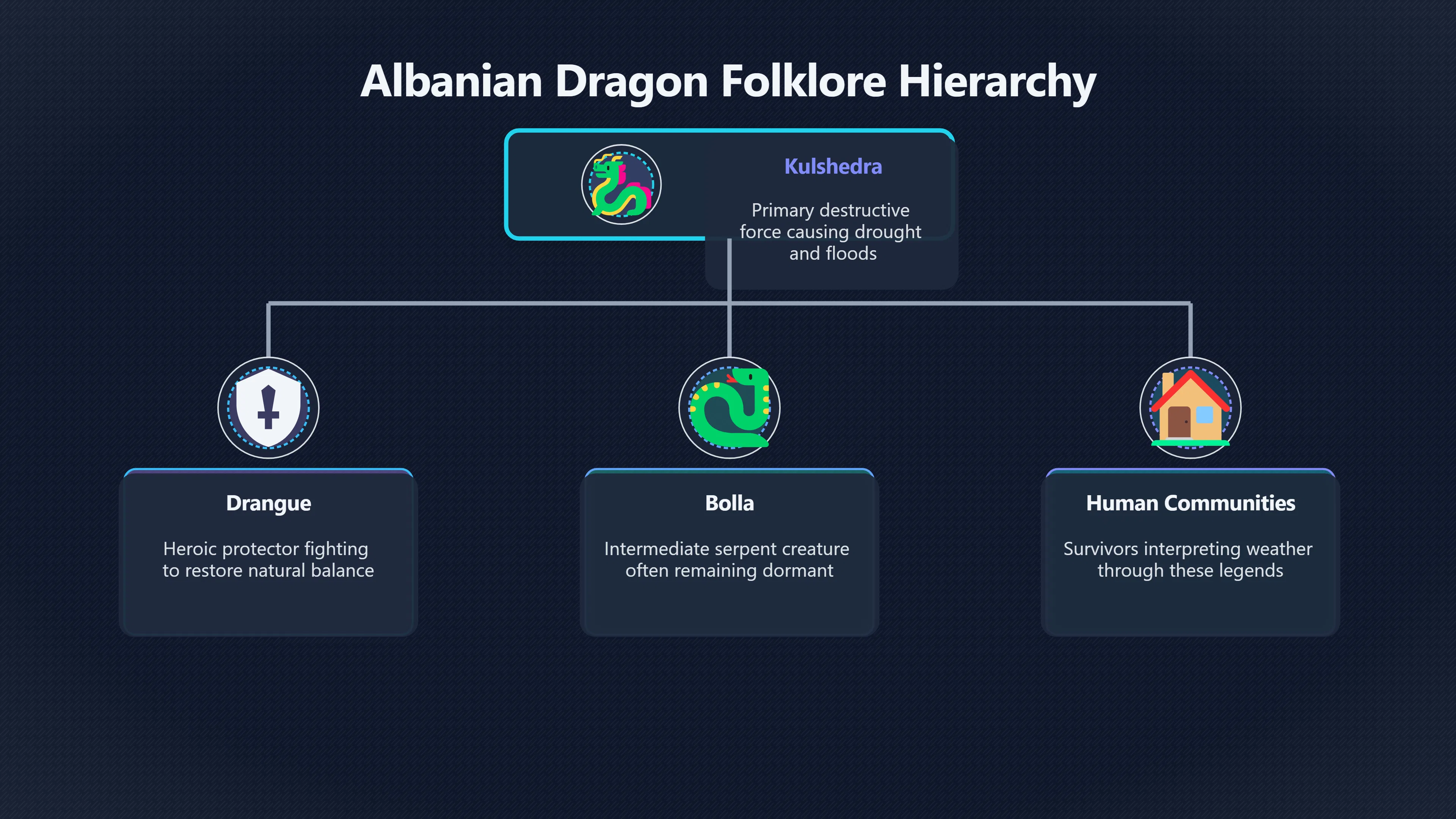
Albania’s most important monster tradition is not a hidden lake creature or an alleged unknown animal. It is a powerful cycle of dragon and serpent folklore centred on the Kulshedra, a destructive dragon-like being associated with storms, drought, floods and natural chaos. In traditional stories, the Kulshedra is opposed by the Drangue, a heroic protector whose battles with the monster explain thunder, lightning and violent weather. Alongside these figures stands the Bolla, a serpent creature that occupies an intermediate place within Albanian dragon lore. Together they form one of the richest mythological systems in the Balkans and one of the clearest examples of how communities used monster stories to explain dangerous natural events.[Wikipedia]WikipediaMarch 22, 2026 — The legendary battle of a heroic deity associated with thunder and weather – like drangue – who fights and slays a huge…
For readers interested in cryptids and mystery creatures, the key point is that these beings belong firmly to folklore rather than zoology. They are remembered because they helped explain weather, disaster and survival in a mountainous landscape where storms, droughts and floods could shape everyday life.[Wikipedia]WikipediaMarch 22, 2026 — The legendary battle of a heroic deity associated with thunder and weather – like drangue – who fights and slays a huge…
Why the Kulshedra Became Albania’s Great Monster
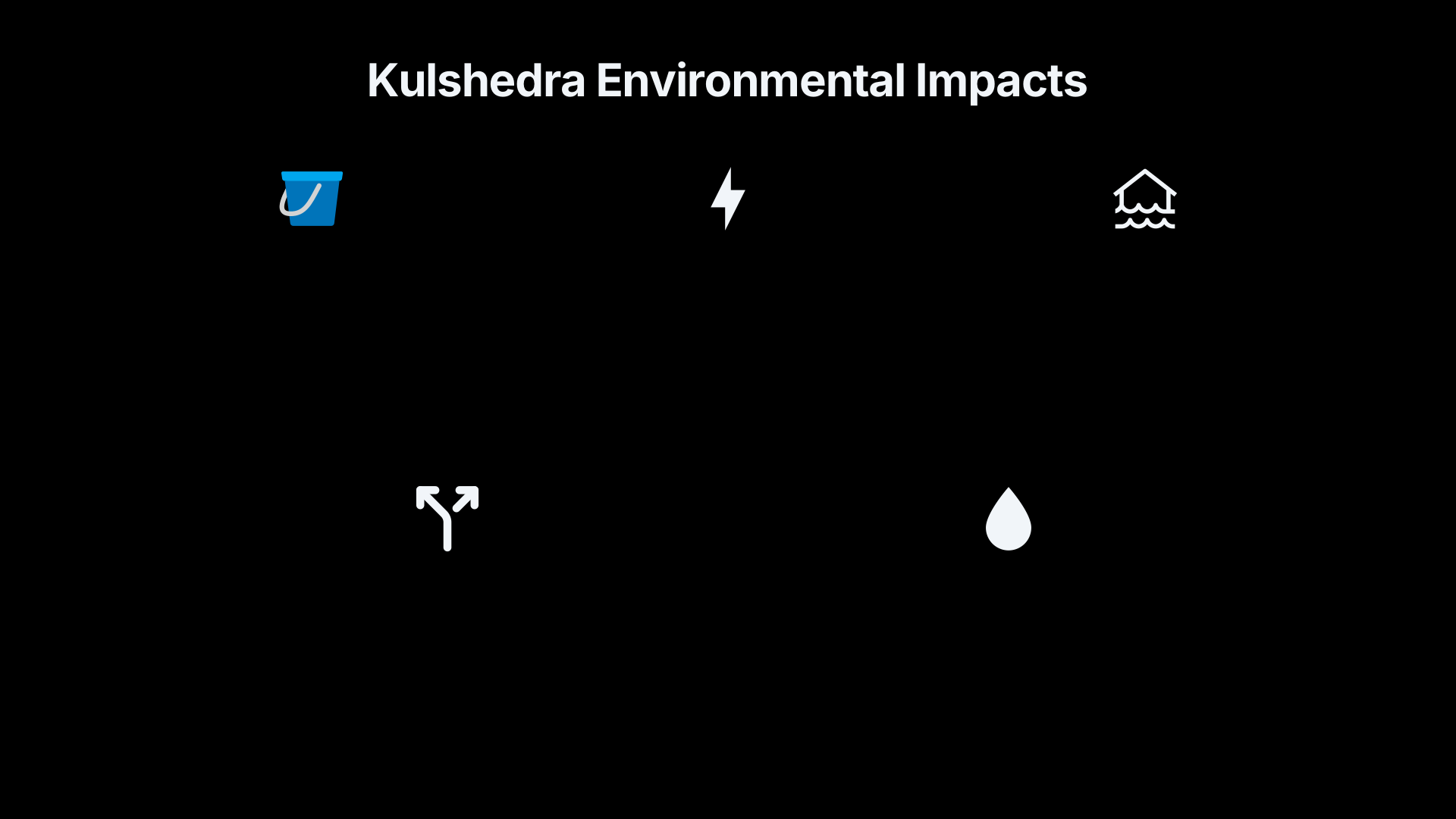
The Kulshedra is usually described in Albanian folklore as a gigantic serpentine dragon, often with multiple heads and supernatural powers. Traditional accounts portray it as a force of destruction capable of bringing drought, violent storms, floods, earthquakes and other calamities upon human communities. In some versions it spits fire; in others it pollutes water sources or blocks life-giving rainfall.[wikipedia.org]WikipediaMarch 22, 2026 — The legendary battle of a heroic deity associated with thunder and weather – like drangue – who fights and slays a huge…
Unlike many European dragons that simply guard treasure, the Kulshedra is closely connected to environmental danger. The creature functions as a mythological explanation for events that could devastate farming communities:
- Long dry periods could be blamed on a dragon withholding water.
- Violent storms could be interpreted as signs of supernatural conflict.
- Floods and destructive weather became evidence of the monster’s activity.
- Sudden natural disasters could be folded into an existing story framework.[wikipedia.org]WikipediaMarch 22, 2026 — The legendary battle of a heroic deity associated with thunder and weather – like drangue – who fights and slays a huge…
This connection to weather and survival helps explain why the Kulshedra remained a prominent figure in Albanian oral tradition long after many other mythical creatures faded from everyday storytelling.
Bolla, Kulshedra and Drangue: Three Parts of One Dragon Tradition
Albanian dragon folklore is best understood as a system rather than a single creature.
The Bolla
The Bolla appears in folklore as a serpent-like being that spends most of its existence dormant. Later traditions often describe it as a creature capable of developing into a more dangerous dragon form. While details vary between regions, the Bolla occupies the boundary between ordinary serpent symbolism and full monster mythology.[BudgetPixel AI]budgetpixel.comultimate list of mythical creatures from albanian folkloreKulshedra – Multi-headed serpent dragon causing droughts and storms. Storm…
The importance of the Bolla is that it demonstrates how Albanian folklore did not treat all serpents as evil. Serpents could be protective, dangerous or transformative depending on the story. This broader serpent symbolism helps place the Kulshedra within a larger cultural landscape rather than presenting it as an isolated monster.
The Kulshedra
The Kulshedra represents uncontrolled destructive power. It is the dragon of drought, chaos and disaster. Its many heads, enormous size and association with extreme weather make it the most fearsome creature in the Albanian folklore tradition.[wikipedia.org]WikipediaMarch 22, 2026 — The legendary battle of a heroic deity associated with thunder and weather – like drangue – who fights and slays a huge…
The Drangue
The Drangue serves as the heroic counterpart. Rather than a monster, it is a supernatural champion and protector of people. Traditional tales portray the Drangue as a powerful being whose purpose is to fight the Kulshedra and restore balance.[Wikipedia]WikipediaDrangueIn Albanian mythology the legendary battle between drangue and kulshedra is the most famous representation of the dualistic strugg…
The relationship between these figures is more important than the individual creatures themselves. Albanian folklore repeatedly returns to the idea that destructive forces and protective forces are locked in an ongoing struggle.
Storms, Drought and the Meaning of Dragon Battles
One of the most distinctive features of Albanian dragon folklore is the belief that storms result from battles between the Drangue and the Kulshedra. Thunder, lightning and violent weather were interpreted as signs of combat taking place beyond ordinary human sight.[wikipedia.org]WikipediaDrangueIn Albanian mythology the legendary battle between drangue and kulshedra is the most famous representation of the dualistic strugg…
This idea appears across many cultures, but it became especially prominent in Albanian tradition because of the country’s dramatic environment. Mountain storms can arrive suddenly and with enormous force. Before modern meteorology, the image of a heroic defender battling a destructive dragon provided an understandable explanation for frightening weather events.
The symbolism also reflects practical concerns:
- The Kulshedra threatens water supplies through drought.
- The Drangue restores order and fertility.
- Storms become visible evidence of their struggle.
- Human survival depends on the triumph of balance over chaos.[Wikipedia]WikipediaMarch 22, 2026 — The legendary battle of a heroic deity associated with thunder and weather – like drangue – who fights and slays a huge…
Modern scholars often connect this pattern to a much older Indo-European mythological theme in which a storm or thunder hero defeats a serpent associated with disorder and blocked waters. The Albanian version preserves this ancient structure in a particularly vivid form.[Wikipedia]WikipediaMarch 22, 2026 — The legendary battle of a heroic deity associated with thunder and weather – like drangue – who fights and slays a huge…
Folklore, Not Hidden Animals
From a cryptozoological perspective, the Kulshedra occupies a very different category from creatures such as alleged lake monsters or mystery cats.
There are no modern eyewitness traditions describing an unknown biological animal called the Kulshedra. There are no photographs, tracks, carcasses or searches aimed at locating a real dragon in Albania. Instead, the creature exists within folklore, legends, fairy tales and traditional explanations of natural phenomena. Robert Elsie’s collections of Albanian folklore identify the Kulshedra as one of the recurring mythological figures found throughout the country’s oral traditions.[Elsie]elsie.deAlbanian TalesAlbanian Tales - Robert ElsieOther figures of mythology which occur regularly in Albanian fairy tales are the kulshedra (dragon), th…
This distinction matters because folklore can be culturally important without being zoologically real. The Kulshedra survives because it expresses fears about weather, survival and disorder, not because people have gathered evidence for a hidden species.
In that sense, the Kulshedra resembles other legendary dragons around Europe. It is a monster of meaning rather than a monster of field reports.

How the Legend Survived
Many traditional Albanian folktales remained alive through oral storytelling in villages and mountain communities well into the modern era. Stories of dragons, witches, vampires and heroic champions were passed from generation to generation, preserving creatures such as the Kulshedra long after belief in them as literal beings declined.[Elsie]elsie.deAlbanian TalesAlbanian Tales - Robert ElsieOther figures of mythology which occur regularly in Albanian fairy tales are the kulshedra (dragon), th…
Today the Kulshedra appears in folklore collections, educational material, fantasy art, mythology discussions and popular retellings of Albanian legends. The creature has become part of the country’s cultural identity, representing a uniquely Albanian version of the dragon myth rather than a modern cryptid hunt.[books.elsie.de]books.elsie.deRobert Elsie - Albanian folktales and legends… Kulshedra in the forest? The fundamental theme of Albanian folk tales, as no doubt of fo…
For anyone exploring Albania’s monster traditions, the Kulshedra remains the central figure. It is not the country’s most famous mystery animal because it was never intended to be an animal at all. It is a weather dragon, a symbol of chaos and danger, and the heart of one of the Balkans’ most enduring folklore traditions.[Wikipedia]WikipediaMarch 22, 2026 — The legendary battle of a heroic deity associated with thunder and weather – like drangue – who fights and slays a huge…
Amazon book picks
Further Reading
Books and field guides related to Why Albania's Dragons Belong to the Weather. Use these as the next step if you want deeper reading beyond the article.
Albanian Folktales and Legends
Contains the core traditions surrounding the Kulshedra and related beings.

The Element Encyclopedia of Magical Creatures
Useful comparative reference for serpent and dragon beings.
eBay marketplace picks
Marketplace Samples
Live-tested eBay searches with available results related to this page.



Endnotes
1.
Source: Wikipedia
Link:https://en.wikipedia.org/wiki/Kulshedra
Source snippet
March 22, 2026 — The legendary battle of a heroic deity associated with thunder and weather – like drangue – who fights and slays a huge...
Published: March 22, 2026
2.
Source: Wikipedia
Link:https://en.wikipedia.org/wiki/Drangue
Source snippet
DrangueIn Albanian mythology the legendary battle between drangue and kulshedra is the most famous representation of the dualistic strugg...
3.
Source: elsie.de
Title: Albanian Tales
Link:https://www.elsie.de/pdf/articles/A2008AlbFolktalesGreenwood.pdf
Source snippet
Albanian Tales - Robert ElsieOther figures of mythology which occur regularly in Albanian fairy tales are the kulshedra (dragon), th...
4.
Source: books.elsie.de
Link:https://books.elsie.de/2004-1986/b09.html
Source snippet
Robert Elsie - Albanian folktales and legends... Kulshedra in the forest? The fundamental theme of Albanian folk tales, as no doubt of fo...
5.
Source: reddit.com
Link:https://www.reddit.com/r/mythology/comments/15xn1fs/kulshedra/
Source snippet
Kulshedra: r/mythologyThe kulshedra is believed to spit fire, cause drought, storms, flooding, earthquakes and other natural disasters a...
6.
Source: budgetpixel.com
Title: ultimate list of mythical creatures from albanian folklore
Link:https://budgetpixel.com/blog/ultimate-list-of-mythical-creatures-from-albanian-folklore
Source snippet
Kulshedra – Multi-headed serpent dragon causing droughts and storms. Storm...
7.
Source: lan-portal.uob.edu.ly
Link:https://lan-portal.uob.edu.ly/exe/EPDF/L3H8553286/the__dictionary_of-albanian_religion-mythology-and_folk-culture.pdf
Source snippet
University of BenghaziThe Dictionary Of Albanian Religion Mythology And Folk...24 Mar 2026 — The kulshedra is believed to spit fire, cau...
8.
Source: albanianregistry.org
Link:https://albanianregistry.org/blog/drangue
Source snippet
National Albanian RegistryDrangue: The Storm-Born Dragon-Slayer of Albanian Myth21 May 2026 — The thing the drangue is born to fight is t...
Published: May 2026
9.
Source: the-demonic-paradise.fandom.com
Link:https://the-demonic-paradise.fandom.com/wiki/Kulshedra
Source snippet
The Demonic Paradise Wiki - FandomKulshedra is generally considered to be a female dragon, like a multi-headed serpent form, but it's kno...
Additional References
10.
Source: drachen.fandom.com
Link:https://drachen.fandom.com/de/wiki/Bolla
Source snippet
Drachen WikiBolla | Drachen Wiki | FandomDie Bolla (auch Bullar) ist ein albanischer Drache mit einem langen, schlangenartigen Körper, vi...
11.
Source: mythlok.com
Link:https://mythlok.com/beings/kucedra/
Source snippet
Kucedra: The 7 headed dragonAlbanian dragon lore tells of a hero, Drangue, battling Kulshedra, a multi-headed dragon. Storms rage as the...
12.
Source: linkedin.com
Link:https://www.linkedin.com/pulse/ciklopi-kucedra-personal-window-albanian-balkan-mythology-shaska-wbkgf
13.
Source: godsandmonsters.info
Link:https://godsandmonsters.info/kulshedra/
14.
Source: youtube.com
Link:http://www.youtube.com/watch?v=CLnBDDDXAsk
Source snippet
Albanian mythology Kulshedra Drangue explained Kucedra: The 7 Headed Dragon | Balkan Mythology | European Mythology | Mythlok Mythlok...
15.
Source: amazon.nl
Link:https://www.amazon.nl/-/en/Albanian-Folktales-Legends-Selected-translated/dp/1507631308?tag=searcht-20
Source snippet
of the best-known Albanian legends (based on historical or mythological events and...Read more...
16.
Source: balkanacademia.com
Title: northern albanian folklore dragons blood and the drangue hero
Link:https://balkanacademia.com/2026/05/07/northern-albanian-folklore-dragons-blood-and-the-drangue-hero/
Source snippet
“Dragon's Blood” and the Drangue Hero7 May 2026 — Northern Albanians poetically call hard and brown coal "gjak drangói" ("dragon's blood"...
Published: May 2026
17.
Source: facebook.com
Link:https://www.facebook.com/groups/707425228171510/posts/1126231802957515/
Source snippet
he water, air and soil, have been slain since ancient times...Read more...
18.
Source: openlibrary.org
Link:https://openlibrary.org/books/OL9336089M/The_Dictionary_of_Albanian_Religion_Mythology_and_Folk_Culture
Source snippet
e, August 2001, Hurst & Co Ltd edition, Hardcover in English...
Published: August 2001
19.
Source: scribd.com
Link:https://www.scribd.com/doc/246210693/Albanian-Folktales-and-Legends
Source snippet
lbanian mythology. Anthology of modern Albanian poetry...
Topic Tree