Where Folklore Ends and Mystery Beasts Begin
Saint Kitts and Nevis does not have a well-documented national cryptid comparable with Scotland’s Loch Ness Monster or Puerto Rico’s chupacabra. Searches of local heritage material, biodiversity records and news archives reveal no sustained series of reports about an unknown ape, giant cat, lake monster or other flesh-and-blood mystery animal.
Page outline Jump by section
Introduction
That distinction matters. A jumbie is understood as a spirit rather than an undiscovered species, while a Moko Jumbie is a stilt-walking masquerader whose appearance draws on older Caribbean traditions. Meanwhile, occasional alarms over snakes or unfamiliar marine animals occur in an island environment filled with introduced species, rare wildlife and imperfect views across deep water. Saint Kitts and Nevis therefore offers something more subtle than a conventional cryptid catalogue: a meeting point between supernatural folklore, animal-shaped theatre and genuine wildlife surprises.
Is there a Saint Kitts and Nevis cryptid?
On the available evidence, there is no named creature supported by a substantial local sighting tradition. No clear newspaper chronology, repeated witness cluster or collection of photographs establishes a distinctly Kittitian or Nevisian mystery beast. Claims found on generic cryptid websites tend to import wider Caribbean creatures without showing that those beings have a specific history in the federation.
The closest local equivalent is the jumbie, a broad Caribbean term for a ghost, spirit or troublesome supernatural presence. In Saint Kitts Creole, “jumbie” is used for an undead spirit or ghost, and stories about such beings are associated across the region with lonely roads, graveyards, abandoned estates, gullies and large old trees. These are not normally zoological claims. A witness who says they encountered a jumbie may describe a shadow, human-like figure, strange voice or shape-changing presence, but the story belongs primarily to beliefs about the dead and the dangerous night rather than to natural history.[Wikipedia]WikipediaSaint Kitts CreoleSaint Kitts Creole
That makes Saint Kitts and Nevis a useful example of why “cryptid” should not be applied too loosely. Three different things can sound similar in a retelling:
- Folklore: a supernatural being whose meaning depends on inherited belief.
- Masquerade: a person deliberately dressed as an extraordinary creature or spirit.
- Mystery-animal report: a claim that an unidentified living animal was physically present.
The country is rich in the first two categories. Firm examples of the third are much harder to find.
Jumbies that walk above the crowd
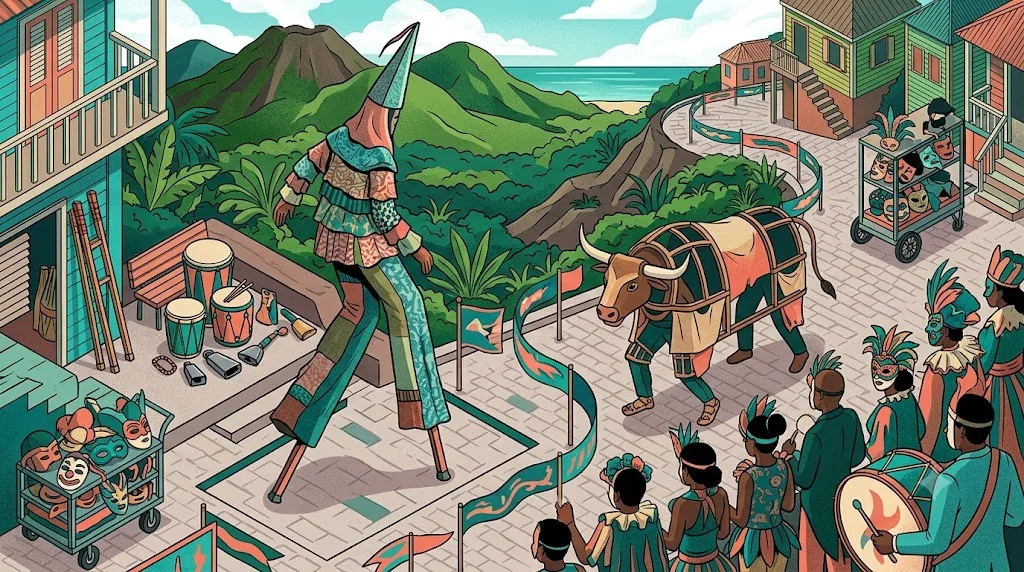
The most visible creature-like figure in the federation is the Moko Jumbie, also spelt Mocko or Moco Jumbie. These performers dance on tall stilts in long, brightly coloured costumes, appearing during Carnival in Saint Kitts and Culturama in Nevis. They are now celebrated as part of national culture alongside Masquerade dancers, Clowns, Actors and the Bull.[sknhcottawa.gov.kn]sknhcottawa.gov.knOpen source on sknhcottawa.gov.kn.
A Moko Jumbie is not a reported monster. It is a living performance tradition with African and Caribbean roots. Historical accounts describe stilt-walking masqueraders appearing at Christmas and other festive occasions across several Caribbean islands from at least the eighteenth century. On Saint Kitts, the troupe traditionally wore long gowns and tapering headdresses while performing above the heads of spectators.[Wikipedia]WikipediaMoko jumbieMoko jumbie
The exact origin of the name remains debated. Heritage material from Historic St Kitts records several possibilities, including a connection with African ethnic names and a tale about a jumbie vampire hiding in a macaw tree. Because the surviving tradition has passed through slavery, colonial rule, oral storytelling and modern Carnival, simple claims that the name has one certain translation should be treated cautiously.[historicstkitts.kn]historicstkitts.knThe Christmas SportKitts · Our Places · Our People · Our Events · Other Items… MOKO JUMBIE has always been a popular troupe. It consists of stilt…Read…
For a child seeing one at night, however, the scholarly distinctions may not matter. A masked figure several metres tall, swaying above torchlight and drums, has the visual force of a giant or long-legged spirit. This helps explain why Moko Jumbies are sometimes listed online among “mythical creatures”, even though spectators know they are skilled performers. The costume preserves the sensation of encountering something beyond ordinary human scale without requiring anyone to believe that an unknown giant roams the hills.
The tradition has also changed its social role. Once associated chiefly with seasonal street performance, Moko Jumbies now function as cultural ambassadors, tourist attractions and symbols of continuity. Government-backed exhibitions and overseas displays have presented them as part of the federation’s heritage rather than as objects of literal fear.[SKNIS]sknis.gov.knKITTS & NEVIS ARTPIECES AND LITERATURE…June 25, 2026 — 25 Jun 2026 — (Dept. of Cultural Heritage, St. Kitts, June 24, 2026): Mocko Jum…
The Bull: a monster chase with a known actor inside
Saint Kitts also has an unusually vivid animal masquerade known simply as the Bull. During the performance, a costumed bull collapses, is examined and revived, then charges about among the spectators. The result is part comedy, part mock emergency and part controlled monster chase.
Local accounts connect the play with an incident at Belmont Estate around 1917, when an estate manager’s prized bull supposedly became ill. The staged revival ends in deliberate disorder as the animal runs wild through the crowd.[sknvibes.com]sknvibes.comOpen source on sknvibes.com.
The Bull occupies an interesting middle ground between history and legend. It may preserve a memory of a real estate animal, but repeated performance has transformed that event into ritual theatre. The important creature is no longer the original bull, whose story cannot easily be verified in detail, but the larger-than-life beast recreated at festivals.
Related Christmas plays also included figures such as a Giant or Dragon, alongside knights, saints, a doctor and other characters inherited or adapted from European mumming traditions. In Saint Kitts these dramas evolved through local music, costume, mock combat and satire rather than remaining copies of British rural plays.[historicstkitts.kn]historicstkitts.knThe Christmas SportKitts · Our Places · Our People · Our Events · Other Items… MOKO JUMBIE has always been a popular troupe. It consists of stilt…Read…
For cryptid history, the Bull is a reminder that frightening animal encounters are sometimes deliberately manufactured. A later visitor hearing that “a bull ran through Carnival” might imagine an escaped animal. A photograph taken at the wrong moment could look like a bizarre horned creature. Local knowledge supplies the missing context: the confusion is part of the performance.
Real animals that can create strange reports
Although the federation lacks a strong unknown-animal legend, its wildlife can still produce surprising encounters. Small islands are especially fertile settings for mistaken identity because introduced animals, rare native species and marine visitors may appear where observers do not expect them.
Monkeys in the forest and on the roadside
African green monkeys have lived on Saint Kitts and Nevis for more than three centuries. They were transported from West Africa during the colonial period and became naturalised after escaping or being released. Today they inhabit woodland, agricultural areas and places frequented by visitors.[Convention on Biological Diversity]cbd.intConvention on Biological Diversity Saint Kitts and NevisConvention on Biological Diversity Saint Kitts and Nevis
A brief sighting can be deceptive. A monkey crossing a road at dusk may seem larger than it is, while calls from a troop concealed in vegetation can sound unfamiliar to a visitor. Their human-like hands, upright sitting posture and rapid movement also encourage exaggerated descriptions. None of this makes them cryptids, but it gives the islands a readily available explanation for occasional tales of small ape-like shapes in the bush.
The monkeys have become part of tourism imagery, yet their real relationship with people is more complicated. They raid crops and are widely discussed as an agricultural problem, particularly where forest edges meet farms. Research into community attitudes on Saint Kitts found a mixture of tolerance, cultural familiarity and concern about economic damage.[Frontiers]frontiersin.orgOpen source on frontiersin.org.
The snake that was supposed to be gone
Snakes are uncommon enough in Saint Kitts and Nevis that a sighting can quickly become news. The small Indian mongoose was introduced to Caribbean islands in the nineteenth century and is thought to have severely reduced native snake populations. Government biodiversity material nevertheless notes that snakes are known to exist or have existed in the federation.[PMC]pmc.ncbi.nlm.nih.govOpen source on nih.gov.
In 2013, local reporting described several snakes found in Saint Kitts, including an animal run over at Frigate Bay. Experts urged people not to kill unusual specimens but to preserve them for identification. The same report referred to earlier accounts of small brown snakes near Cayon and to uncertainty over whether the native racer had disappeared from the islands.[sknvibes.com]sknvibes.comOpen source on sknvibes.com.
This was a genuine mystery-animal situation in the limited sense that people had seen animals whose species had not yet been established. It did not develop into a cryptid tradition because ordinary explanations were immediately available: surviving native snakes, tiny worm snakes, accidental importation in cargo or escaped captive animals. The case shows how a local belief that “there are no snakes here” can make a normal reptile seem almost impossible.
Large shapes at sea
The waters surrounding the federation support turtles, dolphins, whales, sharks and large pelagic fish. National biodiversity reports record marine reptiles and mammals, while regional surveys have documented several cetacean species across the eastern Caribbean.[cbd.int]cbd.intConvention on Biological Diversity CBD Fifth National ReportConvention on Biological Diversity CBD Fifth National Report
These animals provide plenty of ingredients for sea-monster impressions. A whale’s back may appear as several separate humps in rough water. Dolphins surfacing in line can resemble one long, undulating body. A leatherback turtle, seen briefly beside a boat, can look astonishingly large. Floating rope, weed, logs and fishing debris add further opportunities for mistakes.
There is no strong evidence that Saint Kitts and Nevis has developed its own recurring sea-serpent story. That absence is notable because the islands have long maritime traditions. Fishing crews and sailors certainly encountered unfamiliar animals, but surviving public accounts appear to have been absorbed into ordinary knowledge of the sea rather than consolidated around one named monster.
Why monster stories remain thin
Several factors help explain why Saint Kitts and Nevis has folklore without a famous cryptid.
First, the islands are relatively small. Saint Kitts covers about 176 square kilometres, and even its steep forested interior lies close to settlements, farms or established routes. A breeding population of large unknown land animals would be difficult to hide for generations.[Frontiers]frontiersin.orgOpen source on frontiersin.org.
Second, the known terrestrial fauna does not include native bears, big cats or great apes—the kinds of animals most often invoked in modern cryptid reports. The most conspicuous unfamiliar mammal, the green monkey, already has a well-recorded introduction history. Mongooses, bats, deer, livestock and domestic animals account for many other potentially confusing shapes.
Third, local traditions channel the strange into social and supernatural forms. Jumbie tales warn about night travel, dangerous places and improper behaviour. Masquerades preserve history and community identity through costume, music and movement. The Bull turns an unruly animal into comic theatre. These traditions already provide memorable language for fear and mystery, reducing the cultural need for a supposedly undiscovered beast.
Finally, much folklore was transmitted orally. That means the absence of searchable newspaper reports does not prove that nobody ever told stories about peculiar animals. It does mean that isolated recollections should not be promoted into a national cryptid tradition without dates, locations, independent witnesses or contemporary documentation.
How to assess a local mystery-creature claim
A convincing Saint Kitts or Nevis animal mystery would need more than a dramatic retelling. The most useful questions are practical:
Was the being described as physical or supernatural? Vanishing, shape-changing or appearing only in dreams points towards jumbie folklore. Tracks, feeding, repeated movement and interaction with the environment suggest an animal claim.
Could a festival performance explain it? Tall figures may be Moko Jumbies, while horned or masked beings may belong to the Bull, Masquerade or another traditional troupe.
Does the location match known wildlife? Forest-edge sightings favour monkeys, mongooses or feral animals. Shoreline and offshore reports require comparison with turtles, rays, sharks, dolphins and whales.
Was the report recorded at the time? A dated newspaper item, photograph with location data or specimen examined by a biologist carries more weight than a story remembered decades later.
Did separate witnesses describe the same features independently? Repetition alone is not enough when later accounts may have copied an earlier story.
These tests do not remove the pleasure of the tale. They clarify what kind of tale it is.
The country’s real creature tradition
The defining mystery beings of Saint Kitts and Nevis are not hidden animals waiting for scientific recognition. They are jumbies lurking at the edge of inherited belief, giants created by stilts and cloth, dragons remembered in Christmas plays and a festival Bull that repeatedly returns from collapse to scatter the crowd.
Alongside them stands a real island fauna capable of producing momentary puzzles: introduced monkeys moving through mountain vegetation, rare snakes appearing where residents thought none remained, and large marine animals surfacing around boats. Those encounters can be strange without requiring an unknown species.
The most accurate conclusion is therefore modest but revealing. Saint Kitts and Nevis has no securely established national cryptid, yet it possesses a rich monster-shaped culture. Its stories show how the extraordinary can survive not as a zoological secret, but as performance, memory, caution and communal play.
Amazon book picks
Further Reading
Books and field guides related to Where Folklore Ends and Mystery Beasts Begin. Use these as the next step if you want deeper reading beyond the article.
The Serpent and the Rainbow
Explores Caribbean supernatural traditions and how folklore is interpreted.
Myths and Legends of the World
Helps place Caribbean spirit traditions within global folklore.
Caribbean Folklore
Explains jumbies, spirits, legends and the folklore context behind supposed monsters.
eBay marketplace picks
Marketplace Samples
Live-tested eBay searches with available results related to this page.
Endnotes
1.
Source: Wikipedia
Title: Saint Kitts Creole
Link:https://en.wikipedia.org/wiki/Saint_Kitts_Creole
2.
Source: sknhcottawa.gov.kn
Link:https://sknhcottawa.gov.kn/culture/
3.
Source: sknis.gov.kn
Link:https://www.sknis.gov.kn/2025/02/13/st-kitts-and-nevis-vibrant-folklore-illuminates-2025-taiwan-lantern-festival/
Source snippet
Kitts and Nevis' Vibrant Folklore Illuminates 2025 Taiwan...13 Feb 2025 — The lantern features five traditional folklore groups: the Mok...
4.
Source: Wikipedia
Title: Moko jumbie
Link:https://en.wikipedia.org/wiki/Moko_jumbie
5.
Source: historicstkitts.kn
Title: The Christmas Sport
Link:https://www.historicstkitts.kn/events/the-christmas-sport-last-week-of-december
Source snippet
Kitts · Our Places · Our People · Our Events · Other Items... MOKO JUMBIE has always been a popular troupe. It consists of stilt...Read...
6.
Source: sknis.gov.kn
Link:https://www.sknis.gov.kn/2026/06/25/st-kitts-nevis-artpieces-and-literature-showcased-in-masquerade-traditions-exhibtion/
Source snippet
KITTS & NEVIS ARTPIECES AND LITERATURE...June 25, 2026 — 25 Jun 2026 — (Dept. of Cultural Heritage, St. Kitts, June 24, 2026): Mocko Jum...
Published: June 25, 2026
7.
Source: sknvibes.com
Link:https://www.sknvibes.com/islandfacts/sitepage.cfm?p=164
8.
Source: pmc.ncbi.nlm.nih.gov
Link:https://pmc.ncbi.nlm.nih.gov/articles/PMC5978914/
9.
Source: sknvibes.com
Link:https://www.sknvibes.com/news/newsdetails.cfm/79893
10.
Source: aquaticmammalsjournal.org
Title: 36 2 Yoshida
Link:https://www.aquaticmammalsjournal.org/wp-content/uploads/2010/10/36_2_Yoshida.pdf
11.
Source: Wikipedia
Title: Category:Caribbean legendary creatures
Link:https://en.wikipedia.org/wiki/Category%3ACaribbean_legendary_creatures
12.
Source: Wikipedia
Title: Sea serpent
Link:https://en.wikipedia.org/wiki/Sea_serpent
13.
Source: sknis.gov.kn
Title: SKNIS Editor, Author at SKNIS
Link:https://www.sknis.gov.kn/author/skniseditor/page/116/
14.
Source: sknhcottawa.gov.kn
Link:https://sknhcottawa.gov.kn/st-kitts-nevis-profile/
15.
Source: carnival.com
Title: creatures caribbean folklore
Link:https://www.carnival.com/awaywego/travel/caribbean/creatures-caribbean-folklore
16.
Source: skncgtoronto.gov.kn
Link:https://skncgtoronto.gov.kn/2025/02/page/4/
17.
Source: sknvibes.com
Link:https://www.sknvibes.com/islandfacts/sitepage.cfm?p=158
18.
Source: data.jncc.gov.uk
Link:https://data.jncc.gov.uk/data/64ff74a0-4a87-4134-87b6-023f30cf51ea/JNCC-Report-380-FINAL-WEB.pdf
19.
Source: youtube.com
Link:https://www.youtube.com/watch?v=RrmoAOYgUds
Source snippet
MASQUERADE - CULTURE BEAT SKN TV_0015...
20.
Source: youtube.com
Link:https://www.youtube.com/watch?v=JkqNYYiKC_4
Source snippet
Folklore Video Series - Elroy "Sports" Browne...
21.
Source: cbd.int
Title: Convention on Biological Diversity Saint Kitts and Nevis
Link:https://www.cbd.int/countries/profile/?country=kn
22.
Source: frontiersin.org
Link:https://www.frontiersin.org/journals/ecology-and-evolution/articles/10.3389/fevo.2022.904797/full
23.
Source: cbd.int
Title: Convention on Biological Diversity CBD Fifth National Report
Link:https://www.cbd.int/doc/world/kn/kn-nr-05-en.pdf
24.
Source: stkittscatlady.wordpress.com
Title: saint kitts and nevis
Link:https://stkittscatlady.wordpress.com/tag/saint-kitts-and-nevis/
25.
Source: cbd.int
Link:https://www.cbd.int/doc/world/kn/kn-nbsap-01-p5-en.pdf
Additional References
26.
Source: facebook.com
Link:https://www.facebook.com/KittitianHeartbeat/posts/-folklore-video-series-folklore-groups-are-also-tourism-ambassadors-for-st-kitts/678807230661196/
Source snippet
Folklore Video Series Folklore groups are also tourism...These groups tell stories of a Kittitian heritage and culture, allowing...
27.
Source: cincyplay.com
Title: exploring caribbean folklore
Link:https://www.cincyplay.com/blog-single-post/cinncinati-blog/2019/09/17/exploring-caribbean-folklore
Source snippet
cinExploring Caribbean FolkloreSep 17, 2019 — One of the most common parts of Caribbean folklore is the duppy (also called jumbie), which...
28.
Source: marinemammalscience.org
Link:https://marinemammalscience.org/science-and-publications/list-marine-mammal-species-subspecies/
29.
Source: youtube.com
Title: A Taste of Nevis
Link:https://www.youtube.com/watch?v=Cr-ZQoLZxps
Source snippet
History Of The Bull One Of SKN's Traditional Folklore...
30.
Source: youtube.com
Title: Kittitian Folklore Video Series – Masquerade
Link:https://www.youtube.com/watch?v=eEztnbCXWYg
Source snippet
A Taste of Nevis - Culturama 50 Edition: Episode 4 - Moko Jumbie...
31.
Source: irf.org
Link:https://www.irf.org/wp-content/uploads/2015/10/BiodiversityProfile_StKitts-Nevis.pdf
32.
Source: facebook.com
Link:https://www.facebook.com/groups/SKNTimesNewsGroup/posts/1883479499046295/
33.
Source: car-spaw-rac.org
Link:https://www.car-spaw-rac.org/IMG/pdf/BIBLIOGRAPHY_MARINE_MAMMALS_WCR.pdf
34.
Source: medium.com
Link:https://medium.com/%40lidatz/a-barrel-of-monkey-madness-with-green-vervets-on-st-kitts-nevis-ff8db76d613f
35.
Source: facebook.com
Link:https://www.facebook.com/groups/191766699268/posts/10160872753724269/
Topic Tree
Follow this branch
Related pages 192
- Antigua Cryptids
- Maldives Monsters
- Malta Monsters
- Qatar Monsters
- Argentina Monsters
- +187 more in sidebar