Within Dutch Monsters
Why Do Dutch Waters Produce So Many Monsters?
Dutch water creatures turn dangerous canals, breached dikes and drowned settlements into memorable warnings about water and human pride.
On this page
- Mermaids and towns shaped by floods
- Canal creatures as warnings for children
- Dikes, drowned places and environmental memory
Page outline Jump by section
Introduction
The Netherlands is famous for controlling water, but many of its strangest monster stories begin when that control fails. Across Dutch folklore, mermaids, canal creatures and water-dwelling monsters are rarely presented as mysterious animals hiding in remote lakes. Instead, they act as memory devices. They help communities remember floods, breached dikes, dangerous waterways and the ever-present risk of drowning in a country built partly below sea level.
That makes Dutch water-monster traditions different from many better-known cryptid legends. The creatures are often less important than what they represent. A mermaid may appear before a flood. A canal monster may punish careless children. A drowned town may be linked to a curse from a captured sea-being. Beneath the strange imagery lies a practical message: water can take back the land at any time. In a landscape shaped by canals, polders and storm surges, folklore became one way of storing environmental memory across generations.[edamsmuseum.nl]edamsmuseum.nlendelijk thuis de meermin van edamEdam MuseumFinally home: the mermaid of EdamFor instance, in the autumn of 1403, the dike of the Purmer-Ye broke through and flooded the…
Why Do Dutch Waters Produce So Many Monsters?
For centuries, Dutch communities lived with constant flood risk. Storm surges could erase villages, transform farmland into lakes and alter coastlines within a single generation. Before modern engineering, many people experienced water not as scenery but as an unpredictable force capable of destroying homes and livelihoods.[the low countries]the-low-countries.comthe struggle against the water and dutch identitythe low countriesHow the Struggle Against Water Shaped the Dutch Identity17 Nov 2021 — The St Elisabeth Flood, which washed over Zuid-Hol…
Folklore translated that danger into characters and stories. Instead of teaching flood hydraulics, communities told tales about mermaids, water spirits and monsters lurking in canals. These stories were memorable, emotionally powerful and easy to pass on. Children learned where not to play. Adults remembered the consequences of neglecting dikes or ignoring warnings from nature.[Water Mythos]watermythosllc.substack.comWater Mythos The Search for the Netherlands' Water MonsterWater MythosThe Search for the Netherlands' Water MonsterMarch 25, 2025 — All other Dutch water creatures (the Nekker, the eggelman, the…
A recurring pattern appears throughout Dutch legend:
- Water creatures emerge near moments of environmental crisis.
- Human arrogance or carelessness often triggers disaster.
- Floods become moral stories as well as historical events.
- The landscape itself becomes haunted by memory.
The result is a body of folklore in which monsters function as cultural reminders of living with water rather than as reports of undiscovered creatures.
Mermaids and Towns Shaped by Floods
The Mermaid of Edam
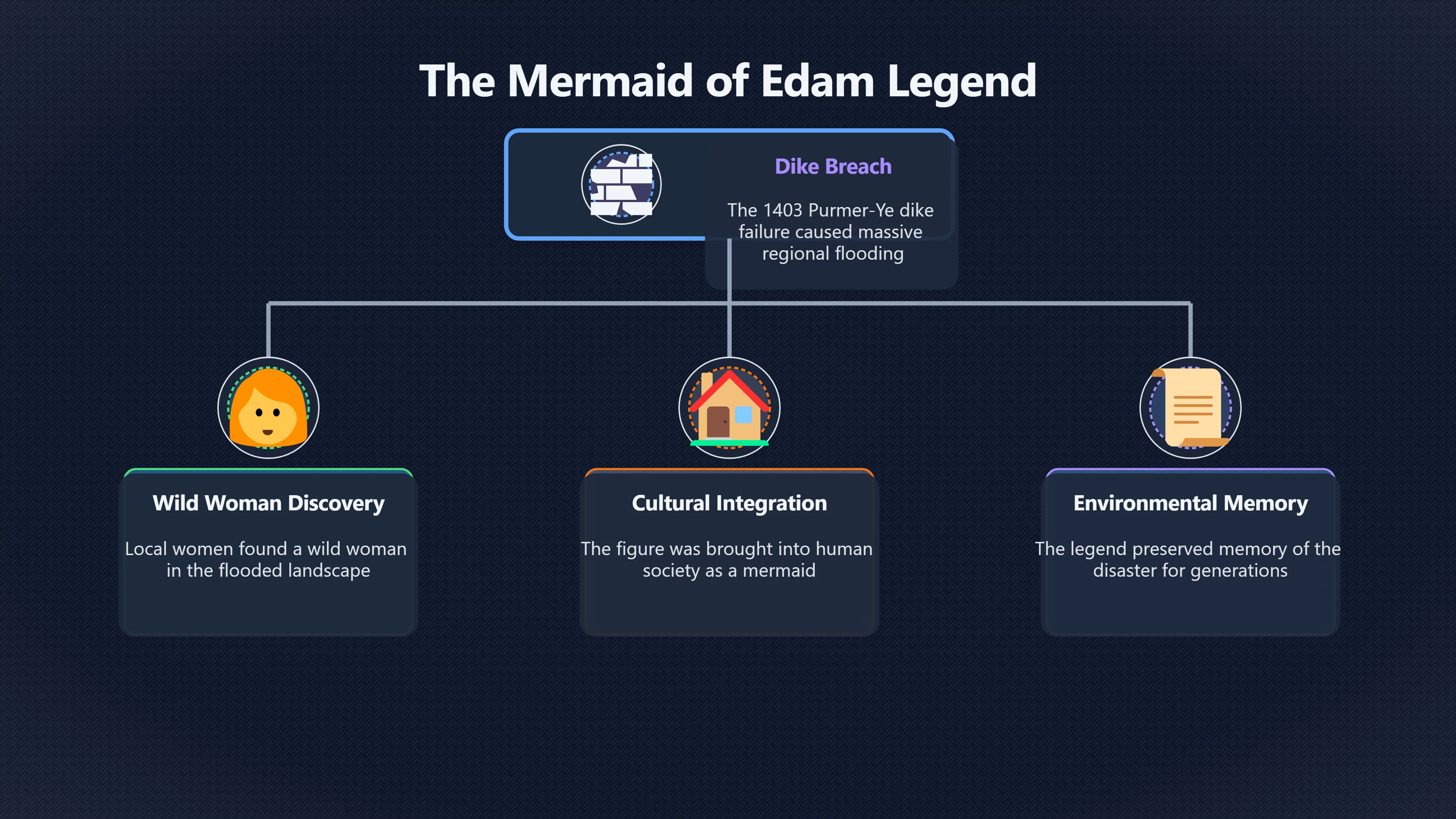
The most famous Dutch mermaid story is the Mermaid of Edam. According to the legend, severe storms and flooding around the beginning of the fifteenth century breached regional dikes. After one such flood, local women supposedly discovered a strange, wild woman in the flooded landscape and brought her into human society. Over time she became known as the Mermaid of Edam.[edamsmuseum.nl]edamsmuseum.nlendelijk thuis de meermin van edamEdam MuseumFinally home: the mermaid of EdamFor instance, in the autumn of 1403, the dike of the Purmer-Ye broke through and flooded the…
The story is closely tied to a real environmental event. The Edam Museum links the legend to the 1403 breach of the Purmer-Ye dike and the flooding that followed. Rather than existing independently from history, the mermaid narrative grew directly from a remembered disaster.[Edam Museum]edamsmuseum.nlendelijk thuis de meermin van edamEdam MuseumFinally home: the mermaid of EdamFor instance, in the autumn of 1403, the dike of the Purmer-Ye broke through and flooded the…
Modern readers sometimes focus on whether the mermaid was meant literally. Historically, however, the more important point may be that the legend preserved memory of a flood. Long after technical details were forgotten, people still remembered the breach because they remembered the mermaid.
Mermaids as Flood Warnings
Other Dutch flood legends also feature mermaids. In several traditions, capturing or mistreating a mermaid brings catastrophe. The creature becomes a messenger whose warning is ignored until the sea responds with destruction.[Wikipedia]WikipediaSaeftinghe legendSaeftinghe legend
This pattern appears especially clearly in stories connected to drowned settlements. Rather than presenting floods as random accidents, folklore often reframes them as consequences of human behaviour. Prosperity turns into pride. Communities become complacent. A supernatural warning arrives. Then the water returns.
The mermaid therefore occupies an unusual place in Dutch folklore. She is not primarily a seductive sea-creature or a hidden aquatic species. She is often a symbol of the relationship between people and the water that surrounds them.

Canal Creatures as Warnings for Children
Many Dutch water monsters were less grand than mermaids and far more practical. They existed to keep children away from canals, rivers and ponds.
In a country threaded with waterways, accidental drowning was a constant danger. Folklore responded by populating the water with frightening beings that could drag careless youngsters beneath the surface. Researchers of Dutch folklore repeatedly note that numerous water spirits and monsters functioned as cautionary figures rather than creatures supported by eyewitness evidence.[Water Mythos]watermythosllc.substack.comWater Mythos The Search for the Netherlands' Water MonsterWater MythosThe Search for the Netherlands' Water MonsterMarch 25, 2025 — All other Dutch water creatures (the Nekker, the eggelman, the…
One of the best-known examples is the Bullebak, a monster said to live in canals, rivers and lakes. Children were warned that if they played too close to the water, the creature would seize them and pull them under. Variations of the story appeared across multiple Dutch provinces under different local names.[Visiting The Dutch Countryside]visitingthedutchcountryside.comThis water creature is found in lakes, rivers and canals and especially scares children. It…Read more…
Other water beings served similar purposes:
- The Nekker and related water spirits were said to lure or seize people near waterways.
- Regional bogeymen were associated with bridges, canal edges and riverbanks.
- Water monsters often appeared in places where children faced genuine physical danger.[Water Mythos]watermythosllc.substack.comWater Mythos The Search for the Netherlands' Water MonsterWater MythosThe Search for the Netherlands' Water MonsterMarch 25, 2025 — All other Dutch water creatures (the Nekker, the eggelman, the…
From a modern perspective, these tales resemble safety campaigns wrapped in folklore. The monster may not have been real, but the risk certainly was.
Dikes, Drowned Places and Environmental Memory
The Water Wolf
One of the most revealing Dutch “monsters” is not a creature at all. The Water Wolf was a metaphor used for the destructive expansion of lakes and floodwaters that consumed land and settlements. As peat extraction weakened landscapes, storms and erosion enlarged bodies of water, swallowing fields and villages. The advancing water became personified as a ravenous wolf.[wikipedia.org]WikipediaOpen source on wikipedia.org.
The metaphor survived because it expressed a lived reality. Entire communities could watch productive land disappear over decades. The “wolf” was invisible but relentlessly hungry.
Unlike many legendary beasts, the Water Wolf corresponded directly to a measurable environmental process. Yet the monster language helped people communicate the threat more vividly than technical descriptions ever could.[Wikipedia]WikipediaOpen source on wikipedia.org.
The Drowned Land of Saeftinghe
The legend of Saeftinghe shows how flood memory and monster lore merge. The real region was devastated by repeated flooding and eventually became a drowned landscape in Zeeland. Folklore transformed this history into a moral tale involving a captured mermaid, an angry merman and a curse that doomed a prosperous community.[Wikipedia]WikipediaSaeftinghe legendSaeftinghe legend
According to the legend, the inhabitants became wealthy and arrogant. After a mermaid was captured and not released, supernatural warnings were ignored. Floodwaters eventually overwhelmed the settlements, leaving only memories and stories behind. Some versions claim that church bells from the lost town can still be heard beneath the water.[Wikipedia]WikipediaSaeftinghe legendSaeftinghe legend
Historically, the floods were real. The mermaid was folklore’s explanation for why catastrophe happened and why future generations should remember it.
Folklore, Cryptids and the Limits of Control
From a cryptid perspective, Dutch mermaids and canal monsters occupy an unusual category. There are few sustained claims that they represent unknown biological species. Most modern discussions treat them as folklore, symbolic narratives or cautionary tales rather than unresolved zoological mysteries.[edamsmuseum.nl]edamsmuseum.nlendelijk thuis de meermin van edamEdam MuseumFinally home: the mermaid of EdamFor instance, in the autumn of 1403, the dike of the Purmer-Ye broke through and flooded the…
Yet these stories remain important because they reveal how communities interpreted environmental risk. In the Netherlands, water has always been both a source of prosperity and a source of danger. Monster legends helped translate that reality into memorable narratives.
The recurring lesson is strikingly consistent. Whether the figure is a mermaid, a canal-dwelling child-snatcher or the Water Wolf itself, the creature usually appears where people forget how powerful water can be. The monster becomes a way of remembering floods long after eyewitnesses are gone.
In that sense, Dutch water monsters are not simply beings of folklore. They are cultural markers left behind by centuries of living at the edge of the sea, where history, landscape and imagination continually flow together.[the-low-countries.com]the-low-countries.comthe struggle against the water and dutch identitythe low countriesHow the Struggle Against Water Shaped the Dutch Identity17 Nov 2021 — The St Elisabeth Flood, which washed over Zuid-Hol…
Amazon book picks
Further Reading
Books and field guides related to Why Do Dutch Waters Produce So Many Monsters?. Use these as the next step if you want deeper reading beyond the article.
The Element Encyclopedia of Magical Creatures
Includes mermaids, water spirits and aquatic folklore.

eBay marketplace picks
Marketplace Samples
Live-tested eBay searches with available results related to this page.


Endnotes
1.
Source: the-low-countries.com
Title: the struggle against the water and dutch identity
Link:https://www.the-low-countries.com/article/the-struggle-against-the-water-and-dutch-identity/
Source snippet
the low countriesHow the Struggle Against Water Shaped the Dutch Identity17 Nov 2021 — The St Elisabeth Flood, which washed over Zuid-Hol...
2.
Source: Wikipedia
Link:https://en.wikipedia.org/wiki/Waterwolf
3.
Source: Wikipedia
Title: Saeftinghe legend
Link:https://en.wikipedia.org/wiki/Saeftinghe_legend
4.
Source: Wikipedia
Title: Folklore of the Low Countries
Link:https://en.wikipedia.org/wiki/Folklore_of_the_Low_Countries
5.
Source: Wikipedia
Link:https://en.wikipedia.org/wiki/Saeftinghe
6.
Source: edamsmuseum.nl
Title: endelijk thuis de meermin van edam
Link:https://edamsmuseum.nl/en/nieuws/endelijk-thuis-de-meermin-van-edam/
Source snippet
Edam MuseumFinally home: the mermaid of EdamFor instance, in the autumn of 1403, the dike of the Purmer-Ye broke through and flooded the...
7.
Source: ru.nl
Title: stories are the ultimate connectors
Link:https://www.ru.nl/en/services/recharge/overview/stories-are-the-ultimate-connectors
Source snippet
Radboud University'Stories are the ultimate connectors' | Radboud University14 Jan 2021 — The metaphor of the water wolf was conceived by...
8.
Source: watermythosllc.substack.com
Title: Water Mythos The Search for the Netherlands’ Water Monster
Link:https://watermythosllc.substack.com/p/the-search-for-the-netherlands-water
Source snippet
Water MythosThe Search for the Netherlands' Water MonsterMarch 25, 2025 — All other Dutch water creatures (the Nekker, the eggelman, the...
Published: March 25, 2025
9.
Source: visitingthedutchcountryside.com
Link:https://www.visitingthedutchcountryside.com/dutch-folklore/bullebak/
Source snippet
This water creature is found in lakes, rivers and canals and especially scares children. It...Read more...
10.
Source: laagholland.com
Link:https://www.laagholland.com/en/edam/legends-of-edam
Source snippet
Laag HollandThe legends of EdamIn Edam, you are almost tripping over the legends. Have you heard of the Purmer Lake mermaid, Langebaard o...
11.
Source: visitingthedutchcountryside.com
Title: mermaid of edam
Link:https://www.visitingthedutchcountryside.com/dutch-folklore/mermaid-of-edam/
Source snippet
The mermaid had no idea how to find the way back and was diving to...Read more...
12.
Source: edamsmuseum.nl
Link:https://edamsmuseum.nl/en/news/
Source snippet
Edam MuseumFinally home: the mermaid of EdamFor instance, in the autumn of 1403, the dike of the Purmer-Ye broke through and flooded the...
13.
Source: library.oapen.org
Link:https://library.oapen.org/bitstream/handle/20.500.12657/87346/water.pdf
Additional References
14.
Source: youtube.com
Title: The Legendary Dutch Mermaid Of Edam, Netherlands | Travel Vlog
Link:https://www.youtube.com/watch?v=WACC3hCux6c
Source snippet
The Night the Sea Carved a New Coastline — and Killed 80,000...
15.
Source: instagram.com
Link:https://www.instagram.com/reel/C7ZIQZYoHYT/?hl=en
16.
Source: hvonstorch.de
Link:https://www.hvonstorch.de/klima/pdf/van.boxsel.netherland.pdf
17.
Source: scribd.com
Link:https://www.scribd.com/document/738808054/levelt-dissertation-pdf
18.
Source: youtube.com
Title: Legends of the World [Pilgrim of Terror]
Link:https://www.youtube.com/watch?v=llunxu_d8uk
Source snippet
The Legendary Dutch Mermaid Of Edam, Netherlands | Travel Vlog...
19.
Source: youtube.com
Title: Mythical Creatures and Monsters from Dutch Folklore
Link:https://www.youtube.com/watch?v=OSFGcAKQo8E
Source snippet
They Took The Mermaid Out Of The Dutch Sea...
20.
Source: facebook.com
Title: in 1421 the netherlands faced one of the most haunting natural disasters in its
Link:https://www.facebook.com/dutcharchaeologist/posts/in-1421-the-netherlands-faced-one-of-the-most-haunting-natural-disasters-in-its-/122164834184834270/
21.
Source: youtube.com
Title: They Took The Mermaid Out Of The Dutch Sea!
Link:https://www.youtube.com/watch?v=2pgRMVykVUo
Source snippet
Legends of the World [Pilgrim of Terror]...
22.
Source: youtube.com
Title: The Night the Sea Carved a New Coastline — and Killed 80,000
Link:https://www.youtube.com/watch?v=USGAjf3N-Qs
23.
Source: bombmagazine.org
Title: domesticating waves in the netherlands
Link:https://bombmagazine.org/articles/2019/03/13/domesticating-waves-in-the-netherlands/
Topic Tree