Within Antigua Cryptids
How Moko Jumbies Became Carnival Giants
Moko jumbies show how a frightening spirit figure became a towering public performance in Antiguan carnival life.
On this page
- Spirit guardians and old fears
- Stilt walkers on Antiguan streets
- From monster image to festival spectacle
Page outline Jump by section
Introduction
Moko jumbies occupy a fascinating place in the folklore of Antigua and Barbuda because they sit on the boundary between monster, spirit and performer. Older Caribbean traditions treated the moko jumbie as a supernatural being: a towering spirit associated with protection, watchfulness and the unseen world. In Antiguan popular memory, these figures could be unsettling as well as reassuring, linked to the wider jumbie tradition of ghosts and spirits that haunted roads, villages and trees after dark. Over time, however, the frightening edge softened. Today the moko jumbie is best known as a spectacular stilt walker in Carnival, towering above crowds in brightly coloured costume. The story of that transformation reveals how folklore can survive by changing form rather than disappearing.[Wikipedia]WikipediaMoko jumbieMoko jumbie
Spirit Guardians and Old Fears
The name itself hints at the moko jumbie’s dual nature. Across the Caribbean, “jumbie” generally refers to a spirit or ghost, while “Moko” is often associated with a powerful guardian, healer or watchful supernatural figure of African origin. Together, the terms describe a being that is both spiritual and protective rather than simply monstrous.[Wikipedia]WikipediaMoko jumbieMoko jumbie
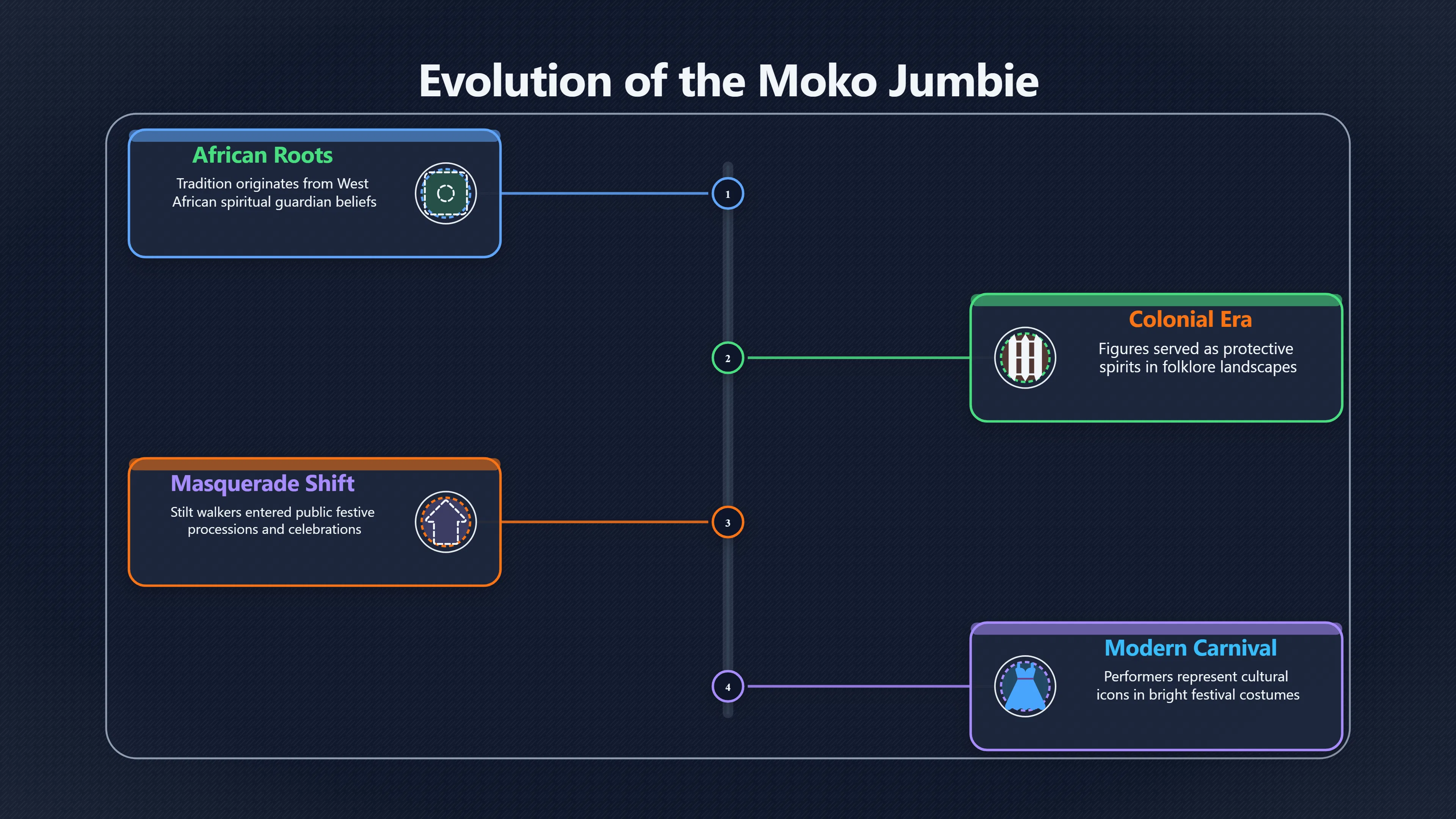
The roots of the tradition lie in African cultural practices carried across the Atlantic by enslaved Africans. Although scholars disagree on the exact linguistic origin of the name, there is broad agreement that the figure emerged from African beliefs about elevated spirit guardians who could see danger from afar. Their unusual height was not merely theatrical. It symbolised a supernatural ability to watch over communities and detect threats before ordinary people could.[wikipedia.org]WikipediaMoko jumbieMoko jumbie
For people living in Antigua and neighbouring islands during the colonial era, the moko jumbie belonged to the same imaginative world as other jumbies. These were not necessarily creatures that left footprints or generated eyewitness reports in the modern cryptid sense. Instead, they were part of a living folklore landscape where spirits might punish wrongdoing, protect communities or appear unexpectedly in the night. The moko jumbie therefore occupied an ambiguous position: feared because it belonged to the supernatural realm, but respected because it was often viewed as a guardian rather than a malevolent force.[wordpress.com]caribbeanauthors.wordpress.comCaribbean Authors Moko Jumbie and Midnight RobberIt is believed that our ancestors hide behind the masks and watch over the revelry of Carnival.Read more…
Stilt Walkers on Antiguan Streets
One reason the moko jumbie survived while many folklore beings faded is that it became visible. Rather than remaining a story told after dark, it stepped into public performance.
Historical accounts place moko jumbies among the masquerade traditions of the eastern Caribbean for more than two centuries. The practice spread across islands including Antigua and Barbuda, where stilt walkers appeared in festive processions and community celebrations. Their height created an immediate sense of wonder. To children especially, a moko jumbie could look less like a person on stilts and more like a giant spirit moving through the street.[Wikipedia]WikipediaMoko jumbieMoko jumbie
Antigua’s older Christmas masquerade traditions included stilt dancers known as moko jumbies, Jumpa-Ben or Long Ghosts. The alternative name “Long Ghosts” is particularly revealing. It shows how closely the performers remained connected to ideas of spirits and uncanny beings even when appearing in festive settings. The towering figures were accompanied by traditional music and formed part of a wider masquerade culture that blended entertainment, memory and folklore.[Wikipedia]WikipediaAntigua CarnivalAntigua Carnival
Unlike many ghost stories, the moko jumbie could be encountered directly. People saw them moving above crowds, balancing impossibly high over spectators and performing feats that appeared almost supernatural. The performance itself reinforced the folklore. A child watching from street level did not need to believe literally in spirits to understand why earlier generations had associated such figures with otherworldly powers.[Thrillist]thrillist.comHistory of Caribbean Moko Jumbie Stilt Walkers in StCroix…14 Dec 2023 — Moko Jumbies, African spiritual protectors embodied by stilt walkers, have long been a Caribbean mainstay. Meet th…

From Monster Image to Festival Spectacle
The most important change in the moko jumbie’s history was not a change in appearance but a change in meaning.
In earlier folklore, the figure belonged to a spiritual landscape populated by jumbies and ancestral presences. By the twentieth century, however, Carnival increasingly became the main stage on which Caribbean communities expressed cultural identity. As Carnival expanded, many traditional masquerade characters survived by becoming performers rather than feared supernatural beings. The moko jumbie was one of the most successful examples.[wikipedia.org]WikipediaAntigua CarnivalAntigua Carnival
Modern moko jumbies still preserve traces of their older role. Performers often describe them as guardians watching over celebrations. Their height continues to symbolise vigilance and protection. Yet the emotional tone has shifted dramatically. Instead of warning people away from dark places or reminding them of spiritual dangers, today’s moko jumbies are welcomed as crowd favourites. Bright costumes, choreographed dances and organised troupes have transformed the figure into one of the most recognisable symbols of Caribbean festival culture.[wikipedia.org]WikipediaMoko jumbieMoko jumbie
In Antigua and Barbuda, the character became firmly embedded in Carnival culture, where stilt walkers now represent heritage, creativity and public celebration. Government and cultural organisations routinely present moko jumbies as living cultural icons rather than objects of fear. The supernatural origins are remembered, but they are remembered as part of a cultural story rather than as an immediate threat.[Cpoise]cpoise.gov.agCpoise Moko Jumbie TodayMoko Jumbie Today - Antigua and Barbuda18 Oct 2022 — The Moko Jumbie (stilt walker) was introduced into the Antiguan culture by Osc…
Why the Moko Jumbie Still Matters
For readers interested in the strange-creature traditions of Antigua and Barbuda, the moko jumbie is significant because it demonstrates how folklore evolves. Many legendary beings either disappear when belief declines or survive only as stories. The moko jumbie followed a different path. It moved from the realm of spirits into public performance while retaining enough of its older symbolism to remain recognisably connected to its supernatural past.[wikipedia.org]WikipediaMoko jumbieMoko jumbie
That transformation also explains why the moko jumbie occupies a unique place in the country’s folklore. It is not a cryptid hidden in remote wilderness, nor simply a ghost story told around a fire. It is a former spirit figure that can still be encountered in broad daylight, towering above Carnival crowds. The giant on stilts represents a rare continuity between old fears, ancestral memory and modern celebration. In Antigua and Barbuda, few folklore beings have made the journey from feared jumbie to beloved cultural icon so successfully.[wikipedia.org]WikipediaAntigua CarnivalAntigua Carnival
Amazon book picks
Further Reading
Books and field guides related to How Moko Jumbies Became Carnival Giants. Use these as the next step if you want deeper reading beyond the article.
The Jumbie God's Revenge
Introduces readers to Caribbean spirit traditions connected to moko jumbies.
The Element Encyclopedia of Magical Creatures
Helps readers compare carnival spirits and folklore beings globally.
eBay marketplace picks
Marketplace Samples
Live-tested eBay searches with available results related to this page.
Endnotes
1.
Source: Wikipedia
Title: Moko jumbie
Link:https://en.wikipedia.org/wiki/Moko_jumbie
2.
Source: Wikipedia
Link:https://en.wikipedia.org/wiki/Jumbee
3.
Source: thrillist.com
Title: History of Caribbean Moko Jumbie Stilt Walkers in St
Link:https://www.thrillist.com/travel/nation/moko-jumbies-history-st-croix-virgin-islands
Source snippet
Croix...14 Dec 2023 — Moko Jumbies, African spiritual protectors embodied by stilt walkers, have long been a Caribbean mainstay. Meet th...
4.
Source: Wikipedia
Title: Antigua Carnival
Link:https://en.wikipedia.org/wiki/Antigua_Carnival
5.
Source: cpoise.gov.ag
Title: Cpoise Moko Jumbie Today
Link:https://cpoise.gov.ag/2022/10/18/moko-jumbie/
Source snippet
Moko Jumbie Today - Antigua and Barbuda18 Oct 2022 — The Moko Jumbie (stilt walker) was introduced into the Antiguan culture by Osc...
6.
Source: jamrockmuseum.com
Link:https://www.jamrockmuseum.com/education/moko-jumbies-origins-meaning-connection-to-slavery-and-continuing-impact-in-jamaica-and-across-the-caribbean/
Source snippet
Jamrock MuseumMoko Jumbies — origins, meaning, connection to slavery...8 Aug 2025 — The Moko Jumbie tradition originates from West Afric...
7.
Source: caribbeanauthors.wordpress.com
Title: Caribbean Authors Moko Jumbie and Midnight Robber
Link:https://caribbeanauthors.wordpress.com/2023/10/08/moko-jumbie-and-midnight-robber/
Source snippet
It is believed that our ancestors hide behind the masks and watch over the revelry of Carnival.Read more...
8.
Source: daily.redbullmusicacademy.com
Title: moko jumbies
Link:https://daily.redbullmusicacademy.com/2013/01/moko-jumbies/
Source snippet
Red Bull Music Academy DailyDancing in the Dragon's Den: The Moko Jumbies of Trinidad29 Jan 2013 — The Moko Jumbie tradition clearly date...
9.
Source: instagram.com
Title: Moko jumbie
Link:https://www.instagram.com/p/DY3Ag3NASVd/?hl=en
Source snippet
Moko originates from Central Africa, meaning a healer, spirit guardian, or deity of...Read more...
Additional References
10.
Source: rangetravel.com
Link:https://www.rangetravel.com/stories/meet-the-stilt-walking-stars-of-trinidad-and-tobago-carnival
Source snippet
Meet the Stilt-Walking Stars of Trinidad and Tobago CarnivalMost Trinidadians and Tobagonians will tell you that the Moko Jumbie represen...
11.
Source: facebook.com
Link:https://www.facebook.com/groups/pointfortin/posts/25220158254238709/
Source snippet
Trinidad's Moko Jumbie tradition and its Guapo historyOrigins in West Africa The roots of the Moko Jumbie lie in West Africa, where stilt...
12.
Source: facebook.com
Link:https://www.facebook.com/welcometobago/posts/%EF%B8%8F-the-protectors-rise-%EF%B8%8Fhigh-above-the-crowd-the-moko-jumbies-watch-over-tobago-c/793143003490290/
Source snippet
Welcome ToBago's postJumbie is one of the most powerful. Jumbie in Caribbean folklore refers to a spirit. warn of danger, and guide the p...
13.
Source: strangersguide.com
Link:https://strangersguide.com/articles/stilt-walkers-moko-jumbies/
Source snippet
Stilt WalkersMoko Jumbies—the Caribbean's unique kind of stilt walkers—have a long lineage in Carnival. These magical, towering figures...
14.
Source: instagram.com
Link:https://www.instagram.com/reel/DGRQ5leJuxu/?hl=en
Source snippet
It is told that the spirit of Moko followed his people along the...Read more...
15.
Source: ttparliament.org
Title: Call For Submissions Rotunda Gallery Moko Jumbies
Link:https://www.ttparliament.org/wp-content/uploads/2026/01/Call-For-Submissions-Rotunda-Gallery-Moko-Jumbies.pdf
Source snippet
Call For Submissions – Rotunda Gallery – Moko Jumbies25 Jan 2026 — Moko Jumbies are more than performers; they are guardians of culture...
16.
Source: instagram.com
Link:https://www.instagram.com/reel/DUMASMViaRm/
Source snippet
ral Africa, meaning a healer, spirit guardian, or deity of...
17.
Source: facebook.com
Link:https://www.facebook.com/ncctt/posts/one-of-the-most-iconic-traditional-mas-characters-the-legendary-moko-jumbietower/1454813240019599/
Source snippet
bie is a symbol of strength, balance and spiritual power...
18.
Source: beverlys-jewelry.com
Title: the legacy of moko jumbies
Link:https://www.beverlys-jewelry.com/blogs/the-legacy-of-moko-jumbies?srsltid=AfmBOoqEgyMXies1ikqhMKkbnC2IuKy7ggV1GyBk75IEpTc4TSSEvoeK
Source snippet
Moko Jumbies in the Caribbean | History & Cultural Legacy5 Feb 2025 — The tradition of Moko Jumbies dates back centuries to West Africa...
19.
Source: beverlys-jewelry.com
Title: the legacy of moko jumbies
Link:https://www.beverlys-jewelry.com/blogs/the-legacy-of-moko-jumbies?srsltid=AfmBOor-wgIGzu9kAuSw_HYAwkQ_hBJXKLN0Ts2HOlf1bqowFKcu2TVs
Source snippet
Moko Jumbies in the Caribbean | History & Cultural Legacy5 Feb 2025 — The tradition of Moko Jumbies dates back centuries to West Africa...
Topic Tree