Within Colombia Monsters
How a Caiman Tale Became a Town Emblem
The Alligator-Man turns real caiman country into a comic warning tale, local emblem and festival tradition on the Magdalena River.
On this page
- The Saúl transformation story and its moral joke
- Plato, the Magdalena River and festival heritage
- Real caimans, river life and sceptical readings
Page outline Jump by section
Introduction
The Alligator-Man of Plato is one of Colombia’s most famous river legends, but it is not a cryptid in the sense of an unknown animal supposedly awaiting discovery. Instead, it is a piece of Magdalena River folklore that blends real caiman country, comic morality tale, local identity and public celebration. The story centres on Saúl Montenegro, a man from the riverside town of Plato in the department of Magdalena who supposedly transformed himself into a caiman so he could secretly watch women bathing in the river. A magical mishap left him trapped as a creature with a human head and a caiman’s body, creating one of the best-known monster figures in Colombian popular tradition.[Wikipedia]WikipediaEl Hombre CaimánEl Hombre Caimán
Unlike many monster legends that survive mainly in old books, the Alligator-Man remains highly visible in modern public culture. Festivals, monuments, songs and local tourism have turned the creature into an emblem of Plato itself, ensuring that the story continues to be told long after any claim of a real encounter ceased to matter.[colombia.co]colombia.cos myths legendsMarca paísColombia's myths and legends1 Oct 2024 — El Hombre Caimán has been immortalized as one of the most iconic legends of riverside…
The Tale of Saúl Montenegro
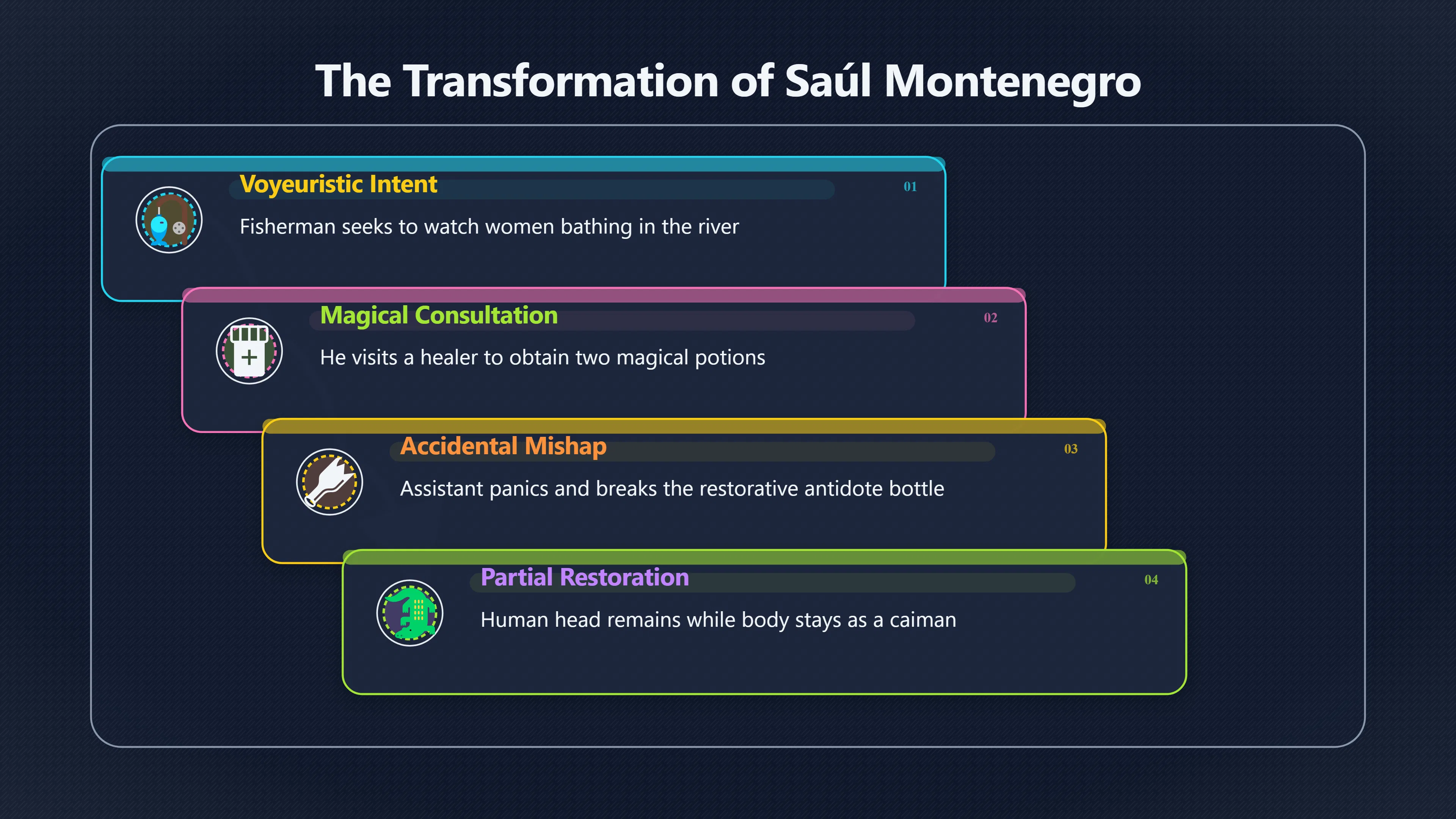
The most familiar version of the legend begins with Saúl Montenegro, usually described as a fisherman or local man who enjoyed spying on women bathing in the Magdalena River. Wanting to observe them without being detected, he travelled to seek magical help from a healer or shaman. He received two potions: one to transform him into a caiman and another to restore his human form.[Wikipedia]WikipediaEl Hombre CaimánEl Hombre Caimán
For a time the plan supposedly worked. Montenegro would enter the water disguised as a reptile and watch unnoticed. The turning point came when an assistant responsible for administering the antidote panicked at the sight of the transformed man. The bottle was dropped or broken, and only part of the restorative potion reached him. His head became human again, but the rest of his body remained that of a caiman.[Wikipedia]WikipediaEl Hombre CaimánEl Hombre Caimán
The story then shifts from comedy to tragedy. Terrified residents and fishermen attempted to drive the creature away. Montenegro became an outcast, cared for only by his mother, who continued bringing him food beside the river. In many retellings she eventually dies, leaving him alone to drift down the Magdalena towards the Caribbean coast. The legend explains why fishermen along the river were said to remain watchful for the strange half-human creature.[Wikipedia]WikipediaEl Hombre CaimánEl Hombre Caimán
As folklore, the tale functions as a moral joke as much as a monster story. The transformation is a punishment for voyeurism and bad behaviour. Rather than presenting a terrifying predator, the narrative turns its central character into an object of ridicule whose own actions create his fate. That comic element helps explain why the legend has remained popular across generations.[Wikipedia]WikipediaEl Hombre CaimánEl Hombre Caimán
How Plato Made the Creature Its Own
The Alligator-Man is inseparable from Plato, a municipality on the Magdalena River in northern Colombia. While similar shape-shifting stories exist elsewhere in Latin America, this particular version became closely associated with the town and eventually evolved into a symbol of local identity.[Wikipedia]WikipediaEl Hombre CaimánEl Hombre Caimán
Accounts collected from local tradition suggest that the modern form of the story became widely known through newspaper articles and retellings during the twentieth century. Local writer and journalist Virgilio Di Filippo is often credited with shaping and popularising the version that became famous throughout the Caribbean region of Colombia.[Wikipedia]WikipediaPlato (MagdalenaPlato (Magdalena
Today the legend is embedded in public space. Plato contains monuments, statues and plazas dedicated to the creature, while local cultural events celebrate the story as part of the town’s heritage. What may once have been a cautionary folk tale has become a civic emblem, similar to the way some towns embrace dragons, giants or sea monsters as symbols of place.[colombia.travel]colombia.travelAlligator Man Monument: Legend of the Colombian…Located in the municipality of Plato, Magdalena, this monument seeks to preserve and c…
A particularly important development was the creation of the Festival del Hombre Caimán, an annual celebration that showcases music, folklore and local traditions. The festival has been held since the early 1970s and has helped preserve the legend for new audiences while linking it to regional cultural identity rather than belief in an actual monster.[Marca país]colombia.cos myths legendsMarca paísColombia's myths and legends1 Oct 2024 — El Hombre Caimán has been immortalized as one of the most iconic legends of riverside…
Why the Legend Fits the Magdalena River
The Magdalena is Colombia’s most important river and has long been a source of stories, livelihoods and dangers. It is also genuine caiman habitat. For generations, people living along the river shared their environment with large reptiles that could appear suddenly among reeds, floating vegetation and muddy banks.[ResearchGate]researchgate.netLegend tells that a fisherman called Saúl Montenegro was obsessed with spying on women bathing nude in the Magdalena River. He did not wa…
This ecological setting makes the legend feel believable within its own world. A human head emerging from water would be startling; a caiman body disappearing beneath the surface would be difficult to track. Folklore often develops by combining familiar animals with human behaviour, and the Alligator-Man follows that pattern perfectly. The monster is not a completely invented beast but a hybrid of ordinary river life and human imagination.[ResearchGate]researchgate.netLegend tells that a fisherman called Saúl Montenegro was obsessed with spying on women bathing nude in the Magdalena River. He did not wa…
The story also reflects social realities of riverside communities. Communal bathing, fishing, river transport and daily life along the Magdalena created opportunities for stories that linked people and wildlife. The legend transforms a familiar animal into a vehicle for discussing privacy, shame, curiosity and community standards.[Wikipedia]WikipediaEl Hombre CaimánEl Hombre Caimán
Monster, Folklore Figure or Cryptid?
From a cryptozoological perspective, there is little evidence that the Alligator-Man was ever treated as an unknown biological species. The story lacks the kind of recurring physical evidence, specimen claims or eyewitness reports usually associated with mystery-animal traditions. Instead, it is overwhelmingly presented as folklore.[Wikipedia]WikipediaEl Hombre CaimánEl Hombre Caimán
That does not mean the legend is unimportant within Colombia’s wider monster tradition. In fact, its significance comes from a different source. The Alligator-Man demonstrates how local communities can transform a humorous cautionary tale into a lasting cultural symbol. While Lake Tota’s monster is often discussed as Colombia’s closest equivalent to a classic lake cryptid, the Alligator-Man occupies another part of the spectrum: a river creature whose power lies in storytelling, memory and place.[Marca país]colombia.cos myths legendsMarca paísColombia's myths and legends1 Oct 2024 — El Hombre Caimán has been immortalized as one of the most iconic legends of riverside…
Some versions even expand the supernatural elements, suggesting the creature still roams the Magdalena or periodically returns. Yet these claims belong to folklore and tradition rather than documented zoological investigation. The enduring popularity of the story stems less from evidence than from its memorable narrative and connection to a real landscape.[Wikipedia]WikipediaColombian folkloreColombian folklore
Real Caimans and Sceptical Explanations
A sceptical reading of the Alligator-Man does not require solving a mystery. The legend is already transparent about its folkloric structure. It features magic potions, supernatural transformation and moral consequences rather than claims that an unknown animal was observed and later misidentified.[Wikipedia]WikipediaEl Hombre CaimánEl Hombre Caimán
Real caimans nevertheless help explain why the tale resonated. Large reptiles have always been among the most impressive animals encountered in the wetlands and waterways of northern Colombia. Their appearance, behaviour and ability to vanish beneath the water make them ideal foundations for storytelling.[ResearchGate]researchgate.netLegend tells that a fisherman called Saúl Montenegro was obsessed with spying on women bathing nude in the Magdalena River. He did not wa…
The strongest evidence for the Alligator-Man is therefore cultural rather than biological. The monuments, festivals, songs and continuing local retellings demonstrate that the creature occupies a secure place in Colombian river folklore. Whether anyone ever believed a half-human caiman swam the Magdalena matters less than the fact that Plato turned the story into one of the country’s most recognisable local legends.[colombia.travel]colombia.travelAlligator Man Monument: Legend of the Colombian…Located in the municipality of Plato, Magdalena, this monument seeks to preserve and c…
Amazon book picks
Further Reading
Books and field guides related to How a Caiman Tale Became a Town Emblem. Use these as the next step if you want deeper reading beyond the article.
The Uses of Enchantment
Helpful for understanding the moral and social functions of transformation tales.
American Monsters
Offers comparative examples of local creature legends becoming cultural icons.
eBay marketplace picks
Marketplace Samples
Live-tested eBay searches with available results related to this page.

Endnotes
1.
Source: Wikipedia
Title: El Hombre Caimán
Link:https://en.wikipedia.org/wiki/El_Hombre_Caim%C3%A1n
2.
Source: Wikipedia
Title: Hombre Caimán
Link:https://es.wikipedia.org/wiki/Hombre_Caim%C3%A1n
3.
Source: colombia.co
Title: s myths legends
Link:https://colombia.co/en/colombia-country/history/colombias-myths-legends
Source snippet
Marca paísColombia's myths and legends1 Oct 2024 — El Hombre Caimán has been immortalized as one of the most iconic legends of riverside...
4.
Source: colombia.travel
Link:https://colombia.travel/en/cienaga/caiman-legend-monumemt
Source snippet
Alligator Man Monument: Legend of the Colombian...Located in the municipality of Plato, Magdalena, this monument seeks to preserve and c...
5.
Source: Wikipedia
Title: Plato (Magdalena)
Link:https://es.wikipedia.org/wiki/Plato_%28Magdalena%29
6.
Source: researchgate.net
Link:https://www.researchgate.net/figure/A-Sculpture-depicting-Hombre-Caiman-at-Plato-Magdalena-Photograph-Juan-Salvador_fig2_401473088
Source snippet
Legend tells that a fisherman called Saúl Montenegro was obsessed with spying on women bathing nude in the Magdalena River. He did not wa...
7.
Source: Wikipedia
Title: Colombian folklore
Link:https://en.wikipedia.org/wiki/Colombian_folklore
8.
Source: colombia.travel
Link:https://colombia.travel/de/cienaga/denkmal-der-kaiman-legende
Source snippet
Denkmal der Kaiman-LegendeEntdecken Sie das Kaimanmann-Denkmal in Plato, Magdalena, und seinen Einfluss auf die Folklore der kolumbianisc...
Additional References
9.
Source: lithub.com
Title: chasing legends down colombias mythic river magdalena
Link:https://lithub.com/chasing-legends-down-colombias-mythic-river-magdalena/
Source snippet
Chasing Legends Down Colombia's Mythic River Magdalena18 Nov 2021 — Juana wasn't meant to run away from home. At least, that's how the le...
10.
Source: facebook.com
Link:https://www.facebook.com/groups/281886105961506/posts/1135588297257945/
Source snippet
la historia de Saúl Montenegro, un joven pescador...Read more...
11.
Source: scribd.com
Link:https://www.scribd.com/document/424993330/Presentacio-n-9
Source snippet
amed Roque Lina, despite her father's disapproval.Read more...
12.
Source: facebook.com
Link:https://www.facebook.com/PeaceCorpsColombia/posts/volunteers-in-plato-magdalena-took-part-in-the-24th-hombre-caiman-festival-celeb/1010442929150172/
Source snippet
ating the legend of the man who turned himself into a...
13.
Source: photocontest.smithsonianmag.com
Title: the alligator man el hombre caiman
Link:https://photocontest.smithsonianmag.com/photocontest/detail/the-alligator-man-el-hombre-caiman/
Source snippet
alligator man (El hombre caimán) - Photo ContestIt is a character from the Colombian Caribbean Coast that represents the legend of the ha...
14.
Source: mythlok.com
Link:https://mythlok.com/urban-legends/el-hombre-caiman/
Source snippet
ut his origins, transformation, and cultural impact...
15.
Source: mythcrafts.com
Title: love bites the alligator man
Link:https://mythcrafts.com/2018/04/05/love-bites-the-alligator-man/
Source snippet
Love Bites: The Alligator Man5 Apr 2018 — Once upon a time, there was a fisherman who enjoyed nothing more than watching the local ladies...
16.
Source: youtube.com
Title: LA HISTORIA DEL HOMBRE CAIMAN PLATO MAGDALENA, JUAN GOSSAIN
Link:https://www.youtube.com/watch?v=pm_6uej6IPQ
Source snippet
PLATO MAGDALENA: El pueblo donde un hombre se convirtió en caimán...
17.
Source: es.scribd.com
Title: the alligator man
Link:https://es.scribd.com/document/892644894/the-alligator-man
Source snippet
Legend of the Alligator Man | PDF | FolkloreThe legend of the Alligator Man tells the story of Saul, a fisherman who transforms into a ca...
18.
Source: generalist.academy
Title: alligator centaur
Link:https://generalist.academy/2021/01/17/alligator-centaur/
Source snippet
17 Jan 2021 — El Hombre Caimán is a popular Colombian myth about a man who is half man, half alligator – the result of an accident while...
Topic Tree