Cryptids of Iceland's Waters
Iceland’s monster tradition is not built around one creature but around two strong currents: the famous lake serpent of Lagarfljót in the east, and a wider coastal folklore of sea monsters, strange seals, mermen, shell-covered beasts and island-sized whales.
Page outline Jump by section
Introduction
The best way to read Icelandic cryptid history is as a layered tradition. Some stories are old folklore, some are local identity and tourism, some are eyewitness claims, and some may be shaped by real animals, difficult water conditions, drifting debris, whales, seals or optical effects. Iceland’s small native land fauna makes ape-like mystery beasts or big-cat flaps less central here than lake and sea creatures; the surrounding marine world is far richer, with seals, whales and occasional unusual visitors giving coastal stories a natural stage.[Náttúrufræðistofnun]natt.isOpen source on natt.is.
Why Iceland’s monsters live in water
Iceland’s creature lore fits the country’s geography. It is an island with long coasts, fjords, glacial rivers, poor-visibility lakes, rough weather and a deep seafaring history. That setting is ideal for stories in which a witness sees a hump, wake, head, back, shell-like surface or island-shaped body only briefly before it disappears.
There is also a biological reason for the pattern. The Icelandic Institute of Natural History notes that Iceland’s marine mammal fauna is much richer than its land mammal fauna: grey seals and harbour seals pup in Iceland, several other seal species are regular visitors, and walruses occasionally appear.[Náttúrufræðistofnun]natt.isOpen source on natt.is. The Icelandic government’s biodiversity material similarly describes marine mammals as including several species of seals and whales.[Government of Iceland]government.isOpen source on government.is. In other words, Iceland has many real large animals offshore, but very few native land animals large enough to generate a convincing mystery-beast tradition.
That does not make the old stories “just seals” or “just whales”. Folklore rarely works that simply. Rather, Icelandic monster stories often begin where real experience becomes difficult to interpret: a dark fjord, a stormy crossing, a glacial lake with low visibility, or a known animal seen at the wrong angle, distance or scale.
The Lagarfljót Worm: Iceland’s best-known lake monster
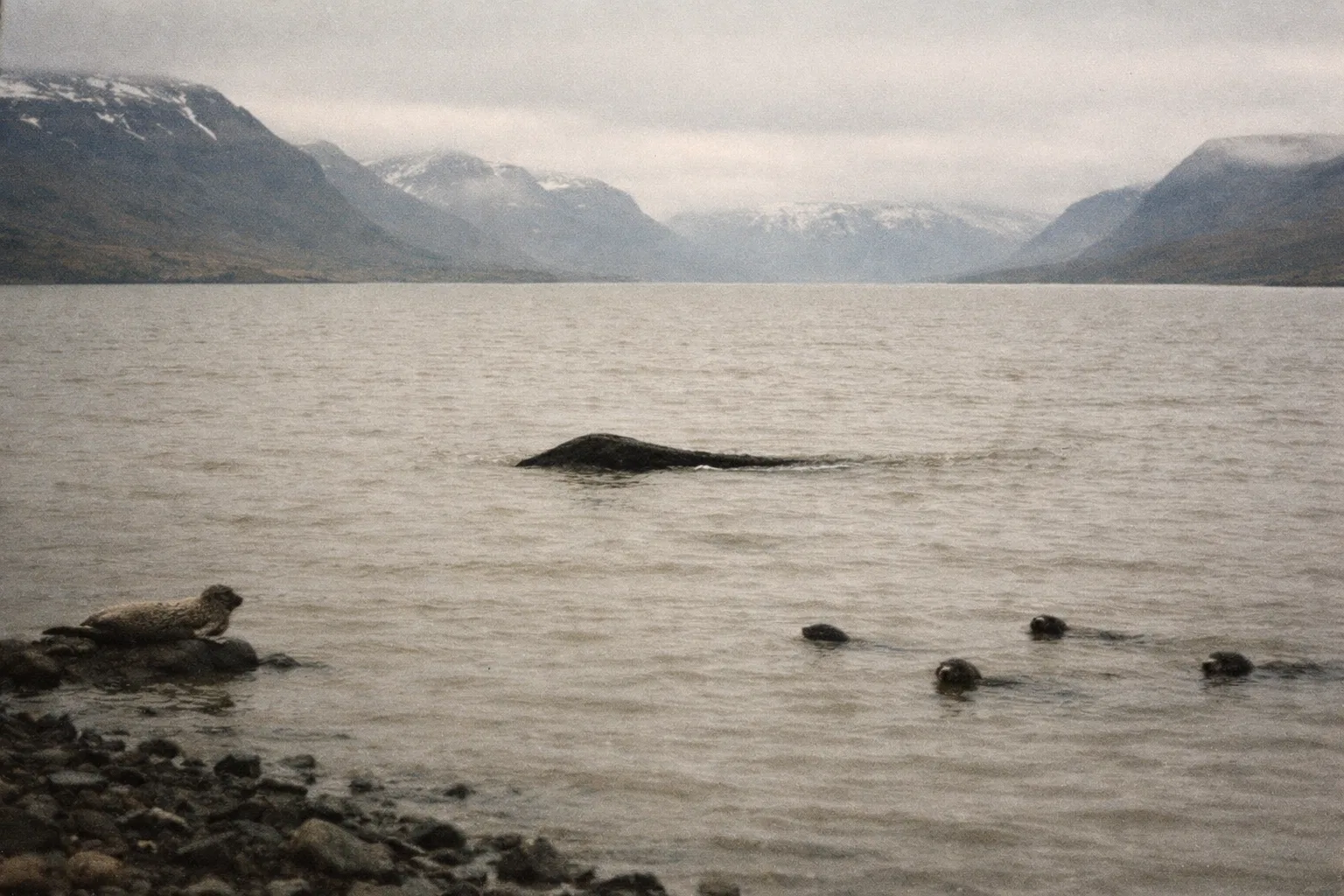
The Lagarfljót Worm is Iceland’s nearest equivalent to the Loch Ness Monster, but its cultural roots are distinctively Icelandic. It is associated with Lagarfljót in East Iceland, a long glacial lake and river system near Egilsstaðir. Local tourism material presents it as an ancient lake monster tradition, while RÚV, Iceland’s national broadcaster, described it in 2012 as one of the country’s best-known monsters and noted that it is first mentioned in 1345.[RÚV]ruv.isRÚVEr þetta Lagarfljótsormurinn?RÚVEr þetta Lagarfljótsormurinn?
The classic origin story is a folktale about a small worm or serpent placed with gold so the treasure would grow. Instead, the creature grows out of control, is thrown into the lake with the gold, and continues to haunt the water. Later versions make the creature enormous, poisonous, dangerous to animals and people, and sometimes visible as humps or a long body at the surface.
What makes this case especially durable is its mix of old and new evidence:
- Medieval roots: the tradition is commonly traced to a 1345 “marvel” at Lagarfljót, later remembered as part of the creature’s history.[RÚV]ruv.isRÚVEr þetta Lagarfljótsormurinn?RÚVEr þetta Lagarfljótsormurinn?
- A strong place identity: the creature is tied to one named landscape, not just to Iceland in general.
- Modern sightings and media: the story has been repeatedly revived through articles, travel writing, television and online video.
- A usable mystery: the lake’s glacial, silty water gives the story a plausible visual setting, because shapes in such water are hard to judge.
The 2012 video is the modern turning point. It appeared to show a long, serpentine shape moving through icy water, and RÚV published it as a possible sighting.[RÚV]ruv.isRÚVEr þetta Lagarfljótsormurinn?RÚVEr þetta Lagarfljótsormurinn? Sceptical analysis soon argued that the object was probably not swimming at all: Live Science reported that a frame-by-frame examination suggested the shape made little or no forward progress and could be an inanimate object, such as netting or debris, moved by current.[Live Science]livescience.com18464 icelandic river monster mystery solved18464 icelandic river monster mystery solved
That is a useful example of how Icelandic monster claims often split into two stories at once. For believers, the video is one more appearance of an old creature. For sceptics, it is a good lesson in how moving water, ice, current and expectation can turn debris into a monster.
The Westfjords and the sea-monster coast
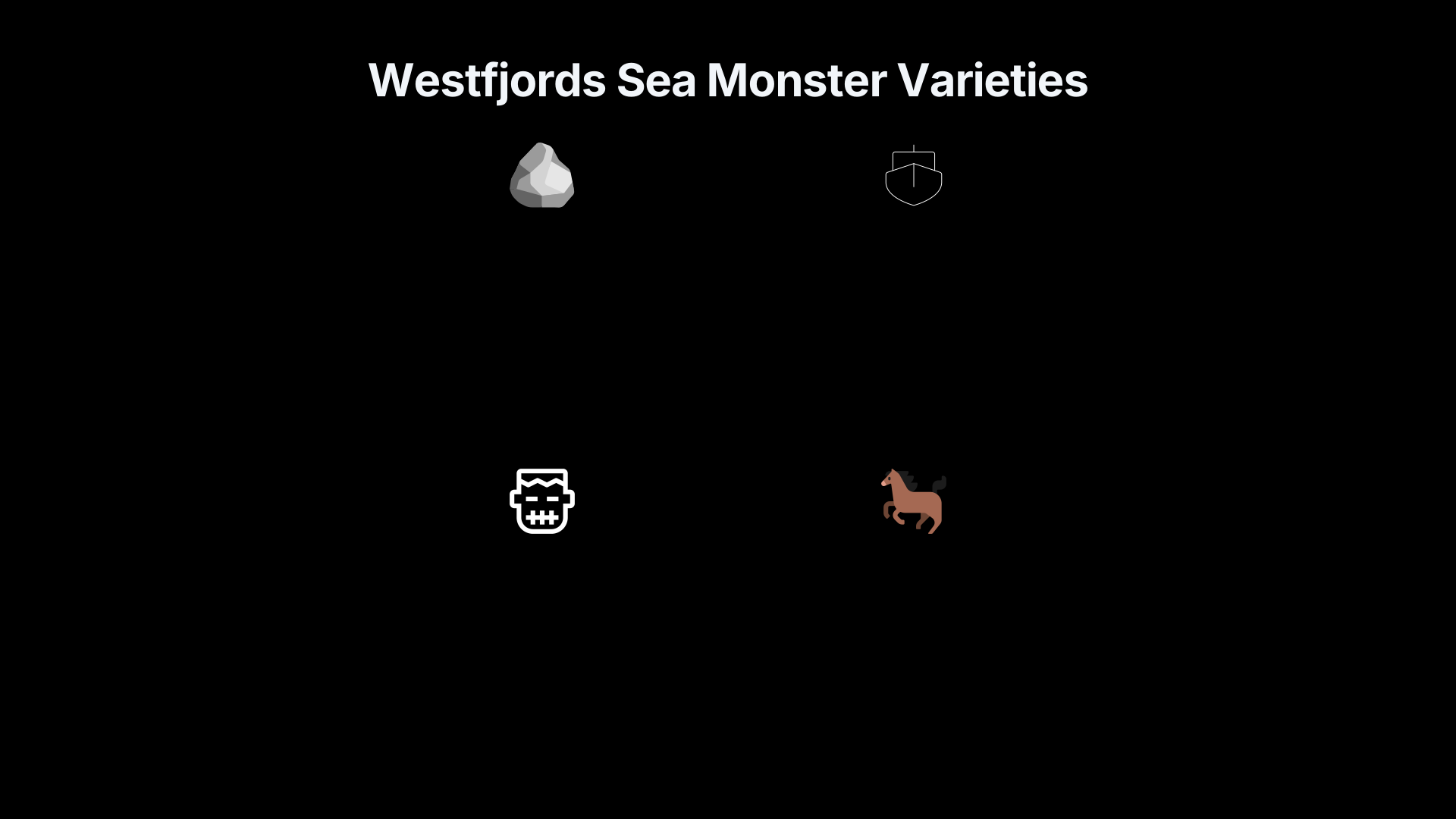
If Lagarfljót is Iceland’s lake-monster capital, the Westfjords are its sea-monster country. The Icelandic Sea Monster Museum in Bíldudalur sits on Arnarfjörður, a fjord promoted by Westfjords tourism as one of Iceland’s most active centres of monster tradition.[Visit Westfjords]westfjords.isOpen source on westfjords.is. The museum treats the stories as part of Icelandic folk culture, with written accounts from around the country and exhibits focused on recurring monster types.[Visit Westfjords]westfjords.isOpen source on westfjords.is.
Several named sea monsters recur in museum and travel accounts. The most commonly listed are the Shore Laddie, the Merman, the Shell Monster and the Combed Monster or Sea Horse.[Iceland Travel]icelandtravel.isOpen source on icelandtravel.is. These are not all the same kind of claim. Some sound like humanoid sea beings, some like anomalous seals or horses, and some like heavily encrusted or shell-covered animals. The value of the museum is that it preserves the range of the tradition instead of reducing everything to one “Icelandic sea serpent”.
Arnarfjörður matters because local clustering gives folklore a sense of geography. A vague “sea monster off Iceland” is easy to forget; a fjord with repeated stories, a local museum, eyewitness interviews and a visitor route becomes a cultural landmark. The Reykjavík Grapevine’s account of visiting the Bíldudalur museum describes the village setting as remote and fjord-bound, which helps explain why these stories feel so rooted in place rather than manufactured for a generic tourist market.[The Reykjavík Grapevine]grapevine.isyou will believe in bildudalur visiting the sea monster museumyou will believe in bildudalur visiting the sea monster museum
A sceptical reading does not empty the Westfjords stories of interest. It makes them more interesting. The real question is not whether four unknown species are hiding around Arnarfjörður, but why certain shapes and behaviours became memorable enough to form named categories: a shoreline creature, a human-like sea being, a shell-covered beast, a horse-like or dragon-like form. Those categories may preserve generations of attempts to classify brief, frightening or ambiguous encounters at sea.
Medieval sea giants and the whale explanation
Some Iceland-linked sea monsters belong to the older North Atlantic literary world rather than to modern cryptid reports. The best example is the Hafgufa, a huge sea creature described in Old Norse material and later discussed as a monster so large it could be mistaken for an island or could swallow fish and ships. The tradition is connected with medieval texts such as the King’s Mirror and later saga material.[Wikipedia]WikipediaOpen source on wikipedia.org.
This is where Icelandic monster lore meets modern animal behaviour in a genuinely surprising way. A 2023 paper in Marine Mammal Science compared the Hafgufa tradition with recently documented whale feeding behaviours known as trap feeding and tread-water feeding. In these behaviours, whales hold their mouths open at the surface and fish gather inside before the jaw closes. The researchers argued that the old description of a creature attracting fish into its mouth has striking parallels with real cetacean behaviour.[Wiley Online Library]onlinelibrary.wiley.comOpen source on wiley.com.
That does not prove medieval sailors saw one specific whale and accurately recorded it without embellishment. It does show how a “monster” tradition can preserve an observation of real animal behaviour after the original natural context has been forgotten. The Natural History Museum’s report on the research highlights the same point: an island-sized fish in an old text may reflect a distorted but recognisable memory of whale feeding.[Natural History Museum]nhm.ac.uklegendary beasts ancient literature may have been whales gulping down fishlegendary beasts ancient literature may have been whales gulping down fish
For Iceland’s cryptid history, this is one of the most valuable sceptical models. Not every monster story is a hoax or a fantasy. Some may be folklore wrapped around real but rare behaviour: a whale feeding strangely, a seal surfacing in bad light, a floating carcass, or a mass of seaweed and shellfish moving in the tide.
The Yule Cat is folklore, not a mystery animal
Iceland also has famous monstrous animals that belong more to folklore than to cryptozoology. The Yule Cat is the clearest case. It is a giant Christmas cat said to threaten people who have not received new clothes before Christmas. Modern accounts usually link its first clear written appearance to Jón Árnason’s 1862 folklore collection and its popularisation to Jóhannes úr Kötlum’s 1932 poetry collection Christmas Is Coming.[Icelandair]icelandair.comicelands yule caticelands yule cat
This creature matters to an Icelandic monster page because it shows the difference between a cryptid claim and a moral folklore figure. The Lagarfljót Worm is attached to a location and has sighting claims. The Westfjords sea monsters are attached to coasts, witnesses and local tradition. The Yule Cat is different: it is a seasonal warning story about work, clothing, social obligation and Christmas custom.
That does not make it less powerful. In fact, the Yule Cat may be better known internationally than many of Iceland’s watery monsters because it is vivid, easy to retell and visually memorable. But it should not be treated as a reported unknown animal. It belongs in the same broad monster tradition while sitting on the folklore side of the boundary.
What sceptics point to first
The strongest sceptical explanations for Icelandic monster reports are not dismissive one-liners. They come from the country’s actual conditions.
First, Icelandic water often makes scale difficult. Glacial lakes and rivers can be silty, cold and opaque; coastal water can be broken by waves, kelp, currents, ice and weather. A small or medium object may look enormous when there is no clear reference point. The Lagarfljót video debate is a good example: the mystery depends heavily on whether the shape is moving under its own power or being carried by current.[Live Science]livescience.com18464 icelandic river monster mystery solved18464 icelandic river monster mystery solved
Second, real marine animals are abundant enough to seed strange reports. Seals, whales, dolphins, porpoises and occasional walruses all provide bodies, heads, backs, wakes and behaviours that can look uncanny when partly seen. Iceland’s official biodiversity account emphasises that the marine mammal fauna is richer than the terrestrial one, which fits the strong coastal bias of the monster tradition.[Náttúrufræðistofnun]natt.isOpen source on natt.is.
Third, folklore gives witnesses a pattern. Once a lake has a serpent, a fjord has sea monsters, or a Christmas season has a giant cat, later experiences are more likely to be sorted into those familiar shapes. This does not mean witnesses are lying. It means culture supplies the labels people reach for when they see something confusing.
Fourth, tourism can preserve and reshape the story. The Sea Monster Museum and East Iceland’s Lagarfljót material keep local traditions visible for visitors, but they also make the creatures part of a public heritage economy.[Visit Westfjords]westfjords.isOpen source on westfjords.is. That can be positive when it preserves local stories, but it can also blur the line between folklore, entertainment and evidence.
How Iceland’s creature legends changed over time
Iceland’s monster tradition has moved through several phases. In medieval and early modern material, sea creatures often belonged to a wider North Atlantic world of whales, island-beasts, monstrous fish and dangerous waters. These stories reflected seafaring uncertainty as much as zoological curiosity.
In the nineteenth century, folklore collecting helped fix many stories into written form. Jón Árnason’s collections are especially important for Icelandic folklore, including the Yule Cat tradition and many broader supernatural and monster motifs.[Wikipedia]WikipediaYule catYule cat Once oral tales enter print, they become easier to quote, translate, teach and package for later readers.
In the twentieth and twenty-first centuries, Icelandic monsters entered tourism, local branding and global internet culture. Lagarfljót became “Iceland’s Loch Ness Monster” in travel language. Bíldudalur became a place where sea-monster folklore could be visited indoors. The 2012 Lagarfljót footage turned an old local serpent into a shareable online case, while sceptical commentary turned it into a case study in video interpretation.[ruv.is]ruv.isRÚVEr þetta Lagarfljótsormurinn?RÚVEr þetta Lagarfljótsormurinn?
The most interesting change is that modern science has not simply killed the old stories. Sometimes it gives them better explanations. The Hafgufa-and-whale-feeding research shows how a legendary sea monster can become more fascinating, not less, when read alongside animal behaviour.[Wiley Online Library]onlinelibrary.wiley.comOpen source on wiley.com.

The most credible way to read Iceland’s cryptids
Iceland has no confirmed hidden lake serpent, sea horse, shell monster or giant Christmas cat. The evidence for unknown animals is thin, and the best-known modern “evidence”, the 2012 Lagarfljót video, has a strong mundane explanation in current, ice and debris.[Live Science]livescience.com18464 icelandic river monster mystery solved18464 icelandic river monster mystery solved
But Iceland does have a rich and coherent monster tradition. Its strongest creature stories cluster where they make environmental sense: silty glacial water, remote fjords, difficult seas and a coastline full of real marine life. The stories also make cultural sense: they preserve local memory, warn children, entertain travellers, turn landscapes into story places, and give communities a distinctive folklore inheritance.
The result is a country-level cryptid tradition that is less about chasing a single undiscovered beast and more about watching how people interpret strange animals, strange water and strange stories. The Lagarfljót Worm remains Iceland’s headline lake monster; the Westfjords preserve the country’s richest sea-monster cluster; the Hafgufa links medieval wonder to real whale behaviour; and the Yule Cat shows how a legendary animal can become culturally real without ever being a zoological claim.
Amazon book picks
Further Reading
Books and field guides related to What Monsters Haunt Iceland's Waters?. Use these as the next step if you want deeper reading beyond the article.
Norse Mythology
Helps readers understand the wider cultural setting of Icelandic lore.
The Book of Imaginary Beings
Provides context for legendary creatures across cultures.
The Lore of Scotland
Includes lake and sea-creature traditions comparable to Icelandic stories.
eBay marketplace picks
Marketplace Samples
Live-tested eBay searches with available results related to this page.
Endnotes
1.
Source: ruv.is
Title: RÚVEr þetta Lagarfljótsormurinn?
Link:https://www.ruv.is/frettir/innlent/er-thetta-lagarfljotsormurinn
2.
Source: government.is
Link:https://government.is/topics/environment-climate-and-nature-protection/biological-diversity/icelandic-flora-funga-and-fauna/
3.
Source: east.is
Link:https://www.east.is/en/place/lagarfljotsormurinn
4.
Source: westfjords.is
Link:https://www.westfjords.is/en/service/the-icelandic-sea-monster-museum
5.
Source: grapevine.is
Title: you will believe in bildudalur visiting the sea monster museum
Link:https://grapevine.is/news/2011/06/24/you-will-believe-in-bildudalur-visiting-the-sea-monster-museum/
6.
Source: Wikipedia
Link:https://en.wikipedia.org/wiki/Hafgufa
7.
Source: onlinelibrary.wiley.com
Link:https://onlinelibrary.wiley.com/doi/10.1111/mms.13009
8.
Source: icelandair.com
Title: icelands yule cat
Link:https://www.icelandair.com/blog/icelands-yule-cat/
9.
Source: Wikipedia
Title: Yule cat
Link:https://en.wikipedia.org/wiki/Yule_cat
10.
Source: Wikipedia
Title: Lagarfljót Worm
Link:https://en.wikipedia.org/wiki/Lagarflj%C3%B3t_Worm
11.
Source: Wikipedia
Title: Icelandic language
Link:https://en.wikipedia.org/wiki/Icelandic_language
12.
Source: Wikipedia
Link:https://en.wikipedia.org/wiki/Iceland
13.
Source: Wikipedia
Title: Fauna of Iceland
Link:https://en.wikipedia.org/wiki/Fauna_of_Iceland
14.
Source: Wikipedia
Title: Icelandic Christmas folklore
Link:https://en.wikipedia.org/wiki/Icelandic_Christmas_folklore
15.
Source: Wikipedia
Link:https://en.wikipedia.org/wiki/Lyngbakr
16.
Source: grapevine.is
Title: truth committee confirms [lagarfljot worm]({{ ‘lagarfljot-worm/’ | relative_url }}) is real
Link:https://grapevine.is/news/2014/08/25/truth-committee-confirms-lagarfljot-worm-is-real/
17.
Source: grapevine.is
Title: monsters and mythical beings the worm of lagarfljot
Link:https://grapevine.is/mag/opinion/2008/11/06/monsters-and-mythical-beings-the-worm-of-lagarfljot/
18.
Source: grapevine.is
Title: the truth is out there
Link:https://grapevine.is/mag/articles/2014/06/12/the-truth-%E2%80%A8is-out-there/
19.
Source: icelandair.com
Title: icelandic language
Link:https://www.icelandair.com/arora/icelandic-language/
20.
Source: youtube.com
Title: Giant Worm Monster Caught On Camera | Boogeymen
Link:https://www.youtube.com/watch?v=TqnhuKffUmU
Source snippet
Bíldudalur - Skrímslasetrið HD...
21.
Source: youtube.com
Link:https://www.youtube.com/watch?v=tmc_U9eYvPc
22.
Source: livescience.com
Title: 18464 icelandic river monster mystery solved
Link:https://www.livescience.com/18464-icelandic-river-monster-mystery-solved.html
23.
Source: natt.is
Link:https://www.natt.is/en/fauna/mammals
24.
Source: icelandtravel.is
Link:https://www.icelandtravel.is/attractions/the-icelandic-sea-monster-museum/
25.
Source: nhm.ac.uk
Title: legendary beasts ancient literature may have been whales gulping down fish
Link:https://www.nhm.ac.uk/discover/news/2023/february/legendary-beasts-ancient-literature-may-have-been-whales-gulping-down-fish.html
26.
Source: ruv.is
Title: faer loksins fe fyrir lagarfljotsmyndbandid
Link:https://www.ruv.is/frettir/innlent/faer-loksins-fe-fyrir-lagarfljotsmyndbandid
27.
Source: mammalwatching.com
Link:https://www.mammalwatching.com/gd_place/iceland/
28.
Source: guidetoiceland.is
Title: icelandic sea monster museum
Link:https://guidetoiceland.is/travel-iceland/drive/icelandic-sea-monster-museum
29.
Source: cntraveller.com
Link:https://www.cntraveller.com/topic/iceland
30.
Source: icelandtravel.is
Link:https://www.icelandtravel.is/attractions/lagarfljot/
Additional References
31.
Source: youtube.com
Title: Iceland’s Lake Monster Caught On Tape
Link:https://www.youtube.com/watch?v=tyEgGo7VdBk
Source snippet
Could this Lake Worm be The Loch Ness Monster?...
32.
Source: facebook.com
Link:https://www.facebook.com/beautifulbizarremagazine/posts/in-icelandic-christmas-folklore-the-yule-cat-is-a-vicious-creature-who-lurks-abo/2504856216315908/
33.
Source: researchgate.net
Link:https://www.researchgate.net/publication/368874548_Parallels_for_cetacean_trap_feeding_and_tread-water_feeding_in_the_historical_record_across_two_millennia
34.
Source: history.co.uk
Link:https://www.history.co.uk/articles/a-festive-feline-meet-the-yule-cat-iceland-s-monstrous-christmas-kitty
35.
Source: facebook.com
Link:https://www.facebook.com/groups/1680627865521217/posts/3262868817297106/
36.
Source: facebook.com
Link:https://www.facebook.com/myvikinggearshop/posts/lyngbakr-awakening-from-the-abyssin-norse-mythology-lyngbakr-is-a-colossal-sea-c/856324000757794/
37.
Source: stuckiniceland.com
Link:https://www.stuckiniceland.com/do-the-icelandic-monster-mash/
38.
Source: facebook.com
Link:https://www.facebook.com/groups/836013126896644/posts/1506313489866601/
39.
Source: facebook.com
Link:https://www.facebook.com/Eyjasund2022/posts/first-mentioned-in-icelandic-folklore-in-the-14th-century-the-lagarflj%C3%B3t-worm-is/864601606285432/
40.
Source: facebook.com
Link:https://www.facebook.com/IcelandTravelTourOperator/posts/iceland-is-a-paradise-for-all-kinds-of-wildlife-from-sea-mammals-like-whales-and/2035235046540927/
Topic Tree
Follow this branch
Related pages 192
- Antigua Cryptids
- Maldives Monsters
- Malta Monsters
- Qatar Monsters
- Argentina Monsters
- +187 more in sidebar