Does Palau Have Its Own Mystery Monsters?
Palau does not appear to have a famous modern cryptid in the mould of Bigfoot or the Loch Ness Monster. There is no well-documented national tradition of repeated monster sightings, organised hunts, disputed photographs or newspaper “flaps”.
Page outline Jump by section
Introduction
That distinction matters. These stories are better understood as cultural narratives than as reports of unidentified animals. They explain why places look as they do, warn against greed and danger, and preserve relationships between people and the sea. At the same time, Palau’s real wildlife—including saltwater crocodiles, enormous clams, sharks and unusual marine-lake animals—provides enough genuine strangeness to show how easily folklore and natural history can overlap without requiring an undiscovered monster.
Is there a Palauan cryptid?
The most accurate answer is: not in the conventional modern sense. Palau has legendary giants, serpents and supernatural animals, but the surviving public record does not reveal a widely recognised mystery beast supported by recurring recent eyewitness reports. The country’s creature traditions belong mainly to oral history, origin mythology and carved visual storytelling.
An inventory of 74 legends held by the Belau National Museum shows how extensive and interconnected that tradition is. The collection divides stories broadly between the age of gods, an era when gods and humans interacted, and the later human world. Its compiler stresses that Palauan legends preserve collective memory—both remembered and imagined—and form a connected account of the country’s origins and social order rather than a loose catalogue of monsters.[Scribd]scribd.comPalauan Legends Inventory at Belau Museum | PDFPalauan Legends Inventory at Belau Museum | PDF…
This makes labels important:
- Folklore communicates meaning through inherited stories.
- Cryptid reports normally claim that an unknown or supposedly extinct animal physically exists.
- Real-animal encounters involve identifiable species, even when the circumstances are frightening or poorly observed.
- Tourism imagery may borrow the appearance of myth without claiming that a monster is real.
In Palau, the first category dominates.

Uab: the giant whose body became Palau
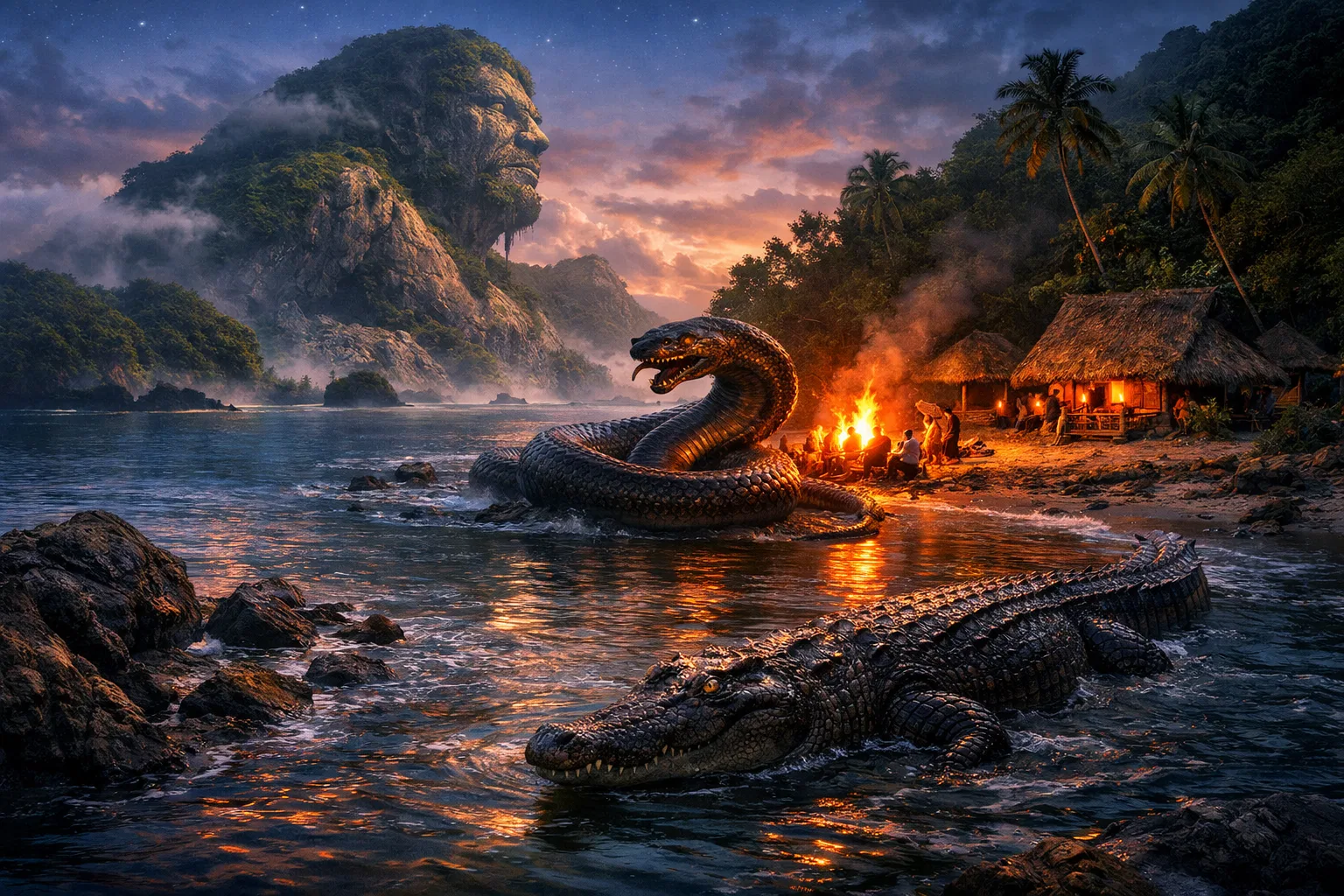
Palau’s most prominent monster-like figure is Uab, an enormous being whose appetite threatens the people around him. Museum records preserve several versions, including spellings such as Huap and Guap and variants in which the giant is male or female. The shared outline is that a rapidly growing child consumes excessive amounts of food, becomes dangerously huge, and is eventually burned by the community. The fallen body breaks apart or transforms into the islands of Palau.[Scribd]scribd.comPalauan Legends Inventory at Belau Museum | PDFPalauan Legends Inventory at Belau Museum | PDF…
A modern Palauan retelling describes Uab as a greedy boy whom villagers must continually feed. When his demands become unbearable, they build a fire around him. As he falls, his body forms Babeldaob and other islands, including the Rock Islands. The writer interprets the story explicitly as a lesson about uncontrolled appetite: what was once whole is broken because one being wants everything.[Island Times News]islandtimes.orgIsland Times News UAB and MILAD Story of PalauIsland Times NewsUAB and MILAD Story of Palau - Island Times News…
Uab is therefore not a giant remembered through disputed footprints or preserved bones. He is a landscape-making figure. His body explains the archipelago while his behaviour explains a human danger: greed can consume both the individual and the community supporting them.
There is also no single fixed “canonical” version. In one museum text, worms emerging from the giant’s decaying body become the people of Palau; another explains differences in forest cover through the inability of a mat to cover the giant completely. Such variation is normal in oral tradition. It suggests a living body of stories adapted by different narrators, not competing eyewitness descriptions of an actual colossal animal.[Scribd]scribd.comPalauan Legends Inventory at Belau Museum | PDFPalauan Legends Inventory at Belau Museum | PDF…
Uab nevertheless fits naturally into a country-level history of legendary creatures because he connects three themes often found in monster traditions: extraordinary size, an appetite that violates social limits, and a body transformed into geography. The story’s enduring value lies less in asking whether a giant existed than in seeing how Palauans used a giant to make land, morality and communal survival part of the same narrative.
The serpent of Chelechui
Palau’s clearest monster story concerns a giant serpent associated with Chelechui. In the version recorded by the Penn Museum, the creature is attracted by cooking fires. Whenever villagers prepare food, it comes to the settlement and eats them. The community eventually abandons the place, leaving an old woman behind. She later gives birth to a son, who grows up and asks why they must eat their food raw.[Penn Museum]penn.museumMuseum Expedition Magazine | The Palauan StoryboardsExpedition Magazine | The Palauan Storyboards…
After learning about the serpent, the young man lights a fire and heats stones. When the monster arrives to devour him, he throws the stones into its mouth, killing it. The villagers can then return. The account also links the narrative to a physical location by stating that the pile of stones could still be seen at Chelechui.[Penn Museum]penn.museumMuseum Expedition Magazine | The Palauan StoryboardsExpedition Magazine | The Palauan Storyboards…
This last detail gives the tale the feel of a local legend rather than a free-floating fairy story. A feature in the landscape acts as evidence within the tradition: not scientific proof of a giant snake, but a visible reminder anchoring the narrative to a particular community.
The serpent’s behaviour also follows a recognisable monster-story pattern. It controls ordinary human activity by making fire dangerous; it empties a settlement; and it seems unbeatable until one thoughtful survivor understands its habits. The hero wins through observation and planning rather than brute strength. Heated stones are especially fitting because the same fire that attracts the monster becomes the means of destroying it.
Palauan storyboards have helped preserve this creature’s afterlife. Traditional pictures carved on meeting houses functioned as memory aids for recalling legends, and modern wooden storyboards adapted those visual conventions. The Chelechui story can be recognised by the image of the boy throwing hot stones into the serpent’s mouth.[Penn Museum]penn.museumMuseum Expedition Magazine | The Palauan StoryboardsExpedition Magazine | The Palauan Storyboards…
That survival through carving complicates any simple division between “old folklore” and “tourist souvenir”. Storyboards may be sold to visitors, but they also transmit local narratives in a recognisably Palauan art form. The monster becomes portable without losing its connection to village history.
Why the sea produces so many strange beings
Palau’s legends emerge from an overwhelmingly marine environment. Reefs, currents, fishing grounds, storms and island channels shape daily life, so sea creatures appear naturally as agents of creation and explanation.
One recorded creation narrative begins with a giant clam on newly raised land. When waves force it open, sea creatures and human forms pour out, filling Palau’s previously empty waters. Another story explains the distribution of spawning mullet and dangerous southern currents through an exchange of “pets” between demigods—one possessing the fish and the other the force of the sea.[PBS]pbs.orgPalau Paradise of the Pacific- Legends of PalauPalau Paradise of the Pacific- Legends of Palau…
These are not claims that an anomalous clam or living current remains hidden today. They express a worldview in which animals, weather, geography and divine activity belong to one connected system. The environment is not passive scenery. It behaves, gives birth, trades places and remembers past actions.
Palau’s actual natural history makes such tales especially vivid. Giant clams are real reef animals; strong currents can rapidly become hazardous; sharks, rays and large fish are familiar rather than imaginary presences. A first-time visitor may see a mythical bestiary, but local stories are frequently built from creatures and forces that are entirely ordinary within island life—then enlarged, personified or given explanatory power.
The real “monster” in Palauan waters
For a sceptical explanation of frightening animal encounters in Palau, the saltwater crocodile is more important than any hypothetical sea serpent. The species is genuinely present in the country and has been recorded around Babeldaob, Koror, Peleliu and the Rock Islands.[CrocAttack]crocattack.orgCroc Attack Saltwater Crocodile, Crocodylus porosusSaltwater Crocodile, Crocodylus porosusMarch 1, 2024 — Distribution (see below for detailed information) Australia, Bangladesh…
A particularly vivid report published in Micronesica describes a night fisherman being seized and pulled underwater by a crocodile. The victim initially saw little more than the animal’s jaws and one eye during the struggle. Investigators estimated its length from bite marks at at least ten feet. The report suggested that fish tied close to the man’s body may have attracted the crocodile.[micronesica.org]micronesica.orgOpen source on micronesica.org.
This case demonstrates why eyewitness descriptions from dark water can become distorted. A person attacked at night, dragged beneath the surface and able to see only part of an animal is in no position to produce a calm anatomical account. A known crocodile can therefore generate an experience that feels thoroughly monstrous without being mysterious zoologically.
Later crocodile assessments recorded a fatal Palauan attack in 1965 and a non-fatal attack in 2012. The rarity of such incidents should not be confused with impossibility: crocodiles are elusive, can remain almost invisible in mangrove water and possess the size and power expected of a traditional water monster.[iucncsg.org]iucncsg.orgSaltwater Crocodile Crocodylus porosusFebruary 18, 2024 — by GJW Webb · Cited by 97 — Two crocodile attacks have been reported in Palau…
Other large marine animals could also generate momentary uncertainty. Sharks seen in poor visibility, rays breaking the surface, tangled groups of fish, floating vegetation and the undulating bodies of long fish may all produce strange silhouettes. Across world sea-serpent traditions, known animals such as oarfish and whales have often been proposed as sources of elongated or many-humped appearances. That general explanation is plausible in Palauan waters, but there is not a strong local archive of sea-serpent sightings requiring a case-by-case solution.[Natural History Museum]nhm.ac.ukNatural History MuseumSea monsters and their inspiration: Serpents, mermaids…Explore the real-life inspiration behind fantastic sea mo…
Jellyfish Lake: stranger than an invented monster
Palau’s most internationally famous unusual-animal site is Jellyfish Lake. It is not a cryptid habitat, although photographs of swimmers surrounded by countless golden jellyfish can look more fantastical than many monster illustrations.
The lake is one of numerous marine lakes within the Rock Islands, separated from the open lagoon but connected through fissures in limestone. Its isolation created distinctive ecological conditions and unusual jellyfish populations. Scientists have studied their movement, population changes and relationship with climate, while tourism authorities regulate access to the fragile site.[Wikipedia]WikipediaJellyfish LakeJellyfish Lake
Jellyfish Lake offers a useful lesson for cryptid enthusiasts: genuine biology can be extraordinary without being unexplained. An isolated saltwater basin filled with migrating jellyfish sounds like folklore, yet it is observable, measurable and repeatedly studied. Its animals require conservation rather than speculation.
It also illustrates how Palau’s international image has developed. Modern tourism tends to promote real marine wonders—the Rock Islands, reefs, sharks, giant clams and jellyfish—rather than a national monster hunt. Palau has not needed to manufacture a Nessie-style attraction because its documented ecosystems already provide striking encounters.
What the evidence supports
The evidence supports a rich Palauan tradition of legendary creatures, but not the existence of an unidentified giant animal.
Uab is best classified as an origin giant and moral figure. Multiple versions explain the formation of the islands and the consequences of limitless hunger.
The Chelechui serpent is a local monster legend connected to a named settlement, a remembered pile of stones and a storyboard tradition. It has the strongest resemblance to a conventional monster tale, but it is preserved as narrative rather than zoological testimony.
Marine creation beings turn clams, fish and currents into agents within a larger account of how Palau came to be. Their role is explanatory and cultural.
Saltwater crocodiles are real large predators capable of producing terrifying and fragmentary encounters. They provide the most concrete natural explanation for reports of dangerous shapes or attacks in mangrove and coastal water.
Palau’s marine lakes and reefs demonstrate that apparently fantastic animals need not be cryptids. Strange appearance alone is not evidence of an unknown species.
The most misleading approach would be to force Palau into a standard cryptozoology template and search for a single national beast. Its creature history is more interesting when treated on its own terms: giants become islands, serpents encode community memory, sea animals help explain environmental patterns, and carved storyboards carry old narratives into museums, homes and the visitor economy.

How the legends changed
Palauan creature traditions have moved through several forms: spoken narration, architectural imagery, museum transcription, tourist storyboards, television retellings and online cultural projects. Each format changes the story slightly.
Oral versions naturally permit differences in gender, spelling, sequence and moral emphasis. Museum catalogues freeze particular tellings into text. Storyboards compress long narratives into instantly recognisable scenes. Modern writers may interpret Uab through present-day concerns such as political power, inequality or environmental pressure.[penn.museum]penn.museumMuseum Expedition Magazine | The Palauan StoryboardsExpedition Magazine | The Palauan Storyboards…
This does not mean the newer forms are false and the older ones authentic. Legends remain alive by being retold. What changes is the question they answer. A creation story once explaining the shape of the islands may later become a warning about consumption. A village serpent may become a celebrated carving. A mythic sea full of active beings may sit alongside scientific research into currents, crocodiles and isolated jellyfish populations.
Palau’s mystery-creature tradition is therefore less about pursuing an animal that has escaped scientific classification than about recognising how people classify danger, appetite, landscape and the living sea. Its monsters belong to places and moral relationships—and that is precisely why they have survived.
Amazon book picks
Further Reading
Books and field guides related to Does Palau Have Its Own Mystery Monsters?. Use these as the next step if you want deeper reading beyond the article.
The Mythology Book
Explains how origin myths and cultural narratives function across societies.
The Hero with a Thousand Faces
Useful for understanding recurring mythic themes behind origin legends.
eBay marketplace picks
Marketplace Samples
Live-tested eBay searches with available results related to this page.


Endnotes
1.
Source: scribd.com
Title: Palauan Legends Inventory at Belau Museum | PDF
Link:https://www.scribd.com/document/525606860/AN1013531X-v30-p113-125
Source snippet
Palauan Legends Inventory at Belau Museum | PDF...
2.
Source: penn.museum
Title: Museum Expedition Magazine | The Palauan Storyboards
Link:https://www.penn.museum/sites/expedition/the-palauan-storyboards/
Source snippet
Expedition Magazine | The Palauan Storyboards...
3.
Source: pbs.org
Title: Palau Paradise of the Pacific- Legends of Palau
Link:https://www.pbs.org/edens/palau/p_legends2.htm
Source snippet
Palau Paradise of the Pacific- Legends of Palau...
4.
Source: crocattack.org
Title: Croc Attack Saltwater Crocodile, Crocodylus porosus
Link:https://crocattack.org/saltwater-crocodile-crocodylus-porosus/
Source snippet
Saltwater Crocodile, Crocodylus porosusMarch 1, 2024 — Distribution (see below for detailed information) Australia, Bangladesh...
Published: March 1, 2024
5.
Source: micronesica.org
Link:https://micronesica.org/sites/default/files/wilson_peter_t.-_report_of_a_crocodile_attack_in_the_western_caroline_islands-1964_june_micronesica_vol._1o.pdf
6.
Source: iucncsg.org
Link:https://www.iucncsg.org/365_docs/attachments/protarea/ad36d8689b30614e8c5db1a9e118d990.pdf
Source snippet
Saltwater Crocodile Crocodylus porosusFebruary 18, 2024 — by GJW Webb · Cited by 97 — Two crocodile attacks have been reported in Palau...
Published: February 18, 2024
7.
Source: Wikipedia
Title: Jellyfish Lake
Link:https://en.wikipedia.org/wiki/Jellyfish_Lake
8.
Source: Wikipedia
Title: List of cryptids
Link:https://en.wikipedia.org/wiki/List_of_cryptids
9.
Source: Wikipedia
Title: List of lake monsters
Link:https://en.wikipedia.org/wiki/List_of_lake_monsters
10.
Source: creation.com
Title: parkie a new pseudo plesiosaur washed up on the nova scotia coast
Link:https://creation.com/en/articles/parkie-a-new-pseudo-plesiosaur-washed-up-on-the-nova-scotia-coast
11.
Source: archive.org
Link:https://archive.org/stream/greatseaserpenth00oude/greatseaserpenth00oude_djvu.txt
12.
Source: islandtimes.org
Title: Island Times News UAB and MILAD Story of Palau
Link:https://islandtimes.org/uab-and-milad-story-of-palau/
Source snippet
Island Times NewsUAB and MILAD Story of Palau - Island Times News...
13.
Source: nhm.ac.uk
Link:https://www.nhm.ac.uk/discover/sea-monsters-inspiration-serpents-mermaids-the-kraken.html
Source snippet
Natural History MuseumSea monsters and their inspiration: Serpents, mermaids...Explore the real-life inspiration behind fantastic sea mo...
14.
Source: trove.nla.gov.au
Link:https://trove.nla.gov.au/newspaper/article/47786355
15.
Source: smartraveller.gov.au
Link:https://www.smartraveller.gov.au/destinations/pacific/palau
16.
Source: tripadvisor.com
Title: Belau National Museum
Link:https://www.tripadvisor.com/Attraction_Review-g294136-d312355-Reviews-Belau_National_Museum-Koror_Koror_Island.html
Additional References
17.
Source: researchgate.net
Link:https://www.researchgate.net/publication/271273272_Notes_on_the_Saltwater_Crocodile_Crocodylus_porosus_in_the_Republic_of_Palau
Source snippet
Notes on the Saltwater Crocodile, Crocodylus porosus, in...2012), but their original distribution would have covered most o...
18.
Source: youtube.com
Title: Traditional Bai in Palau
Link:http://www.youtube.com/watch?v=ac7pcd6oqk8
Source snippet
Palau legends folklore mythology Palauan Mythical Stories #palau #islanders #micronesia #pacificislander #storytellingchannel Islander Th...
19.
Source: youtube.com
Title: Palau’s Ancient Earthworks
Link:http://www.youtube.com/watch?v=sNSdfDsU1ZY
Source snippet
Connecting Culture and Marine Biodiversity in Palau | Nautilus Live...
20.
Source: youtube.com
Title: EPHEMERA VR
Link:http://www.youtube.com/watch?v=wEclhJuEkCM
Source snippet
Palau’s Ancient Earthworks - Monumentality...
21.
Source: researchgate.net
Link:https://www.researchgate.net/publication/337701717_Belief_Narratives_of_Spirit-Animals_A_Case_Study_on_Estonian_Contemporary_Folklore
22.
Source: facebook.com
Link:https://www.facebook.com/natgeosociety/posts/a-saltwater-crocodile-native-to-palau-heads-to-the-surface-in-search-of-prey-liv/1141735111325216/
23.
Source: instagram.com
Link:https://www.instagram.com/reel/DX-xBSWKm8n/
24.
Source: pbslearningmedia.org
Link:https://www.pbslearningmedia.org/resource/prcc12.sci.life.eco.modernuab/an-ancient-legend-teaches-climate-change-adaptation/
25.
Source: palaunationalmuseum.pw
Link:https://palaunationalmuseum.pw/
26.
Source: traveladventures.org
Link:https://www.traveladventures.org/continents/oceania/belau-national-museum.html
Topic Tree
Follow this branch
Related pages 192
- Antigua Cryptids
- Maldives Monsters
- Malta Monsters
- Qatar Monsters
- Argentina Monsters
- +187 more in sidebar