Cryptids of Malawi's Water and Hills
Malawi’s mystery-creature tradition is not built around one neat “Loch Ness” animal.
Page outline Jump by section
The monster that matters most: Napolo
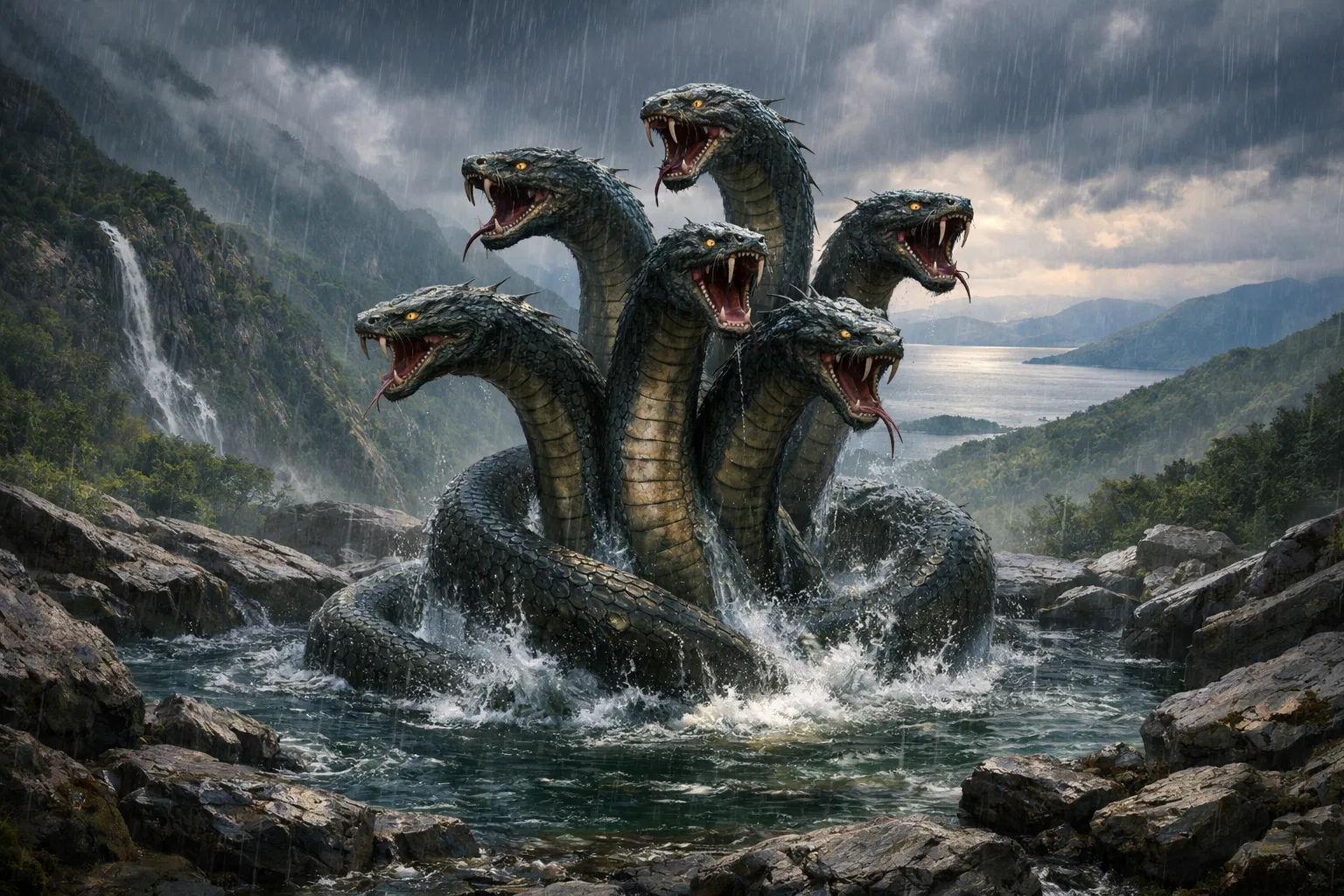
Napolo is the creature most strongly associated with Malawi’s monster folklore. In recent reporting from southern Malawi, it is described as a giant, many-headed snake living in a deep sacred pool under the mountains; when it moves, floods and landslides follow. That is not just a decorative story. After Cyclone Freddy’s devastating mudslides in 2023, some survivors in places such as Blantyre’s Chilobwe area interpreted the destruction through Napolo, while aid workers and climate communicators found that the legend could sit alongside, rather than simply block, scientific discussion of flood risk and environmental change.[africanarguments.org]africanarguments.orgAfrican Arguments A mythical giant snake is helping raise climate awarenessAfrican Arguments A mythical giant snake is helping raise climate awareness
The older literary and scholarly record gives the myth a deeper frame. A study of Steve Chimombo’s Napolo Poems explains that Napolo is widely known in Malawi as an underground mountain snake that causes landslides when it moves from mountains towards lower land. The same source stresses that “nobody really knows what this snake is”; it functions as a myth through which people understand landslides that begin in hills and mountains after heavy rain, sweeping trees, stones, soil and homes down into the valleys.[Transformation Journal]transformationjournal.org.zaTransformation Journal
That makes Napolo unusually interesting for cryptid readers. It is not a simple “unknown animal seen by witnesses” claim. It is a disaster-being: part serpent, part spirit, part explanation for sudden mass movement in a landscape where heavy rain can turn slopes into torrents. The monster’s “tracks” are not footprints in the usual cryptozoological sense, but bare scars, gullies and landslide paths on mountain slopes. Médecins Sans Frontières described the Cyclone Freddy version of the belief in precisely those terms: Napolo’s migration leaves visible marks on hillsides in the form of exposed red earth.[MSF Ireland]msf.ieOpen source on msf.ie.
Why southern Malawi keeps producing serpent stories
Napolo belongs to a landscape where the explanation “a mountain snake moved” has emotional force. Malawi’s south has steep highlands, heavy seasonal rain, densely settled slopes and valleys, and a long memory of destructive mudslides. The 2023 Tropical Cyclone Freddy Post-Disaster Needs Assessment records that on 13 March 2023 flash floods caused multiple debris flows and other landslides in Blantyre, Chiradzulu, Mulanje and Phalombe districts. That geography maps closely onto the modern Napolo reporting: mountains, intense rain, sudden flows and communities trying to make sense of ruin.[PreventionWeb]preventionweb.netmalawi 2023 tropical cyclone freddy post disaster needsmalawi 2023 tropical cyclone freddy post disaster needs
Napolo’s explanatory power also comes from how fast such disasters feel. A slope that looked solid can fail after saturation; a quiet channel can become a roaring debris flow; the result can look less like ordinary flooding than something physically tearing the land open. The Napolo Poems analysis describes the myth as combining “landslide-floods, mountains and hills, and heavy rain”, which is a useful plain-language summary of the natural mechanism behind many Napolo interpretations.[Transformation Journal]transformationjournal.org.zaTransformation Journal
The legend has changed with public life. In Chimombo’s poetry, Napolo became a political metaphor for national suffering under the Banda era, using the old landslide snake as a figure of destructive power and fear. In 2023, the same myth reappeared in climate and disaster conversations after Cyclone Freddy. In both cases, Napolo was not merely a monster in the hills; it was a way to talk about overwhelming forces that ordinary people could not easily confront.[Transformation Journal]transformationjournal.org.zaTransformation Journal
Lake Malawi’s stranger water creatures
Lake Malawi is the obvious place to look for a lake monster story. It is huge, deep, old, biologically rich and culturally central. UNESCO describes Lake Malawi National Park as globally important for freshwater fish diversity, with estimates of up to about 1,000 fish species in the wider lake system and extremely high endemism among cichlids. A lake that contains so much life, much of it unfamiliar to outsiders, naturally invites stories about what else might live below the surface.[UNESCO World Heritage Centre]whc.unesco.orgOpen source on unesco.org.
The most distinctive folklore creature here is Namungumi, also given as Nalumgumi in secondary creature catalogues drawing on ethnographic sources. It is usually glossed as a “whale” and is linked with Yao traditions across Malawi, Mozambique and Tanzania. In the story as summarised by A Book of Creatures, Namungumi lives in Lake Malawi, surfaces near villages, and can provide meat from its vast body without being harmed, because the cut flesh heals again. That places it closer to ritual and abundance folklore than to a modern sighting-based lake monster.[A Book of Creatures]abookofcreatures.comOpen source on abookofcreatures.com.
Liporo is a darker related figure in the same secondary summary. It is described as an Anyanja water creature, smaller than Namungumi, credited with killing hippos and tipping canoes, and said to be extinct. This is exactly the kind of tradition that can look “cryptid-like” from a distance: a dangerous lake animal, attached to canoe travel and large aquatic wildlife, but preserved mainly through folklore rather than a chain of dated eyewitness reports.[A Book of Creatures]abookofcreatures.comOpen source on abookofcreatures.com.
There are also loose “Lake Nyasa monster” references in cryptozoology databases, sometimes using the name Dzimwe and comparing the animal to a sea serpent. These references are thin and derivative compared with the better-attested Napolo and Namungumi material. They are useful mainly as evidence that Lake Malawi/Nyasa has been pulled into the wider global lake-monster habit of turning large inland waters into possible homes for long-necked or serpent-like animals.[cryptidarchives.fandom.com]cryptidarchives.fandom.comLake Nyasa monsterLake Nyasa monster
The Dowa “terror beast”: cryptid flap or hyena attack?
Malawi’s clearest modern monster flap is the so-called “Malawi Terror Beast” of 2003. Contemporary and archived reporting described an unidentified animal in Dowa District that killed three people and severely injured sixteen others, causing thousands of villagers to flee. The story spread because officials and villagers did not fully agree on what the animal was: wildlife officers identified it as a hyena, while some residents insisted it had unusual features and linked it to a similar animal reportedly shot the previous year.[allAfrica.com]allafrica.comOpen source on allafrica.com.
This is a classic cryptid-making pattern. A real attack happens; the injuries are frightening; official explanations arrive under pressure; witnesses compare the animal with known species but find details that do not fit; rumour fills the gap. In Dowa, the strongest mundane explanation remains a spotted hyena, possibly rabid or otherwise behaving abnormally. That explanation does not make the event harmless or uninteresting. It makes it a case where a known animal, in a moment of fear and poor visibility, can become a monster in public memory.[cryptidarchives.fandom.com]cryptidarchives.fandom.comMalawi terror beast | Encyclopaedia of CryptozoologyMalawi terror beast | Encyclopaedia of Cryptozoology
The hyena explanation also fits Malawi’s broader risk context. Spotted hyenas occur in Malawi, and local carnivore research and conservation groups treat them as a real part of the country’s modern wildlife landscape. Human-hyena conflict is not invented folklore: conservation groups working in Malawi now focus on coexistence with urban and peri-urban spotted hyenas, including efforts to reduce conflict between people and carnivores.[CarnivoreResMalawi]carnivoreresearchmalawi.orgOpen source on carnivoreresearchmalawi.org.
For cryptid readers, the Dowa case is valuable because it shows the difference between “unidentified at first” and “unknown species”. The public story became a terror beast because the animal’s identity was disputed and the attacks were severe. The evidence available in open sources, however, points much more strongly towards an extreme human-wildlife conflict event than towards a new carnivore.[allAfrica.com]allafrica.comOpen source on allafrica.com.

What might witnesses be seeing?
Malawi’s creature stories invite several different explanations, and the best one depends on the story type. Napolo is not well explained as a misidentified animal, because the “sighting” is often the disaster itself: a landslide, roaring water, fallen trees, broken slopes and the fear that something powerful has moved through the mountain. The natural explanation is heavy rain, saturated ground, unstable slopes and debris flows; the cultural explanation is Napolo; the two operate on different levels.[Transformation Journal]transformationjournal.org.zaTransformation Journal
Lake Malawi stories sit somewhere else. A huge lake with crocodiles, hippos, large fish, floating debris, storms, night fishing lights and sudden changes in water conditions can generate honest misperceptions. UNESCO’s account of the lake’s exceptional biodiversity makes clear that it is a genuinely extraordinary ecosystem, but that does not amount to evidence for a hidden giant animal. Folkloric beings such as Namungumi and Liporo are better read as water-and-community traditions unless tied to specific, testable modern reports.[UNESCO World Heritage Centre]whc.unesco.orgOpen source on unesco.org.
The Dowa terror beast belongs to a third category: frightening contact with a real predator. Known carnivores can behave in ways that seem “wrong” when injured, diseased, starving, habituated to people or encountered at night. The official hyena identification in the Dowa case should not be treated as perfect simply because it is official, but it is more plausible than an unknown species unless stronger physical evidence appears.[cryptidarchives.fandom.com]cryptidarchives.fandom.comMalawi terror beast | Encyclopaedia of CryptozoologyMalawi terror beast | Encyclopaedia of Cryptozoology
How Malawi’s monster folklore has changed
The older pattern is ecological and ritual: serpents in mountains, beings in deep pools, lake creatures connected to initiation, kinship, water danger and abundance. In those stories, the monster is not merely an animal to be caught. It is part of how people describe landscape, hazard, fertility, food, death and taboo. Namungumi’s healing body, Liporo’s canoe danger and Napolo’s flood-path all belong to that older world of meaningful creatures.[A Book of Creatures]abookofcreatures.comOpen source on abookofcreatures.com.
The modern pattern is media-driven. The Dowa terror beast became a cryptid partly because news reports framed it as a mystery and later online databases preserved it under a monster-like name. Napolo, meanwhile, re-entered international attention through Cyclone Freddy coverage, where journalists and aid organisations used the legend to explain how survivors were interpreting mudslides and loss.[allafrica.com]allafrica.comOpen source on allafrica.com.
There is also a literary afterlife. Steve Chimombo’s Napolo Poems, first published in Malawi in 1987, used the landslide snake as a national metaphor during a period of repression. That matters because it shows a creature moving from oral explanation of disaster into written political art, and then into climate-era journalism. Few cryptids have such a clear path from mountain myth to national literature to disaster communication.[Transformation Journal]transformationjournal.org.zaTransformation Journal

A reader’s field guide to Malawi’s main mystery creatures
Napolo is Malawi’s central monster tradition: a many-headed or underground mountain serpent linked with heavy rain, floods, landslides, sacred pools and southern highland terrain. It is best understood as folklore with strong environmental meaning, not as evidence for a biological serpent of impossible size.[African Arguments]africanarguments.orgAfrican Arguments A mythical giant snake is helping raise climate awarenessAfrican Arguments A mythical giant snake is helping raise climate awareness
Namungumi or Nalumgumi is a Lake Malawi water being, often translated as a whale and associated with Yao tradition. Its story of a vast body that provides self-healing meat points towards ritual symbolism and water abundance rather than a modern unknown-animal case.[A Book of Creatures]abookofcreatures.comOpen source on abookofcreatures.com.
Liporo is a related Anyanja water creature said to tip canoes and kill hippos. It is more threatening than Namungumi, but the available open-source trail is sparse and depends heavily on secondary summaries of ethnographic material.[A Book of Creatures]abookofcreatures.comOpen source on abookofcreatures.com.
The Dowa terror beast is the modern cryptid-style case: a 2003 animal-attack panic in central Malawi, with deaths, injuries, flight from villages and disagreement over whether the attacker was simply a hyena. The balance of evidence favours a hyena-related explanation, while the legend shows how quickly a real predator can become a mystery beast.[allAfrica.com]allafrica.comOpen source on allafrica.com.
Separating the record from the legend of Malawi’s cryptid traditions
Malawi has strong creature folklore, but weak evidence for an undiscovered large animal. Napolo is culturally powerful because it gives shape to terrifying landslides and floods. Namungumi and Liporo preserve lake-based traditions that reflect water, danger, food and community. The Dowa terror beast shows how a known predator can become a cryptid when attacks are severe and witness descriptions clash with official explanations.[transformationjournal.org.za]transformationjournal.org.zaTransformation JournalTransformation Journal
That does not make the stories disposable. In Malawi, monsters often mark places where human life meets real hazard: unstable slopes, sacred pools, deep water, night travel, canoe risk and carnivore conflict. Read that way, the country’s cryptid tradition is less a search for one hidden beast than a map of where the land and lake have felt alive, dangerous and difficult to explain.
Amazon book picks
Further Reading
Books and field guides related to What Monsters Haunt Malawi's Water and Hills?. Use these as the next step if you want deeper reading beyond the article.
African Myths of Origin
Helps place Malawian monster traditions within broader African storytelling.
Mythical Monsters
Covers recurring monster motifs such as giant serpents and water beings.
The Rough Guide to Unexplained Phenomena
Provides background on cryptids, folklore, and mystery-animal claims.
Encyclopedia of Things that Never Were
Provides global context for monster and folklore traditions like those found in Malawi.
eBay marketplace picks
Marketplace Samples
Live-tested eBay searches with available results related to this page.



Endnotes
1.
Source: transformationjournal.org.za
Title: Transformation Journal
Link:https://transformationjournal.org.za/wp-content/uploads/2017/03/tran043007.pdf
2.
Source: allafrica.com
Link:https://allafrica.com/stories/200303250382.html
3.
Source: msf.ie
Link:https://www.msf.ie/article/malawi-msf-support-providing-access-healthcare-cut-populations-after-cyclone-freddy
4.
Source: preventionweb.net
Title: malawi 2023 tropical cyclone freddy post disaster needs
Link:https://www.preventionweb.net/publication/documents-and-publications/malawi-2023-tropical-cyclone-freddy-post-disaster-needs
5.
Source: whc.unesco.org
Link:https://whc.unesco.org/en/list/289/
6.
Source: whc.unesco.org
Link:https://whc.unesco.org/en/canopy/malawi/
7.
Source: cryptidarchives.fandom.com
Title: Lake Nyasa monster
Link:https://cryptidarchives.fandom.com/wiki/Lake_Nyasa_monster
8.
Source: cryptidarchives.fandom.com
Title: Malawi terror beast | Encyclopaedia of Cryptozoology
Link:https://cryptidarchives.fandom.com/wiki/Malawi_terror_beast
9.
Source: articles.unesco.org
Title: PDNA Malawi Culture and Heritage Final
Link:https://articles.unesco.org/sites/default/files/medias/fichiers/2023/10/PDNA%20-%20Malawi%20-%20Culture%20and%20Heritage%20-%20Final.pdf
10.
Source: unesco.org
Title: assesses damage caused cyclone freddy malawis culture and heritage
Link:https://www.unesco.org/en/articles/unesco-assesses-damage-caused-cyclone-freddy-malawis-culture-and-heritage
11.
Source: unesco.org
Link:https://www.unesco.org/en/articles/tropical-cyclone-freddy-2023-post-disaster-needs-assessment-malawis-culture-and-heritage-sectors
12.
Source: whc.unesco.org
Link:https://whc.unesco.org/document/180695
13.
Source: whc.unesco.org
Link:https://whc.unesco.org/en/news/2413
14.
Source: cryptidz.fandom.com
Title: Malawi Terror Beast
Link:https://cryptidz.fandom.com/wiki/Malawi_Terror_Beast
15.
Source: villains.fandom.com
Title: Malawi Terror Beast
Link:https://villains.fandom.com/wiki/Malawi_Terror_Beast
16.
Source: allafrica.com
Link:https://allafrica.com/stories/202308100004.html
17.
Source: malawi.si
Link:https://www.malawi.si/slides/Lake%20Malawi%20Habitats.html
18.
Source: preventionweb.net
Link:https://www.preventionweb.net/media/87994/download
19.
Source: africanarguments.org
Title: African Arguments A mythical giant snake is helping raise climate awareness
Link:https://africanarguments.org/2023/08/a-mythical-giant-snake-is-helping-raise-climate-awareness-in-malawi/
20.
Source: abookofcreatures.com
Link:https://abookofcreatures.com/2021/04/30/namungumi/
21.
Source: carnivoreresearchmalawi.org
Link:https://www.carnivoreresearchmalawi.org/about-carnivores
22.
Source: naturalworldheritagesites.org
Title: Lake Malawi National Park
Link:https://www.naturalworldheritagesites.org/sites/lake-malawi-national-park
23.
Source: facebook.com
Link:https://www.facebook.com/CryptozoologyFacts/photos/the-malawi-terror-beast-is-an-animal-that-has-not-been-officially-identified-tho/933349652134544/
24.
Source: Wikipedia
Title: Cyclone Freddy
Link:https://en.wikipedia.org/wiki/Cyclone_Freddy
25.
Source: Wikipedia
Title: Lake Malawi
Link:https://en.wikipedia.org/wiki/Lake_Malawi
26.
Source: Wikipedia
Title: Malawi Terror Beast
Link:https://en.wikipedia.org/wiki/Malawi_Terror_Beast
27.
Source: Wikipedia
Link:https://en.wikipedia.org/wiki/Hyena
28.
Source: Wikipedia
Title: Lake Malawi National Park
Link:https://en.wikipedia.org/wiki/Lake_Malawi_National_Park
29.
Source: abookofcreatures.com
Link:https://abookofcreatures.com/category/malawi/
30.
Source: abookofcreatures.com
Title: pachyderm slayers
Link:https://abookofcreatures.com/category/pachyderm-slayers/
31.
Source: abookofcreatures.com
Link:https://abookofcreatures.com/tag/whale-folklore/
32.
Source: abookofcreatures.com
Link:https://abookofcreatures.com/category/mozambique/
33.
Source: abookofcreatures.com
Title: lake monsters
Link:https://abookofcreatures.com/tag/lake-monsters/
34.
Source: abookofcreatures.com
Link:https://abookofcreatures.com/tag/african-folklore/
35.
Source: abookofcreatures.com
Link:https://abookofcreatures.com/category/whales/
36.
Source: world-heritage-datasheets.unep-wcmc.org
Title: lake malawi national park
Link:https://world-heritage-datasheets.unep-wcmc.org/datasheet/output/site/lake-malawi-national-park
37.
Source: africanarguments.org
Title: cyclone freddy dumped six months rain in six days
Link:https://africanarguments.org/2023/03/cyclone-freddy-dumped-six-months-rain-in-six-days/
38.
Source: ebsco.com
Link:https://www.ebsco.com/research-starters/science/lake-malawi
39.
Source: scotland-malawipartnership.org
Title: Tropical Cyclone Freddy
Link:https://www.scotland-malawipartnership.org/assets/documents/Tropical-Cyclone-Freddy-Response-Plan_5-04-23_FINAL.pdf
Additional References
40.
Source: science.org
Link:https://www.science.org/content/article/scienceshot-first-sea-monster
41.
Source: academia.edu
Link:https://www.academia.edu/68265820/Pwiti_Gilbert
42.
Source: researchgate.net
Link:https://www.researchgate.net/publication/392430573_Large_carnivores_and_human-wildlife_conflict_warrant_attention_in_the_Horn_of_Africa
43.
Source: africalive.net
Link:https://africalive.net/article/a-mythical-giant-snake-is-helping-raise-climate-awareness-in-malawi/
44.
Source: multispecialityjournal.com
Link:https://www.multispecialityjournal.com/uploads/archives/20240119210448_A-24-05.1.pdf
45.
Source: x.com
Link:https://x.com/mcbrams/status/1637262219170795522
46.
Source: facebook.com
Link:https://www.facebook.com/100084193171166/posts/african-mythology-features-diverse-mythical-creaturescreatures-and-their-charact/752951587521274/
47.
Source: brill.com
Link:https://brill.com/downloadpdf/display/title/68234.pdf?srsltid=AfmBOora6fsLhS9C1zEKWb8MViAEcmMh1wjC3vMsBb_Fbl2Tcyt3Qre5
48.
Source: facebook.com
Link:https://www.facebook.com/HumanRightsCommissionofMalawi/posts/assessment-of-the-impact-of-cyclone-freddy-and-its-aftermath-is-underway-in-all-/778758133948110/
49.
Source: ewt.org
Link:https://ewt.org/wp-content/uploads/2022/11/11.-Spotted-Hyaena-Crocuta-crocuta_NT.pdf
Topic Tree
Follow this branch
Related pages 192
- Antigua Cryptids
- Maldives Monsters
- Malta Monsters
- Qatar Monsters
- Argentina Monsters
- +187 more in sidebar