Within Argentina Monsters
What Other Mystery Creatures Haunt Argentina?
Beyond famous monsters, Argentina hosts phantom cats, Chupacabra scares and older folklore about dangerous creatures.
On this page
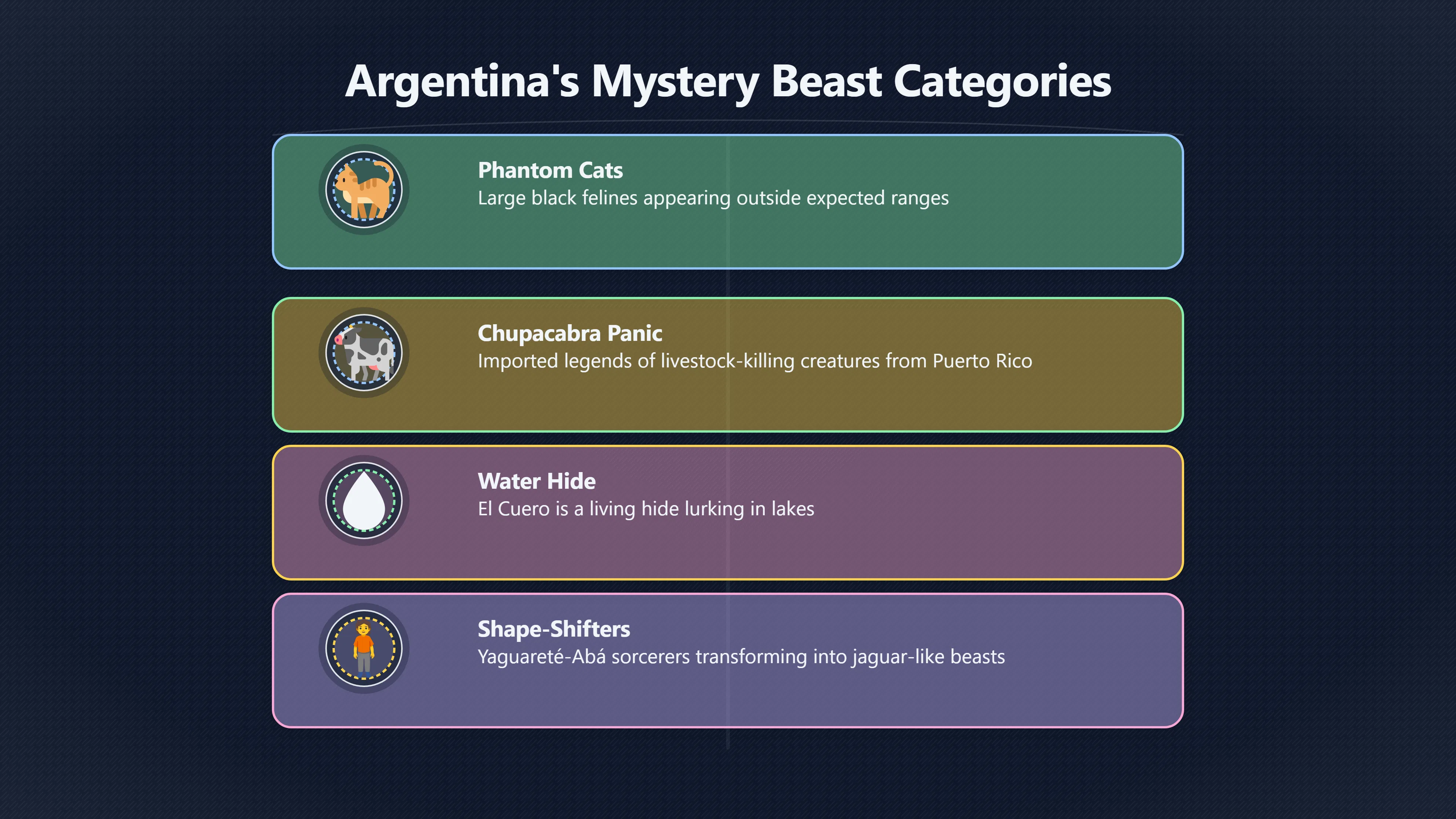
- Phantom Cats and Mystery Predators
- Chupacabra Panics and Media Waves
- Older Water and Shape Shifting Folklore
Page outline Jump by section
Introduction
Argentina’s monster traditions extend well beyond the famous lake creature Nahuelito. Across the country, stories of phantom cats, livestock-killing predators, shape-shifting beings and dangerous water monsters have appeared wherever folklore, wildlife and media attention overlap. Some tales grew from Indigenous traditions that long predate modern newspapers. Others arrived through international monster crazes, especially the Chupacabra panic that swept much of Latin America in the late 1990s and early 2000s. Still others emerged from ordinary encounters with real animals seen under unusual conditions.
What makes Argentina’s wider mystery-beast tradition interesting is not the strength of the physical evidence—most cases remain poorly supported or have mundane explanations—but the way local landscapes and cultural traditions continually generate new creature stories. In Patagonia, the Andes, the Chaco and the north-eastern forests, legends often sit at the boundary between folklore, wildlife observation and modern media mythology.[Wikipedia]WikipediaOpen source on wikipedia.org.
Phantom Cats and Mystery Predators
Large mystery cats appear regularly in Argentine folklore and local reporting, particularly in rural regions where livestock losses create anxiety and where sightings are difficult to verify. Witnesses typically describe unusually large black cats, jaguar-like animals in unexpected places, or predators that seem too large to match familiar wildlife.
Part of the reason these reports persist is that Argentina genuinely possesses impressive native predators. The puma ranges across much of the country, while jaguars historically occupied a far larger area than they do today. A brief glimpse of a puma at dusk, a distant animal seen crossing open ground, or an escaped exotic pet can quickly become a mystery-beast story.
The pattern resembles the “phantom cat” phenomenon reported in many countries. Such reports usually involve large felines appearing outside their expected range. When investigated, explanations often include misidentified native animals, unusually large feral cats, escaped captive animals, or simple errors of scale and distance.[Wikipedia]WikipediaPhantom catJanuary 4, 2026 — Phantom cats, also known as alien big cats (ABCs), are large felids which allegedly appear in regions outside their ind…
Argentina’s folklore also contains older traditions linking humans and big cats. In the north-east, particularly in areas influenced by Guaraní culture, stories tell of the Yaguareté-Abá, sometimes translated as the “jaguar-man”. Rather than an unknown animal, this figure is a shape-shifting sorcerer who transforms into a jaguar-like beast. The legend reflects the historical importance of the jaguar in regional belief systems and demonstrates how animal stories can blur into supernatural folklore.[Wikipedia]WikipediaOpen source on wikipedia.org.
These traditions help explain why modern reports of mystery predators often gain traction. A landscape already rich in stories about powerful feline creatures provides a ready-made framework for interpreting unusual sightings.
Chupacabra Panics and Media Waves
No imported monster had a greater impact on Argentine mystery-animal culture than the Chupacabra. The legend began in Puerto Rico during the mid-1990s and rapidly spread across Latin America through television, newspapers and word of mouth. Reports soon appeared in Argentina alongside claims from Chile, Brazil, Mexico and elsewhere.[Wikipedia]WikipediaOpen source on wikipedia.org.
The Argentine version followed a familiar pattern. Farmers discovered dead livestock, often with unusual injuries or signs of scavenging. Newspapers highlighted mysterious wounds, rumours spread, and the Chupacabra became the preferred explanation before veterinary investigations were completed.
A particularly notable wave occurred in 2002, when cattle mutilation reports appeared across a broad zone stretching between Río Negro and Santa Fe provinces. Media coverage linked the incidents to the Chupacabra phenomenon and, in some cases, to occult activity. Subsequent investigations by Argentina’s National Service of Agrifood Health and Quality (SENASA) concluded that ordinary scavengers and predators offered more plausible explanations for the injuries observed on carcasses. Reports cited foxes and rodents among the likely causes of post-mortem damage.[Wikipedia]WikipediaOpen source on wikipedia.org.
The Chupacabra panic illustrates a recurring feature of mystery-beast culture. Once a dramatic explanation becomes popular, ordinary livestock deaths may be reinterpreted through that lens. Natural decomposition, scavenging, disease and predation can create injuries that appear strange to non-specialists. In dry environments especially, carcasses can take on surprisingly unusual appearances, feeding rumours of unknown attackers.[Wikipedia]WikipediaOpen source on wikipedia.org.
Yet the Chupacabra remained culturally powerful because it provided a simple narrative. Instead of a complex mix of ecological and veterinary factors, there was a single memorable monster. That narrative proved highly portable, allowing a Puerto Rican legend to become part of Argentina’s own mystery-beast landscape.

Older Water and Shape-Shifting Folklore
Long before modern cryptid stories arrived, Indigenous and regional traditions across Argentina featured dangerous animal-like beings associated with rivers, lakes and wilderness areas.
One of the most striking examples is El Cuero, the “water hide”, a creature found in Mapuche tradition and in folklore extending into parts of south-western Argentina. Descriptions vary, but El Cuero is usually imagined as a living hide or flattened aquatic predator lurking beneath the surface of lakes and rivers. Victims are said to be dragged into the water, wrapped up and consumed. In some versions the creature resembles a giant ray; in others it behaves more like an enormous aquatic octopus.[Wikipedia]WikipediaCuero (legendary creatureCuero (legendary creature
The importance of El Cuero lies less in whether anyone believed it was a literal animal and more in what the story accomplished. Dangerous waterways are common in southern landscapes, and legends about hidden aquatic predators can function as cautionary tales. Researchers and folklorists have also noted that some explanations connect the legend to whirlpools, currents and other natural hazards that can appear mysterious to observers.[Wikipedia]WikipediaCuero (legendary creatureCuero (legendary creature
Shape-shifting traditions also appear in several Argentine regions. Stories of humans becoming animal-like beings—especially jaguar-associated creatures in the north-east—reflect older beliefs about the connection between people, spirits and powerful predators. Unlike modern cryptid reports, these legends were generally understood as supernatural rather than zoological.[Wikipedia]WikipediaOpen source on wikipedia.org.
The distinction matters because many contemporary monster stories borrow imagery from older folklore while presenting themselves as reports of unknown animals. Argentina’s mystery-beast culture therefore contains two overlapping strands: folklore about supernatural beings and modern claims about undiscovered creatures.
Why These Stories Keep Returning
Argentina’s wider mystery-beast traditions thrive because several factors repeatedly reinforce one another.
Dramatic environments: From Patagonian lakes to subtropical forests, many landscapes naturally encourage stories about hidden animals.
Real predators: Pumas, jaguars, foxes and other wildlife provide a genuine basis for unusual sightings and livestock losses.
Folklore inheritance: Indigenous and regional traditions already contain powerful images of dangerous water creatures, shape-shifters and animal spirits.
Media amplification: Newspapers, television and social media can transform isolated incidents into national monster scares within days.
Ambiguous evidence: Carcasses, distant sightings and fleeting encounters often leave room for multiple interpretations.
The result is a living tradition rather than a single legend. While Nahuelito remains Argentina’s most famous mystery creature, phantom cats, Chupacabra scares and older folklore beings reveal a broader pattern: strange-animal stories flourish where uncertainty meets imagination. Most eventually acquire ordinary explanations, but the legends survive because they help people make sense of landscapes that still feel vast, remote and unpredictable.[Wikipedia]WikipediaOpen source on wikipedia.org.

Amazon book picks
Further Reading
Books and field guides related to What Other Mystery Creatures Haunt Argentina?. Use these as the next step if you want deeper reading beyond the article.
Abominable Science!
Useful for understanding reports of phantom cats and monster panics.
eBay marketplace picks
Marketplace Samples
Live-tested eBay searches with available results related to this page.


Endnotes
1.
Source: Wikipedia
Link:https://en.wikipedia.org/wiki/Chupacabra
2.
Source: Wikipedia
Title: Cuero (legendary creature)
Link:https://en.wikipedia.org/wiki/Cuero_%28legendary_creature%29
3.
Source: Wikipedia
Title: Phantom cat
Link:https://en.wikipedia.org/wiki/Phantom_cat
Source snippet
January 4, 2026 — Phantom cats, also known as alien big cats (ABCs), are large felids which allegedly appear in regions outside their ind...
Published: January 4, 2026
4.
Source: Wikipedia
Link:https://es.wikipedia.org/wiki/Yaguaret%C3%A9-Ab%C3%A1
5.
Source: Wikipedia
Link:https://es.wikipedia.org/wiki/Chupacabras
6.
Source: Wikipedia
Title: Cuero (leyenda)
Link:https://es.wikipedia.org/wiki/Cuero_%28leyenda%29
7.
Source: youtube.com
Link:http://www.youtube.com/watch?v=v38nm6SJR6E
8.
Source: cryptidz.fandom.com
Title: El Cuero
Link:https://cryptidz.fandom.com/wiki/El_Cuero
Source snippet
Cuero - Cryptid Wiki - FandomEl Cuero is described as a living, sentient hide—usually resembling the flayed skin of a cow, though it can...
9.
Source: youtube.com
Link:https://www.youtube.com/watch?v=7vp4auDrodM
Source snippet
El Cuero | The Leather that Eats FleshEl Cuero is not supposed to be a real animal, more like a supernatural monster to scare children. O...
10.
Source: abookofcreatures.com
Link:https://abookofcreatures.com/2019/11/25/cuero/
Source snippet
25 Nov 2019 — A cuero is a creature that looks like a cowhide, sheepskin, or goatskin, stretched out flat and laid on the surface of the...
Additional References
11.
Source: facebook.com
Link:https://www.facebook.com/groups/southernpanthersightings/posts/1809625239918658/
Source snippet
Black panther sightings explained by misidentificationJaguars and Leopards can rarely have a black coloration but melanistic Mountain Lio...
12.
Source: princeton.edu
Link:https://www.princeton.edu/~accion/chupa21.html
Source snippet
Chupas Time-LineChupacabra blamed for the death of about 150 animals.... The chupas is blamed in the deaths of dozens of turkeys, rabbit...
13.
Source: facebook.com
Title: the chupacabra or chupacabras is a legendary creature in the folklore of parts o
Link:https://www.facebook.com/100078863865802/posts/the-chupacabra-or-chupacabras-is-a-legendary-creature-in-the-folklore-of-parts-o/182484224390372/
Source snippet
The chupacabra or chupacabras is a legendary creature in...The first reported sighting of a chupacabra was in March 1995 in Puerto Rico...
Published: March 1995
14.
Source: facebook.com
Link:https://www.facebook.com/ALPublicTV/posts/the-first-el-chupacabras-sighting-took-place-in-puerto-rico-in-1994-following-a-/10157579138046299/
Source snippet
The first El Chupacabras sighting took place in Puerto Rico...Chupacabras were first reported in 1995, in... Initial reports stated tha...
15.
Source: researchgate.net
Title: 317332796 Retrospective analysis of cattle poisoning in Argentina 2000 2013
Link:https://www.researchgate.net/publication/317332796_Retrospective_analysis_of_cattle_poisoning_in_Argentina
Source snippet
Retrospective analysis of cattle poisoning in Argentina...5 Mar 2026 — A retrospective analysis (2000 to 2013) of cattle poisoning cause...
16.
Source: youtube.com
Link:https://www.youtube.com/watch?v=H5CrJSd-eeU
17.
Source: abc.net.au
Title: hunter valley big cat sighting nsw dpi investigates
Link:https://www.abc.net.au/news/2020-01-20/hunter-valley-big-cat-sighting-nsw-dpi-investigates/11877970
Source snippet
Second sighting of 'puma-sized' cat prompts another DPI...19 Jan 2020 — A second investigation has begun into sightings of a puma-sized...
18.
Source: instagram.com
Link:https://www.instagram.com/p/DF7n5I5P91A/
Source snippet
mingly large sizes, and the so-called big cat tracks are more likely to be...
19.
Source: instagram.com
Link:https://www.instagram.com/reel/DVBjkQ3jEIt/
Source snippet
ats, leaving behind distinct puncture wounds and claims that the animals...
20.
Source: reddit.com
Link:https://www.reddit.com/r/Cryptozoology/comments/9x82vr/why_are_almost_all_phantom_catsalien_big_cats/
Source snippet
cryptids to exist, especially given the primary types of long-tailed...
Topic Tree