Within Slovenian Monsters
Was Slovenia's Baby Dragon a Real Animal?
The olm is a real cave salamander whose strange appearance helped create Slovenia's enduring stories of dragon young.
On this page
- How Olms Became Dragon Young
- What Valvasor Recorded in 1689
- Conservation, Cave Breeding and Modern Tourism
Page outline Jump by section
Introduction
Slovenia’s most famous “monster” is not a monster at all. It is the olm, a rare cave-dwelling salamander that lives in the underground waters of the Dinaric Karst. Yet for centuries local people believed these pale, blind creatures were baby dragons washed out of hidden caves after heavy rain. The story became one of the most enduring legends in Slovenian folklore because it connected a real, highly unusual animal with an underground landscape already associated with dragons, floods and mysterious forces beneath the earth.[newyorker.com]newyorker.comThe New YorkerWhat's Behind Slovenia's Love Affair with a…April 25, 2016 — 25 Apr 2016 — The villager who showed Valvasor the spring e…

Unlike many legendary creatures, the “baby dragon” can still be seen today. Modern biology explains exactly what the animal is, but the legend remains important because it shows how people interpreted strange discoveries before cave ecosystems were understood. In Slovenia, the line between folklore and natural history is unusually clear: the dragon’s offspring turned out to be a genuine species hiding in darkness all along.[Wikipedia]WikipediaOpen source on wikipedia.org.
How Olms Became Dragon Young
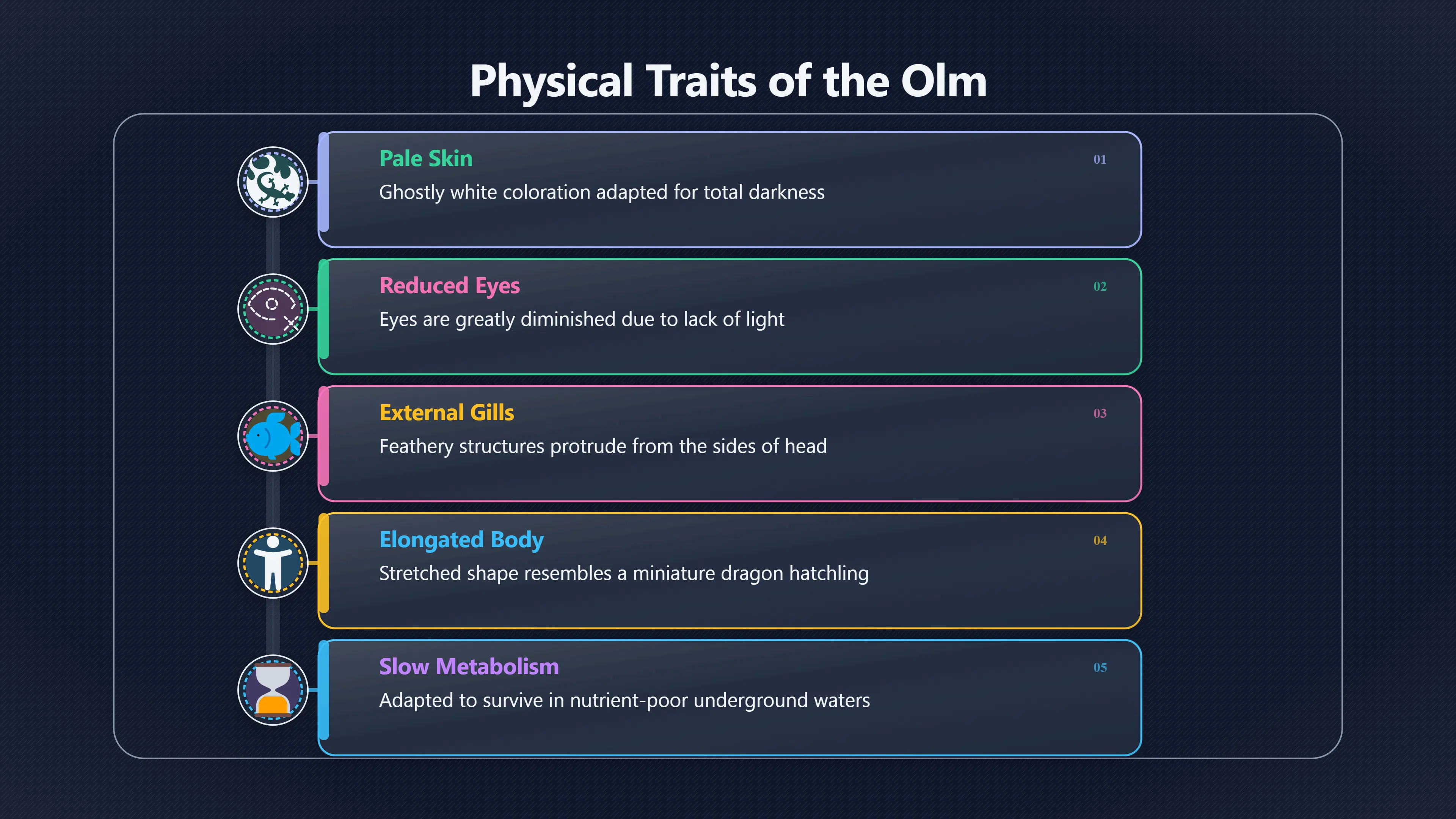
The olm (Proteus anguinus) is one of Europe’s most remarkable amphibians. It spends its entire life in underground water, rarely encounters sunlight, and has evolved a ghostly appearance. Its skin is pale, its eyes are greatly reduced, and feathery external gills protrude from the sides of its head. To people unfamiliar with cave life, it looks less like a typical salamander and more like a creature from a myth.[Wikipedia]WikipediaOpen source on wikipedia.org.
The legend emerged because olms occasionally appeared where people could see them. During periods of heavy rain, underground rivers could carry animals out of caves and springs. Villagers who found these strange pale creatures had no knowledge of subterranean biology. If small dragon-like animals emerged from the earth, it seemed reasonable to conclude that larger dragons must live deeper below.[The New Yorker]newyorker.comThe New YorkerWhat's Behind Slovenia's Love Affair with a…April 25, 2016 — 25 Apr 2016 — The villager who showed Valvasor the spring e…
The idea fitted perfectly with older Slovenian dragon traditions. In karst regions, caves and springs were often imagined as entrances to an underground realm inhabited by powerful creatures. When an olm appeared after a flood, it was not treated as an unknown salamander but as physical evidence supporting stories people already believed. The animal became proof that dragons existed somewhere beneath the landscape.[The New Yorker]newyorker.comThe New YorkerWhat's Behind Slovenia's Love Affair with a…April 25, 2016 — 25 Apr 2016 — The villager who showed Valvasor the spring e…
What makes the story especially memorable is that the olm genuinely resembles a dragon hatchling in miniature. Its elongated body, unusual head and external gills create an appearance unlike almost any other European animal. Even today, visitors encountering an olm for the first time often understand why earlier generations found it difficult to classify.[Postojna Cave Park]postojnska-jama.euThe olms' scientific name is Proteus anguinus. Olms are the largest cave-dwelling animals and the only cave-dwelling vertebrates in Europ…
What Valvasor Recorded in 1689
The best-known early account comes from the scholar and natural historian Johann Weikhard Valvasor in his 1689 work The Glory of the Duchy of Carniola. While describing a spring near present-day Vrhnika, he recorded local claims that a dragon lived in the cave system beneath it.[The New Yorker]newyorker.comThe New YorkerWhat's Behind Slovenia's Love Affair with a…April 25, 2016 — 25 Apr 2016 — The villager who showed Valvasor the spring e…
According to the story told to him, the dragon occasionally disturbed the water system when conditions underground changed. The evidence offered by local residents was simple: after periods of heavy rain, small pale creatures appeared in the spring. These were believed to be the dragon’s offspring. If baby dragons existed, then an adult dragon must also be hidden below.[The New Yorker]newyorker.comThe New YorkerWhat's Behind Slovenia's Love Affair with a…April 25, 2016 — 25 Apr 2016 — The villager who showed Valvasor the spring e…
Valvasor preserved the account even though he approached it with the curiosity of an early scientist rather than the certainty of a believer. His record became one of the earliest written references both to the dragon tradition and to the animal now known as the olm. Later zoologists recognised that the supposed dragon young described in the region were actually members of a previously undescribed species.[Prirodoslovni muzej Slovenije]pms-lj.siPrirodoslovni muzej SlovenijeOlm, or the Human FishWhen Janez Vajkard Valvasor wrote of dragon hatchlings of Vrhnika in 1689, he had no i…
This moment is important because it captures a transition between folklore and science. The same observation—a pale animal emerging from underground water—could be interpreted either as evidence of dragons or as evidence of a new species. Over time, the scientific explanation prevailed, but the older story never completely disappeared.[Prirodoslovni muzej Slovenije]pms-lj.siPrirodoslovni muzej SlovenijeOlm, or the Human FishWhen Janez Vajkard Valvasor wrote of dragon hatchlings of Vrhnika in 1689, he had no i…
Why the Real Animal Seemed More Incredible Than the Legend
Even after the olm was scientifically described in 1768, researchers continued to be fascinated by it. The animal possesses characteristics that once seemed almost unbelievable. It can survive in complete darkness, has an exceptionally slow metabolism and is adapted entirely to subterranean life. It is also the only exclusively cave-dwelling vertebrate species in Europe.[Wikipedia]WikipediaOpen source on wikipedia.org.
These adaptations help explain why the animal inspired myths. Humans rarely encountered it directly. Most knowledge of the underground world came from brief appearances at springs or cave entrances. Without understanding cave ecosystems, people naturally filled the gaps with imagination. The dragon legend was not a random invention but an attempt to explain something genuinely unusual.[The New Yorker]newyorker.comThe New YorkerWhat's Behind Slovenia's Love Affair with a…April 25, 2016 — 25 Apr 2016 — The villager who showed Valvasor the spring e…
In a sense, the scientific discovery did not make the story less interesting. It revealed that the hidden world beneath Slovenia contained a creature every bit as extraordinary as the folklore suggested, even if it was not literally a dragon.[Prirodoslovni muzej Slovenije]pms-lj.siPrirodoslovni muzej SlovenijeOlm, or the Human FishWhen Janez Vajkard Valvasor wrote of dragon hatchlings of Vrhnika in 1689, he had no i…
Conservation, Cave Breeding and Modern Tourism
Today the baby dragon legend is closely associated with Postojna Cave, one of Slovenia’s most famous tourist destinations. The cave has embraced the historical connection between dragons and olms, presenting the animal as a symbol of the mysterious underground world.[I feel Slovenia]slovenia.infoI feel SloveniaMeet "baby dragons" in Postojna CaveThe first hatchling was followed by 21 little dragons that became world stars immediat…
A major moment came in 2016 when a female olm in the cave’s exhibition aquarium laid dozens of eggs. The event attracted international attention because successful breeding of olms under near-natural conditions is extremely rare. The first hatchling emerged after 142 days, and eventually more than twenty young olms survived. Media coverage around the world referred to them as “baby dragons,” echoing the centuries-old folklore.[postojnska-jama.eu]postojnska-jama.euolm diary 2Postojna Cave ParkOlm Diary 20162016. DAY 124. On the 30th of May, 142 days after one of Postojna Cave's guides first spotted the olm egg…
The breeding programme became more than a publicity event. Conservationists used public interest in the baby dragons to highlight the vulnerability of cave ecosystems and the importance of protecting underground water quality. The European Commission later recognised the work as an example of successful conservation outreach linked to a Natura 2000 protected area.[Environment]environment.ec.europa.eupostojna cave baby dragon guardians enPostojna Cave – Baby dragon guardians - EU EnvironmentAn exhibition aquarium, actually in the cave, provides optimal condition…
The story continues to evolve. New generations of hatchlings have been produced in Postojna Cave, and the original 2016 group remains a celebrated attraction. In 2026, the internationally famous hatchlings reached their tenth anniversary, demonstrating how a legend once rooted in folklore now supports conservation, education and tourism.[I feel Slovenia]slovenia.infoI feel SloveniaMeet "baby dragons" in Postojna CaveThe first hatchling was followed by 21 little dragons that became world stars immediat…
Was Slovenia’s Baby Dragon a Real Animal?
The answer is both yes and no.
The dragon itself belongs to folklore. No evidence has ever been found for giant subterranean dragons inhabiting Slovenia’s caves. The stories reflect traditional attempts to explain floods, springs and mysterious underground spaces.[The New Yorker]newyorker.comThe New YorkerWhat's Behind Slovenia's Love Affair with a…April 25, 2016 — 25 Apr 2016 — The villager who showed Valvasor the spring e…
The “baby dragon,” however, is entirely real. The olm is a documented species that lives in the karst waters of Slovenia and neighbouring regions. What generations of local people interpreted as dragon offspring were genuine animals occasionally washed to the surface by underground water systems.[Wikipedia]WikipediaOpen source on wikipedia.org.
That combination of myth and reality is what makes the Slovenian baby dragon legend so distinctive. Many monster stories begin with rumours and remain rumours. In this case, the legendary creature’s supposed offspring turned out to be one of Europe’s most extraordinary animals, transforming a dragon tale into a remarkable chapter of natural history.[newyorker.com]newyorker.comThe New YorkerWhat's Behind Slovenia's Love Affair with a…April 25, 2016 — 25 Apr 2016 — The villager who showed Valvasor the spring e…
Amazon book picks
Further Reading
Books and field guides related to Was Slovenia's Baby Dragon a Real Animal?. Use these as the next step if you want deeper reading beyond the article.
The Lore of the Land
Useful for understanding how landscapes generate monster stories.
The Element Encyclopedia of Magical Creatures
Explains how real animals can become legendary creatures.
The Book of Imaginary Beings
Provides a literary counterpart to the baby-dragon legend.
The Salamanders of Europe, Asia and Northern Africa
Directly relates to the real animal behind the baby-dragon legend.
eBay marketplace picks
Marketplace Samples
Live-tested eBay searches with available results related to this page.
Endnotes
1.
Source: Wikipedia
Link:https://en.wikipedia.org/wiki/Olm
2.
Source: Wikipedia
Title: Johann Weikhard von Valvasor
Link:https://en.wikipedia.org/wiki/Johann_Weikhard_von_Valvasor
3.
Source: slovenia.info
Link:https://www.slovenia.info/en/stories/meet-baby-dragons-in-postojna-cave
Source snippet
I feel SloveniaMeet "baby dragons" in Postojna CaveThe first hatchling was followed by 21 little dragons that became world stars immediat...
4.
Source: Wikipedia
Title: Postojna Cave
Link:https://en.wikipedia.org/wiki/Postojna_Cave
5.
Source: slovenia.info
Title: 38258 baby dragons celebrate their 10th birthday
Link:https://www.slovenia.info/en/press-centre/news-of-the-tourism-press-agency/38258-baby-dragons-celebrate-their-10th-birthday
6.
Source: slovenia.si
Link:https://slovenia.si/this-is-slovenia/olm-offspring-on-display-at-postojna-cave
7.
Source: caves.org
Link:https://caves.org/wp-content/uploads/Publications/JCKS/v83/83_2_57.pdf
8.
Source: youtube.com
Title: Baby Dragons in Postojna Cave
Link:https://www.youtube.com/watch?v=eXiz0Pa3MaU
Source snippet
Postojna Cave Park...
9.
Source: newyorker.com
Link:https://www.newyorker.com/tech/annals-of-technology/whats-behind-slovenias-love-affair-with-a-salamander
Source snippet
The New YorkerWhat's Behind Slovenia's Love Affair with a...April 25, 2016 — 25 Apr 2016 — The villager who showed Valvasor the spring e...
Published: April 25, 2016
10.
Source: pms-lj.si
Link:https://www.pms-lj.si/en/exhibition/olm-or-the-human-fish/
Source snippet
Prirodoslovni muzej SlovenijeOlm, or the Human FishWhen Janez Vajkard Valvasor wrote of dragon hatchlings of Vrhnika in 1689, he had no i...
11.
Source: postojnska-jama.eu
Link:https://www.postojnska-jama.eu/en/postojna-cave/10-years-of-the-world-famous-baby-dragons-from-postojna-cave
Source snippet
The olms' scientific name is Proteus anguinus. Olms are the largest cave-dwelling animals and the only cave-dwelling vertebrates in Europ...
12.
Source: postojnska-jama.eu
Title: olm diary 2
Link:https://www.postojnska-jama.eu/en/wonderland-stories/olm-diary-2/
Source snippet
Postojna Cave ParkOlm Diary 20162016. DAY 124. On the 30th of May, 142 days after one of Postojna Cave's guides first spotted the olm egg...
13.
Source: environment.ec.europa.eu
Title: postojna cave baby dragon guardians en
Link:https://environment.ec.europa.eu/topics/nature-and-biodiversity/natura-2000-award/meet-natura-2000-heroes/postojna-cave-baby-dragon-guardians_en
Source snippet
Postojna Cave – Baby dragon guardians - EU EnvironmentAn exhibition aquarium, actually in the cave, provides optimal condition...
14.
Source: postojnska-jama.eu
Link:https://www.postojnska-jama.eu/en/wonderland-stories/the-birth-of-baby-dragons/
Additional References
15.
Source: scispace.com
Title: the dragon becomes angry so he
Link:https://scispace.com/pdf/an-underworld-tailored-to-tourists-a-dragon-a-photo-model-4fn2o9q0at.pdf
Source snippet
An underworld tailored to tourists: A dragon, a photo-model...1689, Johann Weikhard von Valvasor, Vrhnika area in Slovenia that...
16.
Source: facebook.com
Link:https://www.facebook.com/Postojnacavepark/posts/ten-years-ago-something-incredible-happened-in-postojna-cave-slovenia-for-the-fi/1340651058088395/
17.
Source: facebook.com
Title: ten years ago on 30 may 2016 exactly 142 days after one of postojna caves guides
Link:https://www.facebook.com/Postojnacavepark/posts/ten-years-ago-on-30-may-2016-exactly-142-days-after-one-of-postojna-caves-guides/1402972138522953/
Published: may 2016
18.
Source: facebook.com
Link:https://www.facebook.com/Reuters/posts/three-rare-aquatic-creatures-known-as-baby-dragons-are-going-on-display-in-an-aq/3331175383569461/
19.
Source: youtube.com
Title: Olm: Blind Cave Dragon
Link:https://www.youtube.com/watch?v=A0_N6sIaXVc
Source snippet
Colorless Cave Dwellers | Alpine Underworld...
20.
Source: youtube.com
Title: Searching for the Human Fish | Cave Exploring in Slovenia
Link:https://www.youtube.com/watch?v=YiWkczEMSoE
Source snippet
Olm: Blind Cave Dragon...
21.
Source: youtube.com
Title: What Exactly is: Olm | The Iconic Baby Dragon
Link:https://www.youtube.com/watch?v=BpjQlYkclzY
Source snippet
Baby Dragons in Postojna Cave...
22.
Source: facebook.com
Title: Postojnska jama Cave-Grotte-Höhle
Link:https://www.facebook.com/Postojnacavepark/posts/centuries-ago-after-heavy-rains-mysterious-pale-creatures-appeared-at-the-entran/1434557712031062/
23.
Source: youtube.com
Title: Colorless Cave Dwellers | Alpine Underworld
Link:https://www.youtube.com/watch?v=vth2BMFrJaI
24.
Source: zoochat.com
Title: olm breeding.436283
Link:https://www.zoochat.com/community/threads/olm-breeding.436283/
Topic Tree