Where Burkina Faso's Monsters Become Sacred Animals
Burkina Faso is not known for a single internationally famous “lake monster” or headline-grabbing cryptid in the way some countries are.
Page outline Jump by section
Introduction
The evidence is also uneven. There are travel accounts, local journalism, museum notes, ethnographic work and conservation material, but very little reliable documentation for a modern Burkinabè “cryptid flap” built around repeated eyewitness sightings of an unidentified animal. The most useful approach, then, is to separate four things that often get blurred together: sacred animals that definitely exist, folklore beings represented through ritual art, misidentified or rare wildlife in savanna landscapes, and recent internet-era monster retellings that may be inspired by real sacred sites but should not be treated as established local cryptozoological cases.
The real centre of the mystery: sacred animals, not hidden species
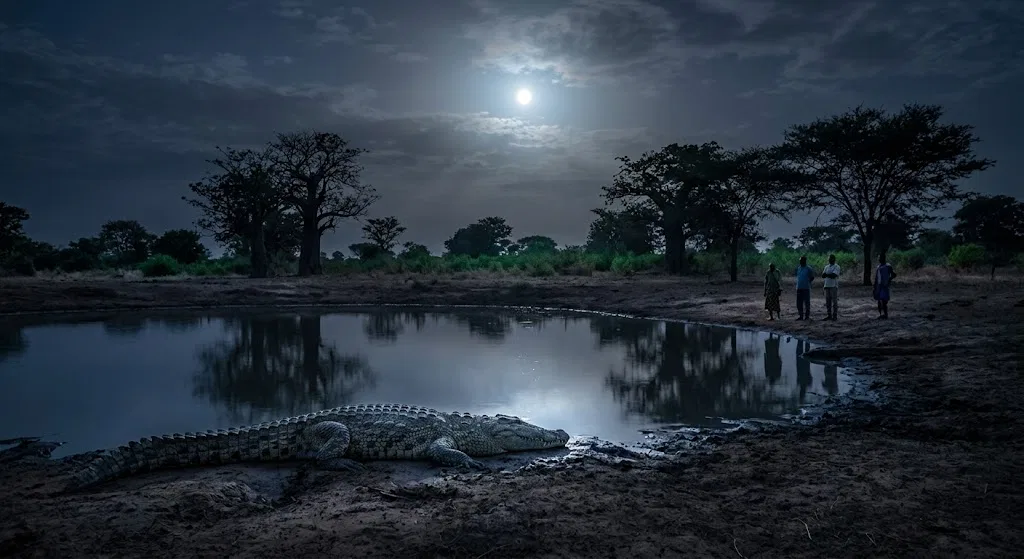
The best-known creature tradition in Burkina Faso concerns crocodiles. Bazoulé, west of Ouagadougou, and Sabou, in Boulkiemdé province, are both associated with sacred crocodile ponds where reptiles are protected by custom, ritual and tourism. Reports and local accounts describe crocodiles as linked to ancestors, rain, village protection and founding stories, not as unknown monsters. In Bazoulé, one widely repeated origin story says that during a severe drought a crocodile led villagers to water; since then the animals have been revered. Associated Press coverage places the local cult of the crocodile as dating, in community memory, to around the 1500s.[AP News]apnews.comAP News COVID takes a bite from Bazoulé's cult of sacred crocodilesAP NewsCOVID takes a bite from Bazoulé's cult of sacred crocodilesOctober 22, 2021 — 22 Oct 2021 — The local cult of the crocodile dates…
That matters because the crocodiles are not imaginary. Conservation and zoological sources identify the relevant species as the West African crocodile, also called the desert or sacred crocodile, a species long confused with the Nile crocodile. An IUCN Crocodile Specialist Group update discussed work on Crocodylus suchus at the sacred sites of Bazoulé and Sabou, while later research summaries reported counts in the hundreds at both sites and argued that traditional beliefs play an important role in their protection.[IUCN CSG]iucncsg.orgSC.2.2. West and Central AfricaSC.2.2. West and Central Africa
For a cryptid reader, the interesting point is not whether there is an unknown crocodile hiding in Burkina Faso. The animal is recognised. The mystery lies in how a dangerous-looking reptile becomes a village relative, rain-bringer, oracle, tourist attraction and conservation beneficiary. Local and journalistic accounts describe funeral-like treatment for dead crocodiles, ritual offerings, and the idea that the animals can signal misfortune. Those claims belong to folklore and religious life rather than zoological proof, but they are central to why Burkina Faso’s crocodile stories feel “monster-like” to outsiders while remaining familiar and meaningful to local communities.[China Daily]global.chinadaily.com.cnOpen source on com.cn.
Bazoulé and Sabou: why the crocodiles became famous
Bazoulé is the site most often mentioned in travel writing and international media. Visitors commonly encounter guides who call crocodiles from the water, feed them chickens and explain the origin story that links the animals to drought, rescue and gratitude. The pond has become a recognised tourist attraction, but it is not merely staged folklore for outsiders. Reports from the village repeatedly frame the crocodiles as protected beings tied to local identity and customary rules.[Amusing Planet]amusingplanet.comAmusing Planet The Sacred Crocodiles of BazouleAmusing Planet The Sacred Crocodiles of Bazoule
Sabou’s sacred crocodile pond has a similar public profile. Tourism material describes more than a hundred crocodiles living in association with the village and recounts a legend in which a crocodile saved an ancestral hunter from the Kaboré family, prompting lasting reverence. These stories differ in detail from Bazoulé’s drought-and-water narrative, but they work in a similar way: a crocodile performs a founding act, humans respond with protection, and the pond becomes a place where animal presence, ancestry and local continuity overlap.[ChicFaso]chicfaso.comOpen source on chicfaso.com.
The sceptical explanation is not that the whole tradition is “fake”. It is better understood as a living example of cultural coexistence with a real animal. West African crocodiles are generally described as less aggressive than Nile crocodiles in many accounts, and long-term feeding, ritual protection and human familiarity can make the animals appear remarkably docile in tourist settings. That does not mean crocodiles are safe pets; it means the Burkinabè sacred-crocodile tradition turns a feared predator into a managed, symbolically charged neighbour.[Amusing Planet]amusingplanet.comAmusing Planet The Sacred Crocodiles of BazouleAmusing Planet The Sacred Crocodiles of Bazoule
Dafra’s sacred catfish: the “god in the water” pattern
The other major water-creature tradition is Dafra, near Bobo-Dioulasso. Here the animals are sacred catfish rather than crocodiles. The site lies at or near the source of the Houet/We river system and is usually described as a gorge or natural water source where people make offerings and vows. Anthropological conference material describes Dafra as a sacrificial site near Burkina Faso’s second-largest city, where silurid catfish are considered the tutelary spirits of Bobo-Dioulasso and where people come seeking help with illness, infertility, money troubles, nightmares, school or business problems.[NomadIT]nomadit.co.ukOfferings to sacred fish: a popular sacrificial site in Burkina…27 Aug 2008 — In it live silurids (catfish); these are consider…
Local journalism gives the story a stronger legendary frame. LeFaso.net reports older accounts in which the first man of Bobo-Dioulasso, able to speak with spirits, is linked to the discovery of the sacred fish pond. Tourism and travel sources often emphasise the dramatic scene: pilgrims, sacrifices, large catfish rising in the water, and strict behavioural rules around the site.[leFaso]lefaso.netOpen source on lefaso.net.
Dafra is especially relevant to modern “cryptid” interest because recent online retellings sometimes repackage it as a West African monster story: a hidden chasm, a dark pool, a god or creature in the water. The grounded version is more interesting and more accurate. The fish are not an unidentified species, but they are treated as more than ordinary animals. They are messengers, ancestors, tutelary beings or spirit-linked creatures depending on the account. That makes Dafra a strong example of a sacred-animal tradition that can look like a monster legend when removed from its ritual context.[ChicFaso]chicfaso.comChic Faso An Ancestral Mystery in the Heart of Bobo-DioulassoChic Faso An Ancestral Mystery in the Heart of Bobo-Dioulasso
Animal spirits in masks: Burkina Faso’s “strange beings” in plain sight
Burkina Faso’s mask traditions add a different kind of creature lore. Museum and art-historical sources describe masks among Bobo, Bwa, Kurumba, Mossi, Winiama, Nunuma and related communities as combining human, animal and insect features. In performance, these masks can embody nature spirits or ancestor spirits that interact with human life. The Metropolitan Museum of Art, for example, notes that imagery from these traditions commonly merges stylised features of humans, animals and insects, and that in use the masks embody spirits with influence over people.[The Metropolitan Museum of Art]metmuseum.orgThe Metropolitan Museum of Art Bwa blacksmithThe Metropolitan Museum of Art Bwa blacksmith
This is important for cryptid history because many “monster” traditions begin with the same basic ingredients: a boundary between village and bush, animals that are more than animals, and beings that appear in hybrid or exaggerated form. Among Winiama and related mask traditions, sources describe bush spirits and spiritual beings taking animalistic forms, with frequent animal references including antelope, buffalo, bush pig, hornbill, hyena and serpent.[DuSable Museum]dusablemuseum.orgOpen source on dusablemuseum.org.
The Bwa and Bobo material is especially vivid. Some Bobo and Bwa masks represent owls, snakes, buffalo, crocodiles and chameleons; other sources describe large plank masks as flying spirits that inhabit the natural world. These are not cryptids in a zoological sense. They are ritual beings, moral beings and social beings. But they help explain why a country-level “mystery creature” page for Burkina Faso should not look only for newspaper monsters. The creature world here is often preserved through performance, initiation, harvest rites, funerals and art rather than through sensational sighting reports.[Africa Online Museum]africaonlinemuseum.orgAfrica Online Museum Bobo & Bwa Masks » PhotosAfrica Online Museum Bobo & Bwa Masks » Photos
Where real wildlife can feed mystery-beast reports
Burkina Faso also has the ecological ingredients for misidentification stories. The W-Arly-Pendjari Complex, shared by Benin, Burkina Faso and Niger, is one of West Africa’s major remaining wildlife landscapes. UNESCO describes it as a refuge for species that have disappeared elsewhere in West Africa, including elephants, African manatees, cheetahs, lions and leopards, and as harbouring the region’s only viable lion population.[UNESCO World Heritage Centre]whc.unesco.orgOpen source on unesco.org.
African Parks similarly describes the wider WAP landscape as one of the last strongholds for north-west African cheetah, West African lion and other large mammals. Its biodiversity material lists more than 50 large mammal species, including elephant, buffalo, hippo, spotted and striped hyena, leopard and numerous antelope species, alongside more than 360 bird species and substantial reptile and fish diversity.[African Parks]africanparks.orgOpen source on africanparks.org.
This matters because in countries with surviving large predators and fragmented wildlife habitat, strange-animal reports can have ordinary roots. A night encounter with a hyena, a brief glimpse of a leopard, the alarm call of a large bird, or the sudden movement of a crocodile at a waterhole can become something larger in retelling. The strongest available evidence does not point to a named Burkinabè phantom cat or unknown ape tradition, but the country’s real fauna gives plenty of material for fear, awe and mistaken identification. A leopard or hyena at the edge of a settlement does not need to be unknown to be unforgettable.
What is missing from Burkina Faso’s cryptid record
The biggest surprise is the absence of a robust modern cryptid dossier. Searches for Burkina Faso-specific cryptids tend to produce generic West African lists, social-media material, thin wiki-style category pages, or recent podcast-style monster retellings rather than well-documented local sighting traditions. That does not prove no such stories exist in oral circulation, but it does mean that public, sourceable English-language evidence is limited.[Cryptid Wiki]cryptidz.fandom.comCryptid Wiki Category:Africa (WesternCryptid Wiki Category:Africa (Western
The gap is partly linguistic and partly cultural. Burkina Faso’s relevant creature traditions are often reported in French, local media, tourism writing, museum catalogues, ethnographic summaries and oral-history contexts rather than in the Anglophone cryptozoology vocabulary of “cryptids”. A reader searching only for “Burkina Faso cryptid” may miss the most important material because local stories are framed as sacred crocodiles, sacred fish, bush spirits, masks, ancestors or village rituals.
There is also a category problem. A sacred crocodile is not a cryptid if the animal is known and countable. A catfish in a ritual pond is not a hidden monster if the species is ordinary. A mask embodying a bush spirit is not an eyewitness report of a new animal. Yet all three belong on a country-level mystery-creature page because they answer the deeper question: which animals in Burkina Faso have been remembered, feared, protected or transformed into beings with powers beyond normal wildlife?

How to read Burkina Faso’s creature traditions without flattening them
The most useful distinction is between “unknown animal” and “more-than-animal”. Burkina Faso’s strongest cases are mostly the second kind. The crocodiles of Bazoulé and Sabou are zoologically real but socially extraordinary. The catfish of Dafra are biologically ordinary but ritually powerful. The animal masks of Bwa, Bobo and Winiama traditions do not claim to document hidden species; they give visible form to spirits, ancestors, bush forces and moral relationships between people and the natural world.[researchgate.net]researchgate.netOpen source on researchgate.net.
That distinction keeps the page evidence-aware without draining the strangeness from it. A sceptical reading can explain many claims through known wildlife, local ecology, tourism performance, oral tradition and ritual symbolism. A culturally attentive reading can still recognise why these creatures matter: they protect water, mark sacred places, connect villages to origin stories, and turn dangerous or uncanny animals into participants in community life.
For readers used to Loch Ness-style cryptid stories, Burkina Faso offers a different model. The mystery is not a single beast hiding from science. It is a landscape where crocodiles may be ancestors, catfish may answer vows, serpents and hyenas may appear as spirit-forms, and the bush remains a place where animal life and moral life are not neatly separated.
The practical shortlist of Burkina Faso’s key mystery-creature sites and motifs
The clearest country-level map looks like this:
- Bazoulé: sacred crocodiles west of Ouagadougou, tied to drought, water-finding, ancestral reverence, tourism and conservation.
- Sabou: another major sacred crocodile pond, with local legend connecting crocodiles to protection and village ancestry.
- Dafra near Bobo-Dioulasso: sacred catfish in a ritual water site, associated with vows, sacrifice, healing, fertility and tutelary spirits.
- Bwa, Bobo, Winiama and related mask traditions: animal and hybrid spirit forms including serpents, buffalo, antelopes, hyenas, hornbills, crocodiles and chameleons.
- W-Arly-Pendjari and other savanna habitats: real predators and large mammals that provide plausible roots for strange encounters, misidentifications and animal fear-lore.
Taken together, these motifs make Burkina Faso a strong example of a country where “cryptid history” is best read through sacred zoology and folklore rather than through claims of undiscovered megafauna. The strange creatures are there, but they usually appear as crocodiles at a village pond, catfish in a sacrificial gorge, or a painted mask stepping out of the human world into the bush.
Amazon book picks
Further Reading
Books and field guides related to Where Burkina Faso's Monsters Become Sacred Animals. Use these as the next step if you want deeper reading beyond the article.
African Religions and Philosophy
Explains spiritual relationships between people, animals and ancestors.
eBay marketplace picks
Marketplace Samples
Live-tested eBay searches with available results related to this page.
Endnotes
1.
Source: researchgate.net
Link:https://www.researchgate.net/publication/366592298_Impact_of_Anthropogenic_Activities_on_the_Abundance_of_Crocodylus_suchus_Saint-Hilaire_1807_within_the_Nazinga_Game_Ranch_Burkina_Faso
2.
Source: chicfaso.com
Link:https://www.chicfaso.com/en/post/la-mare-aux-crocodiles-sacres-de-sabou
3.
Source: researchgate.net
Link:https://www.researchgate.net/publication/279105924_Local_Religion_or_Cult-Shopping_A_Sacrificial_Site_in_Burkina_Faso
4.
Source: lefaso.net
Link:https://lefaso.net/spip.php?article54051=
5.
Source: chicfaso.com
Title: Chic Faso An Ancestral Mystery in the Heart of Bobo-Dioulasso
Link:https://www.chicfaso.com/en/post/dafra-et-ses-silures-sacres
6.
Source: whc.unesco.org
Link:https://whc.unesco.org/en/list/749/
7.
Source: researchgate.net
Link:https://www.researchgate.net/profile/Philipp-Henschel/publication/264799870_Lion_status_updates_from_five_range_countries_in_West_and_Central_Africa/links/53f1d0390cf26b9b7dd10063/Lion-status-updates-from-five-range-countries-in-West-and-Central-Africa.pdf
8.
Source: researchgate.net
Link:https://www.researchgate.net/publication/375624642_Black_Red_and_White_Characterization_of_Painting_Materials_on_a_Group_of_Bwa_Masks_from_Burkina_Faso
9.
Source: whc.unesco.org
Link:https://whc.unesco.org/document/159773
10.
Source: chicfaso.com
Link:https://www.chicfaso.com/en/blog/week-end-touristique-depuis-ouagadougou
11.
Source: apnews.com
Title: AP News COVID takes a bite from Bazoulé’s cult of sacred crocodiles
Link:https://apnews.com/article/lifestyle-travel-religion-environment-and-nature-lakes-f7152056bc8fcc622e10eb0cb50eaa29
Source snippet
AP NewsCOVID takes a bite from Bazoulé's cult of sacred crocodilesOctober 22, 2021 — 22 Oct 2021 — The local cult of the crocodile dates...
Published: October 22, 2021
12.
Source: nomadit.co.uk
Link:https://nomadit.co.uk/conference/easa08/paper/2795
Source snippet
Offerings to sacred fish: a popular sacrificial site in Burkina...27 Aug 2008 — In it live silurids (catfish); these are consider...
13.
Source: metmuseum.org
Title: The Metropolitan Museum of Art Bwa blacksmith
Link:https://www.metmuseum.org/art/collection/search/310796
14.
Source: iucncsg.org
Title: SC.2.2. West and Central Africa
Link:https://www.iucncsg.org/content_images/SC.2.2.%20West%20and%20Central%20Africa.pdf
15.
Source: global.chinadaily.com.cn
Link:https://global.chinadaily.com.cn/a/201806/20/WS5b29beb6a3103349141dd433.html
16.
Source: amusingplanet.com
Title: Amusing Planet The Sacred Crocodiles of Bazoule
Link:https://www.amusingplanet.com/2018/06/the-sacred-crocodiles-of-bazoule.html
17.
Source: metmuseum.org
Title: The Metropolitan Museum of Art Bayiri (elderly female spirit) plank mask
Link:https://www.metmuseum.org/art/collection/search/310771
18.
Source: dusablemuseum.org
Link:https://dusablemuseum.org/winiama-double-crested-mask/
19.
Source: africaonlinemuseum.org
Title: Africa Online Museum Bobo & Bwa Masks » Photos
Link:https://africaonlinemuseum.org/map/burkina-faso/bobo-bwa-kingdom/photos/
20.
Source: africanparks.org
Link:https://www.africanparks.org/the-parks/w
21.
Source: africanparks.org
Link:https://www.africanparks.org/the-parks/w/biodiversity-conservation
22.
Source: cryptidz.fandom.com
Title: Cryptid Wiki Category:Africa (Western)
Link:https://cryptidz.fandom.com/wiki/Category%3AAfrica_%28Western%29
23.
Source: africanparks.org
Link:https://www.africanparks.org/the-parks/pendjari
24.
Source: metmuseum.org
Title: Nunuma or Winiama blacksmith
Link:https://www.metmuseum.org/art/collection/search/317822
25.
Source: thehumanexception.com
Link:https://www.thehumanexception.com/l/hyenas/
26.
Source: Wikipedia
Title: West African crocodile
Link:https://en.wikipedia.org/wiki/West_African_crocodile
27.
Source: africaonlinemuseum.org
Link:https://africaonlinemuseum.org/map/burkina-faso/bobo-bwa-kingdom/video/
28.
Source: beastsoflegend.com
Title: West Africa
Link:https://beastsoflegend.com/bestiary/africa/west/
29.
Source: naturalworldheritagesites.org
Title: W-Arly-Pendjari Complex
Link:https://www.naturalworldheritagesites.org/sites/w-arly-pendjari-complex
30.
Source: cryptidarchives.fandom.com
Title: Category:Cryptids by country
Link:https://cryptidarchives.fandom.com/wiki/Category%3ACryptids_by_country
Additional References
31.
Source: youtube.com
Title: Sacred Crocs, Thriving Tourism | Burkina Faso Village Lives Alongside Reptiles
Link:https://www.youtube.com/watch?v=21MZ6xATBWg
Source snippet
Bobo-Dioulasso: The Houet Marigot in danger, the sacred catfish in distress...
32.
Source: youtube.com
Title: Bobo-Dioulasso: The Houet Marigot in danger, the sacred catfish in distress
Link:https://www.youtube.com/watch?v=UEPXoZvQ0oI
Source snippet
Report on the death of more than 200 sacred catfish in the Houet swamp...
33.
Source: youtube.com
Title: Report on the death of more than 200 sacred catfish in the Houet swamp
Link:https://www.youtube.com/watch?v=ZanOHup5w9A
Source snippet
For Rain to Fall: The Sky Sorcerers of Burkina Faso...
34.
Source: youtube.com
Title: Faces of Africa: Guardians of the Sacred Crocodiles
Link:https://www.youtube.com/watch?v=ajTz36Njf9A
Source snippet
Sacred Crocs, Thriving Tourism | Burkina Faso Village Lives Alongside Reptiles...
35.
Source: iflscience.com
Link:https://www.iflscience.com/200-year-old-rock-art-of-a-tusked-monster-may-depict-an-extinct-creature-that-vanished-200-million-years-ago-83850
36.
Source: animalia.bio
Link:https://animalia.bio/burkina-faso-animals?page=1
37.
Source: instagram.com
Link:https://www.instagram.com/reel/DVWEU7DCGSk/
38.
Source: facebook.com
Link:https://www.facebook.com/Parlonsdtout/videos/bobo-dioulasso-les-silures-sacr%C3%A9es-une-histoire-/590358049256059/
39.
Source: clevelandart.org
Link:https://www.clevelandart.org/art/1969.2
40.
Source: facebook.com
Link:https://www.facebook.com/groups/590222271717799/posts/2325691908170818/
Topic Tree
Follow this branch
Related pages 192
- Antigua Cryptids
- Maldives Monsters
- Malta Monsters
- Qatar Monsters
- Argentina Monsters
- +187 more in sidebar