Cryptids of Montenegro's Wildest Landscapes
Montenegro has no well-documented, nationally famous cryptid on the scale of Loch Ness, but it does have exactly the landscape in which monster stories thrive: a huge border lake, cold mountain tarns, deep canyons, caves, wolf-and-bear country, and a strong South Slavic folklore tradition of dragons, storm-fighters, dog-headed beings and screaming...
Page outline Jump by section
The Lake Skadar monster: Montenegro’s nearest thing to a classic cryptid
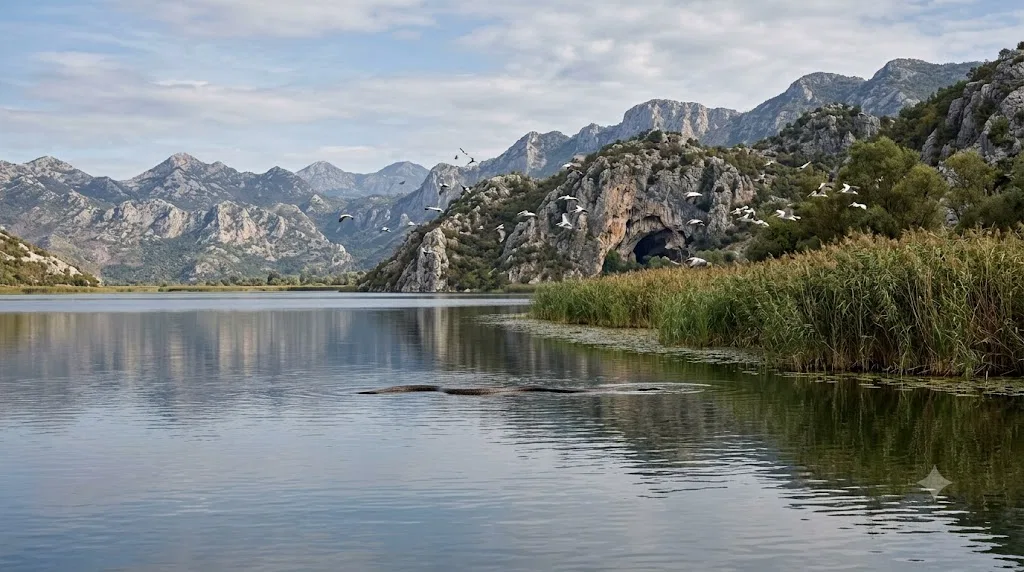
The clearest “mystery animal” attached to Montenegro is the alleged monster of Lake Skadar, reported in cryptid catalogues as a creature seen on the Montenegrin side of the lake. The most repeated description is extravagant: a black animal, fast-moving, around 40 metres long, with three horns, sometimes interpreted through the regional dragon-monster figure known as an aždaja. That description should be treated as folklore and cryptid lore rather than established testimony: it circulates in specialist monster databases, not in a strong chain of dated, independently verified witness reports.[Cryptid Wiki]cryptidz.fandom.comCryptid Wiki Monster of Lake SkadarMontenegrin side of Lake Skadar. The creature is described as being 3 meters… Loch Ness Monster · Champ · Ogopogo · Selma · Beast of B…
What makes the story interesting is not that the monster is likely to be real, but that the lake gives the legend a believable stage. Lake Skadar straddles Montenegro and Albania, varies seasonally in size, contains marshes, rocky shores, islands and underwater springs, and is widely described as the largest lake in the Balkan region. Its Montenegrin side became a national park in 1983, and the wider lake is recognised for wetland importance and biodiversity.[Wikipedia]WikipediaLake SkadarLake Skadar
That environment matters because lake-monster traditions often grow where ordinary perception is difficult. A large shallow lake with reedbeds, changing light, submerged springs, birds taking off from the surface, floating vegetation, fishing activity and large fish creates plenty of chances for honest misidentification. Lake Skadar has hundreds of recorded bird species and roughly 49 fish species, including carp, bleak and eel; BirdLife describes it as home to 281 bird species and 49 fish species, including Dalmatian pelican and whiskered tern.[BirdLife International]birdlife.orgBirdLife InternationalLake SkadarIts waters and wetlands are home to a rich array of wildlife, including 281 bird species and 49 fish spe…
A local media reference also shows that the “is there a monster?” question has become a playful public-facing hook rather than a sober zoological claim. In 2020, TV Vijesti promoted a children’s and family segment in which a fisherman would discuss how to catch fish and whether there are monsters in Lake Skadar. That framing is telling: the monster works as a curiosity around the lake’s real fishing culture, not as a claim supported by biological evidence.[vijesti.me]en.vijesti.meme Is there a monster in Lake Skadar?there a monster in Lake Skadar?November 21, 2020 — 21 Nov 2020 — Is there a monster in Lake Skadar? Buzz with the Bees and fly into… F…
Why a dragon belongs so naturally in the lake
The Lake Skadar monster is often linked to the aždaja, a South Slavic dragon-like monster. In wider Balkan folklore, the aždaja is commonly treated as a dangerous, monstrous dragon or serpent figure, distinct from more protective dragon traditions. The word itself is connected in folklore scholarship and reference works to a wider Balkan and Indo-Iranian dragon lineage, and in South Slavic stories such beings often occupy dark, watery or hostile places.[Wikipedia]WikipediaSlavic dragonSlavic dragon
This helps explain why a lake creature in Montenegro is not just imagined as a big fish or serpent but as something older and more mythic. The country’s monster lore sits at the meeting point of ecology and oral tradition. A dark shape in water can become a giant eel; a giant eel can become a serpent; a serpent can become a dragon; and a dragon can become a named local monster once tourism, internet folklore and cryptid databases begin repeating the story.
Montenegro’s broader folklore also includes weather-fighting spirit-men known as zduhaći in regional tradition. These figures were believed to protect villages or estates from storms and hail, sometimes by sending the soul out during sleep to battle destructive forces in the clouds. The tradition is specifically recorded in Montenegro, eastern Herzegovina, Bosnia and Sandžak, and notable Montenegrin historical figures such as Petar I Petrović-Njegoš and Marko Miljanov were popularly associated with it.[Wikipedia]WikipediaOpen source on wikipedia.org.
That matters for cryptid history because it shows that Montenegrin monster tradition is not only about animals hiding in remote places. It is also about landscape anxiety: storms over crops, dangerous water, mountain isolation, caves, wolves, unknown noises and the feeling that wild country has its own guardians or enemies. In that sense, the Lake Skadar monster is best read as a modern lake-beast skin over a much older dragon-and-weather imagination.
Other Montenegrin monster places
Lake Skadar is the main cryptid-like focus, but Montenegro has several smaller legendary landscapes where monster motifs appear. These are usually local folklore and tourism stories rather than ongoing sighting traditions.
Bukumirsko Lake, in the Kučka Krajina mountains near central Montenegro, has a strong dragon legend. Local retellings say a dragon once lived in the lake and came out at night to frighten the Bukumiri, a pastoral tribe remembered in local tradition. In one version, the tribe drove the dragon away by heating stones and throwing them into the water; the dragon fled, but cursed the Bukumiri before disappearing.[Living in Montenegro:)]montenegro-for.meLiving in Montenegro:)BUKUMIRSKO LAKE, THE HEART OF THE KUČKA KRAJINALiving in Montenegro:)BUKUMIRSKO LAKE, THE HEART OF THE KUČKA KRAJINA
This tale has the shape of a classic origin legend. It explains a place-name, gives the lake a supernatural resident, and links the disappearance or transformation of a people to a dramatic encounter with a water monster. It is not a modern cryptid report, but it is exactly the kind of folklore root from which a cryptid page can grow: a named place, a repeated creature, a dramatic encounter and a lingering mystery.
Durmitor National Park adds a different tone: less “lake monster”, more haunted alpine landscape. UNESCO describes Durmitor as a high mountain region of peaks, forests, glacial lakes and spectacular canyons, including the Tara, often singled out as Europe’s deepest gorge. Its many glacial lakes are locally known as “mountain eyes”, a phrase that almost invites stories about watching, reflection and hidden depth.[UNESCO World Heritage Centre]whc.unesco.orgOpen source on unesco.org.
Vražje Lake, whose name is commonly translated as “Devil’s Lake”, has a legend of a devilish or otherworldly presence beneath the water, including stories of a crystal palace at the bottom of the lake and strange reflections. Such traditions are better understood as place-lore than zoological claims, but they show how Montenegrin lakes are repeatedly imagined as thresholds: beautiful on the surface, uncanny underneath.[Wikipedia]WikipediaVražje LakeVražje Lake
Dog-heads, screamers and night creatures
Not every Montenegrin monster tradition is aquatic. The psoglav, a dog-headed demonic being, is recorded in Balkan mythology, with belief associated with parts of Bosnia and Montenegro. It is typically described as a creature with a human body, horse-like legs, a dog’s head, iron teeth and one eye, living in caves or dark places and behaving as a corpse-eating or man-eating monster.[Wikipedia]WikipediaOpen source on wikipedia.org.
The psoglav is useful for understanding Montenegro’s “cryptid” profile because it belongs to the cave-and-mountain imagination rather than the lake-monster tradition. It is not a likely misidentified animal. It is a folkloric ogre, a boundary creature of darkness, burial places and inaccessible terrain. In a country of limestone mountains, caves and remote passes, that kind of monster has a natural home.
The drekavac, or “screamer”, belongs to wider South Slavic folklore and is also associated with Montenegro in regional accounts. It is variously described as a night creature, revenant, animal-like apparition or spirit connected with the dead, and its defining feature is sound: a frightening cry heard in darkness. Some modern “drekavac” reports elsewhere in the Balkans have turned out to be rotten animal remains or ordinary animal activity reframed through folklore.[Wikipedia]WikipediaOpen source on wikipedia.org.
That sound-based pattern is important. Many monster traditions begin not with a clear sighting but with a noise: a scream in a wood, a splash in reeds, a cry from a marsh, a shape moving too quickly in poor light. Montenegro’s fauna includes real animals capable of startling people at night, while its folklore supplies names and shapes for the fear that follows.

The Adriatic coast: sea monsters, seals and mistaken sightings
Montenegro’s Adriatic coast is less strongly associated with a named sea serpent than Lake Skadar is with a lake beast, but it still offers a useful cryptid-adjacent zone. The coast has real marine animals that can look strange in brief glimpses: dolphins, sea turtles and the very rare Mediterranean monk seal. Montenegro Dolphin Research even runs citizen reporting for sightings and strandings of dolphins, turtles and monk seals, showing that unusual marine encounters are a real part of coastal life.[Montenegro Dolphin Research]montenegrodolphinresearch.orgOpen source on montenegrodolphinresearch.org.
The monk seal is especially relevant because it blurs the line between “lost animal”, “rare animal” and “monster report”. Research summaries and recent reporting indicate that the species was long considered absent or nearly absent from Montenegro, but later sightings and video evidence suggest at least occasional presence. A rare seal surfacing near caves or rocky coastline could easily become a surprising “sea creature” story to an unprepared observer.[researchgate.net]researchgate.netResearch Gate(PDF) The Mediterranean Monk Seal, MonachusResearch Gate(PDF) The Mediterranean Monk Seal, Monachus
This is a useful sceptical model for Montenegrin cryptids in general. A strange report does not have to be a hoax to be wrong. It may be a rare real animal, a common animal seen badly, a floating object, a weather effect, or a folklore-shaped interpretation of a confusing moment.
The evidential limits around Montenegro’s cryptid traditions
The evidence for Montenegro’s cryptids is uneven. Lake Skadar has a named monster tradition, but the available public evidence is mostly second-hand, internet-era and folklore-shaped. Bukumirsko Lake and Vražje Lake have stronger value as local legends than as sighting cases. Psoglav and drekavac belong to regional folklore rather than cryptozoology. The Adriatic coast has real unusual animals, especially rare monk seal records, but not a strong Montenegrin sea-serpent archive.
The strongest interpretation is that Montenegro is a folklore-rich cryptid country rather than an evidence-rich cryptid country. Its monster traditions are rooted in four recurring settings:
- Large water: Lake Skadar provides the best stage for a classic lake monster, with reeds, fish, birds, shifting water levels and cross-border mystery.
- Mountain lakes: Bukumirsko Lake and Durmitor’s glacial lakes carry dragon, devil and uncanny-water legends.
- Caves and dark terrain: Psoglav-type beings fit the country’s limestone, cave and mountain folklore.
- Rare wildlife: dolphins, seals, eels, large carp, birds and nocturnal mammals offer plausible raw material for misidentification.
This does not make the stories uninteresting. It makes them more legible. Montenegro’s monsters are not best approached as hidden zoological specimens waiting to be captured. They are better read as a layered tradition in which real terrain, real animals, oral legend, tourism storytelling and modern cryptid culture keep reshaping one another. The Lake Skadar monster may not be a proven beast, but it is a revealing one: a dragon-shaped question rising from one of the Balkans’ most dramatic wetlands.
Amazon book picks
Further Reading
Books and field guides related to What Monsters Haunt Montenegro's Wildest Landscapes?. Use these as the next step if you want deeper reading beyond the article.
Field Guide to Lake Monsters, Sea Serpents, and Other Mystery...
Directly relates to lake-monster stories such as the Skadar legend.
Slavic Folklore
Provides background for the South Slavic monster traditions discussed.
The Element Encyclopedia of Magical Creatures
Matches the article's blend of monsters, dragons and regional folklore.
The Book of Imaginary Beings
Explores legendary beings from many cultures, fitting a folklore-focused page.
eBay marketplace picks
Marketplace Samples
Live-tested eBay searches with available results related to this page.
Endnotes
1.
Source: birdlife.org
Link:https://www.birdlife.org/landscape-nature-restoration/lake-skadar/
Source snippet
BirdLife InternationalLake SkadarIts waters and wetlands are home to a rich array of wildlife, including 281 bird species and 49 fish spe...
2.
Source: Wikipedia
Title: Lake Skadar
Link:https://en.wikipedia.org/wiki/Lake_Skadar
3.
Source: en.vijesti.me
Title: me Is there a monster in Lake Skadar?
Link:https://en.vijesti.me/tv/shows/488193/Is-there-a-monster-in-Skadar-Lake%3F
Source snippet
there a monster in Lake Skadar?November 21, 2020 — 21 Nov 2020 — Is there a monster in Lake Skadar? Buzz with the Bees and fly into... F...
Published: November 21, 2020
4.
Source: Wikipedia
Title: Slavic dragon
Link:https://en.wikipedia.org/wiki/Slavic_dragon
5.
Source: Wikipedia
Link:https://en.wikipedia.org/wiki/Zduha%C4%87
6.
Source: whc.unesco.org
Link:https://whc.unesco.org/en/list/100/
7.
Source: Wikipedia
Title: Vražje Lake
Link:https://en.wikipedia.org/wiki/Vra%C5%BEje_Lake
8.
Source: Wikipedia
Link:https://en.wikipedia.org/wiki/Psoglav
9.
Source: Wikipedia
Link:https://en.wikipedia.org/wiki/Drekavac
10.
Source: Wikipedia
Link:https://fr.wikipedia.org/wiki/Drekavac
11.
Source: researchgate.net
Title: Research Gate(PDF) The Mediterranean Monk Seal, Monachus
Link:https://www.researchgate.net/publication/349337992_The_Mediterranean_Monk_Seal_Monachus_monachus_in_Montenegro
12.
Source: Wikipedia
Title: Wolves in folklore, religion and mythology
Link:https://en.wikipedia.org/wiki/Wolves_in_folklore%2C_religion_and_mythology
13.
Source: Wikipedia
Link:https://en.wikipedia.org/wiki/Vrykolakas
14.
Source: Wikipedia
Title: Tara River Canyon
Link:https://en.wikipedia.org/wiki/Tara_River_Canyon
15.
Source: Wikipedia
Title: Fauna of Montenegro
Link:https://en.wikipedia.org/wiki/Fauna_of_Montenegro
16.
Source: Wikipedia
Title: Ala (demon)
Link:https://en.wikipedia.org/wiki/Ala_%28demon%29
17.
Source: Wikipedia
Link:https://en.wikipedia.org/wiki/Cadmus
18.
Source: birdlife.org
Title: pelican hotline
Link:https://www.birdlife.org/news/2016/07/25/pelican-hotline/
19.
Source: montenegro.travel
Link:https://www.montenegro.travel/en/unique-montenegro/national-parks-of-montenegro/durmitor-national-park
20.
Source: researchgate.net
Link:https://www.researchgate.net/publication/325848176_The_Obscure_History_of_the_Lake_Skadar_and_Its_Biota_A_Perspective_for_Future_Research
21.
Source: researchgate.net
Link:https://www.researchgate.net/publication/307091751_Length-weight_relationship_of_nine_fish_species_from_Skadar_Lake_Adriatic_catchment_area_of_Montenegro
22.
Source: researchgate.net
Link:https://www.researchgate.net/publication/333723617Dragon_and_Hero_or_How_to_Kill_a_Dragon-_on_the_Example_of_the_Legends_of_Medimurje_about_the_Grabancijas_and_the_Dragon_Zmaj_i_junak_ili_kako_ubiti_zmaja_na_primjeru_medimurskih_predaja_o_grabancija
23.
Source: researchgate.net
Link:https://www.researchgate.net/figure/Mean-age-and-growth-sd-of-female-yellow-eels-in-a-Lake-Sacrow-according-to-Rahn_fig2_31406106
24.
Source: en.vijesti.me
Link:https://en.vijesti.me/blogs/143606/Montenegrin-fans-a
25.
Source: montenegro.net
Title: najbolje atrakcije u budvi
Link:https://montenegro.net/blog/najbolje-atrakcije-u-budvi
26.
Source: montenegro.net
Link:https://montenegro.net/de/blog/en-unesco-durmitor-national-park
27.
Source: montenegro.com
Title: best attractions budva
Link:https://montenegro.com/en/blog/best-attractions-budva
28.
Source: unesco.org
Link:https://www.unesco.org/en/mab/skadar-lake-watershed
29.
Source: montenegro.org
Title: The Bukumirsko Lake
Link:https://montenegro.org/the-hidden-gem-the-bukumirsko-lake/
30.
Source: cryptidz.fandom.com
Title: Cryptid Wiki Monster of Lake Skadar
Link:https://cryptidz.fandom.com/wiki/Monster_of_Lake_Skadar
Source snippet
Montenegrin side of Lake Skadar. The creature is described as being 3 meters... Loch Ness Monster · Champ · Ogopogo · Selma · Beast of B...
31.
Source: montenegro-for.me
Title: Living in Montenegro:)BUKUMIRSKO LAKE, THE HEART OF THE KUČKA KRAJINA
Link:https://montenegro-for.me/2013/07/bukumirsko-lake-the-heart-of-the-kucka-krajina-mountains/
32.
Source: lusticabay.com
Title: bukumirsko lake
Link:https://lusticabay.com/toponym/bukumirsko-lake/
33.
Source: montenegrodolphinresearch.org
Link:https://montenegrodolphinresearch.org/wave-watch-montenegro/
34.
Source: studiamarina.ucg.ac.me
Link:https://studiamarina.ucg.ac.me/assets/pdf/volume-195-39.pdf
35.
Source: facebook.com
Link:https://www.facebook.com/groups/CCCIntentionalCommunities/posts/2567964856741143/
36.
Source: facebook.com
Link:https://www.facebook.com/SlavicSpirituality/photos/evil-balkan-dragon-a%C5%BEdajathe-demon-hala-was-also-called-by-other-names-regionall/1259197302894906/
37.
Source: cryptidz.fandom.com
Title: Category:Lake Monster
Link:https://cryptidz.fandom.com/wiki/Category%3ALake_Monster
38.
Source: mythus.fandom.com
Title: List of Slavic creatures
Link:https://mythus.fandom.com/wiki/List_of_Slavic_creatures
39.
Source: cryptidarchives.fandom.com
Title: List of sea serpent sightings in the Pacific Ocean (1847)
Link:https://cryptidarchives.fandom.com/wiki/List_of_sea_serpent_sightings_in_the_Pacific_Ocean_%28-1847%29
40.
Source: warriorsofmyth.fandom.com
Link:https://warriorsofmyth.fandom.com/wiki/Zduha%C4%87
41.
Source: dragonwisdom.fandom.com
Title: Slavic dragon
Link:https://dragonwisdom.fandom.com/wiki/Slavic_dragon
42.
Source: cryptidz.fandom.com
Link:https://cryptidz.fandom.com/wiki/Category%3AHorned
43.
Source: cryptidz.fandom.com
Link:https://cryptidz.fandom.com/wiki/Drekavac
44.
Source: the-war-of-the-sword.fandom.com
Link:https://the-war-of-the-sword.fandom.com/wiki/Psoglav
45.
Source: adriaticways.com
Title: durmitor national park
Link:https://adriaticways.com/durmitor-national-park/
46.
Source: media.rufford.org
Title: Montenegro Dolphin Research Annual Report
Link:https://media.rufford.org/media/project_reports/Montenegro%20Dolphin%20Research%20Annual%20Report.pdf
47.
Source: brickthology.com
Link:https://brickthology.com/category/bosnia/
48.
Source: tripadvisor.com
Title: Lake Skadar
Link:https://www.tripadvisor.com/Attraction_Review-g635648-d556541-Reviews-or50-Lake_Skadar-Montenegro.html
49.
Source: tripadvisor.com
Title: Bukumirsko Lake
Link:https://www.tripadvisor.com/Attraction_Review-g2558253-d3427190-Reviews-Bukumirsko_Lake-Podgorica_Municipality.html
50.
Source: montenegro-spirit.com
Title: durmitor national park
Link:https://www.montenegro-spirit.com/destinations/durmitor-national-park/
51.
Source: hero.epa.gov
Link:https://hero.epa.gov/reference/4243292/
Additional References
52.
Source: europeangreenbelt.org
Link:https://www.europeangreenbelt.org/european-green-belt/pearls-of-the-european-green-belt/lake-skadar
Source snippet
European Green BeltEGB: Lake SkadarFish: carp (Cyprinus carpio), bleak (Alburnus alburnus), eel (Anguilla anguilla), Skadar Rudd (Scardin...
53.
Source: wldb.ilec.or.jp
Link:https://wldb.ilec.or.jp/Lake/EUR-09
54.
Source: youtube.com
Title: Lake Skadar Montenegro: This Is What Europe’s Amazon Actually Looks Like
Link:https://www.youtube.com/watch?v=sFoRHiqv6tE
Source snippet
DarkDoc | #1 - Aždaja: The Dragon of Slavic Mythology...
55.
Source: sirogojno.rs
Link:https://www.sirogojno.rs/sites/default/files/dokumenta/zduhaci_katalog_en.pdf
Source snippet
thers were considered as zduhać people...
56.
Source: youtube.com
Title: Experience the BEST Boat Trip on Skadar Lake
Link:https://www.youtube.com/watch?v=wbMlJaWTPqQ
Source snippet
Lake Skadar Montenegro: This Is What Europe's Amazon Actually Looks Like...
57.
Source: youtube.com
Title: Dark Doc | #1
Link:https://www.youtube.com/watch?v=9A-m5TpUznM
Source snippet
Slavic Mythology/Folklore - Azhdaya and Zmey...
58.
Source: academia.edu
Link:https://www.academia.edu/105259755/Slavic_demonology_A_brief_survey
59.
Source: shutterstock.com
Link:https://www.shutterstock.com/zh/search/%E6%B0%B4%E6%80%AA
60.
Source: facebook.com
Link:https://www.facebook.com/mythologicalexperience1/posts/a-mu%CD%A7st%CD%AD-re%CD%A4a%CD%A3d%CD%A9-a%E1%B4%A2%CA%9C%E1%B4%85%E1%B4%80%CA%8F%E1%B4%80-azhdaya-is-demonic-version-of-zmaj-zmaj-dragon-created-/149941501109286/
61.
Source: reddit.com
Link:https://www.reddit.com/r/TrueCryptozoology/comments/1oiefdm/a_strange_lake_monster_was_spotted_in_lake_prespa/
Topic Tree
Follow this branch
Related pages 192
- Antigua Cryptids
- Maldives Monsters
- Malta Monsters
- Qatar Monsters
- Argentina Monsters
- +187 more in sidebar