Within Estonian Monsters
Were Estonian Werewolves Really Wolves?
Estonian werewolf stories make more sense when read beside the country's living wolves, forest encounters and rural livestock fears.
On this page
- Transformation beliefs in folklore archives
- Wolf country and rural fear
- Misidentification, accusation and survival stories
Page outline Jump by section
Introduction
Werewolves occupy a special place in Estonian folklore because, unlike in many parts of western Europe, wolves never disappeared entirely from the landscape. For centuries, rural communities shared forests and farmland with real predators, and that reality shaped stories about people who could become wolves. The result is a tradition that feels less like a fantasy monster tale and more like a cultural response to living in wolf country.

Modern Estonia still supports populations of wolves, bears and lynx, giving old werewolf stories an ecological backdrop that remains visible today. Historical records, folklore archives and court documents show that werewolf beliefs were often intertwined with livestock losses, fear of wilderness, social tensions and attempts to explain unusual events. Rather than asking whether Estonian werewolves were real creatures, a more revealing question is why so many people found wolf transformation believable in the first place.[kliimaministeerium.ee]kliimaministeerium.eeConservation and management plan for large carnivoresFebruary 14, 2024 — Since Estonia is a very small land area for populations of large carnivores, risk analysis and an action plan are nec…
Why the Werewolf Became an Estonian Folk Figure
The Estonian werewolf, often known in folklore as the “libahunt”, emerged from a society where wolves were familiar, feared and respected. Folklore researchers have documented around 1,400 werewolf texts in Estonian archives, making the tradition one of the most substantial werewolf collections in northern Europe.[UTLib OJS]ojs.utlib.eeThe… 3 In the Estonian Folklore Archives there are about 1400 werewolf texts that…Read more…
Unlike many later horror stories, Estonian werewolves were not always portrayed as purely evil. Folklore preserves several different models of transformation:
- Some people were believed to become wolves voluntarily.
- Others were thought to be cursed or enchanted.
- Certain stories describe magical objects, skins or rituals that enabled transformation.
- In some traditions, werewolves could even perform useful or protective roles rather than simply attacking people.[manchesterhive.com]manchesterhive.comManchester HiveEstonian werewolf legends collected from the island of…The texts about werewolves can be divided into two larger groups…
This ambiguity reflects the broader place of wolves in traditional Estonian culture. The wolf was dangerous, but it was also admired as a skilled survivor. Historical studies note that peasants sometimes viewed wolves with a degree of respect and even recognised what they saw as the animal’s “right” to prey.[ResearchGate]researchgate.netEstonian Werewolf History 207a wolf,72 partly because wolves were respected and it was believed that they were necessary for…
Transformation Beliefs in Folklore Archives
The most common transformation stories were surprisingly practical in tone. A person might become a wolf after receiving a magical item, eating enchanted food, entering a ritual state or putting on a wolf skin. Some tales described groups of werewolves travelling together, while others focused on individuals who concealed their wolf identity from neighbours and family.[Wikipedia]WikipediaWerewolf witch trialsWerewolf witch trials
Several themes recur throughout the archive material:
The hidden identity. A seemingly ordinary villager is revealed to have a secret wolf form.
The lost skin motif. Stories related to broader Finnic folklore describe wolf-skins or animal coverings that allow transformation and can trap a person between identities.[Wikipedia]WikipediaWerewolf fictionWerewolf fiction
The returning wound. Injuries inflicted on a wolf later appear on a suspected human, supposedly proving the transformation.
The forest boundary. The change usually occurs at the edge of settlements, reinforcing the symbolic divide between cultivated land and wilderness.[Fortean Times Forum]forums.forteana.orgFortean Times ForumEstonian and Livonian Werewolf Lore and the Forest's Place in ItAbstract – This chapter presents a short overview of t…
Many stories were collected in the nineteenth and twentieth centuries, long after belief in literal transformation had begun to fade. Even so, they preserved older attitudes toward wolves and the dangers associated with remote forests.

Wolf Country and Rural Fear
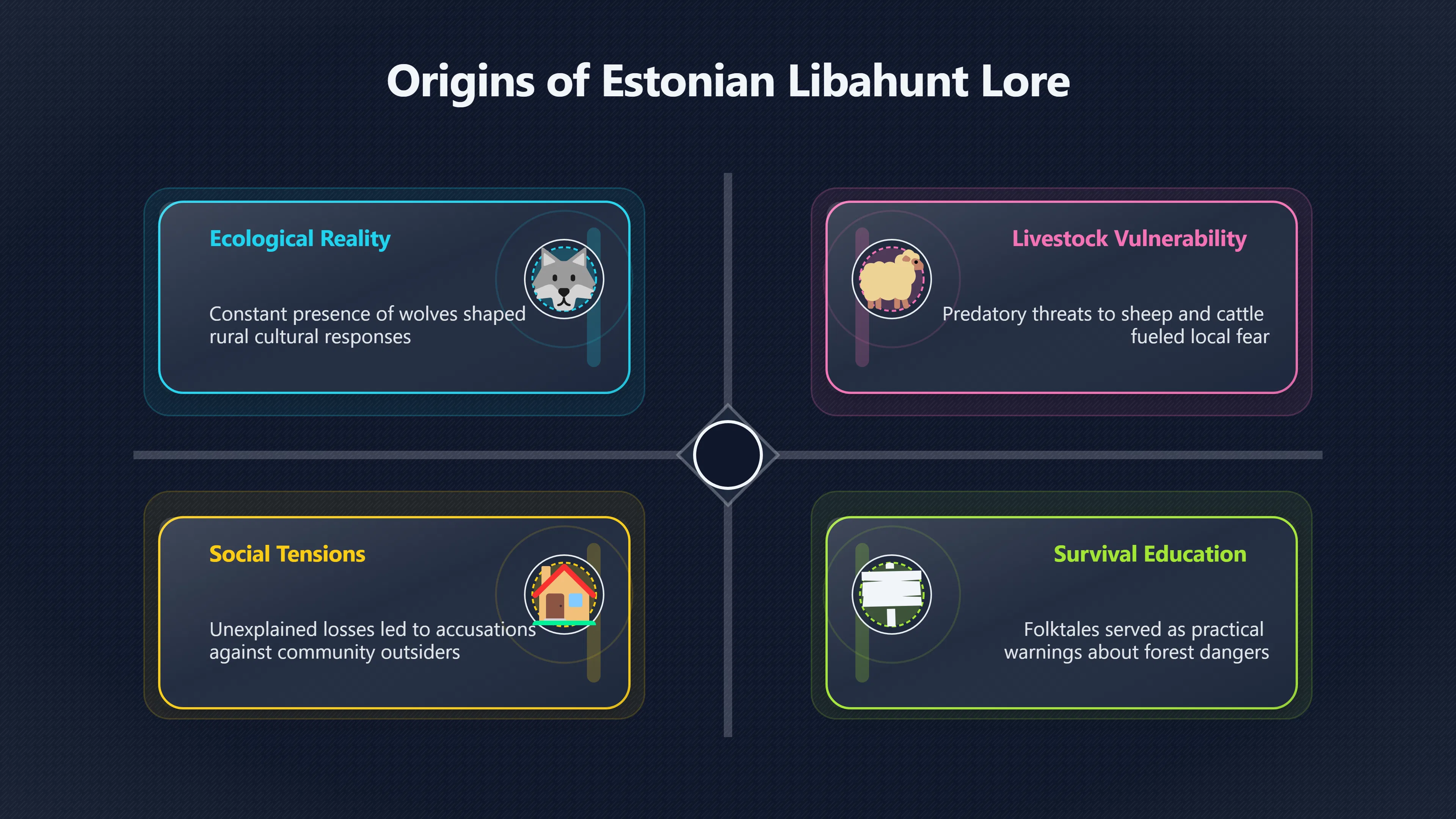
Estonian werewolf traditions make most sense when viewed alongside the country’s real predator history.
Estonia remains one of the few European countries where wolves, brown bears and Eurasian lynx all survive in significant numbers. Modern wildlife authorities continue to manage these populations through conservation and monitoring programmes.[kliimaministeerium.ee]kliimaministeerium.eeConservation and management plan for large carnivoresFebruary 14, 2024 — Since Estonia is a very small land area for populations of large carnivores, risk analysis and an action plan are nec…
Historically, however, encounters with wolves were more immediate than they are today. Livestock losses could threaten a family’s survival, especially during hard winters. Wolves were capable of killing sheep and other domestic animals, and rural communities spent generations developing practical and cultural responses to that threat.[Wolf Center]wolf.orgCenter Estonia | International Wolf CenterWolf CenterEstonia | International Wolf CenterOctober 11, 2007 — Estonia at a glance. Main prey for wolves here are ungulates (hooved ani…
The fear was not entirely imaginary. Historical accounts from the nineteenth century describe periods when wolf attacks on people were remembered as a genuine concern. Research discussed by the University of Tartu has highlighted records indicating that wolves attacked humans in Estonia far more frequently in earlier centuries than they do today. Modern explanations include changes in hunting pressure, prey availability and wolf behaviour.[ut.ee]blog.ut.ee140 Years Ago Wolves Still Ate People in EstoniaNovember 16, 2011 — 16 Nov 2011 — For the last century and a half, wolves haven't attacke…
In that environment, stories about people becoming wolves did not require a huge leap of imagination. The predator was already present, visible and dangerous.
When Werewolves Appeared in Courtrooms
One of the most revealing sources for Estonian and Livonian werewolf beliefs is not folklore but legal records.
Between the sixteenth and eighteenth centuries, authorities investigated numerous accusations involving werewolves. Modern researchers note that local peasant beliefs often differed sharply from the ideas held by German and Swedish officials who ran the courts. Villagers might describe a neighbour transforming into a wolf, while judges interpreted the same claim through the framework of witchcraft and dealings with the Devil.[Wikipedia]WikipediaWerewolf witch trialsWerewolf witch trials
This clash produced unusual trials. Confessions frequently included stories of magical transformation, hunting in wolf form or travelling with packs of werewolves. Some accused people claimed they had received a wolf skin, eaten enchanted food or learned secret techniques from another werewolf.[Wikipedia]WikipediaWerewolf witch trialsWerewolf witch trials
The famous 1640 trial of Kongla Ann, preserved in Tallinn archives, remains one of the best-known Estonian werewolf cases. Her story illustrates how accusations of shape-shifting could become entangled with broader fears about magic and social disorder.[Wikipedia]WikipediaKongla AnnKongla Ann
These records are valuable not because they prove werewolves existed, but because they reveal how seriously such ideas could be taken.

Misidentification, Accusation and Survival Stories
Many werewolf accusations probably grew from ordinary rural uncertainties.
When livestock disappeared, a predator was often responsible, but identifying exactly what had happened could be difficult. Wolves, lynx, dogs and scavengers might leave confusing traces. Folklore researchers have suggested that misunderstandings involving different predators sometimes fed into werewolf narratives.[UTLib OJS]ojs.utlib.eeThe… 3 In the Estonian Folklore Archives there are about 1400 werewolf texts that…Read more…
Social tensions also played a role. People who were outsiders, quarrelsome neighbours or individuals associated with folk healing could become targets of suspicion. In small agricultural communities, unexplained losses demanded explanations, and supernatural interpretations sometimes provided them.
Stories also helped communities pass on survival knowledge. A tale about a werewolf lurking near grazing animals reinforced caution around forests. A story about someone secretly becoming a predator warned listeners about hidden dangers and broken social norms. Folklore often worked as both entertainment and practical education.[arXiv]arxiv.orgSystematic quantitative analyses reveal the folk-zoological knowledge embedded in folktalesJuly 9, 2019…
Were Estonian Werewolves Really Wolves?
In a literal sense, there is no evidence that Estonian werewolf stories describe actual human transformation. The surviving material points instead to a mixture of folklore, court testimony, social anxiety and encounters with real predators.
Yet reducing the stories to simple superstition misses their significance. Estonia’s werewolf tradition emerged in a landscape where wolves were not mythical creatures but neighbours. People heard them, hunted them, lost livestock to them and occasionally feared them. The werewolf became a way of talking about the uncertain boundary between civilisation and wilderness, human behaviour and animal instinct, community and isolation.[researchgate.net]researchgate.netEstonian Werewolf History 207a wolf,72 partly because wolves were respected and it was believed that they were necessary for…
Modern Estonia still lives with wolves, though under very different conditions. Wildlife tourism now advertises the possibility of seeing wolves, bears and lynx, and contemporary guidance emphasises that wolves generally avoid people. That contrast is striking: the same animal that once inspired werewolf accusations and rural fear has become a symbol of successful large-carnivore survival.[visitestonia.com]visitestonia.comVisit EstoniaBears, lynx, wolves, and more: Wildlife watching in EstoniaJanuary 3, 2026 — 3 Jan 2026 — In general, wild animals in Estoni…
Seen in that light, Estonian werewolves were never simply monsters. They were cultural reflections of a society that lived close to real predators and used stories to make sense of the risks, mysteries and boundaries of life in the forest.[researchgate.net]researchgate.netEstonian Werewolf History 207a wolf,72 partly because wolves were respected and it was believed that they were necessary for…
Amazon book picks
Further Reading
Books and field guides related to Were Estonian Werewolves Really Wolves?. Use these as the next step if you want deeper reading beyond the article.
The Werewolf in Lore and Legend
Explains European werewolf beliefs similar to Estonian traditions.
Wolves and the Wilderness in the Middle Ages
Provides ecological and cultural context for wolf beliefs.
eBay marketplace picks
Marketplace Samples
Live-tested eBay searches with available results related to this page.



Endnotes
1.
Source: kliimaministeerium.ee
Title: Conservation and management plan for large carnivores
Link:https://kliimaministeerium.ee/sites/default/files/documents/2025-11/Large%20Carnivore%20action%20plan_EE_2022-2031.pdf
Source snippet
February 14, 2024 — Since Estonia is a very small land area for populations of large carnivores, risk analysis and an action plan are nec...
Published: February 14, 2024
2.
Source: keskkonnaamet.ee
Link:https://keskkonnaamet.ee/en/news/environmental-board-approved-new-action-plan-protection-and-management-large-carnivores-ten
Source snippet
The Environmental Board approved a new action plan for...22 Feb 2022 — The large carnivore protection and management plan now define a m...
3.
Source: ojs.utlib.ee
Link:https://ojs.utlib.ee/index.php/JEF/article/download/22636/17175/31031
Source snippet
The... 3 In the Estonian Folklore Archives there are about 1400 werewolf texts that...Read more...
4.
Source: researchgate.net
Link:https://www.researchgate.net/profile/Merili-Metsvahi/publication/286453441_Estonian_Werewolf_History/links/566a9b4b08aea0892c4a1a05/Estonian-Werewolf-History.pdf
Source snippet
Estonian Werewolf History 207a wolf,72 partly because wolves were respected and it was believed that they were necessary for...
5.
Source: Wikipedia
Title: Werewolf witch trials
Link:https://en.wikipedia.org/wiki/Werewolf_witch_trials
6.
Source: Wikipedia
Title: Werewolf fiction
Link:https://en.wikipedia.org/wiki/Werewolf_fiction
7.
Source: wolf.org
Title: Center Estonia | International Wolf Center
Link:https://wolf.org/wow/europe/estonia/
Source snippet
Wolf CenterEstonia | International Wolf CenterOctober 11, 2007 — Estonia at a glance. Main prey for wolves here are ungulates (hooved ani...
Published: October 11, 2007
8.
Source: blog.ut.ee
Link:https://blog.ut.ee/140-years-ago-wolves-still-ate-people-in-estonia/
Source snippet
140 Years Ago Wolves Still Ate People in EstoniaNovember 16, 2011 — 16 Nov 2011 — For the last century and a half, wolves haven't attacke...
Published: November 16, 2011
9.
Source: Wikipedia
Title: Kongla Ann
Link:https://en.wikipedia.org/wiki/Kongla_Ann
10.
Source: arxiv.org
Link:https://arxiv.org/abs/1907.03969
Source snippet
Systematic quantitative analyses reveal the folk-zoological knowledge embedded in folktalesJuly 9, 2019...
Published: July 9, 2019
11.
Source: researchgate.net
Title: 389320225 Continuing recovery of wolves in Europe
Link:https://www.researchgate.net/publication/389320225_Continuing_recovery_of_wolves_in_Europe
Source snippet
(PDF) Continuing recovery of wolves in Europe25 Feb 2025 — We provide a comprehensive update on wolf populations in Europe, estimated at...
12.
Source: folklore.ee
Title: M Tagused 40
Link:https://www.folklore.ee/tagused/nr40/summ.htm
Source snippet
MTagused 40 - SummaryIn Estonian folk medicine, wolf meat has been used to cure rheumatism; a person who ate its meat was believed to get...
13.
Source: manchesterhive.com
Link:https://www.manchesterhive.com/downloadpdf/9780719098192/9780719098192.00005.pdf
Source snippet
Manchester HiveEstonian werewolf legends collected from the island of...The texts about werewolves can be divided into two larger groups...
14.
Source: forums.forteana.org
Link:https://forums.forteana.org/index.php?attachments%2Fmetsvahi-merili-2022-estonian-and-livonian-werewolf-lore-and-the-forests-place-in-it-chan-pdf.79474%2F=
Source snippet
Fortean Times ForumEstonian and Livonian Werewolf Lore and the Forest's Place in ItAbstract – This chapter presents a short overview of t...
15.
Source: estonianworld.com
Title: 140 years ago wolves still ate people in estonia
Link:https://estonianworld.com/life/140-years-ago-wolves-still-ate-people-in-estonia/
Source snippet
140 years ago, wolves still ate people in Estonia2 May 2018 — One hundred and forty years ago, it was a common occurrence that wolves att...
Published: May 2018
16.
Source: wolfcenter.de
Link:https://wolfcenter.de/wp-content/uploads/2019/03/PDF_NINA_2002_The_fear_of_wolves__A_review_of_wolf_attacks_on_humans.pdf
Source snippet
The fear of wolves: A review of wolfs attacks on humans NINAby JDC Linnell · Cited by 340 — Wildlife management agencies should establish...
17.
Source: visitestonia.com
Link:https://visitestonia.com/en/what-to-do/bears-lynx-wolves-wildlife-watching-in-estonia
Source snippet
Visit EstoniaBears, lynx, wolves, and more: Wildlife watching in EstoniaJanuary 3, 2026 — 3 Jan 2026 — In general, wild animals in Estoni...
Published: January 3, 2026
18.
Source: estonianworld.com
Title: hunting in estonia law wildlife and a debate growing louder
Link:https://estonianworld.com/life/hunting-in-estonia-law-wildlife-and-a-debate-growing-louder/
Source snippet
Hunting in Estonia: law, wildlife and a debate growing louder4 Jan 2026 — Scientific assessments presented to the court indicated that, w...
Additional References
19.
Source: europarl.europa.eu
Link:https://www.europarl.europa.eu/cmsdata/191585/IPOL_STU%282018%29617488_EN%20AGRI-original.pdf
Source snippet
European ParliamentThe revival of wolves and other large predators and its impact...In the last few decades populations of large carnivo...
20.
Source: facebook.com
Link:https://www.facebook.com/EstonianWorld/posts/-wolves-bears-and-the-lawas-large-carnivores-thrive-in-estonias-forests-court-ru/1447303847400790/
Source snippet
Hunting in Estonia: law, wildlife and a debate growing louderEstonia's Environmental Agency has set the cull quota at 144, claiming there...
21.
Source: lciepub.nina.no
Link:https://lciepub.nina.no/pdf/635379340188248258_LC_action%20plan_Estonia_2012-2021.pdf
Source snippet
nina.nono. 12Renewing activities in the large carnivore action plan (I). The composed plan defines conservation and management scheme for...
22.
Source: facebook.com
Title: He shocked the court by agreeing, saying that as a ‘Hound of God’ it was his
Link:https://www.facebook.com/OfficialQI/posts/in-17th-century-estonia-an-elderly-man-was-accused-of-being-a-werewolf-he-shocke/1032312385602383/
Source snippet
In 17th-century Estonia, an elderly man was accused of...In 17th-century Estonia, an elderly man was accused of being a werewolf...
23.
Source: scribd.com
Link:https://www.scribd.com/doc/288033361/Estonian-Werewolf-Legends-Collected-From
Source snippet
ed (including quotations from primary and secondary sources) by...Read more...
24.
Source: findingestonia.com
Title: the werewolf people
Link:https://www.findingestonia.com/post/the-werewolf-people
Source snippet
16 Dec 2025 — At one time the people who lived in what is now Lithuania, Latvia and Estonia were known as “the werewolf people”, by neigh...
25.
Source: youtube.com
Title: The Werewolf Trials of Estonia – Fear or Fake
Link:https://www.youtube.com/watch?v=fmaQnZpyFj0
Source snippet
Estonian folklore libahunt werewolf Exploring Estonia's Mysterious Werewolf History and Werewolves Culture Connect Paranormal...
26.
Source: youtube.com
Title: Exploring Estonia’s Mysterious Werewolf History and Werewolves Culture
Link:https://www.youtube.com/watch?v=KYkVv06tXzY
Source snippet
The dark history of werewolves - Craig Thomson...
27.
Source: beastsoflegend.com
Title: libahunt estonia
Link:https://beastsoflegend.com/bestiary/europe/libahunt-estonia/
Source snippet
Libahunt Werewolf of Estonia12 May 2026 — Estonia's Libahunt is a liminal werewolf—protector, trickster, or predator—bridging village and...
Published: May 2026
28.
Source: youtube.com
Title: The dark history of werewolves
Link:https://www.youtube.com/watch?v=VP0fd2be71s
Source snippet
Estonian Mythology ~ Kalevipoeg, Linda & Kalev...
Topic Tree