Does Turkmenistan Have a Monster of Its Own?
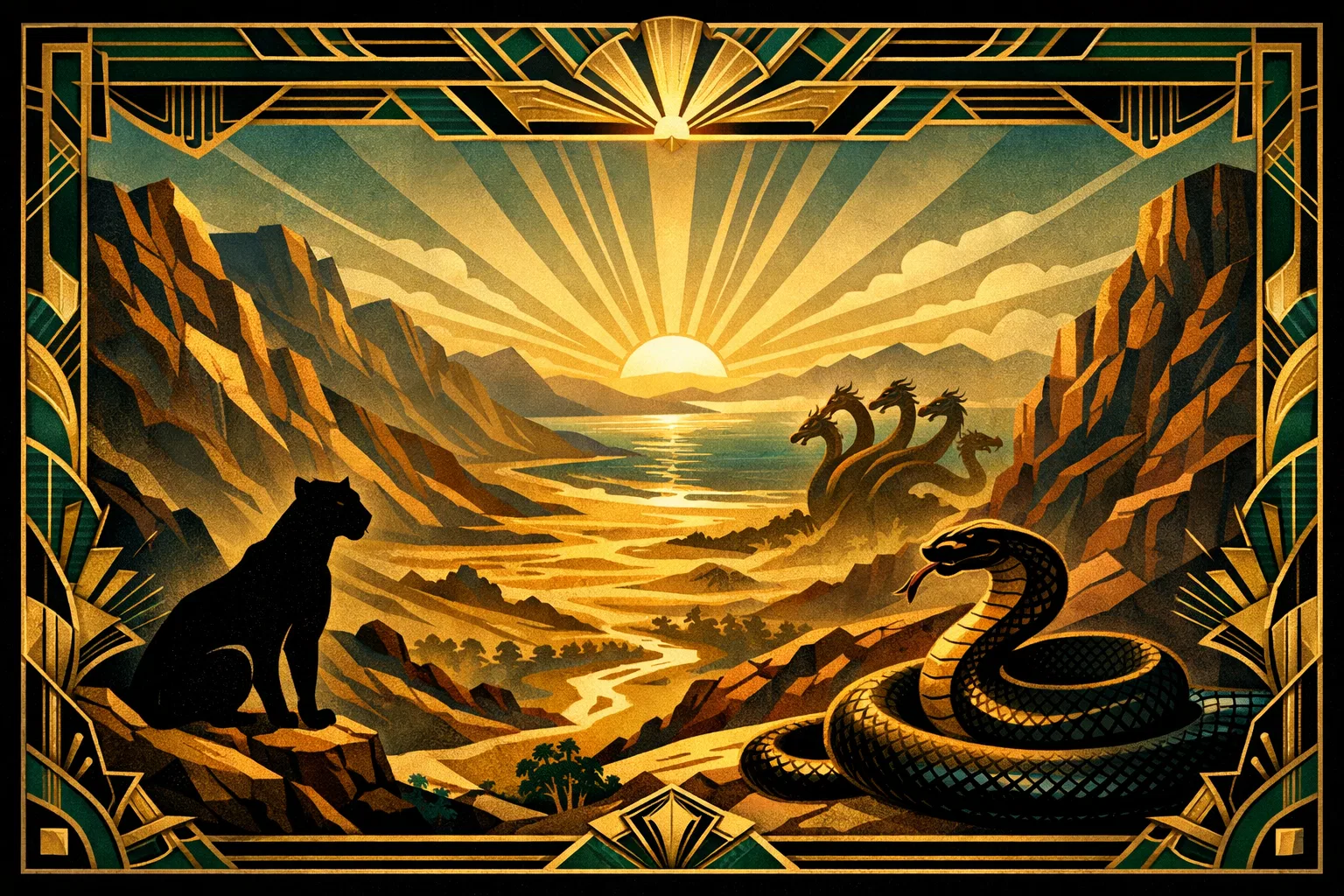
Turkmenistan does not appear to have a single, well-documented national cryptid comparable with Scotland’s Loch Ness Monster or the Himalayan yeti.
Page outline Jump by section
Introduction
That distinction matters. Stories of giants, dragons and other threatening beings are genuine folklore, but they are not necessarily records of unidentified animals. Meanwhile, Persian leopards, large reptiles, Caspian seals and sturgeon can look extraordinary without being unknown to science. Even the famous “Caspian Sea Monster” was not an animal at all, but a gigantic Soviet experimental craft. Turkmenistan’s mystery-beast history is therefore less a catalogue of sightings than a study in how folklore, isolation, rare wildlife and evocative landscapes create the conditions for cryptid stories.
Why Turkmenistan has no famous headline cryptid
A search across accessible English-language reporting, academic material, conservation records and folklore summaries produces no strong trail of recurring eyewitness accounts centred on one named Turkmen creature. There is no clear sequence of dated sightings, independently recorded witnesses, physical traces and sustained newspaper coverage of the kind normally found around established cryptid legends.
This absence should not be mistaken for proof that no local mystery-animal stories exist. Turkmenistan has an exceptionally restricted media environment. Reporters Without Borders states that the country’s domestic media are state-owned and financed, while independent Turkmen outlets operate mainly from abroad. Research into internet filtering has likewise documented extensive censorship and limited online access. Informal village stories, unexplained livestock incidents or unusual wildlife encounters may therefore leave little searchable public record.[Reporters Without Borders]rsf.orgReporters Without BordersTurkmenistanAll media, most of them created by Saparmurat Niyazov, president until his death in 2006, belong to…
Even allowing for that gap, it would be misleading to manufacture a Turkmen cryptid from scattered regional traditions. Central Asian wild-man stories, for example, are well attested in Mongolia, Kazakhstan, Kyrgyzstan and the Pamirs, but the available comparative literature does not establish Turkmenistan as an important sighting centre. The Kopet Dag may look like ideal “wild man” country, yet atmosphere and geographical plausibility are not evidence of a local population or legend.[ResearchGate]researchgate.netResearch Gate(PDF) Wildmen in Central AsiaResearchGate(PDF) Wildmen in Central AsiaJuly 20, 2017 — 8 Aug 2017 — We focus here on the wildmen in Mongolia, Kazakstand, and Kyrgyzsta…
Turkmenistan is therefore best understood as a country with strong monster folklore and cryptid-like environments, rather than a country dominated by one modern mystery beast.
The monsters that belong to folklore
Traditional Turkmen tales contain beings that would look familiar to readers of wider Persian and Turkic folklore: gigantic ogres, dragons, magical predators and shape-changing supernatural figures. An accessible account of Turkmen fairy-tale publishing identifies divs and dragons among the recurring characters, with the div usually representing a hostile power that captures or opposes human figures.[orient.tm]orient.tmIts characters are divs, peri, dragons.Read moreBewitching world of Turkmen fairy talesJanuary 3, 2020 — 3 Jan 2020 — The world of bewitching Turkmen fairy tales closely relates to the…
These beings should be treated as story characters, not zoological reports. Their purpose is generally moral, dramatic or symbolic. They block a hero’s path, imprison someone, guard a place or embody disorder. Their behaviour follows narrative rules rather than animal ecology.
The broader traditions surrounding Turkmen culture help explain their forms:
- Divs are ogre-like adversaries. In Persian and neighbouring traditions, divs may appear as giants, demons, sorcerers or monsters. They can be brutal but also foolish, magical or occasionally compelled to help a hero.[Iranica Online]iranicaonline.orgIranica Online DĪVIranica OnlineDĪV - Encyclopaedia IranicaDīv in the folktales. Many demons figure in Iranian folktales (Marzolph, s.v. daemon). They may…
- Dragons often control land or water. Across Turkic story traditions, a dragon may guard a spring, cause drought or threaten people and animals until defeated. This makes it a powerful symbol in dry pastoral landscapes where access to water determines survival.[Küre Encyclopedia]kureansiklopedi.comKüre Encyclopedia The Dragon Motif in Turkish MythologyKüre EncyclopediaThe Dragon Motif in Turkish MythologyDecember 8, 2025 — 8 Dec 2025 — In folktales, it is often depicted as a giant-like…
- Seven-headed monsters belong to a wider storytelling pattern. The number seven carries particular force in Turkmen ritual and narrative culture, appearing repeatedly in fairy tales, epics and legends. A many-headed beast is therefore partly a creature and partly a storytelling formula: each extra head magnifies danger and the hero’s achievement.[hos.openjournals.ge]hos.openjournals.geMythological Number Seven In Turkmen CultureMythological Number Seven In Turkmen Culture
This is where some internet cryptid catalogues become unreliable. A dragon mentioned in a fairy tale is not automatically a claimed surviving reptile. A div is not necessarily a folk memory of an unknown hominin. Moving directly from symbolic narrative to biological speculation strips the story of its cultural function and creates evidence that was never present.
Could real animals have fed the stories?
Turkmenistan contains enough large, elusive and unfamiliar wildlife to generate startling encounters. A person seeing an animal briefly at dusk, through dust or across a ravine may report something much stranger than what was actually present.
Persian leopards in the Kopet Dag
The most convincing candidate for a modern “phantom beast” experience is the Persian leopard. These large cats survive in Turkmenistan, particularly in the Kopet Dag and other mountainous border regions adjoining Iran. Conservation assessments have treated Turkmenistan as one of the species’ most important remaining Central Asian ranges, although population estimates vary and should be regarded as approximate.[CMS]cms.intConservation of Persian Leopard in TurkmenistanConservation of Persian Leopard in Turkmenistan
A leopard is an ideal engine for mystery reports. It is powerful, mostly solitary, active when visibility is poor and capable of moving through rocky country without being seen. An observer may notice only reflected eyes, a long tail, a large paw print or the remains of livestock. Distance can make a spotted coat appear uniformly dark, encouraging descriptions of a “black” or shadow-like cat even where no melanistic animal has been demonstrated.
Yet this is not evidence for a distinct Turkmen phantom-cat cryptid. It is evidence that a genuinely rare predator can produce fragmentary, emotionally charged encounters. Camera traps, tracks, prey remains and repeated biological surveys place these animals within ordinary zoology, however extraordinary an individual sighting may feel.
Bears, hyenas and other returning animals
The mountains also hold species that many residents may seldom see. Camera traps in the Syunt-Hasardag area have recorded a brown bear whose presence might otherwise have been treated as uncertain or anecdotal. Such cases show how a real animal can seem almost legendary when numbers are low and direct encounters are rare.[News Central Asia (nCa)]newscentralasia.netNews Central Asia (n Ca)Nature's Chronicle: How Turkmenistan Preserves ItsNews Central Asia (n Ca)Nature's Chronicle: How Turkmenistan Preserves Its
Striped hyenas, caracals, lynx and wild sheep offer similar possibilities. A hyena seen at night can appear sloping-backed and oddly proportioned. A caracal’s long ear tufts can create a horned silhouette. A group of mountain sheep crossing broken ground may appear to merge into one large, many-limbed shape. None of these explanations can solve a sighting that was never properly recorded, but they demonstrate why “unknown creature” should not be the first conclusion.
Snakes and desert monitors
Turkmenistan supports a rich reptile fauna, including large vipers and desert monitor lizards. The blunt-nosed viper can reportedly reach about 1.7 metres, while monitors have long necks, muscular bodies and powerful tails. In poor light, a monitor moving between rocks can look more serpentine than lizard-like; a snake viewed without a scale reference can be greatly overestimated.[Turkmenistan Government]turkmenistan.gov.tmTurkmenistan Government Cold-blooded creatures awaken from hibernationTurkmenistan Government Cold-blooded creatures awaken from hibernation
Desert conditions make size errors especially likely. Heat shimmer distorts outlines, while sparse vegetation removes familiar objects that might help an observer judge distance. A metre-long reptile nearby and a much larger animal farther away can occupy the same apparent angle of vision.
These mechanisms offer a grounded route from wildlife to dragon-like description. They do not prove that every dragon story began with a snake or monitor, but they explain why reptilian monsters remain intuitively at home in Turkmenistan’s rocky gorges and deserts.
The Caspian Sea: monsters, seals and giant fish
Turkmenistan’s western boundary lies on the Caspian Sea, a vast enclosed body of water with unusual fauna and an established history of dramatic “monster” language. However, no well-supported Turkmen lake- or sea-monster tradition emerges from the available record.
The best-known phrase, “Caspian Sea Monster,” is a technological nickname. It refers to the KM, a huge Soviet ground-effect vehicle developed in the 1960s. The craft travelled just above the water and appeared so strange in surveillance imagery that Western observers gave it a creature-like label. It was a secret machine, not an unidentified organism.[Wikipedia]WikipediaCaspian Sea MonsterCaspian Sea Monster
The name nevertheless illustrates how easily monster folklore attaches itself to the Caspian. A colossal object appears on or above an isolated sea; observers lack context; a memorable label fills the gap.
Real Caspian animals could produce similar reactions:
Caspian seals are the sea’s only native marine mammals. A seal lifting its head vertically from the water, especially at distance, can resemble the classic “neck and head” profile of a small lake monster. Groups travelling in line may appear to be the humps of one long creature.[IW:LEARN]archive.iwlearn.netOpen source on iwlearn.net.
Sturgeon provide an even stronger monster silhouette. These ancient-looking fish can grow large, with elongated bodies, bony plates and pointed snouts. Their rarity now makes encounters more surprising, while dead specimens washed ashore may look grotesque after decomposition. Caspian mass-mortality events have produced photographs of large sturgeon and seals on beaches, exactly the sort of image that can be detached from its source and recirculated online as a “mystery carcass”.[RadioFreeEurope/RadioLiberty]rferl.orgOpen source on rferl.org.
Waves, floating debris and animal groups complete the explanation set. The central and southern Caspian can experience significant waves, and low viewing angles make ordinary wakes appear elongated or segmented. A line of swimming birds, seals surfacing in sequence or debris rising and falling in swell can briefly imitate a serpentine body.[arXiv]arxiv.orgOpen source on arxiv.org.
None of this rules out every unexplained observation. It does show that a credible Caspian monster claim would require more than a distant shape or ambiguous photograph. Location, duration, scale, movement, weather, independent witnesses and the original image file would all matter.
Koytendag: where legends meet deep time
The Koytendag Mountains in eastern Turkmenistan provide the country’s most convincing real-world “lost world”. The region contains caves, isolated habitats and a celebrated plateau preserving dinosaur tracks. UNESCO’s tentative-list description presents Koytendag as a comparatively isolated natural complex with exceptional geological and biological features.[UNESCO World Heritage Centre]whc.unesco.orgOpen source on unesco.org.
The dinosaur footprints are especially important to Turkmenistan’s monster history because local people knew about the tracks before modern scientific study. Large three-toed impressions in stone naturally invite stories about giants, enormous birds or other extraordinary beings. Later geological work identified them as dinosaur trackways rather than evidence of a recently living monster.
This is a useful example of folklore and science complementing rather than cancelling one another. The traditional interpretation preserved attention around a remarkable site. Palaeontology then supplied a different timescale and explanation. What looked like the footprint of a legendary beast became evidence that genuinely enormous animals had crossed the region in the Jurassic period.
Koytendag’s cave systems add another layer. Biological surveys have found species new to science or previously unrecorded in Turkmenistan, including highly specialised cave invertebrates. In 2017 researchers described an unusual cave-dwelling animal representing a new genus, while later surveys reported further discoveries involving springtails, millipedes, spiders and scorpions.[eurekalert.org]eurekalert.orgnews releasesnews releases
These discoveries are sometimes used to argue that any monster could remain hidden underground. That overstates the evidence. Small cave animals can persist in tiny, specialised habitats on very limited food. A large unknown predator would require far more energy, breeding space and prey, and would be expected to leave bones, droppings, tracks or environmental DNA. Koytendag demonstrates that undiscovered species remain possible; it does not make every scale of undiscovered animal equally plausible.
Why the landscape encourages monster stories
Turkmenistan combines several environments that repeatedly generate cryptid traditions elsewhere: extensive desert, sparsely populated mountains, caves, salt depressions and a vast inland sea. These places limit visibility and make ordinary animals difficult to observe well.
The Karakum Desert is particularly effective at turning perception into mystery. Dust, darkness and heat haze obscure colour and distance. Nocturnal mammals appear briefly in headlights and vanish. Wind can erase tracks within hours. Sounds travel unpredictably across open ground, separating a call from its source.
The Kopet Dag adds deep ravines and broken slopes where a leopard, bear or wild goat can disappear after a few steps. Koytendag contributes caves and prehistoric footprints. The Caspian coast supplies fog, surf, carcasses and large aquatic animals. Together, these habitats create compelling settings even in the absence of a recognised cryptid.
There is also a psychological effect. People interpret an ambiguous sight using the stories available to them. In a culture with dragons, giants and supernatural predators, a half-seen reptile or large cat may be remembered in those terms. Later retellings tend to sharpen the most dramatic details while dropping uncertainty: “I could not identify it” becomes “it was unlike any known animal”.
Folklore, witness claim or zoology?
The clearest way to assess a Turkmen monster story is to identify what kind of account it actually is.
A folklore narrative usually has a hero, a moral structure and supernatural events. Its creature may speak, cast spells, guard treasure or possess several heads. Such a story is evidence of cultural tradition, not automatically of an animal sighting.
A witness claim should be tied to a person, place and date. Useful reports describe distance, duration, lighting, behaviour and nearby known wildlife. Anonymous retellings without an original source are weak evidence, however vivid the creature description.
A media invention or mistranslation often has a dramatic label but little local foundation. The “Caspian Sea Monster” is the perfect warning: the wording sounds zoological, while the underlying object was mechanical.
A misidentification begins with a real observation but assigns it the wrong cause. Leopards, hyenas, monitors, snakes, seals and sturgeon are all capable of looking unfamiliar under poor conditions.
A genuinely unresolved case would remain after these categories had been tested. It would ideally include several independent witnesses, clear original imagery, physical traces examined by specialists and repeated observations in a defined area. No Turkmen case located in the accessible record currently meets that standard.
Tourism and the modern afterlife of the strange
Turkmenistan’s unusual landscapes are more often marketed through real wonders than through cryptid branding. Tours to Koytendag emphasise dinosaur footprints, caves, canyons and biological isolation. The appeal resembles “monster tourism” in one respect: visitors are invited into a landscape where enormous or unfamiliar creatures once existed and where new species may still be found.[Ayan Travel Agency Turkmenistan]ayan-turkmenistan.travelOpen source on ayan-turkmenistan.travel.
The difference is that the central attraction has physical evidence. The dinosaur tracks are visible geological remains, not a disputed photograph. Cave species can be collected, described and compared. Persian leopards can be documented by cameras and genetic material even when tourists never see one.
That evidence-based strangeness may ultimately be Turkmenistan’s most distinctive contribution to a country-by-country cryptid project. It offers no famous monster hunt, but it does provide a rich borderland between mythic beasts and remarkable zoology: dragons in oral tradition, giant footprints turned to stone, rare cats moving through the Kopet Dag, ancient fish beneath the Caspian and tiny animals surviving in caves cut off from daylight.
What remains genuinely unresolved
The main mystery is not whether a specific monster exists. It is how much local creature folklore remains undocumented or inaccessible outside Turkmenistan.
Published summaries confirm a broad tradition of dragons, divs and other fantastic beings, but detailed English-language collections are limited. Restricted journalism and internet access make it difficult to trace local sighting rumours, compare versions or determine whether particular stories are old traditions, recent inventions or imports from neighbouring countries.[academia.edu]academia.eduPDF) Demidov S.M. Plants and animals in the Turkmen'sPDF) Demidov S.M. Plants and animals in the Turkmen's
The responsible conclusion is therefore modest. Turkmenistan has a substantial heritage of legendary creatures and several environments capable of producing convincing mystery-animal encounters. It also shelters rare species and biologically underexplored places. What it does not presently have, in the accessible evidence, is a securely documented modern cryptid with a stable name, repeated sighting history and distinct national identity.
Its strangest creatures remain divided between two worlds: monsters that belong to storytelling, and real animals remarkable enough to seem legendary.
eBay marketplace picks
Marketplace Samples
Live-tested eBay searches with available results related to this page.

![Listing image for The Cute Monsters Doll Character Action Figure Collectible Toys [Random Colour]](/assets/images/marketplace-covers/29f5d3d446a0ddba82a6.jpg)

Endnotes
1.
Source: arxiv.org
Link:https://arxiv.org/abs/2304.04835
2.
Source: researchgate.net
Title: Research Gate(PDF) Wildmen in Central Asia
Link:https://www.researchgate.net/publication/318563173_Wildmen_in_Central_Asia
Source snippet
ResearchGate(PDF) Wildmen in Central AsiaJuly 20, 2017 — 8 Aug 2017 — We focus here on the wildmen in Mongolia, Kazakstand, and Kyrgyzsta...
Published: July 20, 2017
3.
Source: unesco.org
Title: Kopet Dag
Link:https://www.unesco.org/en/mab/kopet-dag
Source snippet
Kopet Dag - Man and the Biosphere Programme (MAB)The Kopet Dag is a chain of mountains between the Balkans and the plateaus of Iran...
4.
Source: orient.tm
Title: Its characters are divs, peri, dragons.Read more
Link:https://orient.tm/en/posts/5313
Source snippet
Bewitching world of Turkmen fairy talesJanuary 3, 2020 — 3 Jan 2020 — The world of bewitching Turkmen fairy tales closely relates to the...
Published: January 3, 2020
5.
Source: hos.openjournals.ge
Title: Mythological Number Seven In Turkmen Culture
Link:https://hos.openjournals.ge/index.php/hos/article/download/7828/7780/13177
6.
Source: cms.int
Title: Conservation of Persian Leopard in Turkmenistan
Link:https://www.cms.int/sites/default/files/document/Conservation%20of%20PeLe%20in%20Turkmenistan.pdf
7.
Source: researchgate.net
Title: 362889852 Status of Persian leopards in northern Iran and Central Asia
Link:https://www.researchgate.net/publication/362889852_Status_of_Persian_leopards_in_northern_Iran_and_Central_Asia
8.
Source: Wikipedia
Title: Caspian Sea Monster
Link:https://en.wikipedia.org/wiki/Caspian_Sea_Monster
9.
Source: archive.iwlearn.net
Link:https://archive.iwlearn.net/caspianenvironment.org/newsite/Caspian-Biodiversity3.htm
10.
Source: arxiv.org
Link:https://arxiv.org/abs/1912.00615
11.
Source: whc.unesco.org
Link:https://whc.unesco.org/en/tentativelists/5434/
12.
Source: eurekalert.org
Title: news releases
Link:https://www.eurekalert.org/news-releases/788322
13.
Source: ab.pensoft.net
Link:https://ab.pensoft.net/article/37858/
14.
Source: academia.edu
Title: (PDF) Demidov S.M. Plants and animals in the Turkmen’s
Link:https://www.academia.edu/98950310/Demidov_S_M_Plants_and_animals_in_the_Turkmen_s_legends_and_beliefs
15.
Source: Wikipedia
Title: Wild man
Link:https://en.wikipedia.org/wiki/Wild_man
16.
Source: Wikipedia
Title: Turkic mythology
Link:https://en.wikipedia.org/wiki/Turkic_mythology
17.
Source: Wikipedia
Title: List of dragons in mythology and folklore
Link:https://en.wikipedia.org/wiki/List_of_dragons_in_mythology_and_folklore
18.
Source: Wikipedia
Title: List of Turkic mythological figures
Link:https://en.wikipedia.org/wiki/List_of_Turkic_mythological_figures
19.
Source: Wikipedia
Title: List of cryptids
Link:https://en.wikipedia.org/wiki/List_of_cryptids
20.
Source: Wikipedia
Title: Div (mythology)
Link:https://en.wikipedia.org/wiki/Div_%28mythology%29
21.
Source: Wikipedia
Title: Wildlife of Turkmenistan
Link:https://en.wikipedia.org/wiki/Wildlife_of_Turkmenistan
22.
Source: Wikipedia
Title: Dinosaur Plateau
Link:https://en.wikipedia.org/wiki/Dinosaur_Plateau
23.
Source: unesdoc.unesco.org
Link:https://unesdoc.unesco.org/ark%3A/48223/pf0000135092
24.
Source: ich.unesco.org
Title: the epic of samba gueladio 01692
Link:https://ich.unesco.org/en/RL/the-epic-of-samba-gueladio-01692
25.
Source: unesdoc.unesco.org
Link:https://unesdoc.unesco.org/ark%3A/48223/pf0000184390
26.
Source: ich.unesco.org
Title: ITH 11 6.CO M CONF.206 Decisions EN.doc
Link:https://ich.unesco.org/doc/src/ITH-11-6.COM-CONF.206-Decisions-EN.doc
27.
Source: unesdoc.unesco.org
Link:https://unesdoc.unesco.org/ark%3A/48223/pf0000053899
28.
Source: unesdoc.unesco.org
Link:https://unesdoc.unesco.org/ark%3A/48223/pf0000119004
29.
Source: unesdoc.unesco.org
Link:https://unesdoc.unesco.org/ark%3A/48223/pf0000111664
30.
Source: whc.unesco.org
Link:https://whc.unesco.org/uploads/nominations/1372.pdf
31.
Source: ich.unesco.org
Title: LHE 24 19.CO M 7.b EN.docx
Link:https://ich.unesco.org/doc/src/LHE-24-19.COM-7.b_EN.docx
32.
Source: unesdoc.unesco.org
Link:https://unesdoc.unesco.org/ark%3A/48223/pf0000392548
33.
Source: whc.unesco.org
Link:https://whc.unesco.org/en/tentativelists/6898/
34.
Source: researchgate.net
Link:https://www.researchgate.net/publication/392349025_The_Turkmen_people%27s_traditions_associated_with_the_golden_eagle
35.
Source: researchgate.net
Title: 339004314 Rapid assessments of wildlife in Turkmenistan 2018
Link:https://www.researchgate.net/publication/339004314_Rapid_assessments_of_wildlife_in_Turkmenistan_2018
36.
Source: researchgate.net
Link:https://www.researchgate.net/publication/396230874_Two_new_cavernicolous_species_of_Entomobryidae_Collembola_from_Turkmenistan_Central_Asia
37.
Source: time.com
Title: furry sea monster washes up russia
Link:https://time.com/5370051/furry-sea-monster-washes-up-russia/
38.
Source: academia.edu
Link:https://www.academia.edu/66908691/Transformation_of_giant_creatures_in_the_Caucasian_mythology
39.
Source: rsf.org
Link:https://rsf.org/en/country/turkmenistan
Source snippet
Reporters Without BordersTurkmenistanAll media, most of them created by Saparmurat Niyazov, president until his death in 2006, belong to...
40.
Source: iranicaonline.org
Title: Iranica Online DĪV
Link:https://www.iranicaonline.org/articles/div/
Source snippet
Iranica OnlineDĪV - Encyclopaedia IranicaDīv in the folktales. Many demons figure in Iranian folktales (Marzolph, s.v. daemon). They may...
41.
Source: kureansiklopedi.com
Title: Küre Encyclopedia The Dragon Motif in Turkish Mythology
Link:https://kureansiklopedi.com/en/detay/the-dragon-motif-in-turkish-mythology-d5360
Source snippet
Küre EncyclopediaThe Dragon Motif in Turkish MythologyDecember 8, 2025 — 8 Dec 2025 — In folktales, it is often depicted as a giant-like...
Published: December 8, 2025
42.
Source: newscentralasia.net
Title: News Central Asia (n Ca)Nature’s Chronicle: How Turkmenistan Preserves Its
Link:https://www.newscentralasia.net/2025/07/08/natures-chronicle-how-turkmenistan-preserves-its-unique-ecosystems/
43.
Source: turkmenistan.gov.tm
Title: Turkmenistan Government Cold-blooded creatures awaken from hibernation
Link:https://www.turkmenistan.gov.tm/en/post/82554/cold-blooded-creatures-awaken-hibernation
44.
Source: ayan-turkmenistan.travel
Title: Ayan Travel Agency Turkmenistan Wildlife of the Karakum desert in Turkmenistan
Link:https://ayan-turkmenistan.travel/wildlife-of-the-karakum.html
45.
Source: rferl.org
Link:https://www.rferl.org/a/kazakhstan-caspian-seal-endangered/31852990.html
46.
Source: turkmenistan.gov.tm
Title: new species cave fauna discovered koytendag
Link:https://www.turkmenistan.gov.tm/en/post/52468/new-species-cave-fauna-discovered-koytendag
47.
Source: ayan-turkmenistan.travel
Link:https://ayan-turkmenistan.travel/tours/ayan-travel/koytendag-mountains-and-dinosaur-plateau
48.
Source: kureansiklopedi.com
Title: turkish mythology 6b5dd
Link:https://kureansiklopedi.com/en/detay/turkish-mythology-6b5dd
49.
Source: kureansiklopedi.com
Title: yelbegen e500e
Link:https://kureansiklopedi.com/en/detay/yelbegen-e500e
50.
Source: hrw.org
Link:https://www.hrw.org/world-report/2025/country-chapters/turkmenistan
51.
Source: theusajournals.com
Link:https://theusajournals.com/index.php/ajps/article/download/6605/6146/8744
52.
Source: jstor.org
Link:https://www.jstor.org/stable/1179054
53.
Source: essentialhistoryandmythology.wordpress.com
Link:https://essentialhistoryandmythology.wordpress.com/2025/04/17/divs/
Additional References
54.
Source: youtube.com
Title: What happened to the Ekranoplan?
Link:https://www.youtube.com/watch?v=x22nVFTd8nI
Source snippet
The Camel and the Mouse – A Turkmen Fairy Tale...
55.
Source: youtube.com
Title: The Monster Airplane the US had Never Seen Before
Link:https://www.youtube.com/watch?v=D40DLmdSNeQ
Source snippet
What happened to the Ekranoplan? - The Caspian Sea Monster...
56.
Source: uzresearchers.com
Link:https://uzresearchers.com/index.php/stj/article/download/4906/5298/9684
57.
Source: history.co.uk
Link:https://www.history.co.uk/articles/strange-sea-serpent-sightings-from-history
58.
Source: islamawareness.net
Link:https://www.islamawareness.net/CentralAsia/Turkmenistan/turkmenistan_article0001.pdf
59.
Source: reddit.com
Link:https://www.reddit.com/r/mongolia/comments/1igmg8p/about_the_almas_the_mongolian_wildman/
60.
Source: ijmrd.in
Link:https://www.ijmrd.in/index.php/imjrd/article/view/3357
61.
Source: caspianpost.com
Link:https://caspianpost.com/stories/does-the-caspian-sea-monster-really-exist
62.
Source: largelandscapes.org
Link:https://largelandscapes.org/news/connecting-leopards/
63.
Source: geotoys.com
Link:https://geotoys.com/blogs/geotoys-blog/cryptids-across-continents-global-legends-of-mystery-and-myth?srsltid=AfmBOop9_-eweXkHvurOic7IlbK4scXYW4QI6G9dUEofkKw1l-KJKMdL
Topic Tree
Follow this branch
Related pages 192
- Antigua Cryptids
- Maldives Monsters
- Malta Monsters
- Qatar Monsters
- Argentina Monsters
- +187 more in sidebar