Cryptids of the Dutch Landscape
The Netherlands has no single national monster on the scale of the Loch Ness Monster or Bigfoot.
Page outline Jump by section
Introduction
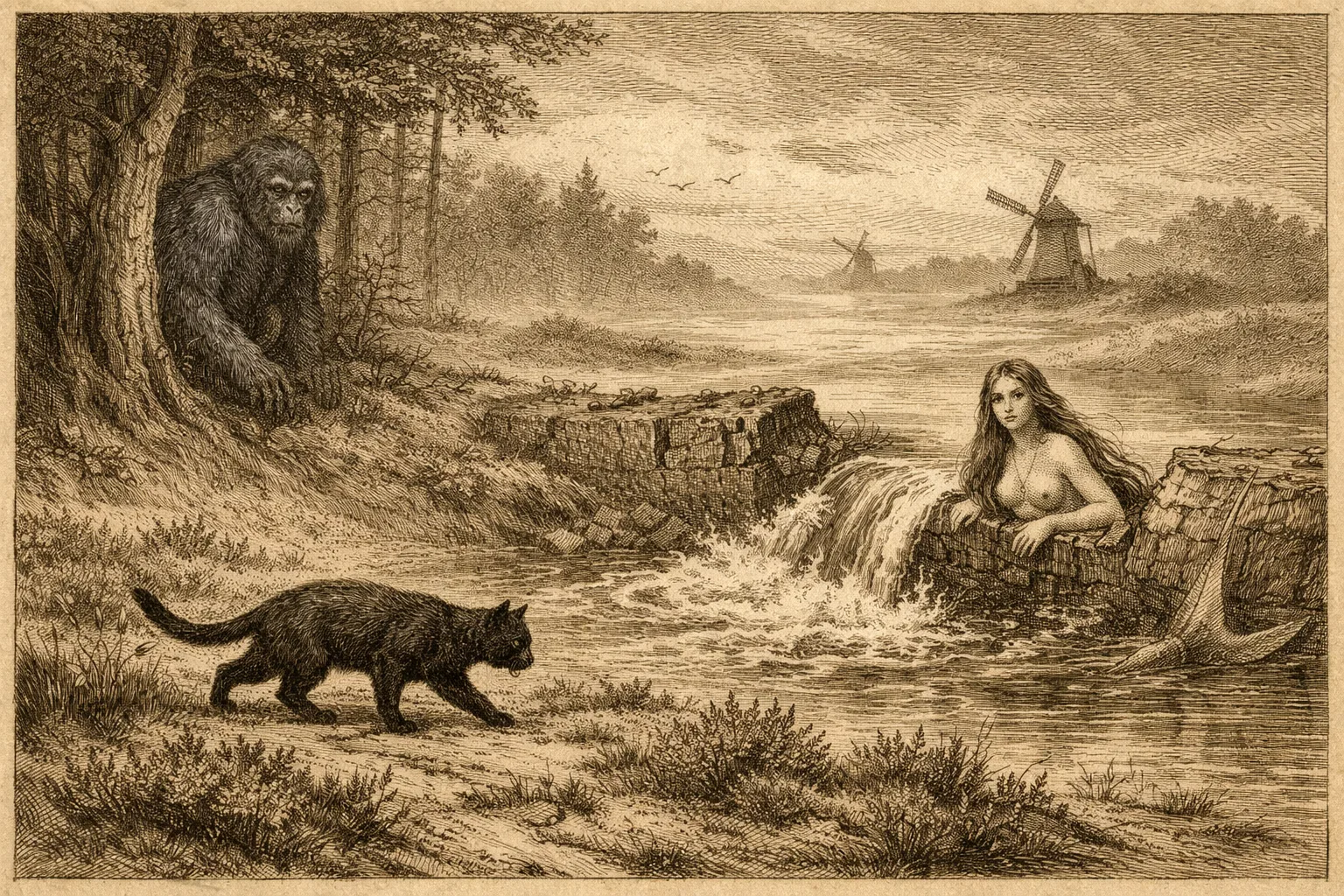
That makes the Netherlands especially interesting for cryptid history. The country’s monster traditions often sit at the border between practical warning, local pride, environmental memory and mistaken wildlife. Its lowlands, canals, reclaimed lakes, forests and storm-battered coasts produced stories that feel less like remote wilderness horror and more like the uncanny breaking into a managed, densely populated landscape.
Why Dutch creature lore feels different
Many famous cryptid traditions depend on vast, hard-to-search terrain: deep lochs, empty forests, mountain ranges or tropical swamps. The Netherlands is different. It is compact, intensively mapped and densely inhabited, so a surviving population of large unknown animals would be difficult to hide for long. That does not kill mystery-beast folklore; it changes its flavour. Dutch stories often ask what happens when the wild seems to intrude into a landscape people believe they have organised.
The Veluwe is the clearest example. It is one of the Netherlands’ best-known wildlife areas, associated with red deer, roe deer, wild boar, foxes and badgers, and promoted as a place where visitors can look for the “Big Five” of Dutch nature.[veluwe.nl]veluwe.nlJune 11, 2024 — The fox, badger, roe deer, wild boar and red deer are the Big Five of the Netherlands and you can spot them all at the Ho… De Hoge Veluwe National Park is described by the Dutch tourism board as a large mixed landscape of forest, heathland, sand drifts, meres and ponds, with animals including boar, red deer, roe deer and mouflon sheep.[Holland]holland.comNational Park De Hoge Veluwe - find our top tips hereApril 7, 2011 — The park attracts various animals, including boar, red deer… That is exactly the sort of place where a shadow at the treeline, a startled deer, a dark dog or a large domestic cat can become, under the right conditions, something more exciting.
Dutch folklore also has unusually strong links to water management. Mermaids, mermen, drowned cities and canal monsters often work as story-shaped memories of floods, dikes, reclaimed lakes and dangerous waterways. The Edam Museum, for example, places the Mermaid of Edam in the context of early fifteenth-century storm surges and the 1403 breaching of the Purmer-Ye dike.[Edam Museum]edamsmuseum.nlendelijk thuis de meermin van edamEdam MuseumFinally home: the mermaid of EdamFor instance, in the autumn of 1403, the dike of the Purmer-Ye broke through and flooded the… In these stories, monsters are rarely just monsters. They are also warnings about water, pride, risk and the limits of human control.
The Veluwe puma: the Netherlands’ best modern mystery-beast flap
In June 2005, reports of a puma-like animal on the Veluwe turned into a national spectacle. Sightings clustered around places including Ede, Harskamp and Wekerom, police and local authorities treated the possibility seriously enough to organise searches, and the creature gained the nickname Winnie the Puma. Meder’s detailed study, published in Contemporary Legend, follows the case as it moved from witness reports into police action, press coverage, expert debate, internet jokes and tourism.[Theomeder]theomeder.nlTheomeder…
The basic pattern will feel familiar to readers of phantom-cat cases in Britain and elsewhere: someone sees a large feline where no such animal should be; authorities must decide whether to treat it as a public danger; journalists amplify the story; experts disagree; poor images and ambiguous tracks are argued over; and the story becomes larger than the animal. In the Veluwe case, Meder records how dubious photographs, talk of possible manipulation, and a video showing what many viewers thought was simply a small cat undermined confidence in the puma claim.[Theomeder]theomeder.nlTheomeder…
The most important point is that the case did not end with a captured puma. Meder’s article describes growing scepticism, jokes about a “common Dutch puma”, and the eventual sense that the hunt had become a summer media farce. He also reports an especially telling trapping result: cages placed in the Ede area caught three wild cats and a black Labrador, not a puma.[Theomeder]theomeder.nlTheomeder…
For a cryptid page, the Veluwe puma matters because it shows how a modern Dutch monster can be made without a traditional supernatural frame. Meder argues that people were not necessarily lying; rather, ordinary clues could be combined under the influence of a circulating story. A cat, dog tracks and illegally killed prey could be read together as “puma evidence” because the puma story was already in the air.[Theomeder]theomeder.nlTheomeder…

Why the puma story was so believable
The Veluwe puma flap worked because it had just enough plausibility. Exotic cats do exist in captivity. Escapes can happen. The Veluwe has woodland and heath where an animal could be glimpsed at a distance. The Netherlands also has real wild mammals large enough to produce surprise sightings, and, since the wolf’s return, genuine large-predator anxiety has become part of Dutch public debate.
That does not mean the puma was real. It means the claim had the right emotional ingredients. Meder notes that many people in the Netherlands are not trained to distinguish wild feline species at a glance; in one television exercise, people shown images of a domestic cat, serval, puma, panther, lynx and tiger often failed to identify them correctly.[Theomeder]theomeder.nlTheomeder… If people are already primed to expect a big cat, a large domestic cat, a deer in motion or a dark dog may briefly fit the rumour better than the facts.
The case also arrived before the Netherlands had grown used to living again with wolves. Wolves were officially back as breeding animals in 2019, after a long absence, and the species is now a real management issue rather than folklore.[AP News]apnews.comLa provincia oriental de Gelderland, que había buscado ahuyentar a los lobos, celebró la decisión. Los lobos, que están protegidos en los… That later wolf context helps explain the puma story retrospectively: Dutch readers know that large predators are not impossible in principle, but the puma claim still lacked the kind of hard evidence that wolf monitoring now provides through sightings, DNA and official reporting.
The Veluwe puma’s afterlife may be more durable than the original claim. It became a joke, a tourist image, a contemporary legend and even public art. Folklore newsletter coverage noted that the story ended with photographs of a large tabby cat and was later memorialised in a steel artwork called Cage With No Puma In It.[Folklore Estonia]folklore.eeFolklore EstoniaFOAFtale News * 70 * June 2008The story of Winnie the Puma ended with photos of a large tabby cat (2005) and got canonize… That is a very Dutch monster ending: the beast disappears, but the story remains useful.
Blue Gerrit and the Veluwe’s older forest weirdness
Long before the puma, the Veluwe already had a strange creature associated with dark roads, loneliness and woodland travel: Blue Gerrit. In modern summaries he is usually described as a blue, ghostly or ape-like nuisance from Gelderland, especially the Veluwe region. The Meertens Institute’s folklore database preserves a 1957 legend from Nunspeet in which Blue Gerrit, described as an ape-like animal, leaps onto the shoulders of passers-by near Elspeet and exhausts them; the entry also links him with the devil.[verhalenbank.nl]verhalenbank.nlVeluwe (1). Word count group. 25-100 (1). 1 resultaten voor "poema AnD veluwe". Geen titel. sage uit 1957. spokerij; In…
Blue Gerrit is not a cryptid in the zoological sense. He is a folklore being, a “plague spirit” or tormentor rather than a flesh-and-blood animal. But he is relevant to the Netherlands’ creature map because he shows how the Veluwe already had a native pattern for uncanny animal-like encounters: something jumps on you in the dark, becomes heavy, interferes with travel, then vanishes or is explained as a spirit.
Modern retellings often soften him into a mischievous local character. A Dutch countryside folklore guide places Blue Gerrit in the Veluwe and describes him as a forest spirit, a blue light, an ape-like being, and a trickster who may tease or help people.[Visiting The Dutch Countryside]visitingthedutchcountryside.comVisiting The Dutch Countryside The Dutch Folk Tale of Blauwe GerritVisiting The Dutch Countryside The Dutch Folk Tale of Blauwe Gerrit The contrast with the puma is instructive. Blue Gerrit belongs to a world where a strange encounter could be processed as spirit folklore; Winnie the Puma belongs to a media age where the same landscape produces police searches, expert statements, blurry images and online parody.
The connection is not that one story caused the other. It is that the Veluwe has repeatedly served as the Netherlands’ main stage for creature stories about the wild pushing back against tidy human expectations. In one era the intruder is a blue ape-like spirit; in another it is a rumoured exotic cat.
White women, mist and the monster shape of weather
The white women of Dutch folklore are among the country’s most widespread supernatural beings, especially in the east and north. They are usually not cryptids, but they belong in a country-level creature history because they show how landscape, weather and inherited belief can create beings that feel almost visible. A Dutch historical explainer describes them as demonic beings from old Dutch folk tales, especially associated with eastern and northern Netherlands, while also noting wider European parallels.[IsGeschiedenis]isgeschiedenis.nlIs Geschiedenis Het mysterie van de witte wievenIs Geschiedenis Het mysterie van de witte wieven
The key naturalistic explanation is in the name’s later visual form: pale mist over fields, mounds and hollows. Dutch-language reference material notes that wisps or banks of fog in northern and eastern Netherlands can themselves be called white women.[Wikipedia]WikipediaWitte wievenWitte wieven That matters because many creature traditions begin with an ordinary stimulus that is hard to interpret at night: fog, animal calls, movement in reeds, lights in marshland or shadows in woodland.
The Meertens Institute’s public folklore collection is especially valuable here because it treats these tales as variants, local narratives and recorded traditions, rather than as a single fixed myth. The institute says its folklore database contains more than 100,000 stories from the Low Countries, with metadata such as place of telling, date of recording and storyteller where available.[Meertens Instituut]meertens.knaw.nlOpen source on knaw.nl. That kind of archive helps separate “a creature people currently claim to see” from “a remembered legend collected in a place”.
For readers interested in cryptids, the white women are a useful caution. Not every eerie “being” in monster history is a misidentified animal. Some are weather, burial landscape, moral teaching and inherited story fused together. They belong to mystery-creature culture, but not to zoology.
Water monsters made for canals, children and floods
The Netherlands’ most practical monster may be the canal or waterway creature used to warn children away from danger. The bull-like bogey of Dutch water folklore is often described as a creature in lakes, rivers and canals that drags children into the water if they come too close. A Dutch folklore guide places this creature across several provinces and stresses its function as a frightening child-safety figure.[Visiting The Dutch Countryside]visitingthedutchcountryside.comVisiting The Dutch Countryside The Scary Dutch Water Creature BullebakVisiting The Dutch Countryside The Scary Dutch Water Creature Bullebak
This is not thinly disguised cryptozoology. It is a warning system in monster form. In a country of canals, ditches, rivers, ponds, harbours and reclaimed water, the danger is real even if the creature is not. That makes the story culturally important: the monster gives a face to drowning risk.
The Mermaid of Edam belongs to a more historical and civic branch of Dutch water lore. According to the Edam Museum, the story begins after storm surges around 1400, including the 1403 breaching of the Purmer-Ye dike; girls crossing Lake Purmer supposedly found a filthy naked woman in the water, beginning the legend of the “Mermaid of Edam”.[Edam Museum]edamsmuseum.nlendelijk thuis de meermin van edamEdam MuseumFinally home: the mermaid of EdamFor instance, in the autumn of 1403, the dike of the Purmer-Ye broke through and flooded the… The museum also notes that the event was mentioned by the end of the fifteenth century in the Chronicle of Holland, and asks whether the “green sea woman” might have been a shipwrecked woman whose language locals could not understand.[Edam Museum]edamsmuseum.nlOpen source on edamsmuseum.nl.
That possible shipwrecked-woman explanation is more plausible than a literal mermaid, but the legend’s power lies elsewhere. It ties Edam to flood, maritime identity, wonder and civic memory. It also shows how a “monster report” can become a local emblem even when later readers no longer take the creature literally.

Mermaids, mermen and drowned-town warnings
Dutch mermaid stories are not all charming. Some are flood legends with moral teeth. In Zeelandic and coastal traditions, captured or mistreated mermaids and mermen can be linked to curses, storm damage and drowned settlements. The Saeftinghe legend, for example, connects a sunken settlement in Zeelandic Flanders with a captured mermaid, a merman’s curse and flood destruction.[Wikipedia]WikipediaSaeftinghe legendSaeftinghe legend
These stories should not be read as weather reports. They are moralised flood memory: pride, cruelty, ignored warnings and water’s revenge. In a Dutch setting, that is not just fantasy. The Netherlands’ history is inseparable from flood control, storm surges and land reclamation, so legends about offended water beings turn environmental vulnerability into narrative.
The Edam mermaid is different in tone from the Saeftinghe mermaid. Edam’s figure is captured, cleaned, moved into human society and remembered as a wonder. Saeftinghe’s mermaid tradition is darker, closer to curse and punishment. Together they show how Dutch water creatures can shift role: foundling, omen, victim, warning, civic symbol or explanation for loss.
For cryptid readers, the useful distinction is this: mermaid legends may begin with odd sightings, bodies, seals, shipwreck survivors or pure narrative invention, but their survival usually depends on meaning. They explain why a place matters. They attach a face to flood memory. They make water morally alive.
Sea serpents and the Dutch maritime imagination
The Netherlands has a strong maritime past, so sea monsters inevitably appear around its wider literary and newspaper culture. Yet the country does not have a single dominant Dutch sea-serpent case that functions like a national cryptid. Instead, sea-serpent material tends to appear as part of international reporting, translated maritime wonder, newspaper curiosity or specialist cryptozoological discussion.
Digitised Dutch newspaper archives such as Delpher show how sea-serpent language circulated in twentieth-century newspapers, including reports and features about sea serpents and the Loch Ness Monster.[Delpher]delpher.nlOpen source on delpher.nl. A modern research project called The Last Sea Serpent also frames sea-serpent material as historical and literary material to be studied through old reports and stories, rather than as straightforward evidence for a surviving unknown animal.[De Laatste Zeeslang]delaatstezeeslang.nlOpen source on delaatstezeeslang.nl.
This matters because it prevents overclaiming. A Dutch reader in the 1930s could encounter sea-serpent stories in the press, just as British or American readers could, but that does not automatically create a specifically Dutch sea-serpent cryptid. The Netherlands’ stronger native water-monster tradition lies in mermaids, mermen, canal bogeys and drowned-city legends, not in one famous long-necked creature repeatedly seen off the coast.
Phantom cats, wolves and mistaken predators
The most cryptid-like Dutch reports are phantom-cat stories. These fit a wider international pattern sometimes called alien big cats: large felids reported outside their normal range, often interpreted as escaped exotic pets, misidentified animals or modern legends when evidence fails. General phantom-cat summaries include the Netherlands among countries with such reports, but the Veluwe puma remains the standout Dutch example.[Wikipedia]WikipediaPhantom catPhantom cat
The modern wolf complicates the picture. Wolves are not cryptids; they are confirmed animals in the Netherlands. But their return changes how predator stories are heard. Associated Press reported that wolves returned as breeding animals in 2019 after being hunted out two centuries earlier, and that Dutch authorities have had to manage human-wolf tensions in popular nature areas.[AP News]apnews.comLa provincia oriental de Gelderland, que había buscado ahuyentar a los lobos, celebró la decisión. Los lobos, que están protegidos en los… Later reporting has covered DNA-confirmed cases and public safety measures around specific wolves, showing that large predator claims can now be investigated with modern tools rather than left as rumour.[AP News]apnews.comThe case highlights the challenges the Netherlands faces with the reintroduction of wolves, which returned from Germany after being extin…
That contrast is important. A wolf can leave DNA, be photographed, monitored, identified and managed. A phantom puma story may leave only sightings, ambiguous tracks, poor photographs and social contagion. The more sophisticated wildlife monitoring becomes, the harder it is for a large mystery animal to remain only a rumour.
The likely explanations for Dutch phantom-cat reports are familiar: large domestic cats, dogs, deer seen briefly, escaped captive animals in rare cases, poor scale judgement, expectation, and the contagious effect of news coverage. Meder’s Veluwe analysis is especially valuable because it does not simply mock witnesses. It shows how sincere perception can be shaped by a story already circulating.[Theomeder]theomeder.nlTheomeder…
Hoax, misidentification or folklore?
Dutch creature traditions are best read in layers rather than sorted into one neat box.
Folklore beings include Blue Gerrit, the white women, canal bogeys, mermaids and mermen. These stories are not strong evidence for unknown species, but they reveal what people feared, remembered and taught through place-based narrative.
Modern mystery-animal claims include the Veluwe puma and other alleged big cats. These borrow the language of wildlife reporting: sightings, tracks, photographs, police action and expert analysis. Their weakness is usually the lack of reliable physical evidence.
Media flaps occur when reporting, repetition and public attention produce more sightings. The Veluwe case shows how quickly a rumoured animal can become a shared national game, with jokes, tourism, scepticism and commercial interest all feeding the story.[Theomeder]theomeder.nlTheomeder…
Misidentifications are often the most plausible explanation for specific reports. In the Veluwe puma case, Meder records examples involving domestic cats, dog tracks, a fawn, and ordinary observations combined into a predator narrative.[Theomeder]theomeder.nlTheomeder… In older folklore, mist itself could become a white woman; in water lore, a dangerous canal becomes a child-grabbing monster.
The result is not a disappointing debunking of Dutch monsters. It is a richer picture. The Netherlands’ creature lore is not about one hidden animal waiting to be discovered. It is about how managed landscapes still produce uncertainty: a shape in fog, a splash in a canal, a rumour in a forest, a flood remembered as a curse, a house cat briefly promoted to national predator.
What survives of Dutch monster tradition today
The Netherlands’ monster tradition survives less through active belief than through local identity, archives, tourism, art and retelling. The Meertens folklore database preserves old and modern narratives at scale, including legends, jokes, urban legends and regional tales from the Low Countries.[verhalenbank.nl]verhalenbank.nlOpen source on verhalenbank.nl. Local museums and regional tourism pages keep stories such as the Mermaid of Edam in circulation, not as zoological claims but as part of place memory.[Laag Holland]laagholland.comOpen source on laagholland.com.
The Veluwe puma survives because it was recent, funny, visual and unresolved enough to become a contemporary legend. Blue Gerrit survives because the Veluwe still invites stories about lonely roads and dark woods. The white women survive because fog over eastern and northern landscapes still looks like something halfway between weather and apparition. The mermaids survive because Dutch flood history keeps giving water a voice.
So the honest answer to “what cryptids does the Netherlands have?” is: few strong candidates for unknown animals, but many powerful creature traditions. Its monsters are usually not hidden breeding populations. They are rumours, warnings, legends, misread animals and environmental memories. In a country famous for controlling water and organising land, the most memorable beasts are the ones that remind people control is never complete.
Amazon book picks
Further Reading
Books and field guides related to What Monsters Haunt the Dutch Landscape?. Use these as the next step if you want deeper reading beyond the article.
The Element Encyclopedia of Magical Creatures
Includes European creature traditions relevant to Dutch folklore.

eBay marketplace picks
Marketplace Samples
Live-tested eBay searches with available results related to this page.


Endnotes
1.
Source: theomeder.nl
Link:https://www.theomeder.nl/Poema.pdf
Source snippet
Theomeder...
2.
Source: veluwe.nl
Link:https://veluwe.nl/en/to-discover/nature/
Source snippet
June 11, 2024 — The fox, badger, roe deer, wild boar and red deer are the Big Five of the Netherlands and you can spot them all at the Ho...
Published: June 11, 2024
3.
Source: holland.com
Link:https://www.holland.com/global/tourism/getting-around/interests/natural-areas/national-park-de-hoge-veluwe-6
Source snippet
National Park De Hoge Veluwe - find our top tips hereApril 7, 2011 — The park attracts various animals, including boar, red deer...
Published: April 7, 2011
4.
Source: folklore.ee
Link:https://www.folklore.ee/FOAFtale/ftn70.htm
Source snippet
Folklore EstoniaFOAFtale News * 70 * June 2008The story of Winnie the Puma ended with photos of a large tabby cat (2005) and got canonize...
5.
Source: verhalenbank.nl
Link:https://www.verhalenbank.nl/solr-search?facet=tag%3A%22spokerij%22+AND+39_s%3A%22Egteren%2C+B.+van%22&free=&q=poema+AnD+veluwe
Source snippet
Veluwe (1). Word count group. 25-100 (1). 1 resultaten voor "poema AnD veluwe". Geen titel. sage uit 1957. spokerij; In...
6.
Source: isgeschiedenis.nl
Title: Is Geschiedenis Het mysterie van de witte wieven
Link:https://isgeschiedenis.nl/nieuws/het-mysterie-van-de-witte-wieven
7.
Source: Wikipedia
Title: Witte wieven
Link:https://nl.wikipedia.org/wiki/Witte_wieven
8.
Source: Wikipedia
Title: Saeftinghe legend
Link:https://en.wikipedia.org/wiki/Saeftinghe_legend
9.
Source: delpher.nl
Link:https://www.delpher.nl/nl/kranten/view?coll=ddd&identifier=ddd%3A010473335%3Ampeg21%3Ap018
10.
Source: Wikipedia
Title: Phantom cat
Link:https://en.wikipedia.org/wiki/Phantom_cat
11.
Source: verhalenbank.nl
Link:https://www.verhalenbank.nl/
12.
Source: delpher.nl
Link:https://www.delpher.nl/nl/kranten/view?coll=ddd&identifier=ddd%3A010674156%3Ampeg21%3Ap018
13.
Source: delpher.nl
Link:https://www.delpher.nl/nl/boeken/view?coll=boeken&identifier=MMKB06%3A000001498%3A01257
14.
Source: delpher.nl
Link:https://www.delpher.nl/nl/api/resource?coll=boeken&identifier=MMKB02%3A000117870%3A00071&operation=download&type=objectocr
15.
Source: Wikipedia
Title: List of cryptids
Link:https://en.wikipedia.org/wiki/List_of_cryptids
16.
Source: Wikipedia
Title: Blauwe Gerrit
Link:https://nl.wikipedia.org/wiki/Blauwe_Gerrit
17.
Source: Wikipedia
Title: De Hoge Veluwe National Park
Link:https://en.wikipedia.org/wiki/De_Hoge_Veluwe_National_Park
18.
Source: Wikipedia
Title: Poema op de Veluwe
Link:https://nl.wikipedia.org/wiki/Poema_op_de_Veluwe
19.
Source: Wikipedia
Title: Winnie (feline)
Link:https://en.wikipedia.org/wiki/Winnie_%28feline%29
20.
Source: verhalenbank.nl
Link:https://www.verhalenbank.nl/solr-search?facet=44_s%3A%22Standaardnederlands%22+AND+63_s%3A%22Puma%22&free=&q=poema+AnD+veluwe
21.
Source: verhalenbank.nl
Link:https://www.verhalenbank.nl/solr-search?facet=95_s%3A%22500-1000%22&free=&q=poema+AnD+veluwe
22.
Source: verhalenbank.nl
Title: monsters en draken
Link:https://www.verhalenbank.nl/exhibits/show/monsters-en-draken/monsters-en-draken
23.
Source: verhalenbank.nl
Link:https://www.verhalenbank.nl/solr-search?facet=tag%3A%22spokerij%22+AND+tag%3A%22duivel%22&free=&q=poema+AnD+veluwe
24.
Source: verhalenbank.nl
Link:https://www.verhalenbank.nl/items/browse/page/2?sort_dir=d&sort_field=Dublin+Core%2CDate&tags=burgemeester
25.
Source: verhalenbank.nl
Link:https://www.verhalenbank.nl/items/show/72491
26.
Source: verhalenbank.nl
Link:https://www.verhalenbank.nl/index.php/solr-search?facet=51_s%3A%22internet%22+AND+95_s%3A%22%3E1000%22+AND+tag%3A%22mama%22+AND+tag%3A%22brug%22&free=&q=
27.
Source: verhalenbank.nl
Link:https://www.verhalenbank.nl/visuals/timeline?facet=tag%3A%22hond%22+AND+tag%3A%22man%22+AND+60_s%3A%22Janneke+Vos%22&free=&q=
28.
Source: theomeder.nl
Link:https://www.theomeder.nl/FullListPublications.pdf
29.
Source: wolf.org
Link:https://wolf.org/wow/europe/netherlands/
30.
Source: archive.org
Link:https://archive.org/stream/EncyclopediaOfUrbanLegends2ndEdition/Encyclopedia%2Bof%2BUrban%2BLegends%2B2nd%2Bedition_djvu.txt
31.
Source: edamsmuseum.nl
Title: endelijk thuis de meermin van edam
Link:https://edamsmuseum.nl/en/nieuws/endelijk-thuis-de-meermin-van-edam/
Source snippet
Edam MuseumFinally home: the mermaid of EdamFor instance, in the autumn of 1403, the dike of the Purmer-Ye broke through and flooded the...
32.
Source: apnews.com
Link:https://apnews.com/article/5022f6b3e391ded02433d28f8f6e150d
Source snippet
La provincia oriental de Gelderland, que había buscado ahuyentar a los lobos, celebró la decisión. Los lobos, que están protegidos en los...
33.
Source: visitingthedutchcountryside.com
Title: Visiting The Dutch Countryside The Dutch Folk Tale of Blauwe Gerrit
Link:https://www.visitingthedutchcountryside.com/gelderland/blauwe-gerrit/
34.
Source: meertens.knaw.nl
Link:https://meertens.knaw.nl/meertens-collectie/volksverhalenbank-van-de-lage-landen/
35.
Source: visitingthedutchcountryside.com
Title: Visiting The Dutch Countryside The Scary Dutch Water Creature Bullebak
Link:https://www.visitingthedutchcountryside.com/dutch-folklore/bullebak/
36.
Source: edamsmuseum.nl
Link:https://edamsmuseum.nl/en/news/
37.
Source: delaatstezeeslang.nl
Link:https://www.delaatstezeeslang.nl/project_en.html
38.
Source: apnews.com
Link:https://apnews.com/article/7ee34818acadc7fa9c4457ae01619a0c
Source snippet
The case highlights the challenges the Netherlands faces with the reintroduction of wolves, which returned from Germany after being extin...
39.
Source: laagholland.com
Link:https://www.laagholland.com/en/edam/legends-of-edam
40.
Source: visitingthedutchcountryside.com
Title: mermaid of edam
Link:https://www.visitingthedutchcountryside.com/dutch-folklore/mermaid-of-edam/
41.
Source: meertens.knaw.nl
Link:https://meertens.knaw.nl/meertens-onderzoek/de-nederlandse-volksverhalenbank-de-nederlandse-liederenbank/
42.
Source: meertens.knaw.nl
Link:https://meertens.knaw.nl/onderzoek/frequently-asked-questions/vragen-over-volksverhalen/
43.
Source: meertens.knaw.nl
Link:https://meertens.knaw.nl/wp-content/uploads/2018/09/Vertelcultuur_420171.pdf
44.
Source: national-parks.org
Link:https://national-parks.org/netherlands/hoge-veluwe/
Additional References
45.
Source: youtube.com
Title: Witte Wieven: The White Ladies of Holland Ancient Dutch Legend
Link:https://www.youtube.com/watch?v=NNXxo5D3xMA
Source snippet
The Haunting Dutch Legend of the White Women (Witte Wieven)...
46.
Source: youtube.com
Title: The Haunting Dutch Legend of the White Women (Witte Wieven)
Link:https://www.youtube.com/watch?v=wvWcWIobhwQ
Source snippet
The Legendary Dutch Mermaid Of Edam, Netherlands | Travel Vlog...
47.
Source: youtube.com
Title: The Legendary Dutch Mermaid Of Edam, Netherlands | Travel Vlog
Link:https://www.youtube.com/watch?v=WACC3hCux6c
Source snippet
Myth Monsters Podcast - S3 Episode 18: Bokkenrijders...
48.
Source: youtube.com
Title: Mythical Creatures and Monsters from Dutch Folklore
Link:https://www.youtube.com/watch?v=OSFGcAKQo8E
Source snippet
Witte Wieven: The White Ladies of Holland Ancient Dutch Legend...
49.
Source: facebook.com
Link:https://www.facebook.com/sainthelenaislandinfo/posts/sea-serpents-have-been-spotted-near-st-helenamore-in-tomorrows-updates-/1672869096079184/
50.
Source: x.com
Link:https://x.com/MwanzoTv/status/1963566284169154726
51.
Source: researchgate.net
Link:https://www.researchgate.net/publication/295246907_The_return_of_the_wild_in_the_Anthropocene_Wolf_resurgence_in_the_Netherlands
52.
Source: reddit.com
Link:https://www.reddit.com/r/Nederland/comments/1nxbbm9/116_wolven_op_de_veluwe_hoogste_dichtheid/?tl=en
53.
Source: reddit.com
Link:https://www.reddit.com/r/Cryptozoology/comments/1agau3s/according_to_bernard_heuvelmans_in_the_wake_of/
54.
Source: reddit.com
Link:https://www.reddit.com/r/mythology/comments/181hpdq/are_there_any_mythological_creatures_in_austrian/
Topic Tree
Follow this branch
Related pages 192
- Antigua Cryptids
- Maldives Monsters
- Malta Monsters
- Qatar Monsters
- Argentina Monsters
- +187 more in sidebar