Cryptids of Italy's Lakes and Marshes
Italy’s mystery-creature tradition is not dominated by one national monster. It is a patchwork of lake beasts, marsh dragons, Alpine ritual creatures, phantom big cats and older “dangerous animal” scares, each tied to a specific landscape.
Page outline Jump by section
Why Italy’s monsters cluster around lakes, marshes and old frontiers
Italy is a good country for creature stories because its landscapes invite them. Deep northern lakes, reclaimed wetlands, mountain villages, river valleys and coastal routes all produce the right conditions for ambiguous sightings and durable folklore. Lake Como is more than 400 metres deep, while Lake Garda reaches about 346 metres, so both naturally encourage “what lives down there?” speculation even when the evidence for a monster is weak.[Wikipedia]WikipediaLake ComoLake Como
That does not mean deep water creates unknown animals. It means deep water creates imaginative space. A wake, a line of fish, a floating log, an otter, a large pike, a sturgeon-like shape, or a story printed in a slow news week can become something far more memorable when attached to a named lake. Italy’s creature tradition often works this way: a real place gives the story weight, then newspapers, tourism, festivals and local memory keep the creature alive long after the original evidence has thinned.
The older dragon legends work differently. Tarantasio and Thyrus belong less to cryptozoology than to environmental folklore: monsters representing disease, marshes, dangerous water, social fear and civic identity. The monster is not simply “seen”; it is defeated, drained, paraded, carved into a coat of arms, or folded into a festival. That makes Italy’s bestiary especially interesting: its creatures are often not failed zoology, but successful storytelling about place.
The Lariosauro: Lake Como’s modern monster with a fossil name
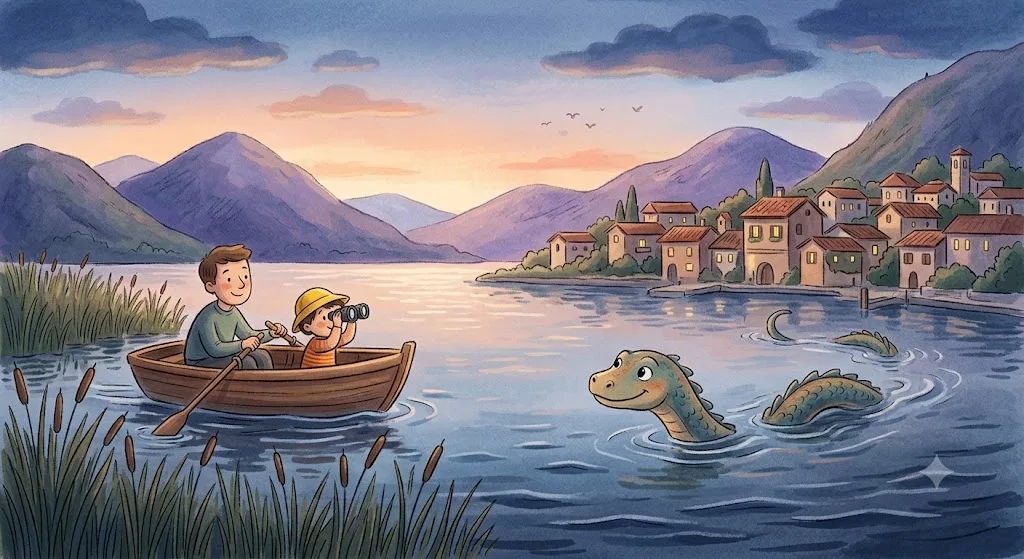
The Lariosauro is Italy’s clearest lake-monster case. It is said to inhabit Lake Como, in Lombardy, and is usually imagined as a reptilian or serpentine creature. The name matters because it borrows authority from real palaeontology: Lariosaurus was a genuine prehistoric aquatic reptile known from fossils in the region, while the “Lariosauro” of folklore is a much later monster story.[Lario Como Boat]lariocomoboat.itLario Como Boat Lariosauro: la Vera Storia del Mostro del Lago diLario Como Boat Lariosauro: la Vera Storia del Mostro del Lago di
The usual starting point is November 1946, when the local paper Corriere Comasco published a dramatic report of two hunters seeing a strange creature at Pian di Spagna, near the northern end of Lake Como. Massimo Polidoro’s summary of the case notes that the report reads like a journalistic invention; he also points out that another local paper, La Provincia, quickly added further monster material, including an alleged earlier sighting.[massimopolidoro.com]massimopolidoro.comun mostro nel lago di como?7 Jun 2007 — Nel novembre del 1946 il “Corriere comasco” pubblicò una notizia secondo la quale nelle acque del lago di Como, al Pian di…
The case then acquired exactly the ingredients lake monsters need: a deep lake, a prehistoric-sounding name, newspaper amplification, and a few later “sightings”. CICAP, the Italian sceptical organisation, has described the Lariosauro as first emerging in 1946 through the Corriere Comasco story, under the headline about the frightening adventure of two hunters.[cicap.org]cicap.orgOpen source on cicap.org.
Later accounts added variety rather than strength. Reports have included a rounded-muzzled, web-footed creature at Argegno in 1954, a large animal between Dongo and Musso in 1957, another odd animal with a crocodile-like head, and a 2003 claim near Lecco of a giant eel-like form. Giorgio Castiglioni, who examined the tradition, has been quoted in local retellings as giving ordinary explanations: inventions by newspapers, an otter, a large pike, or a compact group of fish moving together.[Leccoonline]leccoonline.comSCAFFALE LECCHESE/267: il Lariosauro, l'antico fossileSCAFFALE LECCHESE/267: il Lariosauro, l'antico fossile
That makes the Lariosauro valuable as a case study rather than as evidence for a hidden reptile. It shows how a real fossil animal can lend a scientific aura to a modern legend. The fossil Lariosaurus does not make the lake monster more likely; instead, it helps explain why the story felt plausible and marketable. The creature survives because it is a neat local cousin to Nessie, not because the evidence has improved.

Lake Garda’s Bennie and the tourist afterlife of lake monsters
Lake Garda has its own modern lake-monster figure, often called Bennie, from Benaco, the ancient name associated with the lake. Garda tourism pages describe Bennie as a mysterious inhabitant of the lake’s depths and often frame it as a relative of Scotland’s Loch Ness Monster.[Beeboatservice]beeboatservice.comOpen source on beeboatservice.com.
The pattern is familiar: a large, deep lake becomes a stage for a prehistoric-sounding creature. Garda is Italy’s largest lake and is deep enough to make the idea emotionally satisfying, even if that depth is not evidence of a monster.[trentino.com]trentino.comLake GardaLake Garda
Bennie is best treated as tourism folklore. The available public material is stronger on legend, branding and lake mystery than on named witnesses, dated reports, physical evidence or serious zoological investigation. That does not make the story worthless. It tells us how modern lake monsters often operate: they turn a famous landscape into a playful mystery, giving boat tours, travel writing and local storytelling a creature-shaped hook.
Compared with the Lariosauro, Bennie has less of a documented press-history spine. The Como monster can be traced to a specific post-war newspaper context; Bennie is more diffuse, a lake legend refreshed by tourism. Both show the same mechanism: once a lake has the right scale and mood, a monster can become part of how visitors imagine it.
Tarantasio: the dragon of the lost Lake Gerundo
Tarantasio is one of Italy’s most striking monster traditions because its home no longer exists in the same form. The creature is linked to Lake Gerundo, a former wetland or lake landscape in Lombardy, between areas such as Milan, Lodi, Bergamo and Cremona. Retellings describe Tarantasio as a dragon or serpent that haunted the marshy waters, poisoned the air with its breath and threatened local people, especially children.[Wikipedia]WikipediaGerundo LakeGerundo Lake
This is not a modern cryptid in the usual witness-report sense. It is a landscape legend about a dangerous wet place. The detail of pestilential breath is especially revealing: marshes were historically associated with bad air, disease and death. A dragon that poisons the air is a memorable way of turning environmental danger into a creature.
Tarantasio also has an unusual afterlife in Italian visual culture. Some accounts connect the legend to the inspiration behind Eni’s famous six-legged dog logo, although Eni’s own historical account is cautious and presents several interpretations of the symbol, including readings linked to cars, drivers, African art and the Etruscan chimera.[Eni Archivio storico]archiviostorico.eni.comOpen source on eni.com.
That caution matters. Tarantasio may sit behind some popular explanations of the logo, but the stronger point is broader: Italian monsters often migrate into civic and commercial imagery. Even when the original beast is not treated as real, it can become a symbol people recognise on signs, brands, coats of arms and local stories.
Thyrus of Terni: a city dragon with civic meaning
Thyrus, the dragon associated with Terni in Umbria, is another creature best read through place rather than zoology. Local tourism retellings describe a dragon whose deadly breath terrified the population until it was killed, and one interpretation links the beast to the unhealthy marshy conditions near the Velino River before land improvement.[Exploring Umbria]exploring-umbria.comOpen source on exploring-umbria.com.
The legend’s importance is civic. Thyrus is not just a beast in a story; it became a symbol of Terni, reproduced in banners, crests and flags. The killing of the dragon is commonly read as a symbolic birth or development of the town: the monster represents a dangerous environment, and its defeat represents settlement, drainage, order and communal identity.[Exploring Umbria]exploring-umbria.comOpen source on exploring-umbria.com.
For cryptid readers, Thyrus is useful because it shows the boundary between “monster report” and “monster emblem”. No one needs to believe in a literal dragon to see why the story endured. The creature gives Terni a dramatic founding image: a city overcoming a deadly landscape.
The Badalisc: an Alpine monster that still performs a social job
The Badalisc of Andrista, in Val Camonica, is one of Italy’s most vivid living monster traditions. It is not mainly a creature people claim to glimpse in the woods; it is a ritual figure brought into the village during the Epiphany period. Tourism Valle Camonica describes the event as returning to Andrista in early January, combining folklore, music, conviviality and cultural roots.[Turismo Valle Camonica]turismovallecamonica.itOpen source on turismovallecamonica.it.
Intangible-heritage documentation describes the Badalisc as a mythological being of the Valle Camonica forests, represented by a costume with hides, goat horns, bright eyes and a large mouth.[intangiblesearch.eu]intangiblesearch.euOpen source on intangiblesearch.eu.
Ethnographic work on the festival gives the creature a deeper meaning. Francesca C. Howell’s research describes the Badalisc festival as an Epiphany event in a high mountain village, centred on the annual ritual hunt and capture of a horned serpent-like creature. Her work frames the festival through place, community, embodiment and local identity rather than as a claim about an undiscovered animal.[JSTOR]jstor.orgOpen source on jstor.org.
That makes the Badalisc almost the opposite of a lake monster. With the Lariosauro, the question is whether a reported animal was ever there. With the Badalisc, the creature is definitely there in performance, mask, procession and speech. Its truth is social rather than zoological: the monster lets a village dramatise itself.
The Beast of Milan and Italy’s older animal scares
Not every Italian mystery beast is purely symbolic. The Beast of Milan, often placed in the 1790s, belongs to the older European pattern of dangerous-animal panics, where real attacks, rumour, fear and uncertain identification become tangled. A historical study of death and animal attacks in the eighteenth century discusses a wolf-like beast in the Milan area in 1792, including an attack near San Siro and public efforts to hunt it.[Vargfakta]vargfakta.seIC XVIII Century Studies Living with death in the 1700sIC XVIII Century Studies Living with death in the 1700s
This sort of case sits closer to historical zoology than to dragons. Wolves, feral dogs, rabid animals and escaped captive beasts could all produce real danger. But once fear spreads, the animal can become larger, stranger and more singular in public imagination than the evidence supports.
The Beast of Milan is therefore best handled as a “monsterised predator” case. Something may have attacked people; the later legend turns that danger into a named or semi-named beast. It belongs beside other European man-eater traditions rather than beside surviving-prehistoric-reptile claims.
Phantom panthers and modern mystery cats
Italy’s modern mystery-animal reports also include large black cats. These stories are familiar across Europe: witnesses report a panther-like animal, authorities search, journalists cover the scare, and the explanation usually remains unconfirmed unless an escaped exotic pet is found. In 2021, The Guardian reported that Italian authorities were searching an area in Puglia after locals claimed to have seen a black panther; residents were urged to avoid fields and countryside.[The Guardian]theguardian.comitalian mayor warns public after black panther sightingsitalian mayor warns public after black panther sightings
Euronews reported the same Puglia scare, noting several witness reports in the province of Bari and a local ban on outdoor activities in the area where the animal had supposedly been spotted.[euronews]euronews.comblack panther sightings near bari prompt ban on outdoor activitiesblack panther sightings near bari prompt ban on outdoor activities
Earlier Italian big-cat scares have been reported elsewhere too. ABC News covered a 2011 southern Tuscany case involving a black cat nicknamed Bagheera, while Italy Magazine’s 2008 roundup noted previous reports in Sardinia and Umbria and suggested that some such stories arrive during the summer “silly season”.[ABC News]abcnews.comABC News Phantom Panther Gives Italians Paws for ThoughtABC News Phantom Panther Gives Italians Paws for Thought
Phantom-cat reports are not impossible in the way lake reptiles are biologically implausible. Escaped exotic cats can exist. The difficulty is evidence: photographs, tracks, kills and eyewitness impressions often fail to prove a breeding population of large cats. For Italy, the most careful reading is that individual escapes or misidentifications are plausible in particular cases, while a hidden nationwide panther population is not demonstrated.
What ordinary animals can explain
A good Italy cryptid page needs room for sceptical zoology, because many reports become less mysterious when local fauna and viewing conditions are considered. The Lariosauro tradition itself has been explained through otters, pike, fish groups and newspaper invention. That matters because northern Italy’s animal history has changed: otters declined severely in Italy in the late twentieth century, with northern and much of central Italy losing them for long periods, while more recent conservation material describes recovery work and surveys in regions where the species had suffered historic decline.[ResearchGate]researchgate.netResearch Gate Decline and recovery in otter Lutra lutra populations in ItalyResearch Gate Decline and recovery in otter Lutra lutra populations in Italy
Large carnivores complicate the picture too. Italy is a country where real wolves, bears and lynx belong to conservation debates, not just folklore. The European Commission’s large-carnivore material notes wolf distribution across all monitored European countries and tracks lynx presence across much of Europe; these animals shape public imagination even when they are not responsible for a particular monster sighting.[Environment]environment.ec.europa.euEnvironment Large carnivore populations across EuropeEnvironment Large carnivore populations across Europe
For lakes, likely explanations include swimming mammals, large fish, birds seen at distance, floating debris, waves and grouped fish behaving like one elongated form. For land beasts, explanations include wolves, large dogs, escaped captive animals, oversized domestic cats, poor scale judgement and rumour. None of these explanations is as romantic as a monster, but they usually fit the evidence better.
How Italian monster stories change over time
Italian creature stories tend to change in three main ways.
First, folklore becomes local identity. Thyrus is no longer just a dragon; it is part of Terni’s civic symbolism. Tarantasio is no longer just a marsh monster; it is a Lombard memory of lost wetlands and, in some retellings, a possible ancestor of a famous corporate image.[Exploring Umbria]exploring-umbria.comOpen source on exploring-umbria.com.
Second, reports become tourism. Lake monsters such as the Lariosauro and Bennie give visitors an easy way into a place. The story does not need to be convincing to be useful; it only needs to be memorable, local and repeatable.[Beeboatservice]beeboatservice.comOpen source on beeboatservice.com.
Third, ritual creatures become heritage. The Badalisc is not fading because no one has caught it on camera; it continues because the community performs it. The creature’s value lies in gathering people, staging satire, marking the season and giving Andrista a distinctive cultural voice.[Turismo Valle Camonica]turismovallecamonica.itOpen source on turismovallecamonica.it.
The clearest way to classify Italy’s cryptids
Italy’s mystery creatures make most sense when separated into evidence types rather than treated as one big monster catalogue.
Modern lake monsters: the Lariosauro and Bennie are the strongest examples. They are attached to real lakes and sometimes framed as surviving prehistoric animals, but the public evidence is weak, late and heavily shaped by newspapers and tourism.[massimopolidoro.com]massimopolidoro.comun mostro nel lago di como?7 Jun 2007 — Nel novembre del 1946 il “Corriere comasco” pubblicò una notizia secondo la quale nelle acque del lago di Como, al Pian di…
Landscape dragons: Tarantasio and Thyrus are better understood as folklore about marshes, disease, civic origins and environmental transformation. They are not serious zoological candidates, but they are culturally important.[Wikipedia]WikipediaGerundo LakeGerundo Lake
Ritual beasts: the Badalisc is a living festive monster, not a hidden animal. Its continuing importance comes from performance, community and place.[intangiblesearch.eu]intangiblesearch.euOpen source on intangiblesearch.eu.
Historical predator scares: the Beast of Milan belongs to the world of wolf attacks, panic, rumour and man-eater legend. It may preserve memory of real danger, but the “monster” form is shaped by fear and retelling.[Vargfakta]vargfakta.seIC XVIII Century Studies Living with death in the 1700sIC XVIII Century Studies Living with death in the 1700s
Phantom cats: Italy’s black-panther reports are modern mystery-animal claims that remain plausible in limited escapee scenarios but unproven as evidence for established wild populations.[The Guardian]theguardian.comitalian mayor warns public after black panther sightingsitalian mayor warns public after black panther sightings
Why the Italian bestiary still works
Italy’s monster tradition endures because it rarely depends on a single question of proof. The Lariosauro survives as a playful Lake Como mystery even if its origin looks like a newspaper invention. Tarantasio and Thyrus survive because they turn old fears of water, disease and wild land into memorable dragons. The Badalisc survives because a village still gives it a body. Phantom panthers survive because the idea of a large predator at the edge of a field is just plausible enough to unsettle people.
The evidence-aware answer is therefore not “Italy has hidden monsters” or “Italy has no monsters”. It is more interesting than that. Italy has creature stories that reveal how people read landscapes: deep lakes become hiding places, marshes become dragons, mountains become ritual theatres, and fleeting animal sightings become local news. The monsters are not confirmed animals, but they are real parts of Italian place-memory.
Amazon book picks
Further Reading
Books and field guides related to What Monsters Haunt Italy's Lakes and Marshes?. Use these as the next step if you want deeper reading beyond the article.
Italian Folktales
Foundational collection of Italian folklore and legendary creatures.
The Mythical Creatures Bible
Covers dragon and monster motifs found in Italian traditions.
The Book of Imaginary Beings
Provides context for lake monsters, dragons, and fantastic beasts.
Monsters of the Sea
Relevant to Italian lake-monster traditions such as the Lariosauro.
eBay marketplace picks
Marketplace Samples
Live-tested eBay searches with available results related to this page.


Endnotes
1.
Source: massimopolidoro.com
Title: un mostro nel lago di como
Link:https://www.massimopolidoro.com/misteri/un-mostro-nel-lago-di-como.html
Source snippet
?7 Jun 2007 — Nel novembre del 1946 il “Corriere comasco” pubblicò una notizia secondo la quale nelle acque del lago di Como, al Pian di...
2.
Source: cicap.org
Link:https://www.cicap.org/n/articolo.php?id=278114
3.
Source: Wikipedia
Title: Lake Como
Link:https://en.wikipedia.org/wiki/Lake_Como
4.
Source: trentino.com
Title: Lake Garda
Link:https://www.trentino.com/en/highlights/nature-and-landscape/lakes/lake-garda/
5.
Source: Wikipedia
Link:https://it.wikipedia.org/wiki/Lariosaurus
6.
Source: leccoonline.com
Title: SCAFFALE LECCHESE/267: il Lariosauro, l’antico fossile
Link:https://www.leccoonline.com/notizie/91536/scaffale-lecchese-267-il-lariosauro-l-antico-fossile-diventato-una-leggenda-moderna
7.
Source: beeboatservice.com
Link:https://www.beeboatservice.com/blog/bennie-the-garda-monster-and-mysteries-of-the-lake
8.
Source: Wikipedia
Title: Gerundo Lake
Link:https://en.wikipedia.org/wiki/Gerundo_Lake
9.
Source: archiviostorico.eni.com
Link:https://archiviostorico.eni.com/aseni/en/pills/IT-ENI-CMS0001-000038
10.
Source: exploring-umbria.com
Link:https://www.exploring-umbria.com/en/terni-eng/
11.
Source: intangiblesearch.eu
Link:https://www.intangiblesearch.eu/search/show_ich_detail.php?db_name=intangible_search&idk=ICH-GIU02-0000000576&lingua=inglese
12.
Source: jstor.org
Link:https://www.jstor.org/stable/43297668
13.
Source: vargfakta.se
Title: IC XVIII Century Studies Living with death in the 1700s
Link:https://www.vargfakta.se/wp-content/uploads/2012/03/IC-XVIII-Century-Studies_Living-with-death-in-the-1700s.pdf
14.
Source: euronews.com
Title: black panther sightings near bari prompt ban on outdoor activities
Link:https://www.euronews.com/2021/02/16/black-panther-sightings-near-bari-prompt-ban-on-outdoor-activities
15.
Source: researchgate.net
Title: Research Gate Decline and recovery in otter Lutra lutra populations in Italy
Link:https://www.researchgate.net/publication/229658230_Decline_and_recovery_in_otter_Lutra_lutra_populations_in_Italy
16.
Source: Wikipedia
Title: List of lake monsters
Link:https://en.wikipedia.org/wiki/List_of_lake_monsters
17.
Source: Wikipedia
Link:https://en.wikipedia.org/wiki/Lariosauro
18.
Source: Wikipedia
Title: Folklore of Italy
Link:https://en.wikipedia.org/wiki/Folklore_of_Italy
19.
Source: Wikipedia
Title: Phantom cat
Link:https://en.wikipedia.org/wiki/Phantom_cat
20.
Source: Wikipedia
Title: Ferocious beast
Link:https://en.wikipedia.org/wiki/Ferocious_beast
21.
Source: Wikipedia
Title: Beast of Gévaudan
Link:https://en.wikipedia.org/wiki/Beast_of_G%C3%A9vaudan
22.
Source: Wikipedia
Title: European dragon
Link:https://en.wikipedia.org/wiki/European_dragon
23.
Source: Wikipedia
Link:https://en.wikipedia.org/wiki/Badalisc
24.
Source: Wikipedia
Title: Lake Garda
Link:https://en.wikipedia.org/wiki/Lake_Garda
25.
Source: Wikipedia
Link:https://ca.wikipedia.org/wiki/Fitxer%3ACoat_of_arms_of_the_medieval_commune_of_Terni_%28in_first_half_of_13th_century%29.png
26.
Source: Wikipedia
Link:https://es.wikipedia.org/wiki/Archivo%3ACoat_of_arms_of_the_medieval_commune_of_Terni_%28in_first_half_of_13th_century%29.png
27.
Source: Wikipedia
Link:https://it.wikipedia.org/wiki/Badalisc
28.
Source: researchgate.net
Link:https://www.researchgate.net/figure/Country-reports-for-large-carnivores-in-Europe_tbl1_365068870
29.
Source: researchgate.net
Link:https://www.researchgate.net/publication/263723116_Sense_of_Place_Heterotopia_and_Community_Performing_Land_and_Folding_Time_in_the_Badalisc_Festival_of_Northern_Italy
30.
Source: turismo.comune.terni.it
Link:https://turismo.comune.terni.it/en
31.
Source: intangiblesearch.eu
Link:https://www.intangiblesearch.eu/show_ich_detail.php?db_name=intangible_search&idk=ICH-GIU02-0000000130&lingua=italiano
32.
Source: eni.com
Link:https://www.eni.com/en-IT/media/events/six-legged-dog-exhibition.html
33.
Source: turismovallecamonica.it
Link:https://www.turismovallecamonica.it/eventi/festa-del-badalisc/
34.
Source: theguardian.com
Title: italian mayor warns public after black panther sightings
Link:https://www.theguardian.com/world/2021/feb/15/italian-mayor-warns-public-after-black-panther-sightings
35.
Source: lariocomoboat.it
Title: Lario Como Boat Lariosauro: la Vera Storia del Mostro del Lago di
Link:https://lariocomoboat.it/lago-di-como/la-leggenda-del-lariosauro-il-misterioso-mostro-del-lago-di-como/
36.
Source: abcnews.com
Title: ABC News Phantom Panther Gives Italians Paws for Thought
Link:https://abcnews.com/International/phantom-panther-italians-paws-thought/story?id=14326322
37.
Source: environment.ec.europa.eu
Title: Environment Large carnivore populations across Europe
Link:https://environment.ec.europa.eu/topics/nature-and-biodiversity/habitats-directive/large-carnivores/large-carnivore-populations-across-europe_en
38.
Source: dolomitemountains.com
Link:https://www.dolomitemountains.com/blog/beyond-the-dolomites/lake-garda/lake-garda-in-numbers/
39.
Source: facebook.com
Link:https://www.facebook.com/photo.php?fbid=1094731179329723&id=100063785527782&set=a.716580930478085
40.
Source: ilcrepuscolodeglidei.org
Link:https://www.ilcrepuscolodeglidei.org/?title=Badalisc
41.
Source: cryptidz.fandom.com
Link:https://cryptidz.fandom.com/wiki/Lariosauro
42.
Source: cryptidz.fandom.com
Title: Lake Monsters
Link:https://cryptidz.fandom.com/wiki/Lake_Monsters
43.
Source: atlanticreligion.com
Link:https://atlanticreligion.com/tag/badalisc/
44.
Source: voicemap.me
Link:https://voicemap.me/tour/lake-como/mystery-and-heritage-along-lake-como-s-greenway/sites/lariosauro-lizard-from-larius
Additional References
45.
Source: facebook.com
Link:https://www.facebook.com/7NewsAustralia/posts/a-giant-black-cat-like-creature-has-been-spotted-roaming-rural-australia-and-has/2106934812650034/
46.
Source: facebook.com
Link:https://www.facebook.com/sevensharp/posts/a-phantom-puma-or-just-a-fat-feral-cat-we-put-what-could-be-the-south-island-pan/10157516578707268/
47.
Source: facebook.com
Link:https://www.facebook.com/groups/413414438697407/posts/5343900288982106/
48.
Source: dokumen.pub
Link:https://dokumen.pub/animal-kingdom-of-heaven-anthropozoological-aspects-in-the-late-antique-world-3110601591-9783110601596.html
49.
Source: reddit.com
Link:https://www.reddit.com/r/italianlearning/comments/ybrsbu/any_italian_cryptids/
50.
Source: facebook.com
Link:https://www.facebook.com/TelePontedilegno/videos/badaliscsolo-ed-unicamente-ad-andrista/710176786668400/
51.
Source: johnknifton.com
Link:https://johnknifton.com/tag/beast-of-gevaudan/
52.
Source: mythfolks.com
Link:https://www.mythfolks.com/cryptids/cadborosaurus
53.
Source: reddit.com
Link:https://www.reddit.com/r/heraldry/comments/1b5j84u/coat_of_arms_of_terni_italy/
54.
Source: instagram.com
Link:https://www.instagram.com/p/DSDTygdERMa/
Topic Tree
Follow this branch
Related pages 192
- Antigua Cryptids
- Maldives Monsters
- Malta Monsters
- Qatar Monsters
- Argentina Monsters
- +187 more in sidebar