Within Austria Monsters
Is the Tatzelwurm Austria's Classic Cryptid?
The Tatzelwurm is Austria's most cryptid-like creature, blending mountain folklore with misread reptiles, mammals and shadows.
On this page
- The cat faced crawler in Alpine tradition
- Where Austrian Tatzelwurm stories cluster
- Natural explanations for a sudden mountain beast
Page outline Jump by section
Introduction
The Tatzelwurm is often described as Austria’s closest equivalent to a classic cryptid: a mysterious Alpine creature said to resemble a short-bodied serpent or lizard with a cat-like face and clawed forelegs. Unlike many modern monster stories, however, the Tatzelwurm grew out of older mountain folklore long before the word “cryptid” existed. Reports cluster across the Alps, including Austrian regions such as Tyrol, Salzburg, Styria and the Salzkammergut, where generations of herders, hunters and travellers told stories of a strange beast encountered on remote slopes, in rocky gullies or near caves.[Wikipedia]WikipediaOpen source on wikipedia.org.

What makes the Tatzelwurm interesting is not the strength of the physical evidence—which remains extremely weak—but the way folklore, eyewitness claims and natural-animal explanations overlap. The creature sits at the boundary between dragon legend, mountain superstition and mystery-animal reporting, making it one of the most enduring creatures in Alpine folklore.[Wikipedia]WikipediaOpen source on wikipedia.org.
Is the Tatzelwurm Austria’s Classic Cryptid?
Among Austria’s legendary creatures, the Tatzelwurm comes closest to the modern idea of an unknown animal. It is not tied to a single town or monument in the way the Klagenfurt Lindwurm is. Instead, it appears in scattered reports from mountain communities across the Alpine arc, where witnesses claimed to see an apparently real creature rather than a purely mythical dragon.[Wikipedia]WikipediaOpen source on wikipedia.org.
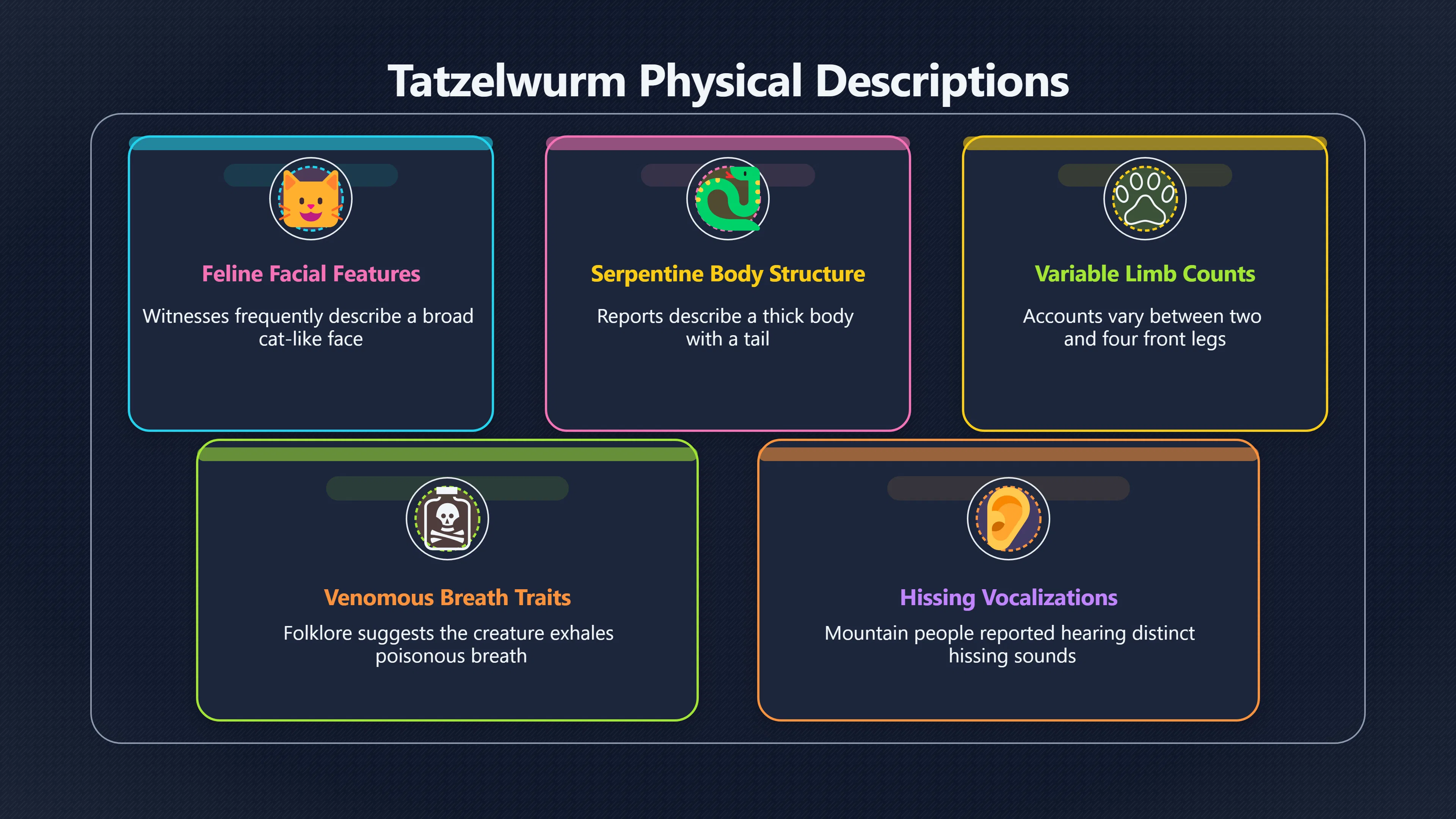
Descriptions vary considerably. Some accounts portray a serpent-like animal with only two front legs. Others give it four legs, a thick body and a tail. Many stories agree on a broad feline head, which led to the popular image of a “cat-faced crawler”. Austrian traditions also sometimes describe the creature as venomous or capable of delivering a poisonous breath, a feature inherited from older European dragon folklore rather than zoological observation.[Wikipedia]WikipediaOpen source on wikipedia.org.
This inconsistency is important. Modern cryptozoological traditions often depend on witnesses describing roughly the same animal. The Tatzelwurm’s appearance shifts from region to region, suggesting that folklore influenced many reports as much as direct observation did.[Wikipedia]WikipediaOpen source on wikipedia.org.
The Cat-Faced Crawler in Alpine Tradition
The Tatzelwurm belongs to a broader family of Alpine dragon and serpent traditions. Different valleys used different names, including Bergstutz, Stollenwurm and Springwurm. In parts of Austria, especially Tyrol and Styria, the name Bergstutz became common, while neighbouring Alpine regions preserved other local variants.[Wikipedia]WikipediaOpen source on wikipedia.org.
Folklore collected during the eighteenth and nineteenth centuries shows that mountain people often regarded the creature as dangerous but not gigantic. Unlike castle-sized dragons from medieval legends, the Tatzelwurm was usually imagined as an animal-sized threat encountered unexpectedly on a trail or hillside. Accounts described hissing sounds, sudden appearances after storms and frightening encounters that sent witnesses fleeing.[Wikipedia]WikipediaOpen source on wikipedia.org.
One frequently repeated story concerns a farmer who allegedly encountered two such creatures in the mountains during the eighteenth century and became so terrified that he later died after recounting the experience. Whether the event occurred as described is impossible to verify, but the story illustrates how the Tatzelwurm functioned within Alpine storytelling: not as a distant mythological monster, but as a lurking hazard of the high mountains.[Wikipedia]WikipediaOpen source on wikipedia.org.
Where Austrian Tatzelwurm Stories Cluster
No single valley can claim ownership of the Tatzelwurm. Instead, reports appear throughout the eastern Alps, especially in regions where steep terrain, forests and rocky escarpments create opportunities for fleeting observations. Austrian traditions are particularly strong in:
- Tyrol and the Zillertal.
- Salzburg and neighbouring Alpine districts.
- Styria.
- The Salzkammergut lake-and-mountain region.
- Valleys associated with older Bergstutz traditions.[Wikipedia]WikipediaOpen source on wikipedia.org.
The geography matters. Most sightings occurred in landscapes where visibility is limited and unusual encounters can be difficult to interpret. A creature glimpsed briefly among rocks, snow patches and shadows can quickly become larger and stranger in memory. Alpine folklore repeatedly uses these environments as settings for dragons, spirits and dangerous animals, making them natural homes for Tatzelwurm stories.[Wikipedia]WikipediaOpen source on wikipedia.org.
During the late nineteenth and early twentieth centuries, newspapers and popular magazines increasingly presented the Tatzelwurm as a possible unknown species rather than merely a folk creature. This shift helped transform local legends into an Alpine mystery discussed far beyond the villages where the stories originated.[Wikipedia]WikipediaTatzelwurm (FabeltierTatzelwurm (Fabeltier

What Evidence Do the Sighting Reports Provide?
The central problem for anyone trying to treat the Tatzelwurm as a real animal is the absence of convincing physical evidence. Despite centuries of stories, there are no verified specimens, bones, photographs accepted by mainstream zoology or genetic samples.[Wikipedia]WikipediaOpen source on wikipedia.org.
What survives are witness accounts. These reports share a few recurring themes:
- The creature appears suddenly and briefly.
- Witnesses often describe shock or fear.
- Size estimates vary dramatically.
- Limb counts differ from report to report.
- The head is frequently described as cat-like.
- Encounters occur in rugged mountain terrain.[Wikipedia]WikipediaOpen source on wikipedia.org.
The reports therefore resemble many mystery-animal traditions around the world. They are intriguing as folklore and local testimony, but they lack the repeatable evidence needed to establish the existence of an unknown Alpine reptile or mammal.[Wikipedia]WikipediaOpen source on wikipedia.org.
Natural Explanations for a Sudden Mountain Beast
Sceptical explanations generally focus on misidentification rather than deliberate hoaxing. The Alpine environment contains several animals that can look surprising under unusual conditions.
Otters have been suggested as one possibility. An Austrian government assessment cited in later discussions reportedly proposed that stray otters could explain some sightings. Seen unexpectedly on land, an otter’s elongated body and bounding movement might appear strange to observers expecting no such animal at high altitude.[Wikipedia]WikipediaOpen source on wikipedia.org.
Other suggested candidates include:
- Pine martens and other mustelids.
- Large salamanders.
- Escaped exotic animals.
- Misidentified snakes.
- Brief views of ordinary wildlife distorted by distance, weather or terrain.[Wikipedia]WikipediaTatzelwurm (FabeltierTatzelwurm (Fabeltier
Folklore itself may also have shaped later reports. Once a region possesses a well-known monster tradition, unusual sightings are more likely to be interpreted through that existing story. A witness who has heard tales of a cat-faced mountain reptile may unconsciously fit an ambiguous observation into that framework. This process helps explain why descriptions often contain traditional features such as the feline head or poisonous breath.[Wikipedia]WikipediaOpen source on wikipedia.org.
Why the Legend Endured
The Tatzelwurm survived because it occupies a useful middle ground between folklore and possibility. A giant dragon is obviously mythical to most modern readers. A small, elusive mountain animal is harder to dismiss completely. That ambiguity allows the creature to remain fascinating even when evidence is scarce.[Manticore Press]manticore.pressTatzelwurmThe Tatzelwurm (pronounced Tatt sell verm – German for Clawed Worm) is one of the lesser known cryptozoological beasts of the w…
The legend also fits the psychology of mountain landscapes. The Alps contain cliffs, caves, scree slopes, sudden weather changes and isolated routes where strange encounters feel plausible. For centuries, stories helped people explain unexpected noises, disappearing livestock, dangerous terrain and the sense that remote places might still conceal unknown creatures.[Mythoi]mythoi.substack.comMythoi The Cat-Wyrm TatzelwurmThe Cat-Wyrm Tatzelwurm - by A.C. Luke - MythoiThe tatzelwurm is a popular Alps tale, speaking to mysterious animal encounters and…
Today the Tatzelwurm functions less as a candidate species than as a cultural symbol of Alpine mystery. It remains one of Austria’s most recognisable creature traditions because it blends eyewitness lore, mountain storytelling and cryptozoological speculation into a single enduring image: a cat-faced crawler glimpsed for a moment among the rocks before vanishing back into the mountains.[Wikipedia]WikipediaOpen source on wikipedia.org.
Amazon book picks
Further Reading
Books and field guides related to Is the Tatzelwurm Austria's Classic Cryptid?. Use these as the next step if you want deeper reading beyond the article.
The Element Encyclopedia of Magical Creatures
Places the Tatzelwurm among wider European creature traditions.
eBay marketplace picks
Marketplace Samples
Live-tested eBay searches with available results related to this page.

Endnotes
1.
Source: Wikipedia
Link:https://en.wikipedia.org/wiki/Tatzelwurm
2.
Source: Wikipedia
Title: Tatzelwurm (Fabeltier)
Link:https://de.wikipedia.org/wiki/Tatzelwurm_%28Fabeltier%29
3.
Source: manticore.press
Link:https://manticore.press/tatzelwurm/
Source snippet
TatzelwurmThe Tatzelwurm (pronounced Tatt sell verm – German for Clawed Worm) is one of the lesser known cryptozoological beasts of the w...
4.
Source: youtube.com
Title: Tatzelwurm: Possible Historical Creature Terrorizing the Swiss Alps?
Link:https://www.youtube.com/watch?v=0SjcS8JziQQ
Source snippet
Alpine Folklore - Tatzelwurm...
5.
Source: youtube.com
Title: Alpine Folklore
Link:https://www.youtube.com/watch?v=HzOzY8aNAgE
Source snippet
The Mystery of the Alpine Tatzelwurm...
6.
Source: mythoi.substack.com
Title: Mythoi The Cat-Wyrm Tatzelwurm
Link:https://mythoi.substack.com/p/the-cat-wyrm-tatzelwurm
Source snippet
The Cat-Wyrm Tatzelwurm - by A.C. Luke - MythoiThe tatzelwurm is a popular Alps tale, speaking to mysterious animal encounters and...
7.
Source: astonishinglegends.com
Link:https://astonishinglegends.com/astonishing-legends/2018/9/24/tatzelwurm
Source snippet
24 Sept 2018 — Tatzelwurms, also known as claw worms, are a strange mix of two creature - a cat and a snake. It makes its home in the mou...
8.
Source: cryptidz.fandom.com
Link:https://cryptidz.fandom.com/wiki/Tatzelwurm
Source snippet
Cryptid Wiki - FandomThe Tatzelwurm, also called the Alps Dragon, is a cryptid reported in several areas in Europe, including Germany...
9.
Source: cryptozoologycryptids.fandom.com
Link:https://cryptozoologycryptids.fandom.com/wiki/Tatzelwurm
Source snippet
Cryptid Wiki - FandomThe Tatzelwurm is a mythological animal, a worm-like cryptid. In Alpine folklore, the Tatzelwurm is a stubby, lizard...
Additional References
10.
Source: facebook.com
Link:https://www.facebook.com/groups/6390022156/posts/10161635162997157/
Source snippet
Tatzelwurm cryptid from alpine mythTatzelwurm is a cryptid from the Alpine region that has sparked curiosity for centuries. It is typical...
11.
Source: reddit.com
Link:https://www.reddit.com/r/Cryptozoology/comments/csgksj/tatzelwurm_unknown_creature_living_in_the/
Source snippet
Tatzelwurm – Unknown Creature Living in the European AlpsGerman for "worm with claws" this mystery creature has been seen several times o...
12.
Source: dinoanimals.com
Link:https://dinoanimals.com/animals/tatzelwurm/
Source snippet
Tatzelwurm – a mysterious cave lizardA mysterious creature that is to inhabit alpine caves. He was given the name Tatzelwurm, which means...
13.
Source: youtube.com
Link:https://www.youtube.com/watch?v=qnLyoIvQ8XI
Source snippet
Europe's Oldest Dragon Mystery: The Tatzelwurm BeastThe belief in fire breathing dragons was common throughout the alpine regions of Euro...
14.
Source: reddit.com
Link:https://www.reddit.com/r/Cryptozoology/comments/1221huo/a_early_report_on_the_tatzelwurm_or_alpine/
Source snippet
So not only does stuff like that exist, it's doing pretty alright all things considered.Read more...
15.
Source: imgur.com
Title: presenting tatzelwurm of austrian folklore Uvhv KC2
Link:https://imgur.com/gallery/presenting-tatzelwurm-of-austrian-folklore-UvhvKC2
Source snippet
Presenting the Tatzelwurm of Austrian FolkloreIn 1970, reports of an alleged Tatzelwurm were published in the Swiss newspaper La Tribune...
16.
Source: x.com
Link:https://x.com/BluebellRaven/status/1996335073851838954
Source snippet
orelimbs, it is said to inhabit remote mountain slopes and forests.Read more...
17.
Source: instagram.com
Link:https://www.instagram.com/p/DM-5c94ubcz/
Source snippet
poisonous breath, and to make a high-pitched or hissing sound.Read more...
18.
Source: blackdrago.com
Link:https://www.blackdrago.com/species/tazelwurm.htm
Source snippet
ies and communities, the Tatzelwurm has many different names...
19.
Source: strangeanimalspodcast.blubrry.net
Title: episode 021 the tatzelworm and friends
Link:https://strangeanimalspodcast.blubrry.net/2017/06/26/episode-021-the-tatzelworm-and-friends/
Source snippet
Strange Animals PodcastEpisode 021: The Tatzelworm and friends26 Jun 2017 — In 1997, cryptozoologist Ivan Mackerle led an expedition in t...
Topic Tree