Within Saudi Mystery Beasts
Why Did Travellers Fear the Desert Ghoul?
The ghoul turned the real dangers of lonely desert travel into stories of shapeshifters, deceivers and flesh-eating beings.
On this page
- What the ghoul was said to do
- How desert dangers shaped the legend
- From Arabian folklore to modern fantasy
Page outline Jump by section
Introduction
The ghoul is the closest thing Arabian desert folklore has to a classic monster. Long before modern horror films borrowed the word, travellers across the deserts of western and central Arabia told stories of a dangerous being that lurked beyond settled places, changed its appearance at will, and lured people away from safety. In the lands that now form Saudi Arabia, the ghoul became a powerful explanation for the risks of desert travel: getting lost, following the wrong guide, trusting a stranger, or disappearing into a landscape where help might be days away. Scholars generally treat the ghoul as a folkloric figure rather than an alleged undiscovered animal, but the legend remains one of the most enduring creature traditions associated with Arabia.[ResearchGate]researchgate.netResearch Gate(PDF) The Mythical Ghoul in Arabic CultureResearchGate(PDF) The Mythical Ghoul in Arabic CultureJanuary 1, 2009 — This study argues that Islam could not change the belief in super…
Unlike many modern cryptid stories, the ghoul was never tied to a single sighting or location. It was a roaming menace of deserts, ruins, lonely tracks and abandoned camps. That flexibility helped the legend survive for centuries and spread far beyond Arabia into global popular culture.[wikipedia.org]WikipediaFebruary 18, 2026 — In folklore, a ghoul (from Arabic: غول, ghūl) is a demon-like being or monstrous humanoid, often associated with gra…
What the ghoul was said to do
Descriptions of the ghoul varied from region to region, but several themes appeared again and again in Arabic folklore.
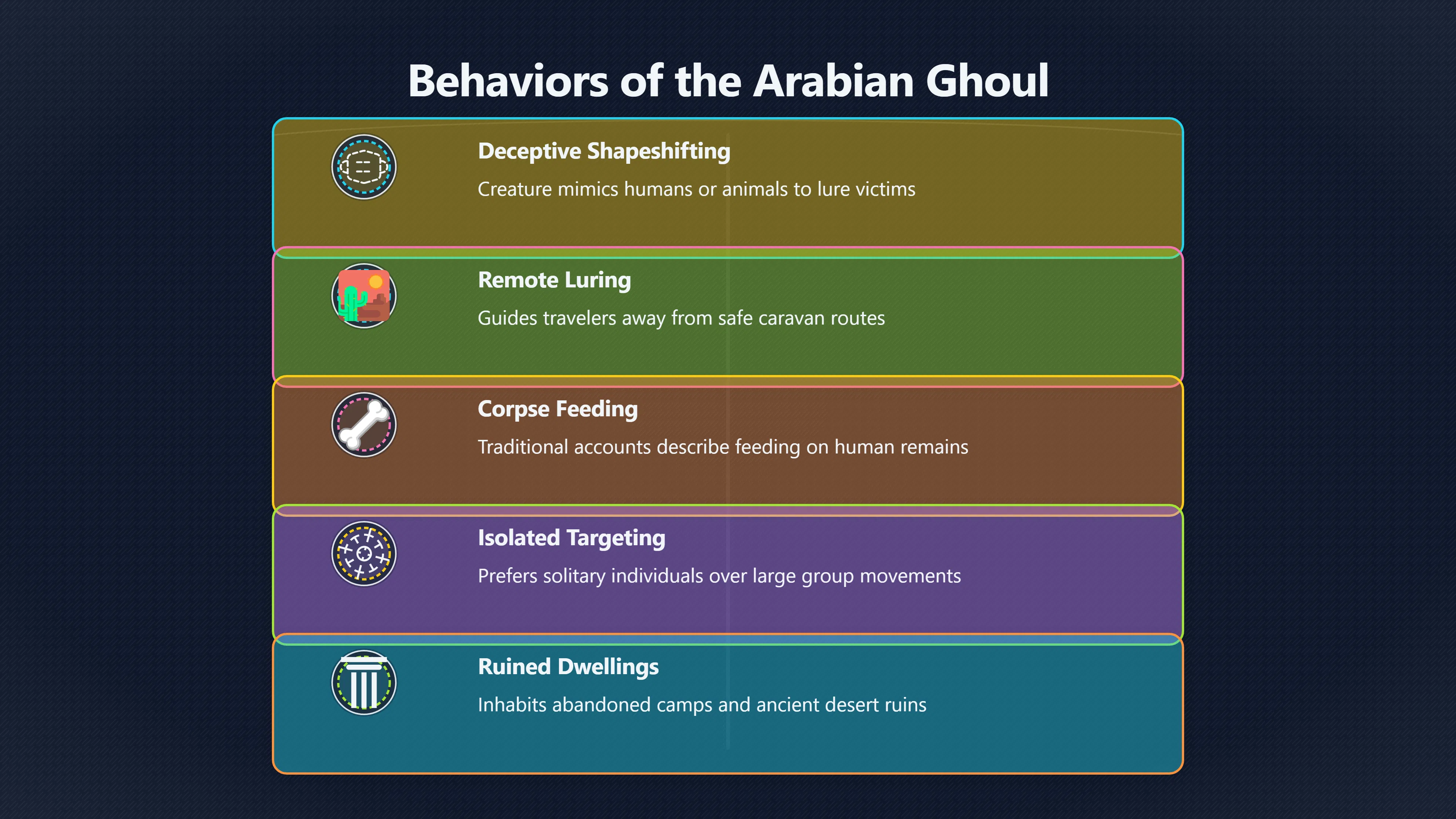
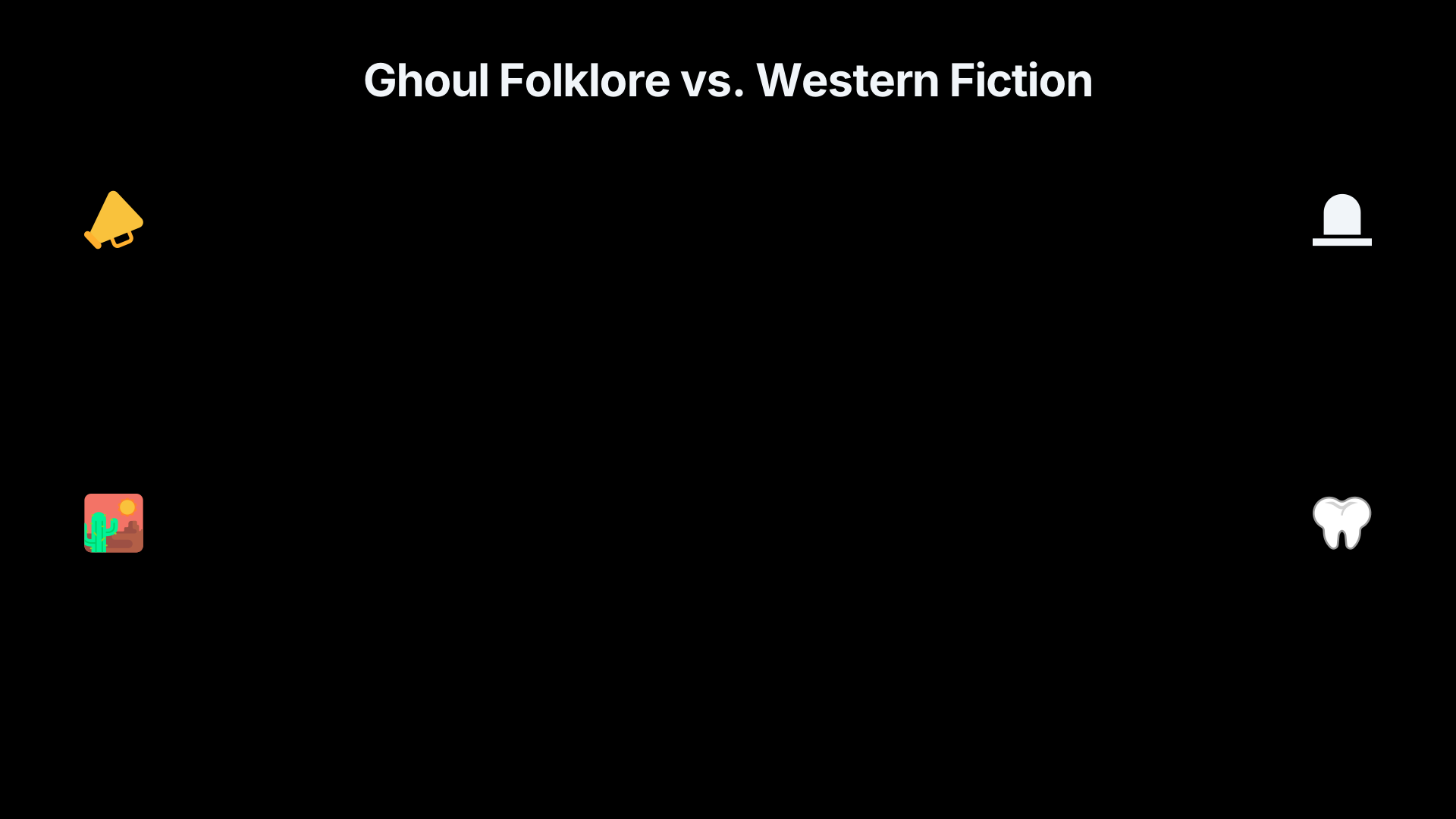
The creature was usually portrayed as a deceiver rather than a straightforward predator. It could imitate a human being, appear as an attractive stranger, mimic a familiar voice, or take the form of an animal. Once a traveller trusted it and left the safety of a caravan or known route, the victim could be led into danger. In many stories the ghoul eventually revealed its monstrous nature and attacked.[gale.com]go.gale.comThe mythical ghoul in Arabic culture - Document - Galeby A Al-Rawi · 2009 · Cited by 54 — In general, the Pre-Islamic ghoul is known…
Traditional accounts commonly attributed the following behaviours to ghouls:
- Leading travellers astray in remote desert regions.
- Appearing in different forms through shapeshifting.
- Dwelling among ruins, wilderness areas and graveyards.
- Feeding on human flesh or corpses.
- Targeting isolated individuals rather than large groups.
- Using trickery and deception instead of brute force alone.[wikipedia.org]WikipediaFebruary 18, 2026 — In folklore, a ghoul (from Arabic: غول, ghūl) is a demon-like being or monstrous humanoid, often associated with gra…
Some medieval stories describe female ghouls who appeared as solitary women encountered in the wilderness. Others portray more animal-like creatures. The contradictions are part of the tradition: the ghoul was feared precisely because it could be anything.[gale.com]go.gale.comThe mythical ghoul in Arabic culture - Document - Galeby A Al-Rawi · 2009 · Cited by 54 — In general, the Pre-Islamic ghoul is known…
How desert dangers shaped the legend
The ghoul makes the most sense when viewed against the realities of Arabian travel before modern roads, navigation systems and rescue services.
For much of Arabian history, crossing large stretches of desert involved genuine risks. Travellers could become disoriented, wander from known routes, run out of water, encounter hostile strangers or die from exposure. In such conditions, folklore often transformed practical dangers into memorable stories. The ghoul became a warning wrapped in a monster tale.[ResearchGate]researchgate.netResearch Gate(PDF) The Mythical Ghoul in Arabic CultureResearchGate(PDF) The Mythical Ghoul in Arabic CultureJanuary 1, 2009 — This study argues that Islam could not change the belief in super…
A traveller who followed a mysterious light into the darkness, trusted the wrong guide or wandered away from a caravan might never return. Folklore explained these disappearances through supernatural agency. Some Arabian traditions even connected wandering desert lights with ghoul-like beings that lured people from safety, turning a natural or misunderstood phenomenon into a cautionary tale.[Wikipedia]WikipediaAbu FanousAbu Fanous
The legend also reflects a broader pattern found in folk traditions worldwide. Dangerous landscapes often acquire supernatural guardians or predators. Mountain passes gain demons, forests gain witches, and deserts gain shape-shifting deceivers. The ghoul served as Arabia’s version of that cultural process.[ResearchGate]researchgate.net254289317 The Arabic Ghoul and its Western TransformationResearchGate(PDF) The Arabic Ghoul and its Western Transformation11 Nov 2009 — This paper discusses the nature of the ghoul as depicted i…
Was the ghoul inspired by real animals?
One reason the ghoul has sometimes been discussed alongside mystery-animal traditions is that some descriptions overlap with real desert wildlife.
Several accounts associate the creature with hyenas. Hyenas are nocturnal scavengers, capable of producing unusual vocalisations and appearing unexpectedly near graves, camps or carcasses. In dim light they can seem oddly human-like in posture and movement. Some folklore traditions explicitly allowed a ghoul to take the form of a hyena or similar animal.[fandom.com]mythus.fandom.comMyth and Folklore GhoulMyth and Folklore Ghoul
This does not mean hyenas created the entire legend. The ghoul’s supernatural abilities go far beyond anything attributed to a real animal. However, encounters with unfamiliar nocturnal creatures may have reinforced existing beliefs and given storytellers vivid examples to attach to older folklore.[ResearchGate]researchgate.net254289317 The Arabic Ghoul and its Western TransformationResearchGate(PDF) The Arabic Ghoul and its Western Transformation11 Nov 2009 — This paper discusses the nature of the ghoul as depicted i…
Why the ghoul remained believable
Modern readers often imagine folklore creatures as obviously fictional, but many people in pre-modern Arabia treated the ghoul as a genuine possibility.
Research into Arabic folklore and literature shows that belief in ghouls was widespread and deeply rooted. References appear in early Arabic writings, later folklore collections and popular storytelling traditions. Even as religious and cultural attitudes changed, the creature remained part of the shared imagination.[ResearchGate]researchgate.netResearch Gate(PDF) The Mythical Ghoul in Arabic CultureResearchGate(PDF) The Mythical Ghoul in Arabic CultureJanuary 1, 2009 — This study argues that Islam could not change the belief in super…
Part of the ghoul’s staying power came from its flexibility. Unlike a creature tied to one appearance, it could explain many different experiences:
- Strange sounds heard at night.
- Missing travellers.
- Encounters with suspicious strangers.
- Unidentified animals glimpsed in darkness.
- The unsettling feeling of isolation in the desert.[Gale]go.gale.comThe mythical ghoul in Arabic culture - Document - Galeby A Al-Rawi · 2009 · Cited by 54 — In general, the Pre-Islamic ghoul is known…
Because the ghoul was a deceiver, contradictory descriptions did not weaken the legend. Instead, they reinforced the idea that the creature could never be recognised with certainty.
From Arabian folklore to modern fantasy
The ghoul’s greatest cultural success may be its escape from Arabia into world literature.
European audiences became familiar with the creature through translations of stories associated with The Arabian Nights. During the eighteenth and nineteenth centuries, the Arabic ghoul entered Western imagination and gradually changed shape. The original desert shapeshifter became increasingly associated with graveyards, tombs and corpse-eating monsters.[Wikipedia]WikipediaGhouls in popular cultureGhouls in popular culture
Scholars have noted that the Western version often differs significantly from the older Arabian figure. In Arabic tradition, the ghoul’s most important trait was deception. In later horror fiction, it became more of a flesh-eating cemetery monster.[JSTOR]jstor.orgAlthough there are different and sometimes contradictory descriptions of the ghoul in Arabic sources, this…Read more…
Today the creature appears in fantasy novels, role-playing games, films, television series and video games. Many modern audiences recognise the word “ghoul” without realising that its roots lie in the deserts of Arabia and in centuries of stories told by travellers crossing some of the harshest landscapes on Earth.[Wikipedia]WikipediaGhouls in popular cultureGhouls in popular culture

Why the ghoul matters in Saudi Arabia’s monster tradition
For a project focused on mystery creatures and folklore in Saudi Arabia, the ghoul occupies a unique position. It is not a cryptid in the modern sense of an alleged undiscovered animal, nor is it merely a literary invention. Instead, it sits at the meeting point of folklore, environmental reality and cultural memory.
The ghoul transformed the practical dangers of desert travel into a memorable character. It warned against isolation, misplaced trust and wandering from known routes. At the same time, it provided a supernatural explanation for losses and mysteries that people could not easily understand.[gale.com]go.gale.comThe mythical ghoul in Arabic culture - Document - Galeby A Al-Rawi · 2009 · Cited by 54 — In general, the Pre-Islamic ghoul is known…
That combination helps explain why the ghoul remains one of the most recognisable creatures associated with Arabia. Even when belief faded, the story survived. The monster that once haunted lonely caravan routes became one of the world’s most influential folklore creatures, carrying a piece of the Arabian desert into modern fantasy and horror.[wikipedia.org]WikipediaGhouls in popular cultureGhouls in popular culture
Amazon book picks
Further Reading
Books and field guides related to Why Did Travellers Fear the Desert Ghoul?. Use these as the next step if you want deeper reading beyond the article.
Arabian Sands
Illustrates the real dangers and isolation that helped shape ghoul legends.
The Arabian Nights
Contains the folklore environment from which ghoul traditions became widely known.
The Mythical Creatures Bible
Places the ghoul alongside other enduring legendary monsters.
Legends of the Fire Spirits
Explores supernatural beings of Arabian tradition including related beliefs.
eBay marketplace picks
Marketplace Samples
Live-tested eBay searches with available results related to this page.
Endnotes
1.
Source: researchgate.net
Title: Research Gate(PDF) The Mythical Ghoul in Arabic Culture
Link:https://www.researchgate.net/publication/277816715_The_Mythical_Ghoul_in_Arabic_Culture
Source snippet
ResearchGate(PDF) The Mythical Ghoul in Arabic CultureJanuary 1, 2009 — This study argues that Islam could not change the belief in super...
Published: January 1, 2009
2.
Source: researchgate.net
Title: 254289317 The Arabic Ghoul and its Western Transformation
Link:https://www.researchgate.net/publication/254289317_The_Arabic_Ghoul_and_its_Western_Transformation
Source snippet
ResearchGate(PDF) The Arabic Ghoul and its Western Transformation11 Nov 2009 — This paper discusses the nature of the ghoul as depicted i...
3.
Source: Wikipedia
Link:https://en.wikipedia.org/wiki/Ghoul
Source snippet
February 18, 2026 — In folklore, a ghoul (from Arabic: غول, ghūl) is a demon-like being or monstrous humanoid, often associated with gra...
Published: February 18, 2026
4.
Source: Wikipedia
Title: Ghouls in popular culture
Link:https://en.wikipedia.org/wiki/Ghouls_in_popular_culture
5.
Source: go.gale.com
Link:https://go.gale.com/ps/i.do?id=GALE%7CA249607720&issn=15377873&it=r&linkaccess=abs&p=AONE&sid=googleScholar&sw=w&v=2.1
Source snippet
The mythical ghoul in Arabic culture - Document - Galeby A Al-Rawi · 2009 · Cited by 54 — In general, the Pre-Islamic ghoul is known...
6.
Source: jstor.org
Link:https://www.jstor.org/stable/40646532
Source snippet
Although there are different and sometimes contradictory descriptions of the ghoul in Arabic sources, this...Read more...
7.
Source: ebsco.com
Link:https://www.ebsco.com/research-starters/literature-and-writing/ghoul-mythical-creature
Source snippet
Ghoul (mythical creature) | Literature and WritingA ghoul is a mythical creature rooted in Arabic folklore, traditionally depicted a...
8.
Source: greydogtales.com
Title: Digging Deeper Than The Grave
Link:https://greydogtales.com/blog/digging-deeper-than-the-grave-the-ghul-part-two/
9.
Source: Wikipedia
Title: Abu Fanous
Link:https://en.wikipedia.org/wiki/Abu_Fanous
10.
Source: Wikipedia
Link:https://es.wikipedia.org/wiki/Gul
11.
Source: Wikipedia
Title: List of English words of Arabic origin (G–J)
Link:https://en.wikipedia.org/wiki/List_of_English_words_of_Arabic_origin_%28G%E2%80%93J%29
12.
Source: Wikipedia
Title: Ra’s al Ghul
Link:https://en.wikipedia.org/wiki/Ra%27s_al_Ghul
13.
Source: youtube.com
Title: The Ghoul: Never Trust What You See
Link:https://www.youtube.com/watch?v=bmIq6UDkQWs
Source snippet
The Ghoul | The Forgotten Flesh-Eating Monster of the Desert...
14.
Source: youtube.com
Title: The Ghoul | The Forgotten Flesh-Eating Monster of the Desert
Link:https://www.youtube.com/watch?v=ethznqnDMPM
Source snippet
Revealing the Djinn - The Complete History of Arabia's Oldest Secret...
15.
Source: mythus.fandom.com
Title: Myth and Folklore Ghoul
Link:https://mythus.fandom.com/wiki/Ghoul
16.
Source: fallout.fandom.com
Link:https://fallout.fandom.com/de/wiki/Ghul
Additional References
17.
Source: tandfonline.com
Link:https://www.tandfonline.com/doi/abs/10.1080/00155870903219730?journalCode=rfol20
Source snippet
Taylor & Francis OnlineThe Arabic Ghoul and its Western Transformation: Folklore11 Nov 2009 — This paper discusses the nature of the ghou...
18.
Source: academia.edu
Link:https://www.academia.edu/5802424/The_Mythical_Ghoul_in_Arabic_Culture
19.
Source: medium.com
Link:https://medium.com/teatime-history/al-ghoul-devilish-arabian-monster-6876c0a5b442
20.
Source: facebook.com
Link:https://www.facebook.com/tommylightfoot.garrett.77/posts/ghoulsthe-source-of-the-english-word-ghoul-the-gh%C5%ABls-of-arabian-myths-are-a-spec/765564735530362/
21.
Source: reddit.com
Link:https://www.reddit.com/r/AcademicQuran/comments/o3s5bj/are_ghul_mentioned_in_quran/
22.
Source: facebook.com
Link:https://www.facebook.com/groups/1374497390170218/posts/1760259991593954/
23.
Source: facebook.com
Link:https://www.facebook.com/NikkuVlogzFB/posts/haunted-arabian-desert-me-aagaye/471665432540121/
24.
Source: tvtropes.org
Link:https://tvtropes.org/pmwiki/pmwiki.php/Main/OurGhoulsAreCreepier
25.
Source: en.wiktionary.org
Link:https://en.wiktionary.org/wiki/ghul
26.
Source: youtube.com
Title: The Ghoul: The Monster That Haunted the Desert
Link:https://www.youtube.com/watch?v=2EEMVoRAjdY
Source snippet
A Jinn That Hunts Lost Travelers! (The Ghoul)...
Topic Tree