Strange Creatures of Bhutan's High Valleys
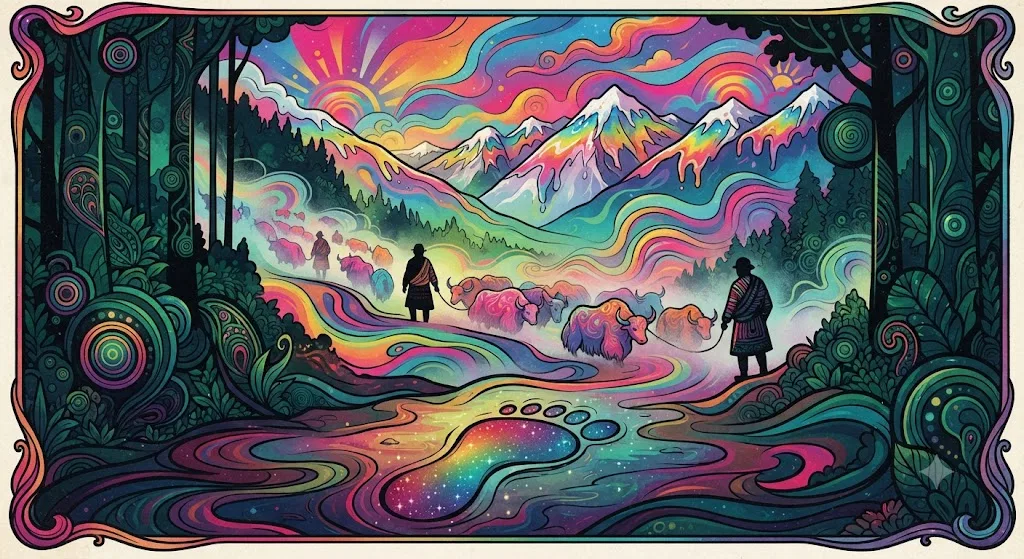
Bhutan’s best-known mystery creature is the Migoi, the country’s local form of the Himalayan yeti: a wild, hairy, human-like being said to inhabit remote highlands and forests, especially around Merak and Sakteng in the east. The important point is not that Bhutan has proved the yeti exists; it has not.
Page outline Jump by section
Introduction
That makes Bhutan unusual in cryptid history. Its mystery-beast tradition is not a lake-monster flap, a tabloid phantom-cat panic, or a one-off hoax. It is a mountain legend rooted in a real ecological setting where bears, snow leopards, red pandas, yak herding, snow, forests, and oral stories all overlap. The likely explanations are natural and cultural rather than monstrous, but the legend remains one of the most vivid ways Bhutan connects folklore with landscape.
The creature people ask about is the Migoi
In Bhutanese yeti accounts, the Migoi is usually treated as a “wild man” or abominable snowman figure rather than a normal animal. Travel descriptions aimed at visitors often present it as an elusive hairy being believed to live in the remote forests and highlands of eastern Bhutan, with Merak and Sakteng as the strongest modern association.[visitbhutan.com]visitbhutan.comOpen source on visitbhutan.com.
The Migoi sits inside the wider Himalayan yeti family of stories, but Bhutan gives it a distinct national setting. In Nepal and Tibet, the yeti became world-famous through mountaineering, Everest exploration, monastery relics, footprints, and international media. In Bhutan, the story is quieter and more local: high valleys, pastoral communities, forest margins, and the idea that certain remote places still hold beings that do not fit ordinary categories.
Descriptions vary because this is folklore rather than zoology. The Migoi may be imagined as human-like, powerful, hairy, shy, dangerous, sacred, or simply unknowable. That looseness matters. A cryptid with a fixed body plan can be tested against tracks, fur, bones, or photographs. A folklore being can shift between animal, spirit, warning, guardian, and memory of the wild.
Why eastern Bhutan became the centre of the story
The strongest geographical anchor is Sakteng Wildlife Sanctuary in eastern Bhutan. UNESCO’s tentative-list description places the sanctuary in Trashigang Dzongkhag, covering much of Merak and Sakteng and part of Lauri, with alpine meadows, temperate forest, warm broadleaf forest, and an altitudinal range given as roughly 1,700 to 4,100 metres. It also stresses that the area is remote, culturally distinctive, and home to semi-nomadic highlanders whose livelihoods are closely tied to livestock.[UNESCO World Heritage Centre]whc.unesco.orgWorld Heritage Centre Sakteng Wildlife Sanctuary (SWSWorld Heritage Centre Sakteng Wildlife Sanctuary (SWS
That setting is exactly the kind of place where mystery-animal traditions tend to persist. Visibility is poor in forest and snow. Large mammals are present. Herders move through remote country at odd hours and in difficult weather. Tracks deform in thawing snow. A story heard from elders can feel more plausible when the surrounding landscape already looks capable of hiding something.
Sakteng’s real wildlife also gives the legend a strong ecological background. WWF Bhutan lists red panda, Himalayan black bear, wild dog, snow leopard, barking deer and Himalayan red fox among the sanctuary’s mammals, while UNESCO’s listing mentions threatened or notable animals including red panda, Himalayan serow, wild dog, goral, common leopard, capped langur, Himalayan black bear, musk deer and jungle cat.[wwfbhutan.org.bt]wwfbhutan.org.btSW S | WWFSW S | WWF
None of those animals is a confirmed Migoi. But several could feed sightings, tracks, noises, carcass stories, or frightening night encounters. The Himalayan black bear is the most obvious candidate for some reports: it is large, can stand on its hind legs, leaves impressive tracks, and is already present in the region’s known fauna. Snow leopards, leopards, wild dogs and foxes widen the pool of possible “something was out there” experiences, especially when a witness sees only movement, eyeshine, prints, or damage to livestock.
The sanctuary story is real, but easy to overstate
A popular claim says Bhutan created a reserve for the yeti. There is a kernel of truth in that: visitor-facing and journalistic sources often say Sakteng Wildlife Sanctuary was set up to protect the elusive Migoi or its habitat, and this is one reason the sanctuary has become famous outside Bhutanese conservation circles.[visitbhutan.com]visitbhutan.comOpen source on visitbhutan.com.
The official conservation framing is more sober. The Sakteng Wildlife Sanctuary Conservation Management Plan says the sanctuary was established in 2003 to represent Bhutan’s easternmost temperate and alpine ecosystems, protect rare and threatened wildlife, and conserve a landscape with notable rhododendron diversity and Brokpa cultural heritage. It also describes Bhutan’s protected-area system, biological corridors, and the need to manage conservation alongside local settlement and livestock use.[saktengws.wordpress.com]saktengws.wordpress.comsakteng wildlife sanctuarysakteng wildlife sanctuary
So the best reading is this: the Migoi helped make Sakteng memorable, but the sanctuary is not a scientific admission that a yeti exists. It is a real protected landscape where folklore, biodiversity, and cultural identity meet. The monster story is part of the place’s public image; the conservation work is about forests, watersheds, wildlife, grazing pressure, plants, communities and ecological connectivity.
That distinction is important because sensational versions flatten Bhutan into a “country that protects the yeti”. The more interesting version is subtler: Bhutan has a protected area whose mythic reputation encourages outsiders to notice a remote ecosystem that is also home to real, threatened, and rarely seen species.
What evidence exists for Bhutan’s yeti?
The evidence for Bhutan’s Migoi is mainly testimony, local tradition, tourism retellings, old media references, and the occasional mention of footprints or plaster casts. A Bhutanese newspaper report from 2012, for example, described framed plaster casts at Bhutan’s Nature Conservation Department labelled as yeti footprints, and tied the country’s Migoi reputation to stamps and Sakteng Wildlife Sanctuary.[The Bhutanese]thebhutanese.btThe Bhutanese The abominable snowman 'drops' by ThrumshinglaThe Bhutanese The abominable snowman 'drops' by Thrumshingla
That is intriguing cultural evidence, but it is not strong biological evidence. Footprints are notoriously difficult to use as proof of unknown animals. Snow melts, stretches and collapses. Animal tracks can overlap. A bear’s hind foot may partly cover its front foot, creating a long, human-like shape. A trackway seen after wind, thaw or refreezing may look much stranger than the animal that made it.
Bhutan also has a philatelic afterlife for the creature. The country issued Abominable Snowman or yeti-themed stamps in the 1960s, and collectors still treat them as part of Bhutan’s famously imaginative stamp history.[Mintage World]mintageworld.comOpen source on mintageworld.com. This does not prove the Migoi any more than a dragon on a flag proves dragons. It does show that the creature became a national symbol of curiosity, mountain mystery and international marketability.
Modern Bhutanese media still occasionally return to the legend. Kuensel search results show recent coverage of the Migoi in Sakteng, presenting the story as something that has not disappeared from the high valleys.[Kuensel Online]kuenselonline.comwhere the migoi still roamswhere the migoi still roams The sourcing can be fragmentary or difficult to access, but the pattern is clear enough: the Migoi remains culturally alive even while biological proof remains absent.
The strongest sceptical explanation is bears, not hoaxing
The most persuasive sceptical explanation for many yeti traditions across the Himalayas is not that everyone lied. It is that people encountered real animals, tracks and remains under conditions that made them hard to interpret. Bears are central to this.
A major genetic study of alleged yeti material from the Himalayas and Tibetan Plateau found that supposed yeti samples were from known animals, especially local brown and black bears. The Royal Society’s summary of the research states that the findings strongly suggest the biological basis of the yeti legend is local brown and black bears, not a mythical creature or a previously unknown bear species.[Royal Society Publishing]royalsocietypublishing.orgOpen source on royalsocietypublishing.org.
That study was not a Bhutan-only survey, so it should not be lazily used to “solve” every Bhutanese story. But it is highly relevant because Bhutan’s Migoi belongs to the same broad Himalayan pattern, and because Himalayan black bear is part of the real fauna recorded for Sakteng.[wwfbhutan.org.bt]wwfbhutan.org.btSW S | WWFSW S | WWF
Other ordinary explanations may also apply:
- Bear tracks in snow: elongated, melting, or overlapping prints can look startlingly human.
- Brief sightings of upright animals: a bear standing or moving through brush can look man-like for a moment.
- Livestock losses: predators, disease, falls, or scavenging can become attached to a feared wild being.
- Distance and weather: fog, snowfall, twilight and forest cover all degrade judgement.
- Story inheritance: once a place is known for a being, ambiguous signs are more likely to be interpreted through that being.
This does not make the Migoi worthless as a subject. It simply moves the question from “Is there a hidden ape in Bhutan?” to “How do real animals, remote landscapes and inherited belief create a durable mystery?”
Why the legend survived modernisation
Yeti belief has weakened in many Himalayan settings as roads, schooling, phones, tourism and conservation science have changed how people interpret wild places. But Bhutan’s Migoi has survived because it is not just a claim about an animal. It is attached to identity, place and memory.
Merak and Sakteng are repeatedly presented as culturally distinctive highland communities. UNESCO describes the Brokpas as semi-nomadic people with their own language, dress, customs and yak-based livelihoods, while WWF notes the villages’ distinctive way of life and dependence on livestock.[UNESCO World Heritage Centre]whc.unesco.orgWorld Heritage Centre Sakteng Wildlife Sanctuary (SWSWorld Heritage Centre Sakteng Wildlife Sanctuary (SWS In that context, the Migoi is not merely a monster to be photographed. It is part of how a landscape is narrated.
The legend also benefits from Bhutan’s wider symbolic world. Bhutan is internationally known as the Land of the Thunder Dragon, and the dragon is an official and cultural emblem rather than a cryptid claim. Government heritage material describes the dragon as a mythical creature and national symbol associated with guardianship, rain and prosperity.[dcdd.moha.gov.bt]dcdd.moha.gov.btDRAGO NDRAGO N
That matters because Bhutanese monster traditions do not always separate neatly into “animal report” and “myth”. A thunder dragon is not being searched for with camera traps. A Migoi is sometimes spoken of more like a wild being that might leave tracks. The takin, Bhutan’s real national animal, also has a folklore origin story attached to it in popular retellings. Bhutan therefore offers a spectrum: confirmed animal with legend, national mythic emblem, and unconfirmed wild-man tradition.
Tourism turned the Migoi into a doorway
For outside readers, the Migoi often functions as an invitation into eastern Bhutan. Travel pages describe Merak and Sakteng as places where visitors can encounter pastoral culture, highland scenery, rhododendrons, rare wildlife and the yeti legend in the same journey.[visitbhutan.com]visitbhutan.comOpen source on visitbhutan.com.
That is not automatically cynical. Folklore can make conservation more legible. A reader may not remember a list of vegetation zones, but they may remember “the valley of the yeti” and then learn that the same landscape shelters red pandas, black bears, snow leopards, alpine meadows, medicinal plants and migratory pastoral routes.
The risk is simplification. If tourism sells Sakteng only as a yeti territory, it can turn a living cultural landscape into a novelty. The better approach is to treat the Migoi as one strand in a larger story: a way into understanding how Bhutan’s highlands combine belief, wildlife, herding, remoteness, conservation pressure and national imagination.
How Bhutan’s cryptid tradition compares with classic monster cases
Bhutan does not have the same cryptid profile as countries famous for lake monsters, sea serpents or phantom cats. There is no Bhutanese Loch Ness equivalent with a modern sequence of boat sightings, sonar claims and blurry tourist photographs. There is no well-documented national flap of escaped big cats comparable to British phantom-cat reports. The centre of gravity is firmly Himalayan and highland.
That makes Bhutan’s case closer to “wild man of the mountains” traditions elsewhere in Asia, but with a distinctive conservation twist. The Migoi is not just a creature in old stories; it is repeatedly tied to a named protected area, a named region, and a recognisable cultural landscape.[UNESCO World Heritage Centre]whc.unesco.orgWorld Heritage Centre Sakteng Wildlife Sanctuary (SWSWorld Heritage Centre Sakteng Wildlife Sanctuary (SWS
The evidence is also more folklore-heavy than case-file-heavy. Readers looking for a neat chronology of sightings will find scattered references rather than a robust archive. Readers interested in how a mystery animal becomes part of a country’s image will find a richer subject: stamps, sanctuary lore, travel writing, local belief, and scientific bear explanations all pointing to the same tension between wonder and evidence.
What probably happened?
The most balanced answer is that Bhutan’s Migoi is a living mountain legend with some roots in real wildlife encounters, especially bear-related confusion, and some roots in cultural ideas about remote places and beings beyond ordinary human control. There is no strong mainstream evidence that an unknown ape-like animal lives in Bhutan. There is, however, strong evidence that the story has become attached to Sakteng, Merak, Brokpa highland culture, and Bhutan’s image as a country where myth and ecology remain unusually close.[unesco.org]whc.unesco.orgWorld Heritage Centre Sakteng Wildlife Sanctuary (SWSWorld Heritage Centre Sakteng Wildlife Sanctuary (SWS
That is why the Migoi is worth taking seriously without taking it literally. As zoology, the case is weak. As folklore, it is durable. As conservation storytelling, it is unusually powerful. Bhutan’s yeti is best understood not as a confirmed hidden animal, but as a creature-shaped meeting point between fear of the wild, respect for mountains, misread animal signs, national symbolism, and the enduring appeal of places that still feel only partly known.

Amazon book picks
Further Reading
Books and field guides related to What Haunts Bhutan's High Valleys?. Use these as the next step if you want deeper reading beyond the article.
Field Guide To Bigfoot, Yeti, & Other Mystery Primates Worldwide
Directly covers yeti-type beings including Himalayan traditions.
eBay marketplace picks
Marketplace Samples
Live-tested eBay searches with available results related to this page.
Endnotes
1.
Source: visitbhutan.com
Link:https://www.visitbhutan.com/destination-detail.php?id=13
2.
Source: whc.unesco.org
Title: World Heritage Centre Sakteng Wildlife Sanctuary (SWS)
Link:https://whc.unesco.org/en/tentativelists/5701/
3.
Source: saktengws.wordpress.com
Title: sakteng wildlife sanctuary
Link:https://saktengws.wordpress.com/wp-content/uploads/2018/08/sakteng-wildlife-sanctuary.pdf
4.
Source: wwfbhutan.org.bt
Title: SW S | WWF
Link:https://www.wwfbhutan.org.bt/b2c2_areas/sws
5.
Source: dcdd.moha.gov.bt
Title: DRAGO N
Link:https://dcdd.moha.gov.bt/collection/dragon-12/
6.
Source: wwfbhutan.org.bt
Link:https://www.wwfbhutan.org.bt/about_us/where_we_work/
7.
Source: yeti.com
Link:https://www.yeti.com/
8.
Source: spunktitud3.wordpress.com
Title: bhutan catch sight of a real life mythical creature at motithang takin preserve
Link:https://spunktitud3.wordpress.com/2016/11/21/bhutan-catch-sight-of-a-real-life-mythical-creature-at-motithang-takin-preserve/
9.
Source: adcochrane.wordpress.com
Title: the wonderful folklore of bhutan
Link:https://adcochrane.wordpress.com/2019/11/28/the-wonderful-folklore-of-bhutan/
10.
Source: biodiversity.bt
Link:https://biodiversity.bt/group/Sakteng_Wildlife_Sanctuary
11.
Source: bhutan.travel
Link:https://bhutan.travel/
12.
Source: bhutan.travel
Link:https://bhutan.travel/visit
13.
Source: dfat.gov.au
Link:https://www.dfat.gov.au/geo/bhutan/bhutan-country-brief
14.
Source: visitbhutan.com
Link:https://www.visitbhutan.com/
15.
Source: thebhutanese.bt
Title: The Bhutanese The abominable snowman ‘drops’ by Thrumshingla
Link:https://thebhutanese.bt/the-abominable-snowman-drops-by-thrumshingla/
16.
Source: mintageworld.com
Link:https://www.mintageworld.com/media/detail/6992-First-yeti-stamps-of-bhutan/
17.
Source: kuenselonline.com
Title: where the migoi still roams
Link:https://kuenselonline.com/news/where-the-migoi-still-roams
18.
Source: royalsocietypublishing.org
Link:https://royalsocietypublishing.org/rspb/article/284/1868/20171804/78775/Evolutionary-history-of-enigmatic-bears-in-the
19.
Source: royalsociety.org
Title: Royal Society Mysteries of the yeti | Royal Society
Link:https://royalsociety.org/blog/2017/11/mysteries-of-the-yeti/
20.
Source: kuenselonline.com
Link:https://kuenselonline.com/index.php/archive?month=November&page=4&year=1992
21.
Source: kuenselonline.com
Link:https://kuenselonline.com/index.php/archive?month=November&page=18&year=2011
22.
Source: kuenselonline.com
Link:https://kuenselonline.com/search?page=575&q=Bhutan
23.
Source: kuenselonline.com
Link:https://kuenselonline.com/index.php/archive?month=August&page=9&year=2003
24.
Source: kuenselonline.com
Link:https://kuenselonline.com/archive?month=January&page=14&year=2019
25.
Source: kuenselonline.com
Link:https://kuenselonline.com/dz/news/his-majesty-and-gyaltsuen-grace-rhododendron-festival
26.
Source: kuenselonline.com
Link:https://kuenselonline.com/archive?month=December&page=7&year=2023
27.
Source: kuenselonline.com
Link:https://kuenselonline.com/index.php/archive?month=May&page=1&year=1986
28.
Source: kuenselonline.com
Link:https://kuenselonline.com/archive?month=November&page=7&year=2016
29.
Source: kuenselonline.com
Link:https://kuenselonline.com/index.php/archive?month=December&page=2&year=1988
30.
Source: kuenselonline.com
Link:https://kuenselonline.com/index.php/archive?month=November&page=16&year=2020
31.
Source: kuenselonline.com
Link:https://kuenselonline.com/search?page=1914
32.
Source: kuenselonline.com
Link:https://kuenselonline.com/index.php/search?page=13
33.
Source: kuenselonline.com
Link:https://kuenselonline.com/archive?month=April&page=8&year=2002
34.
Source: kuenselonline.com
Link:https://kuenselonline.com/archive?month=August&page=21&year=2014
35.
Source: kuenselonline.com
Link:https://kuenselonline.com/en/search?q=fc+coins+xbox+Besuche+die+Website+Buyfc26coins.com.+Alles+super+einfach..hySf
36.
Source: kuenselonline.com
Link:https://kuenselonline.com/archive?month=August&page=25&year=2013
37.
Source: Wikipedia
Link:https://en.wikipedia.org/wiki/Bhutan
38.
Source: Wikipedia
Title: Sakteng Wildlife Sanctuary
Link:https://en.wikipedia.org/wiki/Sakteng_Wildlife_Sanctuary
39.
Source: Wikipedia
Link:https://en.wikipedia.org/wiki/Yeti
40.
Source: Wikipedia
Link:https://en.wikipedia.org/wiki/Dragon
41.
Source: royalsocietypublishing.org
Link:https://royalsocietypublishing.org/rspb/article/282/1800/20141712/77504/Himalayan-yeti-DNA-polar-bear-or-DNA-degradation-A
42.
Source: stampworld.com
Link:https://www.stampworld.com/cz/stamps/Bhutan/Postage%20stamps/1955-2025?page=2
43.
Source: devdutt.com
Title: The Thunder Dragon
Link:https://devdutt.com/the-thunder-dragon/
44.
Source: apnews.com
Link:https://apnews.com/hub/bhutan
45.
Source: himalaya2000.com
Title: Sakteng Wildlife Sanctuary
Link:https://www.himalaya2000.com/bhutan/wildlife-sanctuaries/sakteng.html
Additional References
46.
Source: youtube.com
Title: Inside Sakteng Village: Bhutan’s Remote Land of the Migoi (Yeti)
Link:http://www.youtube.com/watch?v=eZn3In13Bww
Source snippet
"Tales of the Yeti" by Kunzang Choden (Bhutan, 1997)...
47.
Source: youtube.com
Link:http://www.youtube.com/watch?v=MC8hFANdgGY
Source snippet
The Silent Watcher of Sakteng. #bhutan #folktales #yeti #viralvideo...
48.
Source: facebook.com
Link:https://www.facebook.com/bhutanbroadcastingservice/posts/%F0%9D%97%9A%F0%9D%97%BF%F0%9D%97%B2%F0%9D%97%AE%F0%9D%98%81-%F0%9D%97%AC%F0%9D%97%B2%F0%9D%98%81%F0%9D%97%B6-%F0%9D%97%A4%F0%9D%98%82%F0%9D%97%B2%F0%9D%98%80%F0%9D%98%81-%F0%9D%97%99%F0%9D%97%B2%F0%9D%98%80%F0%9D%98%81%F0%9D%97%B6%F0%9D%98%83%F0%9D%97%AE%F0%9D%97%B9-%F0%9D%97%BF%F0%9D%97%B2%F0%9D%98%83%F0%9D%97%B6%F0%9D%98%83%F0%9D%97%B2%F0%9D%98%80-%F0%9D%97%A6%F0%9D%97%AE%F0%9D%97%B8%F0%9D%98%81%F0%9D%97%B2%F0%9D%97%BB%F0%9D%97%B4%F0%9D%98%80-%F0%9D%97%BF%F0%9D%97%AE%F0%9D%97%BF%F0%9D%97%B2-%F0%9D%97%B5%F0%9D%97%BC%F0%9D%98%82%F0%9D%98%80%F0%9D%97%B2-%F0%9D%97%B0%F0%9D%97%BC%F0%9D%97%BB%F0%9D%98%80%F0%9D%97%B2%F0%9D%97%B0%F0%9D%97%BF%F0%9D%97%AE%F0%9D%98%81%F0%9D%97%B6%F0%9D%97%BC%F0%9D%97%BB-%F0%9D%98%81%F0%9D%97%BF%F0%9D%97%AE%F0%9D%97%B1%F0%9D%97%B6%F0%9D%98%81%F0%9D%97%B6%F0%9D%97%BC%F0%9D%97%BBalth/1660285029102818/
49.
Source: facebook.com
Link:https://www.facebook.com/karma.sonam.731831/posts/bhutan-takin-an-animal-from-bhutanese-mythology-the-takin-known-locally-as-drong/1030897016328430/
50.
Source: alamy.com
Link:https://www.alamy.com/stock-photo/bhutan-stamp.html
51.
Source: comohotels.com
Link:https://www.comohotels.com/stories/the-legend-of-bhutans-yeti
52.
Source: alphabiolabs.co.uk
Link:https://www.alphabiolabs.co.uk/blog/dna-tests-disprove-yeti-theory/
53.
Source: facebook.com
Link:https://www.facebook.com/pe.dorji.2025/posts/deep-in-the-mountains-of-bhutan-locals-have-passed-down-stories-of-a-mysterious-/987777067420550/
54.
Source: facebook.com
Link:https://www.facebook.com/groups/1025224317935642/posts/2023868054737925/
55.
Source: instagram.com
Link:https://www.instagram.com/p/C3-n8Ans4rx/?hl=en
Topic Tree
Follow this branch
Related pages 192
- Antigua Cryptids
- Maldives Monsters
- Malta Monsters
- Qatar Monsters
- Argentina Monsters
- +187 more in sidebar