Madagascar's Monsters Between Memory and Myth
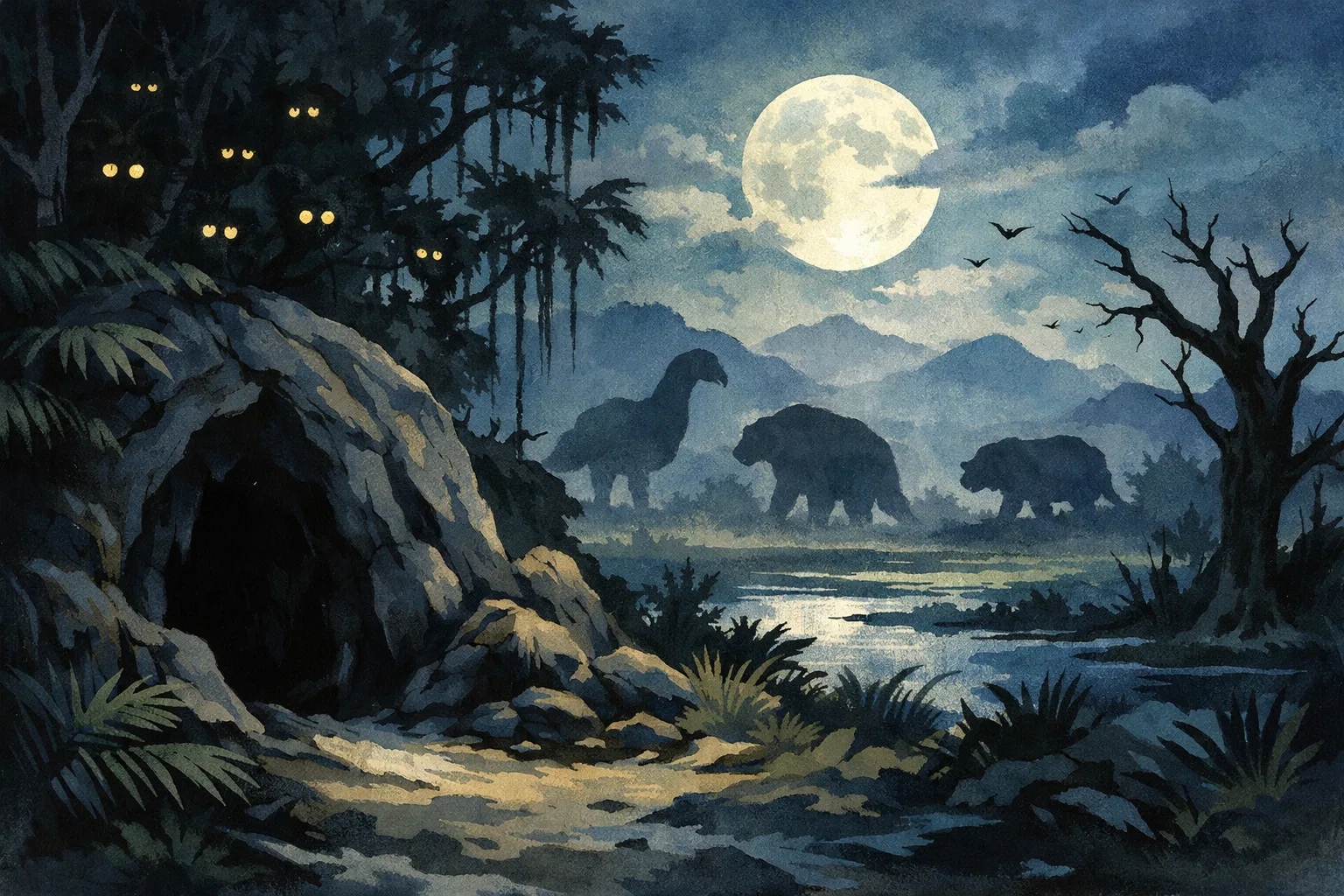
Madagascar’s mystery-creature tradition is unusual because some of its strangest stories sit very close to real natural history. The island really did have giant lemurs, elephant birds, dwarf hippos, a larger extinct fossa, and other recently vanished animals; it also has living lemurs, tenrecs, fossas and chameleons unlike almost anything elsewhere.
Page outline Jump by section
Introduction
The creatures most often discussed are the small forest beings called kalanoro, the giant-lemur-like tratratratra, the donkey-like mangarsahoc, tales of unusually large fossas, and older reports that seem to echo Madagascar’s extinct megafauna. The best reading is evidence-aware rather than dismissive: Madagascar’s folklore is not a field guide, but neither is it random fantasy. It grew from a landscape where caves, forests, taboos, ancestral spirits, vanished animals and colonial natural history all overlapped.[journal.fi]journal.fiLiving with Spirits and Environmental Conservation EffortsLiving with Spirits and Environmental Conservation Efforts
Why Madagascar produces such convincing monster stories
Madagascar split from other landmasses long enough ago for its wildlife to evolve in isolation, and that isolation gave the island an almost storybook animal cast. Lemurs replaced monkeys and apes, fossas filled the role of top mammalian predator, elephant birds became gigantic flightless birds, and several large animals survived late enough to overlap with people. A 2003 study in PNAS found stratigraphic evidence consistent with human presence at least around 2,000 radiocarbon years before present, while later work has complicated the picture with debated claims of much earlier human-modified elephant-bird bones.[pnas.org]pnas.orgOpen source on pnas.org.
That matters for cryptid history because Madagascar is not a place where every “prehistoric survivor” idea is automatically absurd in outline. Some large animals really were present into the late Holocene, the recent geological period that includes human history. Subfossil lemurs, including large forms, are known from remains dating from tens of thousands of years ago to only a few centuries ago, and at least 17 lemur species have gone extinct in the last couple of millennia.[wikipedia.org]WikipediaSubfossil lemurSubfossil lemur
The caution is that “recently extinct” is not the same as “still alive”. Madagascar’s forests have been heavily transformed, many large animals would leave signs, and no accepted modern specimen, DNA sample, clear photograph, or verified carcass has confirmed a surviving giant lemur, giant fossa, elephant bird or unknown hoofed animal. The island’s cryptid stories are therefore strongest as a mixture of oral tradition, ecological memory and occasional eyewitness claim, not as proof of hidden species.[mpg.de]gea.mpg.demadagascar s megafaunal extinctionsmadagascar s megafaunal extinctions
Kalanoro: little forest beings or misread wildlife?
The kalanoro is Madagascar’s best-known humanoid mystery being in modern cryptid writing. Accounts usually describe small, hairy, humanlike figures associated with forests, caves, rocks, rivers or secluded places. In some versions they have long hair, long nails, reversed feet, unusual strength, strange voices, or a habit of appearing at night. They are not simply “ape-men” in the Western cryptozoology sense: in many Malagasy contexts they are spirits, helpers, healers, taboo-givers, or beings connected to ancestors and hidden places.[journal.fi]journal.fiLiving with Spirits and Environmental Conservation EffortsLiving with Spirits and Environmental Conservation Efforts
This is where many online summaries flatten the story. A kalanoro can be presented as a physical forest dwarf, but anthropological and conservation writing more often places such beings inside a living system of spirit belief, taboo and landscape. Recent research on northern Madagascar describes kalanoro alongside other forest-associated spirits and notes that they may communicate with ancestors. A study on magical animals and conservation argues more broadly that “magical” animals should not be treated merely as mistakes or curiosities, because they can shape how people relate to real species and protected places.[journal.fi]journal.fiLiving with Spirits and Environmental Conservation EffortsLiving with Spirits and Environmental Conservation Efforts
As a cryptid claim, the kalanoro has several possible explanations. Some details may be symbolic: reversed feet, for example, are a widespread way of marking a being as uncanny or difficult to track. Some sightings may involve lemurs glimpsed at night, especially in places where reflective eyes, quick movement and humanlike hands can be startling. Some stories may preserve memories of earlier forest peoples or of misunderstood communities, though that explanation can easily become speculative or disrespectful if pushed too far. The safest conclusion is that the kalanoro belongs first to Malagasy spirit and forest folklore, with later cryptid writers recasting it as a possible unknown primate or relict hominin.[researchgate.net]researchgate.netOpen source on researchgate.net.
The legend’s staying power comes from the fact that Madagascar’s forests are both biologically and culturally charged. They are habitats, burial landscapes, ancestral places, resource zones and conservation battlegrounds. A small being that lives in caves or near water is not just a “monster”; it is a way of talking about hidden ownership, danger, healing, taboo, and the limits of human behaviour in the forest.[bioecon-network.org]bioecon-network.orgOpen source on bioecon-network.org.
The tratratratra and the giant lemur problem
The tratratratra is the Madagascan mystery animal most strongly tied to a plausible extinct creature. Early European accounts associated with Étienne de Flacourt’s seventeenth-century writing describe a strange large animal from southern Madagascar, often summarised in later cryptozoological literature as a calf-sized lemur with a round or humanlike face and monkeylike hands. Flacourt’s Histoire de la grande isle Madagascar is one of the key early European sources for Madagascar’s animals and traditions, though it must be read as a colonial text filtered through translation, hearsay and seventeenth-century natural history.[wikimedia.org]upload.wikimedia.orgOpen source on wikimedia.org.
The reason this report matters is that Madagascar did have large extinct lemurs. Palaeopropithecus, one of the so-called sloth lemurs, is a serious candidate behind later interpretations of the tratratratra because it had a more rounded skull and forward-facing eyes than some other giant lemurs, making a “human-faced” description less far-fetched than it first sounds. Subfossil evidence indicates that large lemurs survived late in Madagascar, and some remains have been radiocarbon dated to the last several hundred years.[researchgate.net]researchgate.netResearch Gate The Extinct Sloth Lemurs of MadagascarResearch Gate The Extinct Sloth Lemurs of Madagascar
A useful sceptical distinction is needed here. The old tratratratra tradition may well reflect memory of a real extinct lemur, but that does not prove modern survival. Oral tradition can preserve striking ecological information, especially about large animals, yet it can also compress time, exaggerate size, merge species, and turn animals into moral or spiritual figures. The tratratratra is therefore one of Madagascar’s strongest “cryptid” cases historically, but its strength lies in explaining a remembered extinct animal rather than proving a living one.[wikipedia.org]WikipediaSubfossil lemurSubfossil lemur
This case also shows why Madagascar differs from many monster traditions. A European lake monster or phantom cat often has no known fossil animal sitting conveniently behind it. In Madagascar, the fossil record itself supplies possible originals: sloth lemurs, koala lemurs, giant aye-ayes, elephant birds and other lost animals were recent enough to leave cultural shadows.[wikipedia.org]WikipediaSubfossil lemurSubfossil lemur
Mangarsahoc, songòmby and other beasts from old accounts
Not every Madagascan mystery beast points neatly to a known extinct animal. The mangarsahoc, described in traditions preserved through Flacourt-related material and later bestiary writing, is usually presented as a donkey-like or hoofed creature with long ears. The problem is obvious: Madagascar has no native wild horses, donkeys, antelope or cattle-like hoofed mammals in its natural fauna. That makes the mangarsahoc either a badly distorted report, a name attached to an introduced or imagined animal, or a folkloric creature rather than a straightforward zoological puzzle.[wikimedia.org]upload.wikimedia.orgOpen source on wikimedia.org.
The songòmby is another creature that appears in discussions of Malagasy beast folklore, often as a fierce or carnivorous animal with a name linked in some interpretations to cattle-like imagery. It is harder to treat as a modern cryptid because the evidence is mainly literary and folkloric rather than a chain of dated sightings. Still, it belongs in the same country-level pattern: Madagascar’s creature lore often blends real animal traits, introduced livestock imagery, moral qualities and landscape fear.[A Book of Creatures]abookofcreatures.comA Book of Creatures SongòmbyA Book of Creatures Songòmby
These old beasts are valuable because they warn against an overly literal approach. A strange animal in a seventeenth-century or nineteenth-century source may be a lost species, but it may also be a mistranslation, a traveller’s misunderstanding, a local metaphor, a taboo figure, or a composite built from several animals. The older the report, the more important it is to ask who recorded it, whether they saw the animal themselves, what language chain the description passed through, and whether later writers quietly made the creature more concrete than the original source allowed.[persee.fr]persee.frPersée Histoire de la Grande Isle Madagascar. Édition annotée etPersée Histoire de la Grande Isle Madagascar. Édition annotée et
Giant fossas and phantom cats
Madagascar’s living fossa is already cryptid-like to outsiders: a long-tailed, catlike carnivore that is not a cat, not a civet, and not a mongoose in the simple everyday sense. It is Madagascar’s largest living mammalian carnivore, endemic to the island, and now placed with other Malagasy carnivores in the family Eupleridae. Because it has a catlike body, reflective eyes, a long tail and a predatory reputation, it can easily feed “phantom cat” impressions among observers unfamiliar with local wildlife.[Wikipedia]WikipediaFossa (animalFossa (animal
There is also an extinct larger relative, Cryptoprocta spelea, often called the giant fossa or cave fossa. It is known from subfossil bones found in Madagascar and was larger than the living fossa. Some Malagasy distinctions between larger and smaller fossas, and occasional reports of unusually large individuals, have encouraged speculation about survival, but mainstream evidence currently supports the giant fossa as extinct.[Wikipedia]WikipediaFossa (animalFossa (animal
This is one of the more plausible places for misidentification. A large male fossa seen briefly in poor light could become a “black cat”, “forest lion” or unknown predator in retelling, especially if the observer expected cats rather than Malagasy carnivores. Conversely, the existence of an extinct larger fossa makes the story tempting for cryptozoology: it provides a real animal behind the rumour. The gap is evidence. Without verified modern remains or reliable records, giant-fossa survival remains an interesting claim rather than an established fact.[Wikipedia]WikipediaFossa (animalFossa (animal
Elephant birds, rocs and the danger of a good story
Madagascar’s elephant birds were real, enormous, flightless birds that laid famously huge eggs. They became extinct in historical or near-historical times, and their remains helped shape outside fascination with Madagascar as a land of giants. It is easy to connect them with the legendary roc, the gigantic bird of Indian Ocean and Middle Eastern story traditions, but that link should be handled carefully. The elephant bird may have influenced travellers’ tales about giant birds, yet the roc tradition is wider than Madagascar and cannot be reduced to a single zoological source.[indiatimes.com]timesofindia.indiatimes.comOpen source on indiatimes.com.
For Madagascar’s cryptid page, elephant birds matter less as a living mystery claim and more as context. They prove that the island’s “monster” reputation did not come from nowhere. A bird taller than a person, with eggs of spectacular size, really did live there. Even after extinction, eggshell fragments, bones and stories could keep the animal present in memory, trade and imagination.[science.org]science.orgOpen source on science.org.
The sceptical lesson is the same as with giant lemurs: a real extinct giant can cast a very long legendary shadow. That shadow may preserve useful information, but it can also grow larger as it travels through sailors, merchants, colonial writers, naturalists, children’s books and modern internet cryptid lists.[The Times of India]timesofindia.indiatimes.comOpen source on indiatimes.com.
Where reports and traditions cluster
Madagascar’s creature traditions are not evenly spread as simple pins on a monster map. They cluster around habitats that already carry ecological and cultural weight: caves, forest margins, river places, dry spiny forests, remote highlands and areas where subfossil remains are found. Kalanoro are often linked with forests, caves, rivers and rocks; giant-lemur interpretations point towards areas where large subfossil lemurs once lived; giant-fossa claims naturally follow forest predator territory.[journal.fi]journal.fiLiving with Spirits and Environmental Conservation EffortsLiving with Spirits and Environmental Conservation Efforts
The Ankarana and other cave landscapes are especially important because caves preserve bones, shelter animals, and attract stories about spirits or hidden beings. In Madagascar, caves can be archaeological sites, ritual places, wildlife refuges and monster settings at the same time. That overlap helps explain why a “cave creature” story may be simultaneously folklore, local history and natural-history clue.[journal.fi]journal.fiLiving with Spirits and Environmental Conservation EffortsLiving with Spirits and Environmental Conservation Efforts
The south and west of Madagascar also matter because dry-country subfossil sites have produced evidence for extinct megafauna, while the southwest is associated in scholarship with questions about early human presence, pastoralism, fire, hunting and environmental change. This does not mean every southern monster story is a fossil memory, but it does mean the region’s creature lore sits in a landscape where people and large now-vanished animals once overlapped.[pnas.org]pnas.orgOpen source on pnas.org.
What counts as evidence?
Madagascar’s cryptid evidence falls into several different categories, and mixing them up creates false certainty. A seventeenth-century description is not the same as a modern field observation. A fossil is not the same as a living animal. A spirit tradition is not the same as a zoological sighting. A repeated local name is not proof that all speakers mean the same creature. Good assessment starts by sorting the evidence before judging it.[wikimedia.org]upload.wikimedia.orgOpen source on wikimedia.org.
The main evidence types are:
- Subfossil remains: strong evidence that large animals such as giant lemurs, elephant birds and giant fossas existed in Madagascar, sometimes until surprisingly recently. This supports memory-based explanations but not modern survival by itself.[wikipedia.org]WikipediaSubfossil lemurSubfossil lemur
- Oral tradition and folklore: valuable evidence for cultural belief, ecological memory and human relationships with landscape. It becomes weaker when treated as a literal species description without context.[journal.fi]journal.fiLiving with Spirits and Environmental Conservation EffortsLiving with Spirits and Environmental Conservation Efforts
- Colonial-era natural history: useful but filtered through language barriers, hearsay, European expectations and the politics of colonial writing. Flacourt is important, but not infallible.[wikimedia.org]upload.wikimedia.orgOpen source on wikimedia.org.
- Modern sightings: intriguing when detailed, repeated and tied to habitat, but currently lacking the physical confirmation needed to establish a surviving unknown animal.[Wikipedia]WikipediaSubfossil lemurSubfossil lemur
- Misidentification candidates: living lemurs, fossas, introduced animals, shadows, night-time eye-shine and exaggerated size estimates can explain some reports without requiring an unknown species.[Wikipedia]WikipediaFossa (animalFossa (animal
This layered evidence is what makes Madagascar so interesting. The sceptical answer is not “nothing happened”. Something did happen: people encountered unusual animals, watched some disappear, built stories around forests and caves, and passed on warnings through taboo and spirit language. The unresolved question is how often those stories preserve zoological memory rather than symbolic meaning.[wikipedia.org]WikipediaSubfossil lemurSubfossil lemur
The best natural explanations
The strongest natural explanation for many Madagascan cryptid traditions is not a hoax, but extinction memory. Giant lemurs and elephant birds survived late enough for people to have encountered them or their remains, and some oral traditions may preserve distorted impressions of these animals. The tratratratra is the clearest example: it is difficult to prove as a literal report, but it fits the broader fact that large, strange lemurs once lived on the island.[Wikipedia]WikipediaSubfossil lemurSubfossil lemur
A second explanation is misidentification of living endemic wildlife. Lemurs can look eerily human in posture, hands and gaze; nocturnal species add eye-shine and sudden movement. Fossas can be mistaken for cats, civets or small pumas by people using non-Malagasy animal categories. In a place where the real animals are already unfamiliar to outsiders, the boundary between “rare wildlife” and “monster” can be thin.[wikipedia.org]WikipediaFossa (animalFossa (animal
A third explanation is cultural category mismatch. Some beings that cryptid lists treat as animals are better understood as spirits, taboo figures or ancestral presences. Kalanoro are the prime example. Treating them only as “unknown hominids” strips away much of their meaning and can make Malagasy belief look like failed zoology, when it may be doing a different kind of social and spiritual work.[journal.fi]journal.fiLiving with Spirits and Environmental Conservation EffortsLiving with Spirits and Environmental Conservation Efforts
Finally, some reports may be literary afterlives. Once a creature enters books, television, podcasts, tourism writing or online cryptid databases, later summaries can repeat and harden weak claims. A cautious reader should ask whether a “sighting tradition” rests on many independent accounts or on a small number of old descriptions copied again and again.[fandom.com]cryptidz.fandom.comCryptid Wiki Cryptids of MadagascarCryptid Wiki Cryptids of Madagascar
Tourism, pop culture and modern cryptid afterlives
Madagascar’s monster stories now circulate far beyond the island through cryptozoology books, paranormal television, podcasts, online bestiaries and travel writing. The kalanoro in particular has been reframed for global audiences as a compact “humanoid cryptid”, sometimes detached from the local religious and social context that gives the figure meaning.[wikipedia.org]WikipediaOpen source on wikipedia.org.
This popular afterlife has benefits and risks. It can draw attention to Madagascar’s extraordinary biodiversity and to the fact that extinction is not ancient history there. But it can also turn living cultures into spooky scenery, or imply that Malagasy people are merely reporting “monsters” when they may be describing spirits, taboos, ancestors or moral relations with land. Conservation researchers have increasingly argued that magical animals and local beliefs should be considered carefully, not mined only for publicity or dismissed as superstition.[cambridge.org]cambridge.orgOpen source on cambridge.org.
For readers, the most rewarding approach is to enjoy the weirdness while keeping the categories clear. The tratratratra belongs near extinct giant lemurs. The kalanoro belongs near forest spirits, caves, healing and taboo. The giant fossa belongs near real predator ecology and subfossil evidence. Elephant-bird legends belong near the history of extinction and Indian Ocean storytelling. Each is strange, but not strange in the same way.[wikipedia.org]WikipediaSubfossil lemurSubfossil lemur
What Madagascar’s cryptids really tell us
Madagascar’s cryptids are less about hidden dinosaurs or easy monster hunts than about a rare overlap between folklore and very recent extinction. The island lost large animals within the broad span of human memory and historical record; people continued living among bones, caves, sacred forests, taboos and animals found nowhere else; outsiders then translated that world into the language of marvels and monsters.[pnas.org]pnas.orgOpen source on pnas.org.
The most credible “mystery animal” insight is that some Malagasy traditions may preserve memories of extinct megafauna, especially giant lemurs. The least credible leap is to claim that these animals are still alive without physical evidence. Between those positions lies the interesting territory: how communities remember ecological loss, how spirits guard forests, how real animals become uncanny, and how a vanished fauna can survive as story long after it disappears as flesh and bone.[wikipedia.org]WikipediaSubfossil lemurSubfossil lemur
Madagascar’s creature lore is therefore not a sideshow to its natural history. It is one of the ways that natural history remained visible after extinction. The monsters are not confirmed animals, but they are not empty inventions either. They are traces: of forests, caves, ancestors, colonial reports, living lemurs, lost giants and the human need to explain what has been seen only briefly, remembered imperfectly, or lost just before science arrived to name it.[sciencedaily.com]sciencedaily.comOpen source on sciencedaily.com.
Amazon book picks
Further Reading
Books and field guides related to Madagascar's Monsters Between Memory and Myth. Use these as the next step if you want deeper reading beyond the article.
The Song Of The Dodo
Explains why Madagascar produces unusual animals and enduring legends.
The Future of Life
Provides context for Madagascar's extraordinary wildlife and extinctions.
eBay marketplace picks
Marketplace Samples
Live-tested eBay searches with available results related to this page.



Endnotes
1.
Source: pnas.org
Link:https://www.pnas.org/doi/10.1073/pnas.1534700100
2.
Source: Wikipedia
Title: Subfossil lemur
Link:https://en.wikipedia.org/wiki/Subfossil_lemur
3.
Source: cambridge.org
Link:https://www.cambridge.org/core/journals/oryx/article/fantastic-beasts-and-why-to-conserve-them-animals-magic-and-biodiversity-conservation/467899EEDA175A8C86D4C1CFF606973E
4.
Source: journal.fi
Title: Living with Spirits and Environmental Conservation Efforts
Link:https://journal.fi/ar/article/view/156009/106001
5.
Source: upload.wikimedia.org
Link:https://upload.wikimedia.org/wikipedia/commons/5/5d/Flacourt%2C_%C3%89tienne_de_-_Histoire_de_la_grande_isle_Madagascar%2C_bpt6k1047463.pdf
6.
Source: lemur.duke.edu
Link:https://lemur.duke.edu/megaladapis/
7.
Source: sciencedaily.com
Link:https://www.sciencedaily.com/releases/2021/06/210624114340.htm
8.
Source: sciencedirect.com
Link:https://www.sciencedirect.com/science/article/abs/pii/S0277379110002246
9.
Source: madamagazine.com
Title: The little forest spirits
Link:https://www.madamagazine.com/en/die-kleinen-waldgeister-kalanoro/
10.
Source: researchgate.net
Link:https://www.researchgate.net/figure/Two-depictions-of-the-kalanoro-beneficent-spirits-that-often-inhabit-rivers-or-caves_fig1_281266684
11.
Source: Wikipedia
Title: Mikea people
Link:https://en.wikipedia.org/wiki/Mikea_people
12.
Source: bioecon-network.org
Link:https://bioecon-network.org/pages/9th_2007/Jones.pdf
13.
Source: archive.org
Link:https://archive.org/details/histoiredelagran0000flac
14.
Source: Wikipedia
Title: Histoire de la grande isle Madagascar
Link:https://fr.wikipedia.org/wiki/Histoire_de_la_grande_isle_Madagascar
15.
Source: researchgate.net
Title: Research Gate The Extinct Sloth Lemurs of Madagascar
Link:https://www.researchgate.net/publication/227513050_The_Extinct_Sloth_Lemurs_of_Madagascar
16.
Source: Wikipedia
Title: Étienne de Flacourt
Link:https://en.wikipedia.org/wiki/%C3%89tienne_de_Flacourt
17.
Source: Wikipedia
Title: Fossa (animal)
Link:https://en.wikipedia.org/wiki/Fossa_%28animal%29
18.
Source: wired.com
Link:https://www.wired.com/2015/01/creature-feature-10-fun-facts-fossa
Source snippet
The classification of the fossa has been complex, but recent studies place it in the Eupleridae family, related to mongoose-like ancestor...
19.
Source: Wikipedia
Title: Cryptoprocta spelea
Link:https://en.wikipedia.org/wiki/Cryptoprocta_spelea
20.
Source: Wikipedia
Link:https://en.wikipedia.org/wiki/Teniky
21.
Source: Wikipedia
Link:https://en.wikipedia.org/wiki/Palaeopropithecus
22.
Source: karlshuker.blogspot.com
Link:https://karlshuker.blogspot.com/2010/02/madagascars-elusive-mega-lemurs-and.html
23.
Source: Wikipedia
Link:https://en.wikipedia.org/wiki/Kalanoro
24.
Source: sciencedaily.com
Link:https://www.sciencedaily.com/releases/2017/08/170824090257.htm
25.
Source: researchgate.net
Title: 392431737 Patterns of late Holocene and historical extinctions on Madagascar
Link:https://www.researchgate.net/publication/392431737_Patterns_of_late_Holocene_and_historical_extinctions_on_Madagascar
26.
Source: researchgate.net
Link:https://www.researchgate.net/publication/318660879_Fantastic_beasts_and_why_to_conserve_them_animals_magic_and_biodiversity_conservation
27.
Source: researchgate.net
Link:https://www.researchgate.net/publication/281266667_The_human_health_and_conservation_relevance_of_food_taboos_in_northeastern_Madagascar
28.
Source: researchgate.net
Link:https://www.researchgate.net/publication/5235404_The_Importance_of_Taboos_and_Social_Norms_to_Conservation_in_Madagascar
29.
Source: observation.org
Title: Giant Fossa
Link:https://observation.org/species/200498/
30.
Source: lemur.duke.edu
Title: fossil friday hapalemur plesiopithecus and plesiopithecus
Link:https://lemur.duke.edu/fossil-friday-hapalemur-plesiopithecus-and-plesiopithecus/
31.
Source: lemur.duke.edu
Title: humans reached madagascar 6000 years earlier than previously thought
Link:https://lemur.duke.edu/humans-reached-madagascar-6000-years-earlier-than-previously-thought/
32.
Source: sciencedirect.com
Link:https://www.sciencedirect.com/science/article/pii/S0016718521002827
33.
Source: pubmed.ncbi.nlm.nih.gov
Link:https://pubmed.ncbi.nlm.nih.gov/18616743/
34.
Source: science.org
Link:https://www.science.org/doi/10.1126/sciadv.aat6925
35.
Source: pubmed.ncbi.nlm.nih.gov
Link:https://pubmed.ncbi.nlm.nih.gov/30214938/
36.
Source: gea.mpg.de
Title: madagascar s megafaunal extinctions
Link:https://www.gea.mpg.de/107211/madagascar-s-megafaunal-extinctions
37.
Source: sciencepress.mnhn.fr
Link:https://sciencepress.mnhn.fr/en/periodiques/comptes-rendus-palevol/8/fasc5/new-species-giant-subfossil-lemur-north-west-madagascar-palaeopropithecus-kelyus-primates
38.
Source: abookofcreatures.com
Link:https://abookofcreatures.com/category/madagascar/
39.
Source: cryptidz.fandom.com
Title: Cryptid Wiki Mangarsahoc
Link:https://cryptidz.fandom.com/wiki/Mangarsahoc
40.
Source: abookofcreatures.com
Title: A Book of Creatures Songòmby
Link:https://abookofcreatures.com/2020/04/24/songomby/
41.
Source: persee.fr
Title: Persée Histoire de la Grande Isle Madagascar. Édition annotée et
Link:https://www.persee.fr/doc/outre_0300-9513_1996_num_83_312_3468_t1
42.
Source: timesofindia.indiatimes.com
Link:https://timesofindia.indiatimes.com/etimes/animals/elephant-bird-madagascars-giant-flightless-bird-that-laid-the-largest-eggs-in-earths-history/articleshow/132211979.cms
43.
Source: royalsocietypublishing.org
Link:https://royalsocietypublishing.org/rspb/article/288/1955/20211204/86290/Late-Holocene-spread-of-pastoralism-coincides-with
44.
Source: cryptidz.fandom.com
Title: Cryptid Wiki Cryptids of Madagascar
Link:https://cryptidz.fandom.com/wiki/Cryptids_of_Madagascar
45.
Source: cryptidarchives.fandom.com
Link:https://cryptidarchives.fandom.com/wiki/Tratratratra
46.
Source: cryptidz.fandom.com
Link:https://cryptidz.fandom.com/wiki/Kalanoro
47.
Source: cryptidarchives.fandom.com
Title: Giant lemur
Link:https://cryptidarchives.fandom.com/wiki/Giant_lemur
48.
Source: cryptidz.fandom.com
Link:https://cryptidz.fandom.com/wiki/Tratratratra
49.
Source: cryptidz.fandom.com
Link:https://cryptidz.fandom.com/wiki/Kidoky
50.
Source: prehistoric-planet.fandom.com
Title: Cryptoprocta spelea
Link:https://prehistoric-planet.fandom.com/wiki/Cryptoprocta_spelea
51.
Source: sciencepress.mnhn.fr
Link:https://sciencepress.mnhn.fr/sites/default/files/articles/pdf/z2004n1a9.pdf
52.
Source: books.google.com
Title: Histoire de la grande isle Madagascar
Link:https://books.google.com/books/about/Histoire_de_la_grande_isle_Madagascar.html?id=pZ-YWEdflkMC
53.
Source: journalmcd.com
Link:https://journalmcd.com/index.php/mcd/article/view/967
54.
Source: animals.sandiegozoo.org
Link:https://animals.sandiegozoo.org/animals/fossa
55.
Source: romchip.org
Link:https://romchip.org/index.php/romchip-journal/article/view/206
Additional References
56.
Source: vox.com
Link:https://www.vox.com/climate/467647/lemurs-madagascar-endangered-deforestation
Source snippet
This shift has not only improved agricultural income but also reduced tree-cutting and preserved lemur habitats. Villagers monitor the fo...
57.
Source: facebook.com
Link:https://www.facebook.com/serpenillus/posts/about-17-species-of-lemurs-went-extinct-when-humans-arrived-to-madagascar-these-/936204381840363/
58.
Source: academia.edu
Link:https://www.academia.edu/Documents/in/Anthropology_of_Madagascar/MostDownloaded
59.
Source: crazyalchemist.com
Link:https://www.crazyalchemist.com/bestiary/kalanoro/
60.
Source: reddit.com
Link:https://www.reddit.com/r/Cryptozoology/comments/17sxzsw/did_the_author_of_a_research_paper_possibly_see/
61.
Source: librairieherodote.com
Link:https://www.librairieherodote.com/pages/recits-de-voyages/afrique/flacourt-histoire-de-la-grande-isle-madagascar.html
62.
Source: nationalgeographic.com
Link:https://www.nationalgeographic.com/animals/mammals/facts/fossa
63.
Source: natura-travel.com
Link:https://natura-travel.com/blog/nature-and-biodiversity/the-biggest-carnivorous-mammal-in-madagascar/
64.
Source: reddit.com
Link:https://www.reddit.com/r/NatureIsFuckingLit/comments/1109xw0/fossa_the_largest_mammalian_carnivore_on/
65.
Source: extinction-cometh.com
Link:https://www.extinction-cometh.com/giant-fossa
Topic Tree
Follow this branch
Related pages 192
- Antigua Cryptids
- Maldives Monsters
- Malta Monsters
- Qatar Monsters
- Argentina Monsters
- +187 more in sidebar