Within China Cryptids
Is Shennongjia's Wild Man More Than Folklore?
China's wild man legend mixes forest sightings, scientific searches, local heritage and likely misidentified wildlife.
On this page
- Hairy person traditions and modern wild man fever
- The 1977 expedition and reported witness record
- Bears, monkeys, tourism and cultural heritage
Page outline Jump by section
Introduction
The Shennongjia Wild Man is China’s most famous ape-like mystery creature: a tall, hair-covered figure said to walk upright through the dense forests of north-western Hubei. For decades, witnesses have described encounters with something that looked neither fully human nor clearly animal. The story became so influential that it attracted scientific expeditions, newspaper attention and eventually a place in the cultural identity of the region itself.

Yet the most interesting question is not whether a hidden ape survives in central China. It is why so many people reported seeing one, and why decades of searching failed to produce convincing physical evidence. The Shennongjia case sits at the intersection of folklore, eyewitness testimony, wildlife misidentification, scientific investigation and tourism. The witness record is substantial; the evidence record is far weaker. That tension explains why the Wild Man remains one of China’s most enduring cryptid legends.[Sino-Platonic Papers]sino-platonic.orgSino-Platonic PapersThe Wildman of China: The Search for the Yerenby OD Smith — Dozens of alleged sightings of the Chinese wildman in the…
Is Shennongjia’s Wild Man More Than Folklore?
Shennongjia is a vast mountainous forest region with an unusual reputation even by Chinese standards. Its deep valleys, heavy vegetation and rich wildlife have long encouraged stories about strange creatures living beyond the reach of ordinary settlements. Modern Wild Man reports are often linked to older traditions describing “hairy people” or wild human-like beings inhabiting remote mountains. Historical references to such figures appear in local records and Chinese natural-history traditions centuries before the twentieth-century cryptozoology boom.[sino-platonic.org]sino-platonic.orgSino-Platonic PapersThe Wildman of China: The Search for the Yerenby OD Smith — Dozens of alleged sightings of the Chinese wildman in the…
Unlike many older legends, however, the Wild Man became associated with modern eyewitness claims. Reports described a creature standing roughly human height or taller, covered in reddish-brown or dark hair, walking upright and moving quickly through forests. Witnesses included farmers, forestry workers, soldiers and travellers. Accounts varied considerably, but the recurring image was that of a large bipedal creature inhabiting the mountains around Shennongjia and neighbouring Fang County.[Sino-Platonic Papers]sino-platonic.orgSino-Platonic PapersThe Wildman of China: The Search for the Yerenby OD Smith — Dozens of alleged sightings of the Chinese wildman in the…
The legend gained additional momentum during the late 1970s, when interest in mystery animals expanded in China after the end of the Cultural Revolution. Newspapers reported sightings, local stories circulated widely and a period sometimes described as “Wild Man fever” took hold.[Sino-Platonic Papers]sino-platonic.orgSino-Platonic PapersThe Wildman of China: The Search for the Yerenby OD Smith — Dozens of alleged sightings of the Chinese wildman in the…
Hairy-Person Traditions and Modern Wild Man Fever
Part of the Wild Man’s appeal comes from the way it blends older folklore with modern scientific curiosity. Traditional stories often portrayed mountain-dwelling hairy beings as dangerous, elusive or partly human. These tales were not originally cryptozoological claims in the modern sense. They belonged to a broader landscape of mountain legends and unusual creatures.[Wikipedia]WikipediaSimians in Chinese cultureSimians in Chinese culture
By the twentieth century, however, such traditions became reinterpreted through the lens of creatures such as Bigfoot and the Yeti. Chinese researchers and journalists began asking whether reports might represent an undiscovered primate rather than a legendary being. Some enthusiasts even suggested connections to extinct species such as Gigantopithecus, the giant ape known from fossil remains in southern China. No evidence has ever demonstrated such a connection, but the idea helped fuel public fascination.[Sino-Platonic Papers]sino-platonic.orgSino-Platonic PapersThe Wildman of China: The Search for the Yerenby OD Smith — Dozens of alleged sightings of the Chinese wildman in the…
The result was a rare moment when folklore and scientific investigation overlapped. Rather than dismissing the reports outright, researchers attempted to collect witness testimony, footprints, hairs and other traces that might support or refute the claims.[Sino-Platonic Papers]sino-platonic.orgSino-Platonic PapersThe Wildman of China: The Search for the Yerenby OD Smith — Dozens of alleged sightings of the Chinese wildman in the…
What Happened During the 1977 Expedition?
The most important investigation in Wild Man history took place in 1977, when the Chinese Academy of Sciences organised a large expedition into Shennongjia. Led by anthropologist Zhou Guoxing and involving researchers, photographers and support personnel, the project aimed to evaluate reports systematically rather than rely on rumours.[Sino-Platonic Papers]sino-platonic.orgSino-Platonic PapersThe Wildman of China: The Search for the Yerenby OD Smith — Dozens of alleged sightings of the Chinese wildman in the…
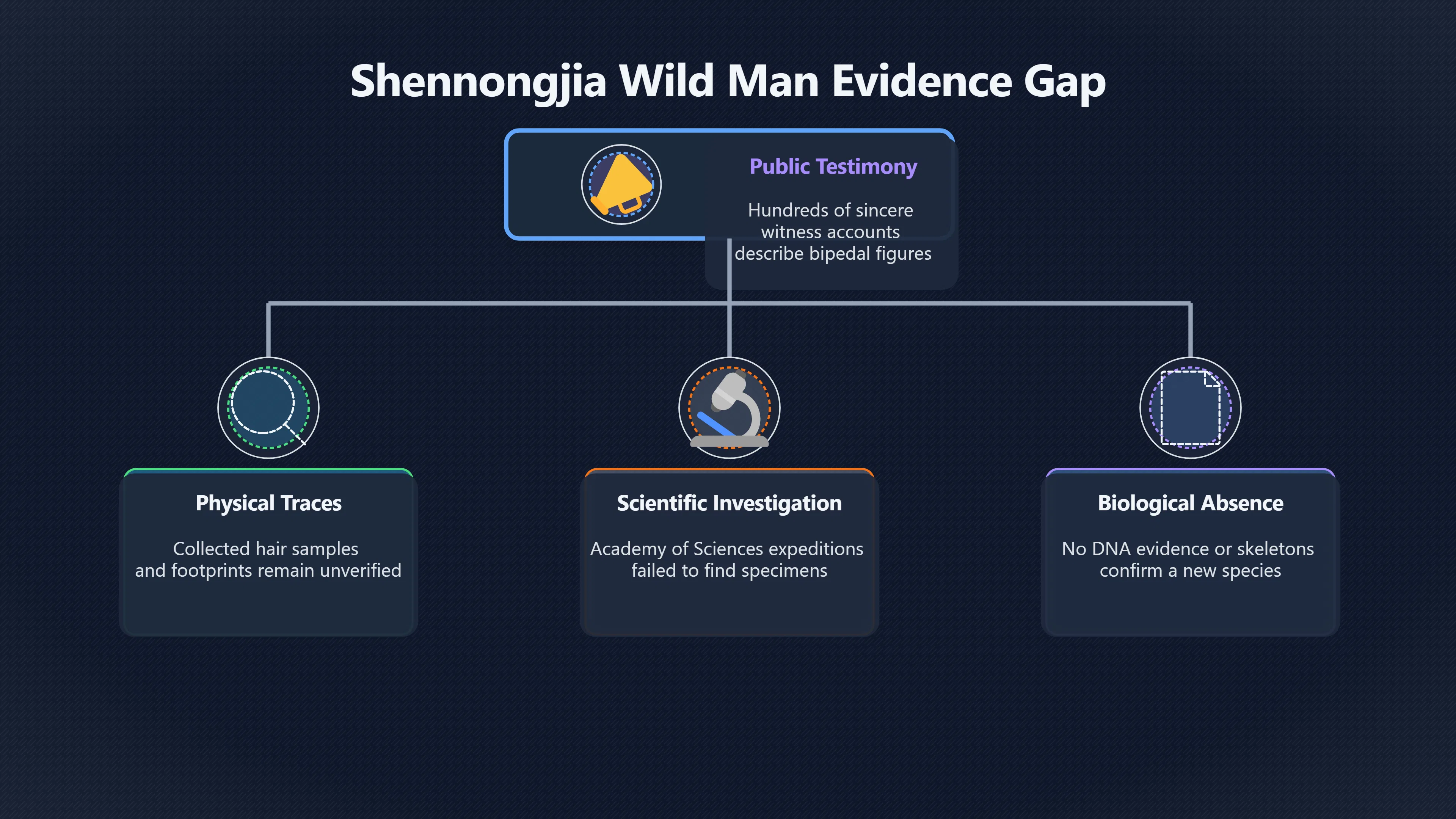
Researchers interviewed witnesses, examined alleged footprints and collected hair samples. The expedition produced a substantial archive of testimony and physical traces. What it did not produce was the one thing needed to establish the creature’s existence: a body, skeleton, living specimen, clear photograph or verifiable biological sample.[Idaho State University]isu.eduFootprint Evidence of Chinese YerenZhou Guoxing gathered eyewitness accounts, hair samples, and footprints, but no specimen of yeren was retrieved. In 2008…
Even so, reports continued. By the 1980s, hundreds of sightings had been recorded in the broader Wild Man literature. Some witnesses described seeing a reddish upright figure crossing roads or moving along distant slopes. Others reported tracks, sounds or fleeting glimpses in dense woodland. The cumulative number of claims became impressive, but the quality of individual reports remained highly uneven.[Sino-Platonic Papers]sino-platonic.orgSino-Platonic PapersThe Wildman of China: The Search for the Yerenby OD Smith — Dozens of alleged sightings of the Chinese wildman in the…
One reason the case attracted attention is that many witnesses appeared sincere. There is little evidence that most were deliberate hoaxers. Instead, the challenge lay in determining what they actually saw under often difficult viewing conditions.[Sino-Platonic Papers]sino-platonic.orgSino-Platonic PapersThe Wildman of China: The Search for the Yerenby OD Smith — Dozens of alleged sightings of the Chinese wildman in the…
Why the Physical Evidence Never Held Up
Supporters frequently point to footprints, hairs and witness consistency. Skeptics focus on what happened when those materials were examined.
Hair samples collected during investigations repeatedly failed to reveal an unknown primate. Zhou Guoxing later stated that specimens presented as Wild Man hair could be matched to known animals rather than a mysterious species. After decades of research, he concluded that no genuine Wild Man hair had been identified.[Idaho State University]isu.eduAll specimens were identified as…
Footprints generated similar problems. Casts were made of some alleged tracks, and researchers debated their significance. Yet footprints alone cannot establish the existence of a new species. Without associated biological material, tracks remain open to multiple interpretations, including distortion caused by weather, terrain or known animals.[Idaho State University]isu.eduFootprint Evidence of Chinese YerenZhou Guoxing gathered eyewitness accounts, hair samples, and footprints, but no specimen of yeren was retrieved. In 2008…
Photographic evidence has been equally disappointing. Despite decades of sightings in a region now visited by tourists, researchers and conservation staff, no widely accepted image has emerged. In an era of cameras and mobile phones, the absence of clear visual documentation has strengthened sceptical interpretations.[The World of Chinese]theworldofchinese.comwhere the wild things are 2The World of ChineseWhere the Wild Things Are28 Feb 2019 — In 2012, Zhou published a disbeliever's manifesto, “Fifty Years of Tracking th…
Bears, Monkeys and Other Sceptical Explanations
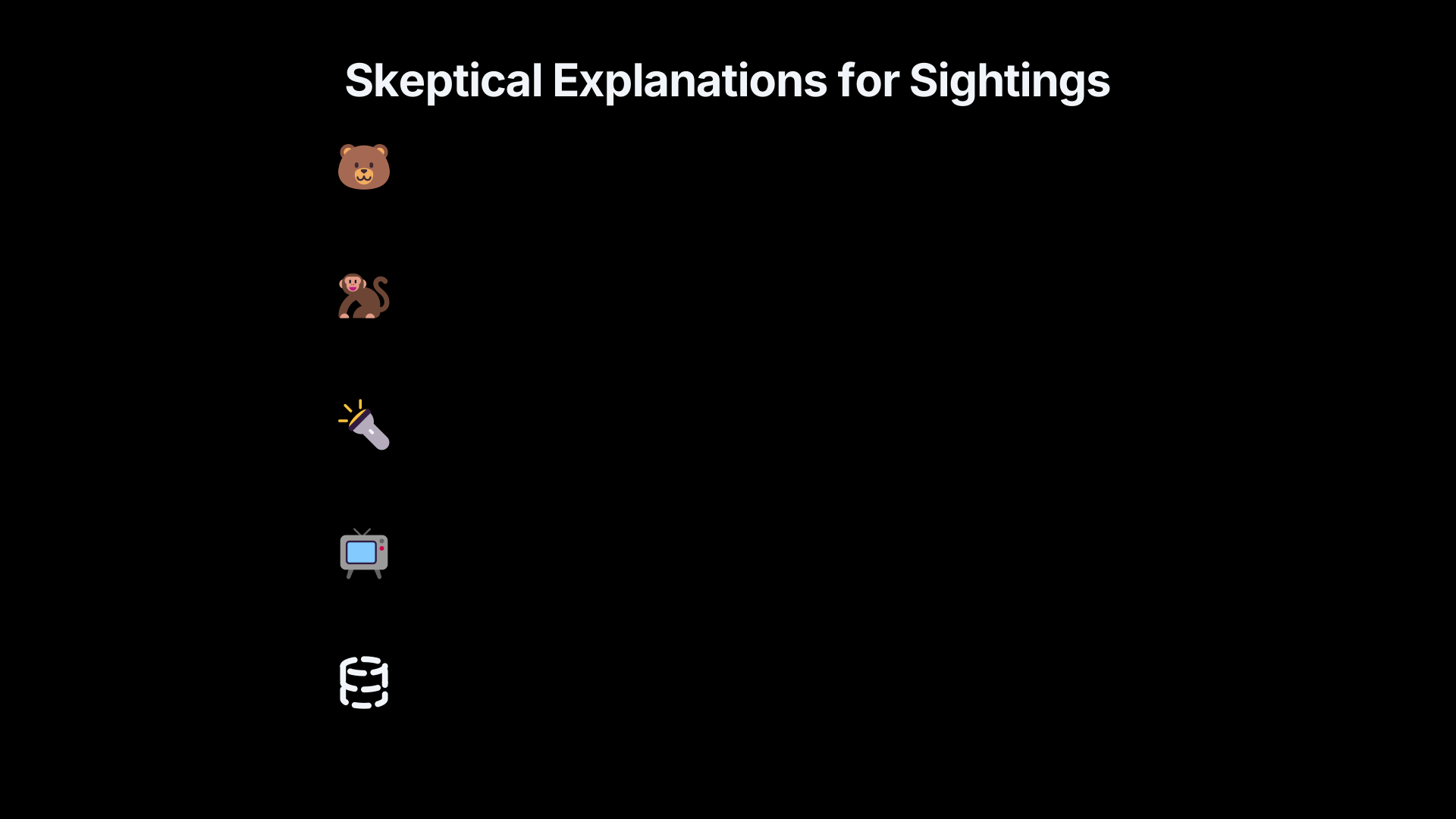
The leading sceptical explanation is straightforward: many Wild Man reports may be misidentified wildlife.
Shennongjia contains an unusually rich animal community, including Asian black bears and populations of golden snub-nosed monkeys. The terrain is rugged, visibility is often poor and sightings are frequently brief. Under such conditions, people can misjudge size, posture and distance.[Wikipedia]WikipediaOpen source on wikipedia.org.
Asian black bears are especially important in sceptical discussions. Bears can occasionally stand upright, move bipedally for short distances and appear surprisingly human-shaped when viewed at a distance. A startled observer catching a glimpse through trees could potentially interpret such an animal as a hairy humanoid.[Wikipedia]WikipediaOpen source on wikipedia.org.
Golden snub-nosed monkeys offer a different possibility. They are large, striking primates with golden fur and inhabit the same broader mountain ecosystem. Although they are far smaller than Wild Man descriptions, unusual viewing angles, poor lighting or expectations shaped by local stories could contribute to mistaken identifications.[Wikipedia]WikipediaGolden snub-nosed monkeyGolden snub-nosed monkey
Sceptics also emphasise psychological factors:
- Witnesses often observe unexpected events for only a few seconds.
- Memory changes over time, especially after retelling.
- Media coverage can influence how later witnesses interpret unusual encounters.
- Once a region becomes famous for a particular creature, ambiguous observations are more likely to be fitted into that narrative.[Sino-Platonic Papers]sino-platonic.orgSino-Platonic PapersThe Wildman of China: The Search for the Yerenby OD Smith — Dozens of alleged sightings of the Chinese wildman in the…
Notably, Zhou Guoxing himself gradually moved from cautious interest toward scepticism. After decades spent investigating claims, interviewing witnesses and examining evidence, he publicly stated that he had found no convincing proof that the Wild Man existed as an undiscovered species.[isu.edu]isu.eduAll specimens were identified as…
How the Wild Man Became Cultural Heritage
Even as scientific support weakened, the Wild Man grew stronger as a cultural symbol.
The legend became part of Shennongjia’s public identity, appearing in museums, exhibits, tourism materials and local storytelling. Visitors can encounter displays dedicated to the mystery, reflecting the creature’s place in regional culture regardless of its biological reality.[South China Morning Post]scmp.comSouth China Morning Post Dreamers, crackpots or realists?The diehards on the trail…26 Aug 2018 — The legend of the Wild Man is alive and well and transforming remote villages in northwest Chi…
This does not necessarily mean the legend was invented for tourism. Historical reports and local traditions clearly predate modern tourist development. However, once Shennongjia became known nationally as the home of the Wild Man, the story acquired economic and cultural value. The creature evolved from a local mystery into a recognisable symbol of the region.[sino-platonic.org]sino-platonic.orgSino-Platonic PapersThe Wildman of China: The Search for the Yerenby OD Smith — Dozens of alleged sightings of the Chinese wildman in the…
That transformation mirrors what has happened with Bigfoot in North America and the Yeti in the Himalayas. Even where evidence remains weak, the stories themselves become part of local heritage.
What Remains Unresolved Today?
The strongest argument for the Wild Man is the sheer number of reported encounters over many decades. Hundreds of people have claimed to see something unusual in or around Shennongjia, and some descriptions share notable similarities.[Sino-Platonic Papers]sino-platonic.orgSino-Platonic PapersThe Wildman of China: The Search for the Yerenby OD Smith — Dozens of alleged sightings of the Chinese wildman in the…
The strongest argument against the Wild Man is equally simple: decades of searching have produced no verified specimen, no accepted DNA evidence and no physical material demonstrating the existence of an unknown ape-like creature. Investigators collected stories, tracks and hairs, but none ultimately established a new species.[Idaho State University]isu.eduAll specimens were identified as…
As a result, the Shennongjia Wild Man occupies an unusual position in China’s mystery-animal tradition. It is not merely folklore, because modern witnesses genuinely reported encounters and scientists genuinely investigated them. Yet it is not accepted zoology either, because the evidence never crossed the threshold required for biological confirmation.
The enduring mystery is therefore less about a hidden ape and more about how landscapes, wildlife, memory, expectation and local tradition can combine to create one of China’s most famous monster legends.

eBay marketplace picks
Marketplace Samples
Live-tested eBay searches with available results related to this page.



Endnotes
1.
Source: sino-platonic.org
Link:https://sino-platonic.org/complete/spp309_chinese_wildman.pdf
Source snippet
Sino-Platonic PapersThe Wildman of China: The Search for the Yerenby OD Smith — Dozens of alleged sightings of the Chinese wildman in the...
2.
Source: Wikipedia
Title: Simians in Chinese culture
Link:https://en.wikipedia.org/wiki/Simians_in_Chinese_culture
3.
Source: Wikipedia
Link:https://en.wikipedia.org/wiki/Yeren
Source snippet
YerenThe yeren is a cryptid apeman reported to inhabit remote, mountainous regions of China, most famously in the Shennongjia Forestry...
4.
Source: Wikipedia
Link:https://en.wikipedia.org/wiki/Shennongjia
5.
Source: Wikipedia
Title: Golden snub-nosed monkey
Link:https://en.wikipedia.org/wiki/Golden_snub-nosed_monkey
6.
Source: isu.edu
Title: Footprint Evidence of Chinese Yeren
Link:https://www.isu.edu/media/libraries/rhi/brief-communications/Footprint-Evidence-of-Chinese-Yeren.pdf
Source snippet
Zhou Guoxing gathered eyewitness accounts, hair samples, and footprints, but no specimen of yeren was retrieved. In 2008...
7.
Source: scmp.com
Title: South China Morning Post Dreamers, crackpots or realists?
Link:https://www.scmp.com/news/china/society/article/2160570/dreamers-crackpots-or-realists-diehards-trail-chinas-bigfoot
Source snippet
The diehards on the trail...26 Aug 2018 — The legend of the Wild Man is alive and well and transforming remote villages in northwest Chi...
8.
Source: theworldofchinese.com
Title: where the wild things are 2
Link:https://www.theworldofchinese.com/2019/02/where-the-wild-things-are-2/
Source snippet
The World of ChineseWhere the Wild Things Are28 Feb 2019 — In 2012, Zhou published a disbeliever's manifesto, “Fifty Years of Tracking th...
9.
Source: isu.edu
Link:https://www.isu.edu/media/libraries/rhi/research-papers/Zhou__Tracking-the-Chinese-Wildman.pdf
Source snippet
All specimens were identified as...
Additional References
10.
Source: bigfootencounters.com
Link:https://www.bigfootencounters.com/biology/zhou.htm
Source snippet
Chinese Wildman, Zhou Guoxing's paperChinese historical documents contain many references to Wildman, a supposed large unknown primate re...
11.
Source: reddit.com
Title: the 1977 chinese yeren expedition was the only
Link:https://www.reddit.com/r/Cryptozoology/comments/1k0gtvk/the_1977_chinese_yeren_expedition_was_the_only/
Source snippet
time a...Second, about the misidentified bears...the Yeren can definitely be a bear most of the time, but not all bears are the same. Th...
12.
Source: olachina.org
Title: Shennongjia has Bigfoot?
Link:https://olachina.org/shennongjia/
Source snippet
The Yeren Legend - OlaChina.org15 Mar 2026 — China's forests hide a secret older than Bigfoot. Scientists searched. Rangers reported si...
13.
Source: facebook.com
Link:https://www.facebook.com/TheFolklorePodcast/posts/the-yeren-%E9%87%8E%E4%BA%BA-is-a-chinese-ape-man-or-wild-man-which-is-reported-to-live-in-remot/1391882632952653/
Source snippet
inous areas of the country...
14.
Source: xianease.com
Title: hubeis wildman
Link:https://www.xianease.com/2019/10/05/hubeis-wildman/
Source snippet
Hubei's Wildman5 Oct 2019 — Zhou Guoxing is quoted in the aforementioned Ancient Origins article as saying he has “evolved” in the decade...
15.
Source: works.hcommons.org
Title: 4sxq1 mvz83
Link:https://works.hcommons.org/records/4sxq1-mvz83
Source snippet
Wildman of China: The Search for the Yeren - KC WorksIn ancient Chinese literature there are several mentions of hairy humanlike beings...
16.
Source: youtube.com
Title: China’s Wild Man: The Yeren Mystery Unveiled
Link:https://www.youtube.com/watch?v=VGQ4junG3Vw
Source snippet
The Yeren: China's Bigfoot and the Unbelievable Encounters...
17.
Source: youtube.com
Title: China’s “Bigfoot”, the Yeren
Link:https://www.youtube.com/watch?v=ry6MvwiBtoc
Source snippet
Hubei Shennongjia: Discover the Untouched Beauty of China...
18.
Source: youtube.com
Title: The Yeren: China’s Bigfoot and the Unbelievable Encounters
Link:https://www.youtube.com/watch?v=_Z8tn0gkKNY
Source snippet
The Yeren - China's Most Wanted Cryptid...
19.
Source: youtube.com
Title: Hubei Shennongjia: Discover the Untouched Beauty of China
Link:https://www.youtube.com/watch?v=3Ob8Zshwudk
Topic Tree