Within Costa Rica Monsters
What Makes La Cegua So Frightening?
La Cegua is the roadside woman who becomes a horse-faced terror when men misread desire, danger and the road home.
On this page
- The roadside encounter and transformation
- Gender, morality and the late ride home
- How the legend moved from horses to cars
Page outline Jump by section
Introduction
La Cegua is one of Costa Rica’s most enduring and frightening roadside monsters. Unlike a cryptid presented as an unknown animal, she is a supernatural warning figure: a beautiful woman who appears alone at night and persuades a man to give her a ride, only to reveal a rotting horse’s face when he draws close. In Costa Rican tradition, her preferred targets are drunkards, womanisers, adulterers, and men travelling recklessly after dark. The story combines horror, morality, and the practical dangers of lonely roads, making it one of the country’s most recognisable monster legends.[Wikipedia]WikipediaOpen source on wikipedia.org.
What makes La Cegua especially interesting within Costa Rica’s monster tradition is that she changes with the times. Once she appeared beside dusty trails and mounted riders. Today she is just as likely to be described stopping cars or motorcycles on a rural road. The monster remains the same even as the transport changes.[Camino Travel]caminotravel.comCamino TravelThree Traditional, Scary Costa Rican Legends - Camino TravelTraditionally, the Cegua appeared to men on horseback, though no…
What Makes La Cegua So Frightening?
The terror of La Cegua comes from transformation. Witnesses do not encounter a monster at first. They encounter someone attractive, vulnerable, and apparently in need of help.
Costa Rican versions usually describe a striking young woman appearing on an isolated road at night. She may ask for a ride to a nearby town, claim she has become separated from companions, or simply seem stranded. Once the man carrying her begins to flirt or imagine a romantic encounter, the illusion breaks. Her face becomes that of a dead horse or horse skull, often described as decaying, foul-smelling, and accompanied by glowing eyes or enormous teeth.[Wikipedia]WikipediaOpen source on wikipedia.org.
The shock is not merely visual. Traditional stories often describe victims being paralysed with fear, left mentally damaged, marked for life, or even killed. In some versions the horse bolts wildly down the road while the creature clings to the rider. In others the victim survives but never fully recovers from the encounter.[Wikipedia]WikipediaLeyendas de Costa RicaLeyendas de Costa Rica
The horse imagery matters. Horses were central to rural life across much of Costa Rica for generations. A horse-faced apparition was therefore not an abstract nightmare but something disturbingly close to everyday experience, twisted into a grotesque form.
The Roadside Encounter and Transformation
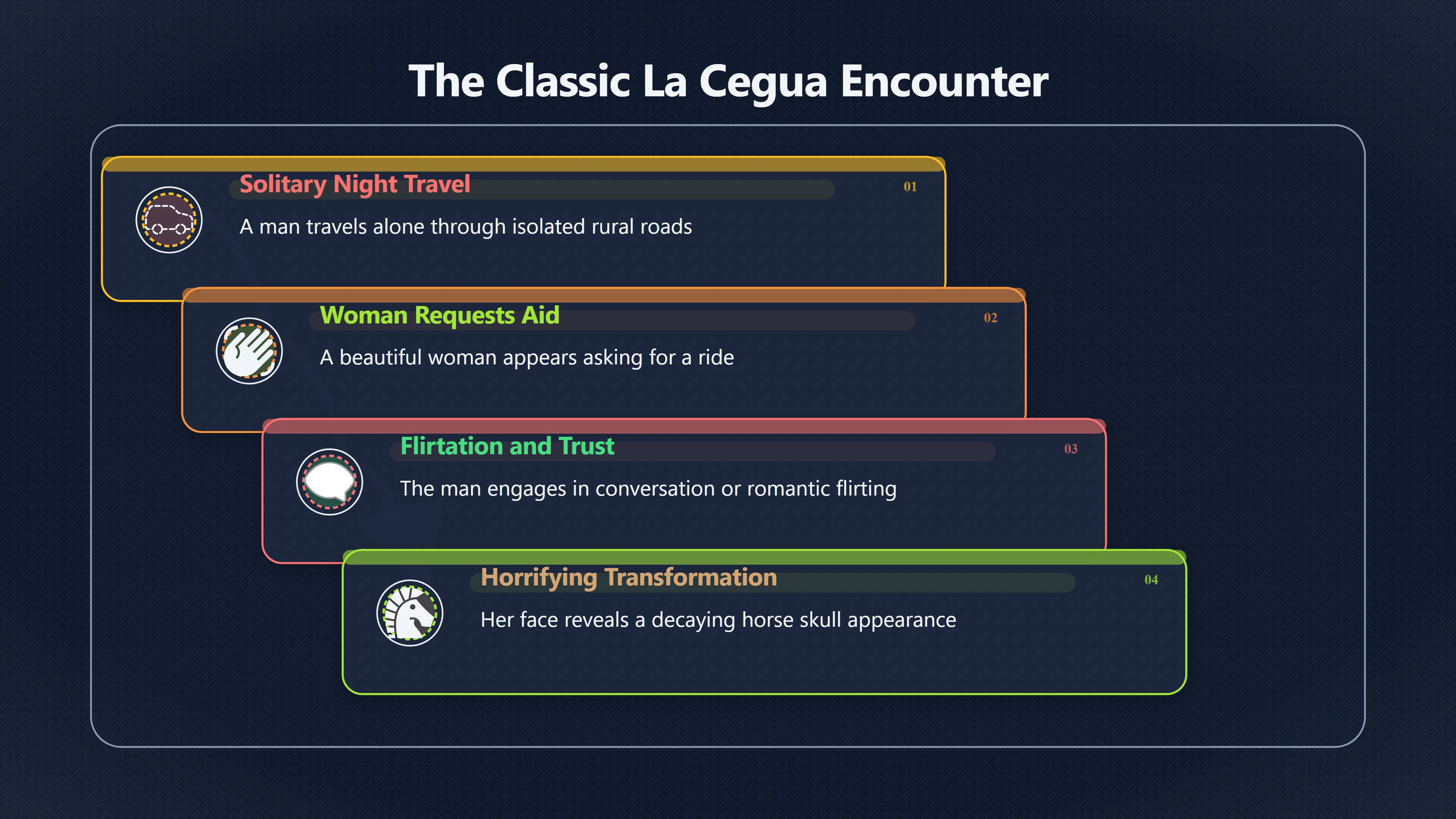
The classic Costa Rican encounter follows a remarkably consistent pattern.
A man is travelling alone at night. He encounters a woman on the roadside. She requests assistance. He agrees, often because he is attracted to her. After a period of travel, he attempts conversation, flirtation, or physical contact. Only then does the transformation occur.[wikipedia.org]WikipediaOpen source on wikipedia.org.
Several regional variants exist:
- The woman asks to be taken to her horse, home, or a nearby settlement.
- She appears among herds of horses, creating panic among animals and riders.
- In some stories she takes the form of a crying child beside a road or river before transforming after being picked up.
- Guanacaste traditions sometimes place her at dances and local festivals, where she charms men before leading them away into the night.[Wikipedia]WikipediaOpen source on wikipedia.org.
The transformation is the legend’s defining mechanism. The audience is meant to experience the same reversal as the victim: attraction instantly becoming horror. The story’s power comes from that sudden collapse of appearances.
Gender, Morality and the Late Ride Home
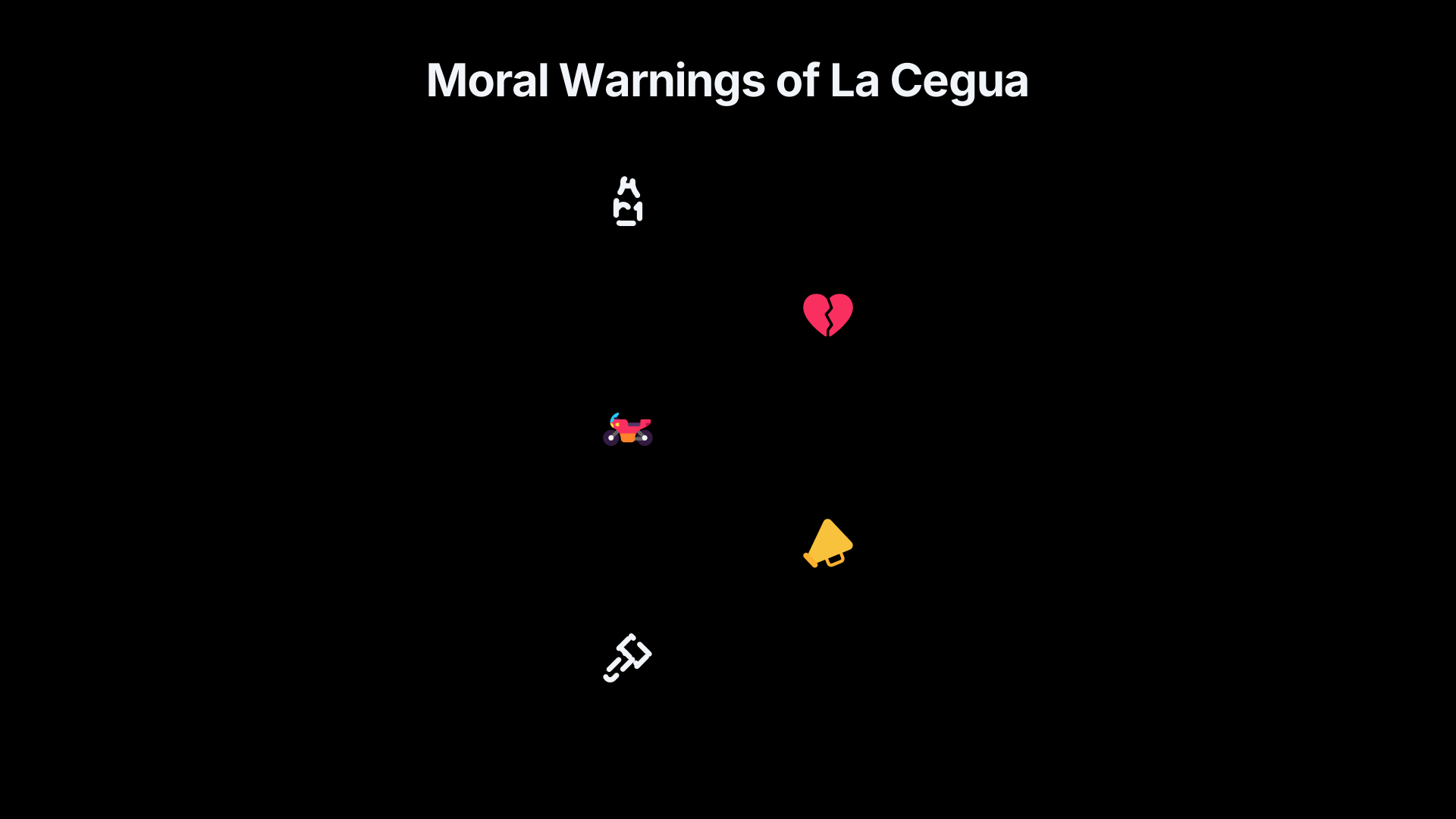
La Cegua is often described as a monster, but she also functions as a moral warning tale. Historically, many versions specifically target men who are drunk, unfaithful, boastful, or pursuing casual affairs. Respectable travellers are sometimes frightened but spared, while habitual womanisers receive harsher treatment.[Wikipedia]WikipediaLeyendas de Costa RicaLeyendas de Costa Rica
This moral dimension helps explain why the legend survived for centuries. Rural communities used stories not only to entertain but also to reinforce social expectations. A frightening supernatural encounter could communicate lessons about alcohol, infidelity, nighttime wandering, and personal conduct more effectively than direct lectures.[Atlas Obscura]atlasobscura.comAtlas Obscura Beware La Siguanaba, Latin America's Murderous, HorseAtlas ObscuraBeware La Siguanaba, Latin America's Murderous, Horse-…April 30, 2024 — 30 Apr 2024 — She has many names—La Siguanaba, La…
The legend also reflects changing attitudes toward gender. Modern readers often notice that the story presents female beauty as both alluring and dangerous. Folklore scholars examining related Central American traditions have noted that such tales frequently express anxieties about sexuality, temptation, and social order. La Cegua therefore works on several levels at once: monster story, cautionary tale, and cultural reflection of the values and fears of the communities that preserved it.[Wikipedia]WikipediaOpen source on wikipedia.org.
Where Did the Legend Come From?
Costa Rica did not create the horse-faced woman tradition in complete isolation. La Cegua belongs to a wider Central American family of legends that includes figures known elsewhere as Siguanaba, Sihuanaba, Cigua, and related names. Across the region, the core pattern remains recognisable: a beautiful woman lures men before revealing a monstrous face.[wikipedia.org]WikipediaOpen source on wikipedia.org.
Researchers and folklorists generally trace the legend to a mixture of Indigenous Mesoamerican beliefs and colonial-era storytelling. Over time, local communities adapted the figure into forms that reflected their own landscapes and social concerns. Costa Rica’s version became particularly associated with horse travel, rural roads, and the image of the decaying mare’s head.[Wikipedia]WikipediaOpen source on wikipedia.org.
The result is not a single origin story but a layered tradition. Some versions describe La Cegua as a cursed young woman. Others portray her as a demonic being. Still others present her as a restless spirit condemned to wander forever. The variation is typical of oral folklore that evolved over generations rather than being created by one author.[Wikipedia]WikipediaOpen source on wikipedia.org.
How the Legend Moved from Horses to Cars
One reason La Cegua remains famous is her ability to adapt.
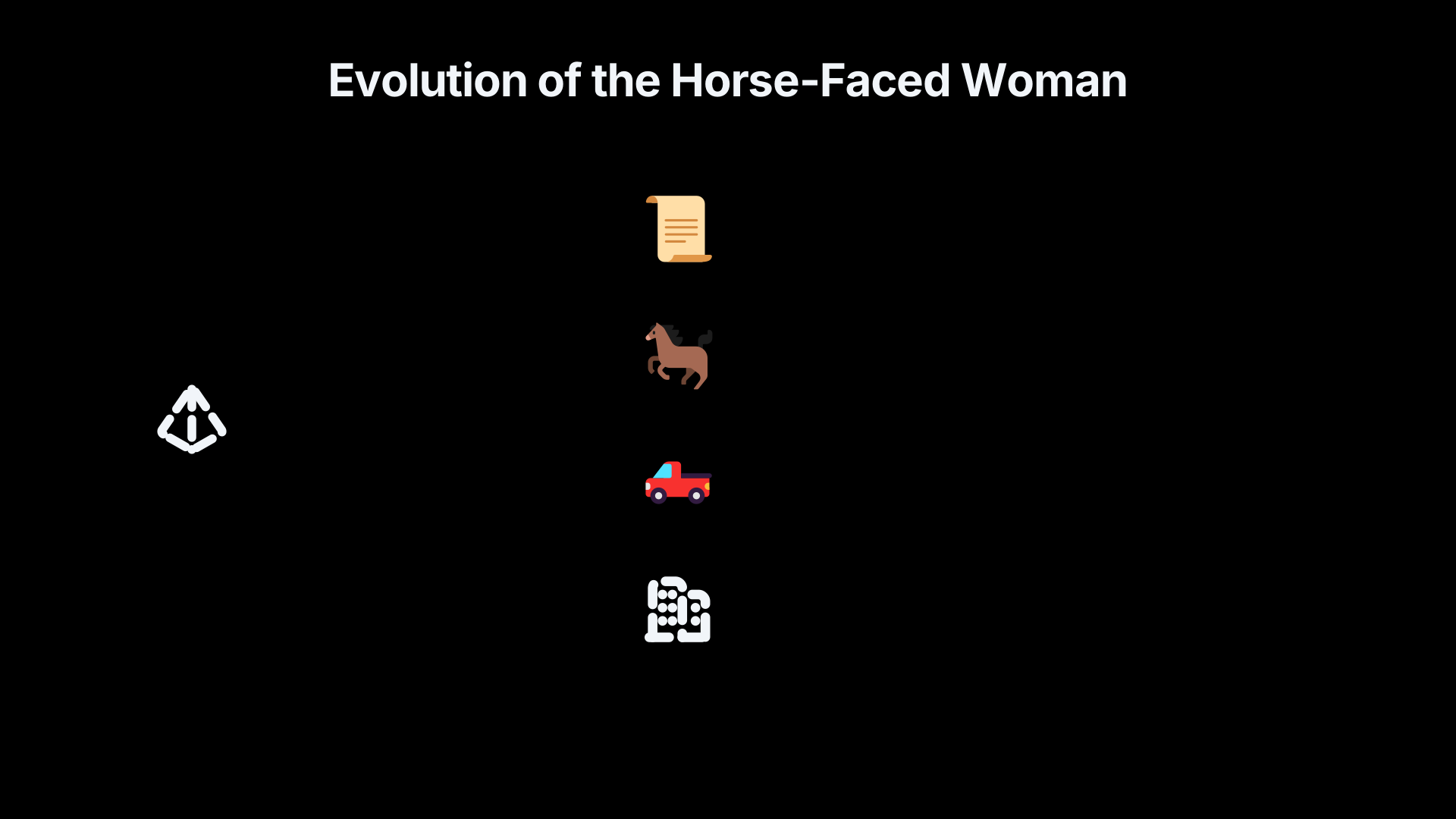
In nineteenth- and early twentieth-century stories, the encounter almost always involved a horse and rider. The victim carried the mysterious woman on horseback, placing her physically behind him until the horrifying revelation occurred. As Costa Rica modernised, storytellers simply transferred the same encounter to newer forms of transport.[Camino Travel]caminotravel.comCamino TravelThree Traditional, Scary Costa Rican Legends - Camino TravelTraditionally, the Cegua appeared to men on horseback, though no…
Today, many retellings feature:
- Drivers picking up a lone woman on a rural road.
- Motorcyclists offering a lift after dark.
- Travellers encountering her on isolated highways rather than forest tracks.
- Urban legends that relocate the story closer to modern towns and cities.[Camino Travel]caminotravel.comCamino TravelThree Traditional, Scary Costa Rican Legends - Camino TravelTraditionally, the Cegua appeared to men on horseback, though no…
This shift is important because it shows that La Cegua is less tied to a specific historical setting than to a recurring situation: a solitary journey at night, a stranger in need of help, and a moment when desire overrides caution.
Folklore, Sightings and Reality
Unlike reports of mystery animals, La Cegua is not supported by physical evidence. There are no specimens, photographs, tracks, or biological investigations suggesting the existence of a horse-faced creature. Her significance lies in folklore rather than zoology.[Wikipedia]WikipediaOpen source on wikipedia.org.
Stories nevertheless persist because they connect to real experiences. Night travel can distort perception. Isolation, fatigue, alcohol consumption, fear, and local expectations all influence how unusual encounters are remembered and retold. A stranger glimpsed in darkness, an unexplained fright on a lonely road, or a frightening ride home can become material for the legend.[Am Costa Rica]amcostarica.comCosta Rican creepy tales La Segua 102621Am Costa RicaCosta Rican creepy tales: La Segua 10262126 Oct 2021 — La Segua was known as a ghostlike figure that appeared suddenly at ni…
For that reason, La Cegua occupies a special place in Costa Rica’s monster tradition. She is not remembered as a hidden animal living in the forest. She is remembered as the thing that waits on the road when travellers believe they know exactly what they are looking at—and are suddenly proven wrong.
Amazon book picks
Further Reading
Books and field guides related to What Makes La Cegua So Frightening?. Use these as the next step if you want deeper reading beyond the article.
Women Who Run with the Wolves
Explores female archetypes and transformative mythic figures.
The Encyclopedia of Ghosts and Spirits
Includes many supernatural female apparition traditions.
Lonely Planet Costa Rica
Helps readers connect the legend to Costa Rican roads and landscapes.
eBay marketplace picks
Marketplace Samples
Live-tested eBay searches with available results related to this page.




Endnotes
1.
Source: Wikipedia
Link:https://en.wikipedia.org/wiki/Sihuanaba
2.
Source: Wikipedia
Title: Leyendas de Costa Rica
Link:https://es.wikipedia.org/wiki/Leyendas_de_Costa_Rica
3.
Source: Wikipedia
Link:https://es.wikipedia.org/wiki/Siguanaba
4.
Source: Wikipedia
Link:https://es.wikipedia.org/wiki/Cegua
5.
Source: caminotravel.com
Link:https://caminotravel.com/three-traditional-and-scary-costa-rica-legends/
Source snippet
Camino TravelThree Traditional, Scary Costa Rican Legends - Camino TravelTraditionally, the Cegua appeared to men on horseback, though no...
6.
Source: amcostarica.com
Title: Costa Rican creepy tales La Segua 102621
Link:https://www.amcostarica.com/Costa%20Rican%20creepy%20tales-%20La%20Segua%20102621.html
Source snippet
Am Costa RicaCosta Rican creepy tales: La Segua 10262126 Oct 2021 — La Segua was known as a ghostlike figure that appeared suddenly at ni...
7.
Source: atlasobscura.com
Title: Atlas Obscura Beware La Siguanaba, Latin America’s Murderous, Horse
Link:https://www.atlasobscura.com/articles/la-siguanaba
Source snippet
Atlas ObscuraBeware La Siguanaba, Latin America's Murderous, Horse-...April 30, 2024 — 30 Apr 2024 — She has many names—La Siguanaba, La...
Published: April 30, 2024
Additional References
8.
Source: poasrentacar.com
Link:https://www.poasrentacar.com/la-cegua-frighteningfriday/
Source snippet
La Cegua #FrighteningFridayThe body of the beautiful maiden was the same, but atop her neck sat a hideous horse's head with bulging, bloo...
9.
Source: medium.com
Link:https://medium.com/are-you-okay/this-legend-kills-cheating-men-la-segua-of-costa-rica-af026d4650a
Source snippet
This Legend Kills Cheating Men: La Segua of Costa RicaShe lures them in with her beauty, but once they get close, her head transforms int...
10.
Source: myguidecostarica.com
Link:https://www.myguidecostarica.com/travel-articles/costa-rica—legend-of-la-segua
11.
Source: jasminacazacu.com
Link:https://www.jasminacazacu.com/la-segua
Source snippet
She is said to pose by the roadside as the beautiful woman she once was before she was...Read more...
12.
Source: reddit.com
Link:https://www.reddit.com/r/mythology/comments/sydav5/the_following_legend_is_a_classic_it_originated/
Source snippet
ries on the roadside or near a river and, when the rider picks him up...Read more...
13.
Source: reddit.com
Title: The Cegua according to costa rican folklore
Link:https://www.reddit.com/r/mythology/comments/10rfz08/the_cegua_according_to_costa_rican_folklore_info/
Source snippet
Info below.La Cegua, as a legendary character, is still deeply rooted in the collective imaginary of the Mesoamerican peoples, forming an...
14.
Source: folktalesamerica.com
Title: la segua the horse faced woman of the night
Link:https://folktalesamerica.com/la-segua-the-horse-faced-woman-of-the-night/
Source snippet
Folktales AmericaLa Segua: The Horse-Faced Woman of the Night28 Oct 2025 — Haunting Costa Rican folktale of La Segua, the ghostly woman w...
15.
Source: milagro.org
Title: S35 03 LaSegua StudyGuide ENG 010919
Link:https://milagro.org/wp-content/uploads/2019/01/S35_03_LaSegua_StudyGuide_ENG_010919.pdf
Source snippet
Study Guide9 Jan 2019 — In this study guide, we look at the legend of la Segua in Costa Rica and Central. America as a whole, learn about...
16.
Source: facebook.com
Link:https://www.facebook.com/MrPsMythopedia/posts/la-cegua-a-costa-rican-legend-poses-as-the-beautiful-lady-that-she-once-was-and-/1780010828698643/
Source snippet
LA CEGUA, a Costa Rican legend, poses as the beautiful...9 Apr 2018 — La Cegua – The Horse-Faced Woman Who Hunts the Unfaithful She wait...
17.
Source: youtube.com
Title: La Segua (Leyenda de Costa Rica) | The Terrifying Costa Rican Legend
Link:https://www.youtube.com/watch?v=WiwHNqt4NYk
Source snippet
Costa Rica’s Most Haunted Stories 🇨🇷 La Llorona, La Cegua & La Mona...
Topic Tree