Cryptids of Algeria's Wild Places
Algeria does not have one neat, world-famous “national cryptid” in the way Scotland has the Loch Ness Monster or Nepal has the yeti.
Page outline Jump by section
Why Algeria’s monster stories are mostly borderland stories
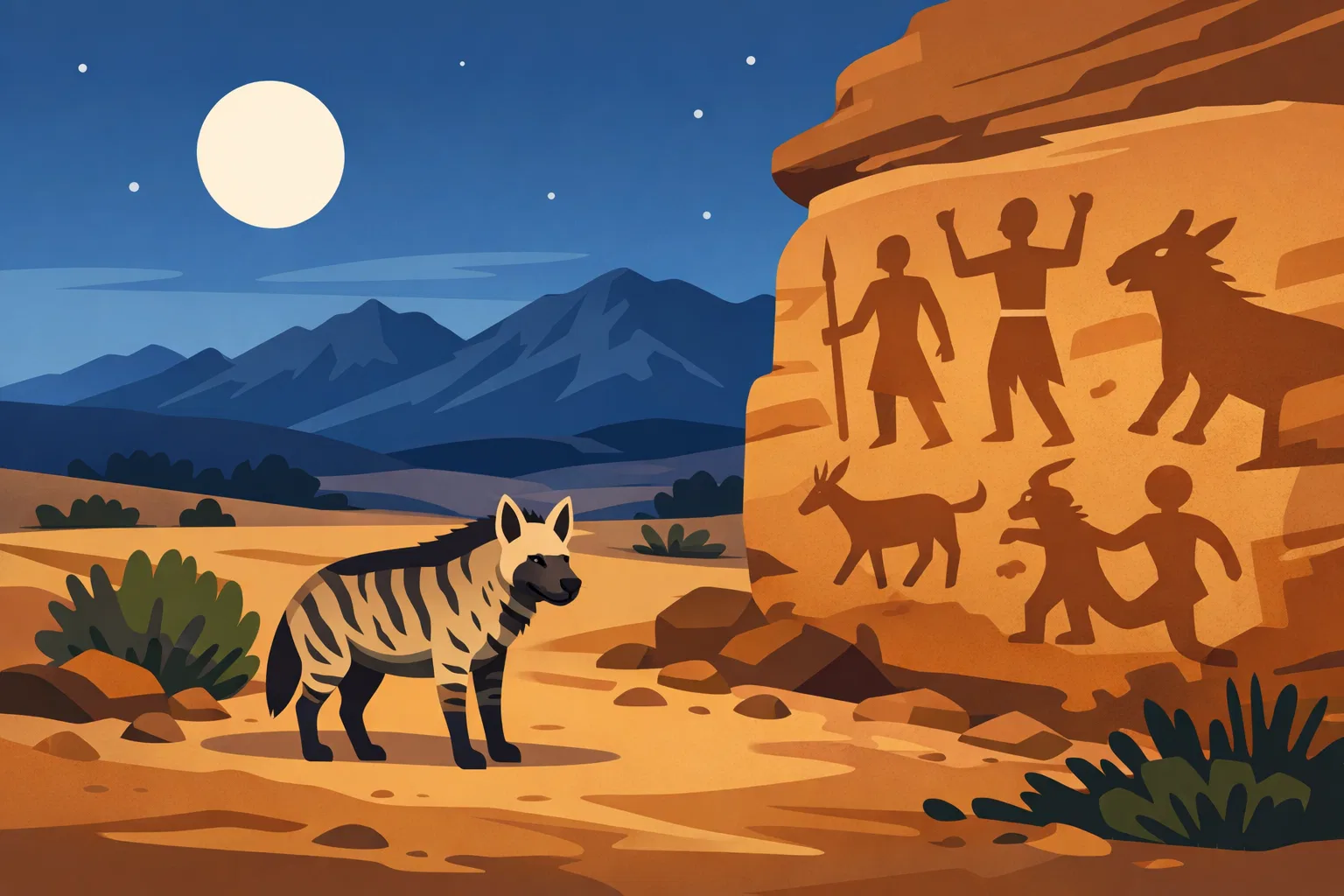
Algeria’s terrain helps explain why its mystery-beast material feels scattered. The country stretches from Mediterranean coast and Kabylie forests to the Atlas ranges, high plateaux, oases and the deep Sahara. That means its “creature” traditions do not all come from the same kind of landscape. A bear-like animal story belongs more naturally to mountain woodland; a giant snake report belongs to desert or oasis country; a jinn-haunted child-eater belongs to domestic and oral folklore; and the uncanny painted beings of Tassili n’Ajjer belong to prehistoric art rather than modern eyewitness cryptozoology.
Tassili n’Ajjer, in south-eastern Algeria, is central to the country’s weird-animal imagination because it preserves one of the world’s great bodies of prehistoric rock art. UNESCO describes more than 15,000 drawings and engravings recording climatic change, animal migrations and human life on the edge of the Sahara from around 6000 BC into the early centuries AD. That matters for cryptid history because the art shows that the Sahara was not always the empty-seeming desert many outsiders imagine; it was once wetter, more animal-rich and more visually crowded with large fauna.[UNESCO World Heritage Centre]whc.unesco.orgWorld Heritage Centre Tassili n'AjjerWorld Heritage Centre Tassili n'Ajjer
This environmental memory is important. Claims about Algerian “monsters” often become more plausible-sounding when they are attached to a real ecological past: crocodiles in Saharan wetlands, large carnivores in the Atlas, macaques in mountain forests, hyenas in remote country, and snakes in hot arid zones. Yet that same ecological history also gives sceptics strong tools. Many reports can be read as exaggerated memories, misidentified surviving wildlife, or stories moved from one North African region to another.
The Atlas bear: Algeria’s most credible almost-cryptid
The Atlas bear is the clearest case where Algerian mystery-beast interest overlaps with a real animal. Brown bears once lived in North Africa, including the Atlas region, and recent palaeontological work describes the Atlas brown bear as a former inhabitant of the North African mountains rather than a purely mythical beast. The modern problem is not whether bears ever lived in the region, but whether late sightings and survival claims have evidence behind them.[Science Press]sciencepress.mnhn.frcomptes rendus palevol2026v25a4comptes rendus palevol2026v25a4
The Atlas bear is often described as Africa’s only native bear surviving into historical times, with Algeria, Morocco and Tunisia appearing in its historical range. Some popular accounts give an extinction date around 1870, but specialists have been more cautious: the taxonomic history is awkward, the original 19th-century specimen evidence is limited, and later claims are not the same as physical proof of survival. That is exactly why the animal sits so naturally in cryptid territory. It is not a fantasy animal; it is a real lost bear surrounded by uncertain late records.[Wikipedia]WikipediaAtlas bearAtlas bear
For Algeria specifically, alleged late bear-like sightings are sometimes linked to Kabylie and other northern mountain areas. These are interesting because Kabylie still has forested habitat and surviving large mammals, but no modern bear population has been documented. A widely circulated 2016 “Atlas bear” claim from Tissemsilt was later treated by cryptozoology commentators and Algerian online discussion as a misidentified striped hyena, reportedly muddied and caught in a trap. The case is useful not because it proves a bear, but because it shows the modern mechanism of Algerian cryptid-making: a rare or distressed animal appears in poor footage, viewers reach for an extinct icon, and sceptical identification pulls the claim back towards known fauna.[fandom.com]cryptidz.fandom.comCryptid Wiki Atlas BearCryptid Wiki Atlas Bear
The Atlas bear is therefore Algeria’s best “serious” mystery-beast candidate only in a limited sense. It has a real zoological basis, a plausible historical setting and a strong afterlife in extinction-survival speculation. What it does not have is modern physical evidence, repeatable field documentation, confirmed tracks, DNA, photographs of diagnostic quality, or a known breeding population.
Giant snakes in the Sahara: old motifs, thin evidence
Giant snake stories are among the most dramatic North African monster claims, but they are also among the hardest to pin down. Classical literature preserves a famous story of Roman forces under Regulus encountering an enormous serpent near the Bagradas River during the Punic Wars. Pliny the Elder’s version gives the snake’s skin as 120 feet long, and later retellings helped turn the episode into a “dragon” story. The setting is usually placed in present-day Tunisia rather than Algeria, but the tale matters for Algeria because it fed a wider North African and Saharan imagination of outsized desert serpents.[attalus.org]attalus.orgOpen source on attalus.org.
Modern cryptid catalogues also attach giant or crested snake reports to western Algeria, including claims around Aïn Sefra and the Béchar region. These accounts tend to be dramatic — huge lengths, crests, military involvement, bulldozers, camels swallowed — but they are generally circulated through secondary cryptid sources rather than robust newspaper archives, museum specimens or scientific reports. They should be treated as claims, not established zoology.[itsmth.fandom.com]itsmth.fandom.comSaharan Crested Snake | It's Something WikiSaharan Crested Snake | It's Something Wiki
The best sceptical reading is not that every large-snake story was invented from nothing. North Africa’s environmental past was different, and researchers have argued that ancient or relict python populations may help explain some classical serpent traditions. Even so, a 30-foot or 120-foot Algerian desert snake would require far stronger evidence than anecdote. Known large snakes, measurement exaggeration, carcass distortion, fear, retelling and regional borrowing all offer more economical explanations than an undiscovered gigantic serpent lineage.[ResearchGate]researchgate.netResearch Gate Ancient Scientific Basis of the “Great Serpent” fromResearch Gate Ancient Scientific Basis of the “Great Serpent” from
Tassili n’Ajjer: strange figures, not proof of monsters
Tassili n’Ajjer often appears in fringe discussions because its prehistoric art includes powerful human-animal images, horned figures and stylised bodies that look uncanny to modern eyes. The famous “Running Horned Woman”, dated broadly to the Neolithic period, is one example: an elegant painted figure with horns, body markings and ritual-looking costume. Smarthistory treats it as ancient rock art, not as a record of a literal horned species.[Smarthistory]smarthistory.orgOpen source on smarthistory.org.
That distinction matters. The figures at Tassili are a vital part of Algeria’s monster-adjacent visual culture, but they should not be flattened into “ancient aliens”, “lost cryptids” or straightforward eyewitness drawings of unknown animals. UNESCO’s description of the site stresses climate, migration, geology and human life, while art historians read the images through ritual, symbolism, pastoral culture and changing human relationships with animals.[UNESCO World Heritage Centre]whc.unesco.orgWorld Heritage Centre Tassili n'AjjerWorld Heritage Centre Tassili n'Ajjer
For cryptid readers, Tassili is most useful as a reminder that Algeria’s uncanny creatures are not only things people claim to have seen recently. Some are images inherited from deep time: horned bodies, dancing forms, animal-headed presences and painted beings whose meanings are partly lost. They belong to archaeology and art history first, folklore second, and cryptozoology only very loosely.
The real animals behind many “monster” impressions
A good Algerian cryptid page needs known wildlife, because much of the mystery-beast material becomes clearer when placed beside animals that actually live, or recently lived, in the country.
The striped hyena is especially important. It is elusive, nocturnal, dog-like but not a dog, and visually odd enough to be misread at distance or in poor light. A 2020 review of its status in Algeria found that the species had vanished from some northern areas of its former range but still occurred across many parts of the country. That makes the hyena a strong candidate for some “strange beast”, “bear-like”, “wolf-like” or carcass-related sightings.[Hal Science]hal.sciencehal 03179827hal 03179827
The Barbary macaque also matters because it is Algeria’s only non-human primate and survives in fragmented northern forest regions. A 2025 review estimated more than 9,000 macaques in Algeria, while noting that comprehensive surveys are still lacking in many places. In folklore terms, a macaque can become uncanny because it is human-like without being human: quick hands, expressive face, social behaviour, sudden appearances near villages or farms.[MDPI]mdpi.comOpen source on mdpi.com.
Large cats create a different kind of ambiguity. Leopards are now described by the IUCN Cat Specialist Group as regionally extinct in Algeria, while historical references and popular “Barbary leopard” discussions keep the idea alive. In practice, modern black-cat or leopard-like claims in Algeria need careful handling: they may involve dogs, hyenas, feral animals, escaped captives, memory of a vanished predator, or simple distance and lighting errors.[IUCN CatSG]catsg.orgIUCN Cat SGLiving SpeciesIUCN Cat SGLiving Species
Even crocodiles belong in the background. Saharan crocodiles are not an Algerian cryptid in the modern sense, but the scientific record shows that crocodiles were once widespread across the Sahara and persisted in some desert refuges into recent historical time. Reports of relict crocodiles in places such as Mauritania and Chad help explain why old Saharan water-monster traditions can feel more realistic than expected. For Algeria, the key point is ecological memory: desert does not always mean lifeless, and former wetlands can leave long cultural shadows.[springer.com]link.springer.comOpen source on springer.com.
Child-frighteners and jinn-linked beings
Not every Algerian monster is an animal claim. Much of the country’s creature folklore belongs to domestic storytelling: beings used to frighten children, warn against wandering, explain danger, or dramatise moral boundaries. Online Algerian discussions commonly mention figures such as the female ghoul and the sack-carrying child-snatcher as widely recognisable, though names and details vary by region and family. Such sources are not formal folklore archives, but they are useful evidence of living memory and everyday usage.[Reddit]reddit.comOpen source on reddit.com.
The ghoul is part of a much wider Arabic folklore tradition: a dangerous, often desert- or graveyard-associated being that may lure, devour, deceive or take monstrous form. Scholarly work on the Arabic ghoul traces how the figure moved from regional folklore into Western monster culture, where it became increasingly associated with corpses and horror fiction. In Algeria, the ghoul-like figure is best understood as folklore rather than cryptid testimony: people are not usually claiming a biological species, but repeating a monster shape with social and moral force.[tandfonline.com]tandfonline.comOpen source on tandfonline.com.
Jinn-linked beings complicate the boundary further. Some Algerian and North African stories describe creatures born from, ruled by, or associated with jinn. A modern retelling of the eastern Algerian figure Al-Ruhban, for example, presents it as a being connected to human-jinn parentage and local oral memory. This is creature folklore, but not cryptozoology in the strict animal-hunting sense. It belongs to a world where “monster” means spiritual category, family warning, uncanny human double or dangerous outsider as much as unknown animal.[كابوس]kabbos.comal ruhban a strange creature from the algerian folkloreal ruhban a strange creature from the algerian folklore
The same caution applies to highly specific online bestiary entries for Algerian monsters such as composite child-eaters. These may preserve genuine oral motifs, but the available English-language evidence is often thin, copied or unsourced. They can be mentioned as part of the modern internet afterlife of Algerian folklore, but they should not be presented as well-documented national traditions unless stronger local sources are available.[mythicalmonstersandcreaturez.blogspot.com]mythicalmonstersandcreaturez.blogspot.commythical creatures in peoplesmythical creatures in peoples
How Algerian legends change online
Algeria’s creature lore has increasingly been reshaped by the internet. Extinct animals become “could it still be alive?” posts. Poor-quality animal footage becomes a bear, wolf, leopard or hyena debate. Local child-frighteners become listicle monsters. Tassili rock art becomes visual fuel for speculative theories. The result is not fake culture, exactly, but a compressed version of folklore where context is often stripped away.
The Atlas bear shows this clearly. In a museum or zoological paper, it is a lost North African brown bear population with uncertain late history. In cryptid spaces, it becomes a survival candidate. In social media posts, it becomes a dramatic “Africa had bears” fact. In Algerian discussions, it can become a point of local pride, ecological loss or sceptical correction. The same animal moves between science, nostalgia, national identity and monster-hunting.[mnhn.fr]sciencepress.mnhn.frcomptes rendus palevol2026v25a4comptes rendus palevol2026v25a4
Tassili n’Ajjer changes in a similar way. In archaeology, the art is evidence of prehistoric life, climate shifts and ritual worlds. In travel writing, it becomes a spectacular hidden gallery. In fringe monster culture, its painted figures are sometimes treated as literal beings. The responsible middle path is to let the images remain strange without forcing them to prove something they do not prove.[unesco.org]whc.unesco.orgWorld Heritage Centre Tassili n'AjjerWorld Heritage Centre Tassili n'Ajjer
What is most likely behind Algeria’s mystery-beast reports?
The most likely explanations vary by creature type.
For bear-like reports, the strongest candidates are memory of the extinct Atlas bear, misidentified striped hyenas, large dogs, livestock, boars, low-quality footage, and the emotional appeal of rediscovering a lost animal. The Atlas bear’s historical reality makes survival stories tempting, but modern evidence remains insufficient.[mnhn.fr]sciencepress.mnhn.frcomptes rendus palevol2026v25a4comptes rendus palevol2026v25a4
For giant snake stories, the likely ingredients are ancient serpent lore, exaggerated measurements, fear of large reptiles, possible memories of formerly wider snake distributions, and modern cryptid copying. A genuinely unknown giant Saharan snake would require hard evidence: a body, tissue sample, clear multi-angle footage, tracks with scale, or repeated expert-verified observations.[attalus.org]attalus.orgOpen source on attalus.org.
For ape-like or human-like beings, Algeria’s Barbary macaques provide one real animal background, while jinn, ghouls and child-frighteners provide the folklore background. Confusing those two categories is a common mistake. A macaque sighting may be zoological; a ghoul story is normally moral, domestic or supernatural folklore.[mdpi.com]mdpi.comOpen source on mdpi.com.
For phantom cats, the shadow of the regionally extinct leopard matters, but so do ordinary misidentifications. The absence of confirmed modern Algerian leopard evidence should make readers cautious about claims based only on brief sightings, tracks without expert confirmation or local rumour.[IUCN CatSG]catsg.orgIUCN Cat SGLiving SpeciesIUCN Cat SGLiving Species
The clearest takeaway
Algeria’s cryptid history is not built around one lake monster or one famous beast. It is a layered field: prehistoric animal art in Tassili n’Ajjer, real extinct megafauna such as the Atlas bear, elusive living animals such as striped hyenas and Barbary macaques, Saharan serpent traditions, and domestic folklore figures shaped by ghoul and jinn belief. The strongest stories are strongest when they are read in that layered way.
The country’s mystery creatures are therefore less about proving hidden monsters than about noticing how landscape, extinction and storytelling feed each other. Algeria’s mountains remember bears and macaques; its desert remembers water, crocodiles and giant-animal art; its villages and families remember warning monsters; and its online culture keeps recombining all of them into new “sightings”, debates and rediscovery hopes.
Amazon book picks
Further Reading
Books and field guides related to What Monsters Haunt Algeria's Wild Places?. Use these as the next step if you want deeper reading beyond the article.
The Atlas of Monsters
Introduces global monster lore and helps place Algerian creature stories in wider context.
The Lore of the Land
Demonstrates how stories become attached to landscapes and local traditions.
eBay marketplace picks
Marketplace Samples
Live-tested eBay searches with available results related to this page.



Endnotes
1.
Source: whc.unesco.org
Title: World Heritage Centre Tassili n’Ajjer
Link:https://whc.unesco.org/en/list/179/
2.
Source: mdpi.com
Link:https://www.mdpi.com/2076-2615/15/13/1860
3.
Source: hal.science
Title: hal 03179827
Link:https://hal.science/hal-03179827/
4.
Source: unesco.org
Title: document 25 eng 2
Link:https://www.unesco.org/archives/multimedia/document-25-eng-2
5.
Source: Wikipedia
Title: List of African species extinct in the Holocene
Link:https://en.wikipedia.org/wiki/List_of_African_species_extinct_in_the_Holocene
6.
Source: Wikipedia
Title: Atlas bear
Link:https://en.wikipedia.org/wiki/Atlas_bear
7.
Source: cryptidz.fandom.com
Title: Cryptid Wiki Atlas Bear
Link:https://cryptidz.fandom.com/wiki/Atlas_Bear
8.
Source: cryptozoonews.com
Title: atlas bear 2016
Link:https://www.cryptozoonews.com/atlas-bear-2016/
9.
Source: reddit.com
Link:https://www.reddit.com/r/algeria/comments/1m0q2vx/old_footage_of_an_atlas_bear_spotted_in/
10.
Source: attalus.org
Link:https://www.attalus.org/pliny/hn8a.html
11.
Source: itsmth.fandom.com
Title: Saharan Crested Snake | It’s Something Wiki
Link:https://itsmth.fandom.com/wiki/Saharan_Crested_Snake
12.
Source: cryptidz.fandom.com
Title: Cryptid Wiki North African Giant Snake
Link:https://cryptidz.fandom.com/wiki/North_African_Giant_Snake
13.
Source: researchgate.net
Title: Research Gate Ancient Scientific Basis of the “Great Serpent” from
Link:https://www.researchgate.net/publication/8225997_Ancient_Scientific_Basis_of_the_Great_Serpent_from_Historical_Evidence
14.
Source: reddit.com
Link:https://www.reddit.com/r/AskHistorians/comments/1rfe87w/can_a_1st_person_written_account_of_the_dragon/
15.
Source: smarthistory.org
Link:https://smarthistory.org/running-horned-woman-tassili-najjer-algeria/
16.
Source: researchgate.net
Link:https://www.researchgate.net/publication/340036597_Distribution_and_status_of_the_striped_hyena_Hyaena_hyaena_Linnaeus_1758_Mammalia_Hyaenidae_in_Algeria
17.
Source: catsg.org
Title: IUCN Cat SGLiving Species
Link:https://www.catsg.org/living-species-leopard
18.
Source: link.springer.com
Link:https://link.springer.com/article/10.1023/A%3A1003592123079
19.
Source: pmc.ncbi.nlm.nih.gov
Link:https://pmc.ncbi.nlm.nih.gov/articles/PMC3045445/
20.
Source: reddit.com
Link:https://www.reddit.com/r/algeria/comments/11do21s/mythical_beasts_in_algeria/
21.
Source: Wikipedia
Title: Sack Man
Link:https://en.wikipedia.org/wiki/Sack_Man
22.
Source: Wikipedia
Link:https://en.wikipedia.org/wiki/Ghoul
23.
Source: Wikipedia
Link:https://en.wikipedia.org/wiki/Jinn
24.
Source: mythicalmonstersandcreaturez.blogspot.com
Title: mythical creatures in peoples
Link:https://mythicalmonstersandcreaturez.blogspot.com/2018/04/mythical-creatures-in-peoples.html
25.
Source: bearconservation.org.uk
Title: atlas bear extinct
Link:https://www.bearconservation.org.uk/atlas-bear-extinct/
26.
Source: Wikipedia
Title: Tassili n’Ajjer
Link:https://en.wikipedia.org/wiki/Tassili_n%27Ajjer
27.
Source: Wikipedia
Title: List of cryptids
Link:https://en.wikipedia.org/wiki/List_of_cryptids
28.
Source: Wikipedia
Title: Barbary macaque
Link:https://en.wikipedia.org/wiki/Barbary_macaque
29.
Source: Wikipedia
Title: Fennec fox
Link:https://en.wikipedia.org/wiki/Fennec_fox
30.
Source: Wikipedia
Title: Striped hyena
Link:https://en.wikipedia.org/wiki/Striped_hyena
31.
Source: Wikipedia
Title: List of mammals of Algeria
Link:https://en.wikipedia.org/wiki/List_of_mammals_of_Algeria
32.
Source: Wikipedia
Title: Battle of the Bagradas River (255 BC)
Link:https://en.wikipedia.org/wiki/Battle_of_the_Bagradas_River_%28255_BC%29
33.
Source: Wikipedia
Title: Tassili n’Ajjer
Link:https://simple.wikipedia.org/wiki/Tassili_n%27Ajjer
34.
Source: researchgate.net
Link:https://www.researchgate.net/publication/308899520_Panthera_pardus_The_IUCN_Red_List_of_Threatened_Species_2016
35.
Source: researchgate.net
Link:https://www.researchgate.net/publication/344338471_New_Data_on_the_Current_Distribution_of_Barbary_Macaque_Macaca_sylvanus_Mammalia_Cercopithecidae_in_Algeria
36.
Source: researchgate.net
Title: Article Heyna Algeria
Link:https://www.researchgate.net/profile/Bounaceur-Farid/publication/376486456_Article_Heyna_Algeriapdf/data/657a9589cbd2c535ea25ac6c/Article-Heyna-Algeria.pdf?origin=publication_list
37.
Source: researchgate.net
Link:https://www.researchgate.net/publication/50250815_Crocodiles_in_the_Sahara_Desert_An_Update_of_Distribution_Habitats_and_Population_Status_for_Conservation_Planning_in_Mauritania
38.
Source: researchgate.net
Link:https://www.researchgate.net/publication/401123830_Environmental_Threats_to_Prehistoric_Treasures_Tassili_n%27Ajjer_and_Hoggar_Facing_Climatic_Disruptions
39.
Source: reddit.com
Link:https://www.reddit.com/r/Cryptozoology/comments/14pb2v4/this_story_of_a_50ft_snake_sighting_makes_me/
40.
Source: reddit.com
Title: alleged encounter with a giant snake in katanga
Link:https://www.reddit.com/r/Cryptozoology/comments/hg6tpg/alleged_encounter_with_a_giant_snake_in_katanga/
41.
Source: reddit.com
Link:https://www.reddit.com/r/ArtefactPorn/comments/v48dmb/a_cave_painting_from_tassili_najjer_in_algeria/
42.
Source: reddit.com
Link:https://www.reddit.com/r/Cryptozoology/comments/1od8hc7/how_likely_do_you_think_the_atlas_bear_is_still/
43.
Source: reddit.com
Link:https://www.reddit.com/r/algeria/comments/1o96dzs/atlas_bear_the_only_native_bear_species_in_africa/
44.
Source: reddit.com
Link:https://www.reddit.com/r/todayilearned/comments/1l4hgu/til_the_african_continent_had_a_native_species_of/
45.
Source: reddit.com
Link:https://www.reddit.com/r/algeria/comments/plaz1q/algerian_urban_legends/
46.
Source: portals.iucn.org
Title: mono 005
Link:https://portals.iucn.org/library/efiles/documents/mono-005.pdf
47.
Source: portals.iucn.org
Link:https://portals.iucn.org/library/sites/library/files/documents/1998-013.pdf
48.
Source: portals.iucn.org
Link:https://portals.iucn.org/library/node/16612
49.
Source: worldheritageoutlook.iucn.org
Link:https://worldheritageoutlook.iucn.org/node/988
50.
Source: mdpi.com
Link:https://www.mdpi.com/2076-0752/3/2/215
51.
Source: cryptidz.fandom.com
Title: Con Rit
Link:https://cryptidz.fandom.com/wiki/Con_Rit
52.
Source: cryptidz.fandom.com
Link:https://cryptidz.fandom.com/wiki/Category%3ACryptids
53.
Source: cryptidz.fandom.com
Title: List of Cryptids
Link:https://cryptidz.fandom.com/wiki/List_of_Cryptids
54.
Source: cryptidz.fandom.com
Link:https://cryptidz.fandom.com/wiki/Sivathere
55.
Source: cryptidz.fandom.com
Title: Category:Cryptid Wiki
Link:https://cryptidz.fandom.com/wiki/Category%3ACryptid_Wiki
56.
Source: cryptidz.fandom.com
Link:https://cryptidz.fandom.com/wiki/Jinn
57.
Source: mythus.fandom.com
Link:https://mythus.fandom.com/wiki/Ghoul
58.
Source: dutch-folklore.fandom.com
Link:https://dutch-folklore.fandom.com/wiki/Kludde
59.
Source: animals.fandom.com
Title: Barbary Leopard
Link:https://animals.fandom.com/wiki/Barbary_Leopard
60.
Source: riordan.fandom.com
Title: Carthaginian Serpent
Link:https://riordan.fandom.com/wiki/Carthaginian_Serpent
61.
Source: icon.ink
Title: Mythical Legends of the Arab World
Link:https://icon.ink/articles/mythical-creatures/
62.
Source: sciencepress.mnhn.fr
Title: comptes rendus palevol2026v25a4
Link:https://sciencepress.mnhn.fr/sites/default/files/articles/pdf/comptes-rendus-palevol2026v25a4.pdf
63.
Source: ancientworldmagazine.com
Title: regulus bagradas dragon
Link:https://www.ancientworldmagazine.com/articles/regulus-bagradas-dragon/
64.
Source: nationalgeographic.com
Title: algeria rock art prehistoric sahara petroglyphs
Link:https://www.nationalgeographic.com/travel/article/algeria-rock-art-prehistoric-sahara-petroglyphs
65.
Source: tandfonline.com
Link:https://www.tandfonline.com/doi/abs/10.1080/00155870903219730
66.
Source: kabbos.com
Title: al ruhban a strange creature from the algerian folklore
Link:https://kabbos.com/en/al-ruhban-a-strange-creature-from-the-algerian-folklore/
67.
Source: facebook.com
Link:https://www.facebook.com/100044276087249/photos/the-sack-man-also-called-the-bag-man-or-man-with-the-bagsack-is-a-figure-similar/1707104202917686/
68.
Source: science.org
Title: extinct brown bear had surprising diet
Link:https://www.science.org/content/article/extinct-brown-bear-had-surprising-diet
69.
Source: youtube.com
Title: The Atlas Bear
Link:https://www.youtube.com/watch?v=5W8t0hp1EOM
70.
Source: observation.org
Title: Atlas Bear
Link:https://observation.org/species/643525/
71.
Source: ramsar.org
Link:https://www.ramsar.org/country-profile/algeria
72.
Source: beastsoflegend.com
Title: North Africa
Link:https://beastsoflegend.com/bestiary/africa/north-africa/
Additional References
73.
Source: youtube.com
Link:http://www.youtube.com/watch?v=2QqAUkTKmYw
Source snippet
Tassili n'Ajjer rock art Algeria documentary THE BIGGEST SECRETS OF THE UNIVERSE, THE TASSILI CAVES IN ALGERIA MIND FUK...
74.
Source: youtube.com
Link:http://www.youtube.com/watch?v=4pfGySbO-Cc
Source snippet
Barbary Macaque facts 🐒 Barbary Ape 🐒 Magot 🐒 native to Atlas 🏔 of Algeria 🇩🇿 Morocco 🇲🇦...
75.
Source: youtube.com
Title: Tassili N Ajjer, the story of the prehistoric cave paintings in Algeria
Link:http://www.youtube.com/watch?v=IT7zSvyOrvw
Source snippet
Discovering Algeria: A Wildlife Safari Through the Land of Fennec Foxes and Barbary Macaques...
76.
Source: trafficj.org
Link:https://www.trafficj.org/cop17/pdf/CoP17_Prop13_Analysis.pdf
77.
Source: mammalsociety.org
Link:https://www.mammalsociety.org/sites/default/files/2023-08/ASM_2022_Abstracts-2022.06.13.pdf
78.
Source: facebook.com
Link:https://www.facebook.com/mostamazingtop10videos/posts/120-foot-monster-snake-found-slithering-through-the-sahara-snake-titanoboa-sahar/1231666948331102/
79.
Source: medium.com
Link:https://medium.com/teatime-history/al-ghoul-devilish-arabian-monster-6876c0a5b442
80.
Source: facebook.com
Link:https://www.facebook.com/BahraniHistory/posts/al-ghoul-devilish-arabian-monsterhow-a-supernatural-creature-preoccupied-the-liv/1177430391238131/
81.
Source: facebook.com
Link:https://www.facebook.com/groups/archaeology.wonders/posts/1216929143795963/
82.
Source: facebook.com
Link:https://www.facebook.com/groups/archeologyandcivilizations/posts/27014281741571994/
Topic Tree
Follow this branch
Related pages 192
- Antigua Cryptids
- Maldives Monsters
- Malta Monsters
- Qatar Monsters
- Argentina Monsters
- +187 more in sidebar