Monster Traditions of Angola
Angola is not a country with a crowded modern cryptid file in the Loch Ness sense.
Page outline Jump by section
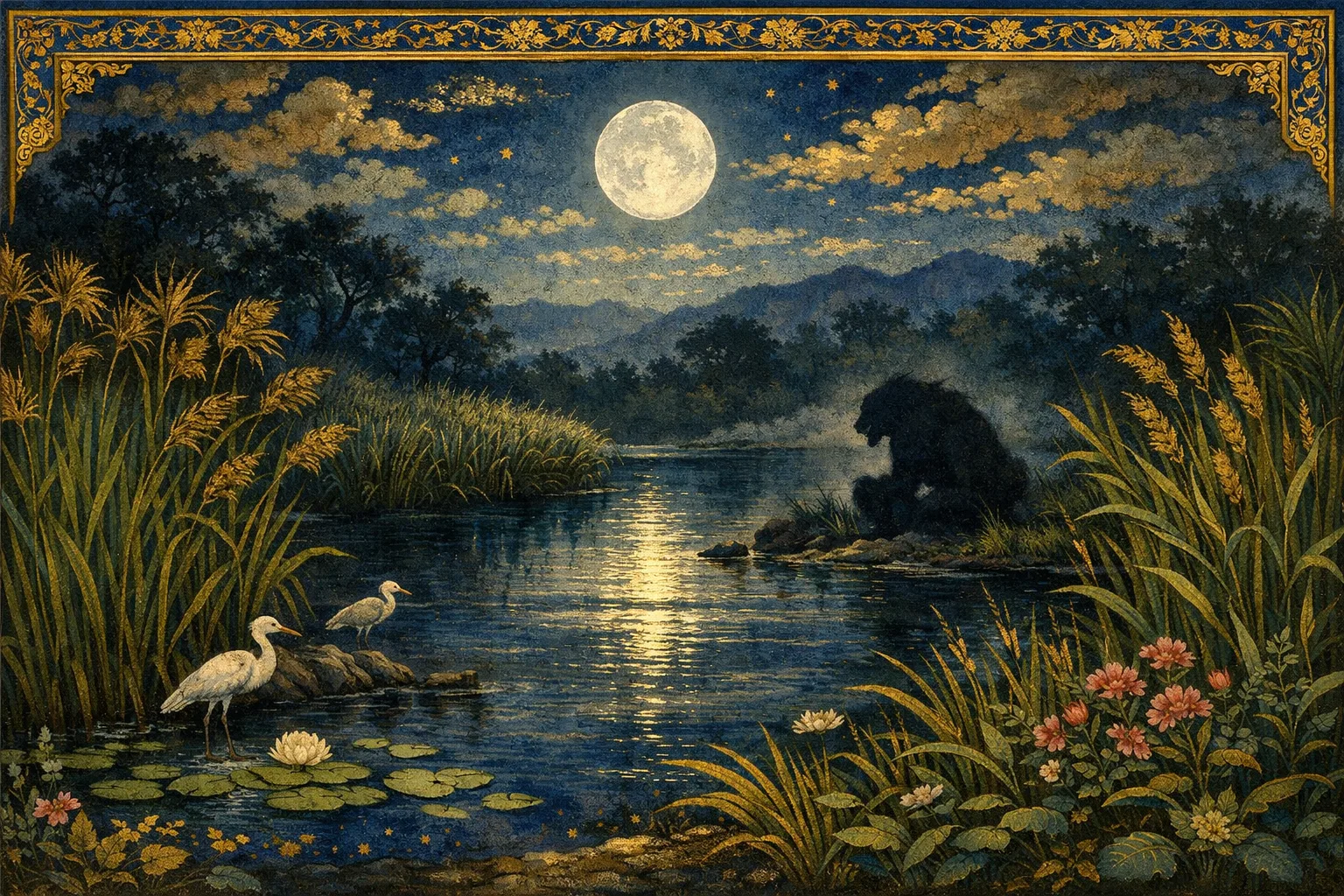
The clearest Angolan monster tradition is Ma-kishi folklore
The most solidly Angolan creature material comes from Héli Chatelain’s nineteenth-century collection Folk-tales of Angola, a major Kimbundu folklore source published in 1894. Its contents include “Sudika-Mbambi”, “Ngana Samba and the Ma-kishi” and “The Girls and the Ma-kishi”, placing Ma-kishi at the centre of several tales rather than as a later internet invention.[Internet Archive]archive.orgOpen source on archive.org.
These Ma-kishi are not “cryptids” in the strict modern sense of animals reported by witnesses and sought by field investigators. They are tale-beings: dangerous, social, plotting, sometimes cannibalistic figures who create the story’s threat. In “Sudika-Mbambi”, the hero goes to fight the Ma-kishi; later the text says that the Ma-kishi are finished after the battle.[Internet Archive]archive.orgOpen source on archive.org. In “The Girls and the Ma-kishi”, the creatures repeatedly test whether their intended victims are asleep, bring food and drink as part of the deception, then try to burn the house and later pursue the girls into a tree.[Internet Archive]archive.orgOpen source on archive.org.
For readers arriving through cryptid culture, this matters because Ma-kishi are often flattened online into “the Kishi”, a two-faced hyena demon from Angola. That modern bestiary version is entertaining, but the older printed Angolan material is broader and stranger: it presents Ma-kishi as a class of monstrous beings in folktale plots, not simply as one standardised animal. The repeated motifs are deception, pursuit, cannibal danger, hidden knowledge and rescue through wit or heroic action.
The best sceptical reading is not “people saw an unknown animal”. It is that the Ma-kishi tradition belongs to a wider Central and Southern African world of cautionary and heroic monster tales, where dangerous outsiders, cannibals, spirits, wild people and animal-like threat figures can overlap. Chatelain’s own notes compare Ma-kishi stories with other African cannibal-monster traditions and discuss long tangled hair, many heads and possible links to remembered conflict with forest peoples, though those nineteenth-century interpretations should be treated cautiously rather than as settled ethnography.[Internet Archive]archive.orgOpen source on archive.org.
Kianda is Angola’s water spirit, not a lake monster
Angola’s most recognisable water-being is Kianda, usually described as a goddess or spirit of the sea and waters, especially associated with Luanda, fishermen and offerings. Global Voices summarises Kianda as a much-loved Angolan water figure traditionally venerated with offerings, while literary scholarship on Pepetela’s “Magias do Mar” describes Kianda as a precolonial Angolan mythological creature believed to be the goddess of the ocean.[Global Voices]globalvoices.orgGlobal Voices Angola: On the mermaid Kianda and other mythical beingsGlobal Voices Angola: On the mermaid Kianda and other mythical beings
This is important because water spirits can look “cryptid-adjacent” to outside readers. Around the world, mermaids, river serpents and lake beings often become monster-page material. In Angola, however, Kianda is better understood as folklore, cosmology, urban memory and literature rather than a reported unknown aquatic animal. Pepetela’s work has helped carry Kianda into modern Angolan cultural discussion: one scholarly reading argues that the figure becomes a way of thinking about water, ecology and the force of non-human nature in a modernising Luanda.[MDPI]mdpi.comOpen source on mdpi.com.
Kianda also explains why a country page about Angolan mystery creatures should not focus only on “beasts”. Angola’s supernatural animal-like tradition is often about relationship with place: sea, lagoon, river, city, offering, danger and respect. That differs from a lake-monster case built around photographs, sonar claims or named eyewitness flaps. The evidence for Kianda is cultural and literary; the claim is not zoological.
Kongamato: the flying reptile that only partly belongs to Angola
Kongamato is the creature most likely to appear when someone searches for “Angola cryptid”. It is usually described as a dangerous, pterosaur-like flying creature associated with swampy parts of Central Africa. The strongest early source is Frank H. Melland’s In Witch-bound Africa, published in 1923, which concerns the Kaonde people of what was then Northern Rhodesia, now Zambia. Internet Archive catalogues the book and identifies “The ‘Kongamato’” among its topics.[Internet Archive]archive.orgOpen source on archive.org.
That geography matters. Kongamato is not primarily an Angolan legend in the way Ma-kishi and Kianda are Angolan. Its best-known reported haunt is the Jiundu or Jiwundu swamp area in north-western Zambia, near the Congo border; geographical databases place Jiwundu Swamp in Zambia’s North-Western Province.[Mindat]mindat.orgOpen source on mindat.org. Angola enters the story because cryptozoology retellings often describe the creature’s range loosely as Zambia, Congo and Angola, or as the swampy borderlands of the region.[Cryptid Wiki]cryptidz.fandom.comCryptid Wiki KongamatoCryptid Wiki Kongamato
The famous pterosaur interpretation is also weak. Pterosaurs were real flying reptiles, but mainstream palaeontology places their extinction at the end of the Cretaceous, about 66 million years ago. The Natural History Museum states that pterosaurs lasted until that extinction event, which coincided with the asteroid impact that also wiped out non-bird dinosaurs.[Natural History Museum]nhm.ac.ukOpen source on nhm.ac.uk. A living pterosaur in modern Angola or Zambia would therefore require extraordinary evidence: a body, bones, clear photographs, DNA or repeated documented observation. Kongamato has none of that.
More ordinary explanations fit the shape of the material better. Large wetland birds, especially storks, herons and other long-billed species, can look startling in poor light or at close range; large bats can also produce “leathery wing” impressions. Some sceptical summaries suggest a large bird such as a saddle-billed stork or a giant bat as a possible source of sightings, while even pro-cryptid write-ups concede that no definitive evidence has been obtained.[Wikipedia]WikipediaOpen source on wikipedia.org. For Angola, Kongamato is best treated as a regional borderland legend with Angolan afterlife in cryptid lists, not as a well-documented Angolan sighting tradition.
Why Angola feels plausible for mystery-beast stories
Angola’s landscape gives monster stories a believable stage. The country includes Atlantic coast, desert, escarpment, miombo woodland, river systems, northern rain forest links and highland water sources. Angola’s own biodiversity strategy describes this range of biomes, from the Namib Desert and Kwanza Basin to the Okavango and Zambezi basins and northern rain forest.[Convention on Biological Diversity]cbd.intConvention on Biological Diversity CBD Strategy and Action PlanConvention on Biological Diversity CBD Strategy and Action Plan
There is also a genuine scientific reason Angola can feel “unfinished” to wildlife readers: its biodiversity was under-studied for long periods. A 2018 annotated snake checklist says Angolan reptile studies were severely curtailed for nearly 60 years after the colonial era, leaving the status and distribution of many snakes poorly known. The same paper records 122 snake species then known from Angola and expects further additions near the country’s borders.[amphibian-reptile-conservation.org]amphibian-reptile-conservation.orgARC 12 2 [General Section] 41 82 e159 low resARC 12 2 [General Section] 41 82 e159 low res A broader reptile history notes important twentieth-century expeditions and collections, including work by the Pulitzer Angola Expedition and later zoologists, but also shows how piecemeal the record has been.[podarcis.de]podarcis.deBIB 12955BIB 12955
That does not mean monsters are hiding in every blank spot. It means Angola is exactly the kind of place where three things can coexist: real undiscovered species, exaggerated animal encounters and old supernatural tales. A newly documented frog, lizard or snake is scientifically plausible. A surviving pterosaur is not plausible without remarkable evidence. A water spirit or Ma-kishi belongs to folklore rather than zoology.
The giant sable shows the difference between rare animal and cryptid
The Angolan giant sable antelope is not a cryptid, but it is the country’s best real-world “lost animal” story and helps clarify the standard of evidence. This striking antelope is unique to Angola and became feared extinct after decades of civil war. DNA work from dung samples provided documented evidence that it had survived, and photographic evidence followed.[University of Johannesburg]pure.uj.ac.zaOpen source on uj.ac.za.
That rediscovery has all the things cryptid cases usually lack: a known animal, a restricted range, museum and historical context, field samples, genetic comparison and camera-trap confirmation. Conservation accounts describe the giant sable as an Angolan national icon; UNEP notes that its horns appear on national symbols including banknotes, postage stamps and football shirts.[UNEP - UN Environment Programme]unep.orgUN Environment Programme UN Environment helps conservationists protectUN Environment Programme UN Environment helps conservationists protect
For an Angola mystery-creature page, the giant sable is a useful reality check. Angola can hide rare animals from ordinary view. War, remoteness, poaching and limited surveys can make even a large mammal seem almost legendary. But when the animal is real, the evidence trail can become concrete: dung, DNA, photographs, collars, locations, conservation work. That is very different from the Kongamato evidence trail, which remains mostly retold testimony and folklore.
What evidence would change the picture?
Angola’s current cryptid picture is strongest as folklore and weakest as zoology. The best-supported creatures are not unknown animals but story-beings and water spirits preserved in oral literature, modern writing and cultural memory. Claims of living prehistoric creatures or large unidentified monsters need a much higher standard of proof.
A strong Angolan mystery-animal case would need at least some of the following:
- Precise location: a named river, coast, wetland, forest or village area rather than a vague “Angola/Congo/Zambia” range.
- Independent witnesses: separate reports that do not appear to copy the same older cryptozoology paragraph.
- Physical trace: clear tracks, remains, hair, scat, feathers, bite evidence or DNA handled by qualified researchers.
- Good images: photographs or video with date, place, scale and original files, not cropped monster-list artwork.
- Wildlife comparison: serious checks against crocodiles, pythons, monitor lizards, manatees, large birds, bats, antelopes and known local species.
Until then, Angola’s monster tradition is best read as a layered field: Ma-kishi for folktale danger, Kianda for water-spirit memory, Kongamato for regional cryptid spillover, and the giant sable for the real lesson that rare animals can vanish from view without becoming monsters.

Amazon book picks
Further Reading
Books and field guides related to What Monsters Does Angola Really Have?. Use these as the next step if you want deeper reading beyond the article.
The Mythical Creatures Bible
Provides context for comparing Angolan monster traditions with global folklore creatures.
Folktales of Angola
Contains foundational Ma-kishi narratives and other Angolan folk traditions.
African Myths of Origin
Places Angolan folklore within wider African storytelling traditions.
The Element Encyclopedia of Magical Creatures
Helps readers compare folklore beings, spirits and monsters across cultures.
eBay marketplace picks
Marketplace Samples
Live-tested eBay searches with available results related to this page.




Endnotes
1.
Source: amphibian-reptile-conservation.org
Title: ARC 12 2 [General Section] 41 82 e159 low res
Link:https://amphibian-reptile-conservation.org/pdfs/Volume/Vol_12no_2/ARC_12_2%5BGeneral_Section%5D_41-82_e159_low_res.pdf
2.
Source: archive.org
Link:https://archive.org/stream/ajs8768.0001.001.umich.edu/ajs8768.0001.001.umich.edu_djvu.txt
3.
Source: archive.org
Link:https://archive.org/stream/folktalesangola00chatgoog/folktalesangola00chatgoog_djvu.txt
4.
Source: mdpi.com
Link:https://www.mdpi.com/2076-0787/9/3/72
5.
Source: archive.org
Link:https://archive.org/details/inwitchboundafri00mell
6.
Source: mindat.org
Link:https://www.mindat.org/feature-916525.html
7.
Source: Wikipedia
Link:https://en.wikipedia.org/wiki/Kongamato
8.
Source: podarcis.de
Title: BIB 12955
Link:https://www.podarcis.de/AF/Bibliografie/BIB_12955.pdf
9.
Source: unep.org
Title: UN Environment Programme UN Environment helps conservationists protect
Link:https://www.unep.org/news-and-stories/story/un-environment-helps-conservationists-protect-endangered-angolan-antelopes
10.
Source: ia801406.us.archive.org
Link:https://ia801406.us.archive.org/35/items/inwitchboundaf00mell/inwitchboundaf00mell.pdf
11.
Source: archive.org
Link:https://archive.org/download/folktalesofango00chat/folktalesofango00chat.pdf
12.
Source: archive.org
Link:https://archive.org/details/folktalesofangol00chat
13.
Source: archive.org
Link:https://archive.org/download/folktalesofangol00chat/folktalesofangol00chat.pdf
14.
Source: archive.org
Link:https://archive.org/details/folktalesofango00chat
15.
Source: archive.org
Link:https://archive.org/details/folktalesangola00chatgoog
16.
Source: archive.org
Link:https://archive.org/download/ajs8768.0001.001.umich.edu/ajs8768.0001.001.umich.edu.pdf
17.
Source: Wikipedia
Link:https://en.wikipedia.org/wiki/Lukwata
18.
Source: Wikipedia
Link:https://en.wikipedia.org/wiki/Grootslang
19.
Source: Wikipedia
Link:https://en.wikipedia.org/wiki/Kianda
20.
Source: Wikipedia
Title: Mami Wata
Link:https://en.wikipedia.org/wiki/Mami_Wata
21.
Source: Wikipedia
Title: Giant sable antelope
Link:https://en.wikipedia.org/wiki/Giant_sable_antelope
22.
Source: Wikipedia
Title: Kishi (folklore)
Link:https://en.wikipedia.org/wiki/Kishi_%28folklore%29
23.
Source: Wikipedia
Link:https://en.wikipedia.org/wiki/Werehyena
24.
Source: Wikipedia
Title: Cretaceous–Paleogene extinction event
Link:https://en.wikipedia.org/wiki/Cretaceous%E2%80%93Paleogene_extinction_event
25.
Source: mdpi.com
Link:https://www.mdpi.com/2076-0752/3/2/215
26.
Source: cbd.int
Title: Convention on Biological Diversity CBD Strategy and Action Plan
Link:https://www.cbd.int/doc/world/ao/ao-nbsap-v2-en.pdf
27.
Source: globalvoices.org
Title: Global Voices Angola: On the mermaid Kianda and other mythical beings
Link:https://globalvoices.org/2008/10/28/angola-on-the-mermaid-kianda-and-other-mythical-beings/
28.
Source: cryptidz.fandom.com
Title: Cryptid Wiki Kongamato
Link:https://cryptidz.fandom.com/wiki/Kongamato
29.
Source: nhm.ac.uk
Link:https://www.nhm.ac.uk/discover/the-truth-about-pterosaurs.html
30.
Source: nhm.ac.uk
Link:https://www.nhm.ac.uk/discover/dinosaur-extinction.html
31.
Source: pure.uj.ac.za
Link:https://pure.uj.ac.za/en/publications/dna-led-rediscovery-of-the-giant-sable-antelope-in-angola
32.
Source: cryptidz.fandom.com
Link:https://cryptidz.fandom.com/wiki/Grootslang
33.
Source: cryptidarchives.fandom.com
Link:https://cryptidarchives.fandom.com/wiki/Chipekwe
34.
Source: cryptidarchives.fandom.com
Title: Lake Tanganyika monster
Link:https://cryptidarchives.fandom.com/wiki/Lake_Tanganyika_monster
35.
Source: cryptidarchives.fandom.com
Link:https://cryptidarchives.fandom.com/wiki/Kongamato
36.
Source: villains.fandom.com
Link:https://villains.fandom.com/wiki/Kongamato
37.
Source: galactic-creatures.fandom.com
Link:https://galactic-creatures.fandom.com/wiki/Kongamato
38.
Source: warriorsofmyth.fandom.com
Link:https://warriorsofmyth.fandom.com/wiki/Kishi
39.
Source: cooldinofacts.fandom.com
Link:https://cooldinofacts.fandom.com/wiki/Kongamato
40.
Source: itsmth.fandom.com
Link:https://itsmth.fandom.com/wiki/Kongamato
41.
Source: nhm.ac.uk
Link:https://www.nhm.ac.uk/discover/the-cretaceous-period.html
42.
Source: nhm.ac.uk
Link:https://www.nhm.ac.uk/discover/how-an-asteroid-caused-extinction-of-dinosaurs.html
43.
Source: abookofcreatures.com
Link:https://abookofcreatures.com/2019/05/20/kongamato/
44.
Source: quod.lib.umich.edu
Link:https://quod.lib.umich.edu/g/genpub/ajs8768.0001.001/300
45.
Source: youtube.com
Link:https://www.youtube.com/watch?v=PBivnQYvxT8
46.
Source: mythbeasts.com
Link:https://mythbeasts.com/beast/kishi/
47.
Source: mythosaurus.com
Link:https://mythosaurus.com/kishi
48.
Source: mythlok.com
Link:https://mythlok.com/kongamato/
49.
Source: lairofmythics.com
Link:https://lairofmythics.com/blogs/cryptid-case-files/kongamato?srsltid=AfmBOopVwv-oJZLtw06jL0a3tD2IUlGNwso_EnNV-s463FiW_axr8r3S
50.
Source: lairofmythics.com
Link:https://lairofmythics.com/blogs/cryptid-case-files/kongamato?srsltid=AfmBOoqYex8ovQQk7i_XmbwHpQXObqicKcht2DQSktLllikFnt6qbNQU
51.
Source: catalog.hathitrust.org
Link:https://catalog.hathitrust.org/Record/001260371
Additional References
52.
Source: reddit.com
Link:https://www.reddit.com/r/Africa/comments/1jmzazj/a_booklet_of_african_mythological_creatures/
53.
Source: reddit.com
Link:https://www.reddit.com/r/Cryptozoology/comments/1ju5pgx/a_painting_of_a_kongamato_a_pterosaur_or_flying/
54.
Source: facebook.com
Link:https://www.facebook.com/groups/16791880228/posts/10153111260590229/
55.
Source: abookofcreatures.com
Link:https://abookofcreatures.com/tag/african-folklore/page/2/
56.
Source: facebook.com
Link:https://www.facebook.com/100084193171166/posts/african-mythology-features-diverse-mythical-creaturescreatures-and-their-charact/752951587521274/
57.
Source: facebook.com
Link:https://www.facebook.com/cnn/posts/an-expedition-to-eastern-angola-announced-it-had-found-dozens-of-species-potenti/1375879311071383/
58.
Source: angolatourism.com
Link:https://angolatourism.com/nature/
59.
Source: researchgate.net
Link:https://www.researchgate.net/publication/368969714_Angolan_Giant_Sable_Rediscovery_Rescue_and_Recovery
60.
Source: afrika-junior.de
Link:https://afrika-junior.de/content/animals/animals-rainforest.html
61.
Source: afdb.org
Link:https://www.afdb.org/sites/default/files/zlr_biodiversity_angola_final.pdf
Topic Tree
Follow this branch
Related pages 192
- Antigua Cryptids
- Maldives Monsters
- Malta Monsters
- Qatar Monsters
- Argentina Monsters
- +187 more in sidebar