Where Lesotho's Monsters Meet Deep Time
Lesotho does not have a modern, well-documented “monster flap” in the Loch Ness or Bigfoot sense. Its strongest mystery-creature tradition is older and more interesting: a cluster of Basotho and San stories in which huge swallowing beasts, dragon-like reptiles, underwater predators and dinosaur traces overlap.
Page outline Jump by section
Introduction
That makes Lesotho unusually important for readers interested in mystery animals. Here, the question is not “is a hidden animal still alive?” but “how did real prehistoric traces become monster tradition?” Dinosaur footprints are public-facing heritage in Lesotho today, with Quthing promoted for its accessible track sites, while scientific work has described giant theropod footprints near Roma and the dinosaur Kholumolumo ellenbergerorum from Maphutseng.[visitlesotho.org.ls]visitlesotho.org.lsOpen source on visitlesotho.org.ls.
The main Lesotho monster is a fossil-haunted devourer
The creature most clearly tied to Lesotho’s monster tradition is Kholumolumo or Khodumodumo, the great swallowing monster of Basotho lore. In modern summaries of the tale, it appears as a vast, poorly defined, sometimes reptilian or dragon-like being that swallows people, cattle and whole communities. A related name, Kammapa, is often treated as a giant river python or ancestral form of the same devouring beast.[A Book of Creatures]abookofcreatures.comA Book of Creatures KhodumodumoA Book of Creatures Khodumodumo
The best-known story places the monster against the hero Ditaolane, also known as Senkatana. After Kammapa has swallowed almost all humanity, Ditaolane is born miraculously, grows with impossible speed, lets the monster swallow him, then cuts his way out from inside and releases the people trapped in its belly. Oxford Reference identifies the tale as Sotho/Lesotho and summarises Ditaolane as the mythic hero who overcomes the prodigious animal Kammapa.[Oxford Reference]oxfordreference.comOpen source on oxfordreference.com.
For a cryptid-country page, the crucial point is that this is not a claim about a currently roaming animal. It is a mythic monster, but one with unusually strong ties to physical traces in the landscape. A 2025 Geoheritage review argues that the Kholumolumo tale is “demonstrably linked” to dinosaur trace and bone fossils in Lesotho and the wider Karoo Basin, making it a strong example of fossil-related folklore rather than a modern zoological mystery.[Springer]link.springer.comOpen source on springer.com.
Why dinosaurs matter so much to Lesotho’s creature lore
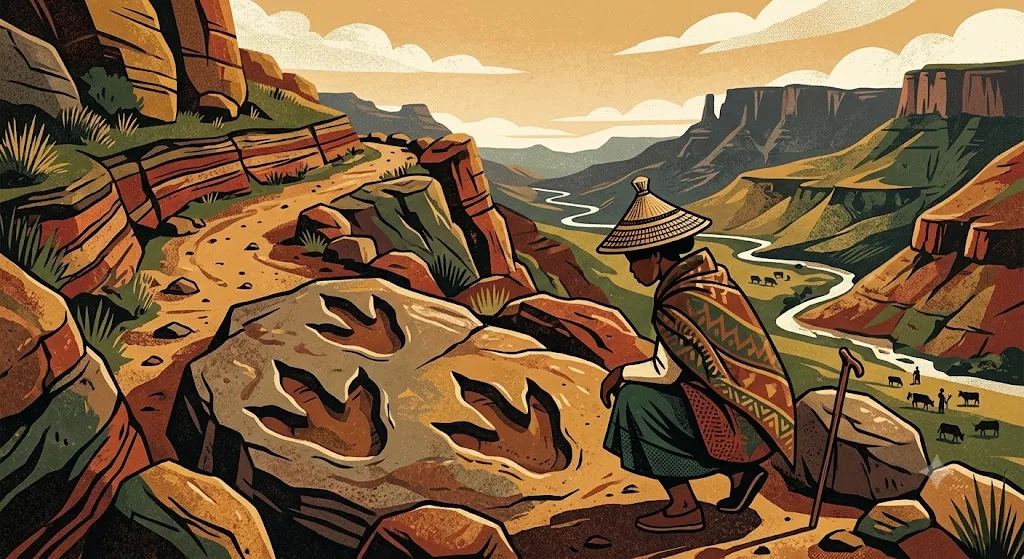
Lesotho is one of the world’s more evocative places for dinosaur-track folklore because fossil footprints are not hidden away in one museum basement. They occur in places that people have seen, crossed, interpreted and reused in stories. The official tourism site describes Quthing as famous for numerous dinosaur footprints, some easily accessible close to town, while other tourism material lists footprint areas around Morija, Subeng Stream, Tsikoane, Maphutseng and Moyeni.[Visit Lesotho]visitlesotho.org.lsOpen source on visitlesotho.org.ls.
Scientific work reinforces why these traces would be memorable. In 2017, researchers described Kayentapus ambrokholohali, a giant three-toed theropod trackway from the Lower Jurassic upper Elliot Formation in western Lesotho. The largest prints were about 57 cm long, and the paper described them as having no Southern Hemisphere equivalent at the time; the University of Cape Town’s account estimated the trackmaker at about 9 metres long and 2.7 metres high at the hip.[PLOS]journals.plos.orgOpen source on plos.org.
This does not mean Basotho storytellers were secretly describing a living dinosaur. It means that Lesotho has the kind of physical evidence that naturally invites monster-making: enormous footprints, bones in rock, mountain passes and riverbeds where strange marks can be encountered without specialist equipment. The 2025 review notes that Paul Ellenberger’s archives preserve accounts of Basotho people discovering dinosaur footprints and bones, and that local awareness of the link between Kholumolumo and fossils has been observed during two decades of geoscientific fieldwork in Lesotho.[Springer]link.springer.comOpen source on springer.com.
The scientific naming of Kholumolumo ellenbergerorum makes the folklore connection unusually visible. The dinosaur, a sauropodomorph from the lower Elliot Formation of Maphutseng, was formally described from historic Lesotho material; the open HAL record describes it as the first complete anatomical description of the “Maphutseng dinosaur”, whose remains were uncovered in 1955. The published abstract also notes that relatively few southern African sauropodomorph specimens come from Lesotho compared with South Africa, making this find nationally significant.[hal.science]hal.scienceOpen source on hal.science.

Where Lesotho’s mystery-creature places cluster
Lesotho’s creature traditions cluster less around one haunted lake and more around a belt of fossil, cave, river and mountain sites. The most important pattern is the overlap between old story landscapes and visible prehistoric traces.
Quthing and Moyeni are among the clearest public-facing anchors. Lesotho’s tourism site points visitors to Quthing dinosaur footprints, while travel sources describe Moyeni and Masitise as part of the country’s footprint circuit. These are not cryptid sighting areas in the modern sense, but they are places where “prehistoric beast” imagery, local heritage and tourism meet.[Visit Lesotho]visitlesotho.org.lsOpen source on visitlesotho.org.ls.
Roma and the National University of Lesotho area matter because the giant Kayentapus ambrokholohali tracks were found on a small dirt road roughly 2 km from the university in the Maseru District. That gives Lesotho a very concrete “monster track” story: not a blurry footprint cast from last week, but a peer-reviewed fossil trackway from about 200 million years ago.[Faculty of Science]science.uct.ac.zaFaculty of Science Meet the giant dinosaur that roamed southern Africa 200Faculty of Science Meet the giant dinosaur that roamed southern Africa 200
Mokhali Cave adds a different kind of evidence. Research summarised in the 2025 review states that San paintings at Mokhali Cave have been interpreted as showing a dinosaur footprint and possible reconstructions of its trackmakers. That interpretation is cautious and scholarly rather than tabloid, but it matters because it suggests that fossil tracks may have entered visual culture as well as oral tradition.[Springer]link.springer.comOpen source on springer.com.
The Nanabolele: Lesotho’s glowing water-dragon tradition
Kholumolumo is not the only monster-like figure attached to Basotho story collections. The Nanabolele, preserved in Basotho folklore collections and retellings, are described as reptilian, predatory beings associated with water and underground places. A Book of Creatures, drawing on Édouard Jacottet’s The Treasury of Ba-suto Lore and Minnie Postma’s Tales from the Basotho, summarises them as creatures that “shine in the night”, live underwater and underground, and are dangerous enough that acquiring their skin becomes a heroic task.[A Book of Creatures]abookofcreatures.comA Book of Creatures NanaboleleA Book of Creatures Nanabolele
The story is usually connected with Thakane, a Basotho heroine who sets out after her brothers demand clothing, shields and other items made from Nanabolele skin. The University of Texas Press listing for Tales from the Basotho includes “Nanabolele, Who Shines in the Night” among its collected tales, while the Internet Archive record for Jacottet’s 1908 Treasury of Ba-suto Lore confirms the older collection’s role as a source for Basotho folktales.[University of Texas Press]utpress.utexas.eduOpen source on utexas.edu.
For cryptid readers, the Nanabolele are tempting because they sound like lake monsters: glowing, reptilian, aquatic and deadly. But the evidence points to folklore rather than a sighting tradition. There is no strong modern record of repeated Nanabolele eyewitness reports, carcasses, photographs or newspaper investigations. Their value is cultural and comparative: they show that Lesotho’s monster imagination includes water-dwelling reptilian beings as well as mountain-and-fossil devourers.
What could explain the creatures?
The strongest explanation for Lesotho’s “cryptids” is not misidentified modern wildlife but layered interpretation. Real fossils, animal behaviour, dangerous waters, initiation tales, hero stories and landscape memory all seem to contribute.
The fossil explanation is strongest for Kholumolumo. The link between dinosaur bones, footprints and Basotho monster tradition is now discussed directly in recent palaeontological and geoheritage research. This does not reduce the story to “people misunderstood fossils”; it makes the story more interesting, because it suggests communities noticed deep-time traces and built them into a moral and mythic world.[Springer]link.springer.comOpen source on springer.com.
For water monsters, ordinary hazards may matter. Lesotho’s rivers belong to the Orange River system, with the Senqu, Makhaleng and Caledon forming major drainage systems; FishBase’s country profile notes that Lesotho has no natural lakes but has rivers, floodplains and swamps. In a mountainous country where watercourses can be dangerous, stories of underwater predators can work as warnings as well as wonder tales.[FishBase]fishbase.seFish Base Territory InformationFish Base Territory Information
Reptile misidentification is possible but limited. Lesotho has snakes and lizards, including species such as the rinkhals, Cape cobra, mountain adder and common brown water snake in reptile lists, but it is not a land of crocodile-filled tropical swamps or undiscovered giant reptiles. A modern zoological reading therefore has to be modest: snakes may colour the imagery, but they do not explain giant world-swallowing monsters on their own.[Wikipedia]WikipediaList of reptiles of LesothoList of reptiles of Lesotho
What Lesotho does not seem to have
A useful evidence-aware page should also say what is missing. Lesotho does not appear to have a strong public record of recent phantom cats, lake monsters, ape-men, winged humanoids or recurring newspaper-backed monster flaps. Searches for Lesotho-specific cryptid and mystery-animal reports mostly return folklore entries, fossil discussions, tourism pages, social-media fragments or material actually centred on neighbouring South Africa. The Mamlambo, for example, is usually a South African river monster story; some retellings mention rivers swollen by Lesotho-season rains, but the reported sightings cluster around South African locations such as Mount Ayliff rather than Lesotho itself.[Cryptid Wiki]cryptidz.fandom.comCryptid Wiki MamlamboCryptid Wiki Mamlambo
That absence matters. It keeps the Lesotho page from pretending that every country has the same kind of cryptid file. Lesotho’s strongest mystery-beast tradition is not a hidden animal hunt but a meeting point between folklore and palaeontology. The “evidence” is not a shaky video; it is a body of oral tradition, fossil trackways, museum and tourism heritage, and scholarly work on how local people have understood ancient remains.
How the legend has changed over time
Lesotho’s monster tradition has moved through several stages. First, there are oral and written folklore collections, especially the early twentieth-century recording of Basotho tales in works such as Jacottet’s The Treasury of Ba-suto Lore. Those collections preserve stories of Senkatana, Thakane, the Nanabolele and other figures as literature, cultural memory and moral narrative rather than cryptozoological evidence.[Internet Archive]archive.orgOpen source on archive.org.
Second, fossil science gave the monster a new frame. Lesotho’s dinosaur tracks and bones became part of formal palaeontology, from missionary-era observations through later work on the Elliot Formation and specific discoveries such as the giant Roma tracks. The naming of Kholumolumo ellenbergerorum in the Journal of Vertebrate Paleontology made the old monster name part of scientific taxonomy, a rare case where folklore visibly enters the language of dinosaur research.[tandfonline.com]tandfonline.comOpen source on tandfonline.com.
Third, tourism and heritage have made the story public-facing. Visitors can encounter Lesotho through dinosaur footprints, rock art, cave sites and mountain landscapes, while modern articles increasingly frame Kholumolumo as a geomyth rather than a mere fantasy beast. That shift gives the creature a different afterlife from many cryptids: it becomes not proof of a surviving monster, but a doorway into how people recognised, remembered and explained deep time.[visitlesotho.org.ls]visitlesotho.org.lsOpen source on visitlesotho.org.ls.
The honest cryptid verdict
Lesotho’s best-known mystery creature is Kholumolumo/Khodumodumo: a devouring Basotho monster with links to the hero Ditaolane and to the country’s dinosaur-rich geology. The most intriguing supporting tradition is the Nanabolele, a glowing water-and-underworld reptilian creature from Basotho tales. Neither should be treated as a confirmed living animal.
The strongest evidence is cultural and geological. Lesotho really does have remarkable dinosaur footprints and fossil sites, including giant theropod tracks near Roma and public footprint localities around Quthing and other districts. Researchers have increasingly treated Kholumolumo as a geomyth: a story-world in which people made sense of bones, tracks and strange stone traces long before modern palaeontology gave them Latin names.[plos.org]journals.plos.orgOpen source on plos.org.
That makes Lesotho’s cryptid profile quieter than countries with dramatic modern sighting files, but arguably more grounded. Its monsters are not lurking in an unsearched lake. They are embedded in rock, story, cave art, tourism and memory — strange enough to satisfy monster lovers, but better understood as folklore meeting fossils than as zoology waiting to be confirmed.
Amazon book picks
Further Reading
Books and field guides related to Where Lesotho's Monsters Meet Deep Time. Use these as the next step if you want deeper reading beyond the article.
The First Fossil Hunters
Explores how ancient people turned fossils into monster stories.
The Rise and Fall of the Dinosaurs
Connects directly to Lesotho's fossil-rich landscape and monster interpretations.
Mythology
Rating: 2.5/5 from 14 Google Books ratings
Useful comparative reading on monster-making in traditional cultures.
eBay marketplace picks
Marketplace Samples
Live-tested eBay searches with available results related to this page.
Endnotes
1.
Source: link.springer.com
Link:https://link.springer.com/article/10.1007/s12371-025-01191-5
2.
Source: archive.org
Link:https://archive.org/details/treasuryofbasuto01jaco
3.
Source: journals.plos.org
Link:https://journals.plos.org/plosone/article?id=10.1371%2Fjournal.pone.0185941
4.
Source: hal.science
Link:https://hal.science/hal-03980325v1
5.
Source: Wikipedia
Link:https://en.wikipedia.org/wiki/Ditaolane
6.
Source: fishbase.se
Title: Fish Base Territory Information
Link:https://www.fishbase.se/country/CountryInfo_Biodiversity.php?c_code=426
7.
Source: Wikipedia
Title: List of reptiles of Lesotho
Link:https://en.wikipedia.org/wiki/List_of_reptiles_of_Lesotho
8.
Source: Wikipedia
Title: List of lake monsters
Link:https://en.wikipedia.org/wiki/List_of_lake_monsters
9.
Source: Wikipedia
Link:https://en.wikipedia.org/wiki/Kamappa
10.
Source: Wikipedia
Link:https://en.wikipedia.org/wiki/Kholumolumo
11.
Source: Wikipedia
Link:https://ig.wikipedia.org/wiki/Ditaolane
12.
Source: dn790002.ca.archive.org
Link:https://dn790002.ca.archive.org/0/items/treasuryofbasuto01jaco/treasuryofbasuto01jaco.pdf
13.
Source: archive.org
Link:https://archive.org/details/treasuryofafrica00cour
14.
Source: archive.org
Link:https://archive.org/details/basutolandrecord03basu
15.
Source: archive.org
Link:https://archive.org/details/historyofbasutoa00elle
16.
Source: youtube.com
Title: The dinosaur footprint over 200 MILLION years old! LESOTHO [part 1]
Link:https://www.youtube.com/watch?v=wiRZOPImEdA
Source snippet
KHOLUMOLUMO - Student Short Film - The Animation School...
17.
Source: youtube.com
Link:https://www.youtube.com/watch?v=8pfy2tgR35I
Source snippet
Discover the Lost Mystery of Lesotho | Mr. Explorer...
18.
Source: visitlesotho.org.ls
Link:https://www.visitlesotho.org.ls/place-to-visit/quthing-dinosaur-footprint
19.
Source: abookofcreatures.com
Title: A Book of Creatures Khodumodumo
Link:https://abookofcreatures.com/2015/12/18/khodumodumo/
20.
Source: oxfordreference.com
Link:https://www.oxfordreference.com/display/10.1093/oi/authority.20110803095722759
21.
Source: seelesotho.com
Link:https://seelesotho.com/dinosaurs/
22.
Source: tandfonline.com
Link:https://www.tandfonline.com/doi/abs/10.1080/02724634.2019.1732996
23.
Source: science.uct.ac.za
Title: Faculty of Science Meet the giant dinosaur that roamed southern Africa 200
Link:https://science.uct.ac.za/articles/2017-10-26-meet-giant-dinosaur-roamed-southern-africa-200-million-years-ago
24.
Source: abookofcreatures.com
Title: A Book of Creatures Nanabolele
Link:https://abookofcreatures.com/2021/04/16/nanabolele/
25.
Source: abookofcreatures.com
Link:https://abookofcreatures.com/category/lesotho/
26.
Source: utpress.utexas.edu
Link:https://utpress.utexas.edu/9781477301715/
27.
Source: cryptidz.fandom.com
Title: Cryptid Wiki Mamlambo
Link:https://cryptidz.fandom.com/wiki/Mamlambo
28.
Source: visitlesotho.org.ls
Link:https://www.visitlesotho.org.ls/why-visit-lesotho
29.
Source: facebook.com
Link:https://www.facebook.com/thakane.morapeli/photos/the-story-of-thakanethakane-was-the-daughter-of-a-great-chief-who-passed-away-le/25475120145474954/
30.
Source: cbd.int
Link:https://www.cbd.int/countries/profile/?country=ls
31.
Source: ui.adsabs.harvard.edu
Link:https://ui.adsabs.harvard.edu/abs/2025Geohe..17..166B/abstract
32.
Source: abookofcreatures.com
Link:https://abookofcreatures.com/category/botswana/
33.
Source: abookofcreatures.com
Link:https://abookofcreatures.com/tag/snake-folklore/
34.
Source: abookofcreatures.com
Link:https://abookofcreatures.com/tag/river-and-lake-monsters/
35.
Source: abookofcreatures.com
Link:https://abookofcreatures.com/tag/african-folklore/page/2/
36.
Source: abookofcreatures.com
Link:https://abookofcreatures.com/tag/african-folklore/
37.
Source: abookofcreatures.com
Link:https://abookofcreatures.com/
38.
Source: abookofcreatures.com
Title: south africa
Link:https://abookofcreatures.com/category/south-africa/
39.
Source: abookofcreatures.com
Link:https://abookofcreatures.com/tag/african-folklore/page/3/
40.
Source: abookofcreatures.com
Link:https://abookofcreatures.com/category/sub-saharan-africa/page/4/
41.
Source: abookofcreatures.com
Link:https://abookofcreatures.com/category/ogres/
42.
Source: abookofcreatures.com
Link:https://abookofcreatures.com/category/zimbabwe/
43.
Source: abookofcreatures.com
Link:https://abookofcreatures.com/category/kenya/
44.
Source: abookofcreatures.com
Link:https://abookofcreatures.com/category/swallowers/
45.
Source: visitlesotho.org.ls
Link:https://www.visitlesotho.org.ls/news/five-animals-to-look-out-for-in-lesotho
46.
Source: visitlesotho.org.ls
Link:https://www.visitlesotho.org.ls/category/places-to-visit/attraction
47.
Source: visitlesotho.org.ls
Link:https://www.visitlesotho.org.ls/place-to-visit/masitise-and-moyeni-to-fort-hartley
48.
Source: stage.visitlesotho.org.ls
Link:https://stage.visitlesotho.org.ls/category/places-to-visit/attraction
49.
Source: visitlesotho.org.ls
Title: Places To Visit Archive
Link:https://www.visitlesotho.org.ls/place-to-visit/page/3
50.
Source: visitlesotho.org.ls
Link:https://www.visitlesotho.org.ls/place-to-visit/lowlands-self-drive
51.
Source: visitlesotho.org.ls
Link:https://www.visitlesotho.org.ls/place-to-visit
52.
Source: visitlesotho.org.ls
Link:https://www.visitlesotho.org.ls/places-to-stay/mountain-view-hotel
53.
Source: visitlesotho.org.ls
Link:https://www.visitlesotho.org.ls/places-to-stay/hotel-mount-maluti
54.
Source: cryptidz.fandom.com
Title: Lake Monsters
Link:https://cryptidz.fandom.com/wiki/Lake_Monsters
55.
Source: allcryptid.fandom.com
Link:https://allcryptid.fandom.com/wiki/Pongo
56.
Source: prehistoric-wiki.fandom.com
Link:https://prehistoric-wiki.fandom.com/wiki/Kholumolumo
57.
Source: dinopedia.fandom.com
Link:https://dinopedia.fandom.com/wiki/Kholumolumo
58.
Source: creatures-of-myth.fandom.com
Link:https://creatures-of-myth.fandom.com/wiki/Kamappa
59.
Source: cryptidz.fandom.com
Link:https://cryptidz.fandom.com/wiki/Tokoloshe
60.
Source: tandfonline.com
Link:https://www.tandfonline.com/doi/abs/10.1080/08912963.2022.2117042
61.
Source: catalog.hathitrust.org
Link:https://catalog.hathitrust.org/Record/011441590
62.
Source: infinite-women.com
Link:https://www.infinite-women.com/thakane/
63.
Source: lonelyplanet.com
Link:https://www.lonelyplanet.com/points-of-interest/dinosaur-footprints/1310615
64.
Source: prehistoric-wildlife.com
Link:https://www.prehistoric-wildlife.com/species/kholumolumo/
65.
Source: cc-tapis.com
Link:https://cc-tapis.com/collections/cryptid
66.
Source: findtourguide.com
Title: Dinosaur Footprints
Link:https://www.findtourguide.com/destinations/lesotho/dinosaur-footprints-2300
67.
Source: bigfoot.einnews.com
Link:https://bigfoot.einnews.com/country/lesotho
Additional References
68.
Source: iol.co.za
Link:https://iol.co.za/travel/south-africa/2017-11-14-200m-year-old-dinosaur-footprints-discovered-in-lesotho/
69.
Source: news.uct.ac.za
Link:https://www.news.uct.ac.za/article/-2017-10-26-uct-led-team-discovers-megacarnivore-roaming-southern-africa-200-million-years-ago
70.
Source: instagram.com
Link:https://www.instagram.com/reel/DX0UF62Dq12/
71.
Source: researchgate.net
Link:https://www.researchgate.net/publication/397696115_Paleontological_Knowledge_among_the_Basotho_and_San_of_Lesotho_A_Review_Including_Insights_from_Paul_Ellenberger%27s_Archives
72.
Source: animalia.bio
Link:https://animalia.bio/lesotho-animals?fbclid=iwzxh0bgnhzw0cmteaar1zlehhagwg1wpz1ifnddd6h13ifawsysyor-nl3vyete-pm_kaod-zfhq_aem_8u7-4zo9vie_2iwogkyalw
73.
Source: africansnakebiteinstitute.com
Link:https://www.africansnakebiteinstitute.com/wp-content/uploads/2017/11/Reptile_Atlas.pdf?srsltid=AfmBOooUR0oLhH8V0VSV6nJ3z7ZGsDx_NPPtZU3_muaD16ma5CV5KuEs
74.
Source: semanticscholar.org
Link:https://www.semanticscholar.org/paper/Atlas-and-red-list-of-the-reptiles-of-South-Africa%2C-Bates-Branch/b98e81e13eb908c7fc56519872f1fc2a73982f68
75.
Source: facebook.com
Link:https://www.facebook.com/groups/2033833066748234/posts/3540394896092036/
76.
Source: facebook.com
Link:https://www.facebook.com/TintswaloAtlantic/posts/can-you-help-us-identify-this-animal-we-captured-this-interesting-animal-in-our-/2744736935790711/
77.
Source: showcaves.com
Link:https://www.showcaves.com/english/other/caves/HaKome.html
Topic Tree
Follow this branch
Related pages 192
- Antigua Cryptids
- Maldives Monsters
- Malta Monsters
- Qatar Monsters
- Argentina Monsters
- +187 more in sidebar