Within Sweden's Mystery Beasts
How Did Storsjodjuret Become Sweden's Defining Monster?
The Lake Storsjon creature changed from an enchanted serpent into a supposed animal, local symbol and tourist attraction.
On this page
- The 1635 serpent legend and troll tale
- From folklore to nineteenth century eyewitness reports
- Tourism, museums and the creature's modern afterlife
Page outline Jump by section
Introduction
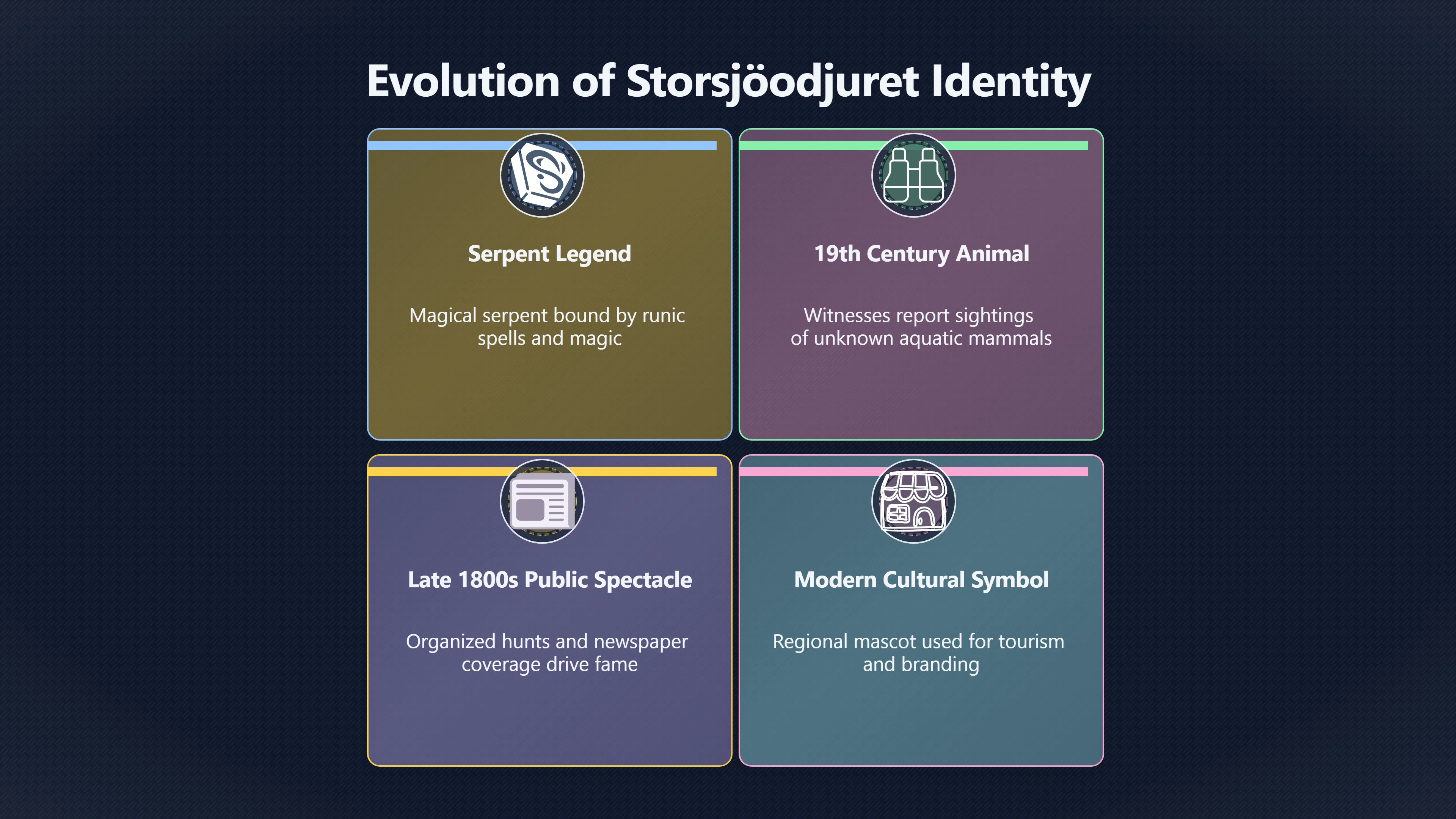
Storsjöodjuret, the legendary creature of Lake Storsjön in Jämtland, did not become Sweden’s best-known monster simply because people claimed to see it. Its remarkable journey lies in how it changed identities over four centuries. What began as a supernatural serpent tied to trolls, magic and a medieval runestone gradually became something closer to a possible unknown animal, then a regional celebrity, and finally a tourism symbol embraced by businesses, museums and local authorities. Unlike many folklore creatures that faded with modernisation, Storsjöodjuret adapted to each era. Every generation found a new way to understand it, helping transform a local legend into one of Sweden’s most enduring cultural mascots.[Wikipedia]WikipediaOpen source on wikipedia.org.
How Did Storsjöodjuret Become Sweden’s Defining Monster?
The creature’s success comes partly from timing. Sweden’s folklore traditions supplied the original story, nineteenth-century newspapers supplied publicity, and twentieth-century tourism supplied a practical reason to keep the legend alive. By the twenty-first century, Storsjöodjuret occupied an unusual position: neither accepted zoology nor forgotten folklore, but a cultural symbol recognised far beyond the shores of Lake Storsjön.[Wikipedia]WikipediaOpen source on wikipedia.org.
What makes the story distinctive is that the monster never remained fixed. The creature described in the oldest legends is not quite the same creature reported by later witnesses, and neither is exactly the same as the friendly mascot promoted in modern Östersund.
The 1635 Serpent Legend and Troll Tale
The earliest known written account dates to 1635. In this version, the creature was not presented as an undiscovered animal but as a magical lake serpent. According to the story, a rune-master named Kettil Runske used powerful spells to bind a monstrous serpent beneath the waters of Storsjön. The tale linked the beast to the famous Frösö Runestone, whose carved serpent motif became associated with the legend centuries after the stone itself was erected.[Wikipedia]WikipediaOpen source on wikipedia.org.
Another version of the story, which became especially popular in local folklore, gave the monster a more dramatic origin. Two trolls, Jata and Kata, spent years brewing a mysterious concoction beside the lake. Eventually a strange creature burst from one of their cauldrons: a beast with a black serpent-like body and a cat-like head. It plunged into the lake, grew to enormous size and terrorised the surrounding countryside until magical intervention restrained it.[Wikipedia]WikipediaOpen source on wikipedia.org.
Several features of this tale reveal its folkloric roots:
- The creature emerges from magic rather than nature.
- Trolls serve as creators, placing the story firmly within Scandinavian folk tradition.
- The monster grows to impossible proportions, even encircling the island of Frösön.
- The runestone functions as a supernatural seal rather than historical evidence.[wikipedia.org]WikipediaOpen source on wikipedia.org.
In other words, the earliest Storsjöodjuret was a mythic being. It belonged to the same imaginative landscape as trolls, enchanted waters and magical bindings, not to natural history.
When the Monster Became an Animal
The most important transformation occurred during the nineteenth century. As folklore increasingly met newspapers, scientific curiosity and public discussion, stories about the creature began to change.
Instead of describing magical origins, witnesses reported seeing something moving across the lake. Accounts spoke of long dark bodies, humps, unusual wakes and heads rising above the water. A frequently cited report from 1857 described workers near an ironworks spotting what appeared to be a dark-headed serpentine creature crossing the lake.[Wikipedia]WikipediaOpen source on wikipedia.org.
This shift was significant. People were no longer saying, “A legendary serpent exists beneath the lake.” They were saying, “I think I saw an animal.”
The change reached a new stage in 1899 when naturalist Peter Olsson published a collection of twenty-two eyewitness testimonies. Rather than treating the reports as folklore, he examined them in the language of natural history. Olsson suggested the sightings might represent an unknown aquatic mammal rather than a supernatural being.[Wikipedia]WikipediaOpen source on wikipedia.org.
Descriptions varied considerably:
- Some witnesses reported a snake-like body.
- Others described a dog-like or cat-like head.
- Some saw humps rising from the water.
- Reported lengths ranged from a few metres to well over ten metres.[Wikipedia]WikipediaOpen source on wikipedia.org.
The inconsistency weakened the case for a real species, but it helped create something else: a mystery. Once the creature entered the realm of eyewitness testimony, people could debate what it might be rather than merely retell a legend.
From Curiosity to Public Phenomenon
By the late nineteenth century, Storsjöodjuret had become a public spectacle.
Following a series of reported sightings, local enthusiasts organised efforts to capture the creature. One campaign in the 1890s even attracted the support of King Oscar II. No monster was found, but the failed hunt generated publicity and reinforced the creature’s fame.[wikipedia.org]WikipediaOpen source on wikipedia.org.
This period marked another important transition. The monster was no longer simply a local tale passed from neighbour to neighbour. It had become a subject for newspapers, public debate and organised expeditions. In many ways it followed a path similar to Scotland’s Loch Ness Monster, though on a smaller scale.
The more people searched for Storsjöodjuret, the more firmly it became part of regional identity. Whether the creature existed mattered less than the fact that people were talking about it.
Why the Legend Survived Modern Scepticism
Many lake-monster traditions disappeared once improved transport, photography and scientific surveys made unexplained sightings harder to sustain. Storsjöodjuret survived because the story adapted rather than resisted change.
Sceptical explanations accumulated over time. Observers pointed to waves, floating logs, groups of swimming birds, otters and errors of distance perception as likely explanations for many reports. No physical evidence has ever confirmed the existence of a large unknown animal in Lake Storsjön. Despite hundreds of claimed sightings, no body, skeleton or verified biological sample has emerged.[Wikipedia]WikipediaOpen source on wikipedia.org.
Yet the absence of proof did not kill the legend. Instead, uncertainty became part of the attraction. The creature occupied a middle ground between folklore and possibility, allowing believers, sceptics and casual visitors to engage with the story in different ways.
That flexibility proved more durable than certainty.
Tourism, Museums and the Creature’s Modern Afterlife
The modern Storsjöodjuret is less a feared serpent than a regional ambassador.
As tourism expanded in Jämtland, the monster became a recognisable local brand. Visitor attractions, souvenir shops, exhibitions and tourist information increasingly treated the creature as a symbol of the region. Rather than hiding the legend behind questions of evidence, local promoters embraced it as part of Jämtland’s cultural identity.[Visit Östersund]visitostersund.seVisit Östersund StorsjöodjuretHe lives with his father Storsjöodjuret and his friend the…Read more…
One of the strangest moments in this transformation came in 1986, when county authorities granted the creature protected status as though it were an endangered species. The decision was largely symbolic and drew international attention. Although the protection was later removed, it demonstrated how thoroughly the monster had moved from folklore into public culture.[Wikipedia]WikipediaOpen source on wikipedia.org.
Museums and cultural institutions also helped preserve the story. Instead of treating the creature solely as a cryptozoological puzzle, they presented it as part of Jämtland’s heritage, connecting local folklore, landscape and community identity.[Wikipedia]WikipediaOpen source on wikipedia.org.
Perhaps the clearest sign of the monster’s reinvention is the appearance of “Birger,” a child-friendly version of Storsjöodjuret used in books, merchandise and public events. The terrifying cat-headed serpent of seventeenth-century folklore became a cheerful mascot who helps introduce children to local culture.[Visit Östersund]visitostersund.seVisit Östersund StorsjöodjuretHe lives with his father Storsjöodjuret and his friend the…Read more…
From Lake Monster to Cultural Symbol
Storsjöodjuret’s lasting significance has little to do with proving whether a mysterious creature swims in Lake Storsjön. Its importance lies in how a story evolved.
The legend began as a magical serpent bound by runic power. It became an apparent unknown animal during the age of eyewitness reports and natural history. It later attracted monster hunters, newspaper attention and cryptozoological speculation. Finally, it settled into a new role as a symbol of Jämtland itself.[wikipedia.org]WikipediaOpen source on wikipedia.org.
That progression explains why Storsjöodjuret remains Sweden’s defining monster. The creature survived not because compelling evidence appeared, but because the legend continuously reinvented itself. Few folklore beings have travelled so far—from enchanted serpent to local celebrity—while remaining recognisably the same monster at the centre of the story.[wikipedia.org]WikipediaOpen source on wikipedia.org.
Amazon book picks
Further Reading
Books and field guides related to How Did Storsjodjuret Become Sweden's Defining Monster?. Use these as the next step if you want deeper reading beyond the article.

The Penguin Book of Dragons
Connects dragon and serpent traditions to monster legends.
eBay marketplace picks
Marketplace Samples
Live-tested eBay searches with available results related to this page.
Endnotes
1.
Source: Wikipedia
Link:https://en.wikipedia.org/wiki/Storsj%C3%B6odjuret
2.
Source: Wikipedia
Link:https://en.wikipedia.org/wiki/J%C3%A4mtland
3.
Source: unixploria.net
Link:https://unixploria.net/onewebmedia/Storsjoodjuret.pdf
Source snippet
The Kingdom of UnixploriaStorsjöodjuretPeter Olsson published an 1899 booklet documenting 22 eyewitness testimonies and collated the deta...
4.
Source: Wikipedia
Link:https://de.wikipedia.org/wiki/Storsj%C3%B6odjuret
5.
Source: Wikipedia
Link:https://fr.wikipedia.org/wiki/Storsj%C3%B6odjuret
6.
Source: Wikipedia
Link:https://sv.wikipedia.org/wiki/Storsj%C3%B6odjuret
7.
Source: visitostersund.se
Title: Visit Östersund Storsjöodjuret
Link:https://visitostersund.se/en/storsjoodjuret-the-great-lake-monster/
Source snippet
He lives with his father Storsjöodjuret and his friend the...Read more...
8.
Source: adventuresweden.com
Link:https://adventuresweden.com/storsjoodjuret-the-great-lake-monster/
Source snippet
Adventure SwedenStorsjöodjuret - The Great Lake MonsterIt tells about two trolls, Jata and Kata, who cooked a witch brew at the shore of...
9.
Source: new-cryptozoology.fandom.com
Link:https://new-cryptozoology.fandom.com/wiki/Storsj%C3%B6odjuret
10.
Source: cryptidz.fandom.com
Link:https://cryptidz.fandom.com/wiki/Storsj%C3%B6odjuret
Additional References
11.
Source: youtube.com
Title: Heat Camera Evidence For Unidentified Creature
Link:https://www.youtube.com/watch?v=KkZnrJFCzr4
Source snippet
The TERRIFYING Lake Monster of Sweden That No One Can Explain...
12.
Source: youtube.com
Title: Sightings of Storsie The Lake Monster of Sweden
Link:https://www.youtube.com/watch?v=jxS4Yng6log
Source snippet
Sweden's Great Lake Monster - The Untold Mystery of Storsjöodjuret...
13.
Source: publicera.kb.se
Link:https://publicera.kb.se/arv/article/download/48343/50718
Source snippet
The Lake and Its Monsterby S Händén-Svensson · 2025 — In this narrative the lake serpent appears in the human world as a pun- is...
14.
Source: youtube.com
Title: Does Sweden Have Lake Monster With A Cat Head
Link:https://www.youtube.com/watch?v=TyNxYiG6v5w
Source snippet
Heat Camera Evidence For Unidentified Creature - Boogeymen...
15.
Source: facebook.com
Link:https://www.facebook.com/groups/1107104873441513/posts/1633664837452178/
16.
Source: avalonlibrary.net
Link:https://avalonlibrary.net/ebooks/Loren%20Coleman%2C%20Jerome%20Clark%20-%20Cryptozoology%20A%20To%20Z%20-%20The%20Encyclopedia%20of%20Loch%20Monsters%2C%20Sasquatch%2C%20Chupacabras%2C%20and%20Other%20Authentic%20Mysteries%20of%20Nature.pdf
17.
Source: facebook.com
Link:https://www.facebook.com/groups/1002571683091379/posts/7914863465195465/
18.
Source: facebook.com
Title: the name storsjöodjuret translates from the swedish as great lake monster this p
Link:https://www.facebook.com/TheFolklorePodcast/photos/the-name-storsj%C3%B6odjuret-translates-from-the-swedish-as-great-lake-monster-this-p/1481285324012383/
19.
Source: watchingtheswedes.com
Title: swedish monsters 3 storsjoodjuret the great lake monster
Link:https://watchingtheswedes.com/2024/06/30/swedish-monsters-3-storsjoodjuret-the-great-lake-monster/
20.
Source: youtube.com
Title: The TERRIFYING Lake Monster of Sweden That No One Can Explain
Link:https://www.youtube.com/watch?v=kN6GqW1OVZI
Topic Tree