Within Gabon Cryptids
Was N'yamala A River Beast Or Misread Wildlife?
N'yamala sits at the heart of Gabon's river-monster tradition, with stories shaped by interviews, tracks, fear and uncertain sightings.
On this page
- Where the Ogooue and Ngounie reports cluster
- Trader Horn, Powell and the picture test problem
- Manatees, hippos, crocodiles and story logic
Page outline Jump by section
Introduction
The N’yamala is the best-known river-monster tradition associated with Gabon. Reported mainly from the Ogooué (often written Ogowe in older accounts) and the Ngounié river systems, it has been described as a large aquatic animal capable of overturning canoes, leaving unusual tracks, and frightening experienced river travellers. Over time, the creature became entangled with wider Central African “living dinosaur” stories, but the original reports are more complicated than a simple dinosaur legend. They combine local testimony, colonial-era storytelling, cryptozoological investigations, uncertain identifications, and a persistent problem: no physical evidence has ever confirmed that an unknown giant animal lives in Gabon’s waterways.[Cryptid Archives]cryptidarchives.fandom.comRiver monsters · FreshwaterCryptid ArchivesN'yamala - Encyclopaedia of Cryptozoology - FandomThe n'yamala ("nya mala", Fang: "mother of canoes") is a neodinosaurian…

The most useful way to approach N’yamala is not to ask whether a dinosaur survives in Gabon, but to examine what people actually claimed to see, where those claims occurred, and how investigators interpreted them.
Was N’yamala A River Beast Or Misread Wildlife?
Descriptions of N’yamala vary, but several themes recur. Witnesses and storytellers described a large creature inhabiting rivers, swamps, and backwaters. It was often portrayed as dangerous to canoes and capable of moving between water and land. Some accounts compared its body shape to a huge canoe, while later cryptozoological writers increasingly presented it as a possible dinosaur-like animal. The name itself has been translated in different ways, including references to canoes or a creature resembling one.[Cryptid Archives]cryptidarchives.fandom.comRiver monsters · FreshwaterCryptid ArchivesN'yamala - Encyclopaedia of Cryptozoology - FandomThe n'yamala ("nya mala", Fang: "mother of canoes") is a neodinosaurian…
One reason the legend gained attention is that Gabon’s river environments are genuinely difficult places in which to identify animals. The Ogooué and Ngounié systems cut through vast stretches of forest, wetlands, channels, and floodplains where visibility is often poor and wildlife can be encountered unexpectedly.[Wikipedia]WikipediaNgounié RiverNgounié River
Unlike many famous lake-monster stories, N’yamala was not usually described as a mysterious shape seen briefly at a distance. Instead, the tradition centred on reports of a dangerous animal known locally and remembered through oral accounts. That distinction made later cryptozoologists regard the stories as potentially more significant than a single unexplained sighting, even though the evidence remained largely anecdotal.[Cryptid Archives]cryptidarchives.fandom.comRiver monsters · FreshwaterCryptid ArchivesN'yamala - Encyclopaedia of Cryptozoology - FandomThe n'yamala ("nya mala", Fang: "mother of canoes") is a neodinosaurian…
Where the Ogooué and Ngounié Reports Cluster
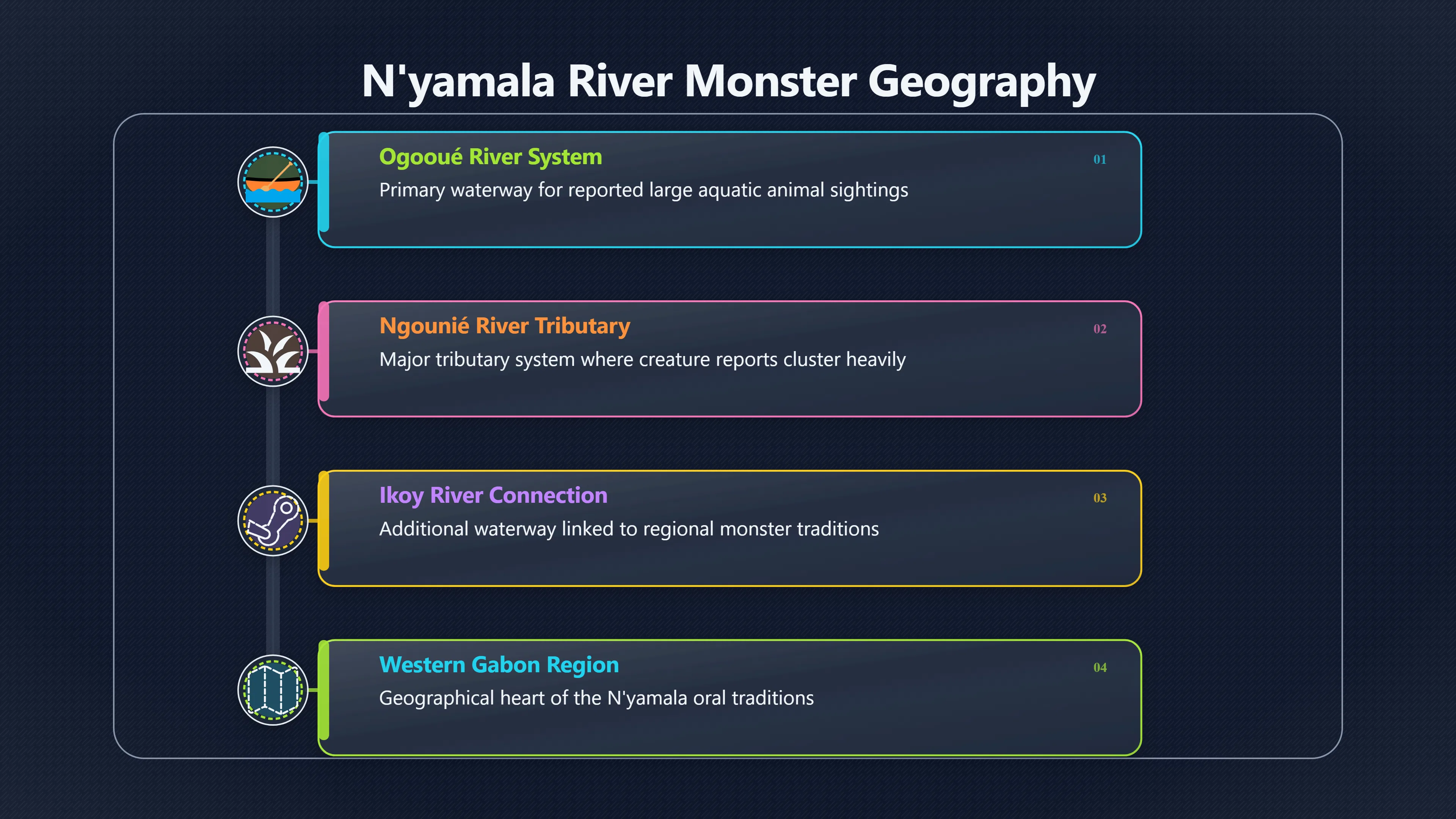
The geographical heart of the N’yamala tradition lies in western and central Gabon, especially around the Ogooué River and its major tributary, the Ngounié. Several later accounts also placed sightings or stories near the Ikoy River, which flows into the Ngounié system.[fandom.com]cryptidarchives.fandom.comRiver monsters · FreshwaterCryptid ArchivesN'yamala - Encyclopaedia of Cryptozoology - FandomThe n'yamala ("nya mala", Fang: "mother of canoes") is a neodinosaurian…
This clustering matters because it differs from the better-known Mokele-mbembe stories of the Congo Basin. Although later writers often merged the traditions, the N’yamala reports were originally tied to specific waterways in Gabon rather than a vast, undefined region. Cryptozoologists argued that recurring stories from connected rivers might indicate a real animal population. Sceptics pointed out that folklore, trade routes, and communication networks also spread stories along rivers, creating the appearance of consistency without requiring an unknown species.[Cryptid Archives]cryptidarchives.fandom.comRiver monsters · FreshwaterCryptid ArchivesN'yamala - Encyclopaedia of Cryptozoology - FandomThe n'yamala ("nya mala", Fang: "mother of canoes") is a neodinosaurian…
The environmental setting further complicates interpretation. These rivers are home to large aquatic and semi-aquatic animals, including crocodiles and, historically, populations of manatees and hippos in suitable habitats. Encounters with such animals can be startling, especially when seen briefly or under poor conditions.[Wikipedia]WikipediaOgooué RiverOgooué River
Trader Horn, Powell and the Picture-Test Problem
Much of what later readers know about N’yamala comes from two very different sources: the colourful memoirs of Alfred Aloysius Smith, better known as Trader Horn, and the investigations of herpetologist James H. Powell Jr.
Smith’s writings helped introduce the wider world to stories of a creature linked to names such as Jago-Nini, Amali, and N’yamala. He repeated reports of a large river animal associated with three-clawed tracks and attacks on people. These stories were presented as things he had heard from local informants rather than events he personally documented under controlled conditions. As a result, historians and sceptics regard them as interesting folklore evidence rather than zoological proof.[Creation.com]creation.comBehemoth or bust: an expedition into Cameroon invesOctober 19, 2007 — Later, while travelling in Cameroon, he visited lakes from which populations of manatees had been wiped out by the N'y…
Decades later, Powell travelled in Central Africa looking for information about large unknown animals. He interviewed witnesses and became convinced that reports of N’yamala and other regional creatures might refer to the same underlying animal later popularised as Mokele-mbembe. According to accounts of his fieldwork, witnesses were shown illustrations of known and extinct animals and asked whether any matched the creature they described. Some reportedly selected sauropod dinosaur images.[Brickthology]brickthology.comCryptid26 May 2024 — Powell, Jr. headed to Gabon, inspired by the book Trader Horn to go study crocodiles and the elusive Mok…
This became one of the most famous pieces of evidence cited by cryptozoologists—and one of the most criticised.
The problem is that picture-identification tests are highly vulnerable to suggestion. Witnesses may choose the closest image from a limited selection rather than identify an exact match. Cultural expectations, interviewer influence, translation issues, and prior exposure to images can all affect responses. Critics therefore argue that selecting a sauropod picture does not demonstrate that witnesses actually observed a dinosaur-like animal. It demonstrates only that a particular drawing resembled their description more closely than the alternatives provided.[Wikipedia]WikipediaOpen source on wikipedia.org.
For many researchers, the picture-test controversy sits at the centre of the N’yamala debate. Supporters see repeated selections of dinosaur-like images as suggestive. Sceptics see a methodological flaw that weakens one of the strongest claimed pieces of evidence.

What Physical Evidence Was Actually Reported?
The most frequently cited physical evidence involves tracks rather than bodies.
Older accounts describe large three-toed footprints found near waterways, sometimes compared in size to a frying pan. Such tracks were treated by some writers as evidence for a large unknown animal. However, no preserved track casts, photographs of scientific quality, skeletal remains, tissue samples, or verified specimens have emerged from the reports.[Creation.com]creation.comBehemoth or bust: an expedition into Cameroon invesOctober 19, 2007 — Later, while travelling in Cameroon, he visited lakes from which populations of manatees had been wiped out by the N'y…
That absence is significant. Many famous cryptid cases survive because at least some physical traces can be re-examined later. In the N’yamala case, most evidence exists only as descriptions in books, interviews, or retellings. The tracks therefore function more as testimony than as independently testable data.[Creation.com]creation.comBehemoth or bust: an expedition into Cameroon invesOctober 19, 2007 — Later, while travelling in Cameroon, he visited lakes from which populations of manatees had been wiped out by the N'y…
Another frequently repeated claim is that the creature attacked canoes or threatened river travellers. Such stories fit the image of a powerful aquatic animal, but they suffer from the same evidential problem: they were recorded as reports rather than documented observations supported by photographs, specimens, or modern wildlife surveys.[Cryptid Archives]cryptidarchives.fandom.comRiver monsters · FreshwaterCryptid ArchivesN'yamala - Encyclopaedia of Cryptozoology - FandomThe n'yamala ("nya mala", Fang: "mother of canoes") is a neodinosaurian…
Manatees, Hippos, Crocodiles and Story Logic
The most common non-mysterious explanations focus on known river animals.
Manatees are often mentioned because they inhabit West and Central African rivers and can appear surprisingly large when glimpsed at the surface. A witness unfamiliar with their shape or behaviour could potentially misjudge what they were seeing. Some historical accounts even connected N’yamala stories with areas where manatees were known.[Creation.com]creation.comBehemoth or bust: an expedition into Cameroon invesOctober 19, 2007 — Later, while travelling in Cameroon, he visited lakes from which populations of manatees had been wiped out by the N'y…
Hippos provide another candidate. Although not as widespread in Gabon as in some other African countries, a large semi-aquatic herbivore capable of damaging boats fits parts of the traditional narrative more closely than a dinosaur does. Hippos are territorial, aggressive, and responsible for many dangerous encounters across Africa. Their behaviour aligns better with reports of attacks on canoes than the imagined behaviour of a surviving sauropod.[Cryptid Archives]cryptidarchives.fandom.comRiver monsters · FreshwaterCryptid ArchivesN'yamala - Encyclopaedia of Cryptozoology - FandomThe n'yamala ("nya mala", Fang: "mother of canoes") is a neodinosaurian…
Crocodiles are also plausible contributors. Large crocodiles are powerful, elusive, and capable of producing alarming sightings in murky river systems. While they do not match every description, they demonstrate how real dangerous wildlife can generate extraordinary stories when observed briefly.[Wikipedia]WikipediaOgooué RiverOgooué River
Beyond specific animals, there is the broader issue of story logic. River folklore often magnifies danger. A genuine encounter with a large animal can become a cautionary tale, then a local legend, and eventually a monster narrative. Over decades, details accumulate, dramatic features are added, and separate stories merge. N’yamala may represent exactly that process: a mixture of real wildlife encounters, local oral traditions, and later cryptozoological reinterpretation.[Cryptid Archives]cryptidarchives.fandom.comRiver monsters · FreshwaterCryptid ArchivesN'yamala - Encyclopaedia of Cryptozoology - FandomThe n'yamala ("nya mala", Fang: "mother of canoes") is a neodinosaurian…

Why N’yamala Remains Unresolved
N’yamala survives in discussions of Gabon’s mystery animals because the reports are specific enough to be intriguing but too weak to establish a new species. There are named rivers, named witnesses, claimed tracks, and recurring descriptions. Yet there are also major gaps: no specimen, no verified photograph, no DNA, and no confirmed modern observation that withstands scientific scrutiny.[Cryptid Archives]cryptidarchives.fandom.comRiver monsters · FreshwaterCryptid ArchivesN'yamala - Encyclopaedia of Cryptozoology - FandomThe n'yamala ("nya mala", Fang: "mother of canoes") is a neodinosaurian…
As a result, the creature occupies an unusual position in Gabon’s monster tradition. It is neither a purely mythical being detached from place nor a well-supported zoological discovery waiting for recognition. Instead, it stands as a river-monster legend built from testimony, memory, and interpretation. The evidence is strong enough to explain why the story endured, but too thin to demonstrate that an unknown giant animal inhabits the Ogooué and Ngounié waterways.[fandom.com]cryptidarchives.fandom.comRiver monsters · FreshwaterCryptid ArchivesN'yamala - Encyclopaedia of Cryptozoology - FandomThe n'yamala ("nya mala", Fang: "mother of canoes") is a neodinosaurian…
Amazon book picks
Further Reading
Books and field guides related to Was N'yamala A River Beast Or Misread Wildlife?. Use these as the next step if you want deeper reading beyond the article.
In Search of Prehistoric Survivors
Relevant to dinosaur-linked interpretations of N'yamala.
The Song Of The Dodo
Helps readers understand biodiversity and species discovery narratives.
eBay marketplace picks
Marketplace Samples
Live-tested eBay searches with available results related to this page.



Endnotes
1.
Source: Wikipedia
Title: Ngounié River
Link:https://en.wikipedia.org/wiki/Ngouni%C3%A9_River
2.
Source: Wikipedia
Title: Ogooué River
Link:https://en.wikipedia.org/wiki/Ogoou%C3%A9_River
3.
Source: Wikipedia
Title: Ikoy River
Link:https://en.wikipedia.org/wiki/Ikoy_River
4.
Source: Wikipedia
Link:https://es.wikipedia.org/wiki/Mok%C3%A8l%C3%A9-mb%C3%A8mb%C3%A9
5.
Source: creation.com
Title: Behemoth or bust: an expedition into Cameroon inves
Link:https://creation.com/images/pdfs/tj/j15_2/j15_2_62-68.pdf
Source snippet
October 19, 2007 — Later, while travelling in Cameroon, he visited lakes from which populations of manatees had been wiped out by the N'y...
Published: October 19, 2007
6.
Source: brickthology.com
Link:https://brickthology.com/tag/cryptid/
Source snippet
Cryptid26 May 2024 — Powell, Jr. headed to Gabon, inspired by the book Trader Horn to go study crocodiles and the elusive Mok...
Published: May 2024
7.
Source: Wikipedia
Link:https://en.wikipedia.org/wiki/N
Source snippet
NN (minuscule: n) is the fourteenth letter of the Latin alphabet, used in the modern English alphabet, the alphabets of other Western...
8.
Source: n.com
Link:https://n.com/
9.
Source: cryptidarchives.fandom.com
Title: River monsters · Freshwater
Link:https://cryptidarchives.fandom.com/wiki/N%27yamala
Source snippet
Cryptid ArchivesN'yamala - Encyclopaedia of Cryptozoology - FandomThe n'yamala ("nya mala", Fang: "mother of canoes") is a neodinosaurian...
10.
Source: genesispark.com
Link:https://genesispark.com/exhibits/cryptozoological-evidence/the-sauropod-paddock/the-river-monster-of-cameroon-and-gabon/
Source snippet
Genesis ParkThe River Monster of Cameroon and GabonThe River Monster of Cameroon and Gabon. In Gabon, a group of African natives known as...
11.
Source: cryptidz.fandom.com
Title: Cryptid Wiki N’yamala
Link:https://cryptidz.fandom.com/wiki/N%27yamala
Source snippet
Cryptid WikiN'yamala - Cryptid Wiki - FandomThe n'yamala ("nya mala", Fang: "mother of canoes" or "animal that resembles a large canoe")...
12.
Source: cryptidarchives.fandom.com
Title: Njago gunda
Link:https://cryptidarchives.fandom.com/wiki/Njago_gunda
Source snippet
Ogooué River, from which the neodinosaurian n'yamala is also reported. The njago gunda... Lake monsters of Africa · Freshwater monsters...
13.
Source: cryptidarchives.fandom.com
Title: Mokele mbembe
Link:https://cryptidarchives.fandom.com/wiki/Mokele-mbembe
Source snippet
fandom.comMokele-mbembe | Encyclopaedia of Cryptozoology - FandomThe monster is herbivorous and mainly feeds on the luxuriant aquatic veg...
14.
Source: cryptidarchives.fandom.com
Title: Njago gunda · Nzemendim. Advertisement. More Information. Categories. African
Link:https://cryptidarchives.fandom.com/wiki/Category%3AGabon
Source snippet
fandom.comCategory:Gabon - Encyclopaedia of Cryptozoology - FandomTuttle Bottoms monster · Yukon giant worm · Sabre-toothed bear; Phantom...
Additional References
15.
Source: ebsco.com
Link:https://www.ebsco.com/research-starters/science/mokele-mbembe-cryptozoology
Source snippet
Mokele-Mbembe (cryptozoology) | ScienceOften described as resembling a sauropod dinosaur, it has been likened to the Loch Ness Monster, c...
16.
Source: reddit.com
Link:https://www.reddit.com/r/Cryptozoology/comments/138m77f/a_collection_of_different_theories_about_what_the/
Source snippet
Theories about Mokele-Mbembe in cryptozoologyAfter this, the pair apparently began carrying out this picture-test as Powell had in Camero...
17.
Source: netflix.com
Link:https://www.netflix.com/
Source snippet
Watch TV Shows Online, Watch Movies OnlineNetflix is a streaming service that offers a wide variety of award-winning TV shows...
18.
Source: reddit.com
Link:https://www.reddit.com/r/Cryptozoology/comments/1d7vlla/the_njago_gunda_is_a_giant_elephantlike_cryptid/
Source snippet
It's known to live in creeks and swamps, attacking people in boats and being...
19.
Source: facebook.com
Link:https://www.facebook.com/johanegerkranspublic/posts/mokele-mbembe-is-a-mythical-water-dwelling-cryptid-rumoured-to-exist-in-the-cong/1301971888397055/
Source snippet
mbling a cross between a hippopotamus and a crocodile. It has...
20.
Source: tetzoo.com
Title: new living animals we want to find
Link:https://tetzoo.com/blog/2018/11/2/new-living-animals-we-want-to-find
Source snippet
2 Nov 2018 — Among my suggested 'fossils we want to find' are protobats (like the hypothetical examples shown at left, from Graham (2002)...
21.
Source: facebook.com
Title: Known as ”the elephant killer”
Link:https://www.facebook.com/johanegerkranspublic/posts/emela-ntouka-is-a-large-horned-cryptid-from-the-congo-rumoured-to-be-a-highly-de/1285484333379144/
Source snippet
Emela-Ntouka is a large, horned, cryptid from the Congo...Emela-Ntouka is a large, horned, cryptid from the Congo, rumoured to be a high...
22.
Source: brill.com
Link:https://brill.com/downloadpdf/display/title/5607.pdf?srsltid=AfmBOoorBrpZOn9fiGjuGvsY7s_CKw3oLcMdELn6mjqIj7hBgCjuveMt
Source snippet
l's informants were Fang-former...Read more...
23.
Source: youtube.com
Title: The Mokele-Mbembe Mystery: Dinosaur, Myth, or Unknown Animal?
Link:https://www.youtube.com/watch?v=sTVTuo48ZpQ
Source snippet
Cryptid Profile: Mokele-mbembe and the “Lost” Dinosaurs of the Congo...
24.
Source: youtube.com
Title: Cryptid Profile: Mokele-mbembe and the “Lost” Dinosaurs of the Congo
Link:https://www.youtube.com/watch?v=TI_9mN8JzpI
Source snippet
Dinosaurs Live! Hunting for the Mokele-Mbembe [Part 1]...
Topic Tree