The Creatures Behind South Africa's Monster Legends
South Africa’s mystery-creature tradition is not one single catalogue of supposedly undiscovered animals. It is a mixture of older water-serpent and storm-bird traditions, settler-era tales of enormous snakes, newspaper-made sea monsters, misidentified wildlife and genuine animals rendered almost legendary by their rarity.
Page outline Jump by section
Introduction
None has produced convincing zoological evidence for a new species. Their value lies elsewhere: they show how dangerous landscapes, real animals, oral tradition, tourism and sensational reporting can combine into durable monster stories. South Africa also offers a useful reversal of the usual cryptid pattern. In the Knysna forest, decades of uncertain sightings concerned a real but exceptionally elusive elephant population, eventually investigated with DNA, camera traps and conservation science.[howickvillage.co.za]howickvillage.co.za1197 what is the howick falls monster a myth or popular folkloreOver thirty years ago the Inkanyamba was blamed for the…Read more…
Where South Africa’s creature stories cluster
The country’s best-known reports tend to gather around places that already encourage uncertainty: deep waterfall pools, remote river gorges, caves, forested mountains and busy coastal waters. These are environments where distance, spray, darkness, submerged objects and unfamiliar animal behaviour can distort what witnesses think they have seen.
Three clusters dominate the tradition:
- KwaZulu-Natal’s waterfalls and coast, especially Howick Falls and Margate.[Wikipedia]WikipediaHowick FallsHowick Falls
- The Orange River and Richtersveld, where giant-snake stories became entangled with caves, prospecting and diamonds.
- The Knysna forests, where faint tracks, dung and rare glimpses preserved rumours of hidden elephants.
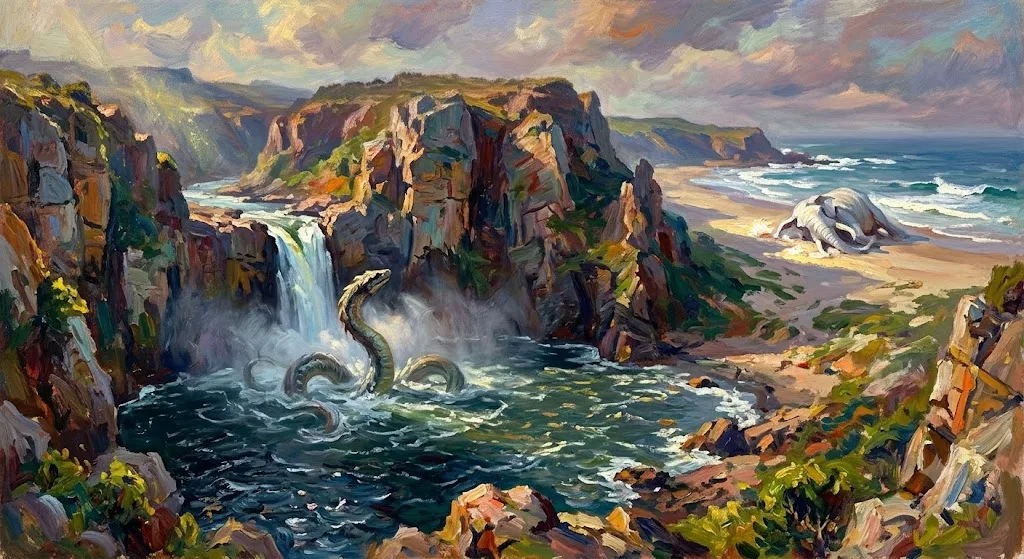
These geographical associations matter because they give each story a recognisable home. The Inkanyamba belongs to the churning pool below a great waterfall; the Grootslang belongs to dry, mineral-rich country cut by a major river; Trunko belongs to a shoreline where whales, sharks and decomposing carcasses are real possibilities. The landscape does much of the storytelling before a creature appears.
The Inkanyamba of Howick Falls
The Inkanyamba is the creature most firmly connected with a specific South African tourist landmark. It is commonly described as a vast serpent or eel-like being inhabiting the pool beneath Howick Falls in KwaZulu-Natal, sometimes with a horse-like head. Later popular accounts often say that it becomes especially active during the summer storm season and that its anger is expressed through violent weather.[wikipedia.org]WikipediaOpen source on wikipedia.org.
The setting is crucial. Howick Falls plunges into a deep, turbulent basin where spray, shadow and moving debris can make observation difficult. The falls also have a long record of fatal accidents and deliberate deaths. Such events have reinforced the pool’s reputation as a dangerous boundary rather than an ordinary stretch of river. Local presentations of the legend describe the water as spiritually significant and traditionally approached with care.[Wikipedia]WikipediaHowick FallsHowick Falls
Modern cryptid retellings often flatten this tradition into a simple claim that a giant unknown animal lives under the waterfall. That is too narrow. The Inkanyamba is better understood as a water being associated with peril, storms and the spiritual character of a particular place. Stories about it do not function like field reports of an unfamiliar antelope. They explain why the water must be respected and why its destructive power can seem intentional.
There is no clear physical evidence for an enormous resident animal. Suggested natural inspirations include snakes, eels, floating branches and shapes briefly visible in disturbed water. South Africa does have genuinely large reptiles: the southern African python can reach roughly five metres, although animals of that size remain far smaller than the monster of later descriptions.[SANBI - Biodiversity of life]sanbi.orgOpen source on sanbi.org.
The legend now serves a second purpose as part of Howick’s visitor identity. It appears in local tourism material and articles about the falls, allowing a culturally rooted warning story to circulate as a picturesque “lake monster” mystery. That shift does not make the tradition false, but it changes it. A being connected with dangerous water and spiritual observance becomes a creature visitors hope to glimpse from a viewing platform.[Howick Village]howickvillage.co.za1197 what is the howick falls monster a myth or popular folkloreOver thirty years ago the Inkanyamba was blamed for the…Read more…
The Grootslang and the diamond caves
The Grootslang, whose name means “great snake”, is associated chiefly with the Richtersveld and remote stretches of the Orange River. In its older recorded form, it is an enormous serpent feared for taking livestock and inhabiting rocks, pools or hidden caverns. One influential early account appears in prospector F. C. Cornell’s 1920 book The Glamour of Prospecting, which describes belief in a huge snake living in a rock in the Orange River.[Wikipedia]WikipediaOpen source on wikipedia.org.
Later versions place the creature in a “Bottomless Pit” or “Wonder Hole” said to contain diamonds or connect through underground passages to the river or sea. This treasure-guardian role fits the history of the region particularly well. The Richtersveld is remote, geologically dramatic and closely associated with mineral prospecting. A gigantic serpent beneath the earth turns the dangers and hopes of prospecting into a single memorable figure.
The Grootslang’s appearance has not remained stable. Some accounts describe an outsized but otherwise recognisable snake. Others give it gleaming eyes, immense bulk or an elephant-like head and trunk. The now-common image of a snake-elephant hybrid appears especially prominent in modern bestiaries, games and online creature art. The variation is a warning against treating every description as evidence supplied by independent witnesses. Much of the creature’s modern anatomy reflects stories borrowing from one another.
Real pythons offer an obvious starting point. The southern African python is a heavy-bodied constrictor associated with woodland, savanna and water, and females can reach about five metres. A brief view of a large python in reeds or beside a river can readily encourage exaggeration, particularly when the observer already expects a dangerous serpent. It cannot, however, account literally for stories of animals tens of metres long or guardians of subterranean diamonds.[SANBI - Biodiversity of life]sanbi.orgOpen source on sanbi.org.
The Grootslang is therefore best classified as layered legend rather than an unresolved zoological case. Its components include genuine large snakes, fear of remote river country, underground-cavern lore and the moral dangers of greed. The diamonds are as important as the monster: the creature punishes those who enter dangerous places imagining that fabulous wealth is waiting below.
Trunko, South Africa’s newspaper sea monster
The strangest South African monster report with a documented newspaper afterlife is the Margate carcass later nicknamed Trunko. The story entered wider circulation through a December 1924 Daily Mail article titled “Fish Like a Polar Bear”. It described witnesses watching a pale, apparently fur-covered creature in a prolonged struggle with two whales before a strange mass washed ashore near Margate. Later retellings supplied an elephant-like trunk, a tail and measurements suggesting a very large animal.[Wikipedia]WikipediaOpen source on wikipedia.org.
For decades, the case appeared unusually impressive because it combined eyewitness testimony with an alleged carcass. Yet its evidential history is poor. No usable scientific specimen was preserved, no contemporary zoological examination settled the identity, and the newspaper descriptions varied as the story travelled. Photographs located many years later show an amorphous pale mass rather than a clearly structured animal with an identifiable head, limbs or skeleton.[Wikipedia]WikipediaOpen source on wikipedia.org.
The strongest explanation is that the object on the beach was a decomposed whale carcass or “globster”. As a whale decays, bones and internal structures may separate while connective tissue and collagen remain as a pale fibrous mass. To an observer unfamiliar with decomposition, those fibres can look like white hair, while torn tissue can resemble a trunk or tentacle. Analyses of other supposed sea-monster blobs have repeatedly identified whale material through microscopy, biochemistry or DNA.[sciencealert.com]sciencealert.comScience Alert Locals Are Freaking Out Over The Weird-as-HellScience Alert Locals Are Freaking Out Over The Weird-as-Hell
That still leaves the reported offshore battle. It may have involved whales interacting with a carcass, attacking another whale or feeding in rough water. It may also have been distorted when a distant scene was converted into a dramatic newspaper narrative. The surviving record does not allow a confident reconstruction.
Trunko remains important because it shows how a monster story can be produced in stages. First comes an ambiguous event at sea. Then a badly decomposed object reaches shore. Finally, vivid newspaper language joins the two into the biography of a single animal. Once illustrations and later summaries repeat the creature as “white”, “furry” and “trunked”, uncertainty hardens into anatomy.

The Knysna elephant: when the hidden animal was real
The Knysna elephant occupies a different category. African elephants genuinely survived in the forests and surrounding fynbos of the southern Cape after hunting and habitat pressure reduced a once larger population. Because the remaining animals were rarely seen, estimates of their numbers varied sharply. Tracks, dung, damaged vegetation and fleeting reports encouraged claims that a small hidden herd might still inhabit the forest.[SciELO]scielo.org.zaOpen source on scielo.org.za.
A 2007 study using DNA extracted from dung reported evidence for five females. That result appeared to overturn the idea that only one elephant remained, but later surveys did not confirm a surviving group.[Smithsonian Research Online]repository.si.eduOpen source on si.edu.
From July 2016 to October 2017, researchers used an extensive camera-trap network across the known range. Despite long coverage and repeated images, they identified only one adult female. SANParks subsequently said that ecological assessments and monitoring supported the same conclusion: one female remained in the forest area. A later analysis of dung likewise supported the camera-trap evidence rather than the earlier estimate of several individuals.[up.ac.za]repository.up.ac.zaOpen source on up.ac.za.
This does not make the elephant a cryptid in the usual sense. Its species and identity are known, and photographs, dung and field observations establish its existence. Its relevance lies in the way genuine rarity produces cryptid-like uncertainty. Dense vegetation can conceal even an enormous mammal; indirect evidence can be duplicated or misread; and hopeful observers may interpret every broken branch as proof of a herd.
The Knysna case also demonstrates what meaningful investigation looks like. Researchers did not depend on dramatic testimony alone. They compared photographs, survey coverage, DNA, feeding signs and repeated detections over time. The result was less romantic than the legend of a secret forest herd, but more valuable: evidence of a real animal living at the edge of local extinction.
Winged beings and storm folklore
South Africa’s mystery-creature landscape also includes the lightning bird, a being associated in several southern African traditions with thunderstorms, destructive power and witchcraft. Descriptions vary, but it is frequently presented as an unnaturally large bird connected with lightning rather than as an ordinary species awaiting scientific discovery.[Wikipedia]WikipediaLightning birdLightning bird
Possible visual associations have included real birds such as the hamerkop, whose unusual silhouette, large nest and waterside habits make it a striking presence. Yet reducing the lightning bird to a misidentified species misses its function. It gives form and agency to a terrifying atmospheric event. Lightning arrives suddenly, kills people and livestock, ignites structures and appears to choose its point of impact. A supernatural bird descending with the storm turns that unpredictability into a story that can be named and discussed.
Modern monster catalogues sometimes place the lightning bird beside supposed flying cryptids. That comparison is misleading unless the distinction between folklore and sighting claim is preserved. There is no stable series of biological reports describing an unknown South African bird population. The tradition concerns weather, danger and supernatural causation, not simply wingspan.
Why ordinary animals become extraordinary
South Africa contains enough large, unusual and occasionally elusive wildlife to supply believable fragments for almost any monster account. Pythons provide the body of a giant serpent. Eels, branches and water turbulence provide brief shapes beneath a waterfall. Whales and decomposing marine tissue provide apparently impossible forms on beaches. Forest elephants show that a huge animal can remain seldom seen even in a monitored landscape.
Misidentification does not require witnesses to be foolish or dishonest. Several conditions make mistakes more likely:
- Distance removes scale. A seal, whale fin or floating carcass seen beyond the surf may appear far larger than it is.
- Water hides structure. Only a small portion of an animal or object may be visible at any moment.
- Decomposition creates false anatomy. Torn skin, connective tissue and exposed bones resemble fur, trunks, horns or tentacles.
- Expectation directs attention. A person who knows a local monster story may organise an indistinct glimpse around its familiar features.
- Retelling adds coherence. Separate details become a single, cleaner narrative once newspapers, guidebooks and websites repeat them.
Hoaxes are possible, but they are not needed to explain most South African cases. Exaggeration, folklore and honest error can produce a strong legend without anyone deliberately manufacturing a monster.
How the legends changed
South Africa’s creature stories have moved through several distinct settings. Oral and local traditions linked dangerous beings to waterfalls, rivers, storms and places requiring caution. Prospecting literature joined giant snakes to inaccessible caverns and mineral wealth. Twentieth-century newspapers converted beach debris and distant marine activity into named monsters. Television, tourism websites and online cryptid catalogues then standardised appearances that had once been variable.
That process is especially visible in the Grootslang. A broad tradition of a feared giant snake acquired increasingly elaborate elephant features. The Inkanyamba became a tourist-friendly “Howick Falls Monster”, comparable at first glance to commercial lake-monster legends elsewhere. Trunko gained a fixed identity and memorable nickname long after the event, despite the absence of a preserved specimen.
Popular culture keeps these beings alive because each has a strong visual hook: the serpent below the waterfall, the diamond-hoarding cave snake and the furry sea creature with a trunk. Games, illustrated bestiaries and paranormal programmes favour definite shapes, even where the historical sources offer ambiguity. The afterlife of the story is therefore often more anatomically precise than the original evidence.
What the evidence supports
No South African case discussed here establishes the existence of a large unknown vertebrate. The Inkanyamba and lightning bird are primarily culturally embedded beings rather than zoological hypotheses. The Grootslang combines giant-snake lore with treasure and cave motifs. Trunko is most plausibly a badly decomposed whale carcass attached to a sensational offshore story.[sanbi.org]sanbi.orgOpen source on sanbi.org.
The Knysna elephant is the instructive exception: not a new species, but a real animal whose extreme rarity created years of disagreement about how many remained. Camera trapping and repeated field study narrowed the mystery rather than enlarging it.[SANParks]sanparks.orgresearch confirms female elephant in the knysna forestResearch confirms female elephant in the Knysna forest6 Feb 2019 — And Then There Was One: a camera trap survey of the declining…
South Africa’s monster traditions are therefore most revealing when folklore, witness report and natural history are kept separate. A story can be culturally meaningful without describing a literal animal. A witness can be sincere without being correct. A carcass can be real while its monster identity is mistaken. And occasionally, as in Knysna, patient investigation can find a living creature behind the rumours—though not the hidden herd people hoped to discover.
Amazon book picks
Further Reading
Books and field guides related to What Lurks Behind South Africa's Monster Legends?. Use these as the next step if you want deeper reading beyond the article.
The Mythical Creatures Bible
Places South African monster traditions in a wider folklore context.
Abominable Science!
Explains how monster legends form and persist despite weak evidence.
eBay marketplace picks
Marketplace Samples
Live-tested eBay searches with available results related to this page.

Endnotes
1.
Source: Wikipedia
Link:https://en.wikipedia.org/wiki/Trunko
2.
Source: sanparks.org
Title: research confirms female elephant in the knysna forest
Link:https://www.sanparks.org/news/research-confirms-female-elephant-in-the-knysna-forest
Source snippet
Research confirms female elephant in the Knysna forest6 Feb 2019 — And Then There Was One: a camera trap survey of the declining...
3.
Source: Wikipedia
Link:https://en.wikipedia.org/wiki/Inkanyamba
4.
Source: Wikipedia
Title: Howick Falls
Link:https://en.wikipedia.org/wiki/Howick_Falls
5.
Source: sanbi.org
Link:https://www.sanbi.org/animal-of-the-week/southern-african-python/
6.
Source: Wikipedia
Link:https://en.wikipedia.org/wiki/Grootslang
7.
Source: karlshuker.blogspot.com
Title: behold trunko
Link:https://karlshuker.blogspot.com/2010/09/behold-trunko.html
8.
Source: sciencealert.com
Title: Science Alert Locals Are Freaking Out Over The Weird-as-Hell
Link:https://www.sciencealert.com/locals-are-freaking-out-over-the-massive-creatures-that-are-washing-up-in-the-phillipines
9.
Source: Wikipedia
Link:https://en.wikipedia.org/wiki/Globster
10.
Source: sanparks.org
Title: pursues evidence based approach on knysna elephant
Link:https://www.sanparks.org/news/sanparks-pursues-evidence-based-approach-on-knysna-elephant
11.
Source: Wikipedia
Title: Lightning bird
Link:https://en.wikipedia.org/wiki/Lightning_bird
12.
Source: sanparks.org
Link:https://www.sanparks.org/wp-content/uploads/2021/12/appendices.pdf
13.
Source: sanparks.org
Title: research report
Link:https://www.sanparks.org/wp-content/uploads/2023/04/2013_research_report.pdf
14.
Source: sanparks.org
Title: Knysna Estuary SAR 2022
Link:https://www.sanparks.org/wp-content/uploads/2024/01/Knysna-Estuary-SAR-2022.pdf
15.
Source: sanparks.org
Title: state knowledge report
Link:https://www.sanparks.org/wp-content/uploads/2023/04/state-knowledge-report.pdf
16.
Source: sanparks.org
Title: Research Report 23 24
Link:https://www.sanparks.org/wp-content/uploads/2025/01/SANParks-Research-Report-23-24.pdf
17.
Source: sanparks.org
Title: RR 22 23 web version final 1
Link:https://www.sanparks.org/wp-content/uploads/2023/12/RR-22-23-web-version-final-1.pdf
18.
Source: sanparks.org
Link:https://www.sanparks.org/wp-content/uploads/2026/03/RR-2024_25_25-Feb-2026-red-1.pdf
19.
Source: sanparks.org
Link:https://www.sanparks.org/wp-content/uploads/2021/06/grnp-approved-plan.pdf
20.
Source: sanparks.org
Link:https://www.sanparks.org/wp-content/uploads/2023/06/guide-for-field-guides.pdf
21.
Source: sanparks.org
Link:https://www.sanparks.org/wp-content/uploads/2023/09/ssnm-2017-program.pdf
22.
Source: Wikipedia
Title: Central African rock python
Link:https://en.wikipedia.org/wiki/Central_African_rock_python
23.
Source: Wikipedia
Title: Knysna elephants
Link:https://en.wikipedia.org/wiki/Knysna_elephants
24.
Source: youtube.com
Link:https://www.youtube.com/watch?v=mUEYRqEtPkg
Source snippet
The Giant Eel...
25.
Source: howickvillage.co.za
Title: 1197 what is the howick falls monster a myth or popular folklore
Link:https://howickvillage.co.za/news/1197-what-is-the-howick-falls-monster-a-myth-or-popular-folklore
Source snippet
Over thirty years ago the Inkanyamba was blamed for the...Read more...
26.
Source: abookofcreatures.com
Link:https://abookofcreatures.com/2021/05/21/grootslang/
Source snippet
A Book of CreaturesGrootslang21 May 2021 — The Grootslang, literally “big snake” or “great snake”, dwells in or around the Orange River i...
Published: May 2021
27.
Source: scielo.org.za
Link:https://scielo.org.za/scielo.php?pid=S0038-23532019000200016&script=sci_arttext
28.
Source: sajs.co.za
Link:https://sajs.co.za/article/view/4805
29.
Source: repository.si.edu
Link:https://repository.si.edu/bitstreams/ea4971ee-0788-4068-9b77-15fc210205c8/download
30.
Source: repository.up.ac.za
Link:https://repository.up.ac.za/items/47a6c6a3-7fae-4b81-a826-c82e82a62f97
31.
Source: tandfonline.com
Link:https://www.tandfonline.com/doi/abs/10.1080/0035919X.2025.2573258
32.
Source: cryptidz.fandom.com
Link:https://cryptidz.fandom.com/wiki/Inkanyamba
33.
Source: cryptidarchives.fandom.com
Link:https://cryptidarchives.fandom.com/wiki/Grootslang
34.
Source: cryptidz.fandom.com
Link:https://cryptidz.fandom.com/wiki/Trunko
35.
Source: cryptozoologycryptids.fandom.com
Link:https://cryptozoologycryptids.fandom.com/wiki/Trunko
36.
Source: youtube.com
Link:https://www.youtube.com/watch?v=IBPguTTGWZc
37.
Source: beastsoflegend.com
Link:https://beastsoflegend.com/bestiary/africa/southern/
38.
Source: viviennemackie.wordpress.com
Title: howick falls
Link:https://viviennemackie.wordpress.com/tag/howick-falls/
39.
Source: ferrebeekeeper.wordpress.com
Link:https://ferrebeekeeper.wordpress.com/2012/12/26/inkanyamba/
40.
Source: abookofcreatures.com
Link:https://abookofcreatures.com/2016/11/07/impundulu/
41.
Source: koedoe.co.za
Link:https://koedoe.co.za/index.php/koedoe/article/view/284
Additional References
42.
Source: iol.co.za
Title: 2011 04 07 falling for howick
Link:https://iol.co.za/travel/south-africa/kwazulu-natal/2011-04-07-falling-for-howick/
Source snippet
Falling for Howick7 Apr 2011 — Many people come to look at Howick Falls but are unaware of the legend of the Inkanyamba or Howick mons...
43.
Source: academia.edu
Link:https://www.academia.edu/33314964/Lightning_Birds_and_Thunder_Trees_The_ZULU_MPUNDULU_
44.
Source: researchgate.net
Link:https://www.researchgate.net/publication/330417654_And_Then_There_was_One_A_Camera_Trap_Survey_of_the_Declining_Population_of_African_Elephants_in_Knysna_South_Africa
45.
Source: journal.com.ph
Link:https://journal.com.ph/mysterious-cavern-africa-and-its-giant-snake-guardian/
46.
Source: reddit.com
Link:https://www.reddit.com/r/Cryptozoology/comments/1ldtq7t/a_globster_is_an_unidentified_organic_mass_that/
47.
Source: facebook.com
Link:https://www.facebook.com/ChrisPappasDA/posts/a-little-bit-about-howick-falls/1346630647152753/
48.
Source: instagram.com
Link:https://www.instagram.com/p/DSp1_dEgi-x/
49.
Source: archive.org
Link:https://archive.org/stream/fabulous-creatures-mythical-monsters-and-animal-power-symbols/FABULOUS%20CREATURES%2C%20MYTHICAL%20MONSTERS%2C%20AND%20ANIMAL%20POWER%20SYMBOLS_djvu.txt
50.
Source: archive.org
Link:https://archive.org/stream/history-of-monsters-mythical-beasts/History%20of%20Monsters%20%26%20Mythical%20Beasts_djvu.txt
51.
Source: archive.org
Link:https://archive.org/stream/the-unexplained-part-80-optimized-pdf/The%20Unexplained%20Part%2080%20Optimized%20PDF_djvu.txt
Topic Tree
Follow this branch
Related pages 192
- Antigua Cryptids
- Maldives Monsters
- Malta Monsters
- Qatar Monsters
- Argentina Monsters
- +187 more in sidebar